Reading 2.0
    Improving Comprehension with Online Tools


                     February 10, 2010
                    Jessica Fries-Gaither


Beyond Penguins is funded by the National Science Foundation
under Grant No. 0733024.
What best describes your
                professional position?

A – Classroom Teacher
B – Librarian
C – Administrator
D – Higher Education
E - Other
                  Answer using the poll buttons
                  underneath the participant
                  window!
What grade(s) do you
                         teach?

A – Grades K-2
B – Grades 3-5
C – Grades 6-8
D – Grades 9-12
E - Other
           Answer using the poll buttons
           underneath the participant
           window!
From where are you joining us today?


                       Answer using the stamping tool
                        to the left of the whiteboard!
Reading 2.0
Improving Comprehension with Online Tools

      Download these slides at:
     http://slidesha.re/reading20
Today’s presenter
    Jessica Fries-Gaither
    Education Resource Specialist

    The Ohio State University
    College of Education and Human Ecology
    School of Teaching and Learning

    fries-gaither.1@osu.edu
About Beyond Penguins and Polar
            Bears

                              •Online magazine
                              •Professional and
                              instructional
                              resources
                              •Science and
                              literacy integration
                              •Aligned to national
                              standards
                              •Multimedia


    http://beyondpenguins.nsdl.org
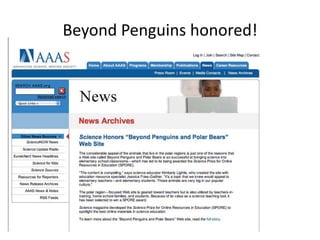
Beyond Penguins honored!
Today’s Agenda
• Why Online Tools?
• Online Tools and the Reading Instruction
  Framework
Do you use online tools in your
              literacy instruction?

A.   Regularly
B.   Occasionally
C.   I’ve tried once or twice.
D.    Not yet!
E.    No

                      Answer using the poll buttons
                      underneath the participant
                      window!
Why Online Tools?
“Emerging technologies can play a vital role in helping
  students in their quest to understand their reading –
  to assist in the explicit teaching of comprehension
  strategies.” (Walter, 2009)

     “Web 2.0 tools were demonstrated to be innovative
     and effective resources in supporting reading
     achievement for K-12 students…Areas such as fluency,
     vocabulary, development, and comprehension of
     texts could all be positively influenced through the
     use of these collaborative environments.” (Banister,
     2008)
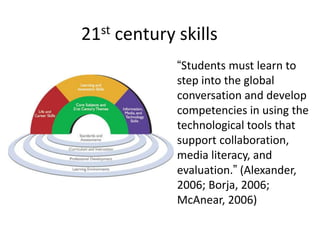
21st century skills
             “Students must learn to
             step into the global
             conversation and develop
             competencies in using the
             technological tools that
             support collaboration,
             media literacy, and
             evaluation.” (Alexander,
             2006; Borja, 2006;
             McAnear, 2006)
What’s so special about online
               tools?
The medium makes all the difference!
  – Frequent updates
  – Ability to give and receive comments
  – Multiple, widespread audiences
  – Ease of editing
  – Archival capabilities
  – Connects to what students and adults do in “real
    life”
Let’s pause for
questions from the
    audience…
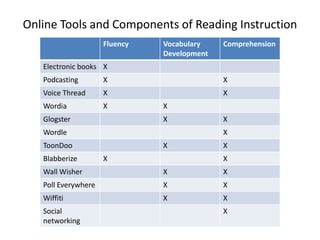
Online Tools and Components of Reading Instruction
                     Fluency   Vocabulary    Comprehension
                               Development
   Electronic books X
   Podcasting        X                       X
   Voice Thread      X                       X
   Wordia            X         X
   Glogster                    X             X
   Wordle                                    X
   ToonDoo                     X             X
   Blabberize        X                       X
   Wall Wisher                 X             X
   Poll Everywhere             X             X
   Wiffiti                     X             X
   Social                                    X
   networking
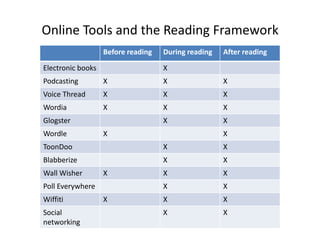
Online Tools and the Reading Framework
                   Before reading   During reading   After reading

Electronic books                    X
Podcasting         X                X                X
Voice Thread       X                X                X
Wordia             X                X                X
Glogster                            X                X
Wordle             X                                 X
ToonDoo                             X                X
Blabberize                          X                X
Wall Wisher        X                X                X
Poll Everywhere                     X                X
Wiffiti            X                X                X
Social                              X                X
networking
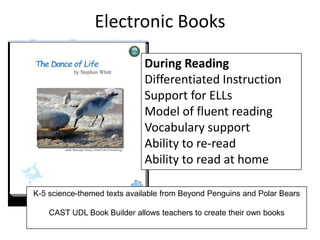
Electronic Books

                             During Reading
                             Differentiated Instruction
                             Support for ELLs
                             Model of fluent reading
                             Vocabulary support
                             Ability to re-read
                             Ability to read at home

K-5 science-themed texts available from Beyond Penguins and Polar Bears

    CAST UDL Book Builder allows teachers to create their own books
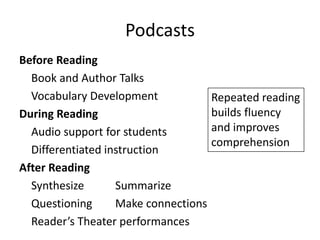
Podcasts
Before Reading
  Book and Author Talks
  Vocabulary Development              Repeated reading
During Reading                        builds fluency
  Audio support for students          and improves
                                      comprehension
  Differentiated instruction
After Reading
  Synthesize       Summarize
  Questioning      Make connections
  Reader’s Theater performances
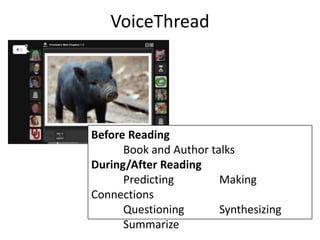
VoiceThread


Before Reading
      Book and Author talks
During/After Reading
      Predicting        Making
Connections
      Questioning       Synthesizing
      Summarize
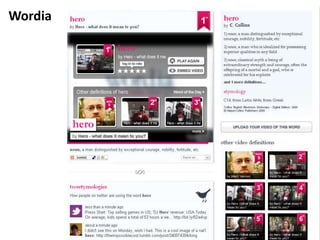
Wordia
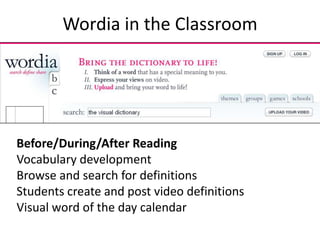
Wordia in the Classroom


Before/During/After Reading
Vocabulary development
Browse and search for definitions
Students create and post video definitions
Visual word of the day calendar
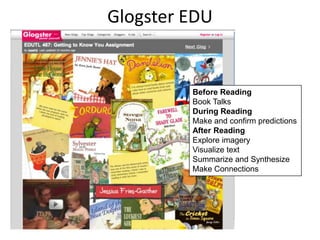
Glogster EDU


         Before Reading
         Book Talks
         During Reading
         Make and confirm predictions
         After Reading
         Explore imagery
         Visualize text
         Summarize and Synthesize
         Make Connections
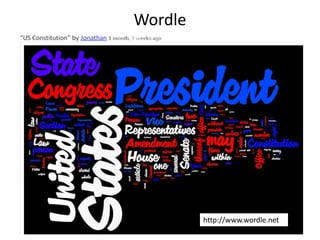
Wordle


         http://www.wordle.net
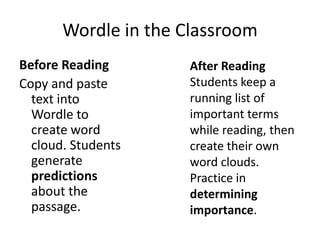
Wordle in the Classroom
Before Reading        After Reading
Copy and paste        Students keep a
  text into           running list of
  Wordle to           important terms
  create word         while reading, then
  cloud. Students     create their own
  generate            word clouds.
  predictions         Practice in
  about the           determining
  passage.            importance.
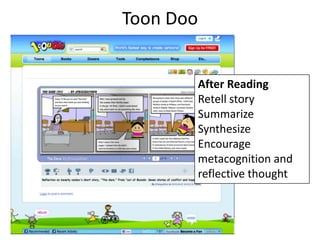
Toon Doo


       After Reading
       Retell story
       Summarize
       Synthesize
       Encourage
       metacognition and
       reflective thought
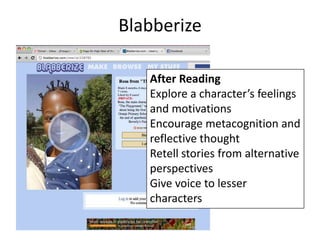
Blabberize

   After Reading
   Explore a character’s feelings
   and motivations
   Encourage metacognition and
   reflective thought
   Retell stories from alternative
   perspectives
   Give voice to lesser
   characters
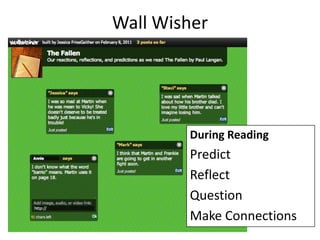
Wall Wisher


        During Reading
        Predict
        Reflect
        Question
        Make Connections
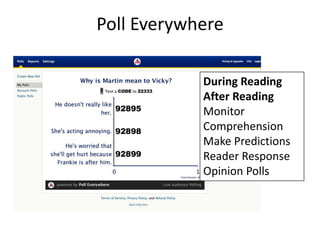
Poll Everywhere

            During Reading
            After Reading
            Monitor
            Comprehension
            Make Predictions
            Reader Response
            Opinion Polls
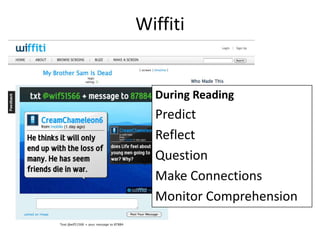
Wiffiti


  During Reading
  Predict
  Reflect
  Question
  Make Connections
  Monitor Comprehension
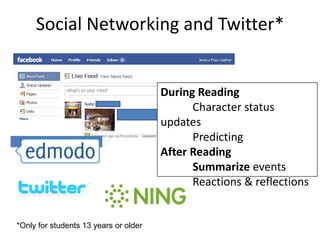
Social Networking and Twitter*


                                       During Reading
                                             Character status
                                       updates
                                             Predicting
                                       After Reading
                                             Summarize events
                                             Reactions & reflections


*Only for students 13 years or older
Coming Soon!
Thursday, March 10, 20101: Visual Literacy and
  Nonlinguistic Representations
Presenter: Jessica Fries-Gaither and Terry Shiverdecker
Do your students struggle to create and interpret
  diagrams, maps, and charts? Join us as we discuss
  how to help students become proficient in creating
  and understanding these sources of information.


 http://wiki.nsdl.org/index.php/BeyondPenguins/Seminars
Thank you!
Jessica Fries-Gaither: fries-gaither.1@osu.edu

Today’s slides available at: http://slidesha.re/reading20

Archived recording at:
http://wiki.nsdl.org/index.php/BeyondPenguins/Seminars

Reading 2.0

  • 1.
    Reading 2.0 Improving Comprehension with Online Tools February 10, 2010 Jessica Fries-Gaither Beyond Penguins is funded by the National Science Foundation under Grant No. 0733024.
  • 2.
    What best describesyour professional position? A – Classroom Teacher B – Librarian C – Administrator D – Higher Education E - Other Answer using the poll buttons underneath the participant window!
  • 3.
    What grade(s) doyou teach? A – Grades K-2 B – Grades 3-5 C – Grades 6-8 D – Grades 9-12 E - Other Answer using the poll buttons underneath the participant window!
  • 4.
    From where areyou joining us today? Answer using the stamping tool to the left of the whiteboard!
  • 5.
    Reading 2.0 Improving Comprehensionwith Online Tools Download these slides at: http://slidesha.re/reading20
  • 6.
    Today’s presenter Jessica Fries-Gaither Education Resource Specialist The Ohio State University College of Education and Human Ecology School of Teaching and Learning fries-gaither.1@osu.edu
  • 7.
    About Beyond Penguinsand Polar Bears •Online magazine •Professional and instructional resources •Science and literacy integration •Aligned to national standards •Multimedia http://beyondpenguins.nsdl.org
  • 8.
  • 9.
    Today’s Agenda • WhyOnline Tools? • Online Tools and the Reading Instruction Framework
  • 10.
    Do you useonline tools in your literacy instruction? A. Regularly B. Occasionally C. I’ve tried once or twice. D. Not yet! E. No Answer using the poll buttons underneath the participant window!
  • 11.
    Why Online Tools? “Emergingtechnologies can play a vital role in helping students in their quest to understand their reading – to assist in the explicit teaching of comprehension strategies.” (Walter, 2009) “Web 2.0 tools were demonstrated to be innovative and effective resources in supporting reading achievement for K-12 students…Areas such as fluency, vocabulary, development, and comprehension of texts could all be positively influenced through the use of these collaborative environments.” (Banister, 2008)
  • 12.
    21st century skills “Students must learn to step into the global conversation and develop competencies in using the technological tools that support collaboration, media literacy, and evaluation.” (Alexander, 2006; Borja, 2006; McAnear, 2006)
  • 13.
    What’s so specialabout online tools? The medium makes all the difference! – Frequent updates – Ability to give and receive comments – Multiple, widespread audiences – Ease of editing – Archival capabilities – Connects to what students and adults do in “real life”
  • 14.
    Let’s pause for questionsfrom the audience…
  • 15.
    Online Tools andComponents of Reading Instruction Fluency Vocabulary Comprehension Development Electronic books X Podcasting X X Voice Thread X X Wordia X X Glogster X X Wordle X ToonDoo X X Blabberize X X Wall Wisher X X Poll Everywhere X X Wiffiti X X Social X networking
  • 16.
    Online Tools andthe Reading Framework Before reading During reading After reading Electronic books X Podcasting X X X Voice Thread X X X Wordia X X X Glogster X X Wordle X X ToonDoo X X Blabberize X X Wall Wisher X X X Poll Everywhere X X Wiffiti X X X Social X X networking
  • 17.
    Electronic Books During Reading Differentiated Instruction Support for ELLs Model of fluent reading Vocabulary support Ability to re-read Ability to read at home K-5 science-themed texts available from Beyond Penguins and Polar Bears CAST UDL Book Builder allows teachers to create their own books
  • 18.
    Podcasts Before Reading Book and Author Talks Vocabulary Development Repeated reading During Reading builds fluency Audio support for students and improves comprehension Differentiated instruction After Reading Synthesize Summarize Questioning Make connections Reader’s Theater performances
  • 19.
    VoiceThread Before Reading Book and Author talks During/After Reading Predicting Making Connections Questioning Synthesizing Summarize
  • 20.
  • 21.
    Wordia in theClassroom Before/During/After Reading Vocabulary development Browse and search for definitions Students create and post video definitions Visual word of the day calendar
  • 22.
    Glogster EDU Before Reading Book Talks During Reading Make and confirm predictions After Reading Explore imagery Visualize text Summarize and Synthesize Make Connections
  • 23.
    Wordle http://www.wordle.net
  • 24.
    Wordle in theClassroom Before Reading After Reading Copy and paste Students keep a text into running list of Wordle to important terms create word while reading, then cloud. Students create their own generate word clouds. predictions Practice in about the determining passage. importance.
  • 25.
    Toon Doo After Reading Retell story Summarize Synthesize Encourage metacognition and reflective thought
  • 26.
    Blabberize After Reading Explore a character’s feelings and motivations Encourage metacognition and reflective thought Retell stories from alternative perspectives Give voice to lesser characters
  • 27.
    Wall Wisher During Reading Predict Reflect Question Make Connections
  • 28.
    Poll Everywhere During Reading After Reading Monitor Comprehension Make Predictions Reader Response Opinion Polls
  • 29.
    Wiffiti DuringReading Predict Reflect Question Make Connections Monitor Comprehension
  • 30.
    Social Networking andTwitter* During Reading Character status updates Predicting After Reading Summarize events Reactions & reflections *Only for students 13 years or older
  • 31.
    Coming Soon! Thursday, March10, 20101: Visual Literacy and Nonlinguistic Representations Presenter: Jessica Fries-Gaither and Terry Shiverdecker Do your students struggle to create and interpret diagrams, maps, and charts? Join us as we discuss how to help students become proficient in creating and understanding these sources of information. http://wiki.nsdl.org/index.php/BeyondPenguins/Seminars
  • 32.
    Thank you! Jessica Fries-Gaither:fries-gaither.1@osu.edu Today’s slides available at: http://slidesha.re/reading20 Archived recording at: http://wiki.nsdl.org/index.php/BeyondPenguins/Seminars

Editor's Notes