Keynote Presentation to the  Adult Literacy Practitioners Association (NZ) Wellington, 22 May, 2009 Derek Wenmoth Director, eLearning CORE Education Ltd Challenges, change & trends in 2009
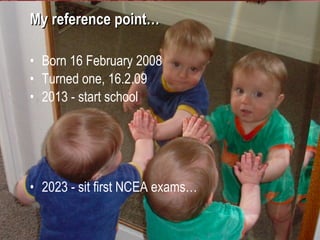
My reference point… Born 16 February 2008 Turned one, 16.2.09 2013 - start school 2023 - sit first NCEA exams…
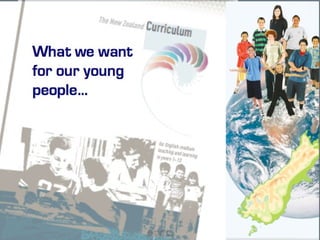
What we want for our young people
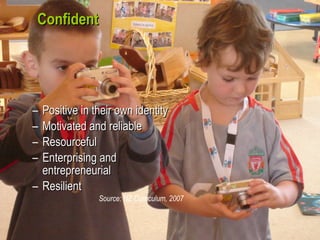
Confident Positive in their own identity Motivated and reliable Resourceful Enterprising and entrepreneurial Resilient Source: NZ Curriculum, 2007
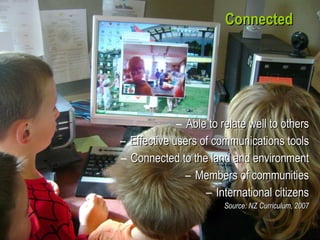
Connected Able to relate well to others Effective users of communications tools Connected to the land and environment Members of communities International citizens Source: NZ Curriculum, 2007
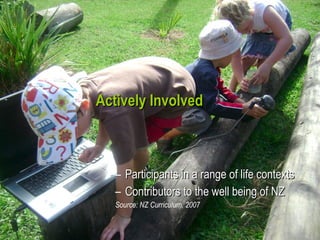
Actively Involved Participants in a range of life contexts Contributors to the well being of NZ Source: NZ Curriculum, 2007
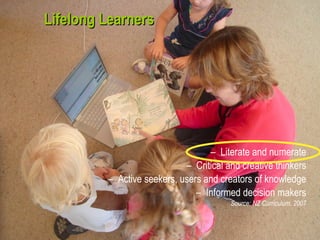
Lifelong Learners Literate and numerate Critical and creative thinkers Active seekers, users and creators of knowledge Informed decision makers Source: NZ Curriculum, 2007
21st Century Literacy “The illiterate of the 21st century will not be those who cannot read and write, but those who cannot learn, unlearn, and relearn.” Alvin Toffler
The Book http://www.youtube.com/watch?v=xpc7Puo78_o
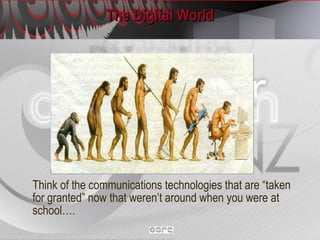
The Digital World Think of the communications technologies that are “taken for granted” now that weren’t around when you were at school….
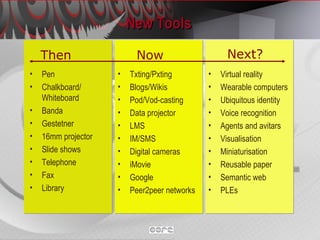
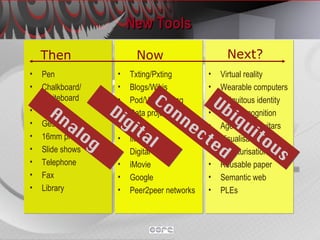
New Tools Then Pen Chalkboard/ Whiteboard Banda Gestetner 16mm projector Slide shows Telephone Fax Library Now Next? Txting/Pxting Blogs/Wikis Pod/Vod-casting Data projector LMS IM/SMS Digital cameras iMovie Google Peer2peer networks Virtual reality Wearable computers Ubiquitous identity Voice recognition Agents and avitars Visualisation Miniaturisation Reusable paper Semantic web PLEs
New Tools Then Pen Chalkboard/ Whiteboard Banda Gestetner 16mm projector Slide shows Telephone Fax Library Now Next? Txting/Pxting Blogs/Wikis Pod/Vod-casting Data projector LMS IM/SMS Digital cameras iMovie Google Peer2peer networks Virtual reality Wearable computers Ubiquitous identity Voice recognition Agents and avitars Visualisation Miniaturisation Reusable paper Semantic web PLEs Analog Digital Connected Ubiquitous
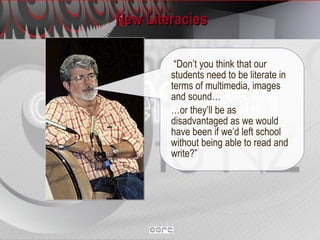
“ Don’t you think that our students need to be literate in terms of multimedia, images and sound… … or they’ll be as disadvantaged as we would have been if we’d left school without being able to read and write?” New Literacies
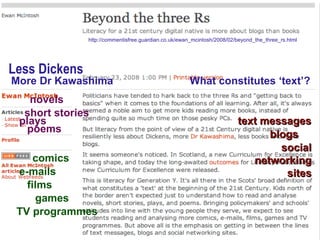
Comment is Free Less Dickens http://commentisfree.guardian.co.uk/ewan_mcintosh/2008/02/beyond_the_three_rs.html   More Dr Kawashima What constitutes ‘text’? novels short stories plays poems comics e-mails films games TV programmes text messages blogs social networking sites
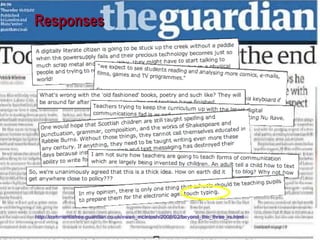
Responses http://commentisfree.guardian.co.uk/ewan_mcintosh/2008/02/beyond_the_three_rs.html
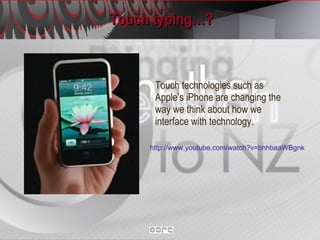
Touch typing…? Touch technologies such as Apple’s iPhone are changing the way we think about how we interface with technology. http://www.youtube.com/watch?v=bhhbaaWBgnk
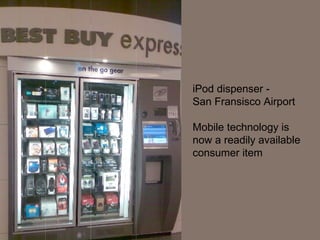
iPhone dispenser iPod dispenser -  San Fransisco Airport Mobile technology is now a readily available consumer item
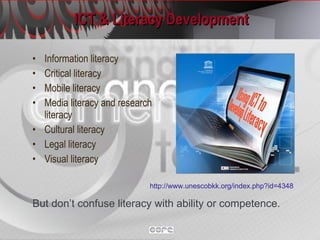
ICT & Literacy Development Information literacy Critical literacy Mobile literacy Media literacy and research literacy Cultural literacy Legal literacy Visual literacy http://www.unescobkk.org/index.php?id=4348   But don’t confuse literacy with ability or competence.
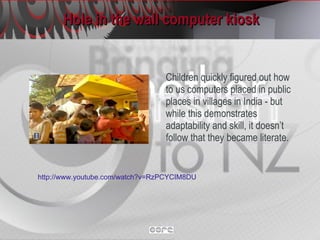
Hole in the wall computer kiosk Children quickly figured out how to us computers placed in public places in villages in India - but while this demonstrates adaptability and skill, it doesn’t follow that they became literate. http://www.youtube.com/watch?v=RzPCYCIM8DU
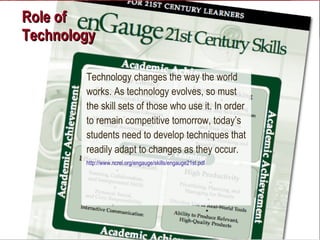
Role of  Technology Technology changes the way the world works. As technology evolves, so must the skill sets of those who use it. In order to remain competitive tomorrow, today ’s  students need to develop techniques that readily adapt to changes as they occur. http://www.ncrel.org/engauge/skills/engauge21st.pdf
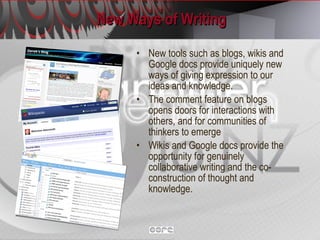
New Ways of Writing New tools such as blogs, wikis and Google docs provide uniquely new ways of giving expression to our ideas and knowledge.  The comment feature on blogs opens doors for interactions with others, and for communities of thinkers to emerge Wikis and Google docs provide the opportunity for genuinely collaborative writing and the co-construction of thought and knowledge.
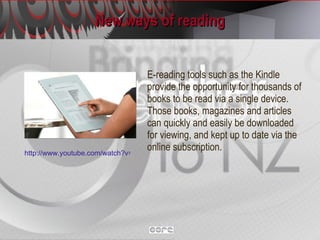
New ways of reading E-reading tools such as the Kindle provide the opportunity for thousands of books to be read via a single device. Those books, magazines and articles can quickly and easily be downloaded for viewing, and kept up to date via the online subscription. http://www.youtube.com/watch?v=myqkadSYT2Q
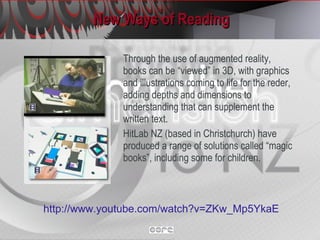
New Ways of Reading Through the use of augmented reality, books can be “viewed” in 3D, with graphics and illustrations coming to life for the reder, adding depths and dimensions to understanding that can supplement the written text.  HitLab NZ (based in Christchurch) have produced a range of solutions called “magic books”, including some for children. http://www.youtube.com/watch?v=ZKw_Mp5YkaE
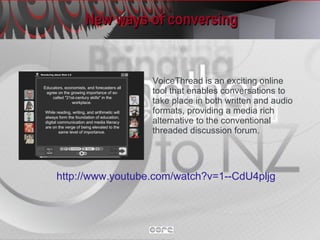
New ways of conversing VoiceThread is an exciting online tool that enables conversations to take place in both written and audio formats, providing a media rich alternative to the conventional threaded discussion forum. http://www.youtube.com/watch?v=1--CdU4pljg
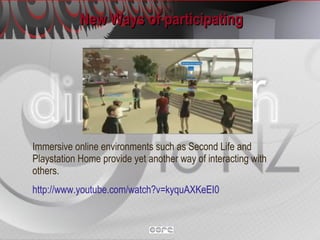
New Ways of participating Immersive online environments such as Second Life and Playstation Home provide yet another way of interacting with others. http://www.youtube.com/watch?v=kyquAXKeEI0
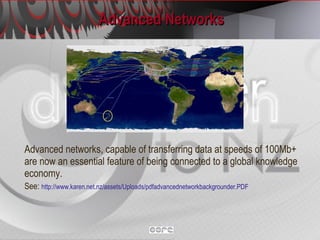
Advanced Networks Advanced networks, capable of transferring data at speeds of 100Mb+ are now an essential feature of being connected to a global knowledge economy.   See:  http://www.karen.net.nz/assets/Uploads/pdfadvancednetworkbackgrounder.PDF
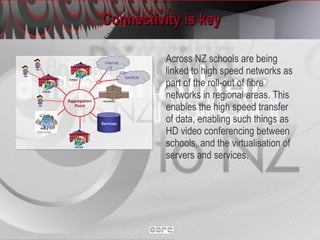
Connectivity is key Across NZ schools are being linked to high speed networks as part of the roll-out of fibre networks in regional areas. This enables the high speed transfer of data, enabling such things as HD video conferencing between schools, and the virtualisation of servers and services.
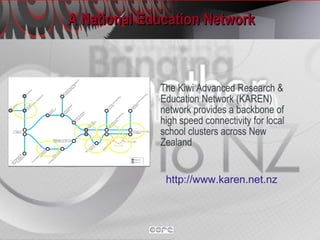
A National Education Network The Kiwi Advanced Research & Education Network (KAREN) network provides a backbone of high speed connectivity for local school clusters across New Zealand http://www.karen.net.nz
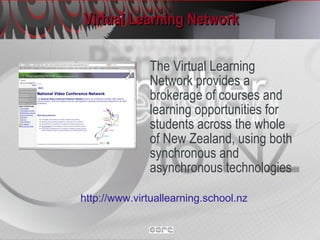
Virtual Learning Network The Virtual Learning Network provides a brokerage of courses and learning opportunities for students across the whole of New Zealand, using both synchronous and asynchronous technologies http://www.virtuallearning.school.nz
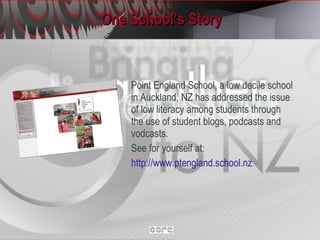
One School’s Story Point England School, a low decile school in Auckland, NZ has addressed the issue of low literacy among students through the use of student blogs, podcasts and vodcasts. See for yourself at: http://www.ptengland.school.nz
Impact on literacy teaching at PES  Gives literacy a purpose – authentic audience Integrates ICT with literacy (blogging) Can be time consuming Can cause imbalance in literacy programme Has provided a “hook” for students and teachers Provides a forum for sharing ideas Provides a forum for reflection on beliefs and practices.
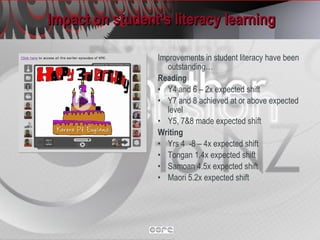
Impact on student’s literacy learning Improvements in student literacy have been outstanding… Reading   Y4 and 6 – 2x expected shift Y7 and 8 achieved at or above expected level  Y5, 7&8 made expected shift Writing  Yrs 4  -8 – 4x expected shift Tongan 1.4x expected shift Samoan 4.5x expected shift Maori 5.2x expected shift
Our challenge as educators To what extent are we prepared, as a society and as educators, for the massive changes in human capabilities that digital technologies are likely to enable in the next 13 years? To what extent are our future visions for education based upon assumptions about humanity, society and technology that are no longer valid? To what extent can we, as educators, help to shape the developments of technology in order to enhance human development? http://www.futurelab.org.uk/resources/documents/opening_education/2020_and_beyond.pdf
Thank you Email me:  [email_address] .net   Blog:  http: //blog .core-ed.net/derek

Challenges, change and trends

  • 1.
    Keynote Presentation tothe Adult Literacy Practitioners Association (NZ) Wellington, 22 May, 2009 Derek Wenmoth Director, eLearning CORE Education Ltd Challenges, change & trends in 2009
  • 2.
    My reference point…Born 16 February 2008 Turned one, 16.2.09 2013 - start school 2023 - sit first NCEA exams…
  • 3.
    What we wantfor our young people
  • 4.
    Confident Positive intheir own identity Motivated and reliable Resourceful Enterprising and entrepreneurial Resilient Source: NZ Curriculum, 2007
  • 5.
    Connected Able torelate well to others Effective users of communications tools Connected to the land and environment Members of communities International citizens Source: NZ Curriculum, 2007
  • 6.
    Actively Involved Participantsin a range of life contexts Contributors to the well being of NZ Source: NZ Curriculum, 2007
  • 7.
    Lifelong Learners Literateand numerate Critical and creative thinkers Active seekers, users and creators of knowledge Informed decision makers Source: NZ Curriculum, 2007
  • 8.
    21st Century Literacy“The illiterate of the 21st century will not be those who cannot read and write, but those who cannot learn, unlearn, and relearn.” Alvin Toffler
  • 9.
  • 10.
    The Digital WorldThink of the communications technologies that are “taken for granted” now that weren’t around when you were at school….
  • 11.
    New Tools ThenPen Chalkboard/ Whiteboard Banda Gestetner 16mm projector Slide shows Telephone Fax Library Now Next? Txting/Pxting Blogs/Wikis Pod/Vod-casting Data projector LMS IM/SMS Digital cameras iMovie Google Peer2peer networks Virtual reality Wearable computers Ubiquitous identity Voice recognition Agents and avitars Visualisation Miniaturisation Reusable paper Semantic web PLEs
  • 12.
    New Tools ThenPen Chalkboard/ Whiteboard Banda Gestetner 16mm projector Slide shows Telephone Fax Library Now Next? Txting/Pxting Blogs/Wikis Pod/Vod-casting Data projector LMS IM/SMS Digital cameras iMovie Google Peer2peer networks Virtual reality Wearable computers Ubiquitous identity Voice recognition Agents and avitars Visualisation Miniaturisation Reusable paper Semantic web PLEs Analog Digital Connected Ubiquitous
  • 13.
    “ Don’t youthink that our students need to be literate in terms of multimedia, images and sound… … or they’ll be as disadvantaged as we would have been if we’d left school without being able to read and write?” New Literacies
  • 14.
    Comment is FreeLess Dickens http://commentisfree.guardian.co.uk/ewan_mcintosh/2008/02/beyond_the_three_rs.html More Dr Kawashima What constitutes ‘text’? novels short stories plays poems comics e-mails films games TV programmes text messages blogs social networking sites
  • 15.
  • 16.
    Touch typing…? Touchtechnologies such as Apple’s iPhone are changing the way we think about how we interface with technology. http://www.youtube.com/watch?v=bhhbaaWBgnk
  • 17.
    iPhone dispenser iPoddispenser - San Fransisco Airport Mobile technology is now a readily available consumer item
  • 18.
    ICT & LiteracyDevelopment Information literacy Critical literacy Mobile literacy Media literacy and research literacy Cultural literacy Legal literacy Visual literacy http://www.unescobkk.org/index.php?id=4348 But don’t confuse literacy with ability or competence.
  • 19.
    Hole in thewall computer kiosk Children quickly figured out how to us computers placed in public places in villages in India - but while this demonstrates adaptability and skill, it doesn’t follow that they became literate. http://www.youtube.com/watch?v=RzPCYCIM8DU
  • 20.
    Role of Technology Technology changes the way the world works. As technology evolves, so must the skill sets of those who use it. In order to remain competitive tomorrow, today ’s students need to develop techniques that readily adapt to changes as they occur. http://www.ncrel.org/engauge/skills/engauge21st.pdf
  • 21.
    New Ways ofWriting New tools such as blogs, wikis and Google docs provide uniquely new ways of giving expression to our ideas and knowledge. The comment feature on blogs opens doors for interactions with others, and for communities of thinkers to emerge Wikis and Google docs provide the opportunity for genuinely collaborative writing and the co-construction of thought and knowledge.
  • 22.
    New ways ofreading E-reading tools such as the Kindle provide the opportunity for thousands of books to be read via a single device. Those books, magazines and articles can quickly and easily be downloaded for viewing, and kept up to date via the online subscription. http://www.youtube.com/watch?v=myqkadSYT2Q
  • 23.
    New Ways ofReading Through the use of augmented reality, books can be “viewed” in 3D, with graphics and illustrations coming to life for the reder, adding depths and dimensions to understanding that can supplement the written text. HitLab NZ (based in Christchurch) have produced a range of solutions called “magic books”, including some for children. http://www.youtube.com/watch?v=ZKw_Mp5YkaE
  • 24.
    New ways ofconversing VoiceThread is an exciting online tool that enables conversations to take place in both written and audio formats, providing a media rich alternative to the conventional threaded discussion forum. http://www.youtube.com/watch?v=1--CdU4pljg
  • 25.
    New Ways ofparticipating Immersive online environments such as Second Life and Playstation Home provide yet another way of interacting with others. http://www.youtube.com/watch?v=kyquAXKeEI0
  • 26.
    Advanced Networks Advancednetworks, capable of transferring data at speeds of 100Mb+ are now an essential feature of being connected to a global knowledge economy. See: http://www.karen.net.nz/assets/Uploads/pdfadvancednetworkbackgrounder.PDF
  • 27.
    Connectivity is keyAcross NZ schools are being linked to high speed networks as part of the roll-out of fibre networks in regional areas. This enables the high speed transfer of data, enabling such things as HD video conferencing between schools, and the virtualisation of servers and services.
  • 28.
    A National EducationNetwork The Kiwi Advanced Research & Education Network (KAREN) network provides a backbone of high speed connectivity for local school clusters across New Zealand http://www.karen.net.nz
  • 29.
    Virtual Learning NetworkThe Virtual Learning Network provides a brokerage of courses and learning opportunities for students across the whole of New Zealand, using both synchronous and asynchronous technologies http://www.virtuallearning.school.nz
  • 30.
    One School’s StoryPoint England School, a low decile school in Auckland, NZ has addressed the issue of low literacy among students through the use of student blogs, podcasts and vodcasts. See for yourself at: http://www.ptengland.school.nz
  • 31.
    Impact on literacyteaching at PES Gives literacy a purpose – authentic audience Integrates ICT with literacy (blogging) Can be time consuming Can cause imbalance in literacy programme Has provided a “hook” for students and teachers Provides a forum for sharing ideas Provides a forum for reflection on beliefs and practices.
  • 32.
    Impact on student’sliteracy learning Improvements in student literacy have been outstanding… Reading Y4 and 6 – 2x expected shift Y7 and 8 achieved at or above expected level Y5, 7&8 made expected shift Writing Yrs 4 -8 – 4x expected shift Tongan 1.4x expected shift Samoan 4.5x expected shift Maori 5.2x expected shift
  • 33.
    Our challenge aseducators To what extent are we prepared, as a society and as educators, for the massive changes in human capabilities that digital technologies are likely to enable in the next 13 years? To what extent are our future visions for education based upon assumptions about humanity, society and technology that are no longer valid? To what extent can we, as educators, help to shape the developments of technology in order to enhance human development? http://www.futurelab.org.uk/resources/documents/opening_education/2020_and_beyond.pdf
  • 34.
    Thank you Emailme: [email_address] .net Blog: http: //blog .core-ed.net/derek

Editor's Notes

  • #12 Illustrating the way in which technology has impacted educationKey thing is transition from analogue to digital
  • #13 Illustrating the way in which technology has impacted educationKey thing is transition from analogue to digital
  • #17 And we still require students to write with pen and paper when sitting exams!
  • #19 UNESCO report * Information literacy: The skills required to organize and search for information, while also analyzing that information.* Critical literacy: the ability to engage in critical thinking, and judge the intention, content and possible effects of written material.* Mobile literacy: The ability to use mobile technology, such as a mobile phone and its non-voice features.* Media literacy and research literacy: The ability to be a discerning reader and the ability to find various types of information.* Cultural literacy: the ability to understand cultural, social and ideological values in a given context.* Legal literacy: the knowledge of basic legal rights and how to protect those rights.* Visual literacy: the interpretation of images, signs, pictures and non-verbal (body) language. ”
  • #23 http://www.nytimes.com/2009/05/04/technology/companies/04reader.html?_r=1&th&emc=thUnlike tiny mobile phones and devices like the Kindle that are made to display text from books, these new gadgets, with screens roughly the size of a standard sheet of paper, could present much of the editorial and advertising content of traditional periodicals in generally the same format as they appear in print. And they might be a way to get readers to pay for those periodicals — something they have been reluctant to do on the Web.