Blended learning experiences  – A case in Hong Kong Dr Paula Hodgson Educational Development Centre The Hong Kong Polytechnic University This work is licensed under a  Creative Commons Attribution-Noncommercial-Share Alike 3.0 Unported License .
Foci Institutional-wide strategic direction on eLearning Areas of support to staff: technical pedagogy scholarship Benefits of blended learning adopted in curriculum
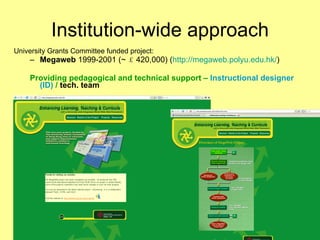
Institution-wide approach University Grants Committee funded project: Megaweb  1999-2001 (~ £ 420,000) ( http://megaweb.polyu.edu.hk/ ) Providing pedagogical and technical support –  Instructional designer (ID)  /  tech. team
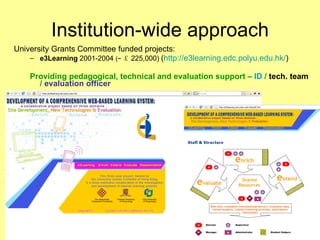
Institution-wide approach University Grants Committee funded projects: e3Learning  2001-2004  (~ £ 225,000)  ( http://e3learning.edc.polyu.edu.hk/ ) Providing pedagogical, technical and evaluation support –  ID  /  tech. team  /  evaluation officer
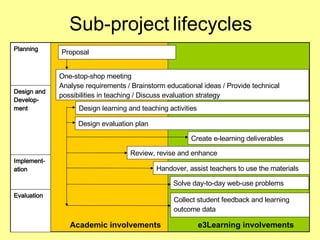
Sub-project   lifecycles Design learning and teaching activities Design evaluation plan Solve day-to-day web-use problems Collect student feedback and learning outcome data Planning Design and Develop-ment Implement-ation One-stop-shop meeting Analyse requirements / Brainstorm educational ideas / Provide technical possibilities in teaching / Discuss evaluation strategy Review, revise and enhance Evaluation Create e-learning deliverables Handover, assist teachers to use the materials Proposal Academic involvements e3Learning involvements
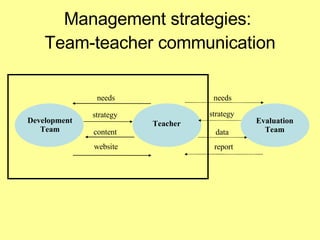
Management strategies:  Team-teacher communication needs needs report content strategy data website strategy Development Team Teacher Evaluation Team
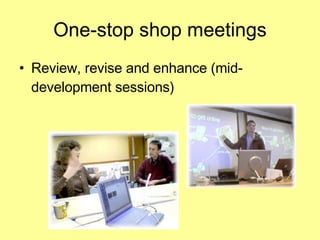
One-stop shop meetings Review, revise and enhance (mid-development sessions)
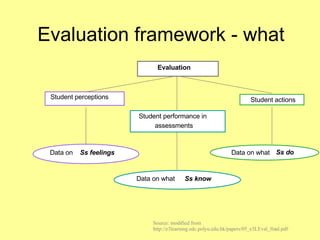
Evaluation framework - what   Source: modified from http://e3learning.edc.polyu.edu.hk/papers/05_e3LEval_final.pdf Student actions Ss do Data on  Ss feelings  Data on what Ss know Evaluation Student performance in  assessments Student perceptions Data on what
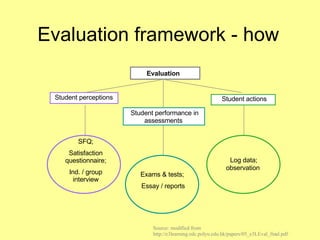
Evaluation framework - how   Source: modified from http://e3learning.edc.polyu.edu.hk/papers/05_e3LEval_final.pdf Evaluation Student performance in  assessments Student actions Student perceptions SFQ; Satisfaction questionnaire; Ind. / group interview Exams & tests;  Essay / reports Log data; observation
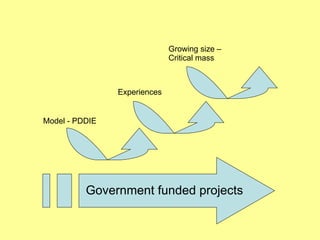
Model - PDDIE Experiences Growing size – Critical mass Government funded projects
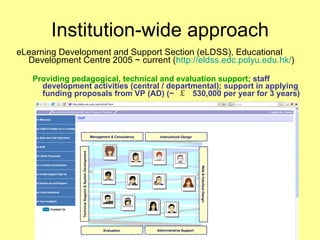
Institution-wide approach eLearning Development and Support Section (eLDSS), Educational Development Centre 2005 ~ current ( http://eldss.edc.polyu.edu.hk/ ) Providing pedagogical, technical and evaluation support;  staff development activities (central / departmental); support in applying funding proposals from VP (AD) (~  £   530,000 per year for 3 years)
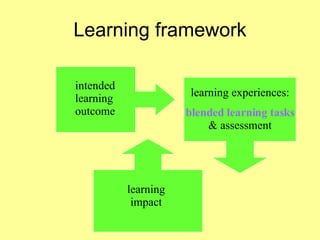
Learning framework intended learning outcome learning experiences: blended learning tasks  & assessment learning impact
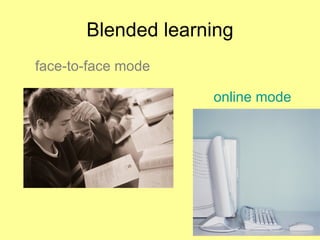
Blended learning face-to-face mode online mode
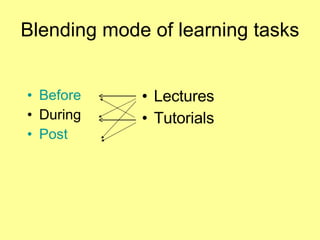
Blending mode of learning tasks Lectures Tutorials Before During Post
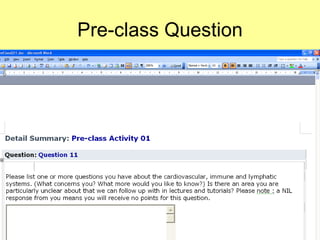
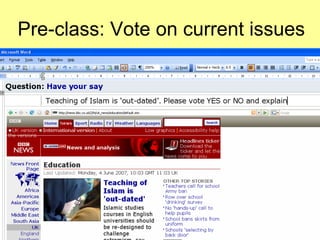
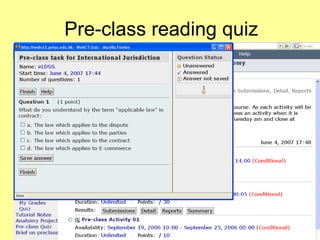
Pre-lecture online tasks Online polling  Assessing preconceptions Online quiz   Assessing previous knowledge Open-ended questions Assessing what they know and don’t know Question corner Inviting questions
Pre-class Question
Pre-class: Vote on current issues
Pre-class reading quiz
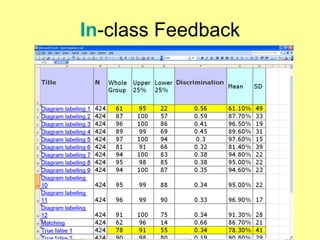
In -class Feedback
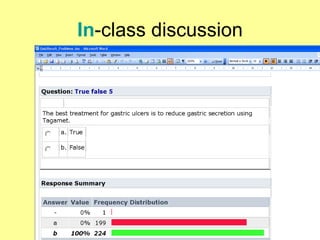
In -class discussion
Post-lecture online tasks Searching online references [e-journals, WWW] Extending learning concepts Making annotations using RefWorks/ Endnote [lib] Reinforcing learning concepts
Post-lecture online tasks Interacting with professionals / expertise in the field locally / overseas through real-time audio/video conferencing, asynchronous e-forums Increasing interactions
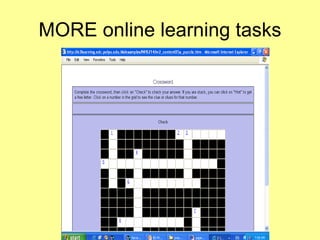
MORE online learning tasks
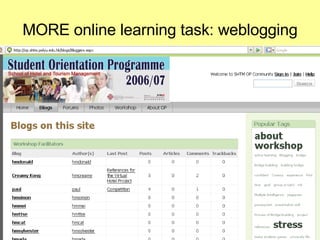
MORE online learning task: weblogging
 
Benefits – increased interactions between students
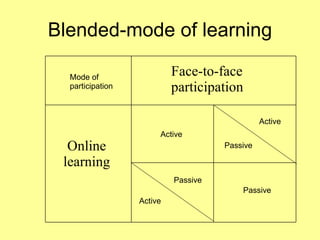
Blended-mode of learning Face-to-face participation Mode of participation Active Passive Online learning Active Passive Active Passive
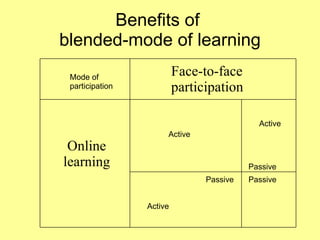
Benefits of  blended-mode of learning Face-to-face participation Mode of participation Active Passive Online learning Active Passive Active Passive

Blended learning experiences – A case in Hong Kong

  • 1.
    Blended learning experiences – A case in Hong Kong Dr Paula Hodgson Educational Development Centre The Hong Kong Polytechnic University This work is licensed under a Creative Commons Attribution-Noncommercial-Share Alike 3.0 Unported License .
  • 2.
    Foci Institutional-wide strategicdirection on eLearning Areas of support to staff: technical pedagogy scholarship Benefits of blended learning adopted in curriculum
  • 3.
    Institution-wide approach UniversityGrants Committee funded project: Megaweb 1999-2001 (~ £ 420,000) ( http://megaweb.polyu.edu.hk/ ) Providing pedagogical and technical support – Instructional designer (ID) / tech. team
  • 4.
    Institution-wide approach UniversityGrants Committee funded projects: e3Learning 2001-2004 (~ £ 225,000) ( http://e3learning.edc.polyu.edu.hk/ ) Providing pedagogical, technical and evaluation support – ID / tech. team / evaluation officer
  • 5.
    Sub-project lifecycles Design learning and teaching activities Design evaluation plan Solve day-to-day web-use problems Collect student feedback and learning outcome data Planning Design and Develop-ment Implement-ation One-stop-shop meeting Analyse requirements / Brainstorm educational ideas / Provide technical possibilities in teaching / Discuss evaluation strategy Review, revise and enhance Evaluation Create e-learning deliverables Handover, assist teachers to use the materials Proposal Academic involvements e3Learning involvements
  • 6.
    Management strategies: Team-teacher communication needs needs report content strategy data website strategy Development Team Teacher Evaluation Team
  • 7.
    One-stop shop meetingsReview, revise and enhance (mid-development sessions)
  • 8.
    Evaluation framework -what Source: modified from http://e3learning.edc.polyu.edu.hk/papers/05_e3LEval_final.pdf Student actions Ss do Data on Ss feelings Data on what Ss know Evaluation Student performance in assessments Student perceptions Data on what
  • 9.
    Evaluation framework -how Source: modified from http://e3learning.edc.polyu.edu.hk/papers/05_e3LEval_final.pdf Evaluation Student performance in assessments Student actions Student perceptions SFQ; Satisfaction questionnaire; Ind. / group interview Exams & tests; Essay / reports Log data; observation
  • 10.
    Model - PDDIEExperiences Growing size – Critical mass Government funded projects
  • 11.
    Institution-wide approach eLearningDevelopment and Support Section (eLDSS), Educational Development Centre 2005 ~ current ( http://eldss.edc.polyu.edu.hk/ ) Providing pedagogical, technical and evaluation support; staff development activities (central / departmental); support in applying funding proposals from VP (AD) (~ £ 530,000 per year for 3 years)
  • 12.
    Learning framework intendedlearning outcome learning experiences: blended learning tasks & assessment learning impact
  • 13.
  • 14.
    Blending mode oflearning tasks Lectures Tutorials Before During Post
  • 15.
    Pre-lecture online tasksOnline polling Assessing preconceptions Online quiz Assessing previous knowledge Open-ended questions Assessing what they know and don’t know Question corner Inviting questions
  • 16.
  • 17.
    Pre-class: Vote oncurrent issues
  • 18.
  • 19.
  • 20.
  • 21.
    Post-lecture online tasksSearching online references [e-journals, WWW] Extending learning concepts Making annotations using RefWorks/ Endnote [lib] Reinforcing learning concepts
  • 22.
    Post-lecture online tasksInteracting with professionals / expertise in the field locally / overseas through real-time audio/video conferencing, asynchronous e-forums Increasing interactions
  • 23.
  • 24.
  • 25.
  • 26.
  • 27.
    MORE online learningtask: weblogging
  • 28.
  • 29.
    Benefits – increasedinteractions between students
  • 30.
    Blended-mode of learningFace-to-face participation Mode of participation Active Passive Online learning Active Passive Active Passive
  • 31.
    Benefits of blended-mode of learning Face-to-face participation Mode of participation Active Passive Online learning Active Passive Active Passive