
TOTAL PRODUCTIVE
MAINTENANCE
PRESENTED BY
AGLAIA
INTRODUCTION
• Maintenance has a far greater impact on corporate
profitability than most managers are willing to consider,
much less admit .
• And, as the competitive environment in the world continues
to increase the pace, companies are looking for new
strategies to save on costs, develop employees to face future
challenges and bring about a new culture at work place.
WHAT IS TOTAL PRODUCTIVE
MAINTENANCE?
• TPM is a plant improvement methodology which enables
continuous and rapid improvement of the manufacturing
process through use of employee involvement, employee
empowerment, and closed-loop measurement of results.
WHY TPM?
TPM was introduced to achieve the following objectives.
The important ones are listed below.
• Avoid wastage in a quickly changing economic
environment.
• Producing goods without reducing product quality.
• Reduce cost.
• Produce a low batch quantity at the earliest possible time.
EVOLUTION OF TPM
• TPM descends from Japan and came into existence in the
seventies.
• After Dr W Edward Deming made an impact in Japan through
his teaching of quality, Japanese organization felt a need for
autonomous maintenance and small group activities to support
the quality movement.
• Today thousands of organizations all over the world are
implementing TPM and about 100organisations are now doing
it in India.
BENEFITS OF TOTAL PRODUCTIVE
MAINTENANCE (TPM)
• Productivity Improvement - Productivity is
improved through fewer losses in the company.
• Employee Ownership - Ownership of equipment by
operators through Autonomous Maintenance.
• Increased Plant Reliability.
• Customer Satisfaction - TPM leads to high delivery
performance and customer satisfaction.
LOSSES OF TOTAL PRODUCTIVE
MAINTENANCE (TPM)
• Breakdown losses
• Setup and adjustment losses
• Idling and minor stoppage losses
• Speed losses
• Quality defects and rework losses
• Strat-up/ yield losses
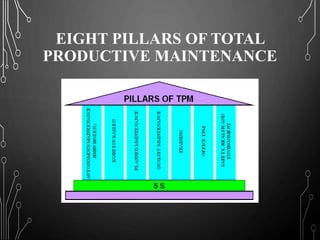
EIGHT PILLARS OF TOTAL
PRODUCTIVE MAINTENANCE
SIMILARITIES AND DIFFERENCE
BETWEEN TQM AND TPM
• The TPM program closely resembles the popular Total
Quality Management (TQM) program. Many of the tools
such as employee empowerment, benchmarking,
documentation, etc. used in TQM are used to implement
and optimize TPM. Following are the similarities
between the two.
• Total commitment to the program by upper level
management is required in both programmers.
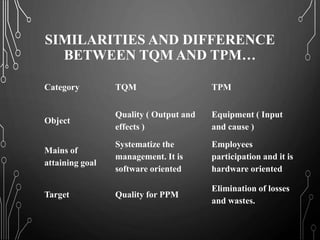
SIMILARITIES AND DIFFERENCE
BETWEEN TQM AND TPM…
Category TQM TPM
Object
Quality ( Output and
effects )
Equipment ( Input
and cause )
Mains of
attaining goal
Systematize the
management. It is
software oriented
Employees
participation and it is
hardware oriented
Target Quality for PPM
Elimination of losses
and wastes.
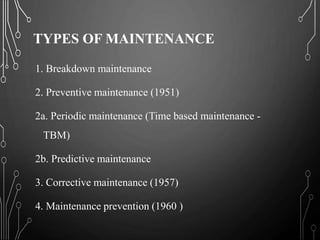
TYPES OF MAINTENANCE
1. Breakdown maintenance
2. Preventive maintenance (1951)
2a. Periodic maintenance (Time based maintenance -
TBM)
2b. Predictive maintenance
3. Corrective maintenance (1957)
4. Maintenance prevention (1960 )
INTRODUCTION TO OEE
• OEE (Overall Equipment Effectiveness) is a metric that identifies the
percentage of planned production time that is truly productive. It was
developed to support TPM initiatives by accurately tracking progress
towards achieving “perfect production”.
• An OEE score of 100% is perfect production.
• An OEE score of 85% is world class for discrete manufacturers.
• An OEE score of 60% is fairly typical for discrete manufacturers.
• An OEE score of 40% is not uncommon for manufacturers without
TPM and/or lean programs.
CONCLUSION
• TPM is a practical and down to earth technique aimed at maximizing
the effectiveness of facility that we use within our organization.
• The essence of TPM is team work, and at its very heart lies the
motivation and encouragement of the people who work within the
organization.
• Today thousands of organizations all over the world are
implementing TPM and about hundred organizations is now doing it
in India.
THANK YOU
For more…. Mail to
aglaiaconnect2018@gmail.com

Total productive maintenance

  • 1.
  • 2.
    INTRODUCTION • Maintenance hasa far greater impact on corporate profitability than most managers are willing to consider, much less admit . • And, as the competitive environment in the world continues to increase the pace, companies are looking for new strategies to save on costs, develop employees to face future challenges and bring about a new culture at work place.
  • 3.
    WHAT IS TOTALPRODUCTIVE MAINTENANCE? • TPM is a plant improvement methodology which enables continuous and rapid improvement of the manufacturing process through use of employee involvement, employee empowerment, and closed-loop measurement of results.
  • 4.
    WHY TPM? TPM wasintroduced to achieve the following objectives. The important ones are listed below. • Avoid wastage in a quickly changing economic environment. • Producing goods without reducing product quality. • Reduce cost. • Produce a low batch quantity at the earliest possible time.
  • 5.
    EVOLUTION OF TPM •TPM descends from Japan and came into existence in the seventies. • After Dr W Edward Deming made an impact in Japan through his teaching of quality, Japanese organization felt a need for autonomous maintenance and small group activities to support the quality movement. • Today thousands of organizations all over the world are implementing TPM and about 100organisations are now doing it in India.
  • 6.
    BENEFITS OF TOTALPRODUCTIVE MAINTENANCE (TPM) • Productivity Improvement - Productivity is improved through fewer losses in the company. • Employee Ownership - Ownership of equipment by operators through Autonomous Maintenance. • Increased Plant Reliability. • Customer Satisfaction - TPM leads to high delivery performance and customer satisfaction.
  • 7.
    LOSSES OF TOTALPRODUCTIVE MAINTENANCE (TPM) • Breakdown losses • Setup and adjustment losses • Idling and minor stoppage losses • Speed losses • Quality defects and rework losses • Strat-up/ yield losses
  • 8.
    EIGHT PILLARS OFTOTAL PRODUCTIVE MAINTENANCE
  • 9.
    SIMILARITIES AND DIFFERENCE BETWEENTQM AND TPM • The TPM program closely resembles the popular Total Quality Management (TQM) program. Many of the tools such as employee empowerment, benchmarking, documentation, etc. used in TQM are used to implement and optimize TPM. Following are the similarities between the two. • Total commitment to the program by upper level management is required in both programmers.
  • 10.
    SIMILARITIES AND DIFFERENCE BETWEENTQM AND TPM… Category TQM TPM Object Quality ( Output and effects ) Equipment ( Input and cause ) Mains of attaining goal Systematize the management. It is software oriented Employees participation and it is hardware oriented Target Quality for PPM Elimination of losses and wastes.
  • 11.
    TYPES OF MAINTENANCE 1.Breakdown maintenance 2. Preventive maintenance (1951) 2a. Periodic maintenance (Time based maintenance - TBM) 2b. Predictive maintenance 3. Corrective maintenance (1957) 4. Maintenance prevention (1960 )
  • 12.
    INTRODUCTION TO OEE •OEE (Overall Equipment Effectiveness) is a metric that identifies the percentage of planned production time that is truly productive. It was developed to support TPM initiatives by accurately tracking progress towards achieving “perfect production”. • An OEE score of 100% is perfect production. • An OEE score of 85% is world class for discrete manufacturers. • An OEE score of 60% is fairly typical for discrete manufacturers. • An OEE score of 40% is not uncommon for manufacturers without TPM and/or lean programs.
  • 13.
    CONCLUSION • TPM isa practical and down to earth technique aimed at maximizing the effectiveness of facility that we use within our organization. • The essence of TPM is team work, and at its very heart lies the motivation and encouragement of the people who work within the organization. • Today thousands of organizations all over the world are implementing TPM and about hundred organizations is now doing it in India.
  • 14.
    THANK YOU For more….Mail to aglaiaconnect2018@gmail.com