Swagatika Sahoo
Admn. No. 29F/16
College of fisheries,OUAT,
Rangeilunda
Asian seabass
farming
ASIAN SEA BASS / BARAMUNDI (Lates calcarifer)
Breeding, Nursing and Grow-out of
Asian Seabass
(Lates calcarifer)
• Background
• Broodstock management to spawning
• Larval rearing: hatching to 2 cm
• Nursing to juvenile: 2 - 5 cm, < 5 - 15 cm
• Grow-out /Culturing > 15 cm to market size
• Euryhaline
• Catadromous
• Spawns during full moon and new moon
• Serially hermaphroditic
• Carnivorous
Facts about seabass
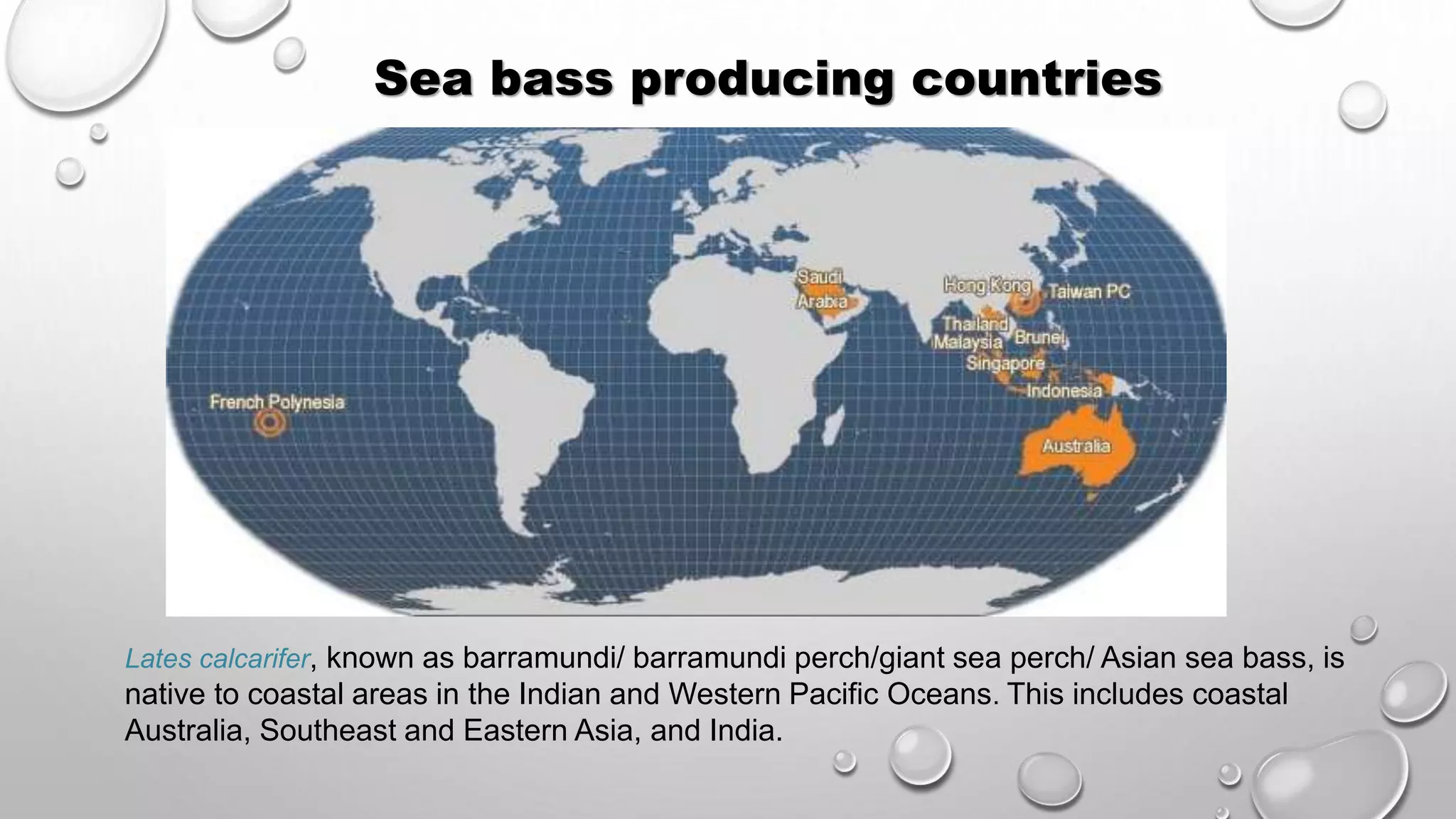
Sea bass producing countries
Lates calcarifer, known as barramundi/ barramundi perch/giant sea perch/ Asian sea bass, is
native to coastal areas in the Indian and Western Pacific Oceans. This includes coastal
Australia, Southeast and Eastern Asia, and India.
Sea bass production
Thailand:
23 provinces
2,614 km coastline
Gulf of Thailand: 17 provinces & 1,660 km
coastline
Andaman Sea: 6 provinces &
954 km coastline
Coastal aquaculture area 775 km2
Asian sea bass (lates calcarifer)
Thailand has fry/fingerlings circulated in the market from
• 8 Private hatcheries about 5 in the east, 3 in the south
• 17 Government hatcheries around the coast line
Department of fisheries(DOF), Thailand
16.7 million sea bass is produced
 For stocking 11.3 million fry
 Sold out 5.4 million fry to fisherman
 Private sector produce about 30 million fry for sell and culture.
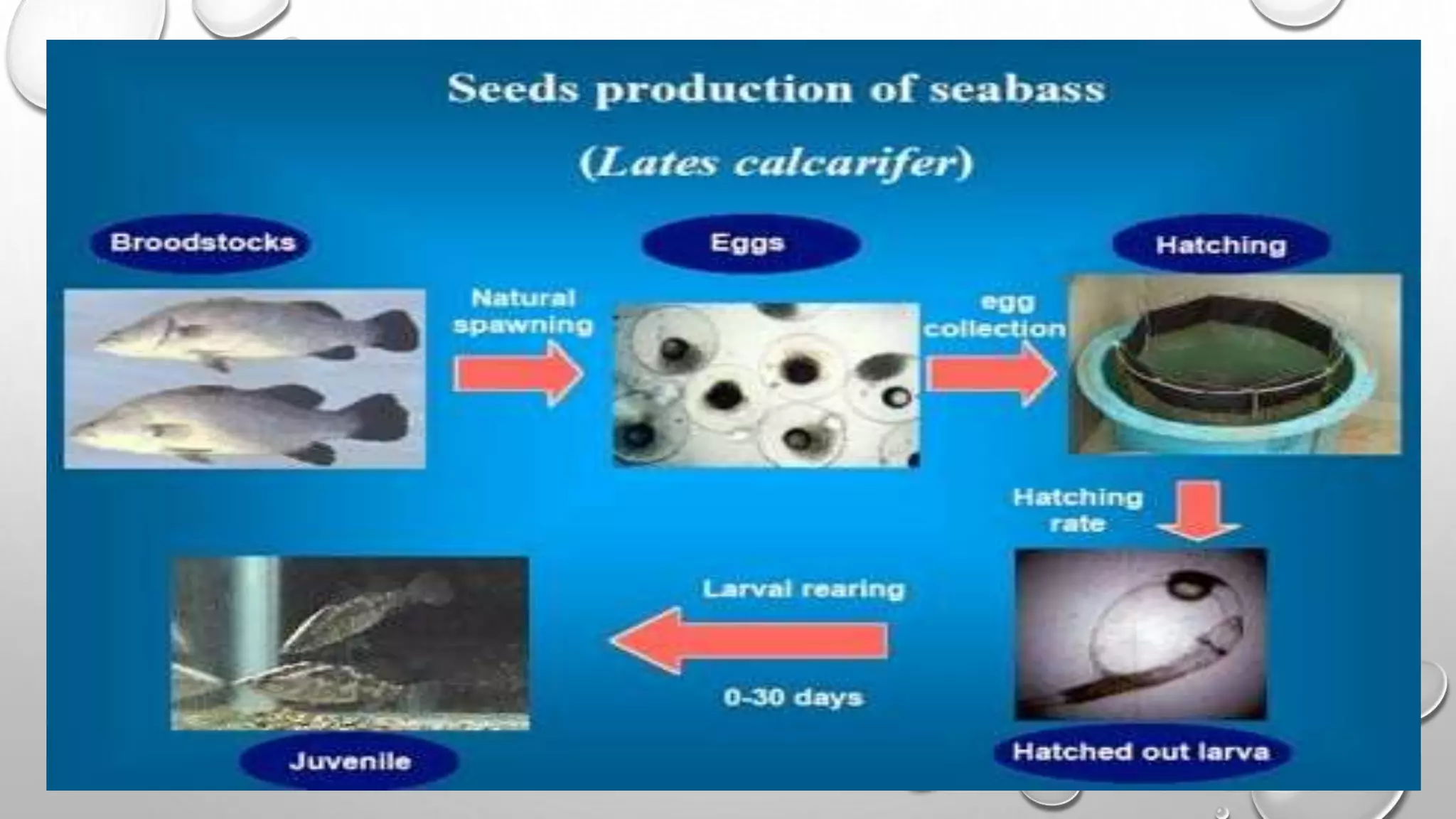
Life cycle of Asian Seabass
BREEDING
Hormone injection
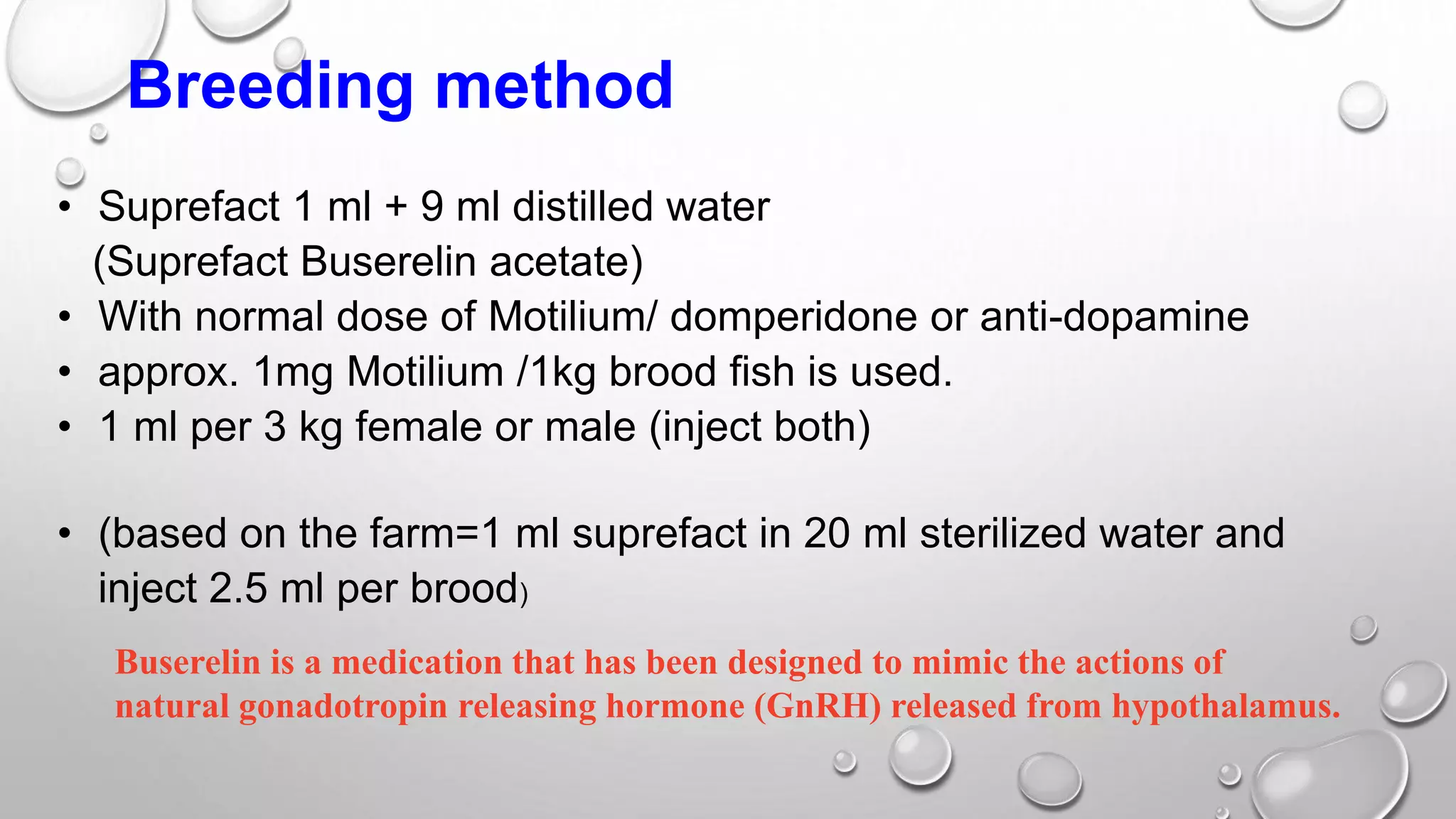
Buserelin is a medication that has been designed to mimic the actions of
natural gonadotropin releasing hormone (GnRH) released from hypothalamus.
Breeding method
• Suprefact 1 ml + 9 ml distilled water
(Suprefact Buserelin acetate)
• With normal dose of Motilium/ domperidone or anti-dopamine
• approx. 1mg Motilium /1kg brood fish is used.
• 1 ml per 3 kg female or male (inject both)
• (based on the farm=1 ml suprefact in 20 ml sterilized water and
inject 2.5 ml per brood)
Hormone preparation with
suprefact and motilium -M
Eggs 1 -day old larvae
Egg dia= 0.7-0.8mm with large oil globule
In 28-30 ppt eggs will float and in less than
28ppt eggs will sink.
1.5-1.7 mm
Stocking, larval rearing
• Temperature 26-28 o
C
• Salinity 30-31 ppt
• Mild aeration
• Put Chlorella sp. (green water) 3-4 x 10⁴
cell per ml.
as food for Rotifer once a day
- Stock 30-40 fry/liter
- Survival = 50% (up to 2 cm)
40% up to 3 cm
Feeding schedule for larvae
• Rotifer, Brachionus rotundiformis size 50-175 μ
Start feeding on the 3rd
day at 10-20 / ml observe
swimming behavior of fish larvae
• Put Rotifer before water exchange
• Reduce Rotifer to 3-5 /ml later, check 3-4
times/day
• 4 mm larvae (8-10 days) fed 1,500
• Stop Rotifer rotiferfeeding on day 15th
Feeding Brine shrimp for larvae
• Brine shrimp or Artemia nauplii size 500
micron
• Start at 8-10 day, fed to 20-25 days
• Pre-adult Brine shrimp 1-10 mm fed during
20-60 days, 4 times / day
Feeding
Mass production of phytoplankton tetraselmis sp. Which
act as food for rotifers
Nursing hapas Juveniles accepting feed in a group
Fry size graders with various
sizes
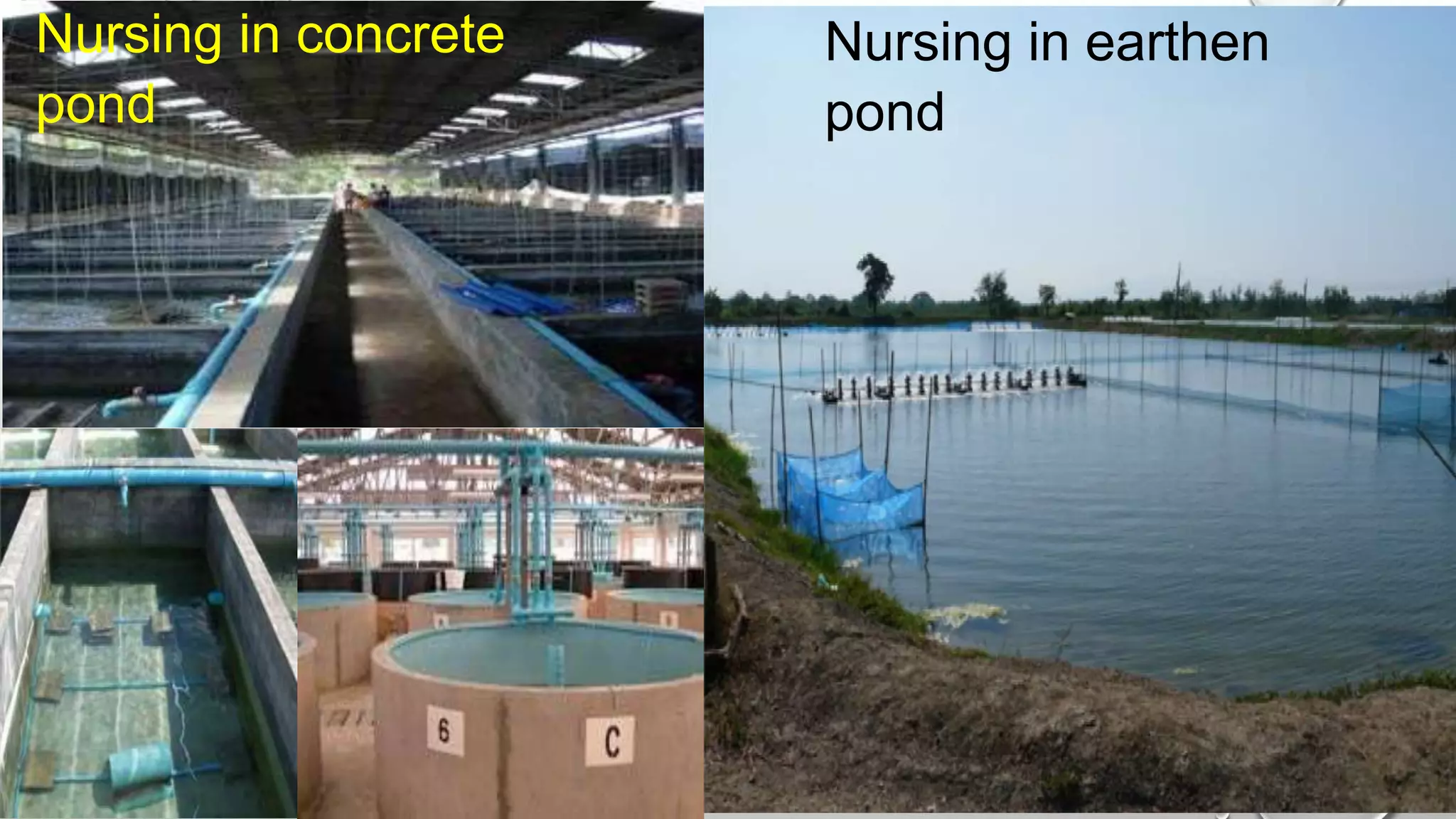
Nursing pf larvae can be done both in
concrete tanks and ponds.
# Frequent grading of fry and fingerlings
more than 9 sizes to reduce cannibalism and
also Nine sizes of feed is used.
Feed of different Nine
pellet sizes
NURSING TO JUVENILE
Nursing in concrete
pond
Nursing in earthen
pond
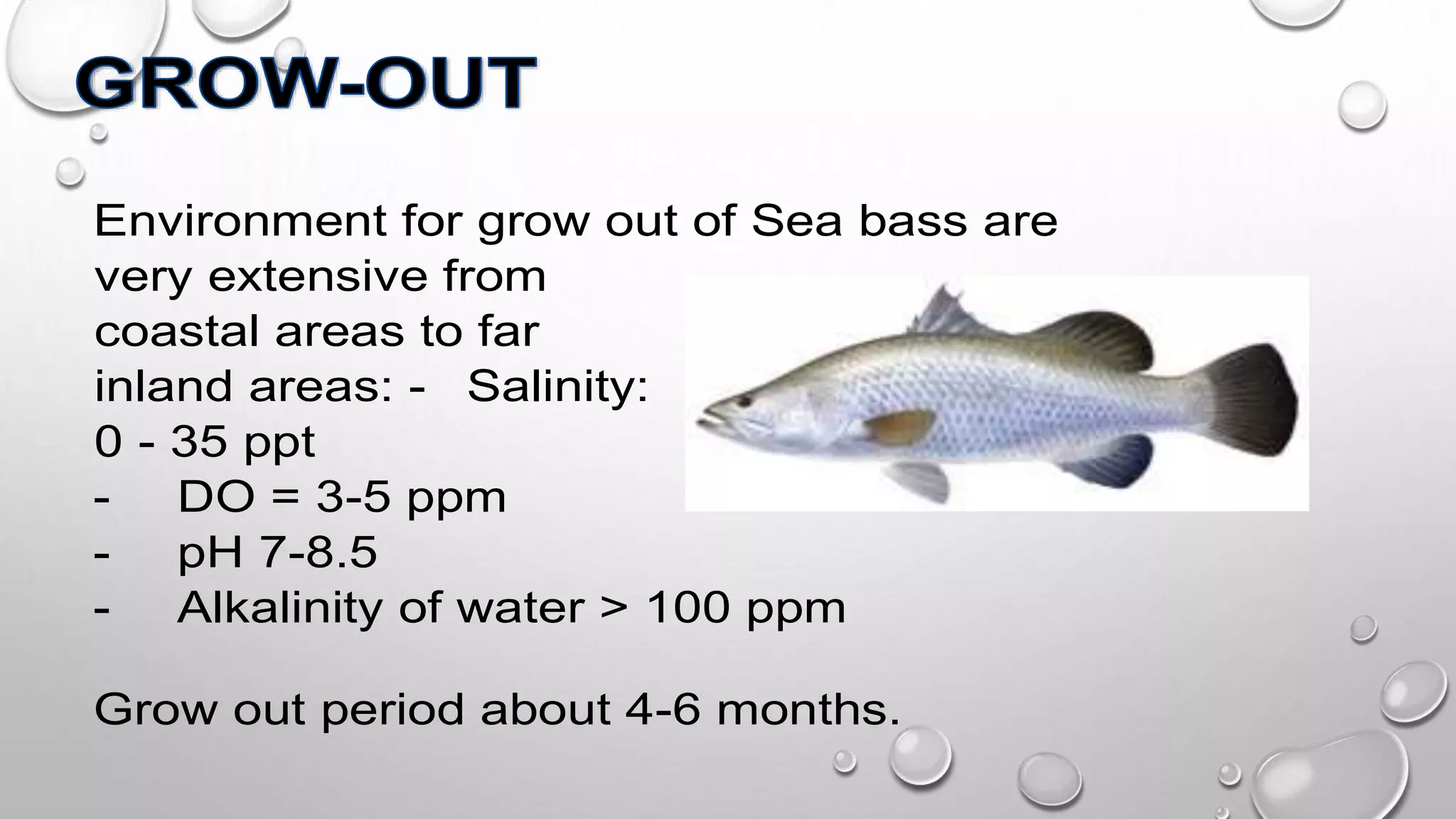
Environment for grow out of Sea bass are
very extensive from
coastal areas to far
inland areas: - Salinity:
0 - 35 ppt
- DO = 3-5 ppm
- pH 7-8.5
- Alkalinity of water > 100 ppm
Grow out period about 4-6 months.
Majority of Sea bass production (>85%) came from
cages:
coastal sea - River mouth
Canals: Fresh/brackish water
Cage culture
Floating net
4x4x2 m3
3x3x2 m3
Production of sea bass from pond culture was only
14% of the total sea bass production.
Sea bass pond culture should have an area in
ranged 800-3200 m2 with 1.5-2.0 meters depth.
Pond culture
Economics
e.g. Boon Sawang Farm
•Cage size 4m x 4m x 2m
•Stocking 4” fingerlings at 3,000 / cages
•Harvest = 700-900 g
•FCR = 1.1-2.0
•Cost of prod = 105 Baht/kg
•Sales price = 140 Baht / kg
•Total prod. = 1.6 ton
•Revenue = 1,600 x 35/31 = US$1800 / cage
Economics
e.g. Boon Sawang Farm
•Pond = 5 rai
•Stocking 3 fingerlings / m2
•Harvest = 600-900 g
•FCR = 1.1-2.0
•Cost of prod = 85 Baht/kg
•Sales price = 120 Baht / kg
•Total prod. = 20 ton
•Revenue = 20,000 x 35/31 = US$22,580 / 5 rai
Visit to ‘SU Thin Farm’ in Chonburi,Thailand. The Farm have cage culture site and processing plant of sea bass.
We tasted deep fried sea bass there.
Baramundi in wild:
https://www.youtube.com/watch?v=wOp1bfx_9TM
Cast net for fingerlings:
https://www.youtube.com/watch?v=yTS3fsoV5tg
Videos
Sea Bass farming in Taiwan:
https://www.youtube.com/watch?v=qb_NJTzGl24
ICAR-India:
https://www.youtube.com/watch?v=lWamZBgPLxQ
Indonesia: https://www.youtube.com/watch?v=YBQSFphHD34
Australia: https://www.youtube.com/watch?v=0BrjaY6U7lQ
Asian  seabass farming ppt

Asian seabass farming ppt

  • 1.
    Swagatika Sahoo Admn. No.29F/16 College of fisheries,OUAT, Rangeilunda Asian seabass farming
  • 2.
    ASIAN SEA BASS/ BARAMUNDI (Lates calcarifer)
  • 3.
    Breeding, Nursing andGrow-out of Asian Seabass (Lates calcarifer) • Background • Broodstock management to spawning • Larval rearing: hatching to 2 cm • Nursing to juvenile: 2 - 5 cm, < 5 - 15 cm • Grow-out /Culturing > 15 cm to market size
  • 4.
    • Euryhaline • Catadromous •Spawns during full moon and new moon • Serially hermaphroditic • Carnivorous Facts about seabass
  • 5.
    Sea bass producingcountries Lates calcarifer, known as barramundi/ barramundi perch/giant sea perch/ Asian sea bass, is native to coastal areas in the Indian and Western Pacific Oceans. This includes coastal Australia, Southeast and Eastern Asia, and India.
  • 8.
  • 9.
    Thailand: 23 provinces 2,614 kmcoastline Gulf of Thailand: 17 provinces & 1,660 km coastline Andaman Sea: 6 provinces & 954 km coastline Coastal aquaculture area 775 km2
  • 10.
    Asian sea bass(lates calcarifer) Thailand has fry/fingerlings circulated in the market from • 8 Private hatcheries about 5 in the east, 3 in the south • 17 Government hatcheries around the coast line Department of fisheries(DOF), Thailand 16.7 million sea bass is produced  For stocking 11.3 million fry  Sold out 5.4 million fry to fisherman  Private sector produce about 30 million fry for sell and culture.
  • 11.
    Life cycle ofAsian Seabass
  • 13.
  • 16.
  • 17.
    Buserelin is amedication that has been designed to mimic the actions of natural gonadotropin releasing hormone (GnRH) released from hypothalamus. Breeding method • Suprefact 1 ml + 9 ml distilled water (Suprefact Buserelin acetate) • With normal dose of Motilium/ domperidone or anti-dopamine • approx. 1mg Motilium /1kg brood fish is used. • 1 ml per 3 kg female or male (inject both) • (based on the farm=1 ml suprefact in 20 ml sterilized water and inject 2.5 ml per brood)
  • 19.
  • 20.
    Eggs 1 -dayold larvae Egg dia= 0.7-0.8mm with large oil globule In 28-30 ppt eggs will float and in less than 28ppt eggs will sink. 1.5-1.7 mm
  • 23.
    Stocking, larval rearing •Temperature 26-28 o C • Salinity 30-31 ppt • Mild aeration • Put Chlorella sp. (green water) 3-4 x 10⁴ cell per ml. as food for Rotifer once a day - Stock 30-40 fry/liter - Survival = 50% (up to 2 cm) 40% up to 3 cm
  • 24.
    Feeding schedule forlarvae • Rotifer, Brachionus rotundiformis size 50-175 μ Start feeding on the 3rd day at 10-20 / ml observe swimming behavior of fish larvae • Put Rotifer before water exchange • Reduce Rotifer to 3-5 /ml later, check 3-4 times/day • 4 mm larvae (8-10 days) fed 1,500 • Stop Rotifer rotiferfeeding on day 15th
  • 25.
    Feeding Brine shrimpfor larvae • Brine shrimp or Artemia nauplii size 500 micron • Start at 8-10 day, fed to 20-25 days • Pre-adult Brine shrimp 1-10 mm fed during 20-60 days, 4 times / day
  • 26.
  • 27.
    Mass production ofphytoplankton tetraselmis sp. Which act as food for rotifers
  • 28.
    Nursing hapas Juvenilesaccepting feed in a group
  • 29.
    Fry size graderswith various sizes
  • 30.
    Nursing pf larvaecan be done both in concrete tanks and ponds. # Frequent grading of fry and fingerlings more than 9 sizes to reduce cannibalism and also Nine sizes of feed is used. Feed of different Nine pellet sizes NURSING TO JUVENILE
  • 31.
  • 32.
    Environment for growout of Sea bass are very extensive from coastal areas to far inland areas: - Salinity: 0 - 35 ppt - DO = 3-5 ppm - pH 7-8.5 - Alkalinity of water > 100 ppm Grow out period about 4-6 months.
  • 33.
    Majority of Seabass production (>85%) came from cages: coastal sea - River mouth Canals: Fresh/brackish water Cage culture Floating net 4x4x2 m3 3x3x2 m3 Production of sea bass from pond culture was only 14% of the total sea bass production. Sea bass pond culture should have an area in ranged 800-3200 m2 with 1.5-2.0 meters depth. Pond culture
  • 34.
    Economics e.g. Boon SawangFarm •Cage size 4m x 4m x 2m •Stocking 4” fingerlings at 3,000 / cages •Harvest = 700-900 g •FCR = 1.1-2.0 •Cost of prod = 105 Baht/kg •Sales price = 140 Baht / kg •Total prod. = 1.6 ton •Revenue = 1,600 x 35/31 = US$1800 / cage
  • 35.
    Economics e.g. Boon SawangFarm •Pond = 5 rai •Stocking 3 fingerlings / m2 •Harvest = 600-900 g •FCR = 1.1-2.0 •Cost of prod = 85 Baht/kg •Sales price = 120 Baht / kg •Total prod. = 20 ton •Revenue = 20,000 x 35/31 = US$22,580 / 5 rai
  • 36.
    Visit to ‘SUThin Farm’ in Chonburi,Thailand. The Farm have cage culture site and processing plant of sea bass. We tasted deep fried sea bass there.
  • 37.
    Baramundi in wild: https://www.youtube.com/watch?v=wOp1bfx_9TM Castnet for fingerlings: https://www.youtube.com/watch?v=yTS3fsoV5tg Videos Sea Bass farming in Taiwan: https://www.youtube.com/watch?v=qb_NJTzGl24 ICAR-India: https://www.youtube.com/watch?v=lWamZBgPLxQ Indonesia: https://www.youtube.com/watch?v=YBQSFphHD34 Australia: https://www.youtube.com/watch?v=0BrjaY6U7lQ