
Hitha.R
Roll.no.05
IV semester
FISHERIES
MANAGEMENT
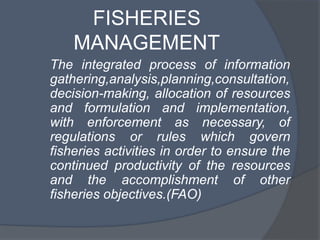
The integrated process of information
gathering,analysis,planning,consultation,
decision-making, allocation of resources
and formulation and implementation,
with enforcement as necessary, of
regulations or rules which govern
fisheries activities in order to ensure the
continued productivity of the resources
and the accomplishment of other
fisheries objectives.(FAO)
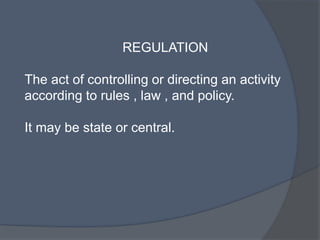
REGULATION
The act of controlling or directing an activity
according to rules , law , and policy.
It may be state or central.
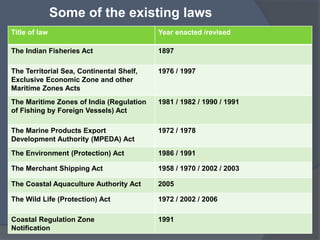
Title of law Year enacted /revised
The Indian Fisheries Act 1897
The Territorial Sea, Continental Shelf,
Exclusive Economic Zone and other
Maritime Zones Acts
1976 / 1997
The Maritime Zones of India (Regulation
of Fishing by Foreign Vessels) Act
1981 / 1982 / 1990 / 1991
The Marine Products Export
Development Authority (MPEDA) Act
1972 / 1978
The Environment (Protection) Act 1986 / 1991
The Merchant Shipping Act 1958 / 1970 / 2002 / 2003
The Coastal Aquaculture Authority Act 2005
The Wild Life (Protection) Act 1972 / 2002 / 2006
Coastal Regulation Zone
Notification
1991
Some of the existing laws
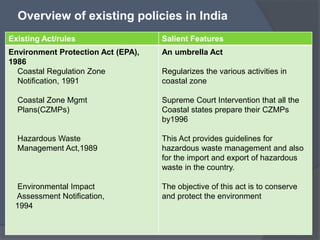
Overview of existing policies in India
Existing Act/rules Salient Features
Environment Protection Act (EPA),
1986
Coastal Regulation Zone
Notification, 1991
Coastal Zone Mgmt
Plans(CZMPs)
Hazardous Waste
Management Act,1989
Environmental Impact
Assessment Notification,
1994
An umbrella Act
Regularizes the various activities in
coastal zone
Supreme Court Intervention that all the
Coastal states prepare their CZMPs
by1996
This Act provides guidelines for
hazardous waste management and also
for the import and export of hazardous
waste in the country.
The objective of this act is to conserve
and protect the environment
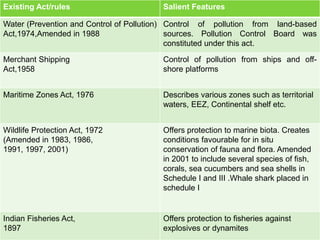
Existing Act/rules Salient Features
Water (Prevention and Control of Pollution)
Act,1974,Amended in 1988
Control of pollution from land-based
sources. Pollution Control Board was
constituted under this act.
Merchant Shipping
Act,1958
Control of pollution from ships and off-
shore platforms
Maritime Zones Act, 1976 Describes various zones such as territorial
waters, EEZ, Continental shelf etc.
Wildlife Protection Act, 1972
(Amended in 1983, 1986,
1991, 1997, 2001)
Offers protection to marine biota. Creates
conditions favourable for in situ
conservation of fauna and flora. Amended
in 2001 to include several species of fish,
corals, sea cucumbers and sea shells in
Schedule I and III .Whale shark placed in
schedule I
Indian Fisheries Act,
1897
Offers protection to fisheries against
explosives or dynamites
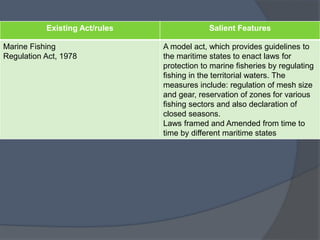
Existing Act/rules Salient Features
Marine Fishing
Regulation Act, 1978
A model act, which provides guidelines to
the maritime states to enact laws for
protection to marine fisheries by regulating
fishing in the territorial waters. The
measures include: regulation of mesh size
and gear, reservation of zones for various
fishing sectors and also declaration of
closed seasons.
Laws framed and Amended from time to
time by different maritime states
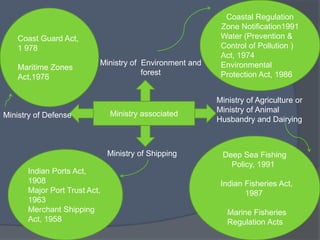
Laws under the purview
of
Different Ministries in
India
Ministry associated
Ministry of Defense
Ministry of Environment and
forest
Ministry of Agriculture or
Ministry of Animal
Husbandry and Dairying
Ministry of Shipping
Coastal Regulation
Zone Notification1991
Water (Prevention &
Control of Pollution )
Act, 1974
Environmental
Protection Act, 1986
Deep Sea Fishing
Policy, 1991
Indian Fisheries Act,
1987
Marine Fisheries
Regulation Acts
Indian Ports Act,
1908
Major Port Trust Act,
1963
Merchant Shipping
Act, 1958
Coast Guard Act,
1 978
Maritime Zones
Act,1976
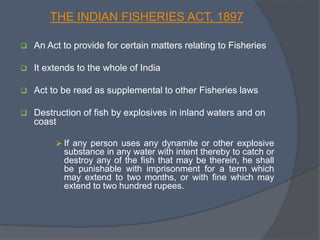
THE INDIAN FISHERIES ACT, 1897
 An Act to provide for certain matters relating to Fisheries
 It extends to the whole of India
 Act to be read as supplemental to other Fisheries laws
 Destruction of fish by explosives in inland waters and on
coast
 If any person uses any dynamite or other explosive
substance in any water with intent thereby to catch or
destroy any of the fish that may be therein, he shall
be punishable with imprisonment for a term which
may extend to two months, or with fine which may
extend to two hundred rupees.
 Destruction of fish by poisoning of waters.
 State government rules may prohibit or
regulate all or any of the following matters
 the erection and use of fixed engine
 the construction of weirs
 the dimension and kind of the nets to be used and the modes of using
them.
 Arrest without warrant for offences under this
Act.
If any person puts any poison, lime or noxious material into
any water with intent thereby to catch or destroy any fish, he
shall be punishable with imprisonment for a term which may
extend to two months, or with fine which may extend to two
hundred rupees.
The Territorial Waters, Continental Shelf,
Exclusive Economic Zone and other
Maritime Zones Act, 1976
 In this Act, "limit" in relation to the territorial waters, ..., the exclusive
economic zone or any other maritime zone of India, means the limit of
such waters, shelf or zone with reference to the mainland of India as
well as the individual or composite group or groups of islands
constituting part of the territory of India.
 Sovereignty over, and limits of territorial waters
(1) The sovereignty of India extends and has always extended to the
territorial waters of India (hereinafter referred to as the territorial
waters) and to the seabed and subsoil underlying, and the airspace
over, such waters.
(2) The limit of the territorial waters is the line every point of which is at a
distance of twelve nautical miles from the nearest point of the
appropriate baseline.
 Use of territorial waters by foreign ships
(1) Without prejudice to the provisions of any other law for the time
being in force, all foreign ships (other than warships including
submarines and other underwater vehicles) shall enjoy the right
of innocent passage through the territorial waters.
Explanation - For the purposes of this section, passage is innocent
so long as it is not prejudicial to the peace, good order or
security of India.
(2) Foreign warships including submarines and other underwater
vehicles may enter or pass through the territorial waters after
giving prior notice to the Central Government:
Provided that submarines and other underwater vehicles shall
navigate on the surface and show their flag while passing
through such waters.
 Contiguous zone of India
The contiguous zone of India (hereinafter referred to as the contiguous
zone) is an area beyond and adjacent to the territorial waters, and the
limit of the contiguous zone is the line every point of which is at a
distance of twenty-four nautical miles from the nearest point of the
baseline
 Continental shelf
The continental shelf of India (hereinafter referred to as the continental
shelf) comprises the seabed and subsoil of the submarine areas that
extend beyond the limit of its territorial waters throughout the natural
prolongation of its land territory to the outer edge of the continental
margin or to a distance of two hundred nautical miles from the baseline
 India has, and always had, full and exclusive sovereign rights in respect
of its continental shelf.
(a) sovereign rights for the purposes of exploration, exploitation,
conservation and management of all resources
(b) exclusive rights and jurisdiction for the construction, maintenance or
operation of artificial islands, off-shore terminals, installations and other
structures and devices necessary for the exploration and exploitation of
the resources of the continental shelf or for the convenience of shipping
or for any other purpose
(c) exclusive jurisdiction to authorize, regulate and control scientific
research
(d) exclusive jurisdiction to preserve and protect the marine environment
and to prevent and control marine pollution.
 Exclusive Economic Zone
The exclusive economic zone of India (hereinafter referred to as the
exclusive economic zone) is an area beyond and adjacent to the
territorial waters, and the limit of such zone is two hundred nautical
miles from the baseline.
No person (including a foreign Government) shall, except under, and in
accordance with, the terms of any agreement with the Central
Government or of a license or a letter of authority granted by the
Central Government, explore or exploit any resources of the exclusive
economic zone or carry out any research or excavation or conduct any
research within the exclusive economic zone or drill therein or
construct, maintain or any artificial island, off-shore terminal, installation
or other structure or device therein for any purpose whatsoever:
Marine Fisheries Legislation in
the Maritime States of India
 The country with the long coastline of 8129
Km
 has an exclusive Economic Zone (EEZ)
extending to 2.02 million Sq.Km. comprising of
0.86 million Sq.Km. on the West Coast
0.56 million Sq.Km. on the East Coast
0.60 million Sq.Km. around the two island union
territories viz Lakshadweep, and Andaman and
Nicobar islands, situated in the Arabian sea and Bay of
Bengal, respectively
Zonation and other fishing regulations in
different states are summerised below
 Maharashtra-MFRA 1981/1982
 Operation of trawl net by mechanized fishing vessels is prohibited
in some specified depth(5 fathoms and 10 fathoms)
 trawl ban during monsoon
 trawl gear operation is not allowed between 6 pm and 6 am etc
 Goa-MFRA 1980/1982
 area up to 5 km from the coast line is specified area and
mechanized fishing vessels are prohibited from fishing in the area
 restriction on mesh size of nets i.e.; 20mm for prawns and 24mm
for fish.
 Karnataka-MFRA 1986
 area up to 6 km from shore or up to 4 fathoms is reserved for the
traditional craft
 Deep Sea vessels are requested to operate beyond 20 km
 Kerala-MFRA 1980
 The Government Notification prohibiting the use of purse-seine,
pelagic trawl and mid water trawl in the territorial sea
 Code end mesh size of bottom trawl-35 mm
 Mesh size of ring seine-20mm
 Mesh size of dip net-20mm
 Prohibition of night trawling
 Closed season during the breeding season
 Andhra Pradesh-MFRA 1983/1995
 The area up to 10 km from shore is reserved for traditional craft
 Mechanized boats are allowed to operate beyond 10 km
 Orissa-MFRA 1982/1985
 Non mechanized traditional craft shall be allowed to operate freely
without restriction.
 Mechanized fishing vessels up to 15 m in length shall be allowed to
operate beyond 5 km from the coast.
 Mechanized fishing vessels of 25 GRT and above or 15 m in length
shall be allowed to operate beyond 10 km from the coast
 Tamil Nadu-MFRA 1983
 Area up to 3 nautical miles reserved for traditional vessels.
 Fishing with in 100m below a river mouth is prohibited.
 No fishing gear of less than 100-mm mesh from knot to knot in
respect of net other than trawl net shall be used.
 West Bengal-MFRA 1993/1995
 The area up to 15 km from the shore is reserved for traditional craft.
 Fishing craft fitted with more than 30-hp engine are allowed to
operate beyond 15 km
Hitha

Hitha

  • 1.
  • 2.
    FISHERIES MANAGEMENT The integrated processof information gathering,analysis,planning,consultation, decision-making, allocation of resources and formulation and implementation, with enforcement as necessary, of regulations or rules which govern fisheries activities in order to ensure the continued productivity of the resources and the accomplishment of other fisheries objectives.(FAO)
  • 3.
    REGULATION The act ofcontrolling or directing an activity according to rules , law , and policy. It may be state or central.
  • 4.
    Title of lawYear enacted /revised The Indian Fisheries Act 1897 The Territorial Sea, Continental Shelf, Exclusive Economic Zone and other Maritime Zones Acts 1976 / 1997 The Maritime Zones of India (Regulation of Fishing by Foreign Vessels) Act 1981 / 1982 / 1990 / 1991 The Marine Products Export Development Authority (MPEDA) Act 1972 / 1978 The Environment (Protection) Act 1986 / 1991 The Merchant Shipping Act 1958 / 1970 / 2002 / 2003 The Coastal Aquaculture Authority Act 2005 The Wild Life (Protection) Act 1972 / 2002 / 2006 Coastal Regulation Zone Notification 1991 Some of the existing laws
  • 5.
    Overview of existingpolicies in India Existing Act/rules Salient Features Environment Protection Act (EPA), 1986 Coastal Regulation Zone Notification, 1991 Coastal Zone Mgmt Plans(CZMPs) Hazardous Waste Management Act,1989 Environmental Impact Assessment Notification, 1994 An umbrella Act Regularizes the various activities in coastal zone Supreme Court Intervention that all the Coastal states prepare their CZMPs by1996 This Act provides guidelines for hazardous waste management and also for the import and export of hazardous waste in the country. The objective of this act is to conserve and protect the environment
  • 6.
    Existing Act/rules SalientFeatures Water (Prevention and Control of Pollution) Act,1974,Amended in 1988 Control of pollution from land-based sources. Pollution Control Board was constituted under this act. Merchant Shipping Act,1958 Control of pollution from ships and off- shore platforms Maritime Zones Act, 1976 Describes various zones such as territorial waters, EEZ, Continental shelf etc. Wildlife Protection Act, 1972 (Amended in 1983, 1986, 1991, 1997, 2001) Offers protection to marine biota. Creates conditions favourable for in situ conservation of fauna and flora. Amended in 2001 to include several species of fish, corals, sea cucumbers and sea shells in Schedule I and III .Whale shark placed in schedule I Indian Fisheries Act, 1897 Offers protection to fisheries against explosives or dynamites
  • 7.
    Existing Act/rules SalientFeatures Marine Fishing Regulation Act, 1978 A model act, which provides guidelines to the maritime states to enact laws for protection to marine fisheries by regulating fishing in the territorial waters. The measures include: regulation of mesh size and gear, reservation of zones for various fishing sectors and also declaration of closed seasons. Laws framed and Amended from time to time by different maritime states
  • 8.
    Laws under thepurview of Different Ministries in India
  • 9.
    Ministry associated Ministry ofDefense Ministry of Environment and forest Ministry of Agriculture or Ministry of Animal Husbandry and Dairying Ministry of Shipping Coastal Regulation Zone Notification1991 Water (Prevention & Control of Pollution ) Act, 1974 Environmental Protection Act, 1986 Deep Sea Fishing Policy, 1991 Indian Fisheries Act, 1987 Marine Fisheries Regulation Acts Indian Ports Act, 1908 Major Port Trust Act, 1963 Merchant Shipping Act, 1958 Coast Guard Act, 1 978 Maritime Zones Act,1976
  • 10.
    THE INDIAN FISHERIESACT, 1897  An Act to provide for certain matters relating to Fisheries  It extends to the whole of India  Act to be read as supplemental to other Fisheries laws  Destruction of fish by explosives in inland waters and on coast  If any person uses any dynamite or other explosive substance in any water with intent thereby to catch or destroy any of the fish that may be therein, he shall be punishable with imprisonment for a term which may extend to two months, or with fine which may extend to two hundred rupees.
  • 11.
     Destruction offish by poisoning of waters.  State government rules may prohibit or regulate all or any of the following matters  the erection and use of fixed engine  the construction of weirs  the dimension and kind of the nets to be used and the modes of using them.  Arrest without warrant for offences under this Act. If any person puts any poison, lime or noxious material into any water with intent thereby to catch or destroy any fish, he shall be punishable with imprisonment for a term which may extend to two months, or with fine which may extend to two hundred rupees.
  • 12.
    The Territorial Waters,Continental Shelf, Exclusive Economic Zone and other Maritime Zones Act, 1976  In this Act, "limit" in relation to the territorial waters, ..., the exclusive economic zone or any other maritime zone of India, means the limit of such waters, shelf or zone with reference to the mainland of India as well as the individual or composite group or groups of islands constituting part of the territory of India.  Sovereignty over, and limits of territorial waters (1) The sovereignty of India extends and has always extended to the territorial waters of India (hereinafter referred to as the territorial waters) and to the seabed and subsoil underlying, and the airspace over, such waters. (2) The limit of the territorial waters is the line every point of which is at a distance of twelve nautical miles from the nearest point of the appropriate baseline.
  • 13.
     Use ofterritorial waters by foreign ships (1) Without prejudice to the provisions of any other law for the time being in force, all foreign ships (other than warships including submarines and other underwater vehicles) shall enjoy the right of innocent passage through the territorial waters. Explanation - For the purposes of this section, passage is innocent so long as it is not prejudicial to the peace, good order or security of India. (2) Foreign warships including submarines and other underwater vehicles may enter or pass through the territorial waters after giving prior notice to the Central Government: Provided that submarines and other underwater vehicles shall navigate on the surface and show their flag while passing through such waters.
  • 14.
     Contiguous zoneof India The contiguous zone of India (hereinafter referred to as the contiguous zone) is an area beyond and adjacent to the territorial waters, and the limit of the contiguous zone is the line every point of which is at a distance of twenty-four nautical miles from the nearest point of the baseline  Continental shelf The continental shelf of India (hereinafter referred to as the continental shelf) comprises the seabed and subsoil of the submarine areas that extend beyond the limit of its territorial waters throughout the natural prolongation of its land territory to the outer edge of the continental margin or to a distance of two hundred nautical miles from the baseline  India has, and always had, full and exclusive sovereign rights in respect of its continental shelf.
  • 15.
    (a) sovereign rightsfor the purposes of exploration, exploitation, conservation and management of all resources (b) exclusive rights and jurisdiction for the construction, maintenance or operation of artificial islands, off-shore terminals, installations and other structures and devices necessary for the exploration and exploitation of the resources of the continental shelf or for the convenience of shipping or for any other purpose (c) exclusive jurisdiction to authorize, regulate and control scientific research (d) exclusive jurisdiction to preserve and protect the marine environment and to prevent and control marine pollution.
  • 16.
     Exclusive EconomicZone The exclusive economic zone of India (hereinafter referred to as the exclusive economic zone) is an area beyond and adjacent to the territorial waters, and the limit of such zone is two hundred nautical miles from the baseline. No person (including a foreign Government) shall, except under, and in accordance with, the terms of any agreement with the Central Government or of a license or a letter of authority granted by the Central Government, explore or exploit any resources of the exclusive economic zone or carry out any research or excavation or conduct any research within the exclusive economic zone or drill therein or construct, maintain or any artificial island, off-shore terminal, installation or other structure or device therein for any purpose whatsoever:
  • 17.
    Marine Fisheries Legislationin the Maritime States of India  The country with the long coastline of 8129 Km  has an exclusive Economic Zone (EEZ) extending to 2.02 million Sq.Km. comprising of 0.86 million Sq.Km. on the West Coast 0.56 million Sq.Km. on the East Coast 0.60 million Sq.Km. around the two island union territories viz Lakshadweep, and Andaman and Nicobar islands, situated in the Arabian sea and Bay of Bengal, respectively
  • 18.
    Zonation and otherfishing regulations in different states are summerised below  Maharashtra-MFRA 1981/1982  Operation of trawl net by mechanized fishing vessels is prohibited in some specified depth(5 fathoms and 10 fathoms)  trawl ban during monsoon  trawl gear operation is not allowed between 6 pm and 6 am etc  Goa-MFRA 1980/1982  area up to 5 km from the coast line is specified area and mechanized fishing vessels are prohibited from fishing in the area  restriction on mesh size of nets i.e.; 20mm for prawns and 24mm for fish.  Karnataka-MFRA 1986  area up to 6 km from shore or up to 4 fathoms is reserved for the traditional craft  Deep Sea vessels are requested to operate beyond 20 km
  • 19.
     Kerala-MFRA 1980 The Government Notification prohibiting the use of purse-seine, pelagic trawl and mid water trawl in the territorial sea  Code end mesh size of bottom trawl-35 mm  Mesh size of ring seine-20mm  Mesh size of dip net-20mm  Prohibition of night trawling  Closed season during the breeding season  Andhra Pradesh-MFRA 1983/1995  The area up to 10 km from shore is reserved for traditional craft  Mechanized boats are allowed to operate beyond 10 km  Orissa-MFRA 1982/1985  Non mechanized traditional craft shall be allowed to operate freely without restriction.  Mechanized fishing vessels up to 15 m in length shall be allowed to operate beyond 5 km from the coast.  Mechanized fishing vessels of 25 GRT and above or 15 m in length shall be allowed to operate beyond 10 km from the coast
  • 20.
     Tamil Nadu-MFRA1983  Area up to 3 nautical miles reserved for traditional vessels.  Fishing with in 100m below a river mouth is prohibited.  No fishing gear of less than 100-mm mesh from knot to knot in respect of net other than trawl net shall be used.  West Bengal-MFRA 1993/1995  The area up to 15 km from the shore is reserved for traditional craft.  Fishing craft fitted with more than 30-hp engine are allowed to operate beyond 15 km