Compatibility and Accuracy of Mesh Generation in HyperMesh and CFD
            Simulation with Acusolve for Torque Converter

          Kathiresan M                              Umamageswari A                                  Subramanian J
         CFD Engineer                                CAE Specialist                                Senior Engineer
  Valeo India Private Limited                  Valeo India Private Limited                   Valeo India Private Limited
  Block - A, 4th Floor, TECCI                  Block - A, 4th Floor, TECCI                   Block - A, 4th Floor, TECCI
  Park, No. 176 Rajiv Gandhi                   Park, No. 176 Rajiv Gandhi                    Park, No. 176 Rajiv Gandhi
    Salai, Sozhanganallur,                       Salai, Sozhanganallur,                        Salai, Sozhanganallur,
   Chennai - 600 119, India                     Chennai - 600 119, India                      Chennai - 600 119, India


          Abbreviations: Finite Volume Method (FVM), Finite Element Method (FEM), Computational Fluid
                         Dynamics (CFD), Moving Reference Frame (MRF), Torque Converter (TC)

          Keywords:            Torque Converter, Impeller, Turbine, Lockup, Stator

                                                                       Abstract
            CFD is the analysis of the systems involving fluid flow, heat transfer and associated phenomena such as chemical reactions
by means of computer -based simulation. The solution to a flow problem (velocity, pressure, temperature etc) is defined at nodes inside
each cell. The accuracy of a CFD solution is governed by the number of cells in the grid. In general, the larger the number of cells at
critical areas, better the solution accuracy. Both the accuracy of a solution and its cost in terms of necessary computer hardware and
calculation time are dependent on the fineness of the grid. At present grid generation is still up to the skills of the CFD user to a design
that is a suitable compromise between desired accuracy and solution cost. Over 50% of the time spent in industry on a CFD project is
devoted to grid generation. Grid design is the main tasks at the input stage and subsequently the user needs to obtain a successful
simulation result.
            This paper is mainly concentrated on grid generation on complex model based on our requirements. Nowadays lots of
commercial soft wares are available for grid generation. Among these, the selection of mesh tool plays an important role to get optimal
mesh for the simulation. For this work, HyperMesh has taken for grid generation. Based on our requirements such as elements quality,
number of cells, mesh generation time, effort to design grid, accuracy of result are considered in this paper. This experimental analysis
is performed on torque converter. The generated mesh from HyperMesh meshing tool is simulated by using FVM solver. Then mesh is
generated in AcuConsole preprocessor and solution is done with AcuSolve (FEM).Then the simulation results are compared with test
results. By this work it will be helpful to select suitable meshing platform for our product torque converter for CFD simulation. So that
HyperMesh helps to reduce the time spent on a CFD project for grid generation.

Introduction
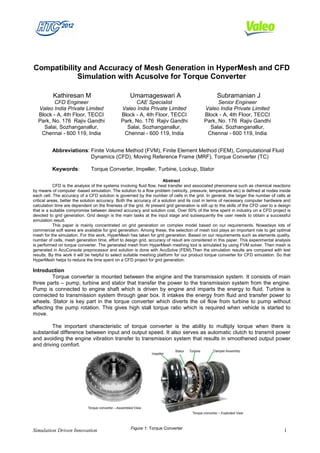
         Torque converter is mounted between the engine and the transmission system. It consists of main
three parts – pump, turbine and stator that transfer the power to the transmission system from the engine.
Pump is connected to engine shaft which is driven by engine and imparts the energy to fluid. Turbine is
connected to transmission system through gear box. It intakes the energy from fluid and transfer power to
wheels. Stator is key part in the torque converter which diverts the oil flow from turbine to pump without
affecting the pump rotation. This gives high stall torque ratio which is required when vehicle is started to
move.

        The important characteristic of torque converter is the ability to multiply torque when there is
substantial difference between input and output speed. It also serves as automatic clutch to transmit power
and avoiding the engine vibration transfer to transmission system that results in smoothened output power
and driving comfort.


                                                     Figure 1: Torque Converter
Simulation Driven Innovation                                                                                                            1
Process Methodology
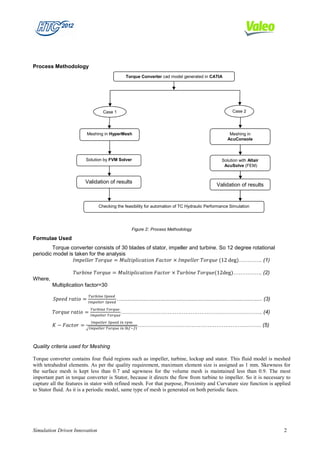
                                                Torque Converter cad model generated in CATIA


                                 Case 1                                                                             Case 2


                         Meshing in HyperMesh                                                                     Meshing in
                                                                                                                 AcuConsole


                        Solution by FVM Solver                                                               Solution with Altair
                                                                                                              AcuSolve (FEM)


                        Validation of results
                                                                                                          Validation of results


                               Checking the feasibility for automation of TC Hydraulic Performance Simulation


                                                   Figure 2: Process Methodology

Formulae Used
        Torque converter consists of 30 blades of stator, impeller and turbine. So 12 degree rotational
periodic model is taken for the analysis
                 ‫ ݁ݑݍݎ݋ܶ ݎ݈݈݁݁݌݉ܫ‬ൌ ‫ ݎ݋ݐܿܽܨ ݊݋݅ݐ݈ܽܿ݅݌݅ݐ݈ݑܯ‬ൈ ‫ ݁ݑݍݎ݋ܶ ݎ݈݈݁݁݌݉ܫ‬ሺ12 degሻ…………. (1)

                  ܶ‫ ݁ݑݍݎ݋ܶ ܾ݁݊݅ݎݑ‬ൌ ‫ ݎ݋ݐܿܽܨ ݊݋݅ݐ݈ܽܿ݅݌݅ݐ݈ݑܯ‬ൈ ܶ‫݁ݑݍݎ݋ܶ ܾ݁݊݅ݎݑ‬ሺ12degሻ……………. (2)
Where,
         Multiplication factor=30

                          ்௨௥௕௜௡௘ ௌ௣௘௘ௗ
         ܵ‫ ݋݅ݐܽݎ ݀݁݁݌‬ൌ                    ….............................................................................................. (3)
                         ூ௠௣௘௟௟௘௥ ௌ௣௘௘ௗ
                           ்௨௥௕௜௡௘ ்௢௥௤௨௘
         ܶ‫ ݋݅ݐܽݎ ݁ݑݍݎ݋‬ൌ                     ……………………………………………………………………. (4)
                          ூ௠௣௘௟௟௘௥ ்௢௥௤௨௘
                           ூ௠௣௘௟௟௘௥ ௌ௣௘௘ௗ ௜௡ ௥௣௠
         ‫ ܭ‬െ ‫ ݎ݋ݐܿܽܨ‬ൌ                                  …………………………………………………………… (5)
                        ඥூ௠௣௘௟௟௘௥ ்௢௥௤௨௘ ௜௡ ௟௕௙ି௙௧


Quality criteria used for Meshing

Torque converter contains four fluid regions such as impeller, turbine, lockup and stator. This fluid model is meshed
with tetrahedral elements. As per the quality requirement, maximum element size is assigned as 1 mm. Skewness for
the surface mesh is kept less than 0.7 and sqewness for the volume mesh is maintained less than 0.9. The most
important part in torque converter is Stator, because it directs the flow from turbine to impeller. So it is necessary to
capture all the features in stator with refined mesh. For that purpose, Proximity and Curvature size function is applied
to Stator fluid. As it is a periodic model, same type of mesh is generated on both periodic faces.


Simulation Driven Innovation                                                                                                                    2
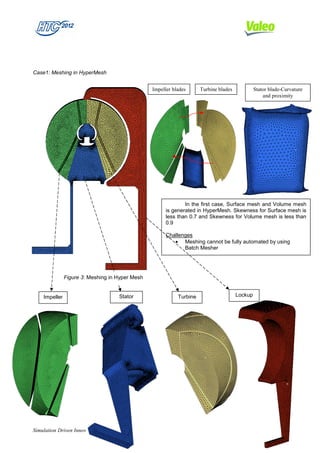
Case1: Meshing in HyperMesh


                                                 Impeller blades      Turbine blades            Stator blade-Curvature
                                                                                                    and proximity


                                                               In the first case, Surface mesh and Volume mesh
                                                       is generated in HyperMesh. Skewness for Surface mesh is
                                                       less than 0.7 and Skewness for Volume mesh is less than
                                                       0.9

                                                       Challenges
                                                          • Meshing cannot be fully automated by using
                                                              Batch Mesher


               Figure 3: Meshing in Hyper Mesh


    Impeller                        Stator                  Turbine                    Lockup


Simulation Driven Innovation                                                                                 3
Results & Discussions

                Solution with FVM solver:

                         The HyperMesh fluid model is solved using FVM solver. Steady state solver with incompressible
                turbulent flow settings is selected. Coupled algorithm for pressure-velocity coupling is used. As it is turbo
                machinery simulation, Moving Reference Frame (MRF) approach is applied for pump and turbine regions.
                The MRF approach implies that there is no relative mesh motion of the rotating and stationary parts. By
                using right hand thumb rule, rotation direction for lockup, impeller and turbine is defined. Well established
                Realizable K- ‫ א‬Turbulence model (2 eqn) is selected for capturing turbulence and oil properties are
                assigned. Impeller rotates at engine speed and turbine speed is assigned based on the speed ratio. To
                improve the calculation stability, initially calculation is performed with first order upwind scheme then it is
                switched to second order upwind scheme
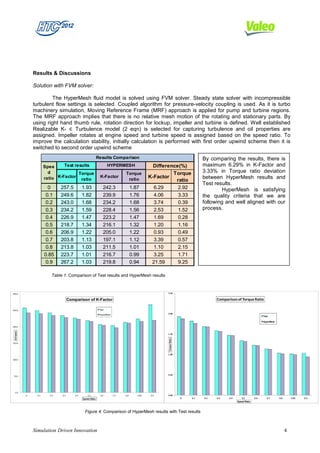
                                                              Results Comparison                                                 By comparing the results, there is
                        Spee     Test results                         HYPERMESH                    Difference(%)                 maximum 6.29% in K-Factor and
                          d           Torque                                     Torque                    Torque                3.33% in Torque ratio deviation
                        ratio K-Factor ratio                   K-Factor
                                                                                  ratio
                                                                                                 K-Factor                        between HyperMesh results and
                                                                                                            ratio
                                                                                                                                 Test results.
                          0     257.5           1.93              242.3                1.87        6.29      2.92                        HyperMesh is satisfying
                         0.1    249.6           1.82              239.9                1.76        4.06      3.33                the quality criteria that we are
                         0.2    243.0           1.68              234.2                1.68        3.74      0.39                following and well aligned with our
                         0.3    234.2           1.59              228.4                1.56        2.53      1.52                process.
                         0.4    226.9           1.47              223.2                1.47        1.69      0.28
                         0.5    218.7           1.34              216.1                1.32        1.20      1.16
                         0.6    206.9           1.22              205.0                1.22        0.93      0.49
                         0.7    203.8           1.13              197.1                1.12        3.39      0.57
                         0.8    213.8           1.03              211.5                1.01        1.10      2.15
                        0.85    223.7           1.01              216.7                0.99        3.25      1.71
                         0.9    267.2           1.03              219.8                0.94       21.59      9.25

                           Table 1: Comparison of Test results and HyperMesh results


300.0                                                                                                   2.50


                                      Comparison of K-Factor                                                                           Comparison of Torque Ratio

250.0                                                          Test
                                                                                                        2.00
                                                               HyperMesh
                                                                                                                                                                       Test

                                                                                                                                                                       HyperMesh

200.0
 K-Factor


                                                                                                        1.50
                                                                                                        Torque Ratio


150.0


                                                                                                        1.00

100.0


                                                                                                        0.50
 50.0


  0.0
            0     0.1     0.2   0.3       0.4       0.5         0.6        0.7   0.8      0.85   0.9    0.00
                                                Speed Ratio                                                            0   0.1   0.2   0.3   0.4      0.5        0.6      0.7      0.8       0.85   0.9
                                                                                                                                                   Speed Ratio


                                                 Figure 4: Comparison of HyperMesh results with Test results


                Simulation Driven Innovation                                                                                                                                             4
Case 2: Meshing in AcuConsole


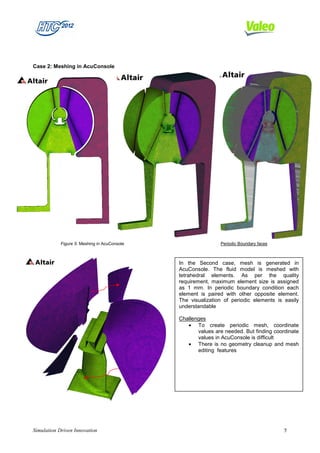
            Figure 5: Meshing in AcuConsole                   Periodic Boundary faces


                                              In the Second case, mesh is generated in
                                              AcuConsole. The fluid model is meshed with
                                              tetrahedral elements. As per the quality
                                              requirement, maximum element size is assigned
                                              as 1 mm. In periodic boundary condition each
                                              element is paired with other opposite element.
                                              The visualization of periodic elements is easily
                                              understandable

                                              Challenges
                                                 • To create periodic mesh, coordinate
                                                     values are needed. But finding coordinate
                                                     values in AcuConsole is difficult
                                                 • There is no geometry cleanup and mesh
                                                     editing features


Simulation Driven Innovation                                                            5
Results & Discussions

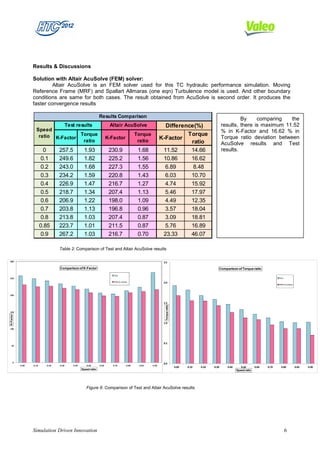
                  Solution with Altair AcuSolve (FEM) solver:
                           Altair AcuSolve is an FEM solver used for this TC hydraulic performance simulation. Moving
                  Reference Frame (MRF) and Spallart Allmaras (one eqn) Turbulence model is used. And other boundary
                  conditions are same for both cases. The result obtained from AcuSolve is second order. It produces the
                  faster convergence results

                                                                 Results Comparison
                                                                                                                                                                   By     comparing   the
                                         Test results                    Altair AcuSolve                       Difference(%)                              results, there is maximum 11.52
                    Speed                                                                                                                                 % in K-Factor and 16.62 % in
                     ratio K-Factor Torque                                                   Torque                    Torque
                                                                        K-Factor                             K-Factor                                     Torque ratio deviation between
                                     ratio                                                    ratio                     ratio                             AcuSolve results and Test
                           0      257.5              1.93                230.9                1.68            11.52     14.66                             results.
                          0.1     249.6              1.82                225.2                1.56            10.86     16.62
                          0.2     243.0              1.68                227.3                1.55             6.89      8.48
                          0.3     234.2              1.59                220.8                1.43             6.03     10.70
                          0.4     226.9              1.47                216.7                1.27             4.74     15.92
                          0.5     218.7              1.34                207.4                1.13             5.46     17.97
                          0.6     206.9              1.22                198.0                1.09             4.49     12.35
                          0.7     203.8              1.13                196.8                0.96             3.57     18.04
                          0.8     213.8              1.03                207.4                0.87             3.09     18.81
                         0.85     223.7              1.01                211.5                0.87             5.76     16.89
                          0.9     267.2              1.03                216.7                0.70            23.33     46.07

                                  Table 2: Comparison of Test and Altair AcuSolve results

300                                                                                                           2.5

                                  Comparison of K-Factor                                                                                              Comparison of Torque ratio
                                                                           Test
250                                                                                                                                                                                            Test
                                                                           FEM-AcuSolve                       2.0
                                                                                                                                                                                               FEM-AcuSolve


200


                                                                                                              1.5
                                                                                                               Torque ratio


150
K-Factor


                                                                                                              1.0

100


                                                                                                              0.5
   50


       0                                                                                                      0.0
           0.00   0.10     0.20   0.30      0.40      0.50       0.60      0.70       0.80    0.85    0.90
                                                                                                                              0.00   0.10   0.20   0.30     0.40      0.50       0.60   0.70    0.80          0.85   0.90
                                                   Speed ratio                                                                                                     Speed ratio


                                                      Figure 6: Comparison of Test and Altair AcuSolve results


                  Simulation Driven Innovation                                                                                                                                                        6
Benefits Summary
         HyperMesh is the promising software for our TC hydraulic performance simulation. It is reducing the
preprocessing hours considerably when CFD model is bigger than 12 deg.
         In other end, AcuSolve has inbuilt preprocessor and has single GUI for meshing and solving. It
avoids mesh export from preprocessor and import to solver time. And it eliminates clean-up and mesh
quality improving time.

Challenges
        Initially we faced periodic definition issue for our fluid model in AcuSolve. For post processing the
contours and vectors, we need to use HyperView separately. If it is inbuilt in AcuSolve, then it will be more
convenient. AcuSolve help documentation is not in detail about features and improvement is needed.

Future Plans
        We are planning to validate further HyperMesh for our TC simulation meshing automation. Also we
are planning to validate AcuSolve for other periodic angles like 36 deg, 120 deg and full model simulation to
understand the results variations & correlation with test measurement.

Conclusions
         We are looking for complete automation for TC hydraulic performance simulation. So we are
validating AcuSolve competency for our process. It shows that AcuSolve can be confidently used to
compare two or more designs for identifying better design quickly. However, difference between AcuSolve
and test measurement is slightly larger than our current process software. We hope it will be improved by
appropriate solver settings and in future release versions.
                                              ACKNOWLEDGEMENTS

       The authors would like to thank Altair Engineering, India for providing technical support in Altair
AcuSolve. The authors would also like to thank Mr.Sriram, R&D Director and Bagath Singh R, engineering
Manager, Power Train Transmissions, VIPL, Chennai for their constant encouragement

                                                        REFERRENCES


[1]     Versteeq H.K. and W. Malalasekara “An Introduction to Computational Fluid Dynamics”, Longman Group Ltd, 1995.

[2]     Ubaldi M., Zunino P., Barigozzi G. and Cattanei A., "An Experimental Investigation of Stator Induced Unsteadiness on
        Centrifugal Impeller Outflow", Journal of Turbo machinery, vol.118, 41-54, 1996.

[3]     Ramamurthi, V., “Finite Element Method in Machine Design”, Narosa Publishing House, January         2009,
        ISBN: 978-81-7319-965-3

[4]     Combès, J.F., Bert, P.F. and Kueny, J.L., "Numerical Investigation of the Rotor-Stator Interaction in a Centrifugal
        Pump Using a Finite Element Method", Proceedings of the 1997 ASME Fluids Engineering Division Summer Meeting,
        FEDSM97-3454, 1997.


Simulation Driven Innovation                                                                                                   7

Cfd fem-09 compatibility-and_accuracy_of_mesh_valeo

  • 1.
    Compatibility and Accuracyof Mesh Generation in HyperMesh and CFD Simulation with Acusolve for Torque Converter Kathiresan M Umamageswari A Subramanian J CFD Engineer CAE Specialist Senior Engineer Valeo India Private Limited Valeo India Private Limited Valeo India Private Limited Block - A, 4th Floor, TECCI Block - A, 4th Floor, TECCI Block - A, 4th Floor, TECCI Park, No. 176 Rajiv Gandhi Park, No. 176 Rajiv Gandhi Park, No. 176 Rajiv Gandhi Salai, Sozhanganallur, Salai, Sozhanganallur, Salai, Sozhanganallur, Chennai - 600 119, India Chennai - 600 119, India Chennai - 600 119, India Abbreviations: Finite Volume Method (FVM), Finite Element Method (FEM), Computational Fluid Dynamics (CFD), Moving Reference Frame (MRF), Torque Converter (TC) Keywords: Torque Converter, Impeller, Turbine, Lockup, Stator Abstract CFD is the analysis of the systems involving fluid flow, heat transfer and associated phenomena such as chemical reactions by means of computer -based simulation. The solution to a flow problem (velocity, pressure, temperature etc) is defined at nodes inside each cell. The accuracy of a CFD solution is governed by the number of cells in the grid. In general, the larger the number of cells at critical areas, better the solution accuracy. Both the accuracy of a solution and its cost in terms of necessary computer hardware and calculation time are dependent on the fineness of the grid. At present grid generation is still up to the skills of the CFD user to a design that is a suitable compromise between desired accuracy and solution cost. Over 50% of the time spent in industry on a CFD project is devoted to grid generation. Grid design is the main tasks at the input stage and subsequently the user needs to obtain a successful simulation result. This paper is mainly concentrated on grid generation on complex model based on our requirements. Nowadays lots of commercial soft wares are available for grid generation. Among these, the selection of mesh tool plays an important role to get optimal mesh for the simulation. For this work, HyperMesh has taken for grid generation. Based on our requirements such as elements quality, number of cells, mesh generation time, effort to design grid, accuracy of result are considered in this paper. This experimental analysis is performed on torque converter. The generated mesh from HyperMesh meshing tool is simulated by using FVM solver. Then mesh is generated in AcuConsole preprocessor and solution is done with AcuSolve (FEM).Then the simulation results are compared with test results. By this work it will be helpful to select suitable meshing platform for our product torque converter for CFD simulation. So that HyperMesh helps to reduce the time spent on a CFD project for grid generation. Introduction Torque converter is mounted between the engine and the transmission system. It consists of main three parts – pump, turbine and stator that transfer the power to the transmission system from the engine. Pump is connected to engine shaft which is driven by engine and imparts the energy to fluid. Turbine is connected to transmission system through gear box. It intakes the energy from fluid and transfer power to wheels. Stator is key part in the torque converter which diverts the oil flow from turbine to pump without affecting the pump rotation. This gives high stall torque ratio which is required when vehicle is started to move. The important characteristic of torque converter is the ability to multiply torque when there is substantial difference between input and output speed. It also serves as automatic clutch to transmit power and avoiding the engine vibration transfer to transmission system that results in smoothened output power and driving comfort. Figure 1: Torque Converter Simulation Driven Innovation 1
  • 2.
    Process Methodology Torque Converter cad model generated in CATIA Case 1 Case 2 Meshing in HyperMesh Meshing in AcuConsole Solution by FVM Solver Solution with Altair AcuSolve (FEM) Validation of results Validation of results Checking the feasibility for automation of TC Hydraulic Performance Simulation Figure 2: Process Methodology Formulae Used Torque converter consists of 30 blades of stator, impeller and turbine. So 12 degree rotational periodic model is taken for the analysis ‫ ݁ݑݍݎ݋ܶ ݎ݈݈݁݁݌݉ܫ‬ൌ ‫ ݎ݋ݐܿܽܨ ݊݋݅ݐ݈ܽܿ݅݌݅ݐ݈ݑܯ‬ൈ ‫ ݁ݑݍݎ݋ܶ ݎ݈݈݁݁݌݉ܫ‬ሺ12 degሻ…………. (1) ܶ‫ ݁ݑݍݎ݋ܶ ܾ݁݊݅ݎݑ‬ൌ ‫ ݎ݋ݐܿܽܨ ݊݋݅ݐ݈ܽܿ݅݌݅ݐ݈ݑܯ‬ൈ ܶ‫݁ݑݍݎ݋ܶ ܾ݁݊݅ݎݑ‬ሺ12degሻ……………. (2) Where, Multiplication factor=30 ்௨௥௕௜௡௘ ௌ௣௘௘ௗ ܵ‫ ݋݅ݐܽݎ ݀݁݁݌‬ൌ ….............................................................................................. (3) ூ௠௣௘௟௟௘௥ ௌ௣௘௘ௗ ்௨௥௕௜௡௘ ்௢௥௤௨௘ ܶ‫ ݋݅ݐܽݎ ݁ݑݍݎ݋‬ൌ ……………………………………………………………………. (4) ூ௠௣௘௟௟௘௥ ்௢௥௤௨௘ ூ௠௣௘௟௟௘௥ ௌ௣௘௘ௗ ௜௡ ௥௣௠ ‫ ܭ‬െ ‫ ݎ݋ݐܿܽܨ‬ൌ …………………………………………………………… (5) ඥூ௠௣௘௟௟௘௥ ்௢௥௤௨௘ ௜௡ ௟௕௙ି௙௧ Quality criteria used for Meshing Torque converter contains four fluid regions such as impeller, turbine, lockup and stator. This fluid model is meshed with tetrahedral elements. As per the quality requirement, maximum element size is assigned as 1 mm. Skewness for the surface mesh is kept less than 0.7 and sqewness for the volume mesh is maintained less than 0.9. The most important part in torque converter is Stator, because it directs the flow from turbine to impeller. So it is necessary to capture all the features in stator with refined mesh. For that purpose, Proximity and Curvature size function is applied to Stator fluid. As it is a periodic model, same type of mesh is generated on both periodic faces. Simulation Driven Innovation 2
  • 3.
    Case1: Meshing inHyperMesh Impeller blades Turbine blades Stator blade-Curvature and proximity In the first case, Surface mesh and Volume mesh is generated in HyperMesh. Skewness for Surface mesh is less than 0.7 and Skewness for Volume mesh is less than 0.9 Challenges • Meshing cannot be fully automated by using Batch Mesher Figure 3: Meshing in Hyper Mesh Impeller Stator Turbine Lockup Simulation Driven Innovation 3
  • 4.
    Results & Discussions Solution with FVM solver: The HyperMesh fluid model is solved using FVM solver. Steady state solver with incompressible turbulent flow settings is selected. Coupled algorithm for pressure-velocity coupling is used. As it is turbo machinery simulation, Moving Reference Frame (MRF) approach is applied for pump and turbine regions. The MRF approach implies that there is no relative mesh motion of the rotating and stationary parts. By using right hand thumb rule, rotation direction for lockup, impeller and turbine is defined. Well established Realizable K- ‫ א‬Turbulence model (2 eqn) is selected for capturing turbulence and oil properties are assigned. Impeller rotates at engine speed and turbine speed is assigned based on the speed ratio. To improve the calculation stability, initially calculation is performed with first order upwind scheme then it is switched to second order upwind scheme Results Comparison By comparing the results, there is Spee Test results HYPERMESH Difference(%) maximum 6.29% in K-Factor and d Torque Torque Torque 3.33% in Torque ratio deviation ratio K-Factor ratio K-Factor ratio K-Factor between HyperMesh results and ratio Test results. 0 257.5 1.93 242.3 1.87 6.29 2.92 HyperMesh is satisfying 0.1 249.6 1.82 239.9 1.76 4.06 3.33 the quality criteria that we are 0.2 243.0 1.68 234.2 1.68 3.74 0.39 following and well aligned with our 0.3 234.2 1.59 228.4 1.56 2.53 1.52 process. 0.4 226.9 1.47 223.2 1.47 1.69 0.28 0.5 218.7 1.34 216.1 1.32 1.20 1.16 0.6 206.9 1.22 205.0 1.22 0.93 0.49 0.7 203.8 1.13 197.1 1.12 3.39 0.57 0.8 213.8 1.03 211.5 1.01 1.10 2.15 0.85 223.7 1.01 216.7 0.99 3.25 1.71 0.9 267.2 1.03 219.8 0.94 21.59 9.25 Table 1: Comparison of Test results and HyperMesh results 300.0 2.50 Comparison of K-Factor Comparison of Torque Ratio 250.0 Test 2.00 HyperMesh Test HyperMesh 200.0 K-Factor 1.50 Torque Ratio 150.0 1.00 100.0 0.50 50.0 0.0 0 0.1 0.2 0.3 0.4 0.5 0.6 0.7 0.8 0.85 0.9 0.00 Speed Ratio 0 0.1 0.2 0.3 0.4 0.5 0.6 0.7 0.8 0.85 0.9 Speed Ratio Figure 4: Comparison of HyperMesh results with Test results Simulation Driven Innovation 4
  • 5.
    Case 2: Meshingin AcuConsole Figure 5: Meshing in AcuConsole Periodic Boundary faces In the Second case, mesh is generated in AcuConsole. The fluid model is meshed with tetrahedral elements. As per the quality requirement, maximum element size is assigned as 1 mm. In periodic boundary condition each element is paired with other opposite element. The visualization of periodic elements is easily understandable Challenges • To create periodic mesh, coordinate values are needed. But finding coordinate values in AcuConsole is difficult • There is no geometry cleanup and mesh editing features Simulation Driven Innovation 5
  • 6.
    Results & Discussions Solution with Altair AcuSolve (FEM) solver: Altair AcuSolve is an FEM solver used for this TC hydraulic performance simulation. Moving Reference Frame (MRF) and Spallart Allmaras (one eqn) Turbulence model is used. And other boundary conditions are same for both cases. The result obtained from AcuSolve is second order. It produces the faster convergence results Results Comparison By comparing the Test results Altair AcuSolve Difference(%) results, there is maximum 11.52 Speed % in K-Factor and 16.62 % in ratio K-Factor Torque Torque Torque K-Factor K-Factor Torque ratio deviation between ratio ratio ratio AcuSolve results and Test 0 257.5 1.93 230.9 1.68 11.52 14.66 results. 0.1 249.6 1.82 225.2 1.56 10.86 16.62 0.2 243.0 1.68 227.3 1.55 6.89 8.48 0.3 234.2 1.59 220.8 1.43 6.03 10.70 0.4 226.9 1.47 216.7 1.27 4.74 15.92 0.5 218.7 1.34 207.4 1.13 5.46 17.97 0.6 206.9 1.22 198.0 1.09 4.49 12.35 0.7 203.8 1.13 196.8 0.96 3.57 18.04 0.8 213.8 1.03 207.4 0.87 3.09 18.81 0.85 223.7 1.01 211.5 0.87 5.76 16.89 0.9 267.2 1.03 216.7 0.70 23.33 46.07 Table 2: Comparison of Test and Altair AcuSolve results 300 2.5 Comparison of K-Factor Comparison of Torque ratio Test 250 Test FEM-AcuSolve 2.0 FEM-AcuSolve 200 1.5 Torque ratio 150 K-Factor 1.0 100 0.5 50 0 0.0 0.00 0.10 0.20 0.30 0.40 0.50 0.60 0.70 0.80 0.85 0.90 0.00 0.10 0.20 0.30 0.40 0.50 0.60 0.70 0.80 0.85 0.90 Speed ratio Speed ratio Figure 6: Comparison of Test and Altair AcuSolve results Simulation Driven Innovation 6
  • 7.
    Benefits Summary HyperMesh is the promising software for our TC hydraulic performance simulation. It is reducing the preprocessing hours considerably when CFD model is bigger than 12 deg. In other end, AcuSolve has inbuilt preprocessor and has single GUI for meshing and solving. It avoids mesh export from preprocessor and import to solver time. And it eliminates clean-up and mesh quality improving time. Challenges Initially we faced periodic definition issue for our fluid model in AcuSolve. For post processing the contours and vectors, we need to use HyperView separately. If it is inbuilt in AcuSolve, then it will be more convenient. AcuSolve help documentation is not in detail about features and improvement is needed. Future Plans We are planning to validate further HyperMesh for our TC simulation meshing automation. Also we are planning to validate AcuSolve for other periodic angles like 36 deg, 120 deg and full model simulation to understand the results variations & correlation with test measurement. Conclusions We are looking for complete automation for TC hydraulic performance simulation. So we are validating AcuSolve competency for our process. It shows that AcuSolve can be confidently used to compare two or more designs for identifying better design quickly. However, difference between AcuSolve and test measurement is slightly larger than our current process software. We hope it will be improved by appropriate solver settings and in future release versions. ACKNOWLEDGEMENTS The authors would like to thank Altair Engineering, India for providing technical support in Altair AcuSolve. The authors would also like to thank Mr.Sriram, R&D Director and Bagath Singh R, engineering Manager, Power Train Transmissions, VIPL, Chennai for their constant encouragement REFERRENCES [1] Versteeq H.K. and W. Malalasekara “An Introduction to Computational Fluid Dynamics”, Longman Group Ltd, 1995. [2] Ubaldi M., Zunino P., Barigozzi G. and Cattanei A., "An Experimental Investigation of Stator Induced Unsteadiness on Centrifugal Impeller Outflow", Journal of Turbo machinery, vol.118, 41-54, 1996. [3] Ramamurthi, V., “Finite Element Method in Machine Design”, Narosa Publishing House, January 2009, ISBN: 978-81-7319-965-3 [4] Combès, J.F., Bert, P.F. and Kueny, J.L., "Numerical Investigation of the Rotor-Stator Interaction in a Centrifugal Pump Using a Finite Element Method", Proceedings of the 1997 ASME Fluids Engineering Division Summer Meeting, FEDSM97-3454, 1997. Simulation Driven Innovation 7