TOPIC 7
EARNINGS PER SHARE (EPS)
1
∗ Refer to MFRS 133
∗ Effective =1 January 2012
∗ Definition : the amount of profit attributable to each
equity share
∗ Useful information to investors:
∗ EPS is used by investors to evaluate & compare company
performance
∗ EPS forms the basis for calculating the price-earning ratio (a
standard share market indicator)
∗ Ratio used to value the shares of a company in a variety of
investment decisions – buying shares, mergers & acquisition.
2
EARNING PER SHARE
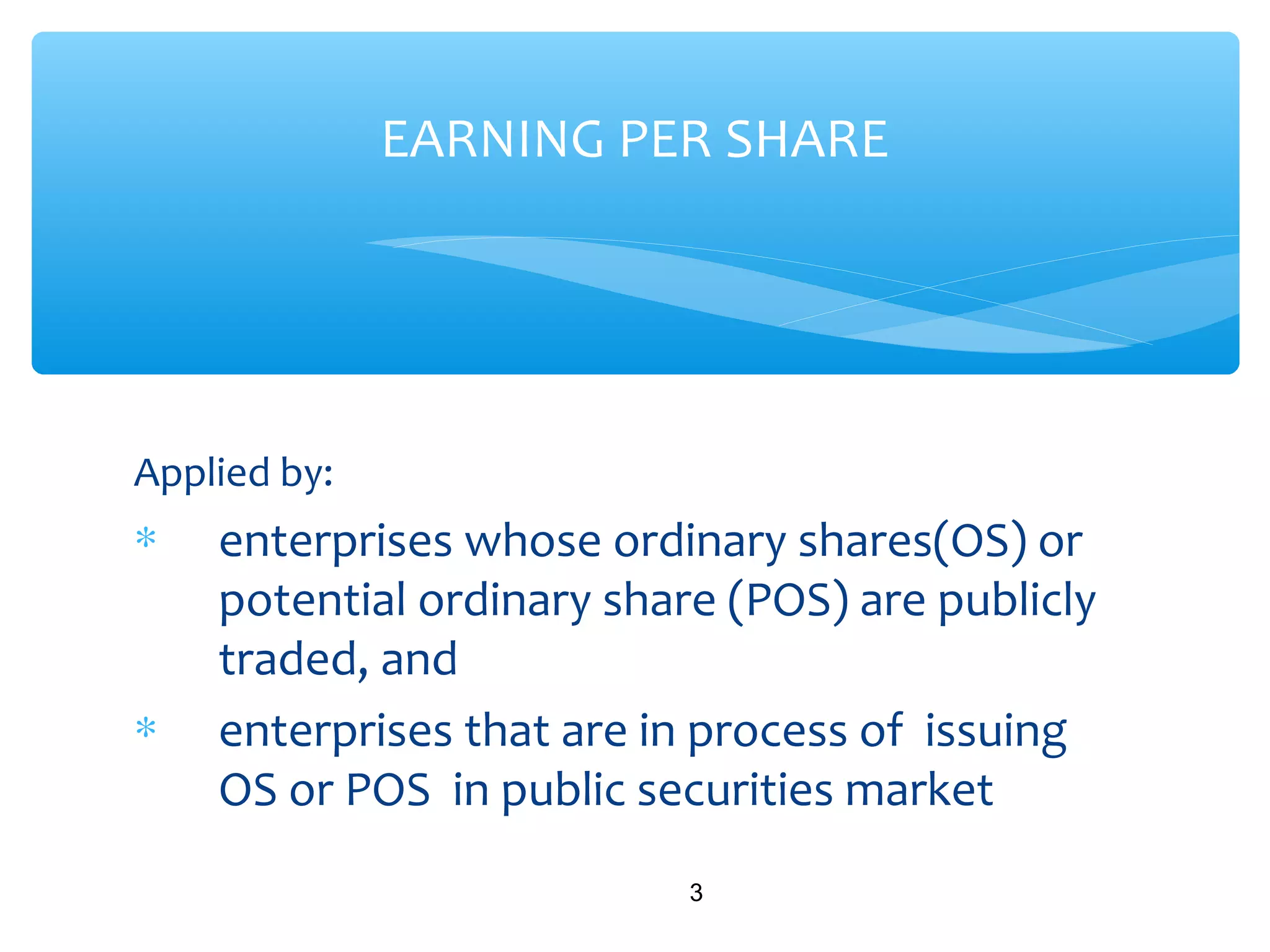
Applied by:
∗ enterprises whose ordinary shares(OS) or
potential ordinary share (POS) are publicly
traded, and
∗ enterprises that are in process of issuing
OS or POS in public securities market
3
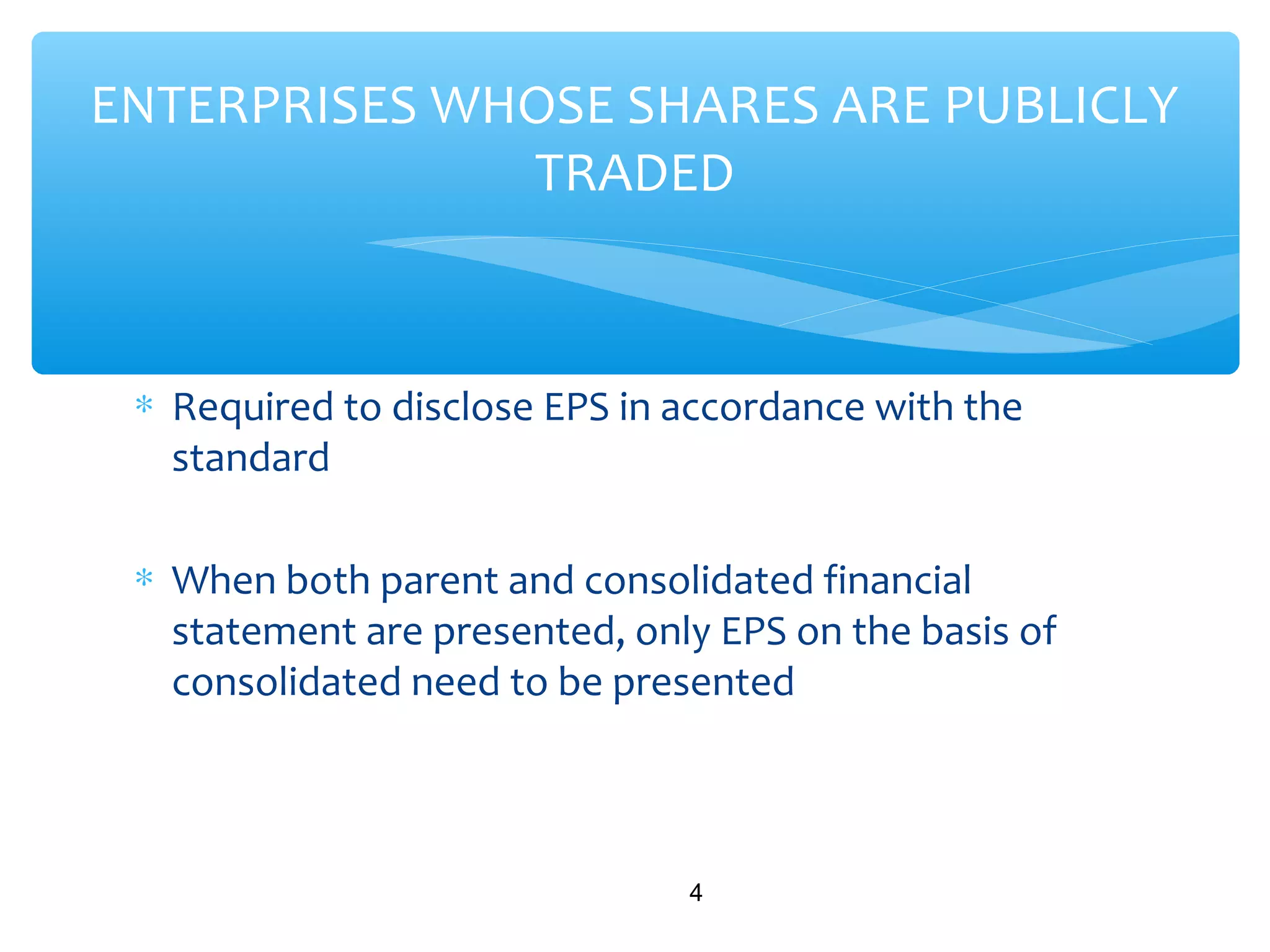
EARNING PER SHARE
∗ Required to disclose EPS in accordance with the
standard
∗ When both parent and consolidated financial
statement are presented, only EPS on the basis of
consolidated need to be presented
4
ENTERPRISES WHOSE SHARES ARE PUBLICLY
TRADED
∗ NOT required to disclosed EPS. However, if EPS is to be
disclosed, the calculation and disclosure should apply
accordance with the standard
5
ENTERPRISES WHOSE SHARES ARE NOT
PUBLICLY TRADED
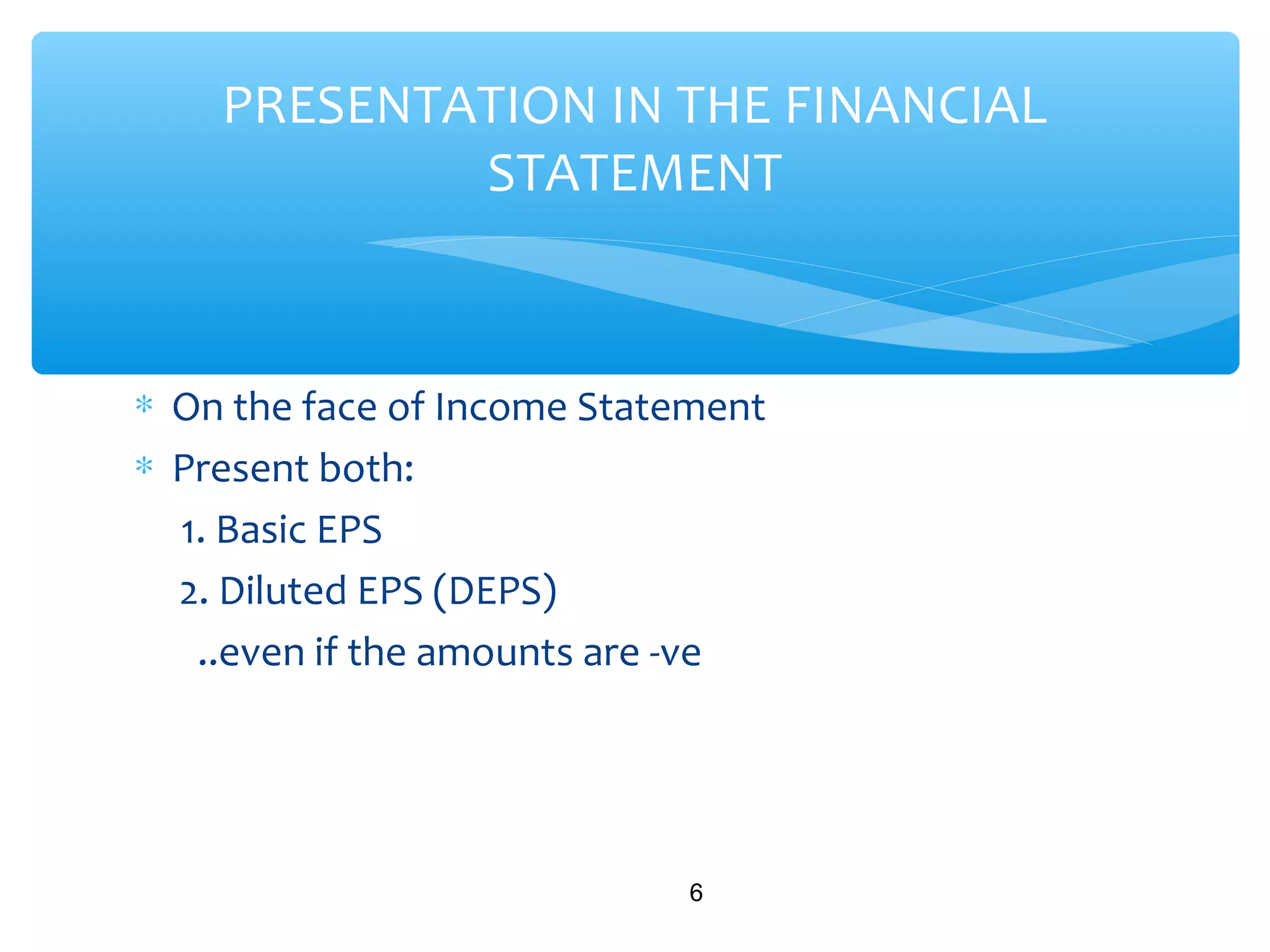
∗ On the face of Income Statement
∗ Present both:
1. Basic EPS
2. Diluted EPS (DEPS)
..even if the amounts are -ve
6
PRESENTATION IN THE FINANCIAL
STATEMENT
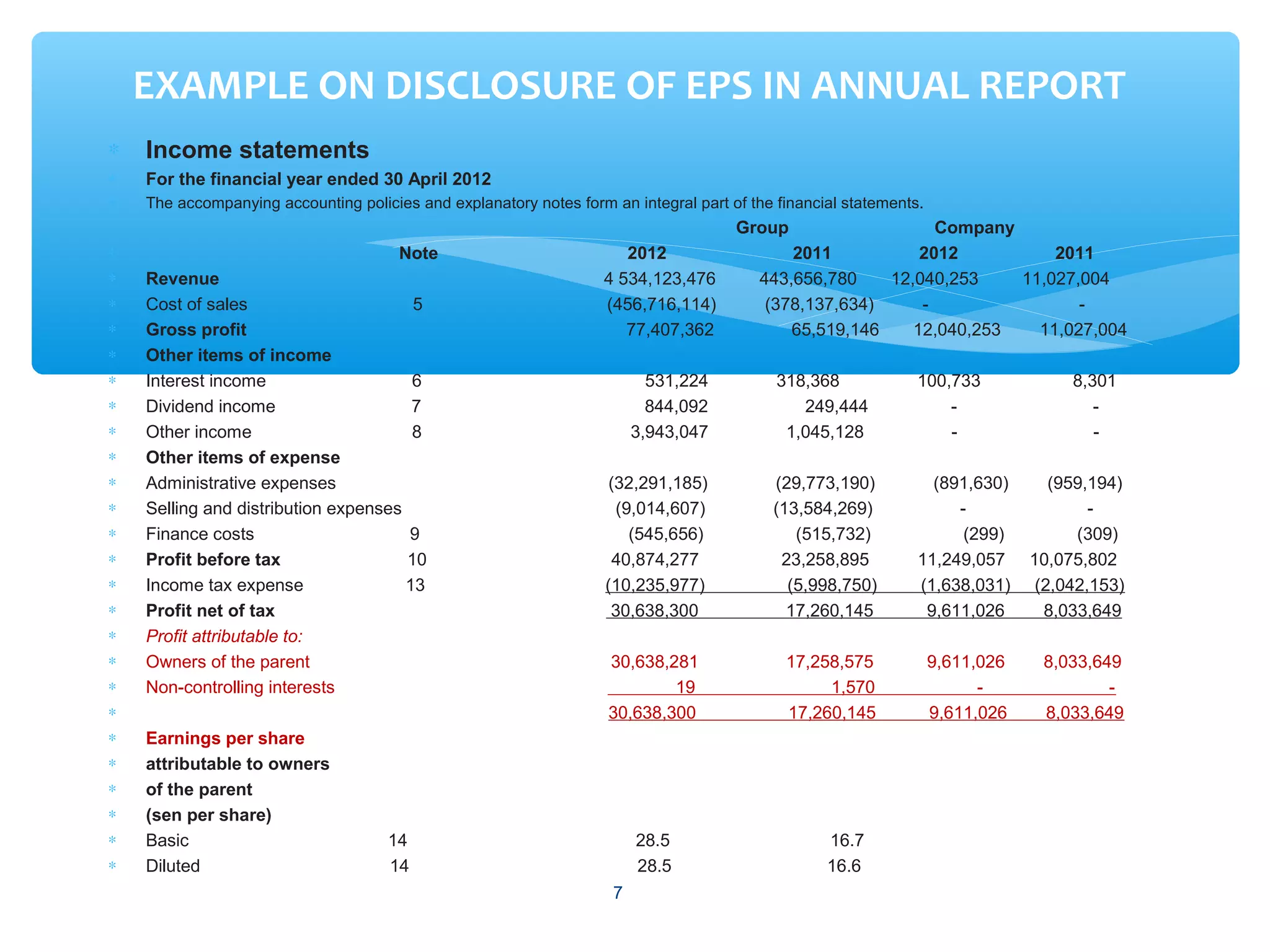
∗ Income statements
∗ For the financial year ended 30 April 2012
∗ The accompanying accounting policies and explanatory notes form an integral part of the financial statements.
Group Company
∗ Note 2012 2011 2012 2011
∗ Revenue 4 534,123,476 443,656,780 12,040,253 11,027,004
∗ Cost of sales 5 (456,716,114) (378,137,634) - -
∗ Gross profit 77,407,362 65,519,146 12,040,253 11,027,004
∗ Other items of income
∗ Interest income 6 531,224 318,368 100,733 8,301
∗ Dividend income 7 844,092 249,444 - -
∗ Other income 8 3,943,047 1,045,128 - -
∗ Other items of expense
∗ Administrative expenses (32,291,185) (29,773,190) (891,630) (959,194)
∗ Selling and distribution expenses (9,014,607) (13,584,269) - -
∗ Finance costs 9 (545,656) (515,732) (299) (309)
∗ Profit before tax 10 40,874,277 23,258,895 11,249,057 10,075,802
∗ Income tax expense 13 (10,235,977) (5,998,750) (1,638,031) (2,042,153)
∗ Profit net of tax 30,638,300 17,260,145 9,611,026 8,033,649
∗ Profit attributable to:
∗ Owners of the parent 30,638,281 17,258,575 9,611,026 8,033,649
∗ Non-controlling interests 19 1,570 - -
∗ 30,638,300 17,260,145 9,611,026 8,033,649
∗ Earnings per share
∗ attributable to owners
∗ of the parent
∗ (sen per share)
∗ Basic 14 28.5 16.7
∗ Diluted 14 28.5 16.6
EXAMPLE ON DISCLOSURE OF EPS IN ANNUAL REPORT
7
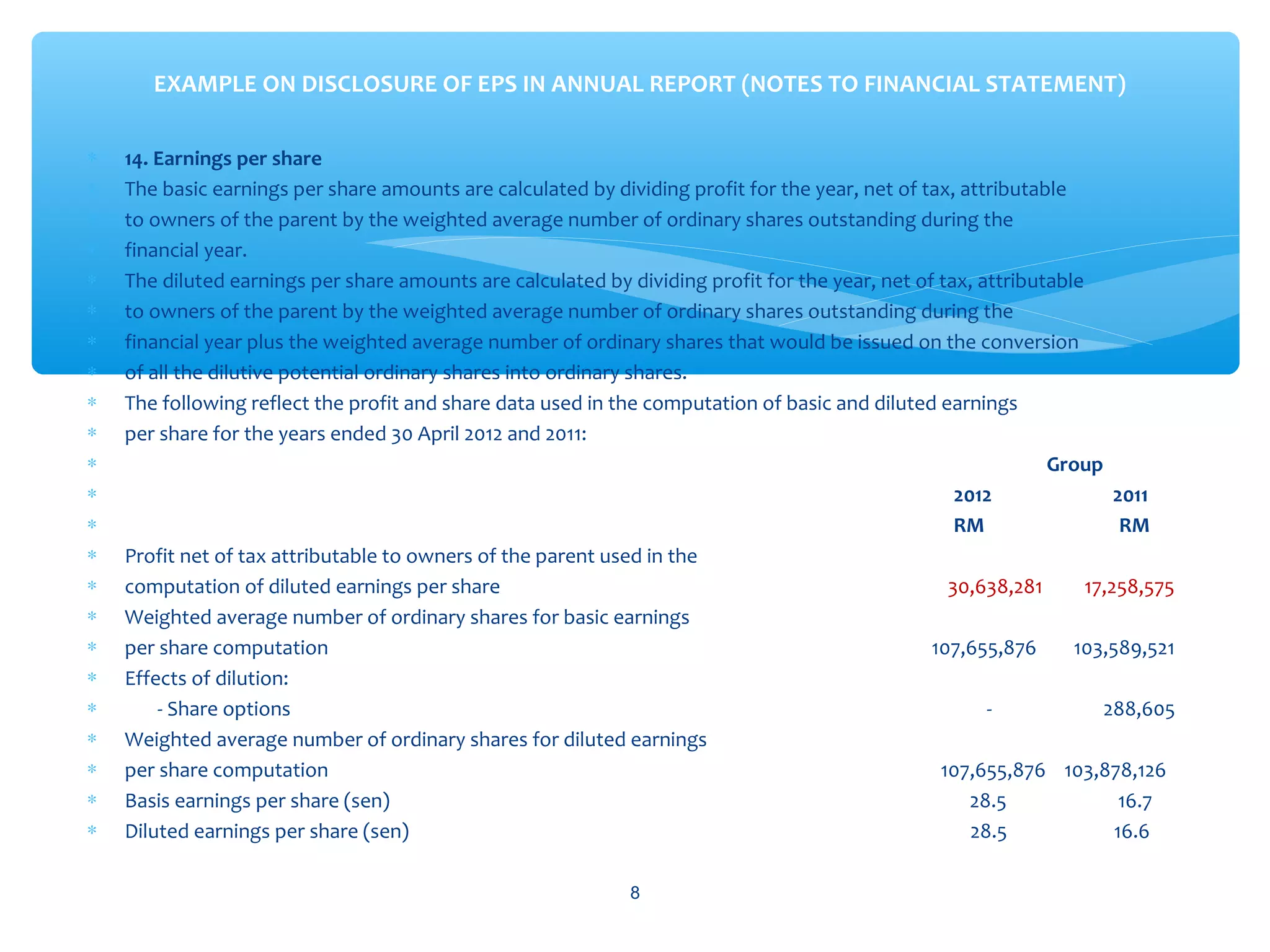
∗ 14. Earnings per share
∗ The basic earnings per share amounts are calculated by dividing profit for the year, net of tax, attributable
∗ to owners of the parent by the weighted average number of ordinary shares outstanding during the
∗ financial year.
∗ The diluted earnings per share amounts are calculated by dividing profit for the year, net of tax, attributable
∗ to owners of the parent by the weighted average number of ordinary shares outstanding during the
∗ financial year plus the weighted average number of ordinary shares that would be issued on the conversion
∗ of all the dilutive potential ordinary shares into ordinary shares.
∗ The following reflect the profit and share data used in the computation of basic and diluted earnings
∗ per share for the years ended 30 April 2012 and 2011:
∗ Group
∗ 2012 2011
∗ RM RM
∗ Profit net of tax attributable to owners of the parent used in the
∗ computation of diluted earnings per share 30,638,281 17,258,575
∗ Weighted average number of ordinary shares for basic earnings
∗ per share computation 107,655,876 103,589,521
∗ Effects of dilution:
∗ - Share options - 288,605
∗ Weighted average number of ordinary shares for diluted earnings
∗ per share computation 107,655,876 103,878,126
∗ Basis earnings per share (sen) 28.5 16.7
∗ Diluted earnings per share (sen) 28.5 16.6
EXAMPLE ON DISCLOSURE OF EPS IN ANNUAL REPORT (NOTES TO FINANCIAL STATEMENT)
8
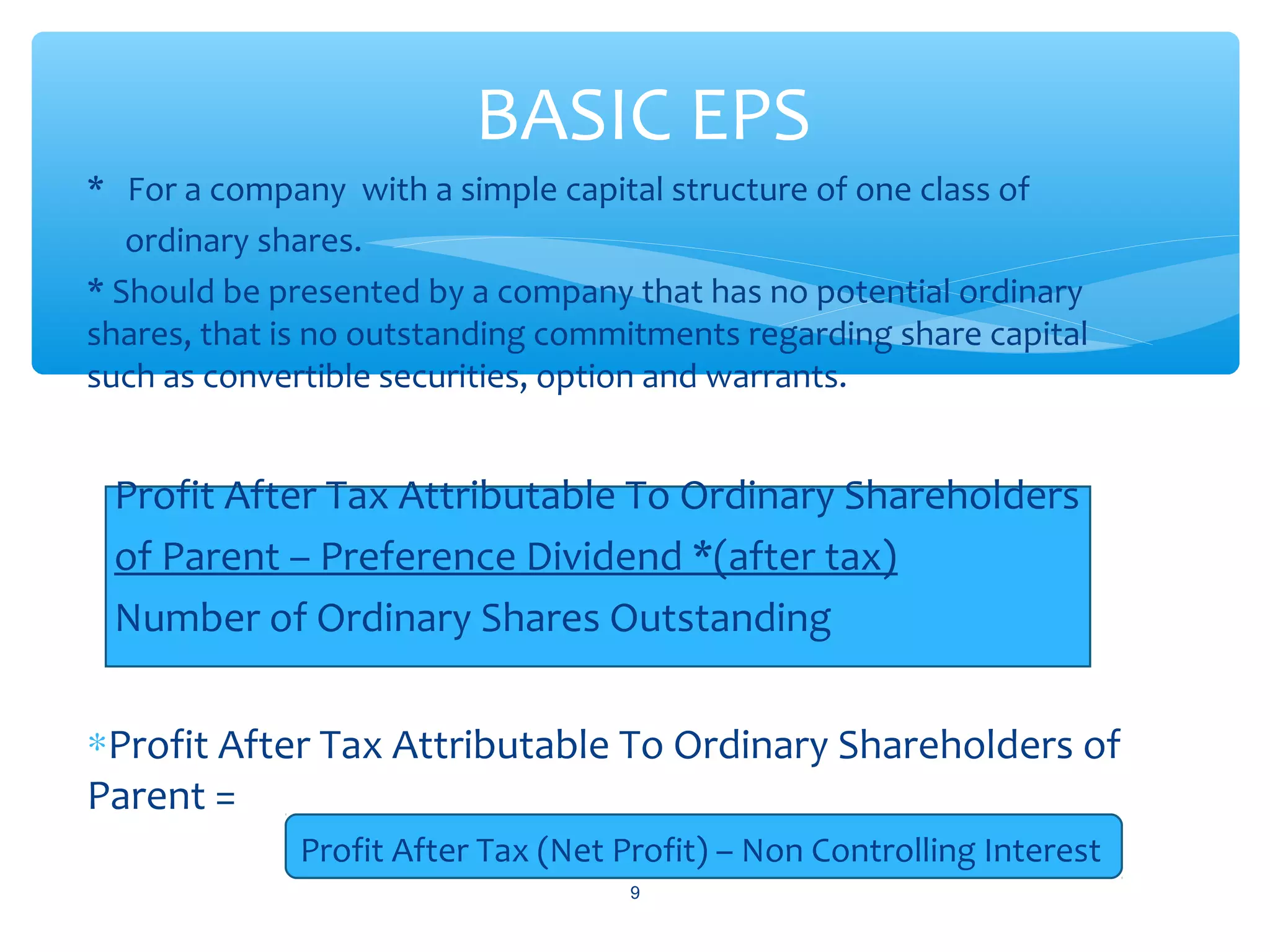
* For a company with a simple capital structure of one class of
ordinary shares.
* Should be presented by a company that has no potential ordinary
shares, that is no outstanding commitments regarding share capital
such as convertible securities, option and warrants.
Profit After Tax Attributable To Ordinary Shareholders
of Parent – Preference Dividend *(after tax)
Number of Ordinary Shares Outstanding
∗Profit After Tax Attributable To Ordinary Shareholders of
Parent =
Profit After Tax (Net Profit) – Non Controlling Interest
9
BASIC EPS
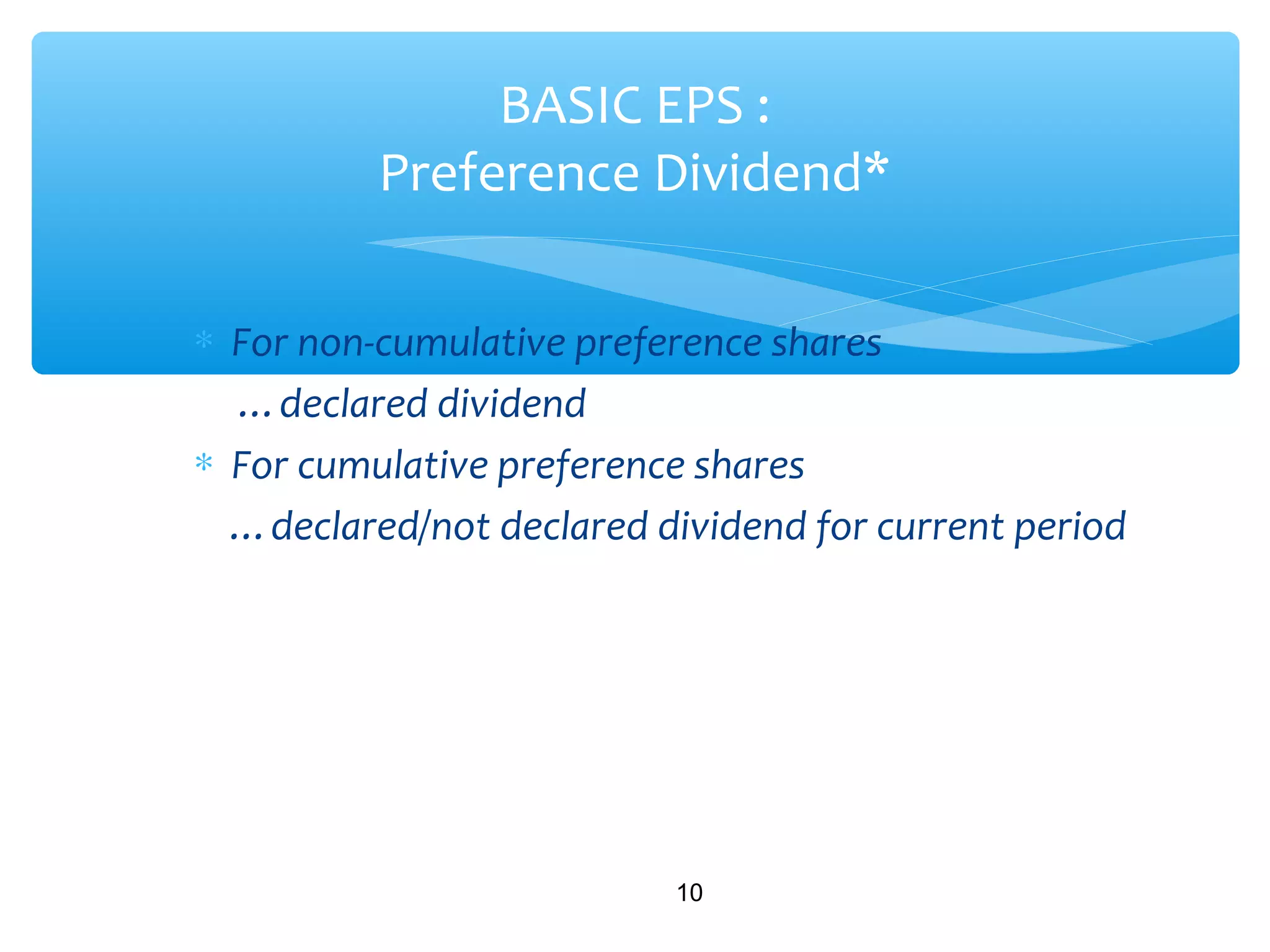
∗ For non-cumulative preference shares
…declared dividend
∗ For cumulative preference shares
…declared/not declared dividend for current period
10
BASIC EPS :
Preference Dividend*
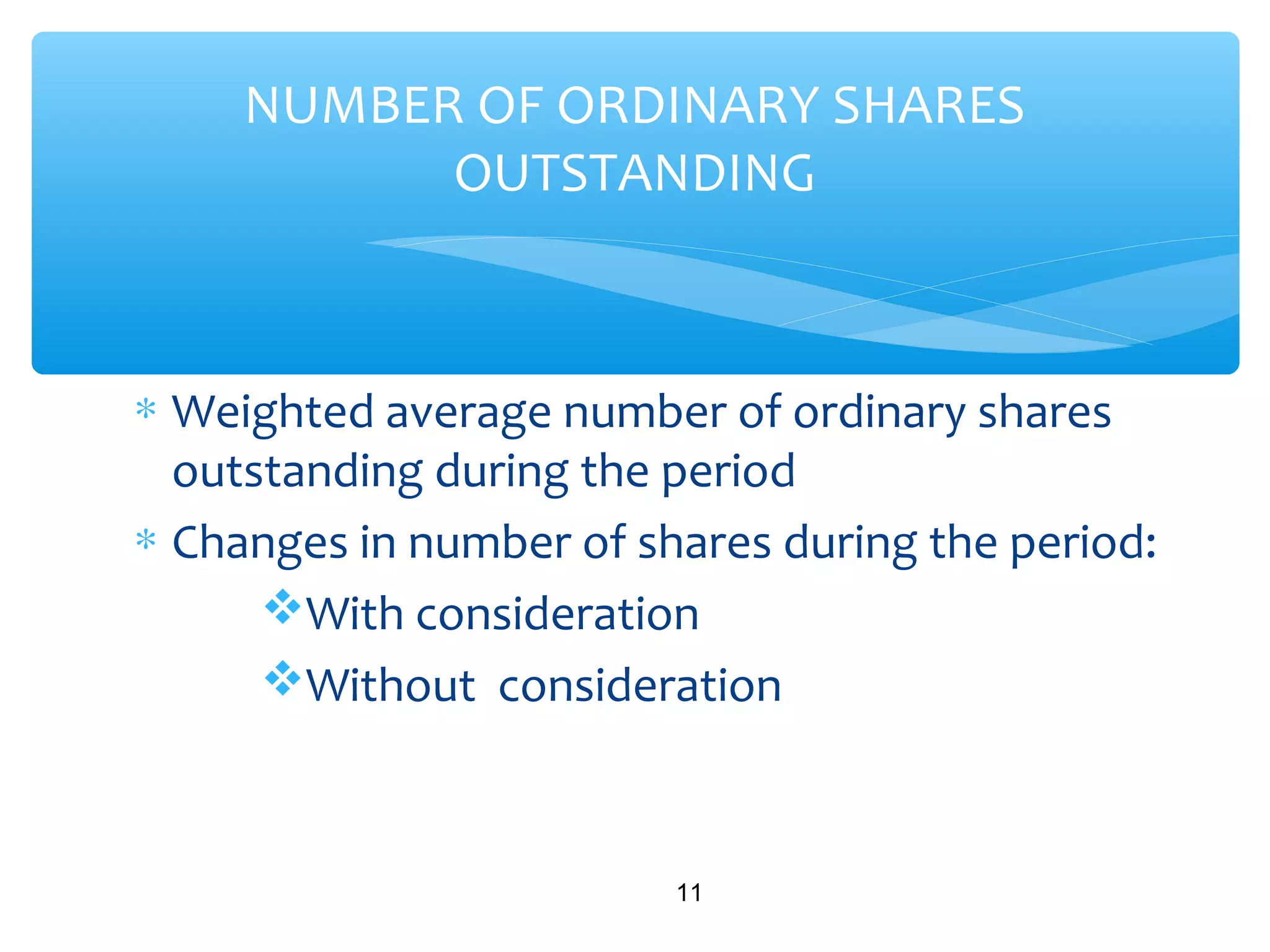
∗ Weighted average number of ordinary shares
outstanding during the period
∗ Changes in number of shares during the period:
With consideration
Without consideration
11
NUMBER OF ORDINARY SHARES
OUTSTANDING
∗ There have a changes in resources (increase
or inflow of net asset) :
a) New shares issue for cash
b) Shares buy back
** number of OS are adjusted for the new shares issued
and share buy back on a time proportionate basis.
12
CHANGES IN NUMBER OF SHARE
..WITH CONSIDERATION
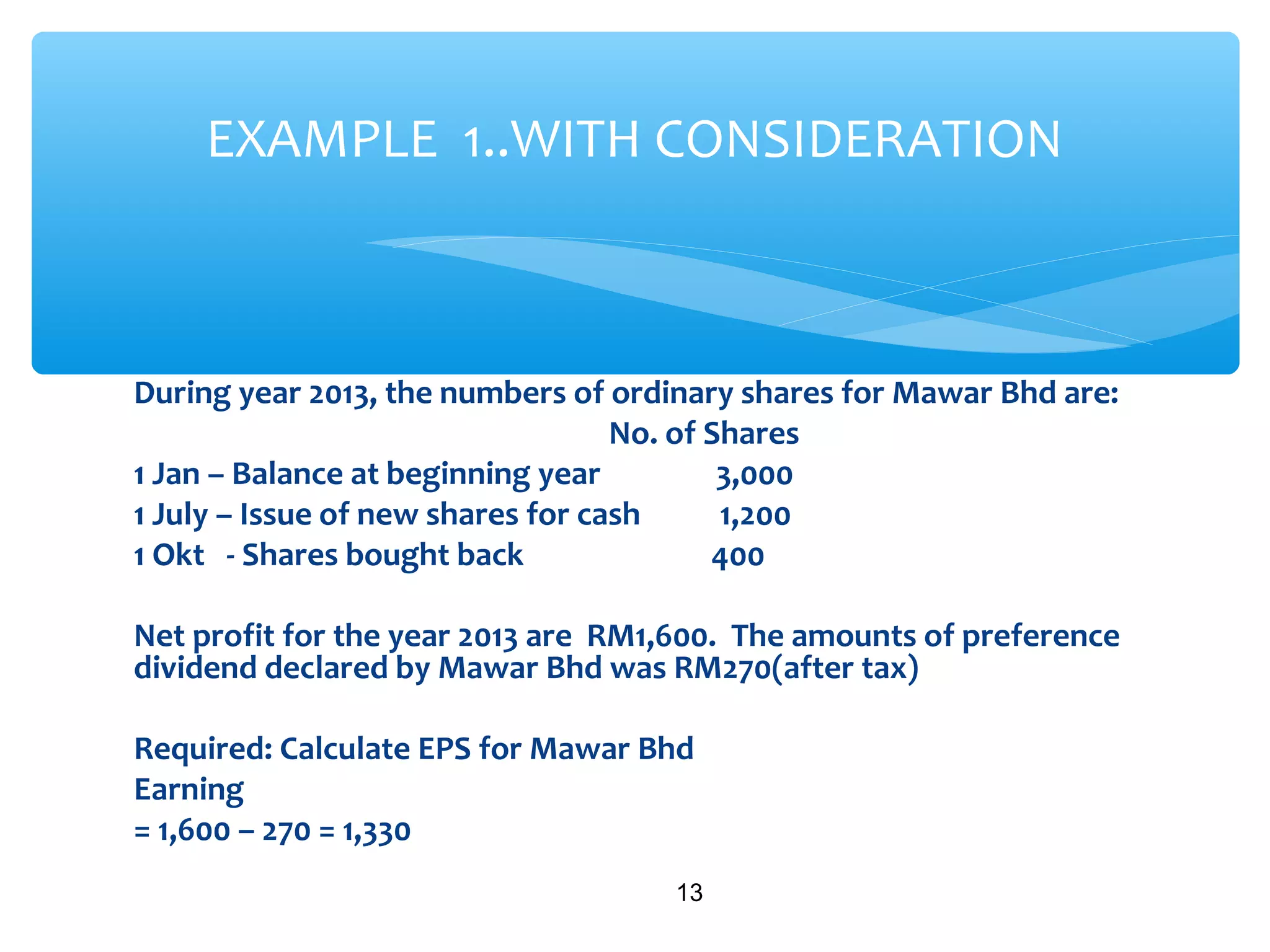
During year 2013, the numbers of ordinary shares for Mawar Bhd are:
No. of Shares
1 Jan – Balance at beginning year 3,000
1 July – Issue of new shares for cash 1,200
1 Okt - Shares bought back 400
Net profit for the year 2013 are RM1,600. The amounts of preference
dividend declared by Mawar Bhd was RM270(after tax)
Required: Calculate EPS for Mawar Bhd
Earning
= 1,600 – 270 = 1,330
13
EXAMPLE 1..WITH CONSIDERATION
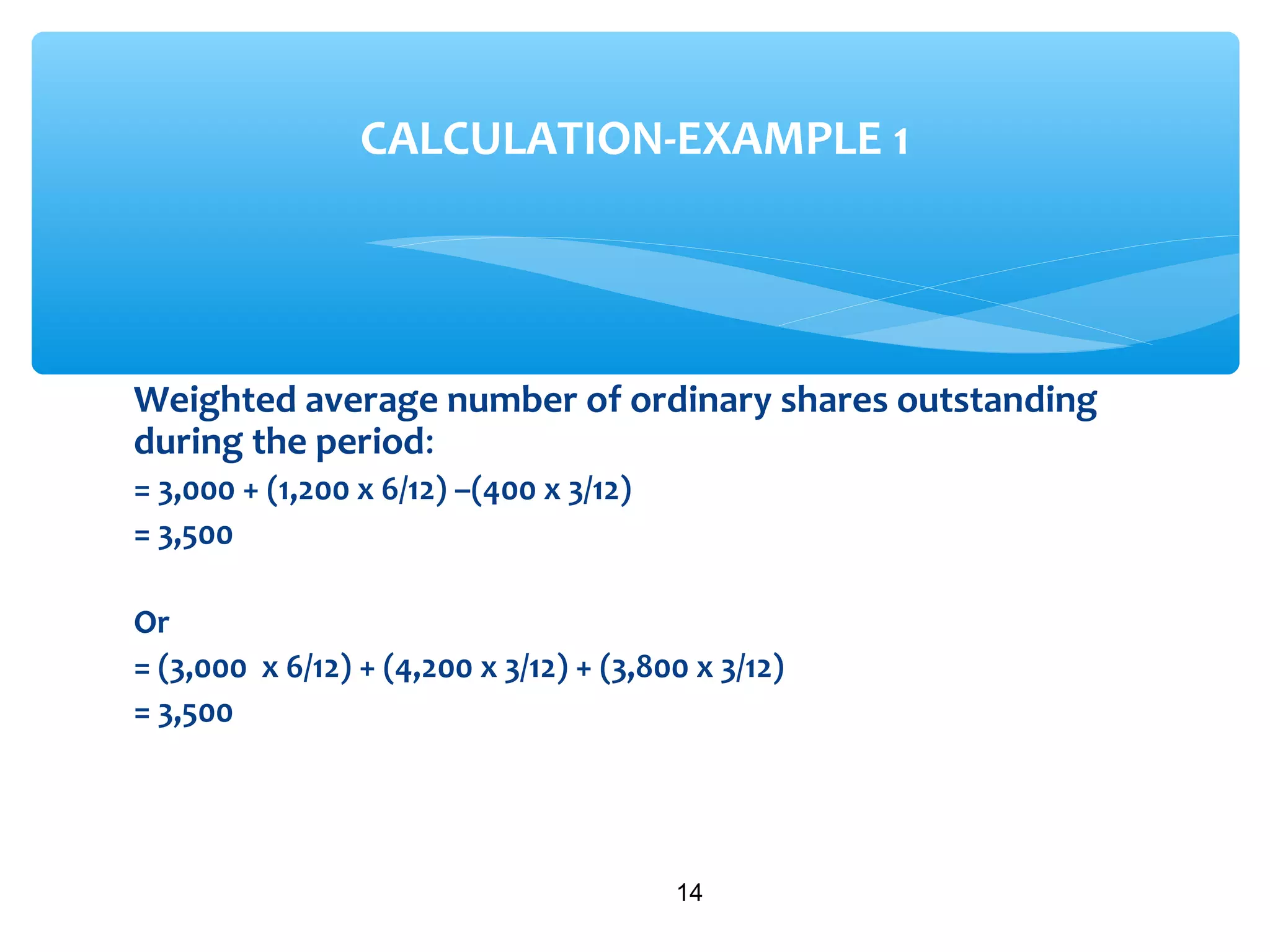
Weighted average number of ordinary shares outstanding
during the period:
= 3,000 + (1,200 x 6/12) –(400 x 3/12)
= 3,500
Or
= (3,000 x 6/12) + (4,200 x 3/12) + (3,800 x 3/12)
= 3,500
14
CALCULATION-EXAMPLE 1
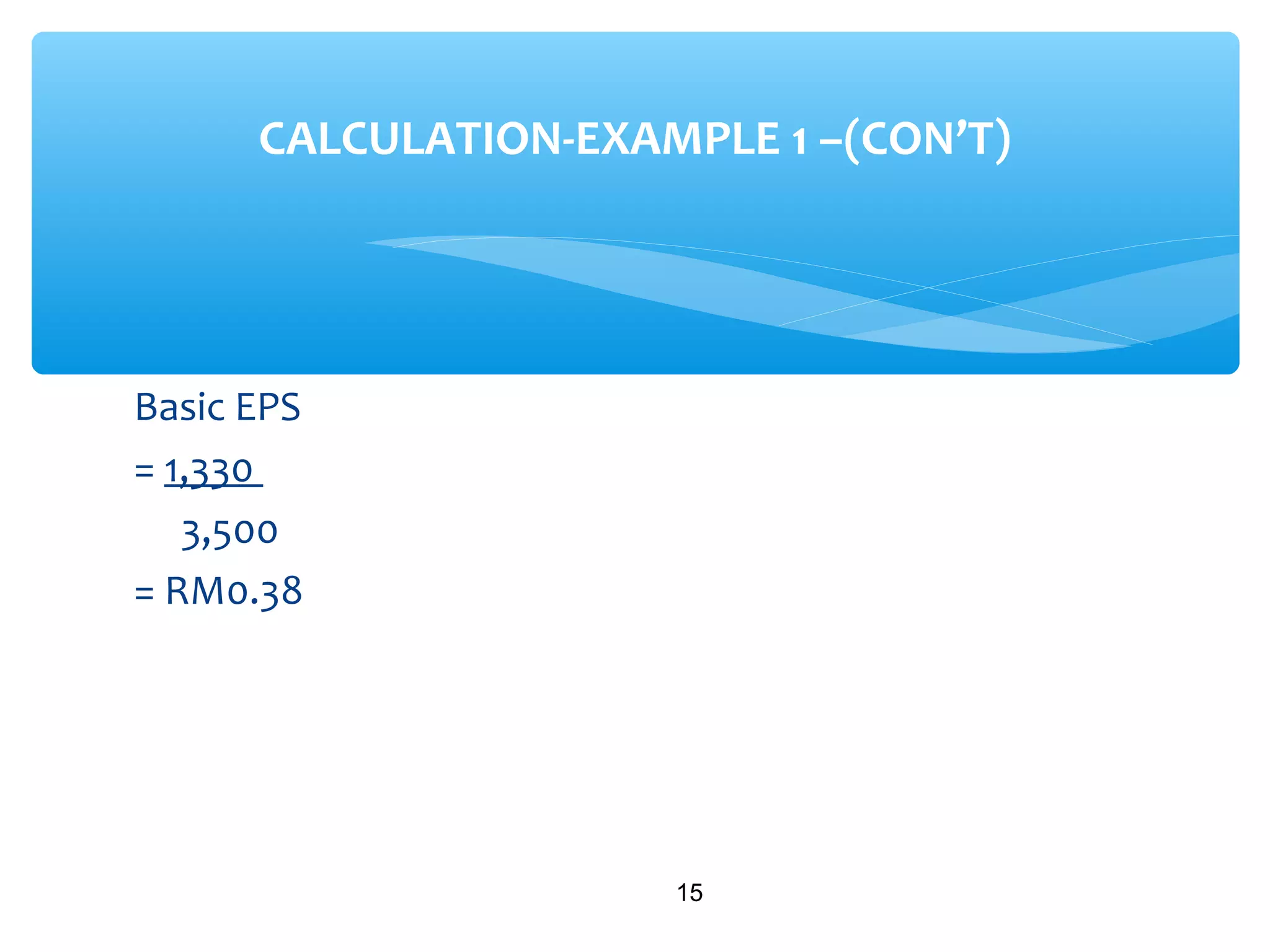
Basic EPS
= 1,330
3,500
= RM0.38
15
CALCULATION-EXAMPLE 1 –(CON’T)
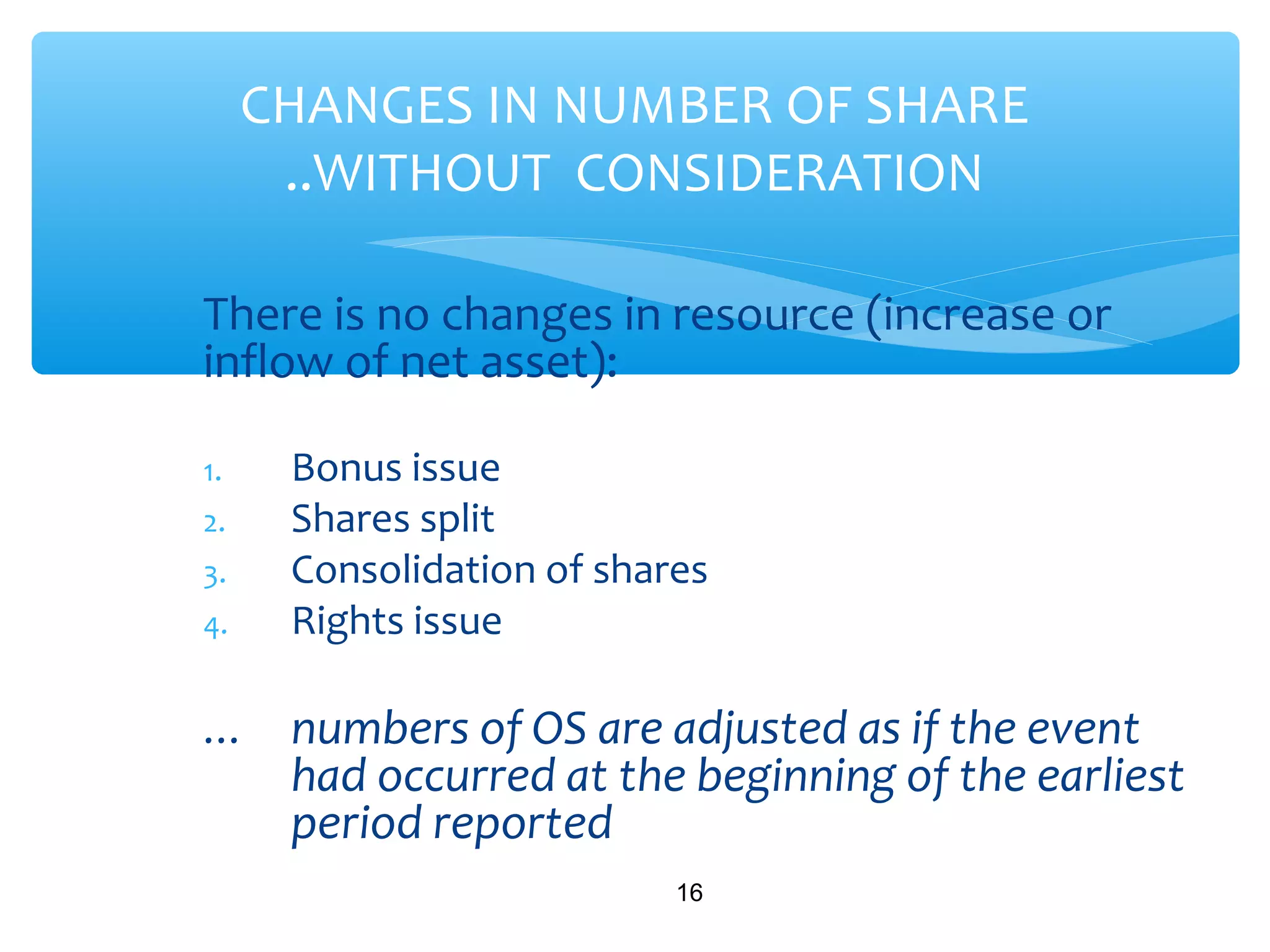
There is no changes in resource (increase or
inflow of net asset):
1. Bonus issue
2. Shares split
3. Consolidation of shares
4. Rights issue
… numbers of OS are adjusted as if the event
had occurred at the beginning of the earliest
period reported
16
CHANGES IN NUMBER OF SHARE
..WITHOUT CONSIDERATION
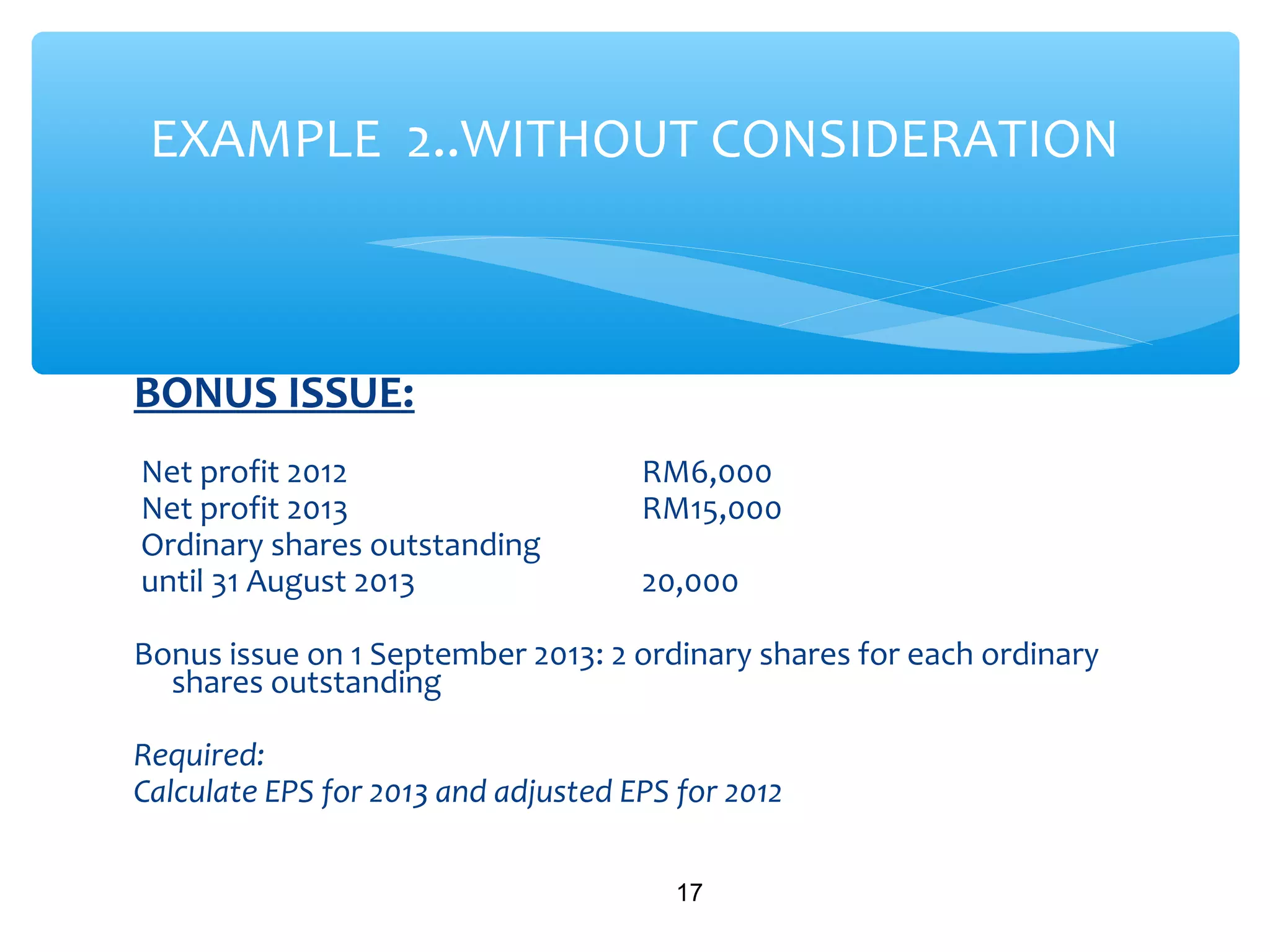
BONUS ISSUE:
Net profit 2012 RM6,000
Net profit 2013 RM15,000
Ordinary shares outstanding
until 31 August 2013 20,000
Bonus issue on 1 September 2013: 2 ordinary shares for each ordinary
shares outstanding
Required:
Calculate EPS for 2013 and adjusted EPS for 2012
17
EXAMPLE 2..WITHOUT CONSIDERATION
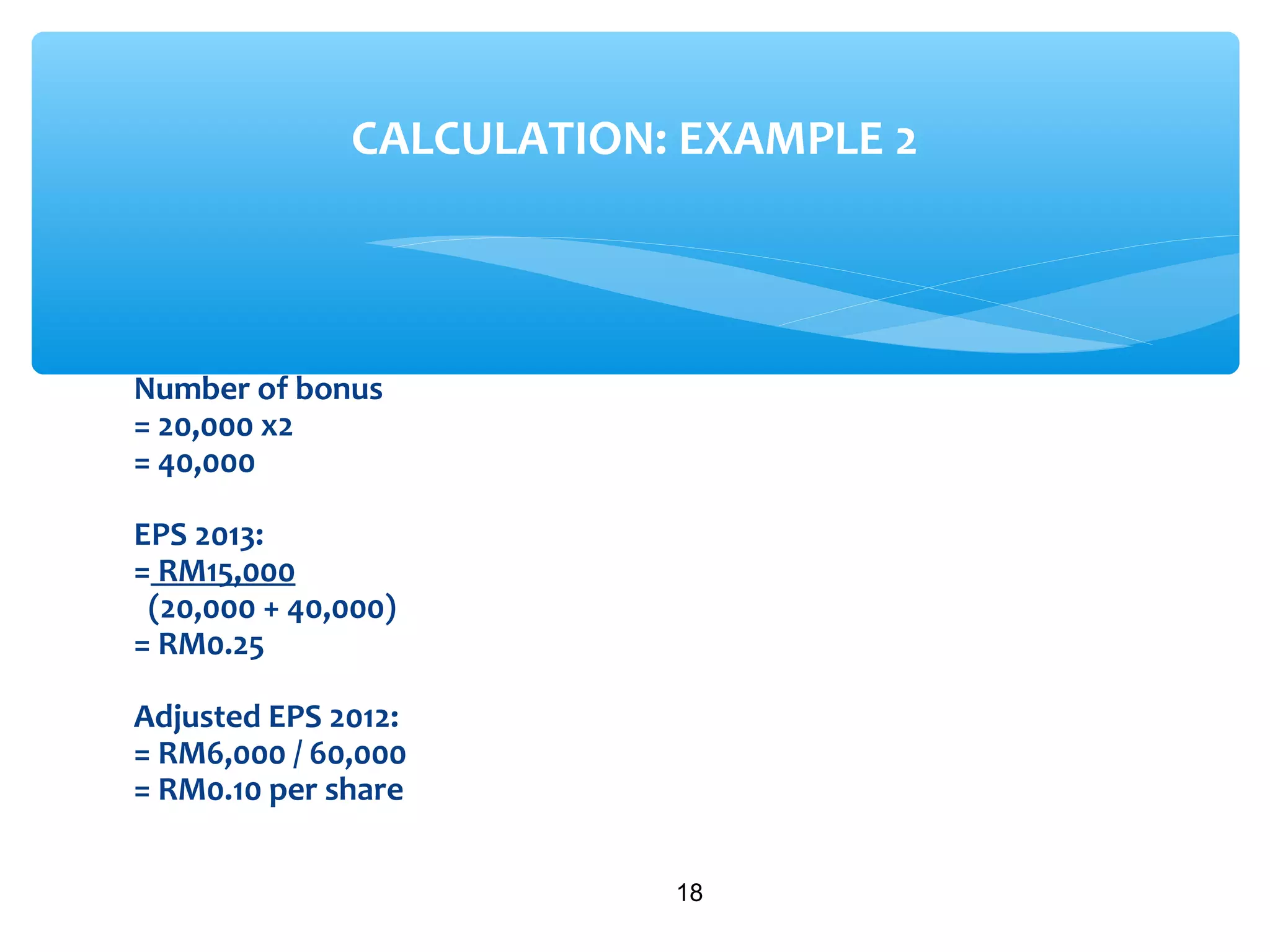
Number of bonus
= 20,000 x2
= 40,000
EPS 2013:
= RM15,000
(20,000 + 40,000)
= RM0.25
Adjusted EPS 2012:
= RM6,000 / 60,000
= RM0.10 per share
18
CALCULATION: EXAMPLE 2
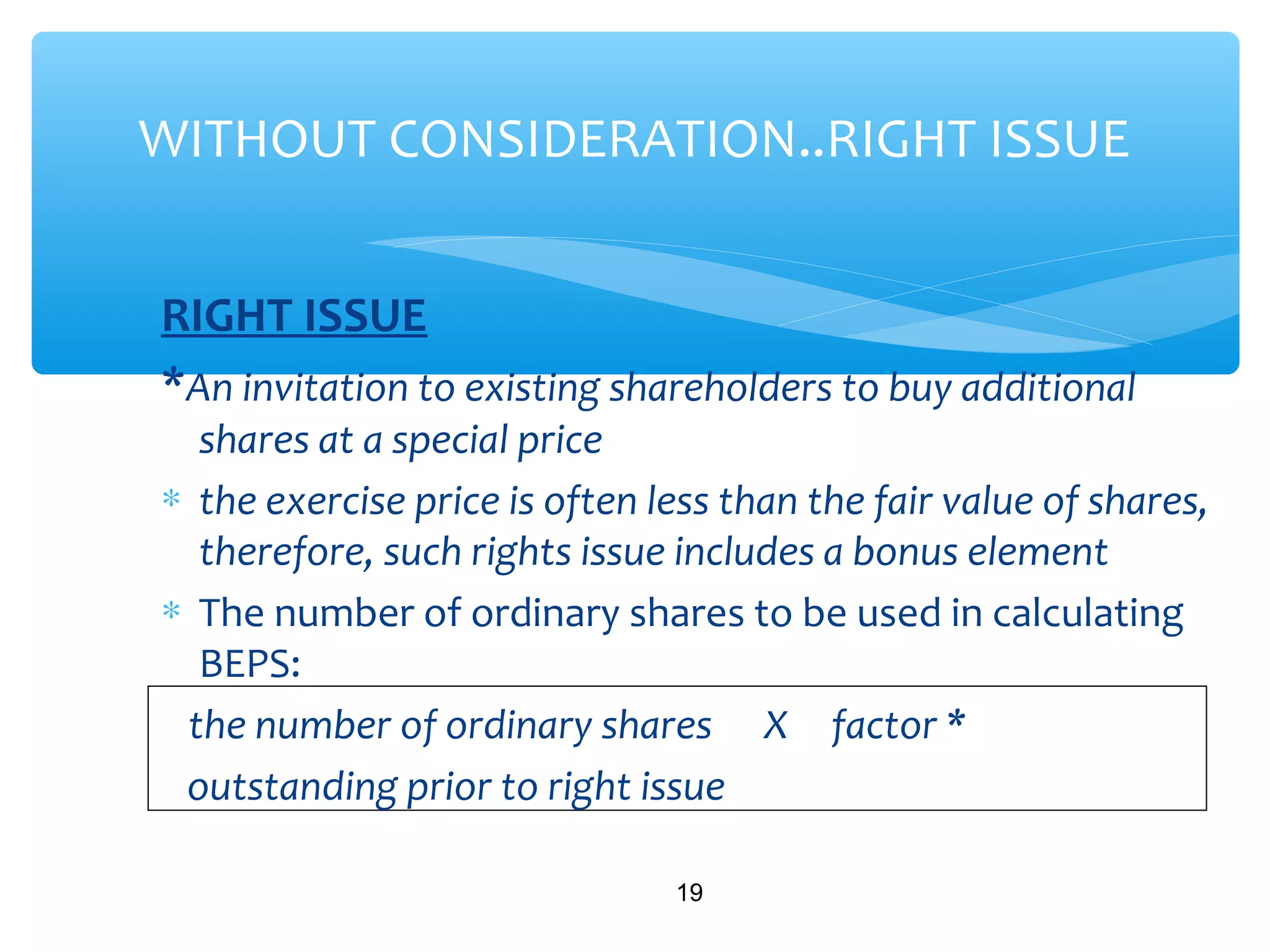
RIGHT ISSUE
*An invitation to existing shareholders to buy additional
shares at a special price
∗ the exercise price is often less than the fair value of shares,
therefore, such rights issue includes a bonus element
∗ The number of ordinary shares to be used in calculating
BEPS:
the number of ordinary shares X factor *
outstanding prior to right issue
19
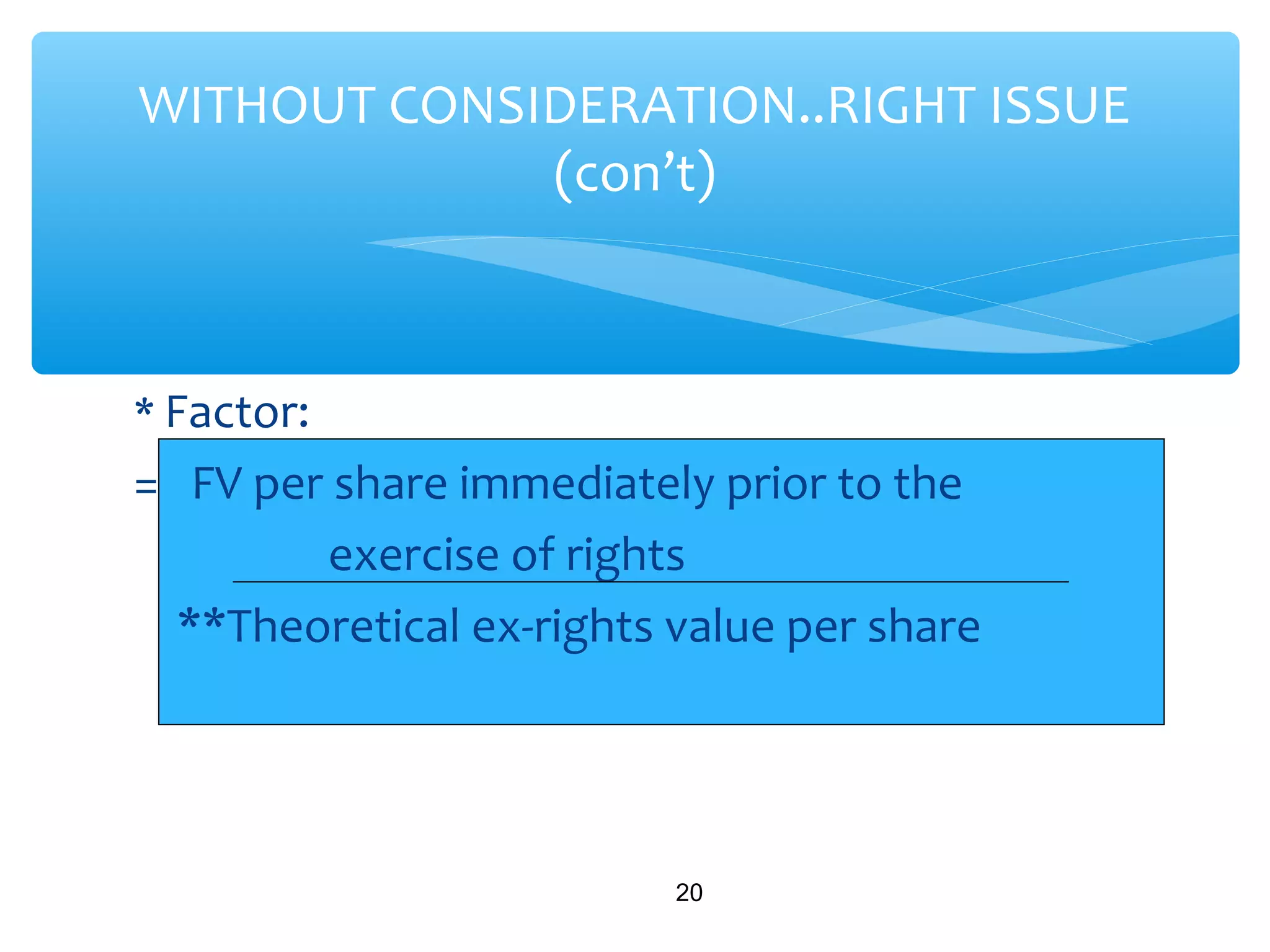
WITHOUT CONSIDERATION..RIGHT ISSUE
* Factor:
= FV per share immediately prior to the
exercise of rights
**Theoretical ex-rights value per share
20
WITHOUT CONSIDERATION..RIGHT ISSUE
(con’t)
**Theoretical ex-rights value per share :
(Number of Shares before the Rights Issue X ‘Cum right price) +
( Number of Shares Issued under the rights issue X Exercise Price)
Number of Share After the Right Issue
(Number of Share Outstanding before the rights Issue +
Number of Share Issued in the Exercise)
21
WITHOUT CONSIDERATION..
RIGHT ISSUE (con’t)
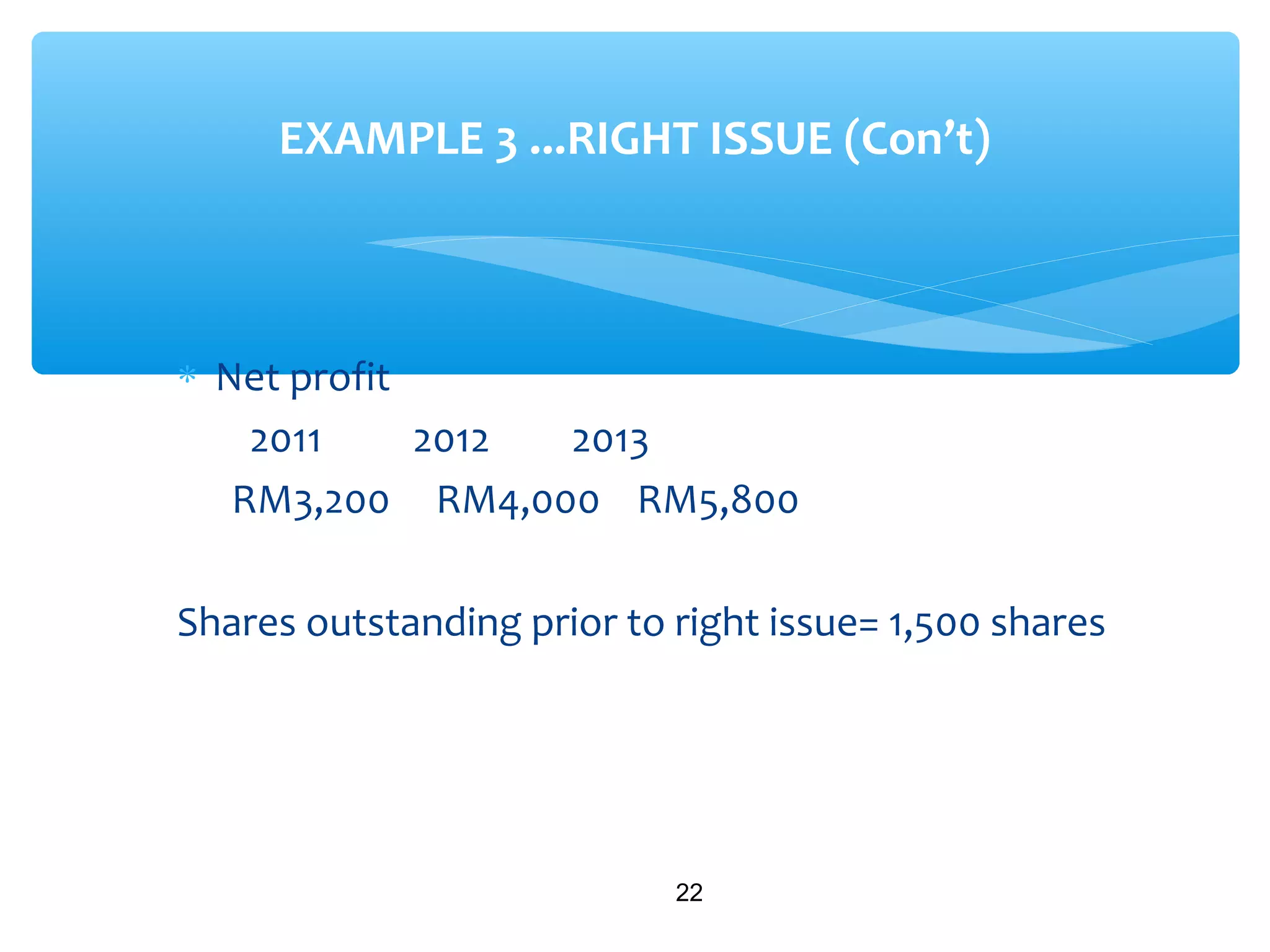
∗ Net profit
2011 2012 2013
RM3,200 RM4,000 RM5,800
Shares outstanding prior to right issue= 1,500 shares
22
EXAMPLE 3 ...RIGHT ISSUE (Con’t)
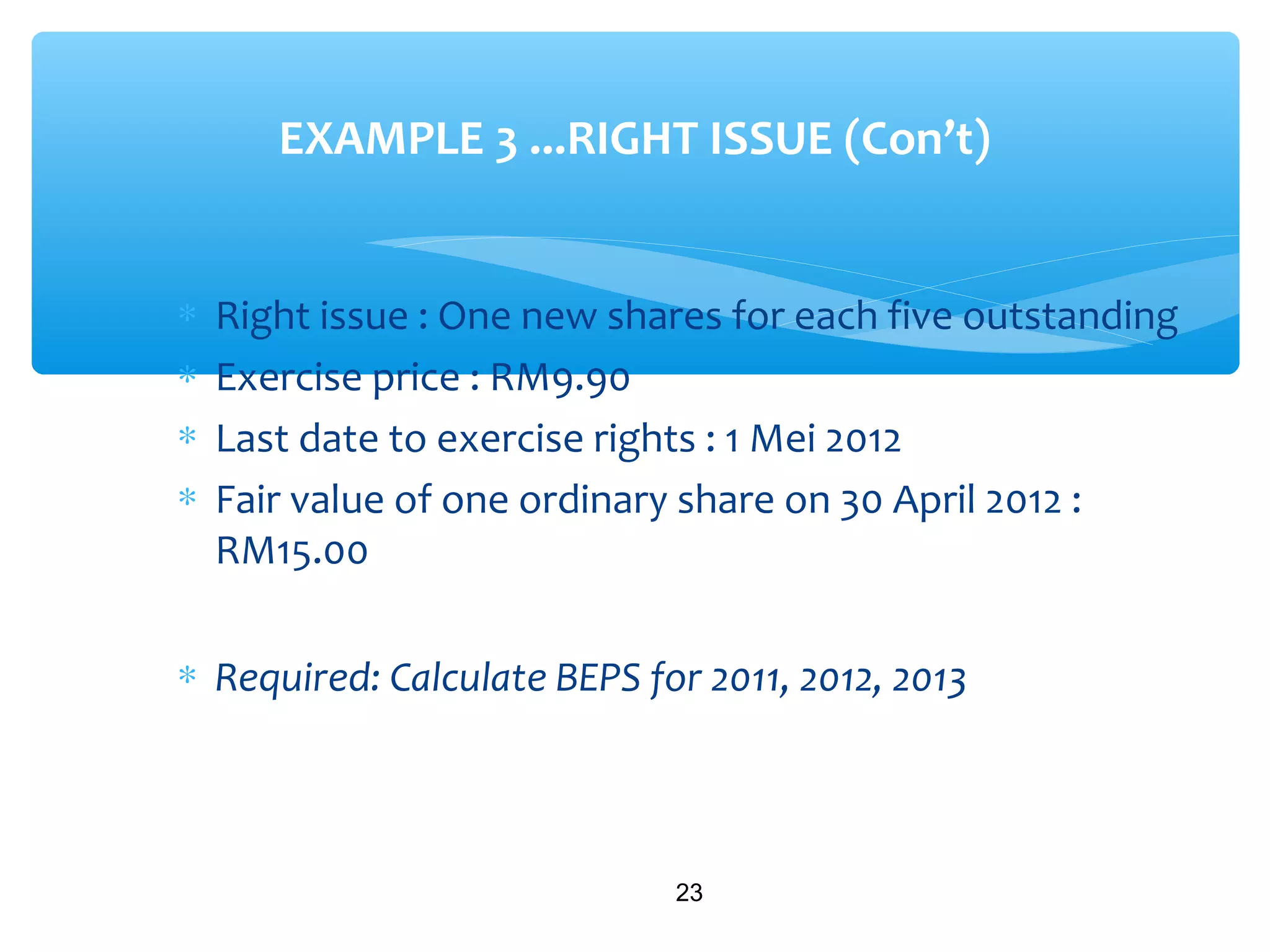
∗ Right issue : One new shares for each five outstanding
∗ Exercise price : RM9.90
∗ Last date to exercise rights : 1 Mei 2012
∗ Fair value of one ordinary share on 30 April 2012 :
RM15.00
∗ Required: Calculate BEPS for 2011, 2012, 2013
23
EXAMPLE 3 ...RIGHT ISSUE (Con’t)
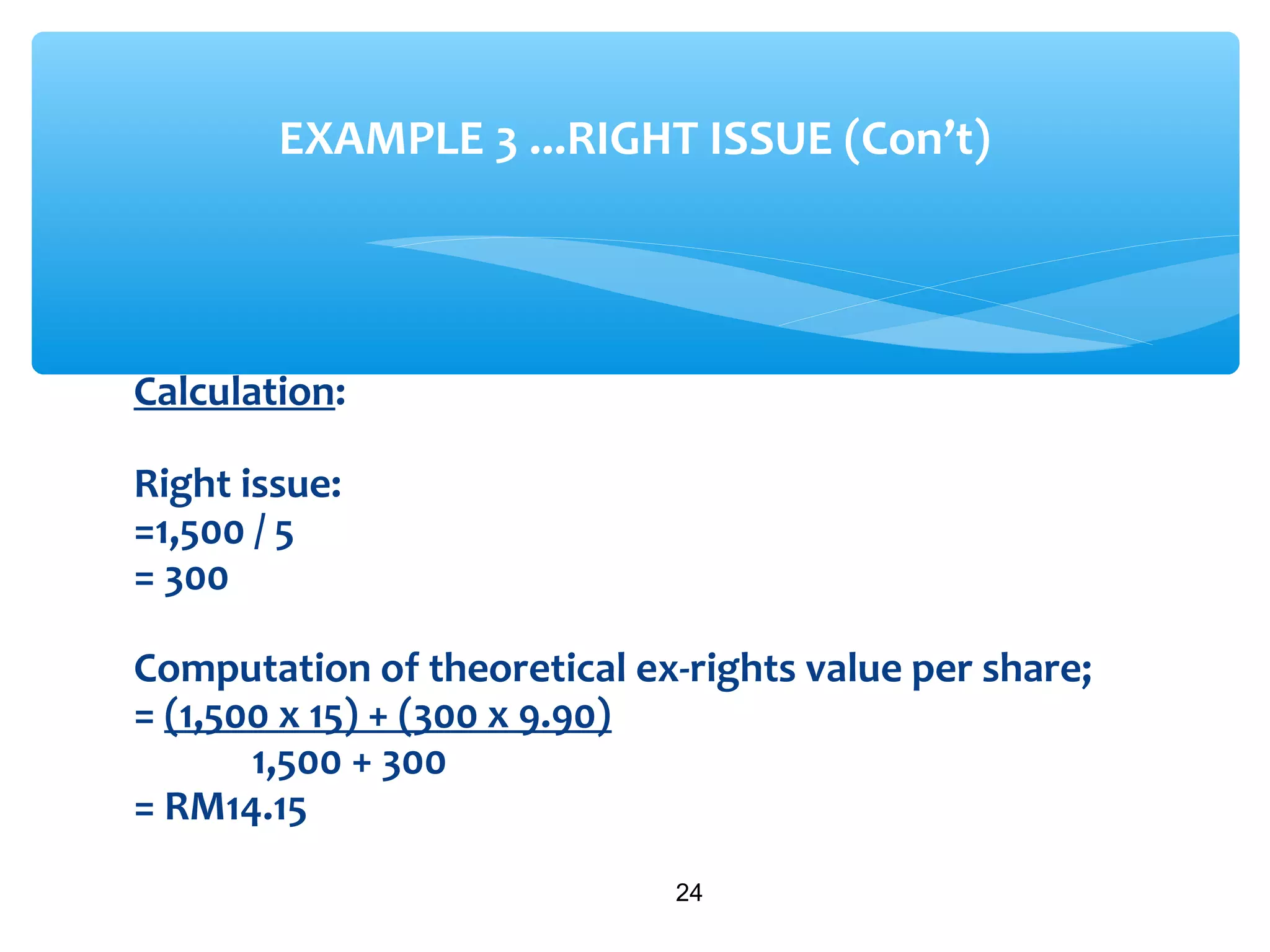
Calculation:
Right issue:
=1,500 / 5
= 300
Computation of theoretical ex-rights value per share;
= (1,500 x 15) + (300 x 9.90)
1,500 + 300
= RM14.15
24
EXAMPLE 3 ...RIGHT ISSUE (Con’t)
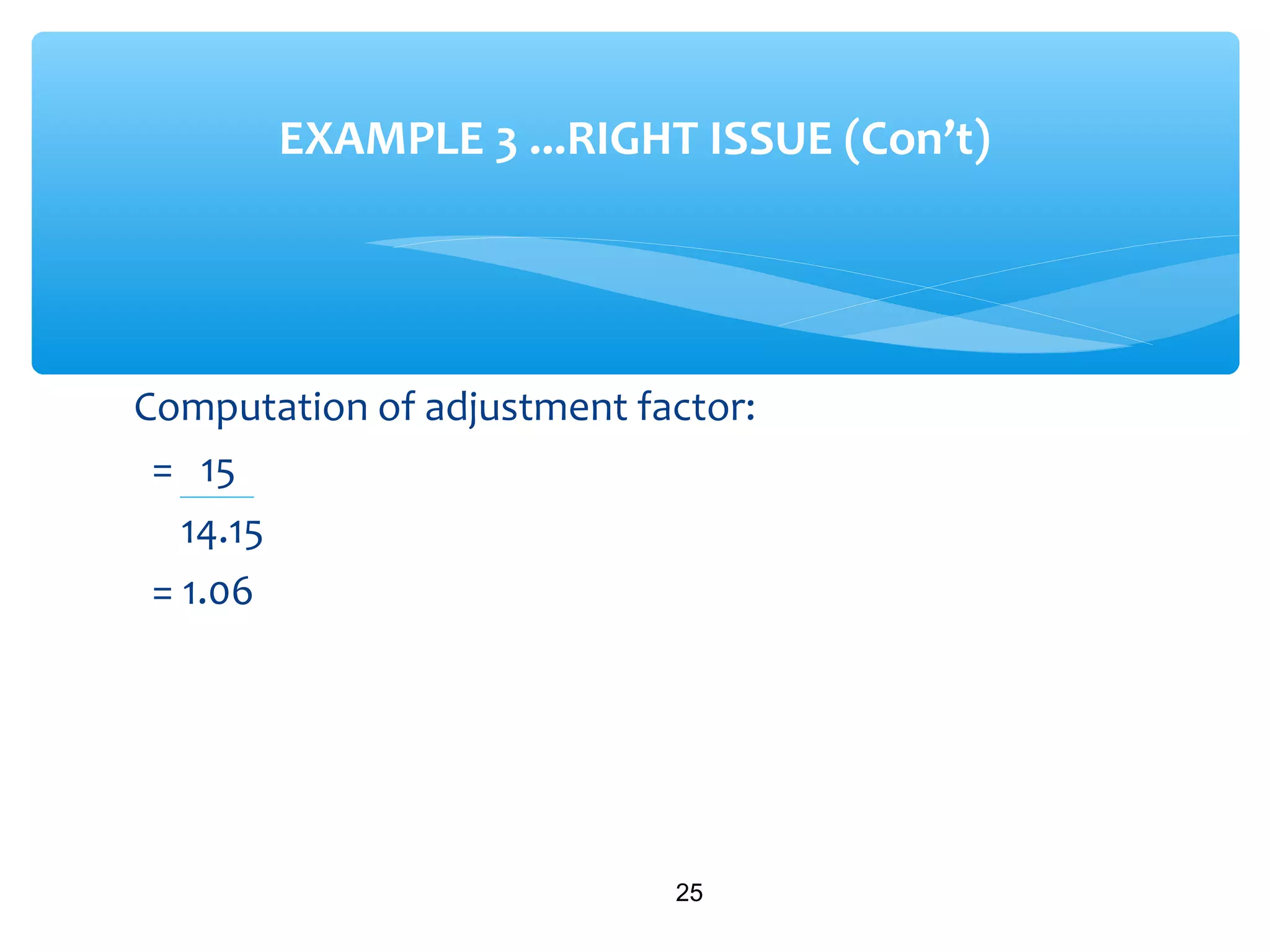
Computation of adjustment factor:
= 15
14.15
= 1.06
25
EXAMPLE 3 ...RIGHT ISSUE (Con’t)
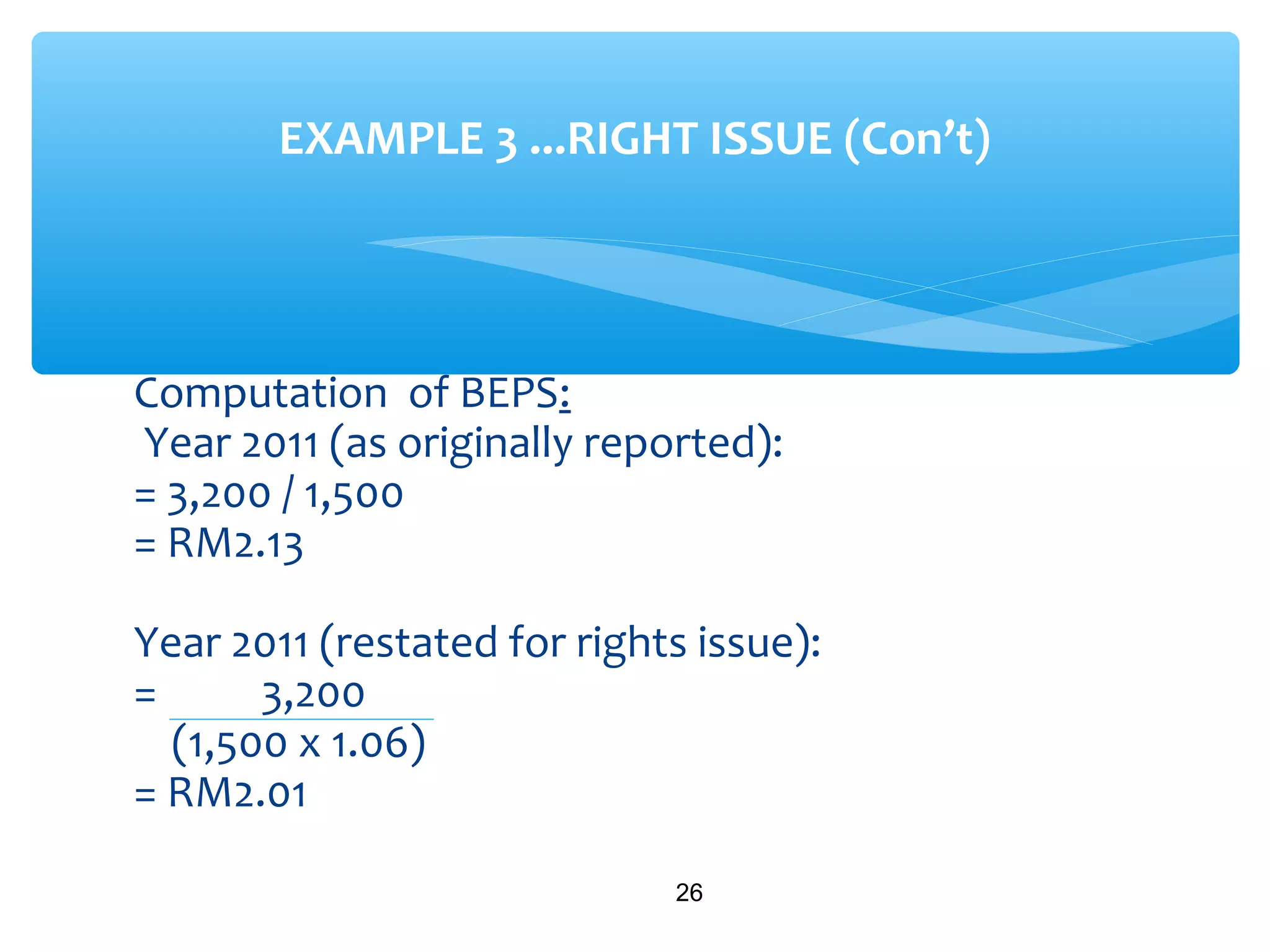
Computation of BEPS:
Year 2011 (as originally reported):
= 3,200 / 1,500
= RM2.13
Year 2011 (restated for rights issue):
= 3,200
(1,500 x 1.06)
= RM2.01
26
EXAMPLE 3 ...RIGHT ISSUE (Con’t)
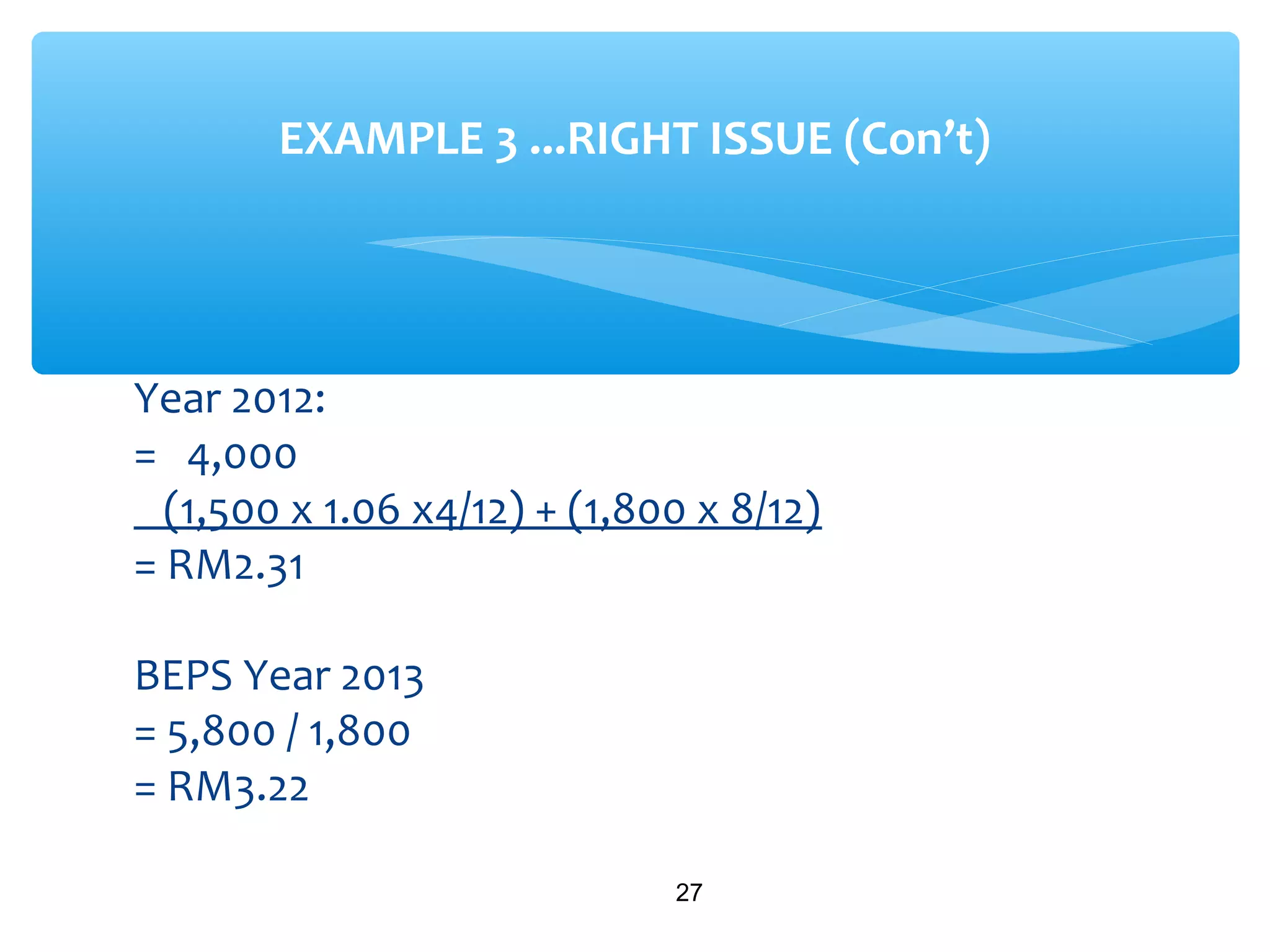
Year 2012:
= 4,000
(1,500 x 1.06 x4/12) + (1,800 x 8/12)
= RM2.31
BEPS Year 2013
= 5,800 / 1,800
= RM3.22
27
EXAMPLE 3 ...RIGHT ISSUE (Con’t)
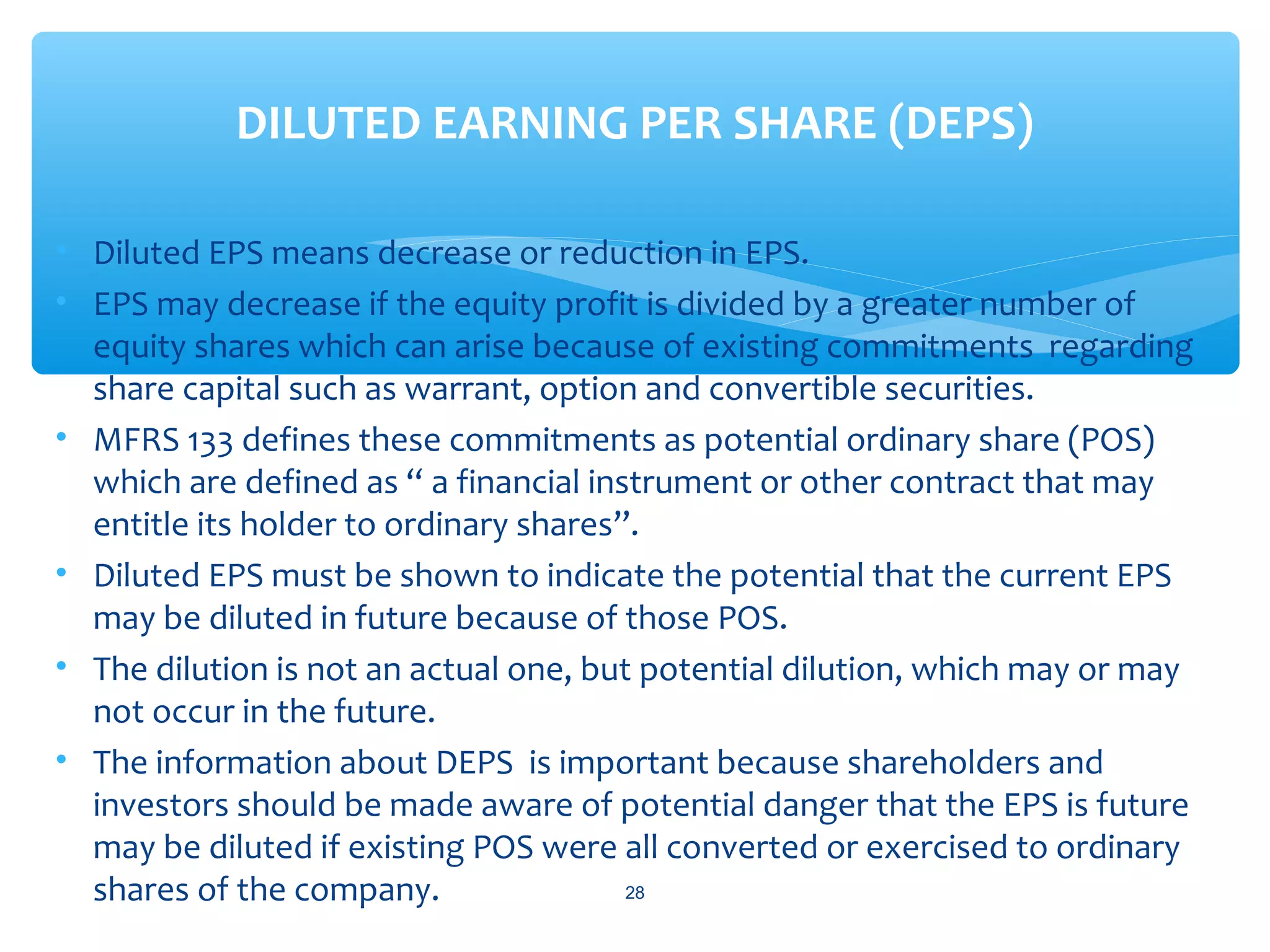
• Diluted EPS means decrease or reduction in EPS.
• EPS may decrease if the equity profit is divided by a greater number of
equity shares which can arise because of existing commitments regarding
share capital such as warrant, option and convertible securities.
• MFRS 133 defines these commitments as potential ordinary share (POS)
which are defined as “ a financial instrument or other contract that may
entitle its holder to ordinary shares”.
• Diluted EPS must be shown to indicate the potential that the current EPS
may be diluted in future because of those POS.
• The dilution is not an actual one, but potential dilution, which may or may
not occur in the future.
• The information about DEPS is important because shareholders and
investors should be made aware of potential danger that the EPS is future
may be diluted if existing POS were all converted or exercised to ordinary
shares of the company.
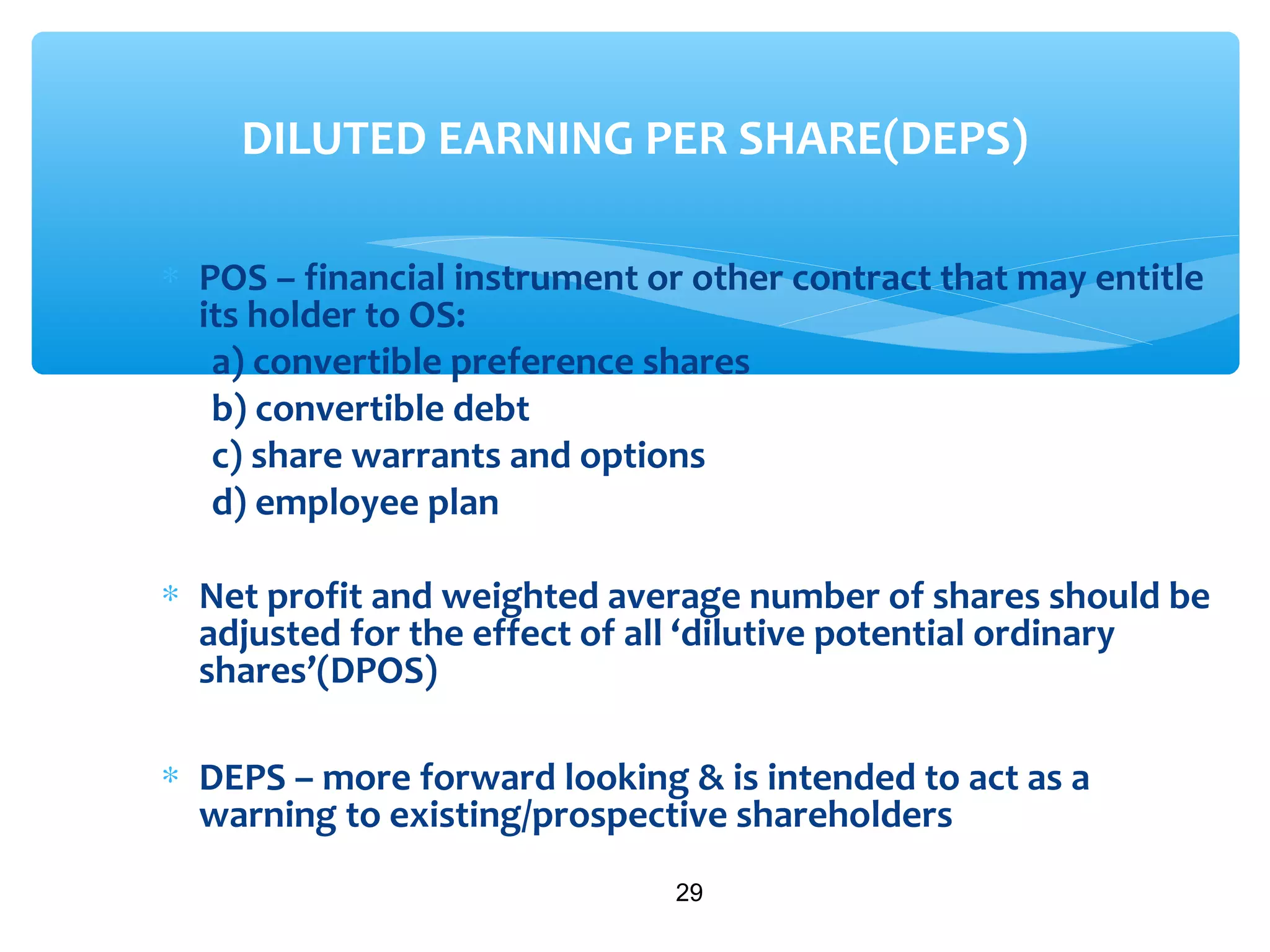
DILUTED EARNING PER SHARE (DEPS)
28
∗ POS – financial instrument or other contract that may entitle
its holder to OS:
a) convertible preference shares
b) convertible debt
c) share warrants and options
d) employee plan
∗ Net profit and weighted average number of shares should be
adjusted for the effect of all ‘dilutive potential ordinary
shares’(DPOS)
∗ DEPS – more forward looking & is intended to act as a
warning to existing/prospective shareholders
29
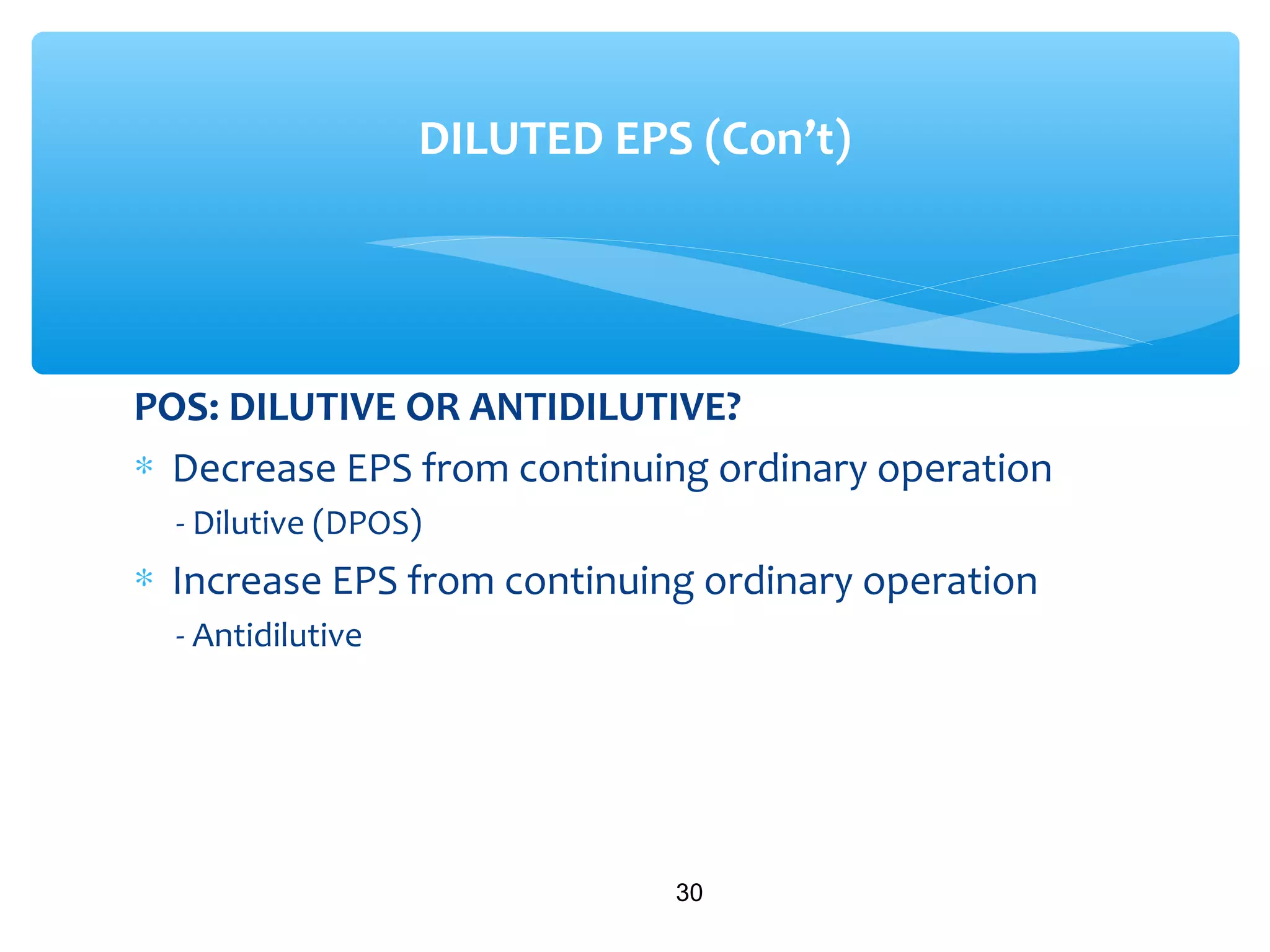
DILUTED EARNING PER SHARE(DEPS)
POS: DILUTIVE OR ANTIDILUTIVE?
∗ Decrease EPS from continuing ordinary operation
- Dilutive (DPOS)
∗ Increase EPS from continuing ordinary operation
- Antidilutive
30
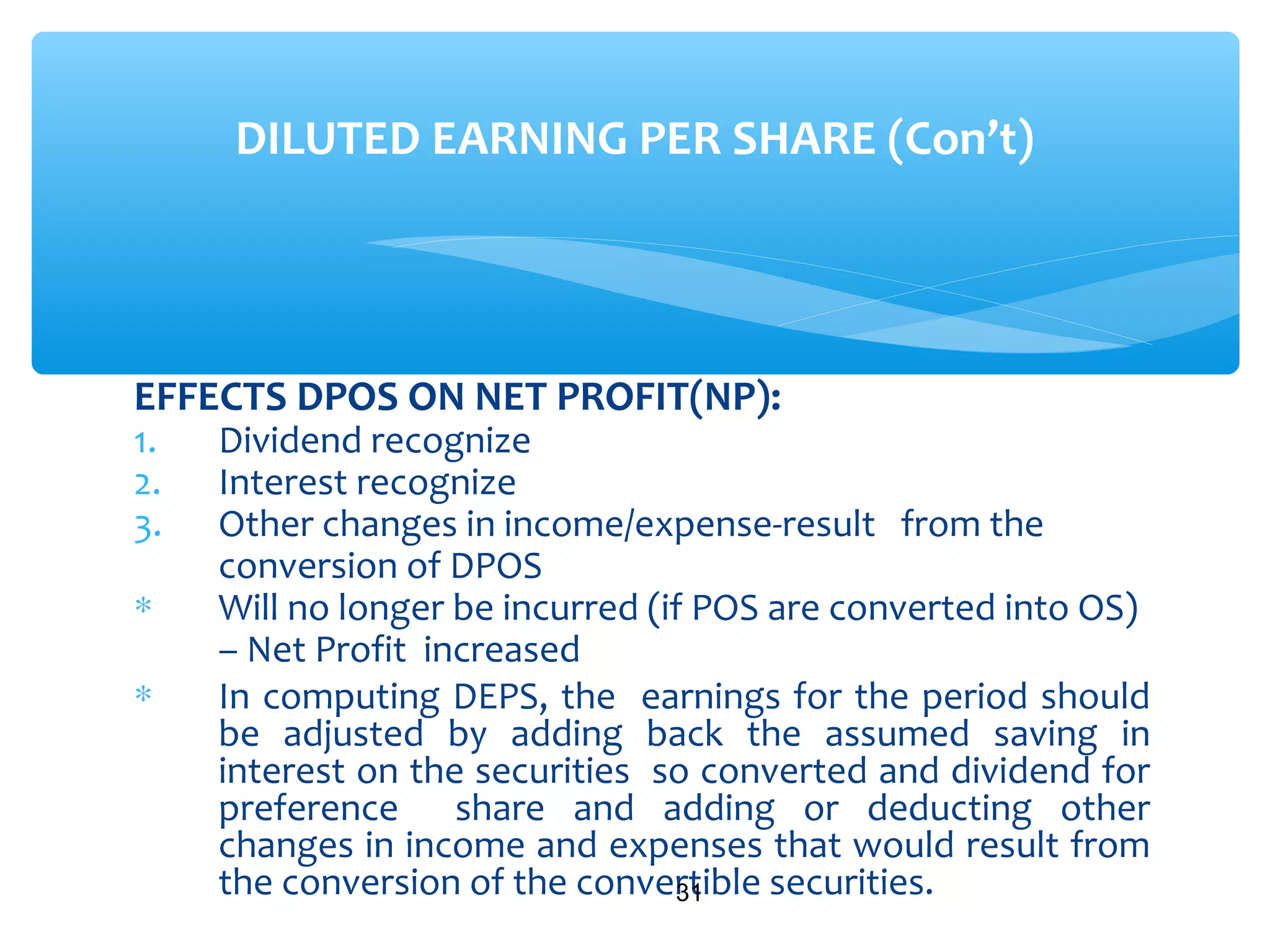
DILUTED EPS (Con’t)
EFFECTS DPOS ON NET PROFIT(NP):
1. Dividend recognize
2. Interest recognize
3. Other changes in income/expense-result from the
conversion of DPOS
∗ Will no longer be incurred (if POS are converted into OS)
– Net Profit increased
∗ In computing DEPS, the earnings for the period should
be adjusted by adding back the assumed saving in
interest on the securities so converted and dividend for
preference share and adding or deducting other
changes in income and expenses that would result from
the conversion of the convertible securities.31
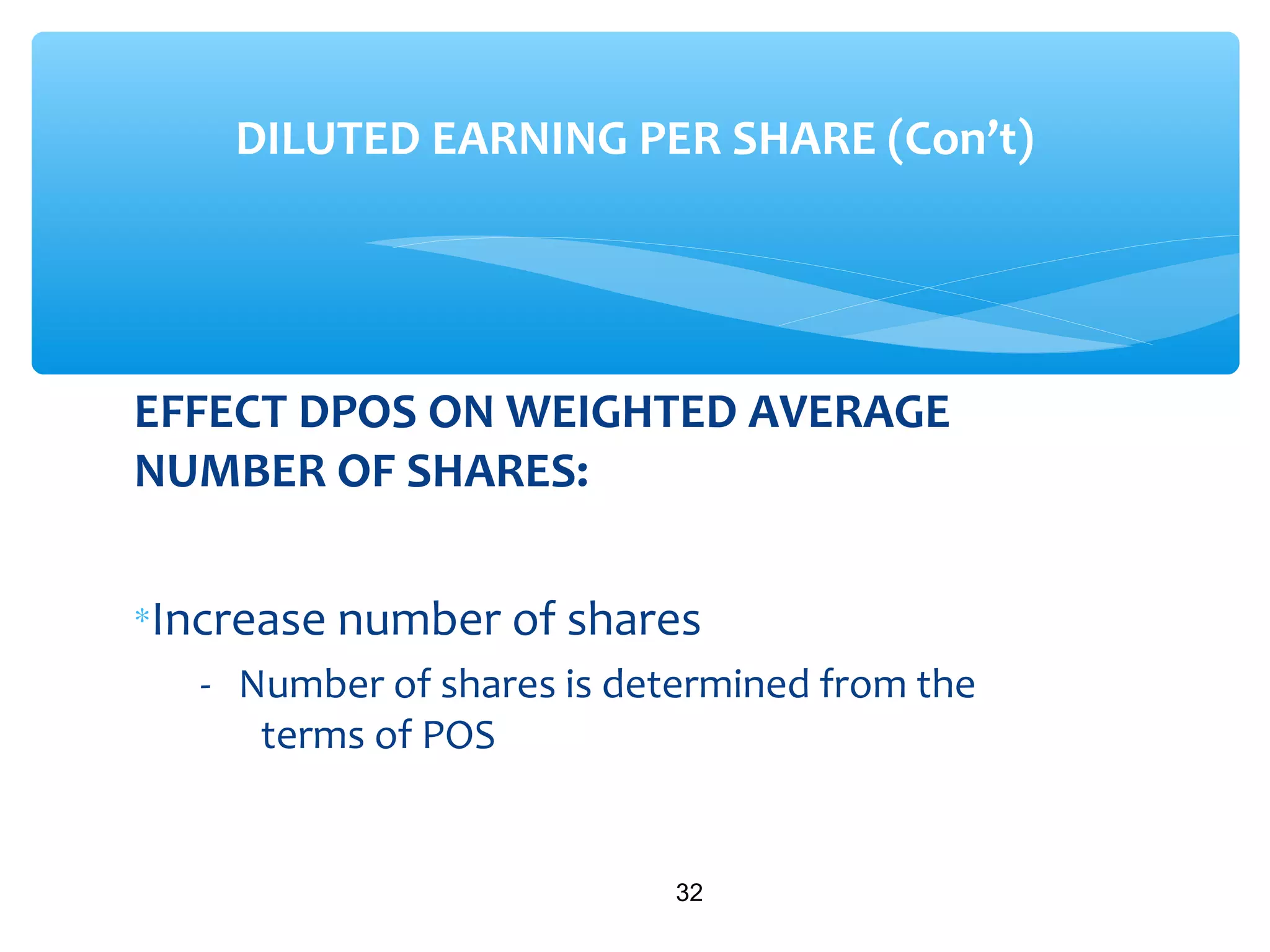
DILUTED EARNING PER SHARE (Con’t)
EFFECT DPOS ON WEIGHTED AVERAGE
NUMBER OF SHARES:
∗Increase number of shares
- Number of shares is determined from the
terms of POS
32
DILUTED EARNING PER SHARE (Con’t)
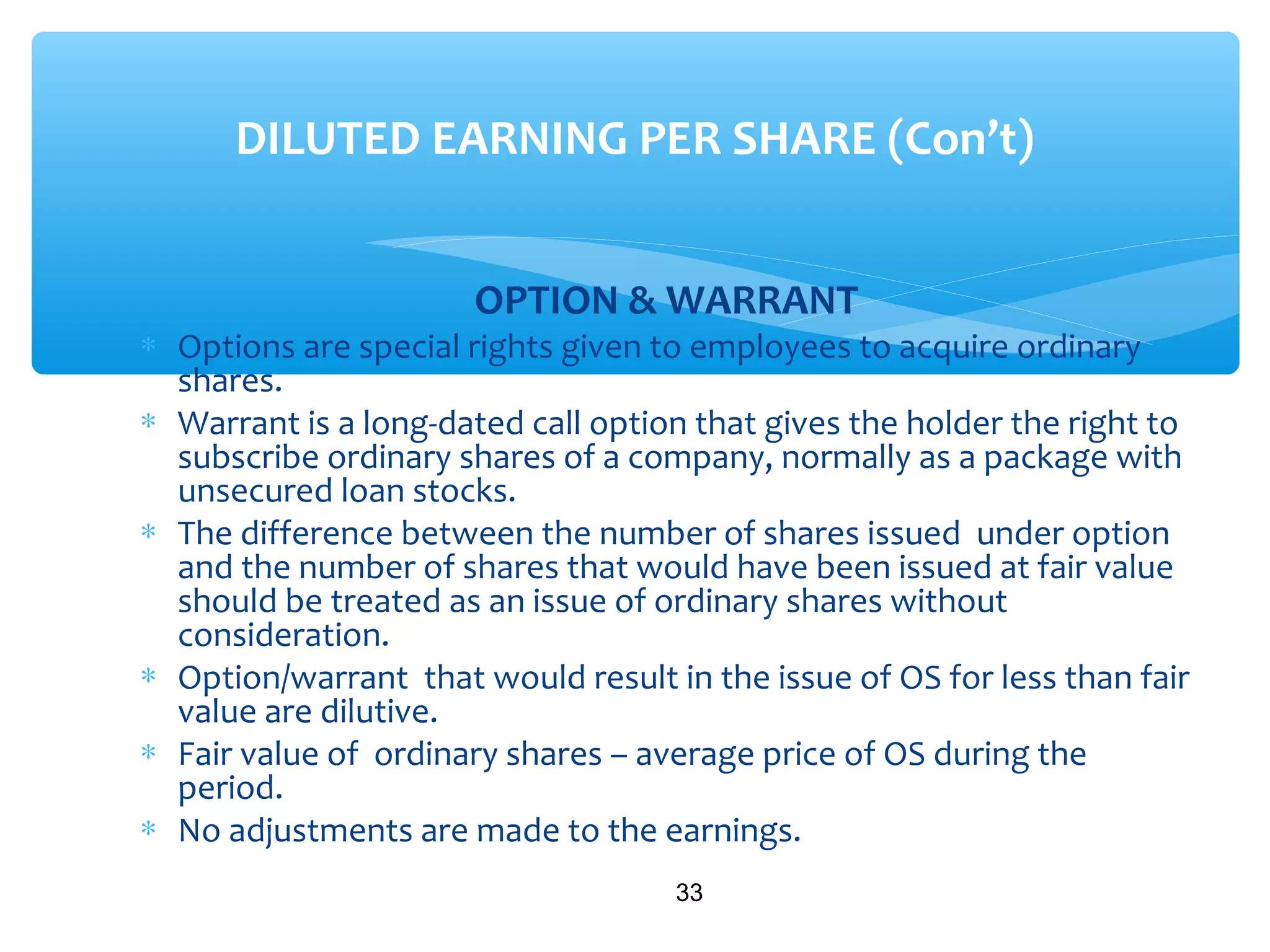
OPTION & WARRANT
∗ Options are special rights given to employees to acquire ordinary
shares.
∗ Warrant is a long-dated call option that gives the holder the right to
subscribe ordinary shares of a company, normally as a package with
unsecured loan stocks.
∗ The difference between the number of shares issued under option
and the number of shares that would have been issued at fair value
should be treated as an issue of ordinary shares without
consideration.
∗ Option/warrant that would result in the issue of OS for less than fair
value are dilutive.
∗ Fair value of ordinary shares – average price of OS during the
period.
∗ No adjustments are made to the earnings.
33
DILUTED EARNING PER SHARE (Con’t)
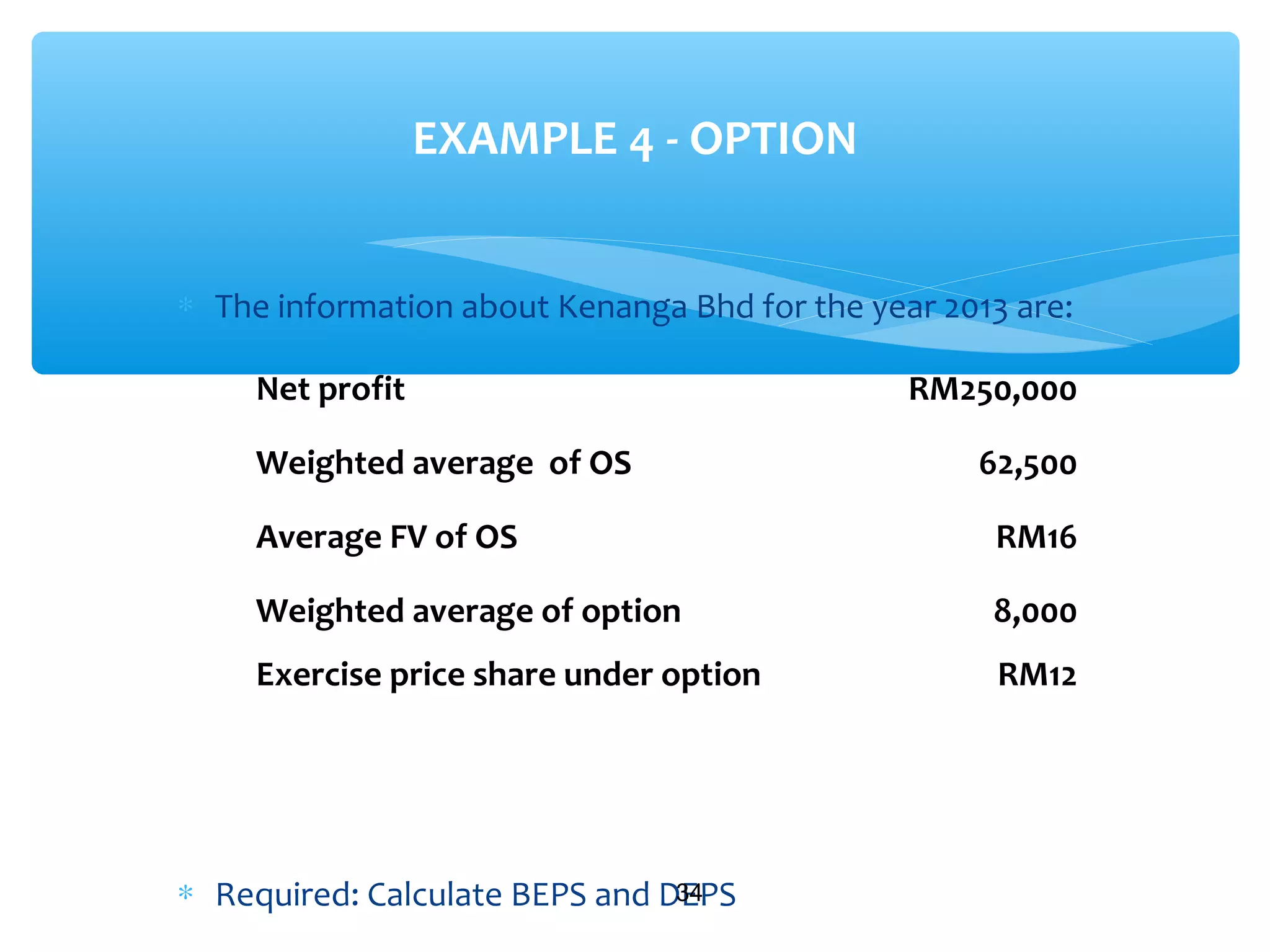
∗ The information about Kenanga Bhd for the year 2013 are:
∗ Required: Calculate BEPS and DEPS34
EXAMPLE 4 - OPTION
Net profit RM250,000
Weighted average of OS 62,500
Average FV of OS RM16
Weighted average of option 8,000
Exercise price share under option RM12
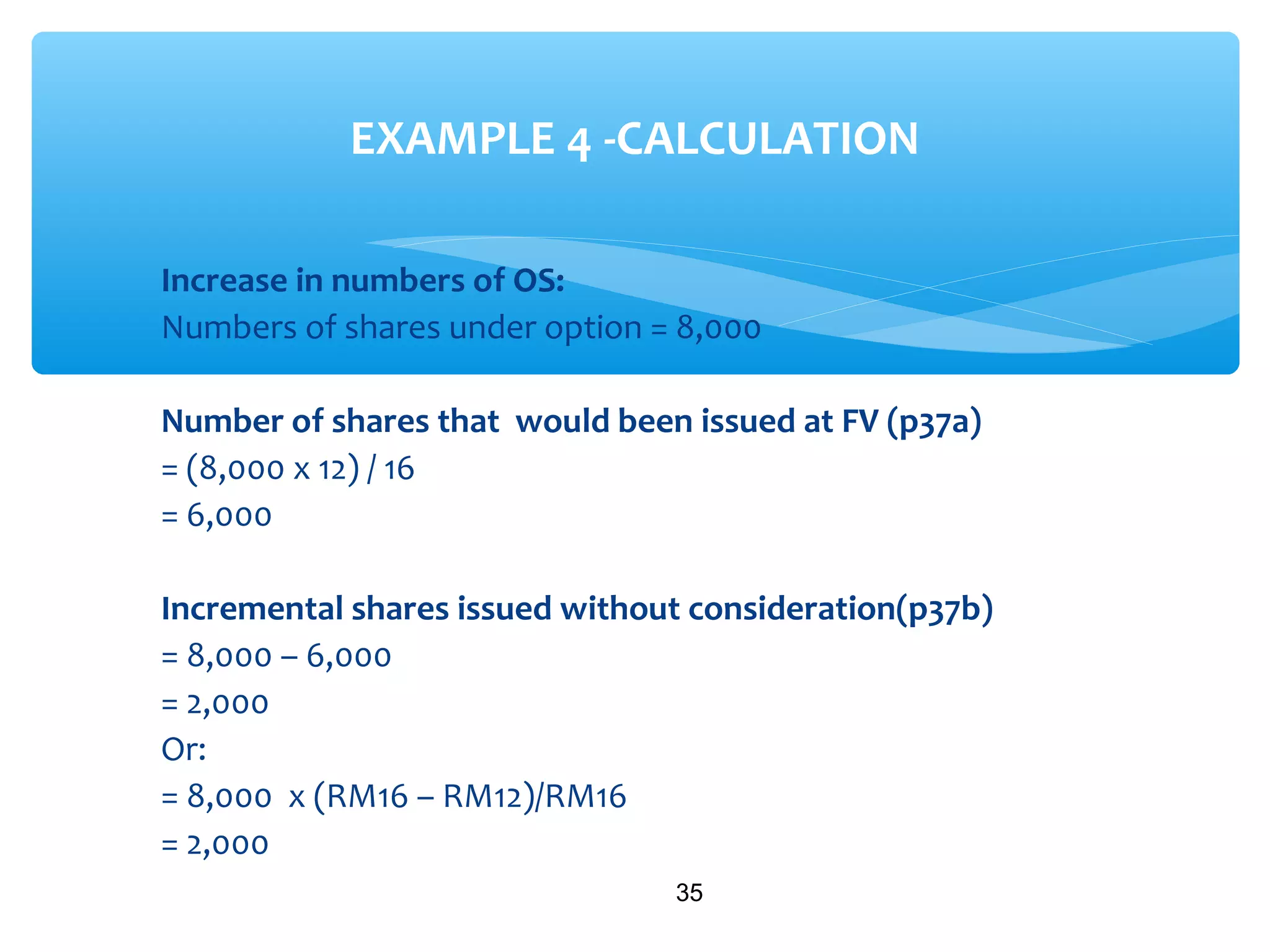
Increase in numbers of OS:
Numbers of shares under option = 8,000
Number of shares that would been issued at FV (p37a)
= (8,000 x 12) / 16
= 6,000
Incremental shares issued without consideration(p37b)
= 8,000 – 6,000
= 2,000
Or:
= 8,000 x (RM16 – RM12)/RM16
= 2,000
35
EXAMPLE 4 -CALCULATION
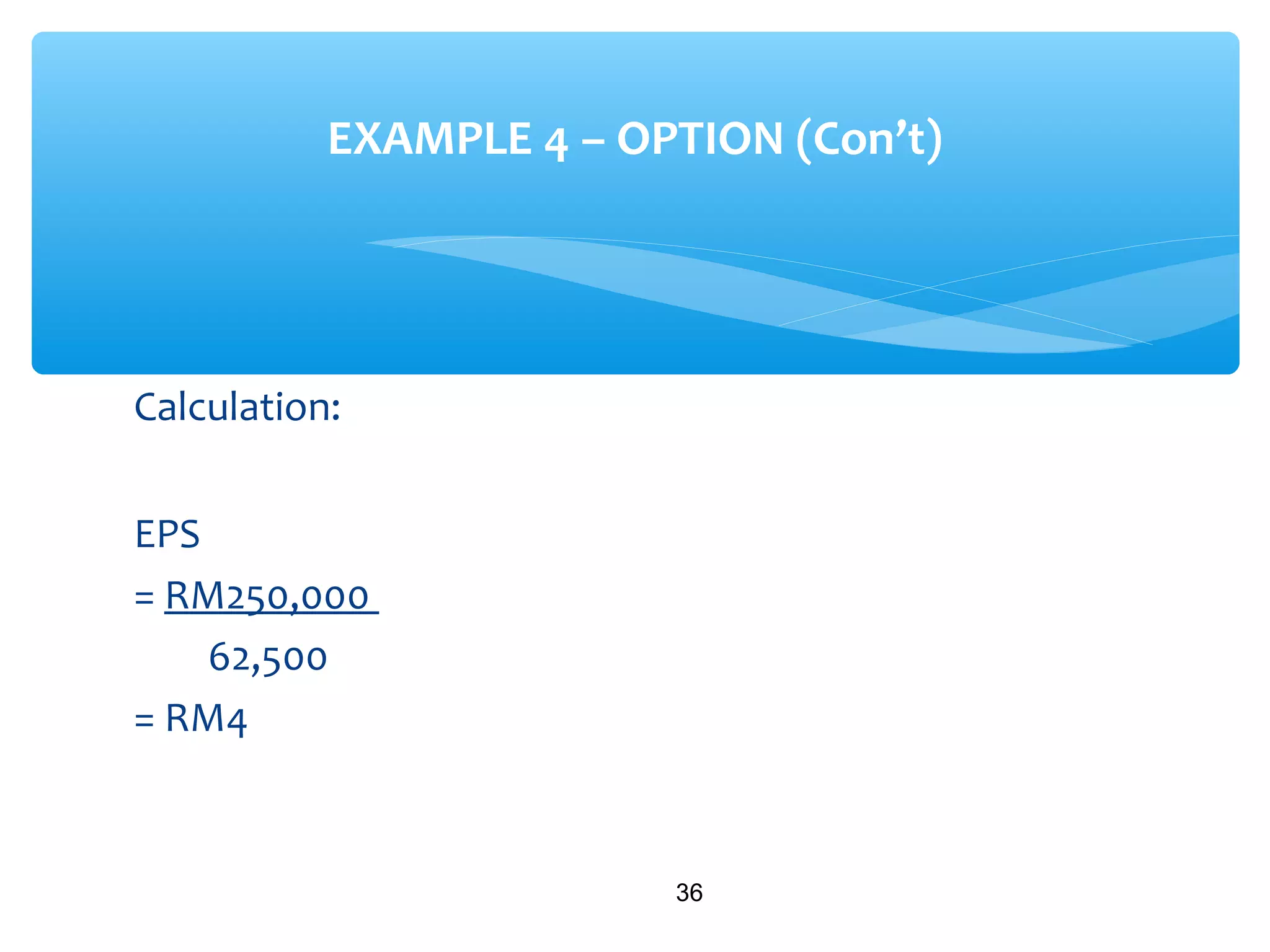
Calculation:
EPS
= RM250,000
62,500
= RM4
36
EXAMPLE 4 – OPTION (Con’t)
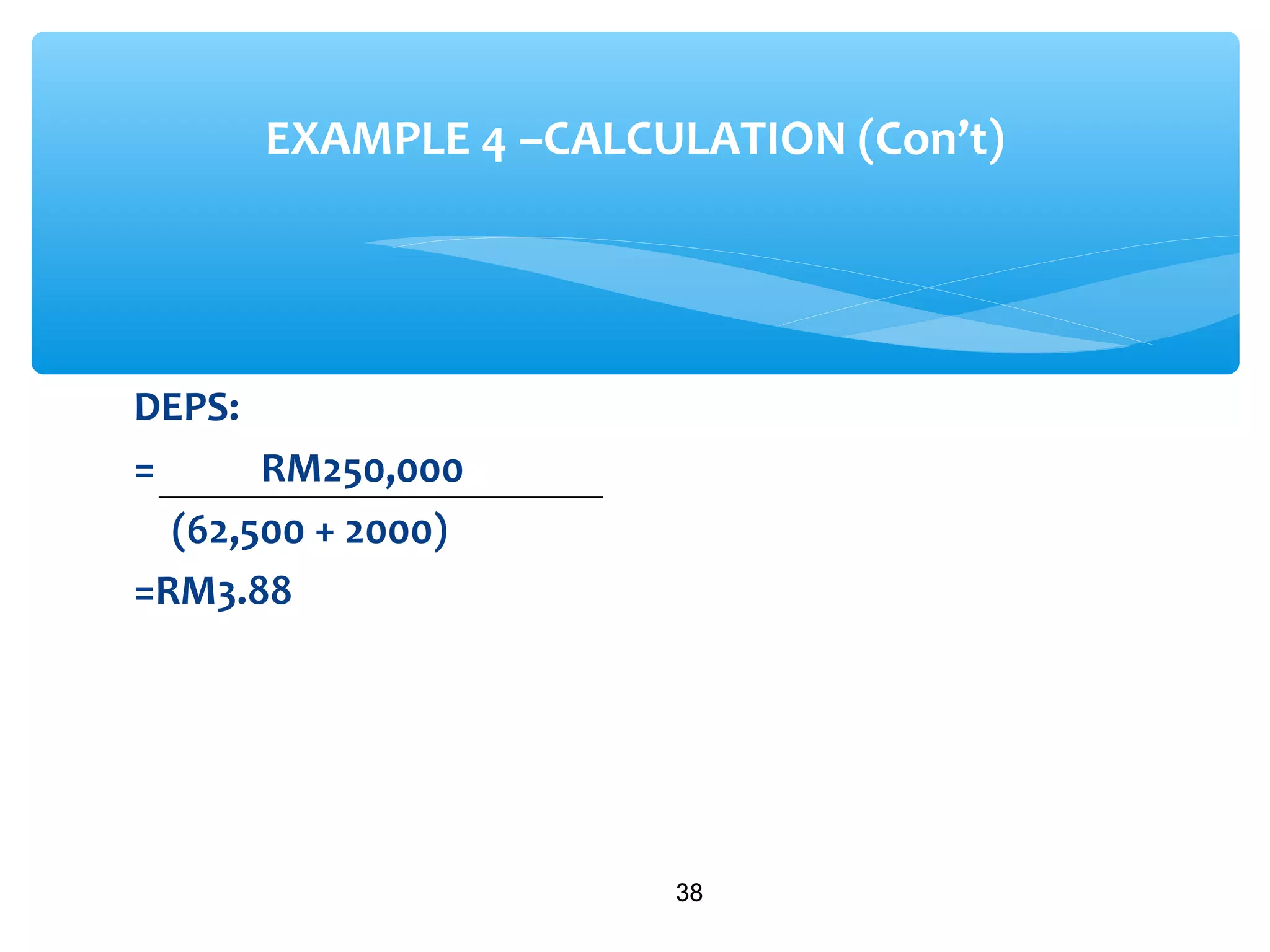
DEPS:
Increase in earning =0
Increase in numbers of OS:
37
EXAMPLE 4 -CALCULATION
Numbers of shares under option 8,000
(-) Number of shares that would been
issued at FV
[(8,000 x 12) / 16]
6,000
Incremental shares issued without
consideration 2,000
DEPS:
= RM250,000
(62,500 + 2000)
=RM3.88
38
EXAMPLE 4 –CALCULATION (Con’t)
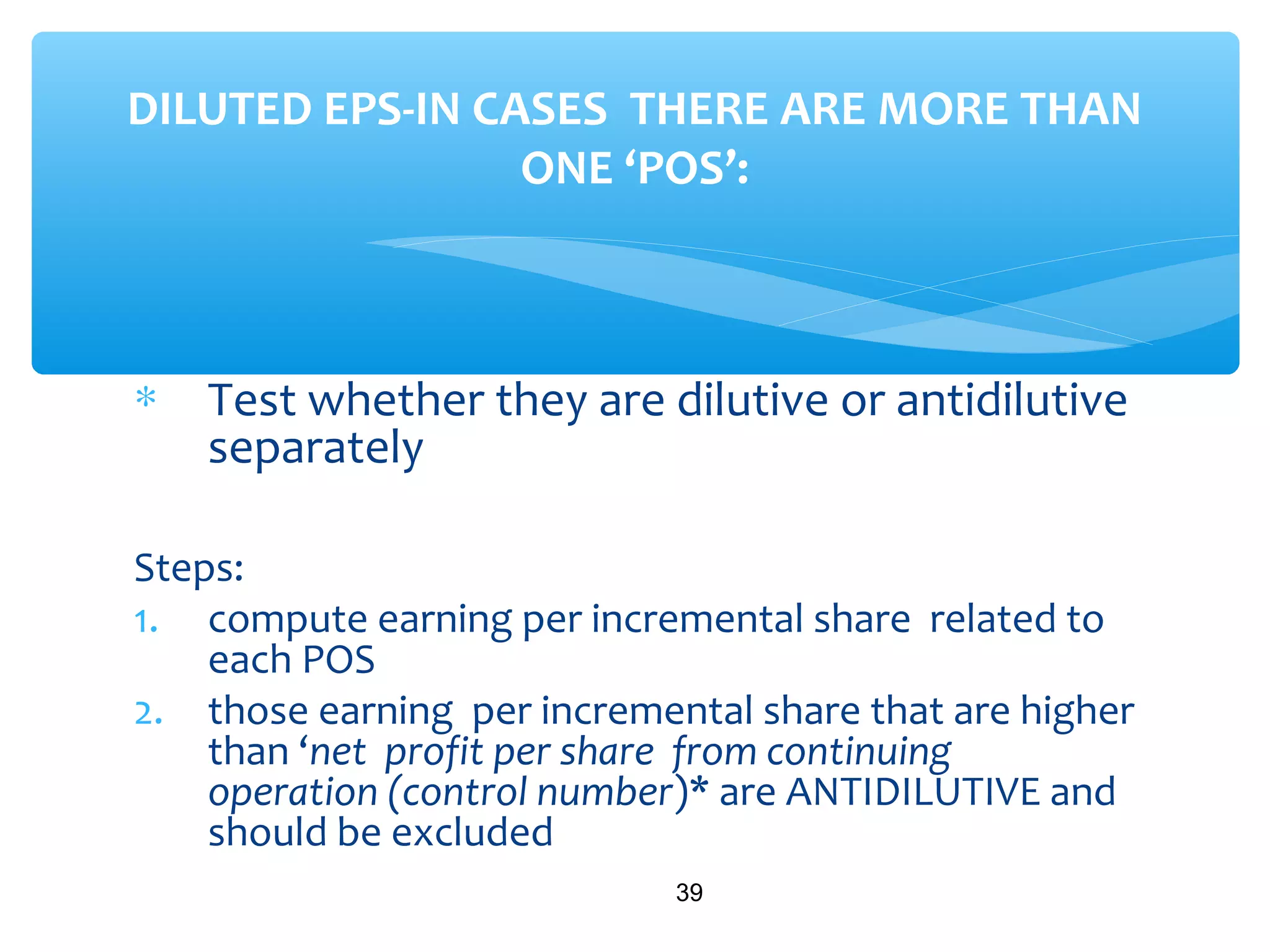
∗ Test whether they are dilutive or antidilutive
separately
Steps:
1. compute earning per incremental share related to
each POS
2. those earning per incremental share that are higher
than ‘net profit per share from continuing
operation (control number)* are ANTIDILUTIVE and
should be excluded
39
DILUTED EPS-IN CASES THERE ARE MORE THAN
ONE ‘POS’:
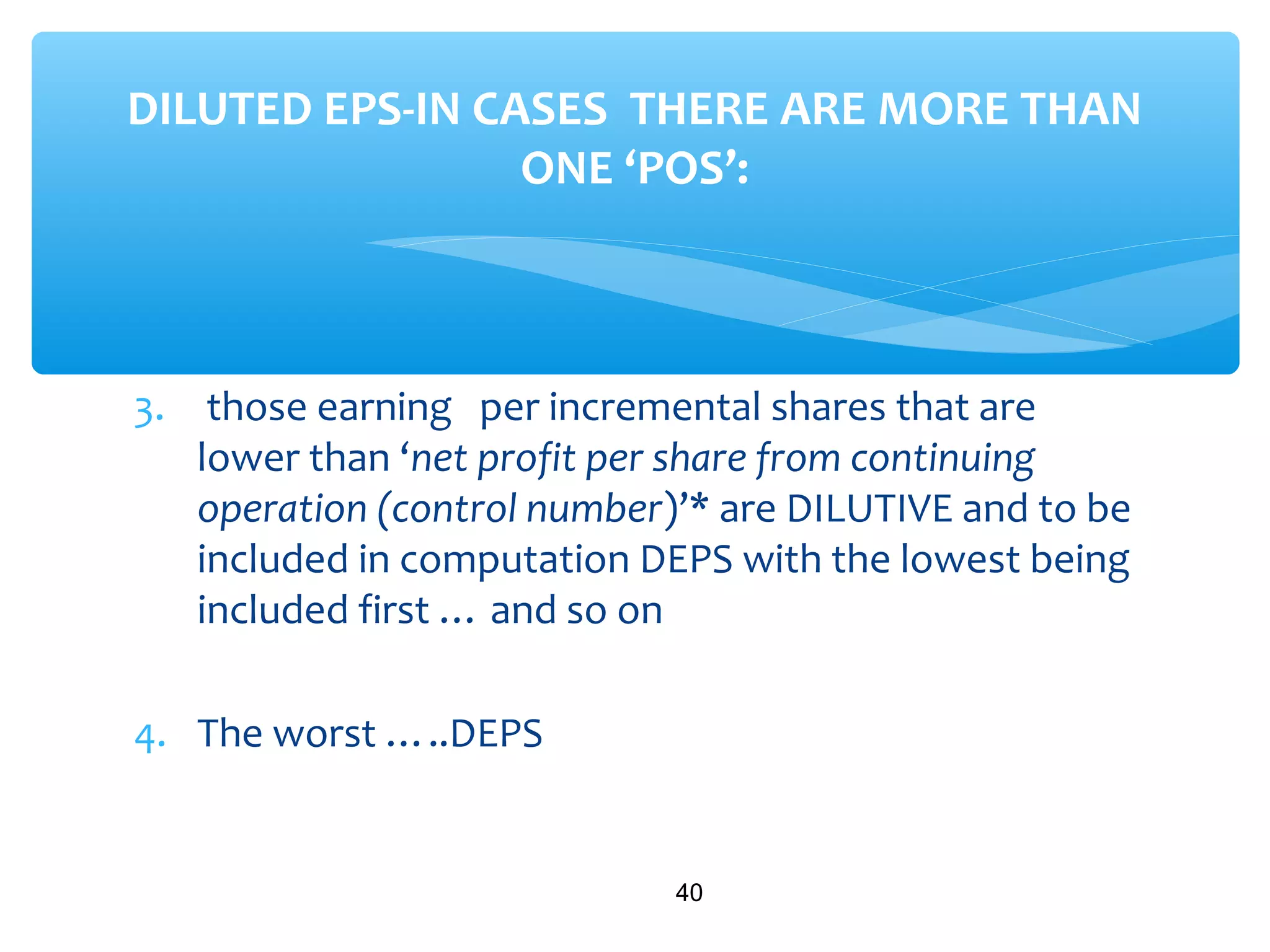
3. those earning per incremental shares that are
lower than ‘net profit per share from continuing
operation (control number)’* are DILUTIVE and to be
included in computation DEPS with the lowest being
included first … and so on
4. The worst …..DEPS
40
DILUTED EPS-IN CASES THERE ARE MORE THAN
ONE ‘POS’:
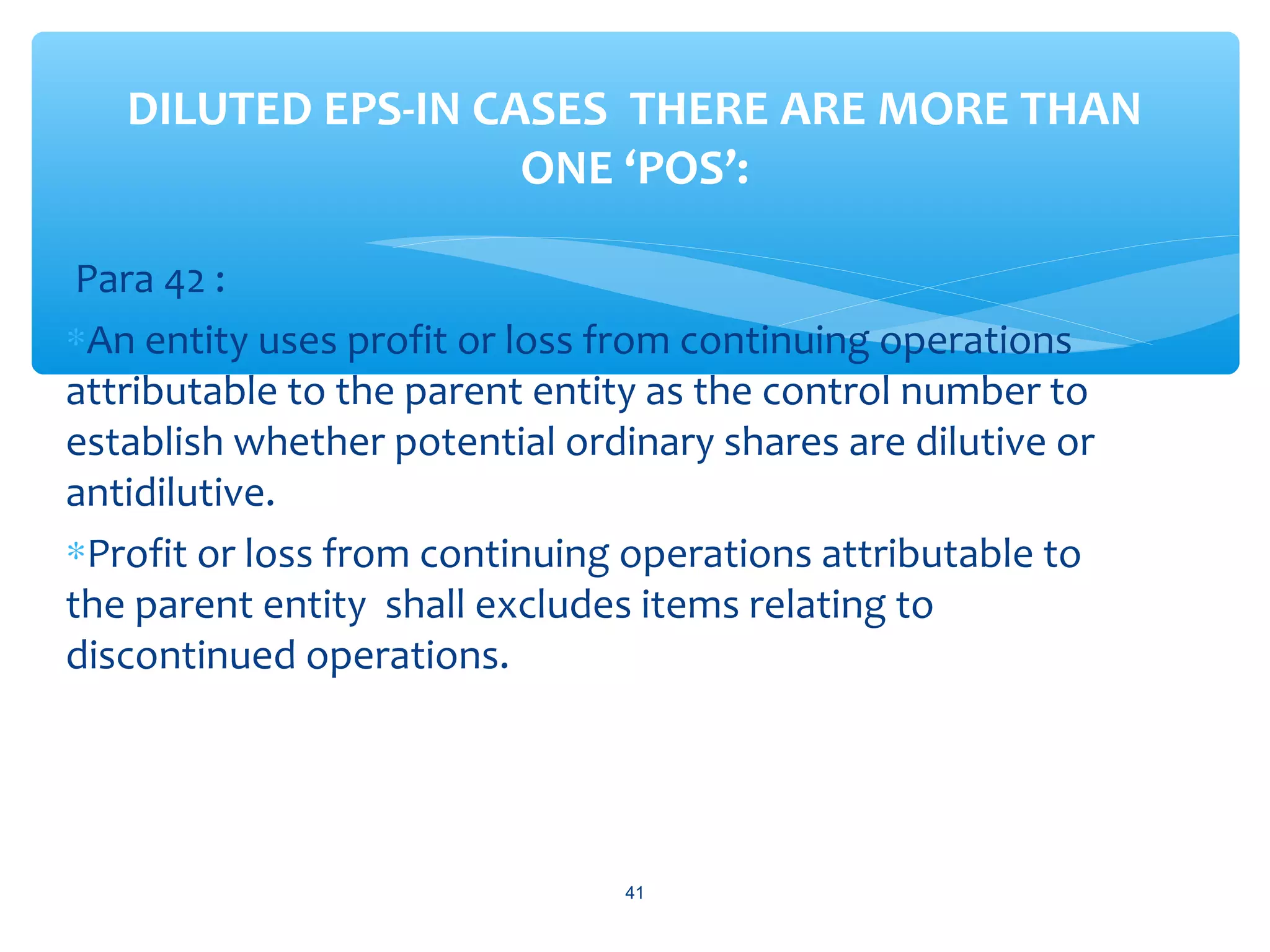
Para 42 :
∗An entity uses profit or loss from continuing operations
attributable to the parent entity as the control number to
establish whether potential ordinary shares are dilutive or
antidilutive.
∗Profit or loss from continuing operations attributable to
the parent entity shall excludes items relating to
discontinued operations.
DILUTED EPS-IN CASES THERE ARE MORE THAN
ONE ‘POS’:
41
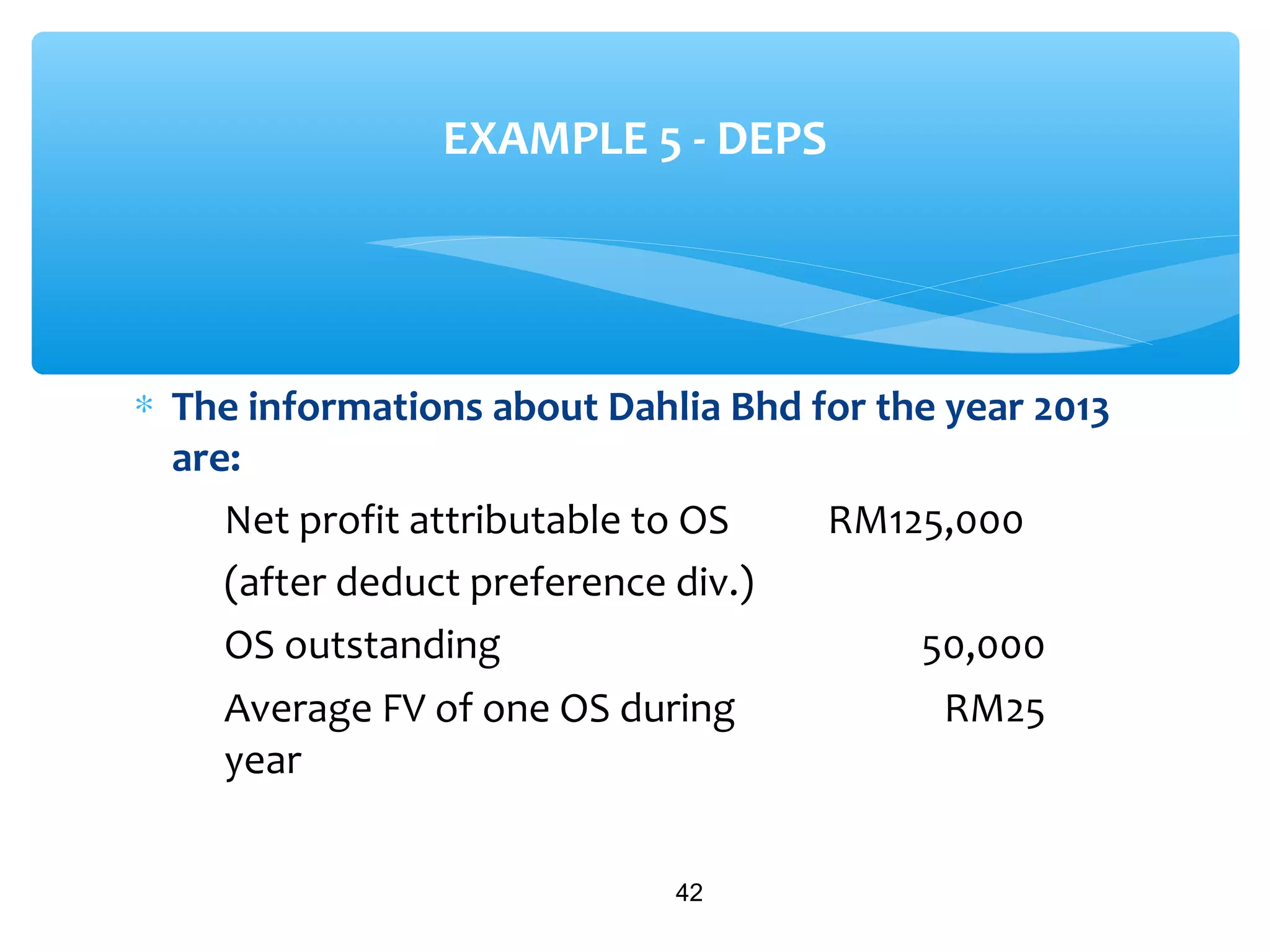
∗ The informations about Dahlia Bhd for the year 2013
are:
42
EXAMPLE 5 - DEPS
Net profit attributable to OS
(after deduct preference div.)
RM125,000
OS outstanding 50,000
Average FV of one OS during
year
RM25
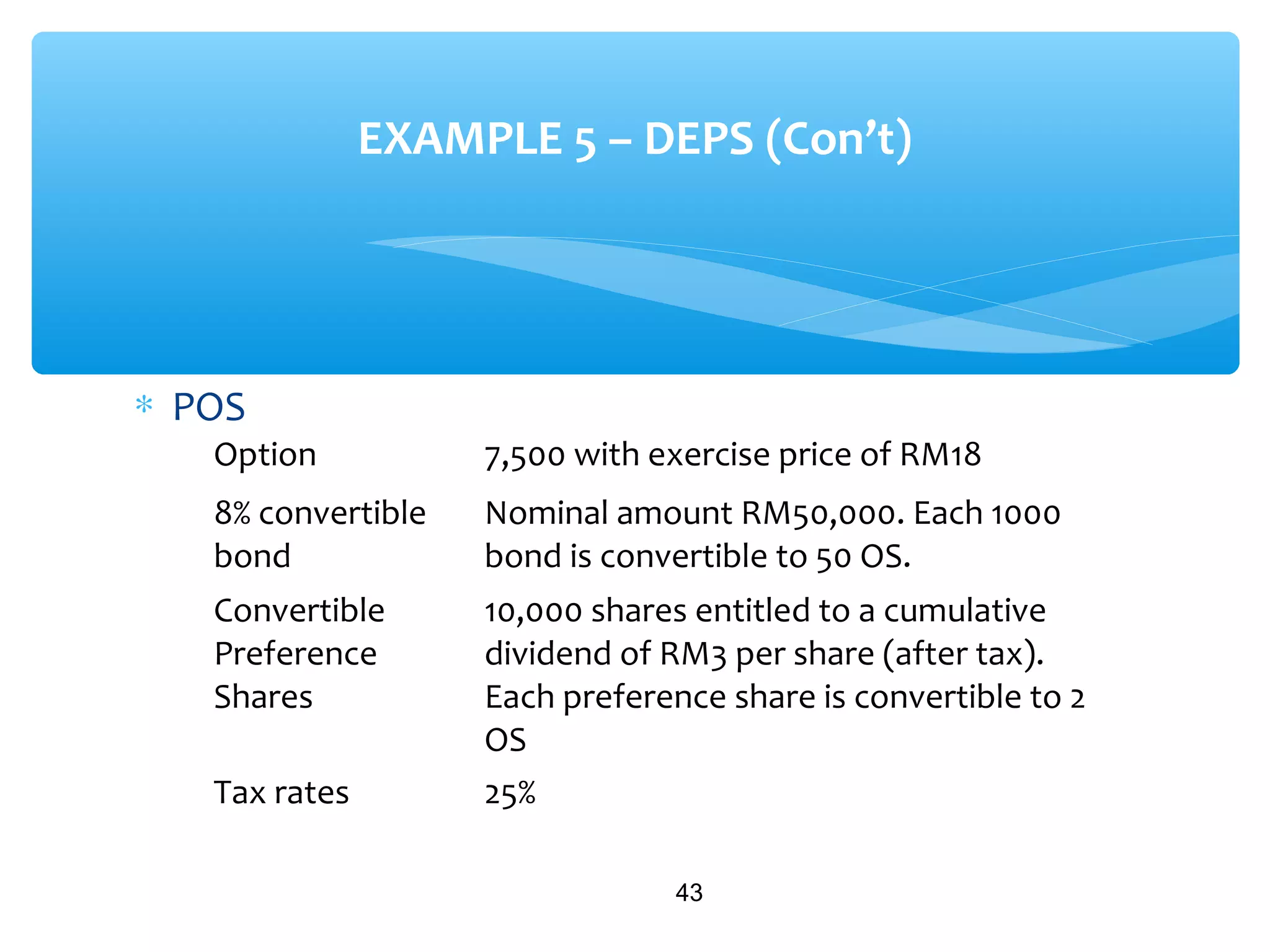
∗ POS
43
EXAMPLE 5 – DEPS (Con’t)
Option 7,500 with exercise price of RM18
8% convertible
bond
Nominal amount RM50,000. Each 1000
bond is convertible to 50 OS.
Convertible
Preference
Shares
10,000 shares entitled to a cumulative
dividend of RM3 per share (after tax).
Each preference share is convertible to 2
OS
Tax rates 25%
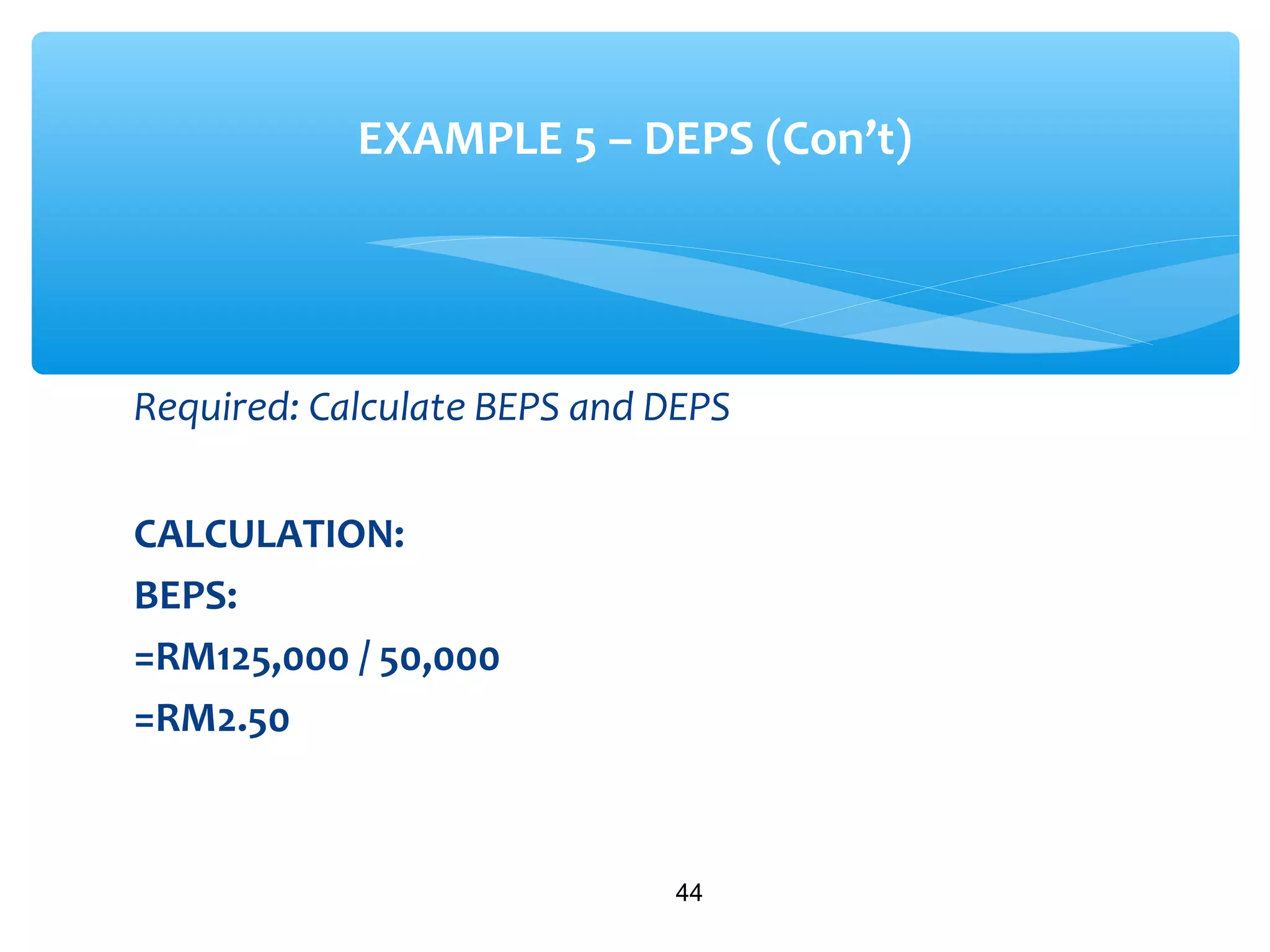
Required: Calculate BEPS and DEPS
CALCULATION:
BEPS:
=RM125,000 / 50,000
=RM2.50
44
EXAMPLE 5 – DEPS (Con’t)
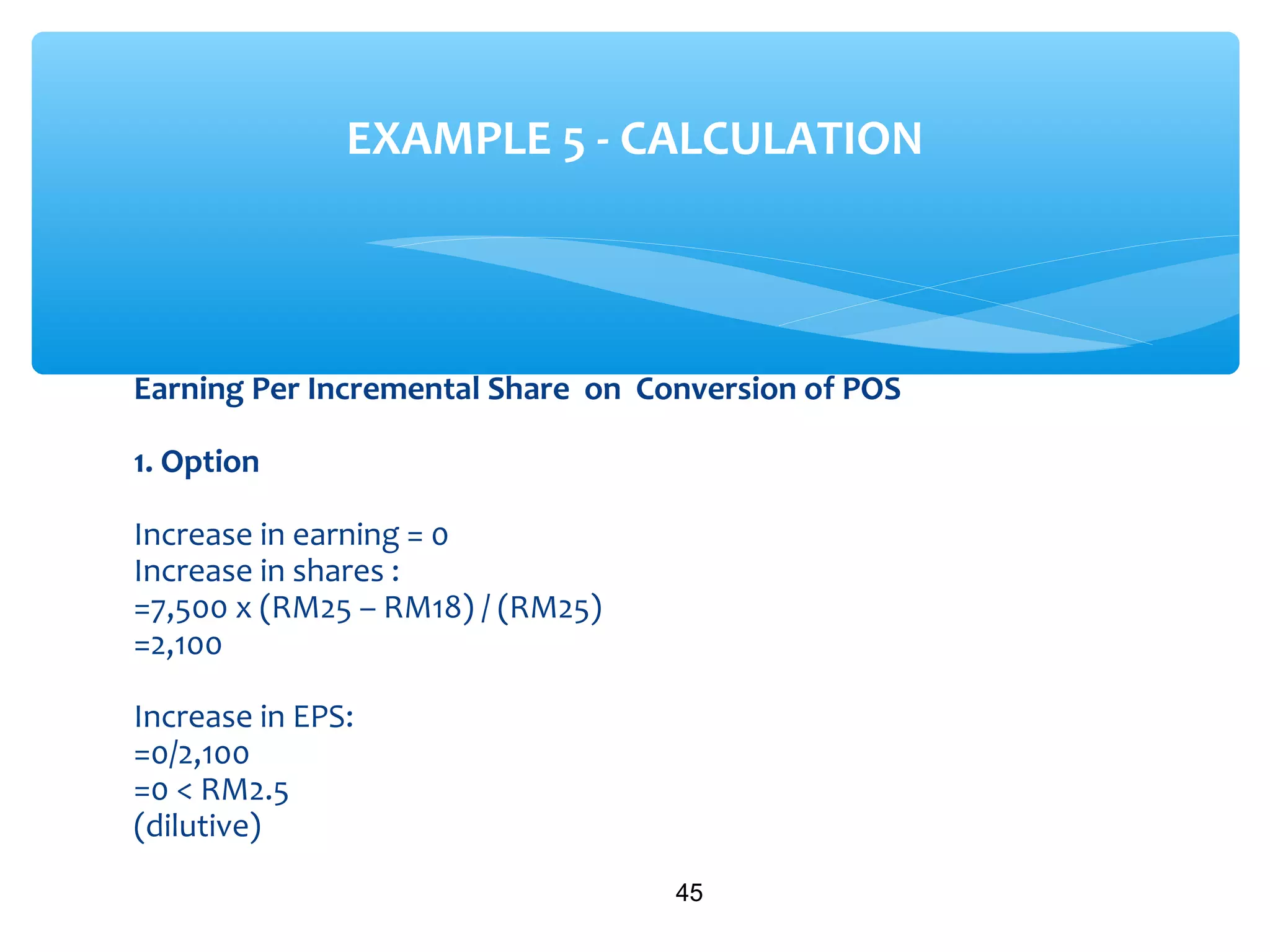
Earning Per Incremental Share on Conversion of POS
1. Option
Increase in earning = 0
Increase in shares :
=7,500 x (RM25 – RM18) / (RM25)
=2,100
Increase in EPS:
=0/2,100
=0 < RM2.5
(dilutive)
45
EXAMPLE 5 - CALCULATION
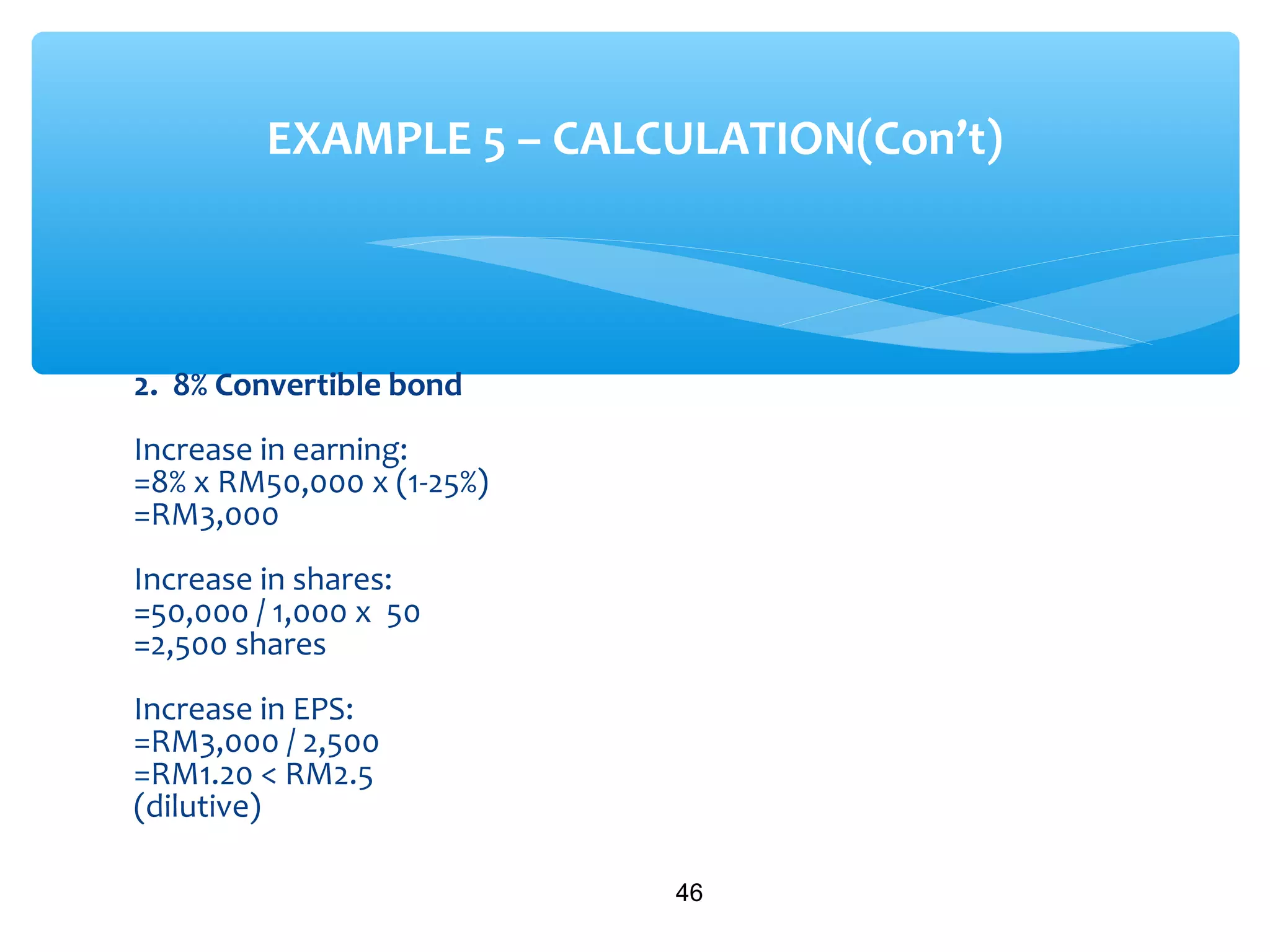
2. 8% Convertible bond
Increase in earning:
=8% x RM50,000 x (1-25%)
=RM3,000
Increase in shares:
=50,000 / 1,000 x 50
=2,500 shares
Increase in EPS:
=RM3,000 / 2,500
=RM1.20 < RM2.5
(dilutive)
46
EXAMPLE 5 – CALCULATION(Con’t)
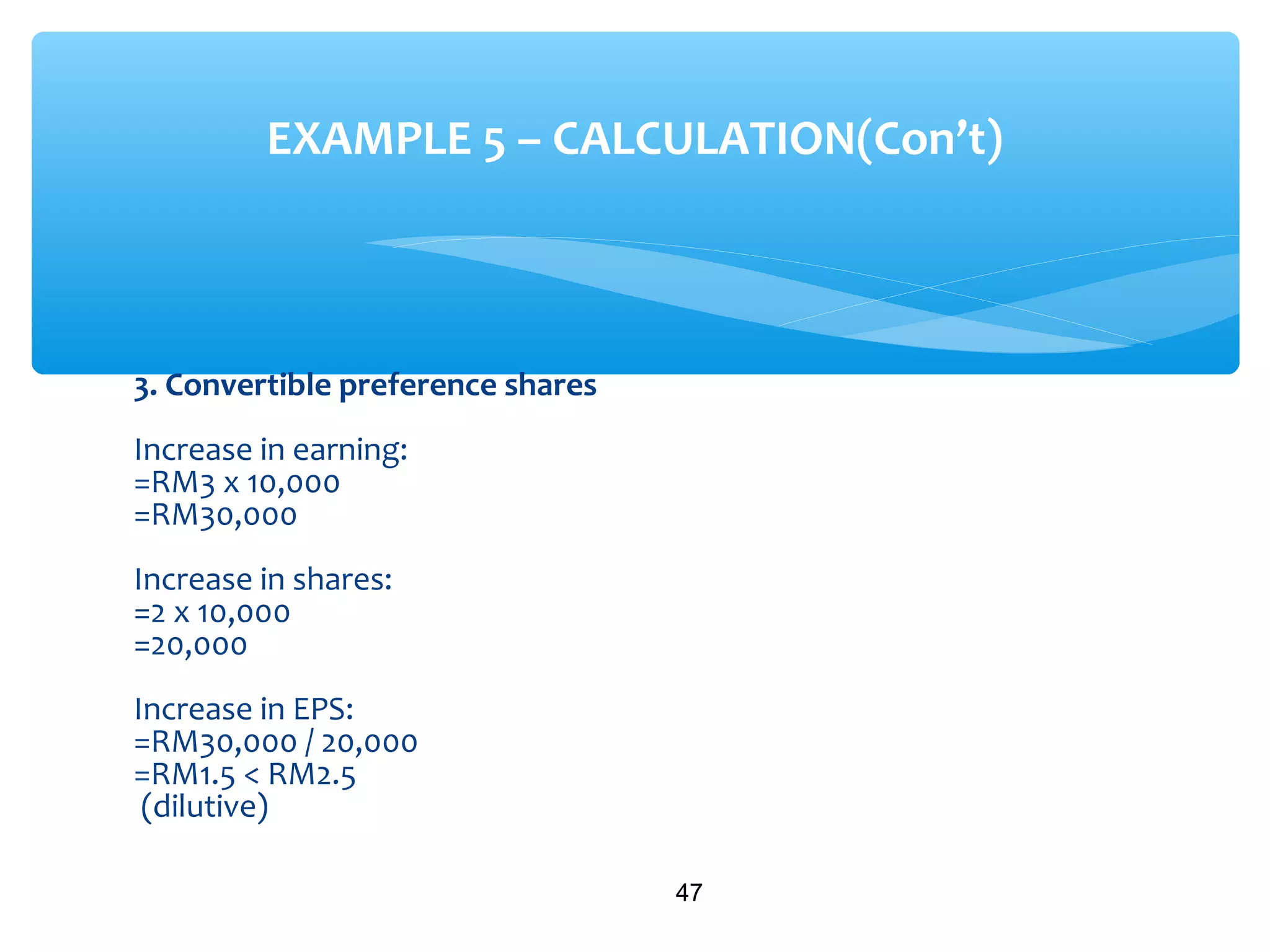
3. Convertible preference shares
Increase in earning:
=RM3 x 10,000
=RM30,000
Increase in shares:
=2 x 10,000
=20,000
Increase in EPS:
=RM30,000 / 20,000
=RM1.5 < RM2.5
(dilutive)
47
EXAMPLE 5 – CALCULATION(Con’t)
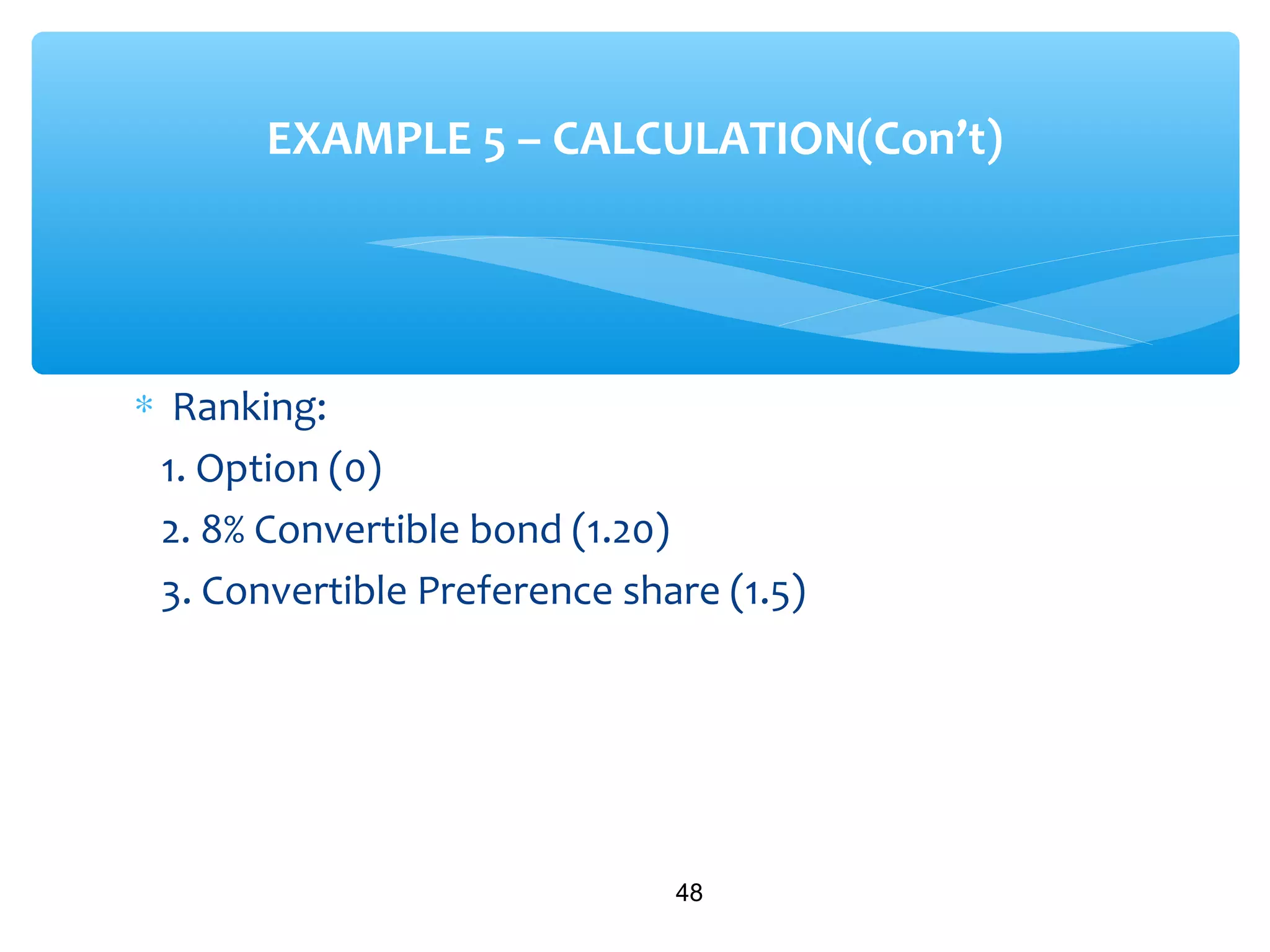
∗ Ranking:
1. Option (0)
2. 8% Convertible bond (1.20)
3. Convertible Preference share (1.5)
48
EXAMPLE 5 – CALCULATION(Con’t)
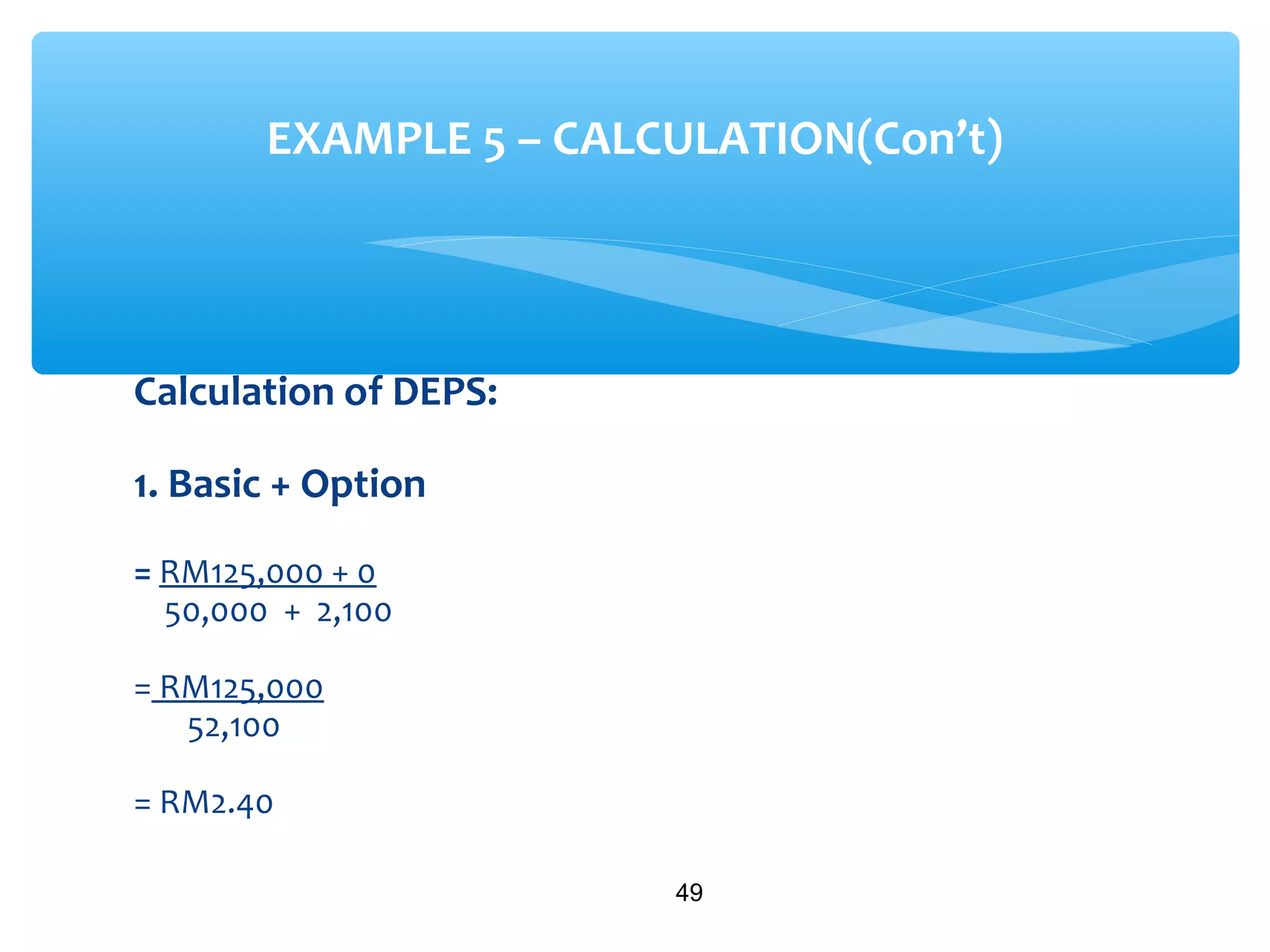
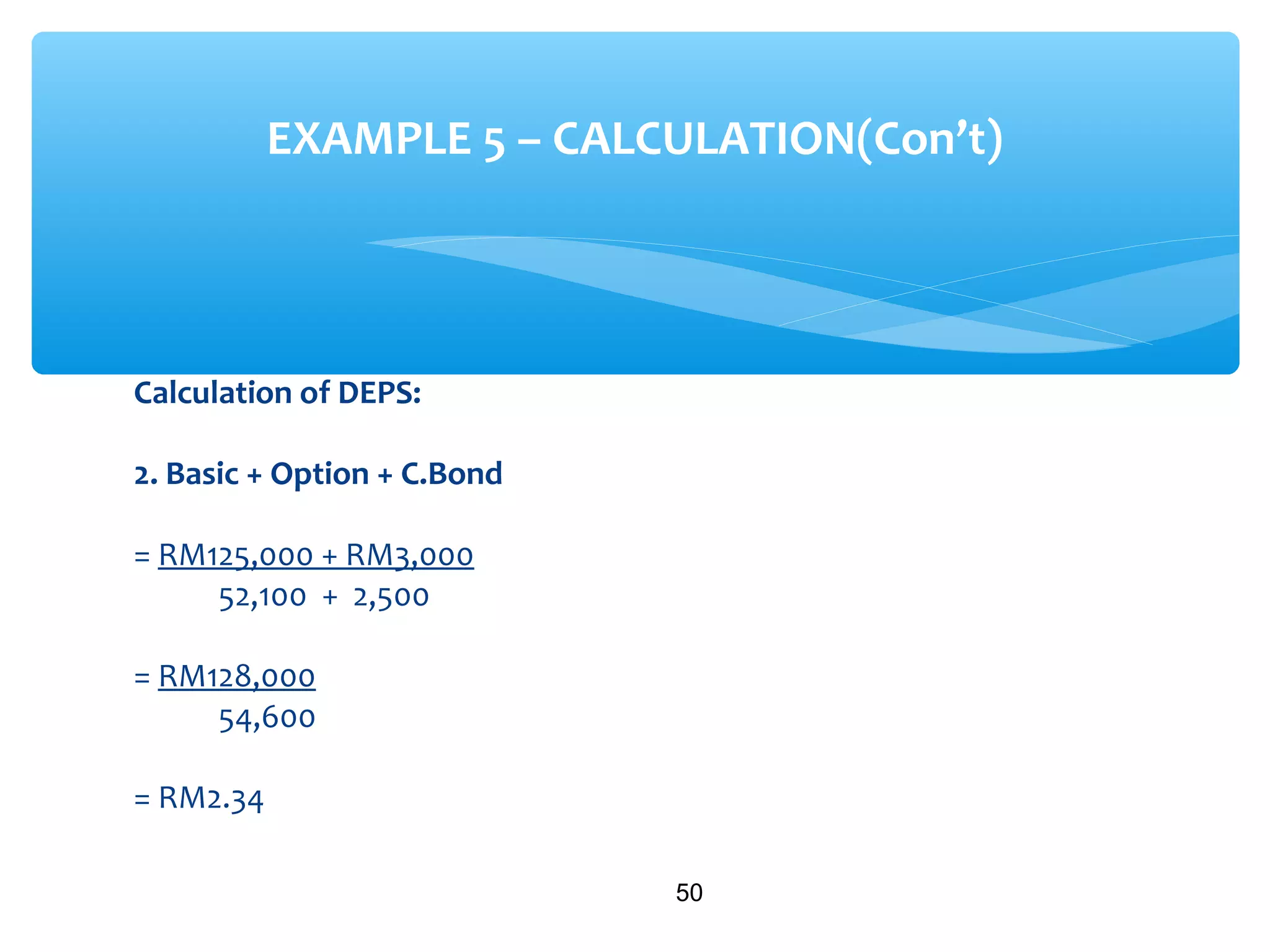
Calculation of DEPS:
1. Basic + Option
= RM125,000 + 0
50,000 + 2,100
= RM125,000
52,100
= RM2.40
49
EXAMPLE 5 – CALCULATION(Con’t)
Calculation of DEPS:
2. Basic + Option + C.Bond
= RM125,000 + RM3,000
52,100 + 2,500
= RM128,000
54,600
= RM2.34
50
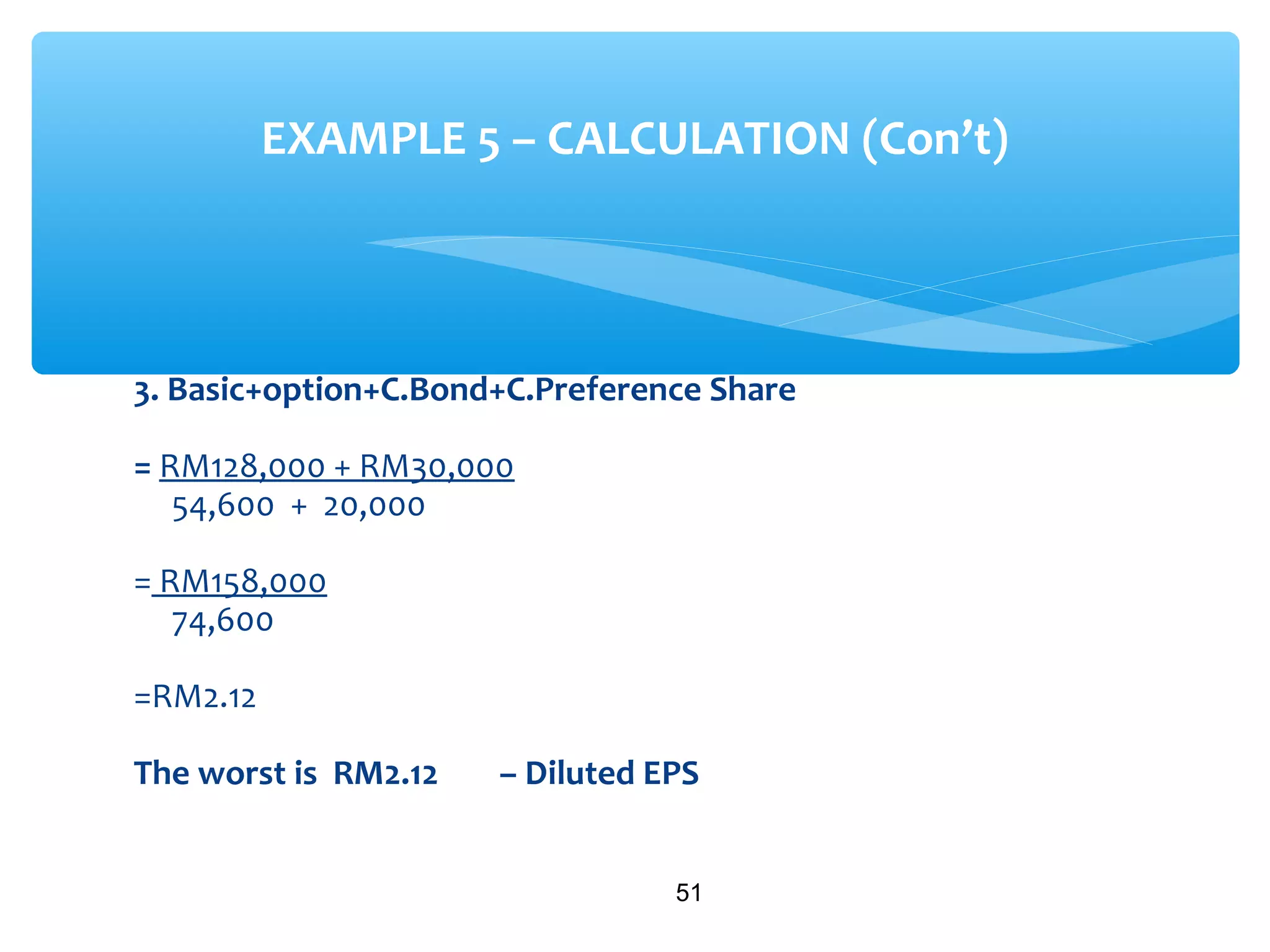
EXAMPLE 5 – CALCULATION(Con’t)
3. Basic+option+C.Bond+C.Preference Share
= RM128,000 + RM30,000
54,600 + 20,000
= RM158,000
74,600
=RM2.12
The worst is RM2.12 – Diluted EPS
51
EXAMPLE 5 – CALCULATION (Con’t)
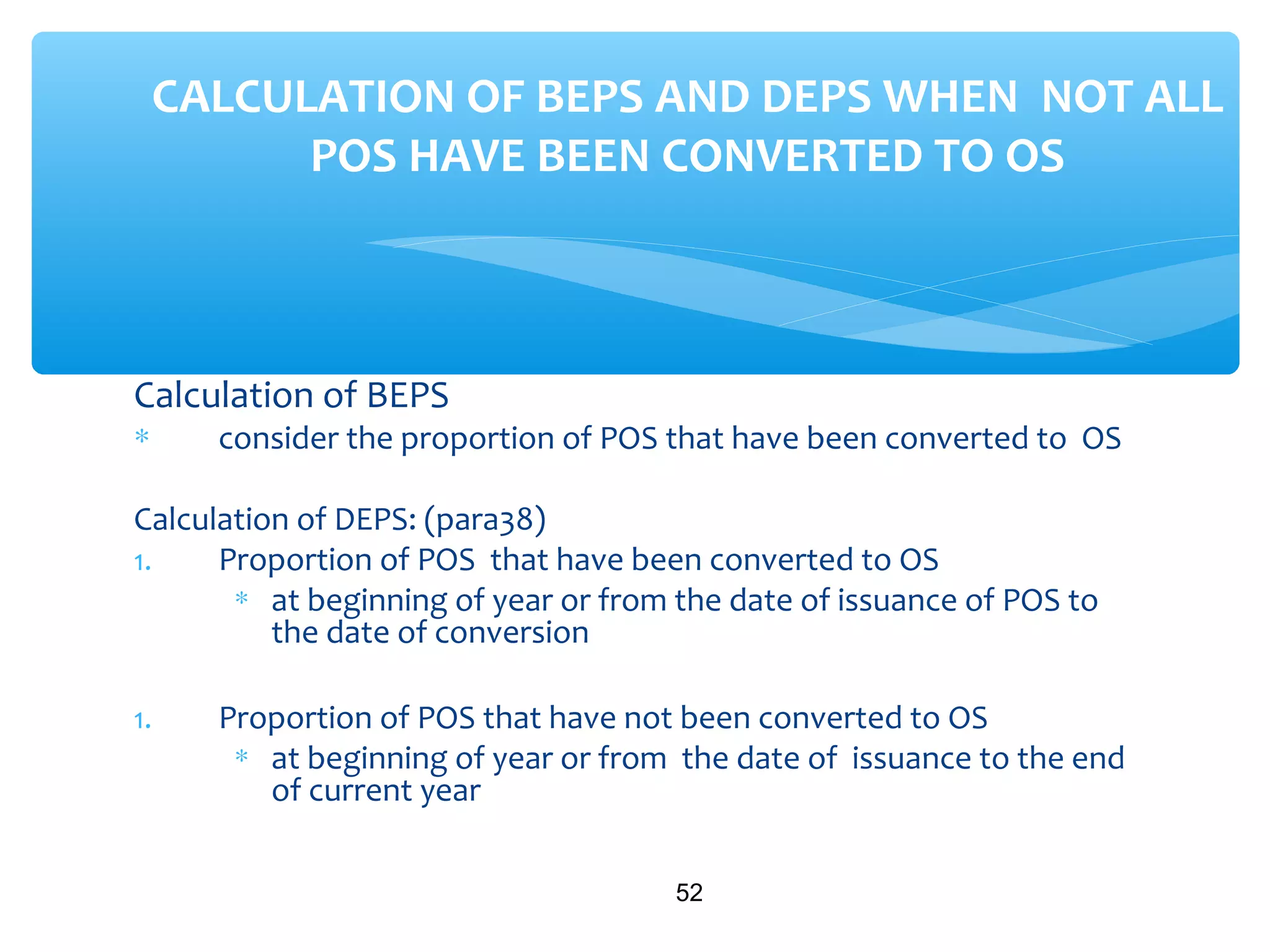
Calculation of BEPS
∗ consider the proportion of POS that have been converted to OS
Calculation of DEPS: (para38)
1. Proportion of POS that have been converted to OS
∗ at beginning of year or from the date of issuance of POS to
the date of conversion
1. Proportion of POS that have not been converted to OS
∗ at beginning of year or from the date of issuance to the end
of current year
52
CALCULATION OF BEPS AND DEPS WHEN NOT ALL
POS HAVE BEEN CONVERTED TO OS
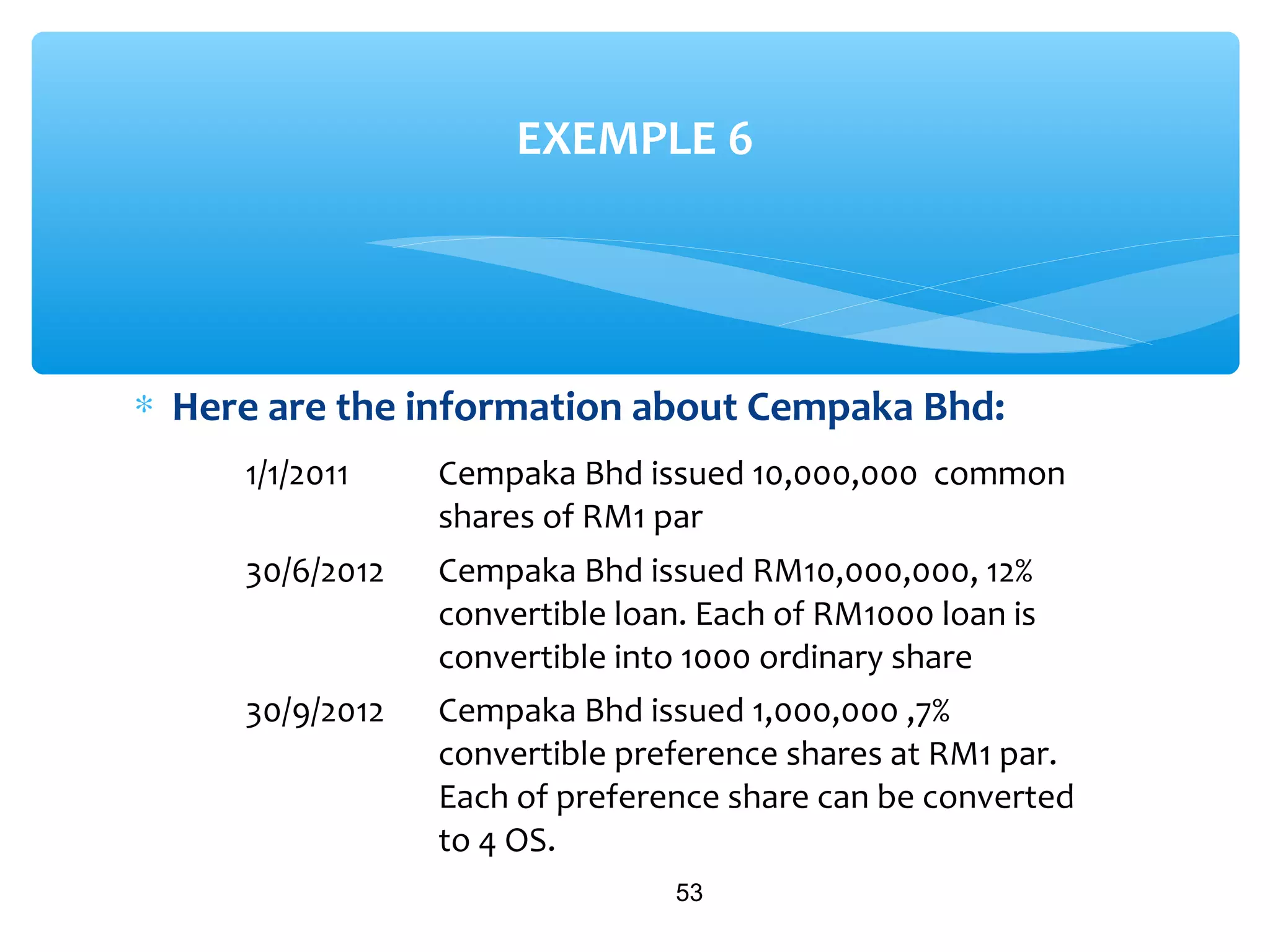
∗ Here are the information about Cempaka Bhd:
53
EXEMPLE 6
1/1/2011 Cempaka Bhd issued 10,000,000 common
shares of RM1 par
30/6/2012 Cempaka Bhd issued RM10,000,000, 12%
convertible loan. Each of RM1000 loan is
convertible into 1000 ordinary share
30/9/2012 Cempaka Bhd issued 1,000,000 ,7%
convertible preference shares at RM1 par.
Each of preference share can be converted
to 4 OS.
54
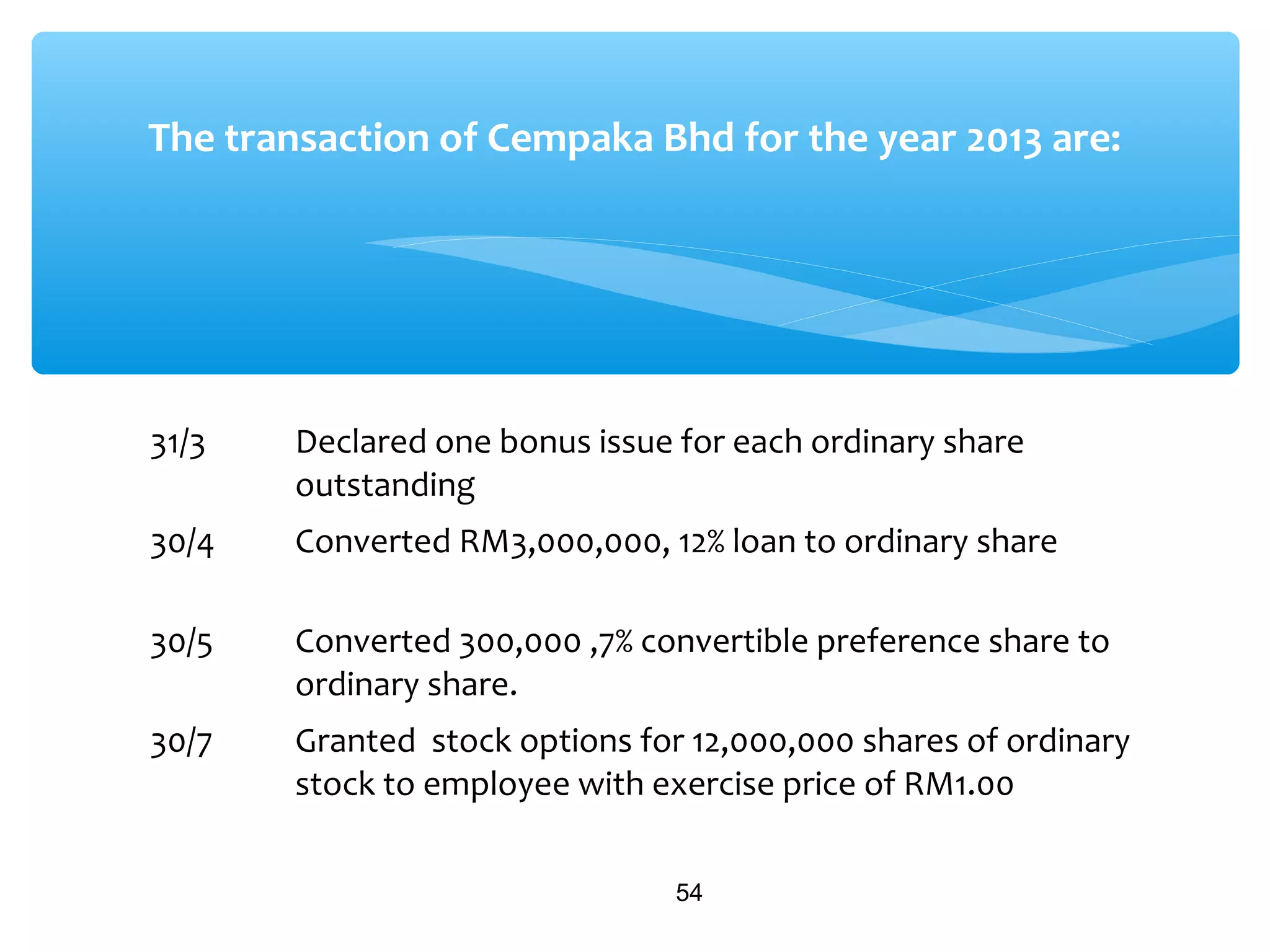
The transaction of Cempaka Bhd for the year 2013 are:
31/3 Declared one bonus issue for each ordinary share
outstanding
30/4 Converted RM3,000,000, 12% loan to ordinary share
30/5 Converted 300,000 ,7% convertible preference share to
ordinary share.
30/7 Granted stock options for 12,000,000 shares of ordinary
stock to employee with exercise price of RM1.00
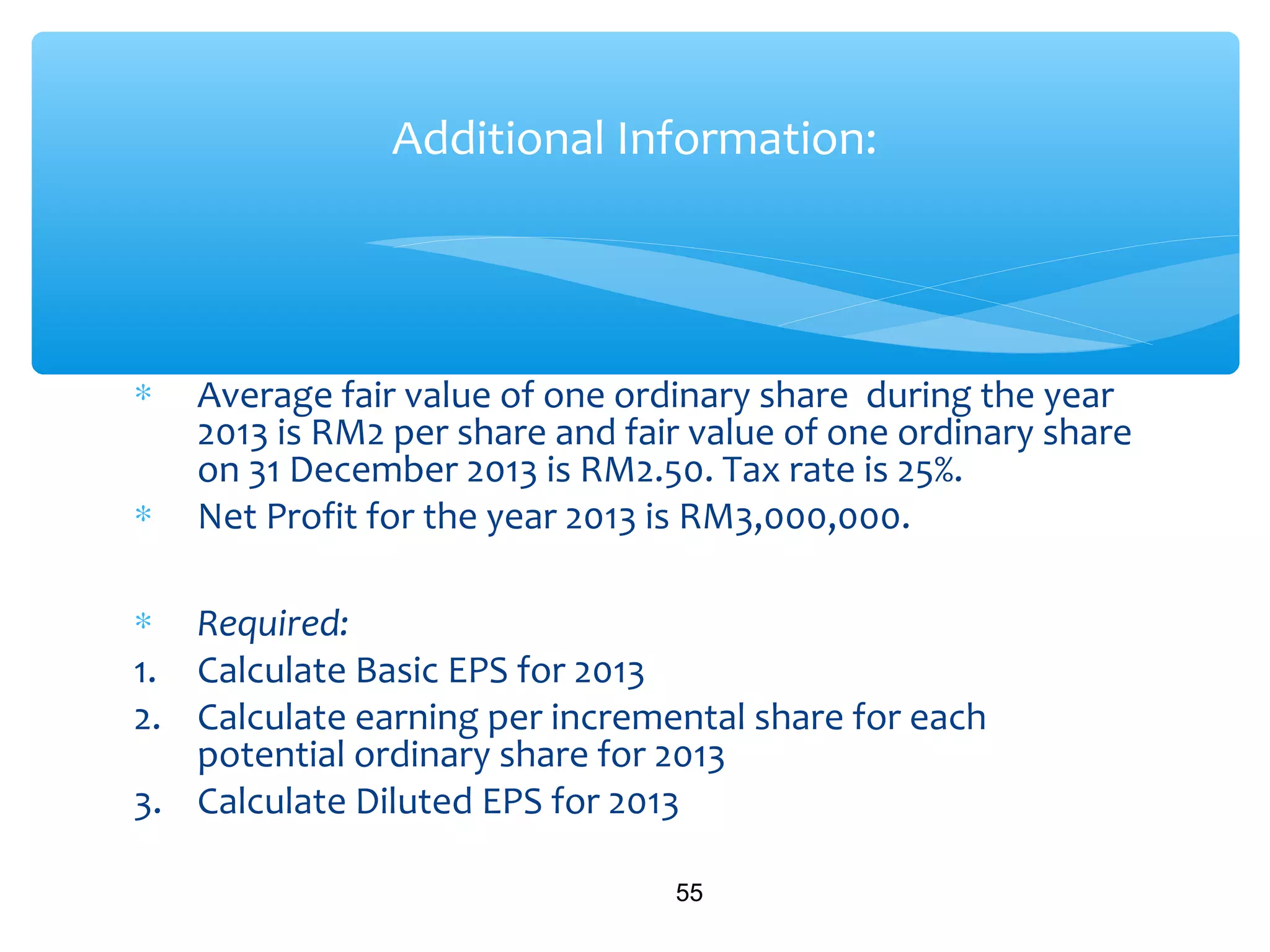
∗ Average fair value of one ordinary share during the year
2013 is RM2 per share and fair value of one ordinary share
on 31 December 2013 is RM2.50. Tax rate is 25%.
∗ Net Profit for the year 2013 is RM3,000,000.
∗ Required:
1. Calculate Basic EPS for 2013
2. Calculate earning per incremental share for each
potential ordinary share for 2013
3. Calculate Diluted EPS for 2013
55
Additional Information:
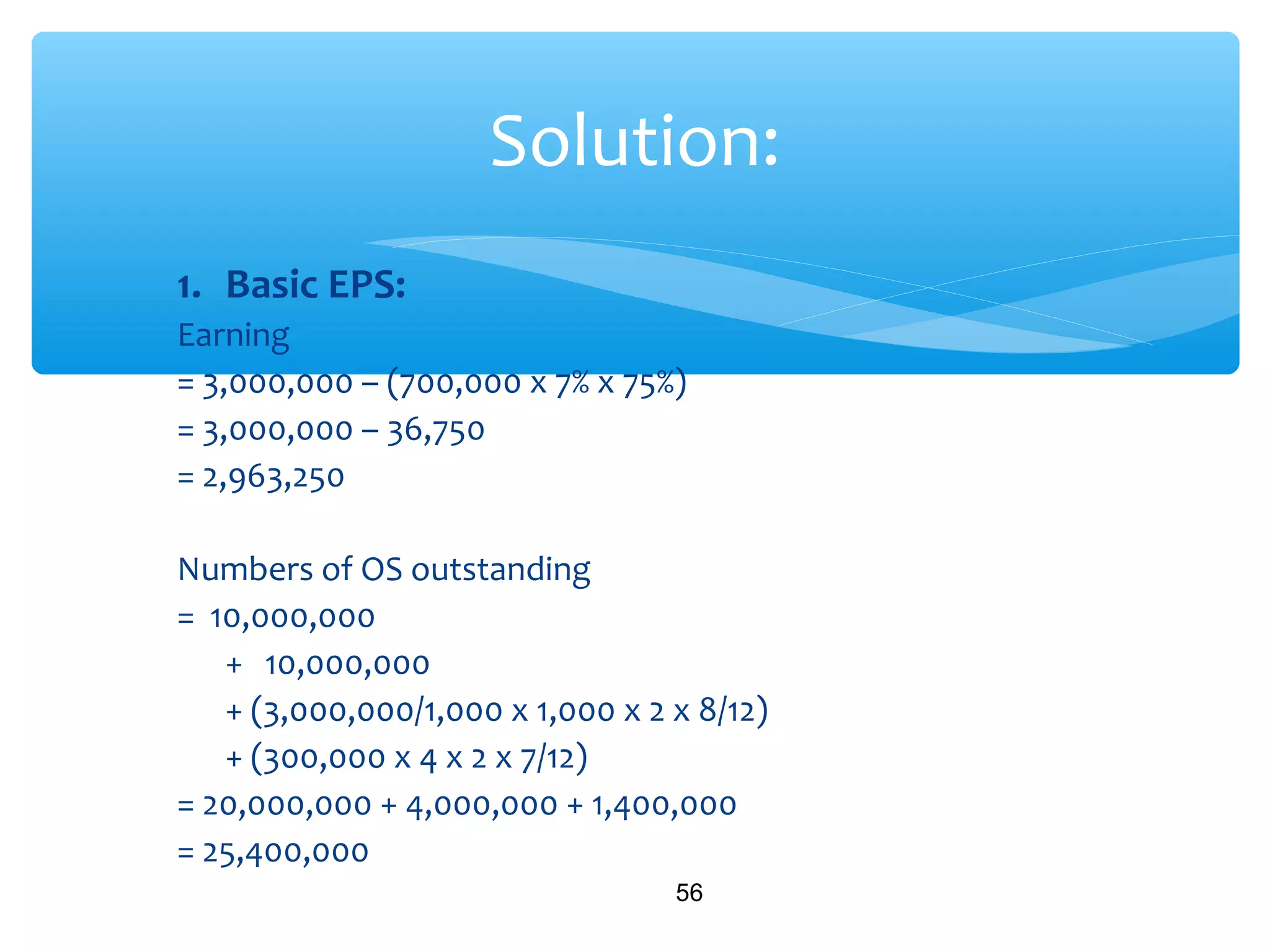
1. Basic EPS:
Earning
= 3,000,000 – (700,000 x 7% x 75%)
= 3,000,000 – 36,750
= 2,963,250
Numbers of OS outstanding
= 10,000,000
+ 10,000,000
+ (3,000,000/1,000 x 1,000 x 2 x 8/12)
+ (300,000 x 4 x 2 x 7/12)
= 20,000,000 + 4,000,000 + 1,400,000
= 25,400,000
56
Solution:
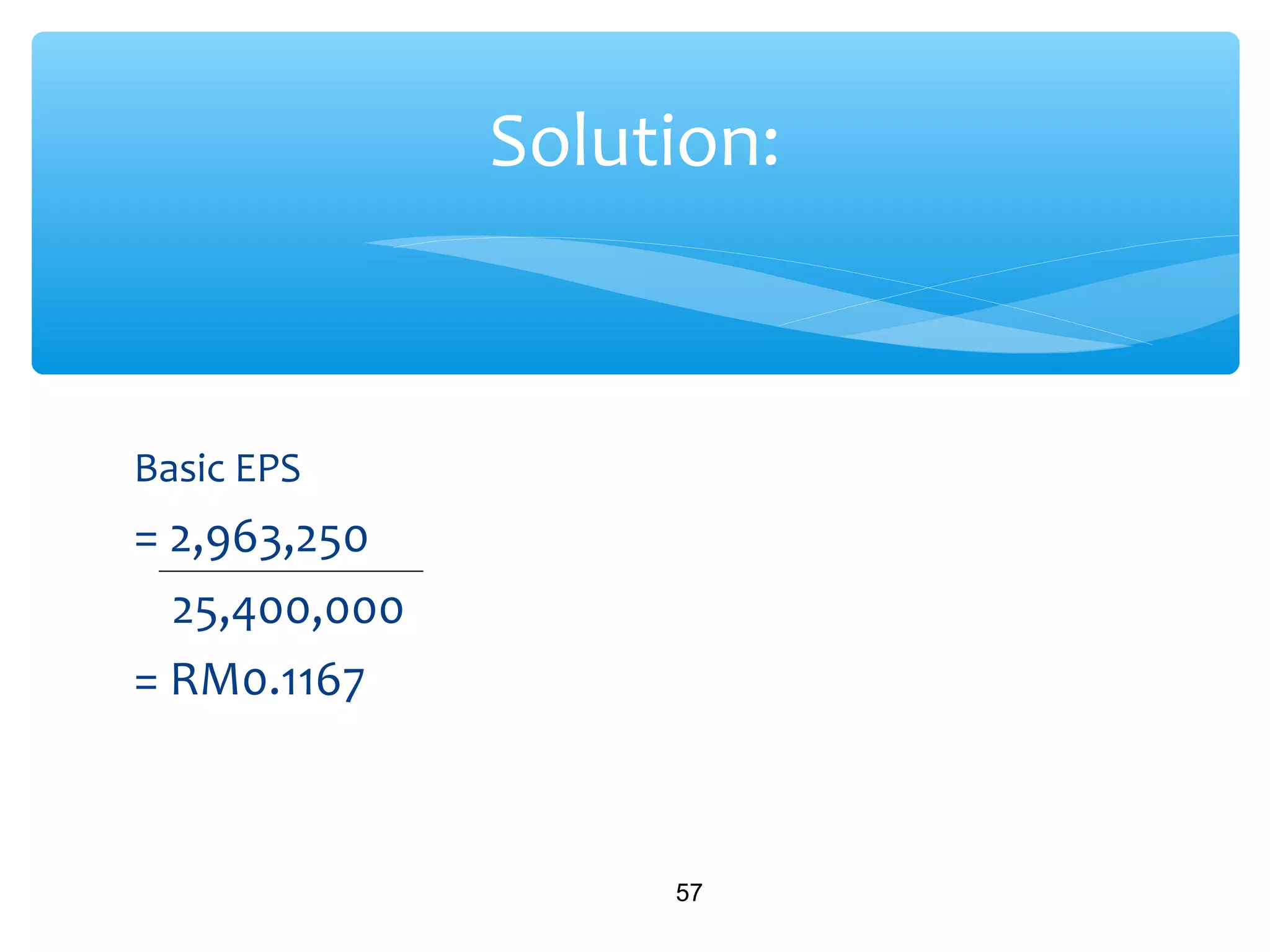
Basic EPS
= 2,963,250
25,400,000
= RM0.1167
57
Solution:
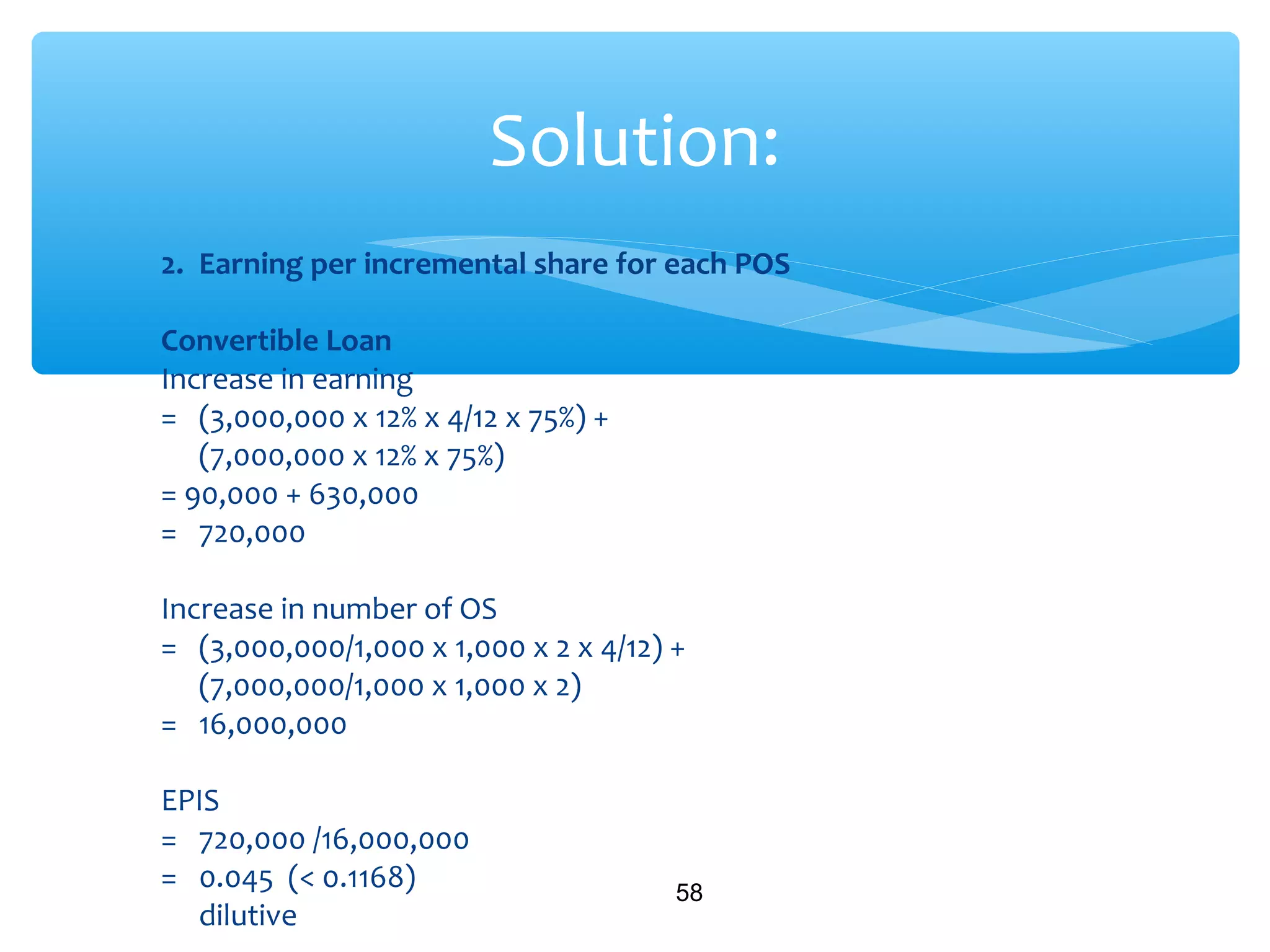
2. Earning per incremental share for each POS
Convertible Loan
Increase in earning
= (3,000,000 x 12% x 4/12 x 75%) +
(7,000,000 x 12% x 75%)
= 90,000 + 630,000
= 720,000
Increase in number of OS
= (3,000,000/1,000 x 1,000 x 2 x 4/12) +
(7,000,000/1,000 x 1,000 x 2)
= 16,000,000
EPIS
= 720,000 /16,000,000
= 0.045 (< 0.1168)
dilutive
58
Solution:
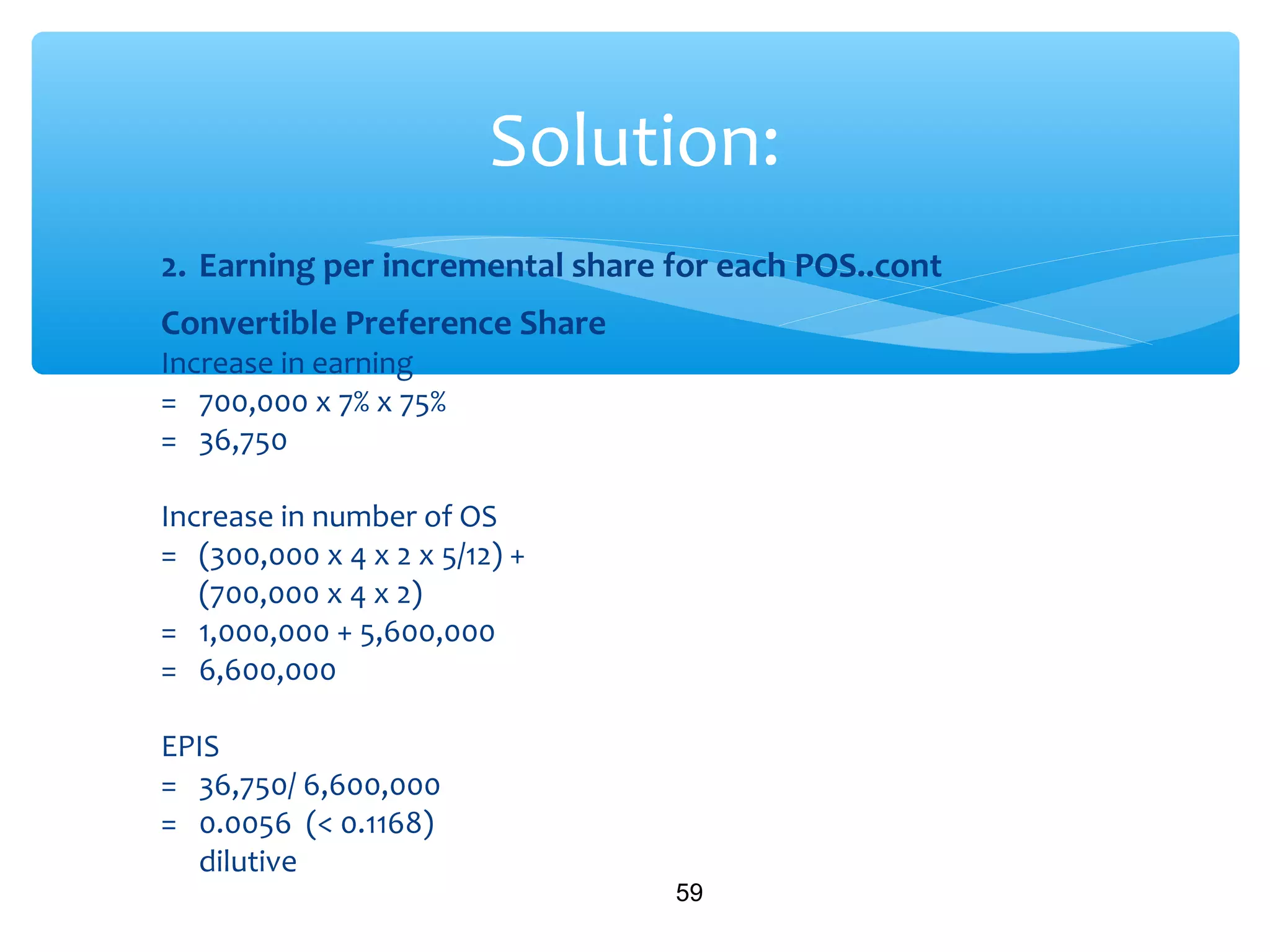
2. Earning per incremental share for each POS..cont
Convertible Preference Share
Increase in earning
= 700,000 x 7% x 75%
= 36,750
Increase in number of OS
= (300,000 x 4 x 2 x 5/12) +
(700,000 x 4 x 2)
= 1,000,000 + 5,600,000
= 6,600,000
EPIS
= 36,750/ 6,600,000
= 0.0056 (< 0.1168)
dilutive
59
Solution:
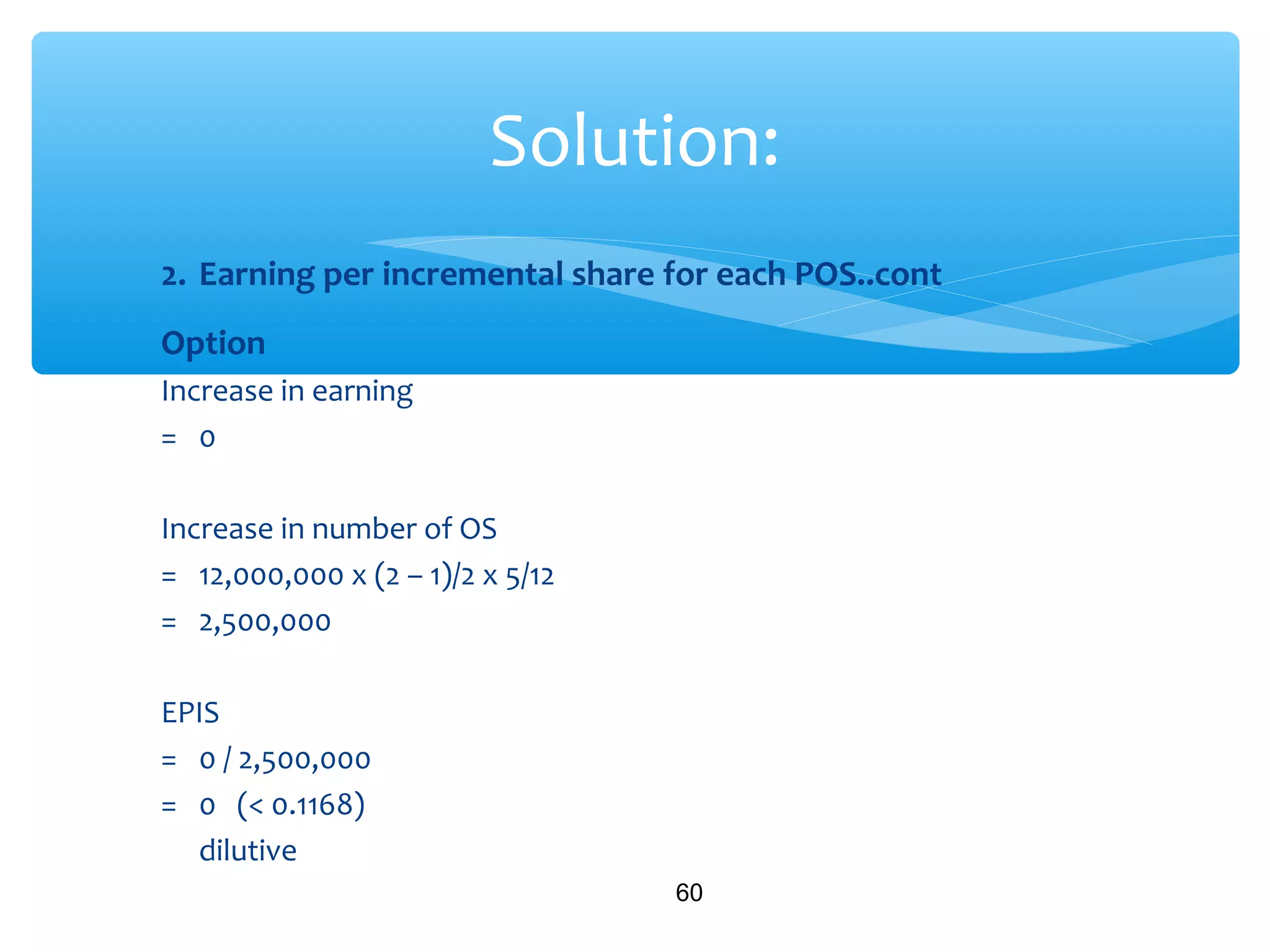
2. Earning per incremental share for each POS..cont
Option
Increase in earning
= 0
Increase in number of OS
= 12,000,000 x (2 – 1)/2 x 5/12
= 2,500,000
EPIS
= 0 / 2,500,000
= 0 (< 0.1168)
dilutive
60
Solution:
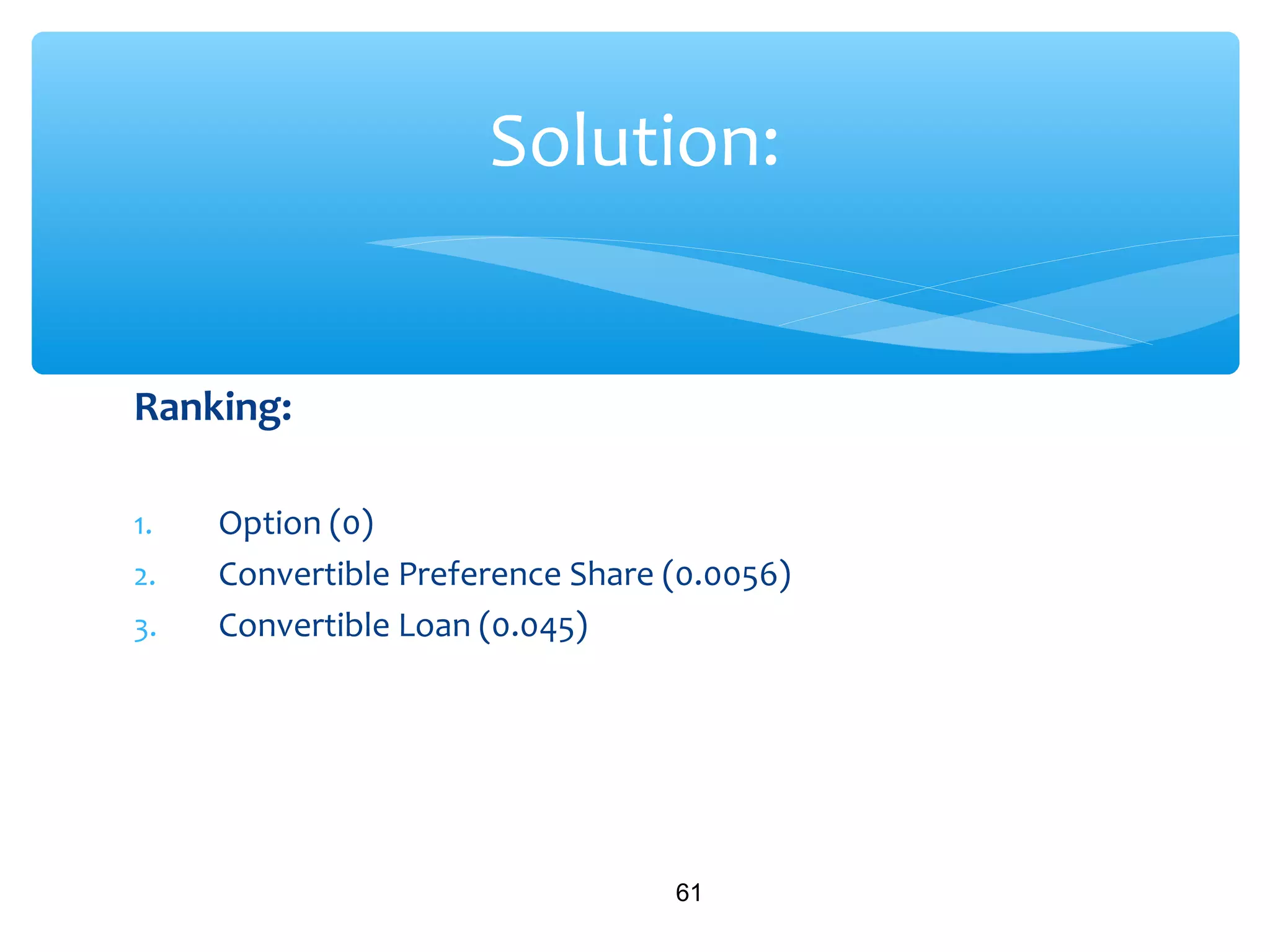
Ranking:
1. Option (0)
2. Convertible Preference Share (0.0056)
3. Convertible Loan (0.045)
61
Solution:
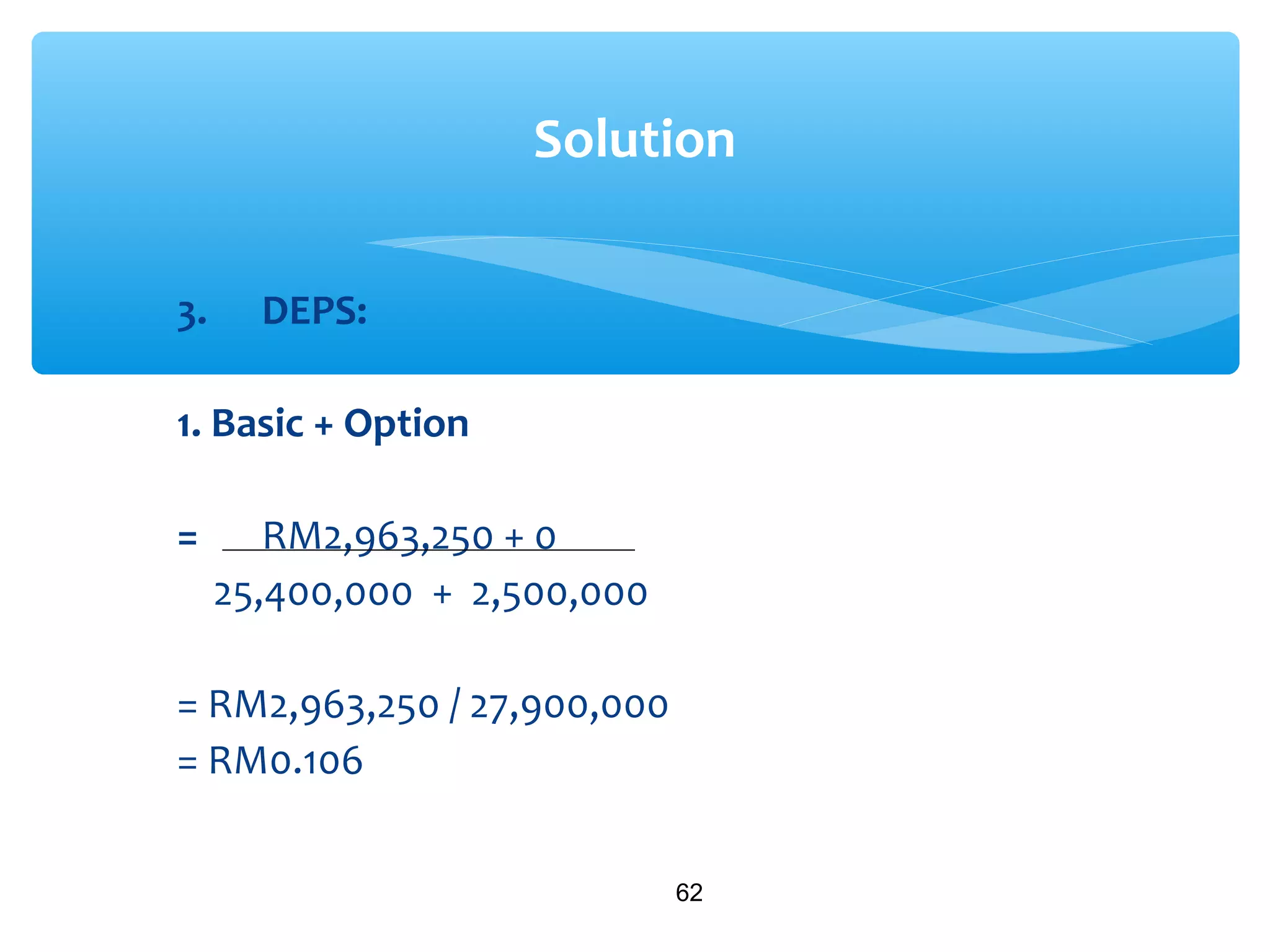
3. DEPS:
1. Basic + Option
= RM2,963,250 + 0
25,400,000 + 2,500,000
= RM2,963,250 / 27,900,000
= RM0.106
62
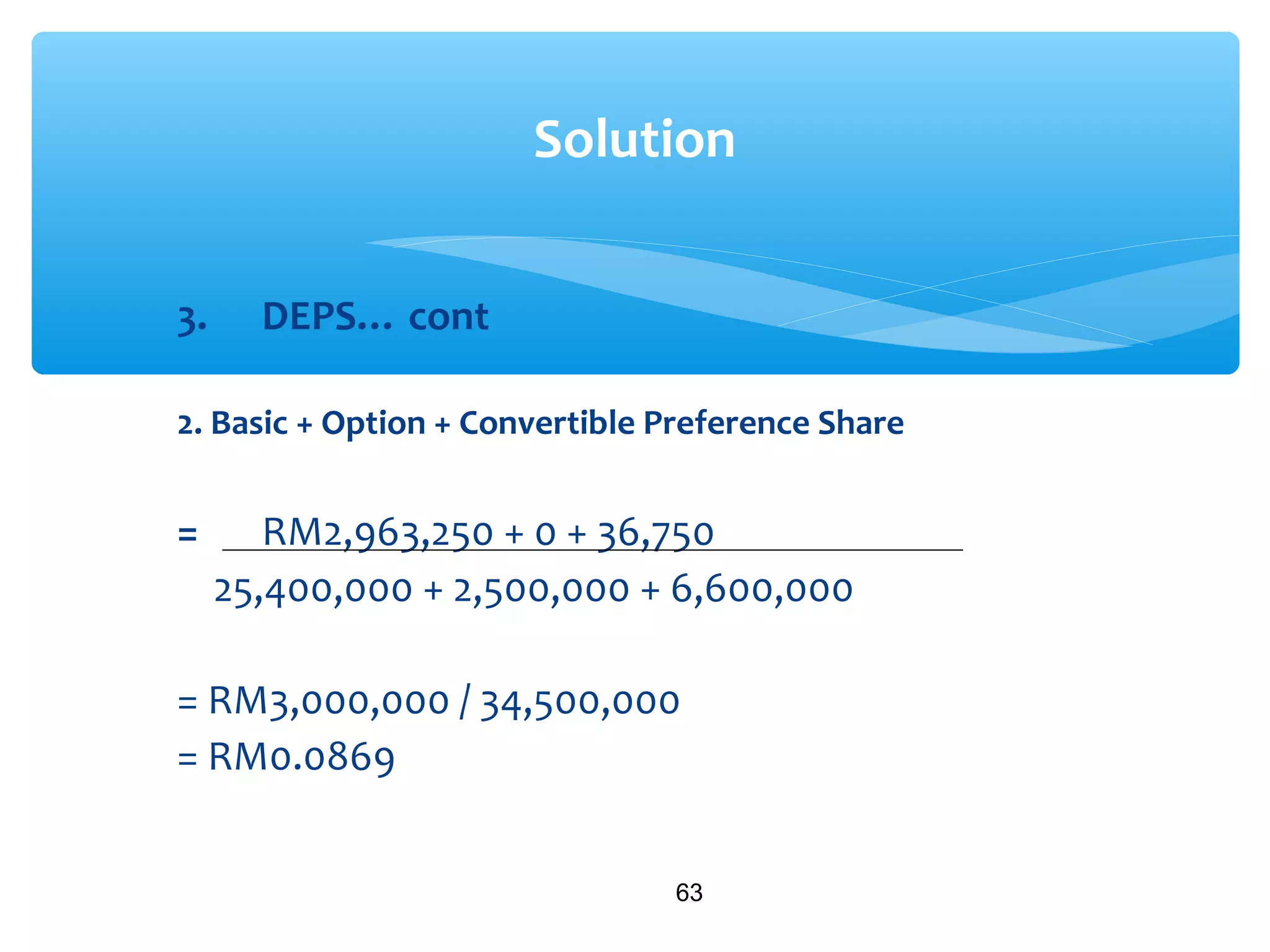
Solution
3. DEPS… cont
2. Basic + Option + Convertible Preference Share
= RM2,963,250 + 0 + 36,750
25,400,000 + 2,500,000 + 6,600,000
= RM3,000,000 / 34,500,000
= RM0.0869
63
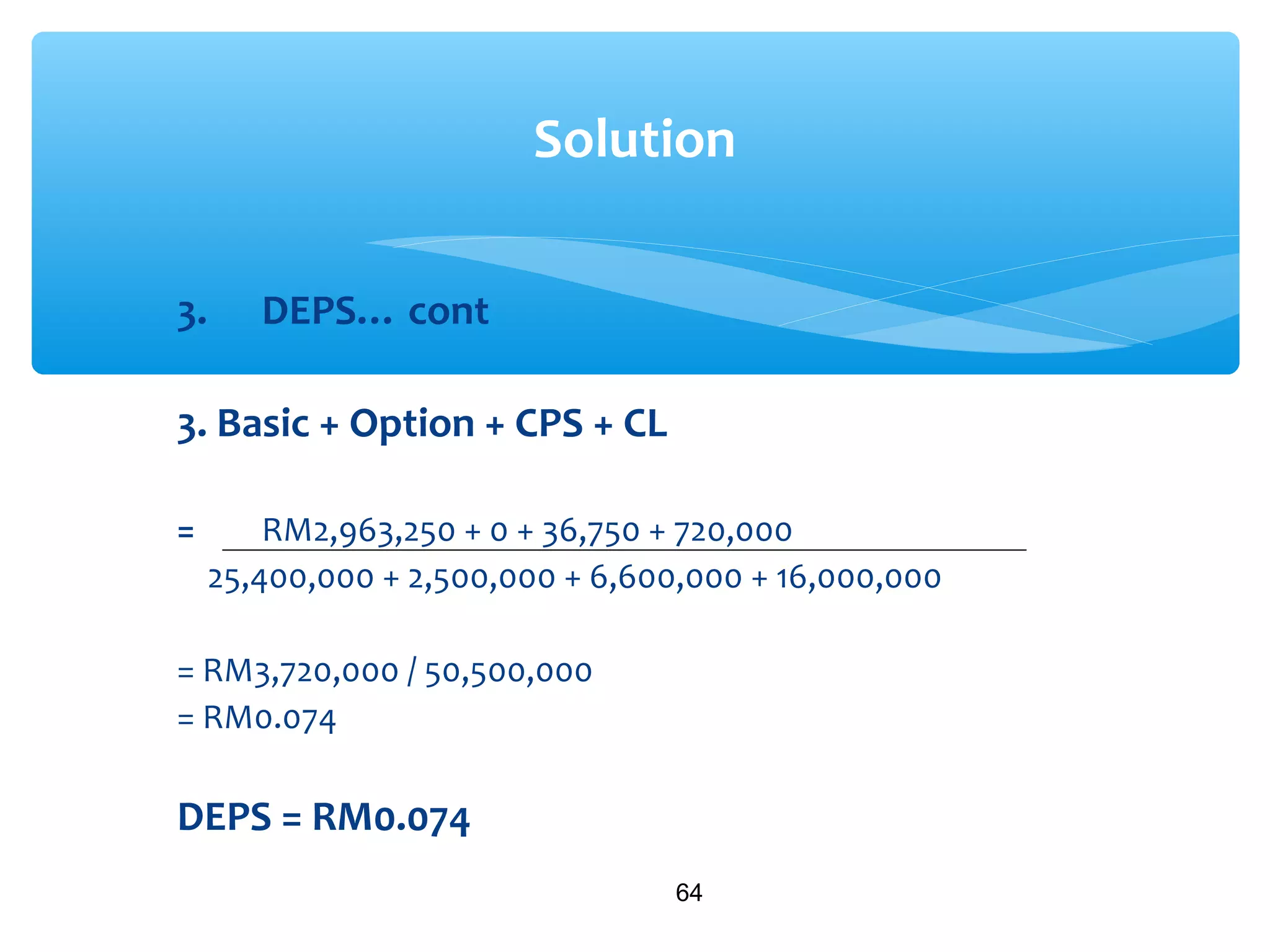
Solution
3. DEPS… cont
3. Basic + Option + CPS + CL
= RM2,963,250 + 0 + 36,750 + 720,000
25,400,000 + 2,500,000 + 6,600,000 + 16,000,000
= RM3,720,000 / 50,500,000
= RM0.074
DEPS = RM0.074
64
Solution
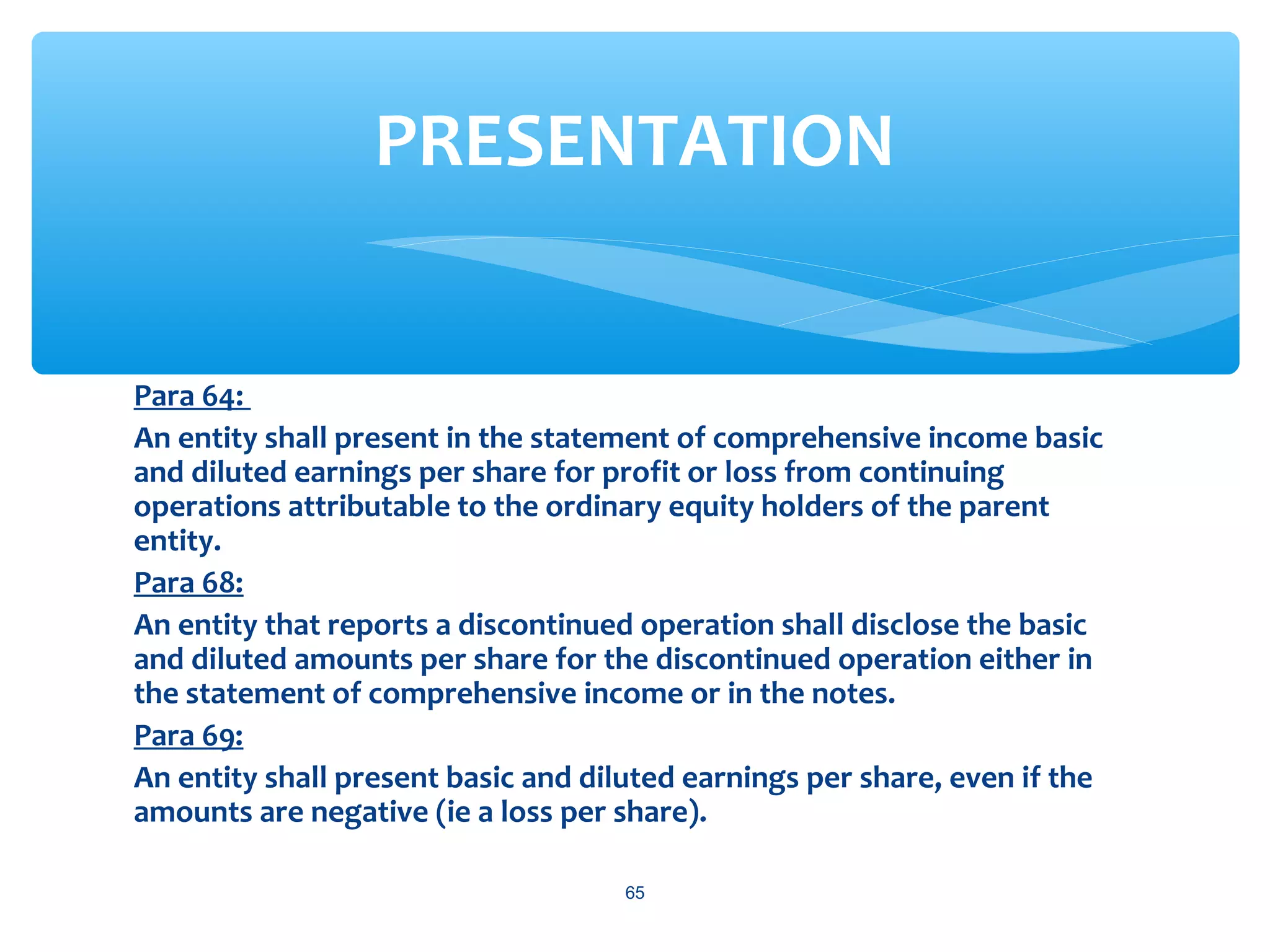
Para 64:
An entity shall present in the statement of comprehensive income basic
and diluted earnings per share for profit or loss from continuing
operations attributable to the ordinary equity holders of the parent
entity.
Para 68:
An entity that reports a discontinued operation shall disclose the basic
and diluted amounts per share for the discontinued operation either in
the statement of comprehensive income or in the notes.
Para 69:
An entity shall present basic and diluted earnings per share, even if the
amounts are negative (ie a loss per share).
65
PRESENTATION
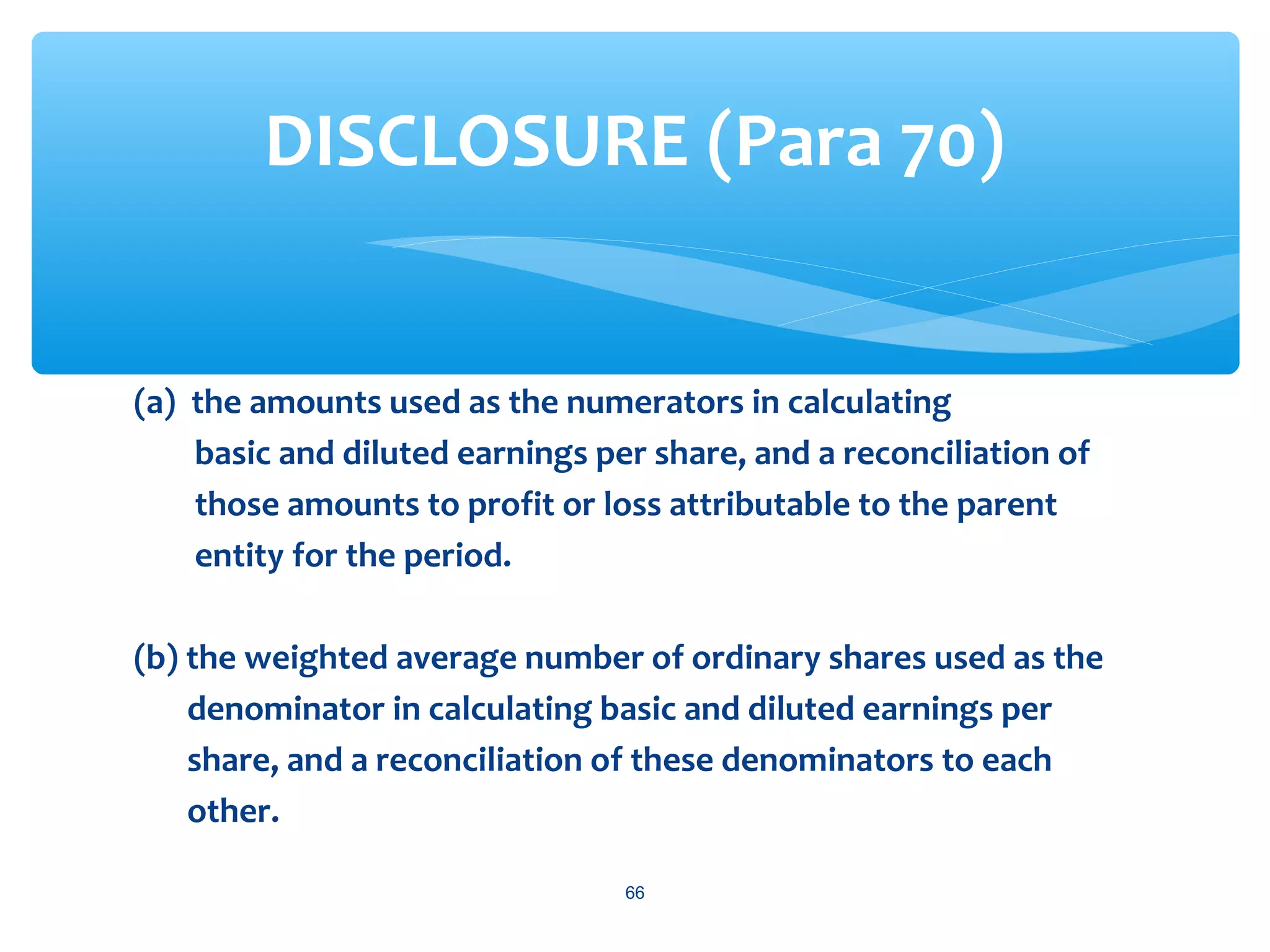
(a) the amounts used as the numerators in calculating
basic and diluted earnings per share, and a reconciliation of
those amounts to profit or loss attributable to the parent
entity for the period.
(b) the weighted average number of ordinary shares used as the
denominator in calculating basic and diluted earnings per
share, and a reconciliation of these denominators to each
other.
66
DISCLOSURE (Para 70)
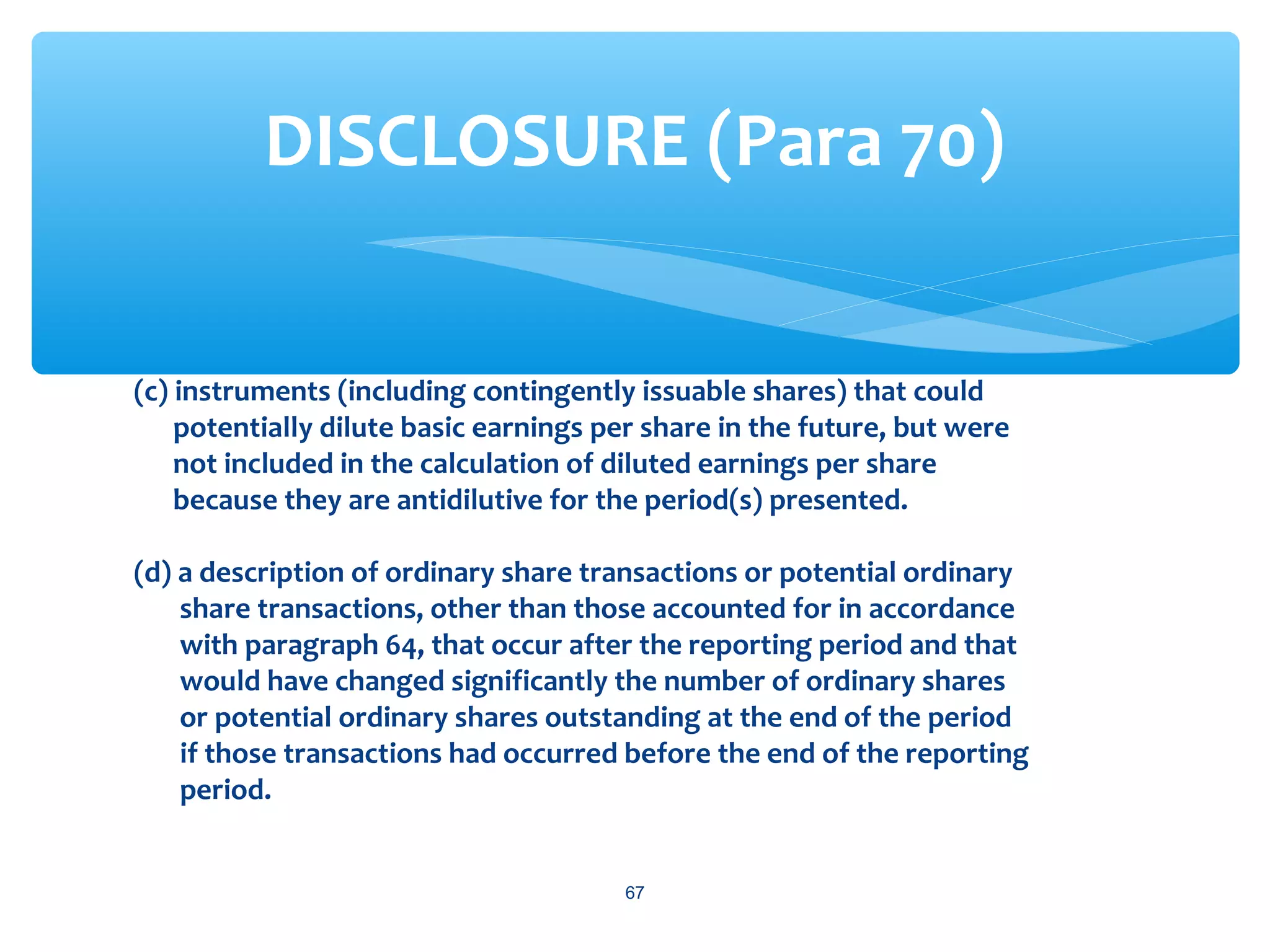
(c) instruments (including contingently issuable shares) that could
potentially dilute basic earnings per share in the future, but were
not included in the calculation of diluted earnings per share
because they are antidilutive for the period(s) presented.
(d) a description of ordinary share transactions or potential ordinary
share transactions, other than those accounted for in accordance
with paragraph 64, that occur after the reporting period and that
would have changed significantly the number of ordinary shares
or potential ordinary shares outstanding at the end of the period
if those transactions had occurred before the end of the reporting
period.
67
DISCLOSURE (Para 70)
END OF TOPIC 7
68

Topic 7 earnings_per_share

  • 1.
    TOPIC 7 EARNINGS PERSHARE (EPS) 1
  • 2.
    ∗ Refer toMFRS 133 ∗ Effective =1 January 2012 ∗ Definition : the amount of profit attributable to each equity share ∗ Useful information to investors: ∗ EPS is used by investors to evaluate & compare company performance ∗ EPS forms the basis for calculating the price-earning ratio (a standard share market indicator) ∗ Ratio used to value the shares of a company in a variety of investment decisions – buying shares, mergers & acquisition. 2 EARNING PER SHARE
  • 3.
    Applied by: ∗ enterpriseswhose ordinary shares(OS) or potential ordinary share (POS) are publicly traded, and ∗ enterprises that are in process of issuing OS or POS in public securities market 3 EARNING PER SHARE
  • 4.
    ∗ Required todisclose EPS in accordance with the standard ∗ When both parent and consolidated financial statement are presented, only EPS on the basis of consolidated need to be presented 4 ENTERPRISES WHOSE SHARES ARE PUBLICLY TRADED
  • 5.
    ∗ NOT requiredto disclosed EPS. However, if EPS is to be disclosed, the calculation and disclosure should apply accordance with the standard 5 ENTERPRISES WHOSE SHARES ARE NOT PUBLICLY TRADED
  • 6.
    ∗ On theface of Income Statement ∗ Present both: 1. Basic EPS 2. Diluted EPS (DEPS) ..even if the amounts are -ve 6 PRESENTATION IN THE FINANCIAL STATEMENT
  • 7.
    ∗ Income statements ∗For the financial year ended 30 April 2012 ∗ The accompanying accounting policies and explanatory notes form an integral part of the financial statements. Group Company ∗ Note 2012 2011 2012 2011 ∗ Revenue 4 534,123,476 443,656,780 12,040,253 11,027,004 ∗ Cost of sales 5 (456,716,114) (378,137,634) - - ∗ Gross profit 77,407,362 65,519,146 12,040,253 11,027,004 ∗ Other items of income ∗ Interest income 6 531,224 318,368 100,733 8,301 ∗ Dividend income 7 844,092 249,444 - - ∗ Other income 8 3,943,047 1,045,128 - - ∗ Other items of expense ∗ Administrative expenses (32,291,185) (29,773,190) (891,630) (959,194) ∗ Selling and distribution expenses (9,014,607) (13,584,269) - - ∗ Finance costs 9 (545,656) (515,732) (299) (309) ∗ Profit before tax 10 40,874,277 23,258,895 11,249,057 10,075,802 ∗ Income tax expense 13 (10,235,977) (5,998,750) (1,638,031) (2,042,153) ∗ Profit net of tax 30,638,300 17,260,145 9,611,026 8,033,649 ∗ Profit attributable to: ∗ Owners of the parent 30,638,281 17,258,575 9,611,026 8,033,649 ∗ Non-controlling interests 19 1,570 - - ∗ 30,638,300 17,260,145 9,611,026 8,033,649 ∗ Earnings per share ∗ attributable to owners ∗ of the parent ∗ (sen per share) ∗ Basic 14 28.5 16.7 ∗ Diluted 14 28.5 16.6 EXAMPLE ON DISCLOSURE OF EPS IN ANNUAL REPORT 7
  • 8.
    ∗ 14. Earningsper share ∗ The basic earnings per share amounts are calculated by dividing profit for the year, net of tax, attributable ∗ to owners of the parent by the weighted average number of ordinary shares outstanding during the ∗ financial year. ∗ The diluted earnings per share amounts are calculated by dividing profit for the year, net of tax, attributable ∗ to owners of the parent by the weighted average number of ordinary shares outstanding during the ∗ financial year plus the weighted average number of ordinary shares that would be issued on the conversion ∗ of all the dilutive potential ordinary shares into ordinary shares. ∗ The following reflect the profit and share data used in the computation of basic and diluted earnings ∗ per share for the years ended 30 April 2012 and 2011: ∗ Group ∗ 2012 2011 ∗ RM RM ∗ Profit net of tax attributable to owners of the parent used in the ∗ computation of diluted earnings per share 30,638,281 17,258,575 ∗ Weighted average number of ordinary shares for basic earnings ∗ per share computation 107,655,876 103,589,521 ∗ Effects of dilution: ∗ - Share options - 288,605 ∗ Weighted average number of ordinary shares for diluted earnings ∗ per share computation 107,655,876 103,878,126 ∗ Basis earnings per share (sen) 28.5 16.7 ∗ Diluted earnings per share (sen) 28.5 16.6 EXAMPLE ON DISCLOSURE OF EPS IN ANNUAL REPORT (NOTES TO FINANCIAL STATEMENT) 8
  • 9.
    * For acompany with a simple capital structure of one class of ordinary shares. * Should be presented by a company that has no potential ordinary shares, that is no outstanding commitments regarding share capital such as convertible securities, option and warrants. Profit After Tax Attributable To Ordinary Shareholders of Parent – Preference Dividend *(after tax) Number of Ordinary Shares Outstanding ∗Profit After Tax Attributable To Ordinary Shareholders of Parent = Profit After Tax (Net Profit) – Non Controlling Interest 9 BASIC EPS
  • 10.
    ∗ For non-cumulativepreference shares …declared dividend ∗ For cumulative preference shares …declared/not declared dividend for current period 10 BASIC EPS : Preference Dividend*
  • 11.
    ∗ Weighted averagenumber of ordinary shares outstanding during the period ∗ Changes in number of shares during the period: With consideration Without consideration 11 NUMBER OF ORDINARY SHARES OUTSTANDING
  • 12.
    ∗ There havea changes in resources (increase or inflow of net asset) : a) New shares issue for cash b) Shares buy back ** number of OS are adjusted for the new shares issued and share buy back on a time proportionate basis. 12 CHANGES IN NUMBER OF SHARE ..WITH CONSIDERATION
  • 13.
    During year 2013,the numbers of ordinary shares for Mawar Bhd are: No. of Shares 1 Jan – Balance at beginning year 3,000 1 July – Issue of new shares for cash 1,200 1 Okt - Shares bought back 400 Net profit for the year 2013 are RM1,600. The amounts of preference dividend declared by Mawar Bhd was RM270(after tax) Required: Calculate EPS for Mawar Bhd Earning = 1,600 – 270 = 1,330 13 EXAMPLE 1..WITH CONSIDERATION
  • 14.
    Weighted average numberof ordinary shares outstanding during the period: = 3,000 + (1,200 x 6/12) –(400 x 3/12) = 3,500 Or = (3,000 x 6/12) + (4,200 x 3/12) + (3,800 x 3/12) = 3,500 14 CALCULATION-EXAMPLE 1
  • 15.
    Basic EPS = 1,330 3,500 =RM0.38 15 CALCULATION-EXAMPLE 1 –(CON’T)
  • 16.
    There is nochanges in resource (increase or inflow of net asset): 1. Bonus issue 2. Shares split 3. Consolidation of shares 4. Rights issue … numbers of OS are adjusted as if the event had occurred at the beginning of the earliest period reported 16 CHANGES IN NUMBER OF SHARE ..WITHOUT CONSIDERATION
  • 17.
    BONUS ISSUE: Net profit2012 RM6,000 Net profit 2013 RM15,000 Ordinary shares outstanding until 31 August 2013 20,000 Bonus issue on 1 September 2013: 2 ordinary shares for each ordinary shares outstanding Required: Calculate EPS for 2013 and adjusted EPS for 2012 17 EXAMPLE 2..WITHOUT CONSIDERATION
  • 18.
    Number of bonus =20,000 x2 = 40,000 EPS 2013: = RM15,000 (20,000 + 40,000) = RM0.25 Adjusted EPS 2012: = RM6,000 / 60,000 = RM0.10 per share 18 CALCULATION: EXAMPLE 2
  • 19.
    RIGHT ISSUE *An invitationto existing shareholders to buy additional shares at a special price ∗ the exercise price is often less than the fair value of shares, therefore, such rights issue includes a bonus element ∗ The number of ordinary shares to be used in calculating BEPS: the number of ordinary shares X factor * outstanding prior to right issue 19 WITHOUT CONSIDERATION..RIGHT ISSUE
  • 20.
    * Factor: = FVper share immediately prior to the exercise of rights **Theoretical ex-rights value per share 20 WITHOUT CONSIDERATION..RIGHT ISSUE (con’t)
  • 21.
    **Theoretical ex-rights valueper share : (Number of Shares before the Rights Issue X ‘Cum right price) + ( Number of Shares Issued under the rights issue X Exercise Price) Number of Share After the Right Issue (Number of Share Outstanding before the rights Issue + Number of Share Issued in the Exercise) 21 WITHOUT CONSIDERATION.. RIGHT ISSUE (con’t)
  • 22.
    ∗ Net profit 20112012 2013 RM3,200 RM4,000 RM5,800 Shares outstanding prior to right issue= 1,500 shares 22 EXAMPLE 3 ...RIGHT ISSUE (Con’t)
  • 23.
    ∗ Right issue: One new shares for each five outstanding ∗ Exercise price : RM9.90 ∗ Last date to exercise rights : 1 Mei 2012 ∗ Fair value of one ordinary share on 30 April 2012 : RM15.00 ∗ Required: Calculate BEPS for 2011, 2012, 2013 23 EXAMPLE 3 ...RIGHT ISSUE (Con’t)
  • 24.
    Calculation: Right issue: =1,500 /5 = 300 Computation of theoretical ex-rights value per share; = (1,500 x 15) + (300 x 9.90) 1,500 + 300 = RM14.15 24 EXAMPLE 3 ...RIGHT ISSUE (Con’t)
  • 25.
    Computation of adjustmentfactor: = 15 14.15 = 1.06 25 EXAMPLE 3 ...RIGHT ISSUE (Con’t)
  • 26.
    Computation of BEPS: Year2011 (as originally reported): = 3,200 / 1,500 = RM2.13 Year 2011 (restated for rights issue): = 3,200 (1,500 x 1.06) = RM2.01 26 EXAMPLE 3 ...RIGHT ISSUE (Con’t)
  • 27.
    Year 2012: = 4,000 (1,500x 1.06 x4/12) + (1,800 x 8/12) = RM2.31 BEPS Year 2013 = 5,800 / 1,800 = RM3.22 27 EXAMPLE 3 ...RIGHT ISSUE (Con’t)
  • 28.
    • Diluted EPSmeans decrease or reduction in EPS. • EPS may decrease if the equity profit is divided by a greater number of equity shares which can arise because of existing commitments regarding share capital such as warrant, option and convertible securities. • MFRS 133 defines these commitments as potential ordinary share (POS) which are defined as “ a financial instrument or other contract that may entitle its holder to ordinary shares”. • Diluted EPS must be shown to indicate the potential that the current EPS may be diluted in future because of those POS. • The dilution is not an actual one, but potential dilution, which may or may not occur in the future. • The information about DEPS is important because shareholders and investors should be made aware of potential danger that the EPS is future may be diluted if existing POS were all converted or exercised to ordinary shares of the company. DILUTED EARNING PER SHARE (DEPS) 28
  • 29.
    ∗ POS –financial instrument or other contract that may entitle its holder to OS: a) convertible preference shares b) convertible debt c) share warrants and options d) employee plan ∗ Net profit and weighted average number of shares should be adjusted for the effect of all ‘dilutive potential ordinary shares’(DPOS) ∗ DEPS – more forward looking & is intended to act as a warning to existing/prospective shareholders 29 DILUTED EARNING PER SHARE(DEPS)
  • 30.
    POS: DILUTIVE ORANTIDILUTIVE? ∗ Decrease EPS from continuing ordinary operation - Dilutive (DPOS) ∗ Increase EPS from continuing ordinary operation - Antidilutive 30 DILUTED EPS (Con’t)
  • 31.
    EFFECTS DPOS ONNET PROFIT(NP): 1. Dividend recognize 2. Interest recognize 3. Other changes in income/expense-result from the conversion of DPOS ∗ Will no longer be incurred (if POS are converted into OS) – Net Profit increased ∗ In computing DEPS, the earnings for the period should be adjusted by adding back the assumed saving in interest on the securities so converted and dividend for preference share and adding or deducting other changes in income and expenses that would result from the conversion of the convertible securities.31 DILUTED EARNING PER SHARE (Con’t)
  • 32.
    EFFECT DPOS ONWEIGHTED AVERAGE NUMBER OF SHARES: ∗Increase number of shares - Number of shares is determined from the terms of POS 32 DILUTED EARNING PER SHARE (Con’t)
  • 33.
    OPTION & WARRANT ∗Options are special rights given to employees to acquire ordinary shares. ∗ Warrant is a long-dated call option that gives the holder the right to subscribe ordinary shares of a company, normally as a package with unsecured loan stocks. ∗ The difference between the number of shares issued under option and the number of shares that would have been issued at fair value should be treated as an issue of ordinary shares without consideration. ∗ Option/warrant that would result in the issue of OS for less than fair value are dilutive. ∗ Fair value of ordinary shares – average price of OS during the period. ∗ No adjustments are made to the earnings. 33 DILUTED EARNING PER SHARE (Con’t)
  • 34.
    ∗ The informationabout Kenanga Bhd for the year 2013 are: ∗ Required: Calculate BEPS and DEPS34 EXAMPLE 4 - OPTION Net profit RM250,000 Weighted average of OS 62,500 Average FV of OS RM16 Weighted average of option 8,000 Exercise price share under option RM12
  • 35.
    Increase in numbersof OS: Numbers of shares under option = 8,000 Number of shares that would been issued at FV (p37a) = (8,000 x 12) / 16 = 6,000 Incremental shares issued without consideration(p37b) = 8,000 – 6,000 = 2,000 Or: = 8,000 x (RM16 – RM12)/RM16 = 2,000 35 EXAMPLE 4 -CALCULATION
  • 36.
  • 37.
    DEPS: Increase in earning=0 Increase in numbers of OS: 37 EXAMPLE 4 -CALCULATION Numbers of shares under option 8,000 (-) Number of shares that would been issued at FV [(8,000 x 12) / 16] 6,000 Incremental shares issued without consideration 2,000
  • 38.
    DEPS: = RM250,000 (62,500 +2000) =RM3.88 38 EXAMPLE 4 –CALCULATION (Con’t)
  • 39.
    ∗ Test whetherthey are dilutive or antidilutive separately Steps: 1. compute earning per incremental share related to each POS 2. those earning per incremental share that are higher than ‘net profit per share from continuing operation (control number)* are ANTIDILUTIVE and should be excluded 39 DILUTED EPS-IN CASES THERE ARE MORE THAN ONE ‘POS’:
  • 40.
    3. those earningper incremental shares that are lower than ‘net profit per share from continuing operation (control number)’* are DILUTIVE and to be included in computation DEPS with the lowest being included first … and so on 4. The worst …..DEPS 40 DILUTED EPS-IN CASES THERE ARE MORE THAN ONE ‘POS’:
  • 41.
    Para 42 : ∗Anentity uses profit or loss from continuing operations attributable to the parent entity as the control number to establish whether potential ordinary shares are dilutive or antidilutive. ∗Profit or loss from continuing operations attributable to the parent entity shall excludes items relating to discontinued operations. DILUTED EPS-IN CASES THERE ARE MORE THAN ONE ‘POS’: 41
  • 42.
    ∗ The informationsabout Dahlia Bhd for the year 2013 are: 42 EXAMPLE 5 - DEPS Net profit attributable to OS (after deduct preference div.) RM125,000 OS outstanding 50,000 Average FV of one OS during year RM25
  • 43.
    ∗ POS 43 EXAMPLE 5– DEPS (Con’t) Option 7,500 with exercise price of RM18 8% convertible bond Nominal amount RM50,000. Each 1000 bond is convertible to 50 OS. Convertible Preference Shares 10,000 shares entitled to a cumulative dividend of RM3 per share (after tax). Each preference share is convertible to 2 OS Tax rates 25%
  • 44.
    Required: Calculate BEPSand DEPS CALCULATION: BEPS: =RM125,000 / 50,000 =RM2.50 44 EXAMPLE 5 – DEPS (Con’t)
  • 45.
    Earning Per IncrementalShare on Conversion of POS 1. Option Increase in earning = 0 Increase in shares : =7,500 x (RM25 – RM18) / (RM25) =2,100 Increase in EPS: =0/2,100 =0 < RM2.5 (dilutive) 45 EXAMPLE 5 - CALCULATION
  • 46.
    2. 8% Convertiblebond Increase in earning: =8% x RM50,000 x (1-25%) =RM3,000 Increase in shares: =50,000 / 1,000 x 50 =2,500 shares Increase in EPS: =RM3,000 / 2,500 =RM1.20 < RM2.5 (dilutive) 46 EXAMPLE 5 – CALCULATION(Con’t)
  • 47.
    3. Convertible preferenceshares Increase in earning: =RM3 x 10,000 =RM30,000 Increase in shares: =2 x 10,000 =20,000 Increase in EPS: =RM30,000 / 20,000 =RM1.5 < RM2.5 (dilutive) 47 EXAMPLE 5 – CALCULATION(Con’t)
  • 48.
    ∗ Ranking: 1. Option(0) 2. 8% Convertible bond (1.20) 3. Convertible Preference share (1.5) 48 EXAMPLE 5 – CALCULATION(Con’t)
  • 49.
    Calculation of DEPS: 1.Basic + Option = RM125,000 + 0 50,000 + 2,100 = RM125,000 52,100 = RM2.40 49 EXAMPLE 5 – CALCULATION(Con’t)
  • 50.
    Calculation of DEPS: 2.Basic + Option + C.Bond = RM125,000 + RM3,000 52,100 + 2,500 = RM128,000 54,600 = RM2.34 50 EXAMPLE 5 – CALCULATION(Con’t)
  • 51.
    3. Basic+option+C.Bond+C.Preference Share =RM128,000 + RM30,000 54,600 + 20,000 = RM158,000 74,600 =RM2.12 The worst is RM2.12 – Diluted EPS 51 EXAMPLE 5 – CALCULATION (Con’t)
  • 52.
    Calculation of BEPS ∗consider the proportion of POS that have been converted to OS Calculation of DEPS: (para38) 1. Proportion of POS that have been converted to OS ∗ at beginning of year or from the date of issuance of POS to the date of conversion 1. Proportion of POS that have not been converted to OS ∗ at beginning of year or from the date of issuance to the end of current year 52 CALCULATION OF BEPS AND DEPS WHEN NOT ALL POS HAVE BEEN CONVERTED TO OS
  • 53.
    ∗ Here arethe information about Cempaka Bhd: 53 EXEMPLE 6 1/1/2011 Cempaka Bhd issued 10,000,000 common shares of RM1 par 30/6/2012 Cempaka Bhd issued RM10,000,000, 12% convertible loan. Each of RM1000 loan is convertible into 1000 ordinary share 30/9/2012 Cempaka Bhd issued 1,000,000 ,7% convertible preference shares at RM1 par. Each of preference share can be converted to 4 OS.
  • 54.
    54 The transaction ofCempaka Bhd for the year 2013 are: 31/3 Declared one bonus issue for each ordinary share outstanding 30/4 Converted RM3,000,000, 12% loan to ordinary share 30/5 Converted 300,000 ,7% convertible preference share to ordinary share. 30/7 Granted stock options for 12,000,000 shares of ordinary stock to employee with exercise price of RM1.00
  • 55.
    ∗ Average fairvalue of one ordinary share during the year 2013 is RM2 per share and fair value of one ordinary share on 31 December 2013 is RM2.50. Tax rate is 25%. ∗ Net Profit for the year 2013 is RM3,000,000. ∗ Required: 1. Calculate Basic EPS for 2013 2. Calculate earning per incremental share for each potential ordinary share for 2013 3. Calculate Diluted EPS for 2013 55 Additional Information:
  • 56.
    1. Basic EPS: Earning =3,000,000 – (700,000 x 7% x 75%) = 3,000,000 – 36,750 = 2,963,250 Numbers of OS outstanding = 10,000,000 + 10,000,000 + (3,000,000/1,000 x 1,000 x 2 x 8/12) + (300,000 x 4 x 2 x 7/12) = 20,000,000 + 4,000,000 + 1,400,000 = 25,400,000 56 Solution:
  • 57.
  • 58.
    2. Earning perincremental share for each POS Convertible Loan Increase in earning = (3,000,000 x 12% x 4/12 x 75%) + (7,000,000 x 12% x 75%) = 90,000 + 630,000 = 720,000 Increase in number of OS = (3,000,000/1,000 x 1,000 x 2 x 4/12) + (7,000,000/1,000 x 1,000 x 2) = 16,000,000 EPIS = 720,000 /16,000,000 = 0.045 (< 0.1168) dilutive 58 Solution:
  • 59.
    2. Earning perincremental share for each POS..cont Convertible Preference Share Increase in earning = 700,000 x 7% x 75% = 36,750 Increase in number of OS = (300,000 x 4 x 2 x 5/12) + (700,000 x 4 x 2) = 1,000,000 + 5,600,000 = 6,600,000 EPIS = 36,750/ 6,600,000 = 0.0056 (< 0.1168) dilutive 59 Solution:
  • 60.
    2. Earning perincremental share for each POS..cont Option Increase in earning = 0 Increase in number of OS = 12,000,000 x (2 – 1)/2 x 5/12 = 2,500,000 EPIS = 0 / 2,500,000 = 0 (< 0.1168) dilutive 60 Solution:
  • 61.
    Ranking: 1. Option (0) 2.Convertible Preference Share (0.0056) 3. Convertible Loan (0.045) 61 Solution:
  • 62.
    3. DEPS: 1. Basic+ Option = RM2,963,250 + 0 25,400,000 + 2,500,000 = RM2,963,250 / 27,900,000 = RM0.106 62 Solution
  • 63.
    3. DEPS… cont 2.Basic + Option + Convertible Preference Share = RM2,963,250 + 0 + 36,750 25,400,000 + 2,500,000 + 6,600,000 = RM3,000,000 / 34,500,000 = RM0.0869 63 Solution
  • 64.
    3. DEPS… cont 3.Basic + Option + CPS + CL = RM2,963,250 + 0 + 36,750 + 720,000 25,400,000 + 2,500,000 + 6,600,000 + 16,000,000 = RM3,720,000 / 50,500,000 = RM0.074 DEPS = RM0.074 64 Solution
  • 65.
    Para 64: An entityshall present in the statement of comprehensive income basic and diluted earnings per share for profit or loss from continuing operations attributable to the ordinary equity holders of the parent entity. Para 68: An entity that reports a discontinued operation shall disclose the basic and diluted amounts per share for the discontinued operation either in the statement of comprehensive income or in the notes. Para 69: An entity shall present basic and diluted earnings per share, even if the amounts are negative (ie a loss per share). 65 PRESENTATION
  • 66.
    (a) the amountsused as the numerators in calculating basic and diluted earnings per share, and a reconciliation of those amounts to profit or loss attributable to the parent entity for the period. (b) the weighted average number of ordinary shares used as the denominator in calculating basic and diluted earnings per share, and a reconciliation of these denominators to each other. 66 DISCLOSURE (Para 70)
  • 67.
    (c) instruments (includingcontingently issuable shares) that could potentially dilute basic earnings per share in the future, but were not included in the calculation of diluted earnings per share because they are antidilutive for the period(s) presented. (d) a description of ordinary share transactions or potential ordinary share transactions, other than those accounted for in accordance with paragraph 64, that occur after the reporting period and that would have changed significantly the number of ordinary shares or potential ordinary shares outstanding at the end of the period if those transactions had occurred before the end of the reporting period. 67 DISCLOSURE (Para 70)
  • 68.