Stock Exchange
HOW DOES STOCK MARKET WORK?
If you start investing in the
stock market
you probably wondered
HOW TO DEAL AND INVEST IN
STOCK EXCHANGE
In order to deal with a securities one hast to have an account called
DEMAT A/c or Trading A/c. it is just like a bank account. Same
procedure od opening the bank account is followed to open the
account. But all the banks do not give this facility. After DENAT A/c is
opened then securities is bought and sold. This banks which gives
facility of DEMAT A/c in India are:
 ICICI Bank
 Citi Bank
 Bank of Baroda
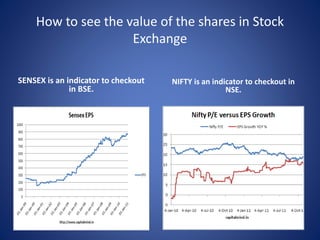
How to see the value of the shares in Stock
Exchange
SENSEX is an indicator to checkout
in BSE.
NIFTY is an indicator to checkout in
NSE.
SPECULATION AND SPECULATOR
 SPECULATION: It is the transaction of members to buy or sell
securities on stock exchange with a view to make profits to
anticipated raise or fall in prices of securities.
 SPECULATOR: The dealer in stock exchange who indulge in
speculation are called speculators. They do not take delivery of
securities purchased or sold by them, but only pap or rescue the
difference between the purchase price and sale price. The different
types of speculators are:
 BULL
 BEAR
 STAG
 LAME DUCK
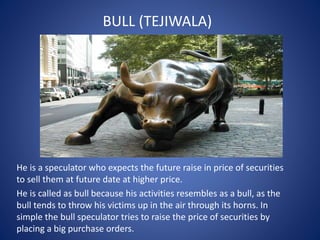
BULL (TEJIWALA)
He is a speculator who expects the future raise in price of securities
to sell them at future date at higher price.
He is called as bull because his activities resembles as a bull, as the
bull tends to throw his victims up in the air through its horns. In
simple the bull speculator tries to raise the price of securities by
placing a big purchase orders.
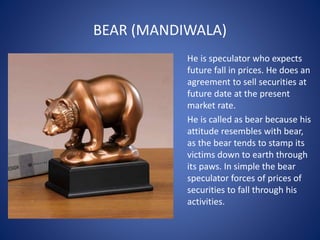
BEAR (MANDIWALA)
He is speculator who expects
future fall in prices. He does an
agreement to sell securities at
future date at the present
market rate.
He is called as bear because his
attitude resembles with bear,
as the bear tends to stamp its
victims down to earth through
its paws. In simple the bear
speculator forces of prices of
securities to fall through his
activities.
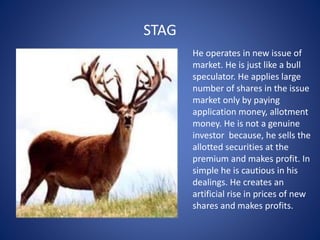
STAG
He operates in new issue of
market. He is just like a bull
speculator. He applies large
number of shares in the issue
market only by paying
application money, allotment
money. He is not a genuine
investor because, he sells the
allotted securities at the
premium and makes profit. In
simple he is cautious in his
dealings. He creates an
artificial rise in prices of new
shares and makes profits.
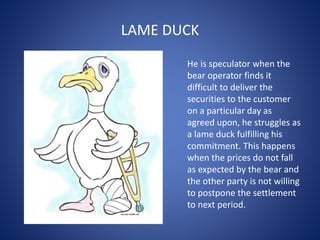
LAME DUCK
He is speculator when the
bear operator finds it
difficult to deliver the
securities to the customer
on a particular day as
agreed upon, he struggles as
a lame duck fulfilling his
commitment. This happens
when the prices do not fall
as expected by the bear and
the other party is not willing
to postpone the settlement
to next period.
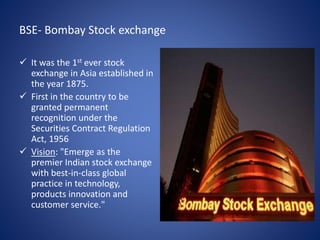
BSE- Bombay Stock exchange
 It was the 1st ever stock
exchange in Asia established in
the year 1875.
 First in the country to be
granted permanent
recognition under the
Securities Contract Regulation
Act, 1956
 Vision: "Emerge as the
premier Indian stock exchange
with best-in-class global
practice in technology,
products innovation and
customer service."
NSE-National Stock Exchange
FEATURES OF NSE
 National wide coverage i.e., investors from all over country.
 Ringless i.e., it has no ring or trading floor.
 Screen-based trading i.e., trading in this stock exchange is done electrically.
 Transparency, i.e., the use of computer screen for trading makes the dealings in
securities transparent.
 Professionalization in trading, i.e., it brings professionalism in its functions.
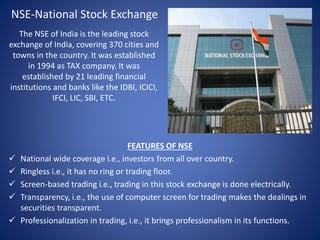
The NSE of India is the leading stock
exchange of India, covering 370 cities and
towns in the country. It was established
in 1994 as TAX company. It was
established by 21 leading financial
institutions and banks like the IDBI, ICICI,
IFCI, LIC, SBI, ETC.
Securities and Exchange Board Of
India ( SEBI )
The SEBI was constituted on 12th April,
1988 under a resolution of the
Government of India. On 31st January
1992, it was made a STATUTORY BODY by
the Securities and Exchange Board Of India
Act, 1992. The Companies (Amendment)
Act,2000 has given certain powers to SEBI
as regards the issue and transfer of
securities and non- payment of dividend.
Functions of SEBI
 Regulating the business in stock exchange and any other securities markets.
 Promoting and regulating self-regulatory organization.
 Registering and regulating the work of collective investment scheme, including
mutual funds.
 Prohibiting fraudulent and unfair trade practices relating to securities market.
 Promoting education, and training of intermediaries of securities market.
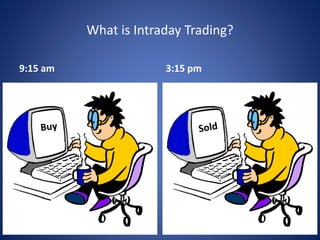
What is Intraday Trading?
9:15 am 3:15 pm
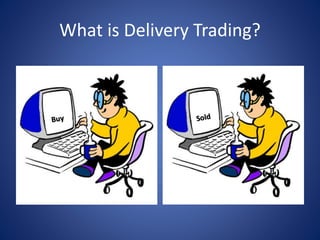
What is Delivery Trading?
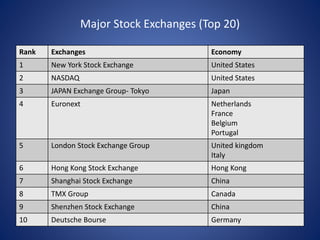
Major Stock Exchanges (Top 20)
Rank Exchanges Economy
1 New York Stock Exchange United States
2 NASDAQ United States
3 JAPAN Exchange Group- Tokyo Japan
4 Euronext Netherlands
France
Belgium
Portugal
5 London Stock Exchange Group United kingdom
Italy
6 Hong Kong Stock Exchange Hong Kong
7 Shanghai Stock Exchange China
8 TMX Group Canada
9 Shenzhen Stock Exchange China
10 Deutsche Bourse Germany
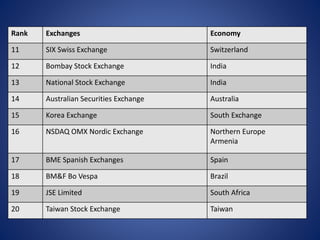
Rank Exchanges Economy
11 SIX Swiss Exchange Switzerland
12 Bombay Stock Exchange India
13 National Stock Exchange India
14 Australian Securities Exchange Australia
15 Korea Exchange South Exchange
16 NSDAQ OMX Nordic Exchange Northern Europe
Armenia
17 BME Spanish Exchanges Spain
18 BM&F Bo Vespa Brazil
19 JSE Limited South Africa
20 Taiwan Stock Exchange Taiwan
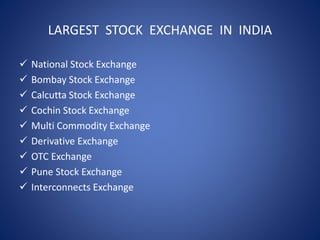
LARGEST STOCK EXCHANGE IN INDIA
 National Stock Exchange
 Bombay Stock Exchange
 Calcutta Stock Exchange
 Cochin Stock Exchange
 Multi Commodity Exchange
 Derivative Exchange
 OTC Exchange
 Pune Stock Exchange
 Interconnects Exchange
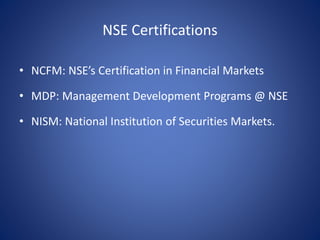
NSE Certifications
• NCFM: NSE’s Certification in Financial Markets
• MDP: Management Development Programs @ NSE
• NISM: National Institution of Securities Markets.
THANK YOU

Stock exchange

  • 1.
  • 2.
    HOW DOES STOCKMARKET WORK? If you start investing in the stock market you probably wondered
  • 3.
    HOW TO DEALAND INVEST IN STOCK EXCHANGE In order to deal with a securities one hast to have an account called DEMAT A/c or Trading A/c. it is just like a bank account. Same procedure od opening the bank account is followed to open the account. But all the banks do not give this facility. After DENAT A/c is opened then securities is bought and sold. This banks which gives facility of DEMAT A/c in India are:  ICICI Bank  Citi Bank  Bank of Baroda
  • 4.
    How to seethe value of the shares in Stock Exchange SENSEX is an indicator to checkout in BSE. NIFTY is an indicator to checkout in NSE.
  • 5.
    SPECULATION AND SPECULATOR SPECULATION: It is the transaction of members to buy or sell securities on stock exchange with a view to make profits to anticipated raise or fall in prices of securities.  SPECULATOR: The dealer in stock exchange who indulge in speculation are called speculators. They do not take delivery of securities purchased or sold by them, but only pap or rescue the difference between the purchase price and sale price. The different types of speculators are:  BULL  BEAR  STAG  LAME DUCK
  • 6.
    BULL (TEJIWALA) He isa speculator who expects the future raise in price of securities to sell them at future date at higher price. He is called as bull because his activities resembles as a bull, as the bull tends to throw his victims up in the air through its horns. In simple the bull speculator tries to raise the price of securities by placing a big purchase orders.
  • 7.
    BEAR (MANDIWALA) He isspeculator who expects future fall in prices. He does an agreement to sell securities at future date at the present market rate. He is called as bear because his attitude resembles with bear, as the bear tends to stamp its victims down to earth through its paws. In simple the bear speculator forces of prices of securities to fall through his activities.
  • 8.
    STAG He operates innew issue of market. He is just like a bull speculator. He applies large number of shares in the issue market only by paying application money, allotment money. He is not a genuine investor because, he sells the allotted securities at the premium and makes profit. In simple he is cautious in his dealings. He creates an artificial rise in prices of new shares and makes profits.
  • 9.
    LAME DUCK He isspeculator when the bear operator finds it difficult to deliver the securities to the customer on a particular day as agreed upon, he struggles as a lame duck fulfilling his commitment. This happens when the prices do not fall as expected by the bear and the other party is not willing to postpone the settlement to next period.
  • 10.
    BSE- Bombay Stockexchange  It was the 1st ever stock exchange in Asia established in the year 1875.  First in the country to be granted permanent recognition under the Securities Contract Regulation Act, 1956  Vision: "Emerge as the premier Indian stock exchange with best-in-class global practice in technology, products innovation and customer service."
  • 11.
    NSE-National Stock Exchange FEATURESOF NSE  National wide coverage i.e., investors from all over country.  Ringless i.e., it has no ring or trading floor.  Screen-based trading i.e., trading in this stock exchange is done electrically.  Transparency, i.e., the use of computer screen for trading makes the dealings in securities transparent.  Professionalization in trading, i.e., it brings professionalism in its functions. The NSE of India is the leading stock exchange of India, covering 370 cities and towns in the country. It was established in 1994 as TAX company. It was established by 21 leading financial institutions and banks like the IDBI, ICICI, IFCI, LIC, SBI, ETC.
  • 12.
    Securities and ExchangeBoard Of India ( SEBI ) The SEBI was constituted on 12th April, 1988 under a resolution of the Government of India. On 31st January 1992, it was made a STATUTORY BODY by the Securities and Exchange Board Of India Act, 1992. The Companies (Amendment) Act,2000 has given certain powers to SEBI as regards the issue and transfer of securities and non- payment of dividend. Functions of SEBI  Regulating the business in stock exchange and any other securities markets.  Promoting and regulating self-regulatory organization.  Registering and regulating the work of collective investment scheme, including mutual funds.  Prohibiting fraudulent and unfair trade practices relating to securities market.  Promoting education, and training of intermediaries of securities market.
  • 13.
    What is IntradayTrading? 9:15 am 3:15 pm
  • 14.
  • 15.
    Major Stock Exchanges(Top 20) Rank Exchanges Economy 1 New York Stock Exchange United States 2 NASDAQ United States 3 JAPAN Exchange Group- Tokyo Japan 4 Euronext Netherlands France Belgium Portugal 5 London Stock Exchange Group United kingdom Italy 6 Hong Kong Stock Exchange Hong Kong 7 Shanghai Stock Exchange China 8 TMX Group Canada 9 Shenzhen Stock Exchange China 10 Deutsche Bourse Germany
  • 16.
    Rank Exchanges Economy 11SIX Swiss Exchange Switzerland 12 Bombay Stock Exchange India 13 National Stock Exchange India 14 Australian Securities Exchange Australia 15 Korea Exchange South Exchange 16 NSDAQ OMX Nordic Exchange Northern Europe Armenia 17 BME Spanish Exchanges Spain 18 BM&F Bo Vespa Brazil 19 JSE Limited South Africa 20 Taiwan Stock Exchange Taiwan
  • 17.
    LARGEST STOCK EXCHANGEIN INDIA  National Stock Exchange  Bombay Stock Exchange  Calcutta Stock Exchange  Cochin Stock Exchange  Multi Commodity Exchange  Derivative Exchange  OTC Exchange  Pune Stock Exchange  Interconnects Exchange
  • 18.
    NSE Certifications • NCFM:NSE’s Certification in Financial Markets • MDP: Management Development Programs @ NSE • NISM: National Institution of Securities Markets.
  • 19.