THE  MINT  OF FORTUNE …
 
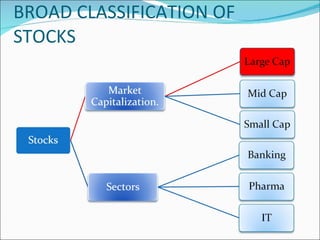
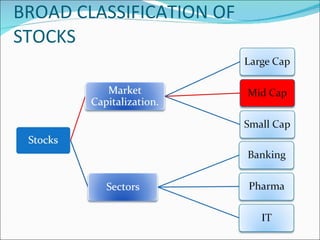
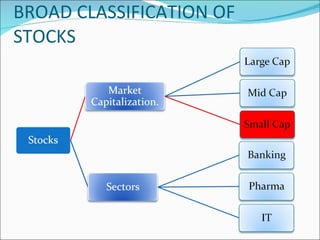
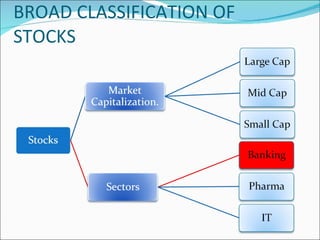
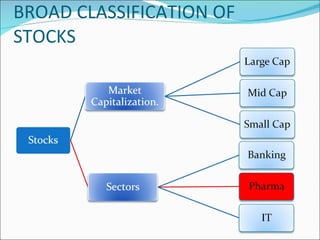
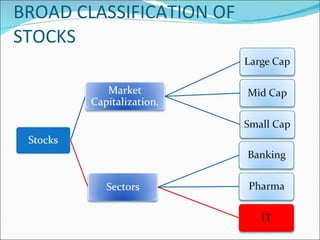
BROAD CLASSIFICATION OF STOCKS
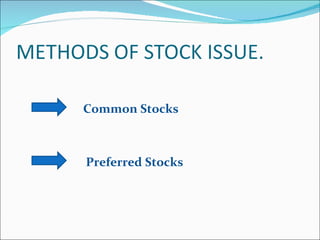
Common Stocks Preferred Stocks
 
History BSE Today
History BSE Today
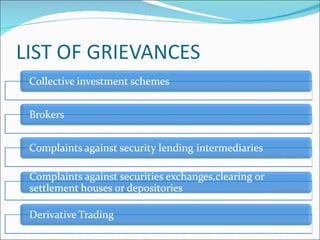
Introduction. List of Grievances. Approaching SEBI.
 
How can one approach SEBI?
 
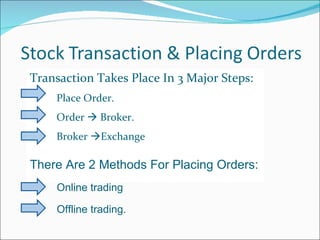
Transaction Takes Place In 3 Major Steps: Place Order. Order    Broker. Broker   Exchange There Are 2 Methods For Placing Orders: Online trading  Offline trading.
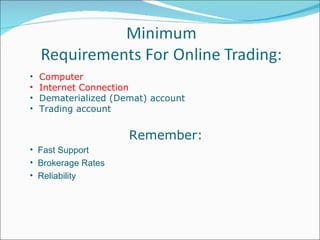
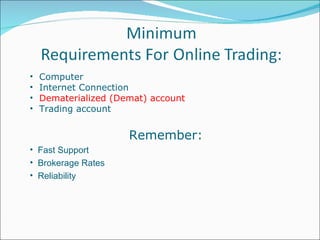
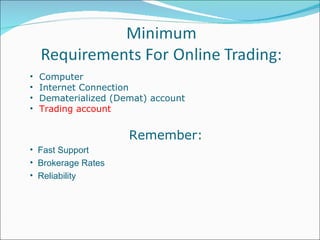
Computer  Internet Connection  Dematerialized (Demat) account  Trading account Remember: Fast Support Brokerage Rates Reliability
Bonds  Stocks Mutual Funds  Options and Futures
 
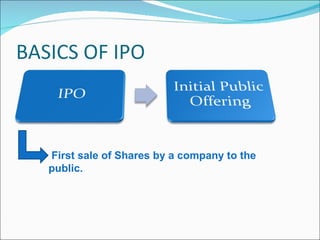
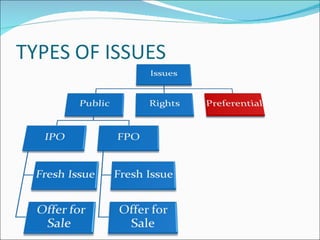
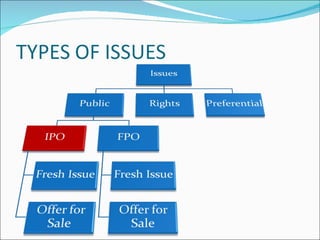
First sale of Shares by a company to the public.


What are mutual funds?
A Vehicle for investing  in Stocks. Pools money of investors and invests this in Stocks, Bonds, Money market instruments and other types of securities. Owner of a mutual fund unit gets a share of the fund’s gains, losses, income and expenses.
Funds make investments in sectors that have been specified in the prospectus of the funds.  Amount of Returns totally depends on performance of particular Industry or Sector. They are risky in comparison with funds that are Diversified.
Software, Petroleum stocks, Power, and Pharmaceuticals are some various sectors Main mutual fund companies that have launched Sector- Specific Funds are: Prudential ICICI Mutual Fund  Birla Sun Life Mutual Fund  Franklin Templeton India Mutual Fund  Unit Trust of India Mutual Fund
Asset   Management   Company (AMC ) It is the company that puts together a mutual fund. AMC may have several mutual fund schemes . AMC hires a professional money manager, who buys and sells securities in line with the fund's stated objective.
Net Asset Value(NAV) NAV is the total asset value (net of expenses) per unit of the fund and is calculated by the AMC at the end of every business day.  The performance of a particular scheme of a mutual fund is denoted by NAV.
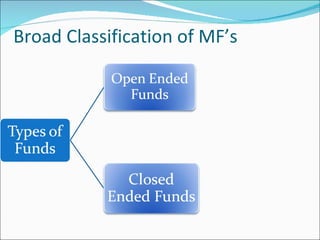
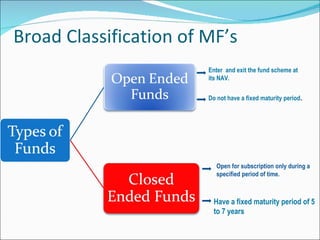
Broad Classification of MF’s
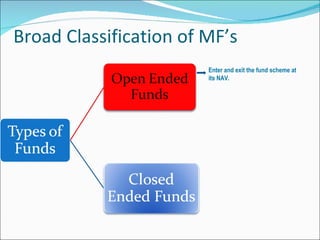
Broad Classification of MF’s Enter and exit the fund scheme at its NAV.
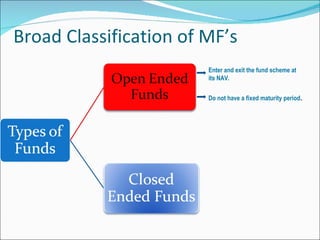
Broad Classification of MF’s Enter and exit the fund scheme at its NAV. Do not have a fixed maturity period .
Broad Classification of MF’s Enter  and exit the fund scheme at its NAV. Do not have a fixed maturity period . Open for subscription only during a specified period of time.
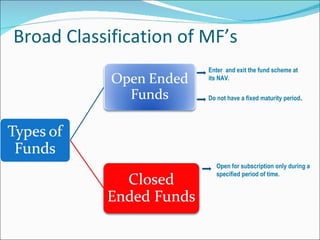
Broad Classification of MF’s Enter  and exit the fund scheme at its NAV. Do not have a fixed maturity period . Open for subscription only during a specified period of time. Have a fixed maturity period of 5 to 7 years
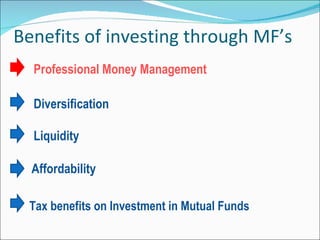
Benefits of investing through MF’s Professional Money Management  Diversification  Liquidity    Affordability   Tax benefits on Investment in Mutual Funds
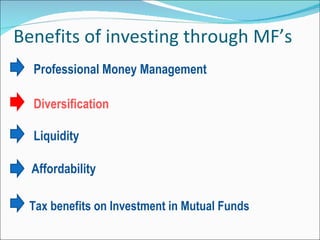
Benefits of investing through MF’s Professional Money Management  Diversification   Liquidity    Affordability   Tax benefits on Investment in Mutual Funds
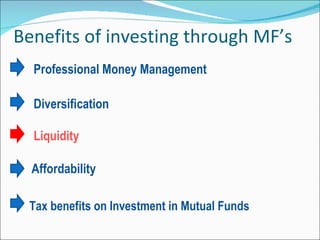
Benefits of investing through MF’s Professional Money Management  Diversification  Liquidity     Affordability   Tax benefits on Investment in Mutual Funds
Benefits of investing through MF’s Professional Money Management  Diversification  Liquidity    Affordability   Tax benefits on Investment in Mutual Funds
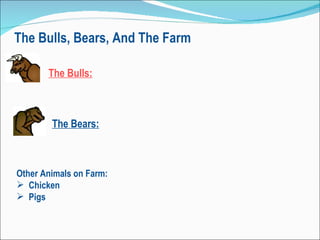
The Bulls, Bears, And The Farm  The Bulls:   The Bears:   Other Animals on Farm: Chicken Pigs
 
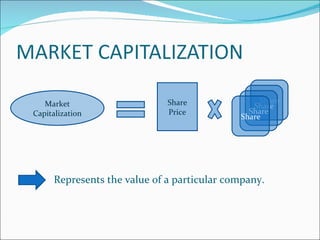
The value of the share of a particular company is known as stock price. When  net supply>demand then stock price increases and vice versa.
Market Capitalization Share Price Share Share Share Share Represents the value of a particular company.
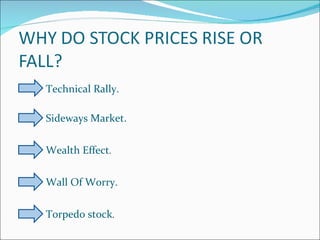
Technical Rally. Sideways Market. Wealth Effect . Wall Of Worry. Torpedo stock .
 
 
Top-Down Approach  Overall Evaluation Of  The General Economy.  The Economy Expands, Companies Benefit And Grow.  The Economy Declines,  Companies Suffer.
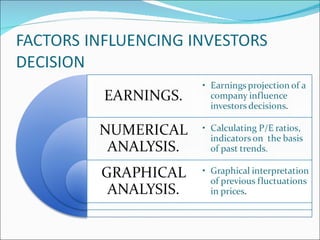
Important Parameters: Earning per share – EPS Price to Earnings Ratio – PE Dividend Yield  Debt ratio Profit after Tax - PAT
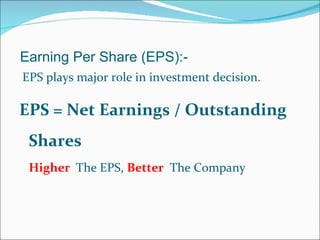
Earning Per Share (EPS):- EPS plays major role in investment decision.  EPS = Net Earnings / Outstanding Shares Higher  The EPS,  Better   The Company
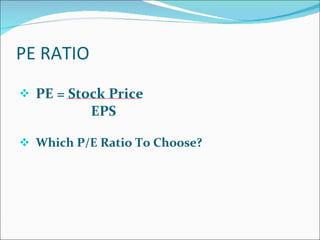
PE RATIO PE = Stock Price EPS  Which P/E Ratio To Choose?  
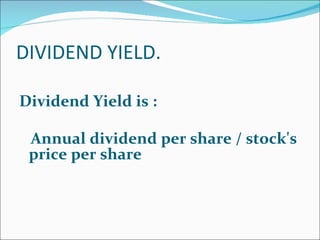
DIVIDEND YIELD. Dividend Yield is : Annual dividend per share / stock's  price per share
DEBT RATIO Debt Ratio tells you how much company relies on debit to finance its assets.  The higher the ratio the more risk for company to manage.  Companies have low debit ratio, generally less than 1.
PROFIT AFTER TAX. Short term to mid term trader quarterly PAT  Long term investor  yearly PAT.
STRENGTHS OF FUNDAMENTAL ANALYSIS Long-term Trends : Value Spotting : Business Acumen:
 
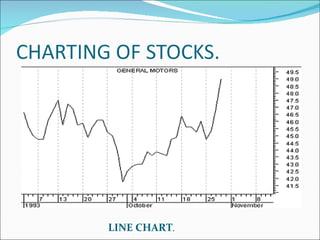
LINE CHART .
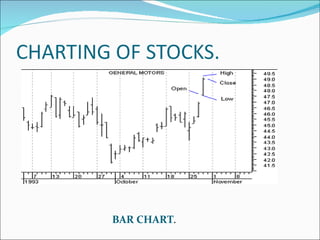
BAR CHART .
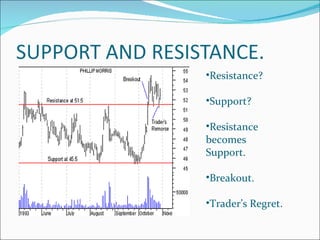
Resistance? Support? Resistance becomes  Support. Breakout. Trader’s Regret.
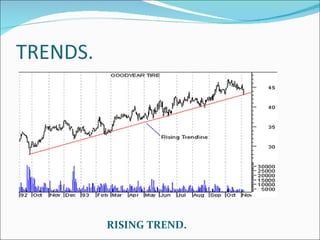
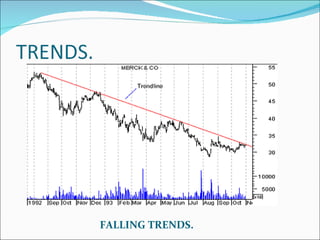
RISING TREND.
FALLING TRENDS.
 
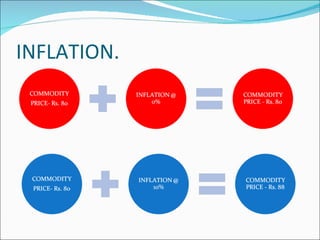
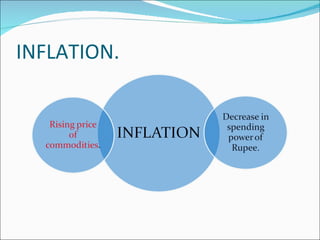
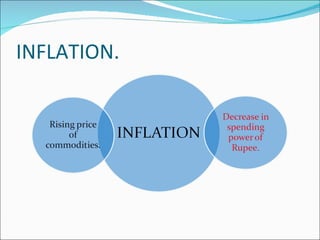
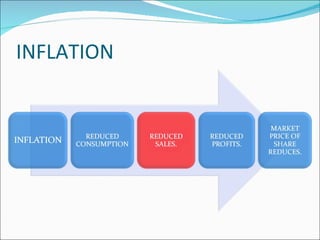
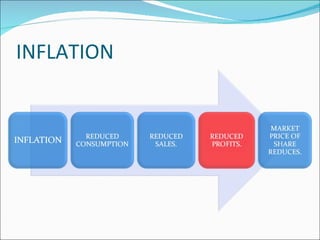
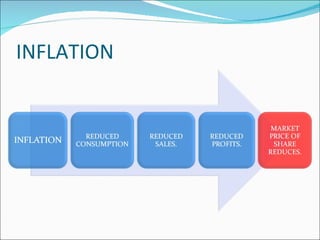
INFLATION.
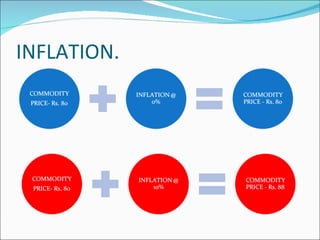
INFLATION.
INFLATION.
INFLATION.
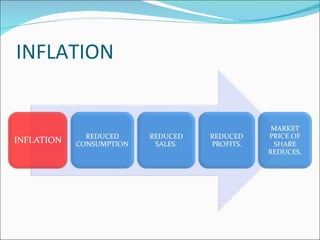
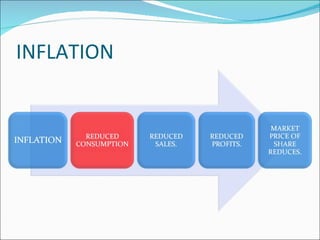
INFLATION
INFLATION
INFLATION
INFLATION
INFLATION
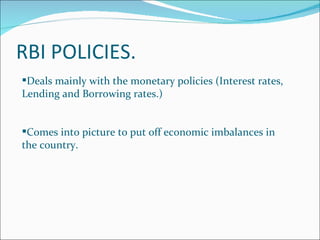
RBI POLICIES. Deals mainly with the monetary policies (Interest rates, Lending and Borrowing rates.) Comes into picture to put off economic imbalances in the country.
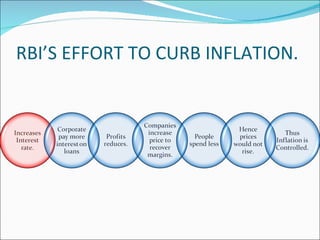
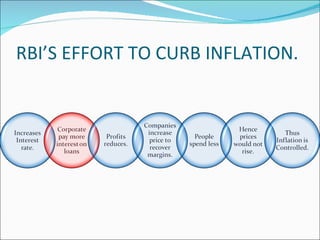
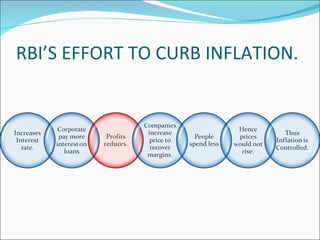
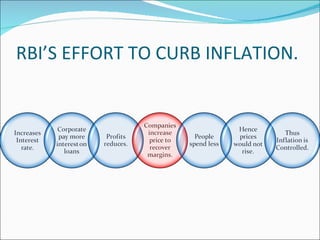
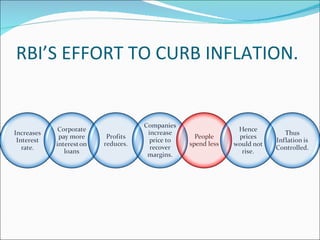
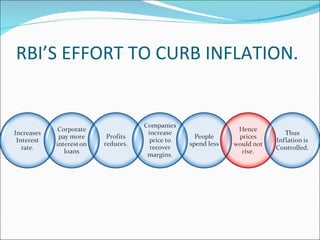
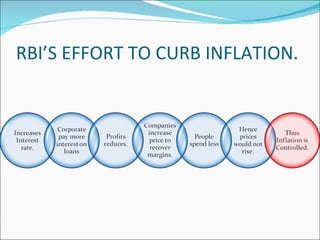
RBI’S EFFORT TO CURB INFLATION.
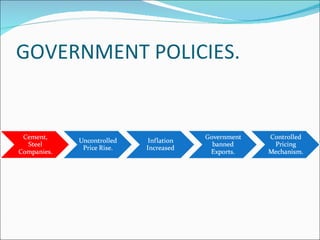
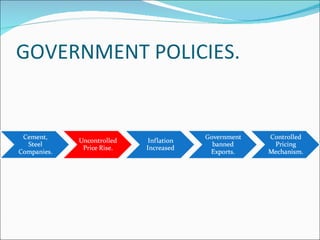
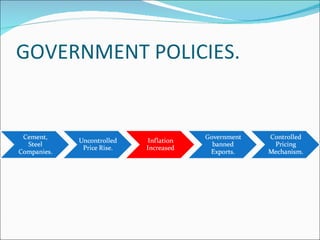
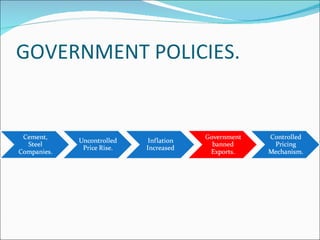
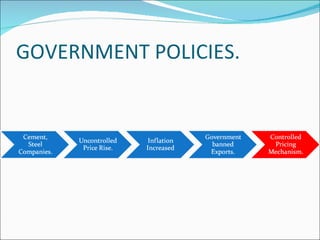
GOVERNMENT POLICIES. Government makes various fiscal policies to control economic imbalance in the country. This ensure a sustainable environment for the growth of the companies, thus helping to create a bullish market.
GOVERNMENT POLICIES.
 
Foreign Direct Investment(FDI) Foreign Institutional Investors(FII’S) FII’s 1st Invested In Indian Markets In DEC 1993
Highest NET Investment Of US$ 17.2 Billion Instrumental In BSE Crossing 20,000 Mark And NSE  Crossing 6000 Mark 70% Investment Through FCCB’S,QIP’S And IPO’S FCCB’S Raised US$ 11-13 Billion, QIP’S Raised 3.2  Billion And IPO’S A Record Gain Of US$ 12.41 In 2007-08 Out Of US$ 299.23 Billion , US$ 103.56 Invested In  Securities
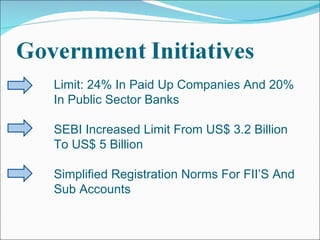
Limit: 24% In Paid Up Companies And 20%  In Public Sector Banks SEBI Increased Limit From US$ 3.2 Billion  To US$ 5 Billion Simplified Registration Norms For FII’S And  Sub Accounts
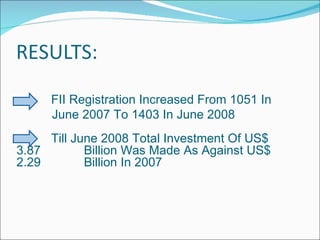
FII Registration Increased From 1051 In   June 2007 To 1403 In June 2008 Till June 2008 Total Investment Of US$ 3.87   Billion Was Made As Against US$ 2.29     Billion In 2007
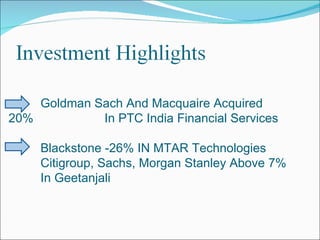
Goldman Sach And Macquaire Acquired 20%  In PTC India Financial Services Blackstone -26% IN MTAR Technologies  Citigroup, Sachs, Morgan Stanley Above 7%  In Geetanjali
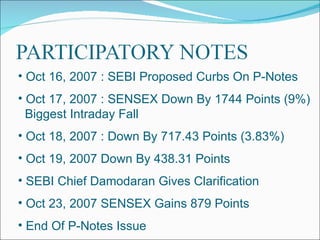
Oct 16, 2007 : SEBI Proposed Curbs On P-Notes Oct 17, 2007 : SENSEX Down By 1744 Points (9%)  Biggest Intraday Fall Oct 18, 2007 : Down By 717.43 Points (3.83%) Oct 19, 2007 Down By 438.31 Points  SEBI Chief Damodaran Gives Clarification Oct 23, 2007 SENSEX Gains 879 Points  End Of P-Notes Issue
Safe Heaven For Global Investors Slowdown Of US Economy Not To Affect  India Much Most Attractive Place For Investments
 
What is a scam? How to spot a scam?
 
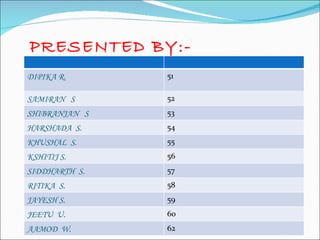
PRESENTED BY:- DIPIKA R.  51 SAMIRAN  S 52 SHIBRANJAN  S 53 HARSHADA  S.  54 KHUSHAL  S.  55 KSHITIJ S.  56 SIDDHARTH  S.  57 RITIKA  S.  58 JAYESH S.  59 JEETU  U.  60 AAMOD  W. 62
 

Stock Markets in India

  • 1.
    THE MINT OF FORTUNE …
  • 2.
  • 3.
  • 4.
  • 5.
  • 6.
  • 7.
  • 8.
  • 9.
  • 10.
  • 11.
  • 12.
  • 13.
    Introduction. List ofGrievances. Approaching SEBI.
  • 14.
  • 15.
    How can oneapproach SEBI?
  • 16.
  • 17.
    Transaction Takes PlaceIn 3 Major Steps: Place Order. Order  Broker. Broker  Exchange There Are 2 Methods For Placing Orders: Online trading Offline trading.
  • 18.
    Computer InternetConnection Dematerialized (Demat) account Trading account Remember: Fast Support Brokerage Rates Reliability
  • 19.
    Computer InternetConnection Dematerialized (Demat) account Trading account Remember: Fast Support Brokerage Rates Reliability
  • 20.
    Computer InternetConnection Dematerialized (Demat) account Trading account Remember: Fast Support Brokerage Rates Reliability
  • 21.
    Computer InternetConnection Dematerialized (Demat) account Trading account Remember: Fast Support Brokerage Rates Reliability
  • 22.
    Computer InternetConnection Dematerialized (Demat) account Trading account Remember: Fast Support Brokerage Rates Reliability
  • 23.
    Computer InternetConnection Dematerialized (Demat) account Trading account Remember: Fast Support Brokerage Rates Reliability
  • 24.
    Bonds StocksMutual Funds Options and Futures
  • 25.
    Bonds StocksMutual Funds Options and Futures
  • 26.
    Bonds StocksMutual Funds Options and Futures
  • 27.
    Bonds StocksMutual Funds Options and Futures
  • 28.
    Bonds StocksMutual Funds Options and Futures
  • 29.
  • 30.
    First sale ofShares by a company to the public.
  • 31.
  • 32.
  • 33.
  • 34.
  • 35.
  • 36.
  • 37.
  • 38.
  • 39.
  • 40.
  • 41.
  • 42.
  • 43.
    A Vehicle forinvesting in Stocks. Pools money of investors and invests this in Stocks, Bonds, Money market instruments and other types of securities. Owner of a mutual fund unit gets a share of the fund’s gains, losses, income and expenses.
  • 44.
    A Vehicle forinvesting in Stocks. Pools money of investors and invests this in Stocks, Bonds, Money market instruments and other types of securities. Owner of a mutual fund unit gets a share of the fund’s gains, losses, income and expenses.
  • 45.
    A Vehicle forinvesting in Stocks. Pools money of investors and invests this in Stocks, Bonds, Money market instruments and other types of securities. Owner of a mutual fund unit gets a share of the fund’s gains, losses, income and expenses.
  • 46.
    Funds make investmentsin sectors that have been specified in the prospectus of the funds. Amount of Returns totally depends on performance of particular Industry or Sector. They are risky in comparison with funds that are Diversified.
  • 47.
    Funds make investmentsin sectors that have been specified in the prospectus of the funds. Amount of Returns totally depends on performance of particular Industry or Sector. They are risky in comparison with funds that are Diversified.
  • 48.
    Funds make investmentsin sectors that have been specified in the prospectus of the funds. Amount of Returns totally depends on performance of particular Industry or Sector. They are risky in comparison with funds that are Diversified.
  • 49.
    Software, Petroleum stocks,Power, and Pharmaceuticals are some various sectors Main mutual fund companies that have launched Sector- Specific Funds are: Prudential ICICI Mutual Fund Birla Sun Life Mutual Fund Franklin Templeton India Mutual Fund Unit Trust of India Mutual Fund
  • 50.
    Asset Management Company (AMC ) It is the company that puts together a mutual fund. AMC may have several mutual fund schemes . AMC hires a professional money manager, who buys and sells securities in line with the fund's stated objective.
  • 51.
    Asset Management Company (AMC ) It is the company that puts together a mutual fund. AMC may have several mutual fund schemes . AMC hires a professional money manager, who buys and sells securities in line with the fund's stated objective.
  • 52.
    Asset Management Company (AMC ) It is the company that puts together a mutual fund. AMC may have several mutual fund schemes . AMC hires a professional money manager, who buys and sells securities in line with the fund's stated objective.
  • 53.
    Net Asset Value(NAV)NAV is the total asset value (net of expenses) per unit of the fund and is calculated by the AMC at the end of every business day. The performance of a particular scheme of a mutual fund is denoted by NAV.
  • 54.
    Net Asset Value(NAV)NAV is the total asset value (net of expenses) per unit of the fund and is calculated by the AMC at the end of every business day. The performance of a particular scheme of a mutual fund is denoted by NAV.
  • 55.
  • 56.
    Broad Classification ofMF’s Enter and exit the fund scheme at its NAV.
  • 57.
    Broad Classification ofMF’s Enter and exit the fund scheme at its NAV. Do not have a fixed maturity period .
  • 58.
    Broad Classification ofMF’s Enter and exit the fund scheme at its NAV. Do not have a fixed maturity period . Open for subscription only during a specified period of time.
  • 59.
    Broad Classification ofMF’s Enter and exit the fund scheme at its NAV. Do not have a fixed maturity period . Open for subscription only during a specified period of time. Have a fixed maturity period of 5 to 7 years
  • 60.
    Benefits of investingthrough MF’s Professional Money Management Diversification Liquidity   Affordability Tax benefits on Investment in Mutual Funds
  • 61.
    Benefits of investingthrough MF’s Professional Money Management Diversification Liquidity   Affordability Tax benefits on Investment in Mutual Funds
  • 62.
    Benefits of investingthrough MF’s Professional Money Management Diversification Liquidity   Affordability Tax benefits on Investment in Mutual Funds
  • 63.
    Benefits of investingthrough MF’s Professional Money Management Diversification Liquidity   Affordability Tax benefits on Investment in Mutual Funds
  • 64.
    Benefits of investingthrough MF’s Professional Money Management Diversification Liquidity   Affordability Tax benefits on Investment in Mutual Funds
  • 65.
    The Bulls, Bears,And The Farm The Bulls: The Bears: Other Animals on Farm: Chicken Pigs
  • 66.
    The Bulls, Bears,And The Farm The Bulls: The Bears: Other Animals on Farm: Chicken Pigs
  • 67.
    The Bulls, Bears,And The Farm The Bulls: The Bears: Other Animals on Farm: Chicken Pigs
  • 68.
  • 69.
    The value ofthe share of a particular company is known as stock price. When net supply>demand then stock price increases and vice versa.
  • 70.
    Market Capitalization SharePrice Share Share Share Share Represents the value of a particular company.
  • 71.
    Technical Rally. SidewaysMarket. Wealth Effect . Wall Of Worry. Torpedo stock .
  • 72.
  • 73.
  • 74.
    Top-Down Approach Overall Evaluation Of The General Economy. The Economy Expands, Companies Benefit And Grow. The Economy Declines, Companies Suffer.
  • 75.
    Important Parameters: Earningper share – EPS Price to Earnings Ratio – PE Dividend Yield Debt ratio Profit after Tax - PAT
  • 76.
    Earning Per Share(EPS):- EPS plays major role in investment decision. EPS = Net Earnings / Outstanding Shares Higher The EPS, Better The Company
  • 77.
    PE RATIO PE= Stock Price EPS Which P/E Ratio To Choose?  
  • 78.
    DIVIDEND YIELD. DividendYield is : Annual dividend per share / stock's price per share
  • 79.
    DEBT RATIO DebtRatio tells you how much company relies on debit to finance its assets. The higher the ratio the more risk for company to manage. Companies have low debit ratio, generally less than 1.
  • 80.
    PROFIT AFTER TAX.Short term to mid term trader quarterly PAT Long term investor yearly PAT.
  • 81.
    STRENGTHS OF FUNDAMENTALANALYSIS Long-term Trends : Value Spotting : Business Acumen:
  • 82.
  • 83.
  • 84.
  • 85.
    Resistance? Support? Resistancebecomes Support. Breakout. Trader’s Regret.
  • 86.
  • 87.
  • 88.
  • 89.
  • 90.
  • 91.
  • 92.
  • 93.
  • 94.
  • 95.
  • 96.
  • 97.
  • 98.
    RBI POLICIES. Dealsmainly with the monetary policies (Interest rates, Lending and Borrowing rates.) Comes into picture to put off economic imbalances in the country.
  • 99.
    RBI’S EFFORT TOCURB INFLATION.
  • 100.
    RBI’S EFFORT TOCURB INFLATION.
  • 101.
    RBI’S EFFORT TOCURB INFLATION.
  • 102.
    RBI’S EFFORT TOCURB INFLATION.
  • 103.
    RBI’S EFFORT TOCURB INFLATION.
  • 104.
    RBI’S EFFORT TOCURB INFLATION.
  • 105.
    RBI’S EFFORT TOCURB INFLATION.
  • 106.
    GOVERNMENT POLICIES. Governmentmakes various fiscal policies to control economic imbalance in the country. This ensure a sustainable environment for the growth of the companies, thus helping to create a bullish market.
  • 107.
  • 108.
  • 109.
  • 110.
  • 111.
  • 112.
  • 113.
    Foreign Direct Investment(FDI)Foreign Institutional Investors(FII’S) FII’s 1st Invested In Indian Markets In DEC 1993
  • 114.
    Highest NET InvestmentOf US$ 17.2 Billion Instrumental In BSE Crossing 20,000 Mark And NSE Crossing 6000 Mark 70% Investment Through FCCB’S,QIP’S And IPO’S FCCB’S Raised US$ 11-13 Billion, QIP’S Raised 3.2 Billion And IPO’S A Record Gain Of US$ 12.41 In 2007-08 Out Of US$ 299.23 Billion , US$ 103.56 Invested In Securities
  • 115.
    Limit: 24% InPaid Up Companies And 20% In Public Sector Banks SEBI Increased Limit From US$ 3.2 Billion To US$ 5 Billion Simplified Registration Norms For FII’S And Sub Accounts
  • 116.
    FII Registration IncreasedFrom 1051 In June 2007 To 1403 In June 2008 Till June 2008 Total Investment Of US$ 3.87 Billion Was Made As Against US$ 2.29 Billion In 2007
  • 117.
    Goldman Sach AndMacquaire Acquired 20% In PTC India Financial Services Blackstone -26% IN MTAR Technologies Citigroup, Sachs, Morgan Stanley Above 7% In Geetanjali
  • 118.
    Oct 16, 2007: SEBI Proposed Curbs On P-Notes Oct 17, 2007 : SENSEX Down By 1744 Points (9%) Biggest Intraday Fall Oct 18, 2007 : Down By 717.43 Points (3.83%) Oct 19, 2007 Down By 438.31 Points SEBI Chief Damodaran Gives Clarification Oct 23, 2007 SENSEX Gains 879 Points End Of P-Notes Issue
  • 119.
    Safe Heaven ForGlobal Investors Slowdown Of US Economy Not To Affect India Much Most Attractive Place For Investments
  • 120.
  • 121.
    What is ascam? How to spot a scam?
  • 122.
    What is ascam? How to spot a scam?
  • 123.
  • 124.
    PRESENTED BY:- DIPIKAR. 51 SAMIRAN S 52 SHIBRANJAN S 53 HARSHADA S. 54 KHUSHAL S. 55 KSHITIJ S. 56 SIDDHARTH S. 57 RITIKA S. 58 JAYESH S. 59 JEETU U. 60 AAMOD W. 62
  • 125.