
EARNINGS
MULTIPLIER MODEL


            RANGANATH
    AMITY BUSINESS SCHOOL, NOIDA
EARNINGS MULTIPLIER MODEL
Many investors prefer to estimate the value of common stock using an
earnings multiplier model.

Basic Concept: The value of any investment is the present value of future
returns.

In the case of common stocks, the returns that investors are entitled to
receive are the net earnings of the firm. Therefore, one way investors can
estimate value is by determining how many rupees they are willing to pay
for a rupee of expected earnings (typically represented by the estimated
earnings during the following 12-month period).

Example: If investors are willing to pay 10 times expected earnings, they
would value a stock they expect to earn Rs. 2 a share during the following
year at Rs.20.
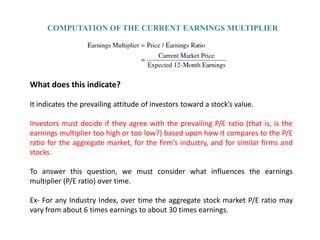
COMPUTATION OF THE CURRENT EARNINGS MULTIPLIER


What does this indicate?

It indicates the prevailing attitude of investors toward a stock’s value.

Investors must decide if they agree with the prevailing P/E ratio (that is, is the
earnings multiplier too high or too low?) based upon how it compares to the P/E
ratio for the aggregate market, for the firm’s industry, and for similar firms and
stocks.

To answer this question, we must consider what influences the earnings
multiplier (P/E ratio) over time.

Ex- For any Industry Index, over time the aggregate stock market P/E ratio may
vary from about 6 times earnings to about 30 times earnings.
FACTORS AFFECTING P/E RATIO
The infinite period dividend discount model can be used to indicate the variables
that should determine the value of the P/E ratio as follows:


If we divide both sides of the equation by E1 (expected earnings during the next
12 months), the result is:


Thus, the P/E ratio is determined by:
1. The expected dividend payout ratio (dividends divided by earnings)
2. The estimated required rate of return on the stock (k)
3. The expected growth rate of dividends for the stock (g)
EXAMPLE
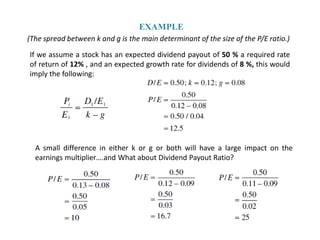
(The spread between k and g is the main determinant of the size of the P/E ratio.)

If we assume a stock has an expected dividend payout of 50 % a required rate
of return of 12% , and an expected growth rate for dividends of 8 %, this would
imply the following:


  A small difference in either k or g or both will have a large impact on the
  earnings multiplier….and What about Dividend Payout Ratio?
HOW WOULD YOU DO YOUR STOCK VALUATION ?
After estimating the earnings multiple, you would apply it to your estimate of
earnings for the next year (E1) to arrive at an estimated value.

E1 is based on the earnings for the current year (E0) and your expected growth
rate of earnings. Using these two estimates, you would compute an estimated
value of the stock and compare this estimated value to its market price.

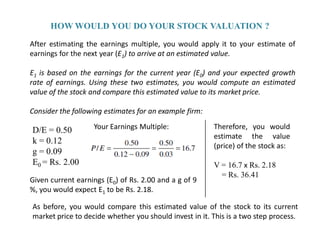
Consider the following estimates for an example firm:

D/E = 0.50         Your Earnings Multiple:              Therefore, you would
                                                        estimate the value
k = 0.12
                                                        (price) of the stock as:
g = 0.09
E0 = Rs. 2.00                                           V = 16.7 x Rs. 2.18
                                                          = Rs. 36.41
Given current earnings (E0) of Rs. 2.00 and a g of 9
%, you would expect E1 to be Rs. 2.18.

As before, you would compare this estimated value of the stock to its current
market price to decide whether you should invest in it. This is a two step process.

Earnings multiplier model

  • 1.
    EARNINGS MULTIPLIER MODEL RANGANATH AMITY BUSINESS SCHOOL, NOIDA
  • 2.
    EARNINGS MULTIPLIER MODEL Manyinvestors prefer to estimate the value of common stock using an earnings multiplier model. Basic Concept: The value of any investment is the present value of future returns. In the case of common stocks, the returns that investors are entitled to receive are the net earnings of the firm. Therefore, one way investors can estimate value is by determining how many rupees they are willing to pay for a rupee of expected earnings (typically represented by the estimated earnings during the following 12-month period). Example: If investors are willing to pay 10 times expected earnings, they would value a stock they expect to earn Rs. 2 a share during the following year at Rs.20.
  • 3.
    COMPUTATION OF THECURRENT EARNINGS MULTIPLIER What does this indicate? It indicates the prevailing attitude of investors toward a stock’s value. Investors must decide if they agree with the prevailing P/E ratio (that is, is the earnings multiplier too high or too low?) based upon how it compares to the P/E ratio for the aggregate market, for the firm’s industry, and for similar firms and stocks. To answer this question, we must consider what influences the earnings multiplier (P/E ratio) over time. Ex- For any Industry Index, over time the aggregate stock market P/E ratio may vary from about 6 times earnings to about 30 times earnings.
  • 4.
    FACTORS AFFECTING P/ERATIO The infinite period dividend discount model can be used to indicate the variables that should determine the value of the P/E ratio as follows: If we divide both sides of the equation by E1 (expected earnings during the next 12 months), the result is: Thus, the P/E ratio is determined by: 1. The expected dividend payout ratio (dividends divided by earnings) 2. The estimated required rate of return on the stock (k) 3. The expected growth rate of dividends for the stock (g)
  • 5.
    EXAMPLE (The spread betweenk and g is the main determinant of the size of the P/E ratio.) If we assume a stock has an expected dividend payout of 50 % a required rate of return of 12% , and an expected growth rate for dividends of 8 %, this would imply the following: A small difference in either k or g or both will have a large impact on the earnings multiplier….and What about Dividend Payout Ratio?
  • 6.
    HOW WOULD YOUDO YOUR STOCK VALUATION ? After estimating the earnings multiple, you would apply it to your estimate of earnings for the next year (E1) to arrive at an estimated value. E1 is based on the earnings for the current year (E0) and your expected growth rate of earnings. Using these two estimates, you would compute an estimated value of the stock and compare this estimated value to its market price. Consider the following estimates for an example firm: D/E = 0.50 Your Earnings Multiple: Therefore, you would estimate the value k = 0.12 (price) of the stock as: g = 0.09 E0 = Rs. 2.00 V = 16.7 x Rs. 2.18 = Rs. 36.41 Given current earnings (E0) of Rs. 2.00 and a g of 9 %, you would expect E1 to be Rs. 2.18. As before, you would compare this estimated value of the stock to its current market price to decide whether you should invest in it. This is a two step process.