FRICTION AND HEAT IN MACHINING
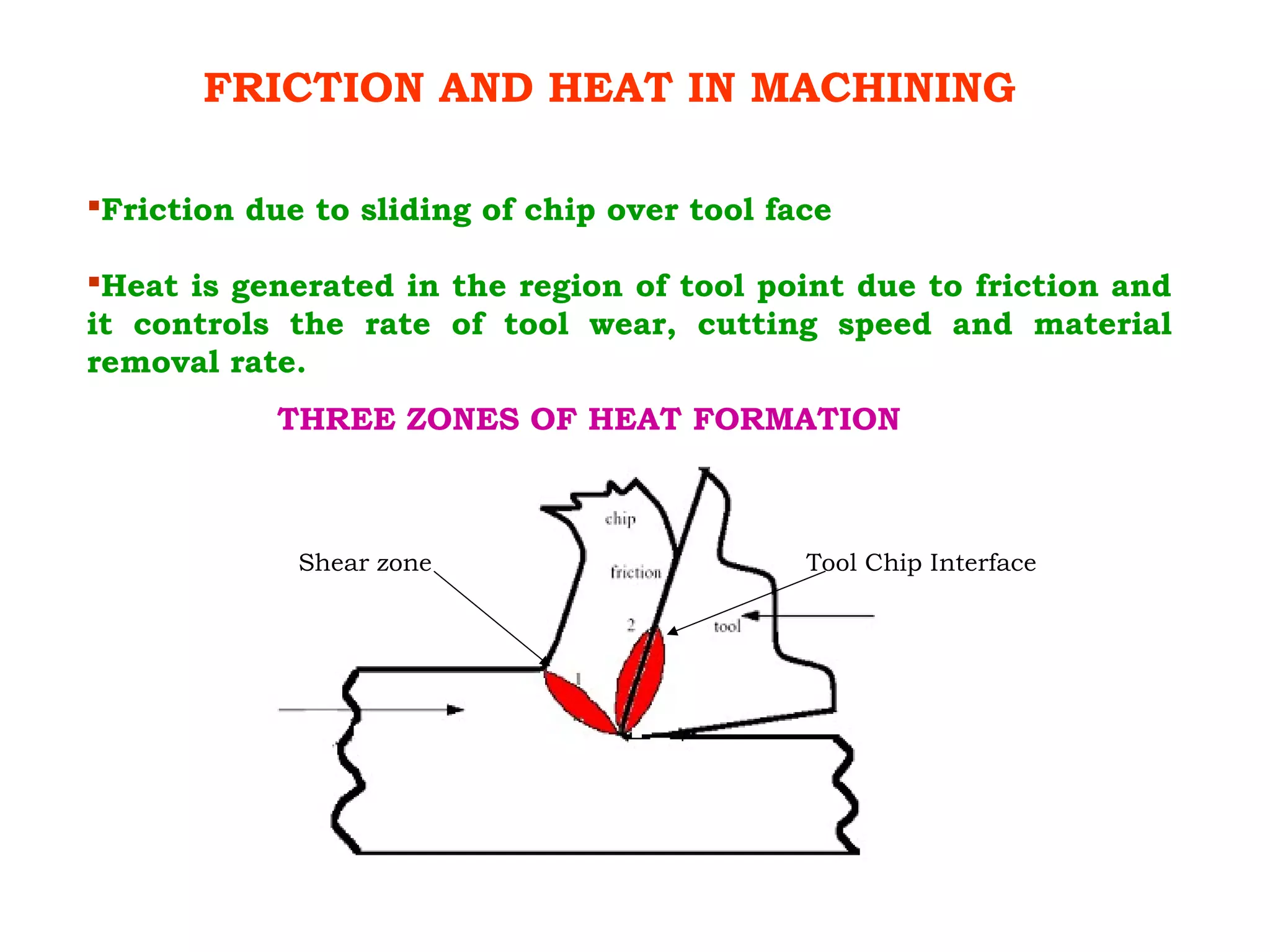
Friction due to sliding of chip over tool face
Heat is generated in the region of tool point due to friction and
it controls the rate of tool wear, cutting speed and material
removal rate.
THREE ZONES OF HEAT FORMATION
Shear zone Tool Chip Interface
FRICTION AND HEAT IN MACHINING
Friction due to sliding of chip over tool face
Heat is generated in the region of tool point due to friction and
it controls the rate of tool wear, cutting speed and material
removal rate.
THREE ZONES OF HEAT FORMATION
Shear zone Tool Chip Interface
Tool-work interface
Types of tool wear
Types of tool wear
Types of tool wear
Types of tool wear
Types of tool wear
Types of tool wear
Types of tool wear
Types of tool wear
TOOL LIFE
Tool life is defined as the effective cutting time
between resharpening.
The Taylor’s equation for tool life is
V Tn
=C
 
where,
V = cutting velocity in m/min.
T = tool life in minutes
n = a constant based on the tool material
C = a constant based on the tool and work
 
TOOL LIFE
Tool life is defined as the effective cutting time
between resharpening.
The Taylor’s equation for tool life is
V Tn
=C
 
where,
V = cutting velocity in m/min.
T = tool life in minutes
n = a constant based on the tool material
C = a constant based on the tool and work
 
PPROPERTIES OF CUTTING TOOL MATERIALS
 
 Wear Resistance, necessary to enable the cutting tool
to retain its shape and cutting efficiency
         Hot hardness, to retain the cutting ability and
hardness that may be lost due to high temperature
developed at the tool –chip interface
        Toughness, to withstand the force due to cutting and
to absorb shocks and to prevent chipping of the fine
cutting edge.
Grades of Tungsten Carbides (as per ISO)
ISO
APPLICATION
COLOUR
CODE
APPLICATION
P Blue
For machining long chipping
ferrous materials. – Steel
M Yellow
For machining long or short
chipping ferrous materials-
Stainless steel
K Red
For machining short chipping,
ferrous and non-ferrous
material and non-metals.- Cast
iron
MMATERIALS USED FOR COATING
TThe most commonly used materials for coating are
1.      Titanium carbide (TiC)
2.      Titanium nitride (TiN)
3.      Titanium carbonitride (TiCN)
4.      Aluminium oxide (Al2
O3
)
5.      Aluminium oxynitride (ALON)
 
Maximum tolerable temperature for different
coating materials
Advantages
 Coating acts as a diffusion barrier
 Increased hot hardness of tool
 Reduced welding of chip on tool face
 Low specific heat and thermal conductivity – low
interface temperature
 Reduced built up edges
 Reduced tendency to form comb-cracks and plastic
deformation
 Wear reducing effect even when the coated layer is
interrupted
ISO
application
Group
Color
code
Material Process
P01 Blue Steel, Steel castings
Precision turning and boring requiring high finish and
close tolerance, high cutting speed small chip section,
no vibrations.
P10 Blue Steel, steel castings
Turning, threading and milling high cutting speed,
small or medium chip section.
P20 Blue
Steel, steel castings, malleable
cast iron forming long chips
Turning, milling, medium cutting speed and medium
chip section planning with small chip section.
P30 Blue
Steel, steel castings malleable
cast iron forming long chips
Turning, milling, planning medium or low cutting
speed, medium or large chip section under unfavorable
conditions such as changing hardness or chip section,
intermittent cut.
P40 Blue
Steel and steel casting with
sand inclusions or shrinkage
cavities
Turning, planning, shaping, low cutting speed, large
chip section under unfavorable conditions.
P50 Blue
Steel and steel castings of
medium or low tensile strength
with and large chip section
cavities
Operations requiring high toughness turning, planning,
shaping at low cutting speeds shrinkage under
unfavorable condition.
SELECTION OF CUTTING TOOLS
ISO
application
Group
Color
code
Material Process
M10 Yellow
Steel, steel castings, manganese
steel, grey CI., alloyed CI.
Turning, medium or high cutting speed, small or
medium chip section.
M20 Yellow
Steel, steel casting, austenitic
steal, manganese steel, Grey CI.,
spherodized CI., Malleable CI.
Turing, milling, medium cutting speed and medium
chip section.
M30 Yellow
Steel, steel casting, austenitic
steel, grey CI. spherodized C .1.
heat resisting alloys
Turning, milling, planning, medium cutting speed,
medium or large chip section.
M40 Yellow
Free cutting steel, low tensile
strength steel, brass and light
alloys
Turning, profile turning, especially in automatic
machines.
ISO
application
Group
Color
code
Material Process
K01 Red
Very hard grey CI. Chilled casting of
hardness up to 60 HRc. Al alloys
with high silicon, hardened steel,
abrasive plastics hard board and
ceramics
Turning, precision turning and boring, milling
scraping.
K10 Red
Grey CI. hardness> 220 HB.
Malleable CI. forming short chips,
tempered steel, Cu alloys, plastics,
glass, hard rubber, hard card board
porcelain, stone
Turning, milling, boring, reaming, broaching,
scraping.
K20 Red
Grey CI. hardness up to 220 HB. Non
ferrous metals such as Cu, Brass, AI,
abrasive laminated wood.
Turning, milling, planning, reaming, broaching,
requiring high toughness of carbide tip.
K30 Red
Soft grey C .1. Low
tensile strength steel, laminated
wood
Turning, reaming, planning, shaping under
unfavorable conditions, like changing chip
thickness, intermittent cut.
K40 Red
Soft or hard natural wood, non-
ferrous metals
Turning, milling, planning, shaping, under
unfavorable conditions like changing chip
section and intermittent cuts.
Cutting parameters
Material Properties Tools used Speed
m/min
Feed
mm/rev
Grey cast iron
Low strength
Hardness less than 150 BHN
and up to 300 BHN
Straight cemented carbides
Coated carbides
Ceramics
-60 to 150
-100 to 300
-350 to 700
0.1 to 1
0.1 to 1
0.1 to 0.4
White cast iron
Extremely hard up to
600 BHN
CBN or alumina based ceramics 100 to 180 0.1 to 0.4
Ductile cast iron
(SG)
Strong, tough and ductile
110 to 320 BHN
Carbides M grade
Coated carbides
50 to 120 0.1 to 1
Plain carbon steel Ductile
Cemented carbides
Coated carbides
60 to 200
90 to 400
1.2 to 0.1
0.8 to 0.1
Alloy steel
Tough, high tensile strength,
hardness, ductility and wear
resistant
Coated carbide
CBN
100 to 300 0.1 to 0.8
Tool Steel
High strength, wear resistant
and hardness impact resistant
Coated carbide
CBN
50 to 250
50 to 120
01 to 0.5
0.1 to 0.5
Cutting parameters
Material Properties Tools used Speed
m/min
Feed
mm/rev
Stainless steel
Austentic,
ferritic,
martensitic
High corrosion resistant,
resistant to oxidation, highly
ductile
Coated carbides
Cermets
75 to 220
80 to 180
0.8 to 0.1
0.4 to .1
Copper and its
alloys
Brass/Bronze
Ductile nd malleable Straight cemented carbides 200 to 300 0.5 to 0.1
Aluminium and
its alloys
Great strength to weight ratio Straight cemented carbides 400 to 2000 0.5 to 0.1
Nickel and its
alloys
Inconel/Hastelloy
Corrosion resistance, heat
resistance and high strength
Coated carbides
Ceramics
Cermets
CBN
20 to 100
90 to 230
30 to 150
100 to 160
0.3 to 0.1
0.3 to 0.1
0.3 to 0.1
0.2
Titanium and its
alloys
Straight tungsten carbide
K20
10 to 125 0.1 to 0.4
ISO CODE FOR INSERT DESIGNATION
1 2 3 4 5 6 7 8 9 10
D C M T 11 T3 O8 -26
S P K N 12 O3 ED R
Reference
 
1.PRODUCTION TECHNOLOGY
– HMT
2.CUTTING TOOLS FOR PRODUCTIVE MACHINING
– T.A. SADASIVAN, D.SARATHY
3.METAL WORKING PRODUCTS
– SANDVIK COROMANT
Tool material

Tool material

  • 1.
    FRICTION AND HEATIN MACHINING Friction due to sliding of chip over tool face Heat is generated in the region of tool point due to friction and it controls the rate of tool wear, cutting speed and material removal rate. THREE ZONES OF HEAT FORMATION Shear zone Tool Chip Interface
  • 2.
    FRICTION AND HEATIN MACHINING Friction due to sliding of chip over tool face Heat is generated in the region of tool point due to friction and it controls the rate of tool wear, cutting speed and material removal rate. THREE ZONES OF HEAT FORMATION Shear zone Tool Chip Interface Tool-work interface
  • 3.
  • 4.
  • 5.
  • 6.
  • 7.
  • 8.
  • 9.
  • 10.
  • 11.
    TOOL LIFE Tool lifeis defined as the effective cutting time between resharpening. The Taylor’s equation for tool life is V Tn =C   where, V = cutting velocity in m/min. T = tool life in minutes n = a constant based on the tool material C = a constant based on the tool and work  
  • 12.
    TOOL LIFE Tool lifeis defined as the effective cutting time between resharpening. The Taylor’s equation for tool life is V Tn =C   where, V = cutting velocity in m/min. T = tool life in minutes n = a constant based on the tool material C = a constant based on the tool and work  
  • 13.
    PPROPERTIES OF CUTTINGTOOL MATERIALS    Wear Resistance, necessary to enable the cutting tool to retain its shape and cutting efficiency          Hot hardness, to retain the cutting ability and hardness that may be lost due to high temperature developed at the tool –chip interface         Toughness, to withstand the force due to cutting and to absorb shocks and to prevent chipping of the fine cutting edge.
  • 17.
    Grades of TungstenCarbides (as per ISO) ISO APPLICATION COLOUR CODE APPLICATION P Blue For machining long chipping ferrous materials. – Steel M Yellow For machining long or short chipping ferrous materials- Stainless steel K Red For machining short chipping, ferrous and non-ferrous material and non-metals.- Cast iron
  • 18.
    MMATERIALS USED FORCOATING TThe most commonly used materials for coating are 1.      Titanium carbide (TiC) 2.      Titanium nitride (TiN) 3.      Titanium carbonitride (TiCN) 4.      Aluminium oxide (Al2 O3 ) 5.      Aluminium oxynitride (ALON)  
  • 19.
    Maximum tolerable temperaturefor different coating materials
  • 20.
    Advantages  Coating actsas a diffusion barrier  Increased hot hardness of tool  Reduced welding of chip on tool face  Low specific heat and thermal conductivity – low interface temperature  Reduced built up edges  Reduced tendency to form comb-cracks and plastic deformation  Wear reducing effect even when the coated layer is interrupted
  • 21.
    ISO application Group Color code Material Process P01 BlueSteel, Steel castings Precision turning and boring requiring high finish and close tolerance, high cutting speed small chip section, no vibrations. P10 Blue Steel, steel castings Turning, threading and milling high cutting speed, small or medium chip section. P20 Blue Steel, steel castings, malleable cast iron forming long chips Turning, milling, medium cutting speed and medium chip section planning with small chip section. P30 Blue Steel, steel castings malleable cast iron forming long chips Turning, milling, planning medium or low cutting speed, medium or large chip section under unfavorable conditions such as changing hardness or chip section, intermittent cut. P40 Blue Steel and steel casting with sand inclusions or shrinkage cavities Turning, planning, shaping, low cutting speed, large chip section under unfavorable conditions. P50 Blue Steel and steel castings of medium or low tensile strength with and large chip section cavities Operations requiring high toughness turning, planning, shaping at low cutting speeds shrinkage under unfavorable condition. SELECTION OF CUTTING TOOLS
  • 22.
    ISO application Group Color code Material Process M10 Yellow Steel,steel castings, manganese steel, grey CI., alloyed CI. Turning, medium or high cutting speed, small or medium chip section. M20 Yellow Steel, steel casting, austenitic steal, manganese steel, Grey CI., spherodized CI., Malleable CI. Turing, milling, medium cutting speed and medium chip section. M30 Yellow Steel, steel casting, austenitic steel, grey CI. spherodized C .1. heat resisting alloys Turning, milling, planning, medium cutting speed, medium or large chip section. M40 Yellow Free cutting steel, low tensile strength steel, brass and light alloys Turning, profile turning, especially in automatic machines.
  • 23.
    ISO application Group Color code Material Process K01 Red Veryhard grey CI. Chilled casting of hardness up to 60 HRc. Al alloys with high silicon, hardened steel, abrasive plastics hard board and ceramics Turning, precision turning and boring, milling scraping. K10 Red Grey CI. hardness> 220 HB. Malleable CI. forming short chips, tempered steel, Cu alloys, plastics, glass, hard rubber, hard card board porcelain, stone Turning, milling, boring, reaming, broaching, scraping. K20 Red Grey CI. hardness up to 220 HB. Non ferrous metals such as Cu, Brass, AI, abrasive laminated wood. Turning, milling, planning, reaming, broaching, requiring high toughness of carbide tip. K30 Red Soft grey C .1. Low tensile strength steel, laminated wood Turning, reaming, planning, shaping under unfavorable conditions, like changing chip thickness, intermittent cut. K40 Red Soft or hard natural wood, non- ferrous metals Turning, milling, planning, shaping, under unfavorable conditions like changing chip section and intermittent cuts.
  • 24.
    Cutting parameters Material PropertiesTools used Speed m/min Feed mm/rev Grey cast iron Low strength Hardness less than 150 BHN and up to 300 BHN Straight cemented carbides Coated carbides Ceramics -60 to 150 -100 to 300 -350 to 700 0.1 to 1 0.1 to 1 0.1 to 0.4 White cast iron Extremely hard up to 600 BHN CBN or alumina based ceramics 100 to 180 0.1 to 0.4 Ductile cast iron (SG) Strong, tough and ductile 110 to 320 BHN Carbides M grade Coated carbides 50 to 120 0.1 to 1 Plain carbon steel Ductile Cemented carbides Coated carbides 60 to 200 90 to 400 1.2 to 0.1 0.8 to 0.1 Alloy steel Tough, high tensile strength, hardness, ductility and wear resistant Coated carbide CBN 100 to 300 0.1 to 0.8 Tool Steel High strength, wear resistant and hardness impact resistant Coated carbide CBN 50 to 250 50 to 120 01 to 0.5 0.1 to 0.5
  • 25.
    Cutting parameters Material PropertiesTools used Speed m/min Feed mm/rev Stainless steel Austentic, ferritic, martensitic High corrosion resistant, resistant to oxidation, highly ductile Coated carbides Cermets 75 to 220 80 to 180 0.8 to 0.1 0.4 to .1 Copper and its alloys Brass/Bronze Ductile nd malleable Straight cemented carbides 200 to 300 0.5 to 0.1 Aluminium and its alloys Great strength to weight ratio Straight cemented carbides 400 to 2000 0.5 to 0.1 Nickel and its alloys Inconel/Hastelloy Corrosion resistance, heat resistance and high strength Coated carbides Ceramics Cermets CBN 20 to 100 90 to 230 30 to 150 100 to 160 0.3 to 0.1 0.3 to 0.1 0.3 to 0.1 0.2 Titanium and its alloys Straight tungsten carbide K20 10 to 125 0.1 to 0.4
  • 26.
    ISO CODE FORINSERT DESIGNATION 1 2 3 4 5 6 7 8 9 10 D C M T 11 T3 O8 -26 S P K N 12 O3 ED R
  • 31.
    Reference   1.PRODUCTION TECHNOLOGY – HMT 2.CUTTINGTOOLS FOR PRODUCTIVE MACHINING – T.A. SADASIVAN, D.SARATHY 3.METAL WORKING PRODUCTS – SANDVIK COROMANT