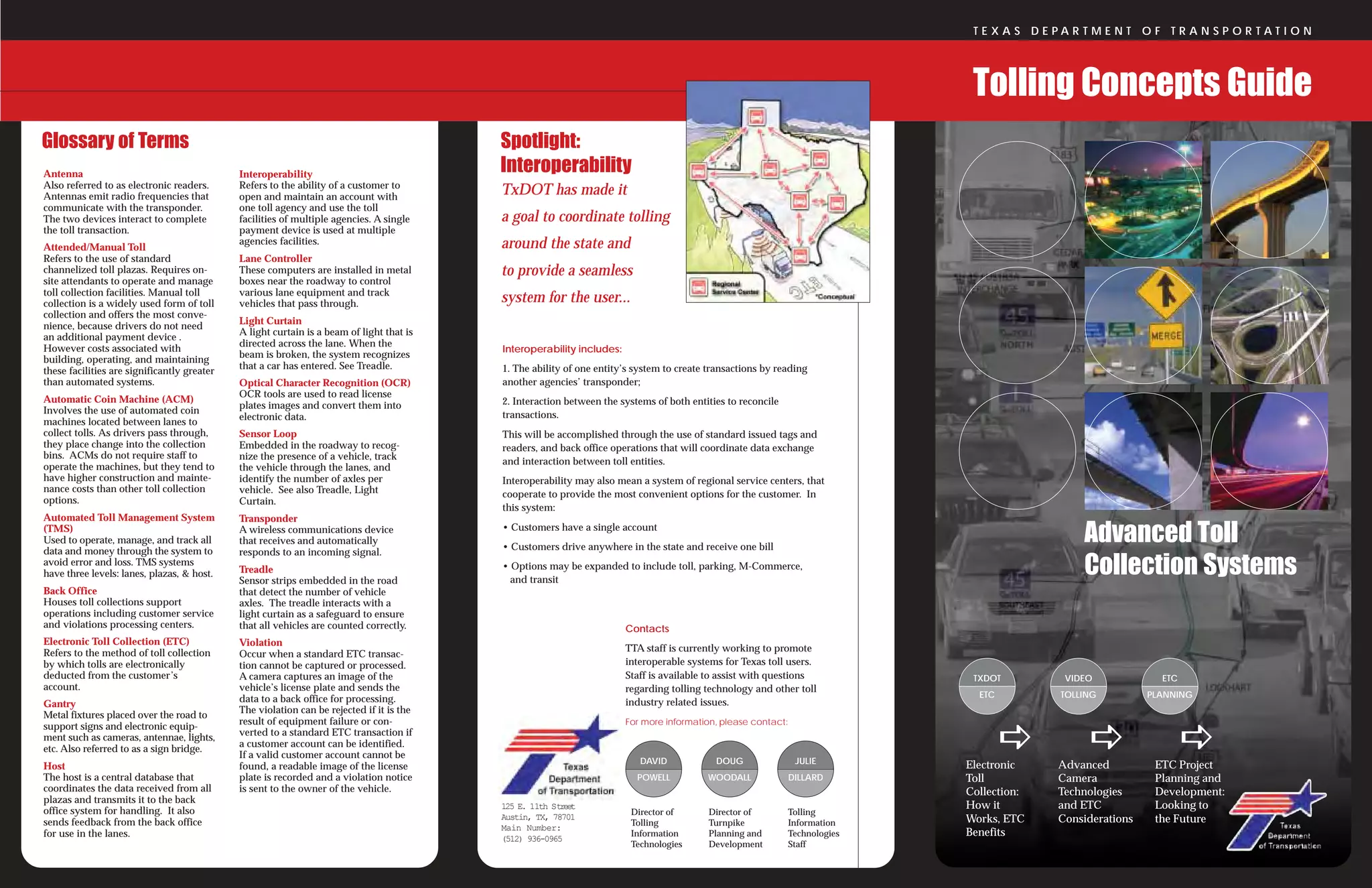
TxDOT has made it
a goal to coordinate tolling
around the state and
to provide a seamless
system for the user...
DAVID
POWELL
JULIE
DILLARD
Antenna
Also referred to as electronic readers.
Antennas emit radio frequencies that
communicate with the transponder.
The two devices interact to complete
the toll transaction.
Attended/Manual Toll
Refers to the use of standard
channelized toll plazas. Requires on-
site attendants to operate and manage
toll collection facilities. Manual toll
collection is a widely used form of toll
collection and offers the most conve-
nience, because drivers do not need
an additional payment device .
However costs associated with
building, operating, and maintaining
these facilities are significantly greater
than automated systems.
Automatic Coin Machine (ACM)
Involves the use of automated coin
machines located between lanes to
collect tolls. As drivers pass through,
they place change into the collection
bins. ACMs do not require staff to
operate the machines, but they tend to
have higher construction and mainte-
nance costs than other toll collection
options.
Automated Toll Management System
(TMS)
Used to operate, manage, and track all
data and money through the system to
avoid error and loss. TMS systems
have three levels: lanes, plazas, & host.
Back Office
Houses toll collections support
operations including customer service
and violations processing centers.
Electronic Toll Collection (ETC)
Refers to the method of toll collection
by which tolls are electronically
deducted from the customer’s
account.
Gantry
Metal fixtures placed over the road to
support signs and electronic equip-
ment such as cameras, antennae, lights,
etc. Also referred to as a sign bridge.
Host
The host is a central database that
coordinates the data received from all
plazas and transmits it to the back
office system for handling. It also
sends feedback from the back office
for use in the lanes.
Interoperability includes:
1. The ability of one entity’s system to create transactions by reading
another agencies’ transponder;
2. Interaction between the systems of both entities to reconcile
transactions.
This will be accomplished through the use of standard issued tags and
readers, and back office operations that will coordinate data exchange
and interaction between toll entities.
Interoperability may also mean a system of regional service centers, that
cooperate to provide the most convenient options for the customer. In
this system:
• Customers have a single account
• Customers drive anywhere in the state and receive one bill
• Options may be expanded to include toll, parking, M-Commerce,
and transit
Interoperability
Refers to the ability of a customer to
open and maintain an account with
one toll agency and use the toll
facilities of multiple agencies. A single
payment device is used at multiple
agencies facilities.
Lane Controller
These computers are installed in metal
boxes near the roadway to control
various lane equipment and track
vehicles that pass through.
Light Curtain
A light curtain is a beam of light that is
directed across the lane. When the
beam is broken, the system recognizes
that a car has entered. See Treadle.
Optical Character Recognition (OCR)
OCR tools are used to read license
plates images and convert them into
electronic data.
Sensor Loop
Embedded in the roadway to recog-
nize the presence of a vehicle, track
the vehicle through the lanes, and
identify the number of axles per
vehicle. See also Treadle, Light
Curtain.
Transponder
A wireless communications device
that receives and automatically
responds to an incoming signal.
Treadle
Sensor strips embedded in the road
that detect the number of vehicle
axles. The treadle interacts with a
light curtain as a safeguard to ensure
that all vehicles are counted correctly.
Violation
Occur when a standard ETC transac-
tion cannot be captured or processed.
A camera captures an image of the
vehicle’s license plate and sends the
data to a back office for processing.
The violation can be rejected if it is the
result of equipment failure or con-
verted to a standard ETC transaction if
a customer account can be identified.
If a valid customer account cannot be
found, a readable image of the license
plate is recorded and a violation notice
is sent to the owner of the vehicle.
Glossary of Terms Spotlight:
Interoperability
Contacts
TTA staff is currently working to promote
interoperable systems for Texas toll users.
Staff is available to assist with questions
regarding tolling technology and other toll
industry related issues.
For more information, please contact:
125 E. 11th Street
Austin, TX, 78701
Main Number:
(512) 936-0965
Director of
Turnpike
Planning and
Development
Director of
Tolling
Information
Technologies
Tolling
Information
Technologies
Staff
DOUG
WOODALL
Tolling Concepts Guide
TXDOT
ETC
VIDEO
TOLLING
ETC
PLANNING
T E X A S D E P A R T M E N T O F T R A N S P O R T A T I O N
Electronic
Toll
Collection:
How it
Works, ETC
Benefits
Advanced
Camera
Technologies
and ETC
Considerations
ETC Project
Planning and
Development:
Looking to
the Future
! ! !
Advanced Toll
Collection Systems
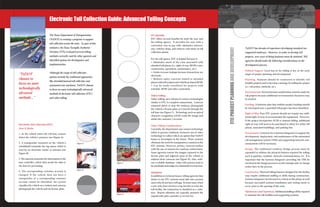
The Texas Department of Transportation
(TxDOT) is creating a program to support
toll collection across the state. As part of this
initiative, the Texas Turnpike Authority
Division (TTA) evaluated several tolling
methods currently used by other agencies and
identified options for development and
implementation.
Although the range of toll collection
options include the traditional approaches
like attended/manual toll collection and
automated coin machines, TxDOT chooses
to focus on more technologically advanced
methods of electronic toll collection (ETC)
and video tolling.
“TxDOT
chooses to
focus on more
technologically
advanced
methods...”
TxDOT has decades of experience developing standard tax-
supported roadways. However, in order to develop toll
projects, new ways of doing business must be initiated. Toll
agencies should make the following considerations in the
development process:
Political Support. Local buy-in for tolling is key in the early
stages of project planning and development.
Planning. Analyses should be conducted to identify toll
feasible projects and to develop a strategy for tolling the project
(i.e. toll points, methods, etc.)
Environmental. Environmental consideration must be made for
toll projects because additional environmental clearances may
be needed.
Funding. A business plan that outlines project funding should
be developed once a potential toll project has been identified,
Right-of-Way. Pure ETC systems should not require any addi-
tional right-of-way to accommodate the equipment. However,
if the project incorporates ACM or manual tolling, additional
right-of-way will need to be purchased to allow for wider toll
plazas, associated buildings, and parking lots.
Procurement. Contracts for a Systems Integrator to support the
development, deployment, and maintenance of the automated
toll management system (TMS) and supporting network com-
munications will be necessary.
Design. The traditional roadway design process must be
expanded to address the physical features required for tolling
such as gantries, conduits, network communications, etc. It is
important that the Systems Integrator providing the TMS be
involved in the design process to avoid redesign and/or change
orders later in the process.
Construction. Physical tolling features designed for the facility
may require additional staffing or skills during construction.
Systems Integrator involvement is critical at this phase as well
because successful systems installation and testing needs to
occur prior to the opening of the road.
Maintenance and Operations.Additional staffing will be required
to maintain the toll facilities and supporting systems.
ETC Benefits
ETC offers several benefits for both the user and
the tolling agency. It provides the user with a
convenient way to pay tolls, eliminates unneces-
sary vehicles stops, and reduces wait times at toll
collection plazas.
For the toll agency, ETC is helpful because it:
• Eliminates much of the costs associated with
attended toll plazas (i.e. right-of-way (ROW) costs,
construction, operations, maintenance, etc.);
• Limits revenue leakage because transactions are
electronic;
• Reduces safety concerns related to attended
plazaswithtollworkersandvehiclesinsharedROW;
• Can be easily retrofitted for projects with
schedule, ROW and other constraints.
Video Tolling
Video tolling uses advanced camera technologies
similar to ETC to complete transactions. Cameras
mounted above or near the roadway photograph
the vehicle’s license plate as it travels through the
toll lane (see Figure C). Technology such as optical
character recognition (OCR) reads the image and
debits the customer’s account.
Video Tolling Considerations
Currently, the department uses camera technology
solely to process violations. Exclusive use of video
technology to collect tolls is an option that TxDOT
hopes to investigate in the future. These systems
eliminate the need for transponders common to the
ETC systems. However, privacy concerns surface
with the use of cameras for roadway enforcement.
Some agencies restrict the images captured to the
license plate and adjacent parts of the vehicle to
address these concerns (see Figure D). Also, with-
out a reliable database, video toll systems tend to
be unreliable and subject to substantial revenue loss.
Violations
In addition to technical issues, tolling agencies that
desire to use ETC systems must take into account
users who do not have toll tags. In most cases, when
a user who does not have a tag decides to enter the
toll facility, the transaction is classified as a viola-
tion. Repeat offenders are typically assessed the
unpaid tolls plus a penalty or service fee.
Electronic Toll Collection (ETC)
How It Works
1. As the vehicle enters the toll lane, sensors
detect the vehicle’s presence (see Figure A).
2. A transponder mounted on the vehicle’s
windshield transmits the tag status which is
read by an electronic reader or antenna (see
Figure B).
3. The antenna transmits the information to the
lane controller, which then sends the data to
the host for processing.
4. The corresponding customer account is
charged. If the vehicle does not have a
transponder, or a corresponding customer
account cannot be identified, the system
classifies the vehicle as a violator and cameras
photograph the vehicle and its license plate.
Figure D
Figure C
Electronic Toll Collection Guide: Advanced Tolling Concepts
ETCPROJECTPLANNINGANDDEVELOPMENT
Figure A
Figure B

Tolling Concepts Guide: Advance Toll Concepts Systems

  • 1.
    TxDOT has madeit a goal to coordinate tolling around the state and to provide a seamless system for the user... DAVID POWELL JULIE DILLARD Antenna Also referred to as electronic readers. Antennas emit radio frequencies that communicate with the transponder. The two devices interact to complete the toll transaction. Attended/Manual Toll Refers to the use of standard channelized toll plazas. Requires on- site attendants to operate and manage toll collection facilities. Manual toll collection is a widely used form of toll collection and offers the most conve- nience, because drivers do not need an additional payment device . However costs associated with building, operating, and maintaining these facilities are significantly greater than automated systems. Automatic Coin Machine (ACM) Involves the use of automated coin machines located between lanes to collect tolls. As drivers pass through, they place change into the collection bins. ACMs do not require staff to operate the machines, but they tend to have higher construction and mainte- nance costs than other toll collection options. Automated Toll Management System (TMS) Used to operate, manage, and track all data and money through the system to avoid error and loss. TMS systems have three levels: lanes, plazas, & host. Back Office Houses toll collections support operations including customer service and violations processing centers. Electronic Toll Collection (ETC) Refers to the method of toll collection by which tolls are electronically deducted from the customer’s account. Gantry Metal fixtures placed over the road to support signs and electronic equip- ment such as cameras, antennae, lights, etc. Also referred to as a sign bridge. Host The host is a central database that coordinates the data received from all plazas and transmits it to the back office system for handling. It also sends feedback from the back office for use in the lanes. Interoperability includes: 1. The ability of one entity’s system to create transactions by reading another agencies’ transponder; 2. Interaction between the systems of both entities to reconcile transactions. This will be accomplished through the use of standard issued tags and readers, and back office operations that will coordinate data exchange and interaction between toll entities. Interoperability may also mean a system of regional service centers, that cooperate to provide the most convenient options for the customer. In this system: • Customers have a single account • Customers drive anywhere in the state and receive one bill • Options may be expanded to include toll, parking, M-Commerce, and transit Interoperability Refers to the ability of a customer to open and maintain an account with one toll agency and use the toll facilities of multiple agencies. A single payment device is used at multiple agencies facilities. Lane Controller These computers are installed in metal boxes near the roadway to control various lane equipment and track vehicles that pass through. Light Curtain A light curtain is a beam of light that is directed across the lane. When the beam is broken, the system recognizes that a car has entered. See Treadle. Optical Character Recognition (OCR) OCR tools are used to read license plates images and convert them into electronic data. Sensor Loop Embedded in the roadway to recog- nize the presence of a vehicle, track the vehicle through the lanes, and identify the number of axles per vehicle. See also Treadle, Light Curtain. Transponder A wireless communications device that receives and automatically responds to an incoming signal. Treadle Sensor strips embedded in the road that detect the number of vehicle axles. The treadle interacts with a light curtain as a safeguard to ensure that all vehicles are counted correctly. Violation Occur when a standard ETC transac- tion cannot be captured or processed. A camera captures an image of the vehicle’s license plate and sends the data to a back office for processing. The violation can be rejected if it is the result of equipment failure or con- verted to a standard ETC transaction if a customer account can be identified. If a valid customer account cannot be found, a readable image of the license plate is recorded and a violation notice is sent to the owner of the vehicle. Glossary of Terms Spotlight: Interoperability Contacts TTA staff is currently working to promote interoperable systems for Texas toll users. Staff is available to assist with questions regarding tolling technology and other toll industry related issues. For more information, please contact: 125 E. 11th Street Austin, TX, 78701 Main Number: (512) 936-0965 Director of Turnpike Planning and Development Director of Tolling Information Technologies Tolling Information Technologies Staff DOUG WOODALL Tolling Concepts Guide TXDOT ETC VIDEO TOLLING ETC PLANNING T E X A S D E P A R T M E N T O F T R A N S P O R T A T I O N Electronic Toll Collection: How it Works, ETC Benefits Advanced Camera Technologies and ETC Considerations ETC Project Planning and Development: Looking to the Future ! ! ! Advanced Toll Collection Systems
  • 2.
    The Texas Departmentof Transportation (TxDOT) is creating a program to support toll collection across the state. As part of this initiative, the Texas Turnpike Authority Division (TTA) evaluated several tolling methods currently used by other agencies and identified options for development and implementation. Although the range of toll collection options include the traditional approaches like attended/manual toll collection and automated coin machines, TxDOT chooses to focus on more technologically advanced methods of electronic toll collection (ETC) and video tolling. “TxDOT chooses to focus on more technologically advanced methods...” TxDOT has decades of experience developing standard tax- supported roadways. However, in order to develop toll projects, new ways of doing business must be initiated. Toll agencies should make the following considerations in the development process: Political Support. Local buy-in for tolling is key in the early stages of project planning and development. Planning. Analyses should be conducted to identify toll feasible projects and to develop a strategy for tolling the project (i.e. toll points, methods, etc.) Environmental. Environmental consideration must be made for toll projects because additional environmental clearances may be needed. Funding. A business plan that outlines project funding should be developed once a potential toll project has been identified, Right-of-Way. Pure ETC systems should not require any addi- tional right-of-way to accommodate the equipment. However, if the project incorporates ACM or manual tolling, additional right-of-way will need to be purchased to allow for wider toll plazas, associated buildings, and parking lots. Procurement. Contracts for a Systems Integrator to support the development, deployment, and maintenance of the automated toll management system (TMS) and supporting network com- munications will be necessary. Design. The traditional roadway design process must be expanded to address the physical features required for tolling such as gantries, conduits, network communications, etc. It is important that the Systems Integrator providing the TMS be involved in the design process to avoid redesign and/or change orders later in the process. Construction. Physical tolling features designed for the facility may require additional staffing or skills during construction. Systems Integrator involvement is critical at this phase as well because successful systems installation and testing needs to occur prior to the opening of the road. Maintenance and Operations.Additional staffing will be required to maintain the toll facilities and supporting systems. ETC Benefits ETC offers several benefits for both the user and the tolling agency. It provides the user with a convenient way to pay tolls, eliminates unneces- sary vehicles stops, and reduces wait times at toll collection plazas. For the toll agency, ETC is helpful because it: • Eliminates much of the costs associated with attended toll plazas (i.e. right-of-way (ROW) costs, construction, operations, maintenance, etc.); • Limits revenue leakage because transactions are electronic; • Reduces safety concerns related to attended plazaswithtollworkersandvehiclesinsharedROW; • Can be easily retrofitted for projects with schedule, ROW and other constraints. Video Tolling Video tolling uses advanced camera technologies similar to ETC to complete transactions. Cameras mounted above or near the roadway photograph the vehicle’s license plate as it travels through the toll lane (see Figure C). Technology such as optical character recognition (OCR) reads the image and debits the customer’s account. Video Tolling Considerations Currently, the department uses camera technology solely to process violations. Exclusive use of video technology to collect tolls is an option that TxDOT hopes to investigate in the future. These systems eliminate the need for transponders common to the ETC systems. However, privacy concerns surface with the use of cameras for roadway enforcement. Some agencies restrict the images captured to the license plate and adjacent parts of the vehicle to address these concerns (see Figure D). Also, with- out a reliable database, video toll systems tend to be unreliable and subject to substantial revenue loss. Violations In addition to technical issues, tolling agencies that desire to use ETC systems must take into account users who do not have toll tags. In most cases, when a user who does not have a tag decides to enter the toll facility, the transaction is classified as a viola- tion. Repeat offenders are typically assessed the unpaid tolls plus a penalty or service fee. Electronic Toll Collection (ETC) How It Works 1. As the vehicle enters the toll lane, sensors detect the vehicle’s presence (see Figure A). 2. A transponder mounted on the vehicle’s windshield transmits the tag status which is read by an electronic reader or antenna (see Figure B). 3. The antenna transmits the information to the lane controller, which then sends the data to the host for processing. 4. The corresponding customer account is charged. If the vehicle does not have a transponder, or a corresponding customer account cannot be identified, the system classifies the vehicle as a violator and cameras photograph the vehicle and its license plate. Figure D Figure C Electronic Toll Collection Guide: Advanced Tolling Concepts ETCPROJECTPLANNINGANDDEVELOPMENT Figure A Figure B