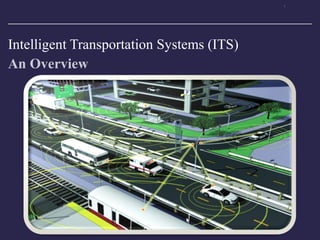
Intelligent Transportation Systems (ITS)
An Overview
ITS Overview
What are ITS?
−Intelligent Transport Systems (ITS) involve the collection and
processing of data:
− to provide information;
− to advise or control the actions of:
− travellers;
− drivers;
− fleet operators; and
− network managers
− using computers with multi-media communications and
other technology.
ITS Overview
What Does ITS Offer?
− Allows improved use of existing infrastructure by:
− Providing a better understanding of the transport network
− Live traffic and travel information – quick response
− Providing new methods to manage the network
− Improved traffic signals and vehicle priority
− Improved intra/inter organisational communications
− Providing new services to the public
− Travel Information to make journeys easier and more pleasant
ITS Overview
ITS Overview
How Does ITS Help?
− ITS is a tool to implement transport (and other) policy
− Not an end in itself
− Not a panacea
− ITS can be beneficial
− On its own
− Supporting other measures
− ITS builds on what is there
− Not all new
− SCOOT UTC
− Flexibility to respond to changing priorities
ITS Overview
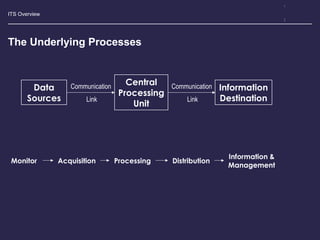
The Underlying Processes
Data
Sources
Central
Processing
Unit
Information
Destination
Communication
Link
Communication
Link
Monitor Acquisition Processing Distribution
Information &
Management
ITS Overview
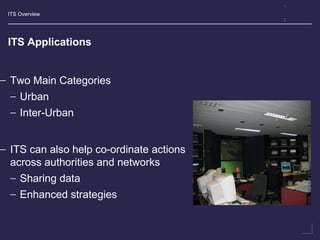
ITS Applications
− Two Main Categories
− Urban
− Inter-Urban
− ITS can also help co-ordinate actions
across authorities and networks
− Sharing data
− Enhanced strategies
Urban ITS
Improving Transport Within Towns and Cities
ITS Overview
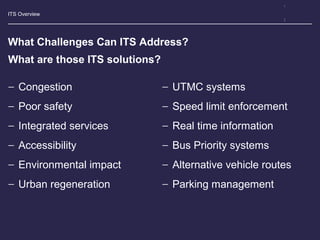
What Challenges Can ITS Address?
− Congestion
− Poor safety
− Integrated services
− Accessibility
− Environmental impact
− Urban regeneration
− UTMC systems
− Speed limit enforcement
− Real time information
− Bus Priority systems
− Alternative vehicle routes
− Parking management
What are those ITS solutions?
ITS Overview
UTMC
− Based on a common database
− Can fulfil many objectives
− Costs vary depending upon the complexity of the system and its
requirements
− Designed for interoperability with non proprietary systems
− May include, for example
− SCOOT Urban traffic control
− Variable message signs
− Bus priority measures at traffic signals
− Real time travel information
Urban Traffic Management and Control
ITS Overview
Integration - Sharing Data
UTMC COMMUNICATIONS NETWORK
Operators
Terminals
Signal
Control
VMS
Public
Transport
Priority
Emissions
Monitoring
Road
Pricing
Other Functions
as Required
Common
Database
Other Systems
& Services
Other Users of Information
ITS Overview
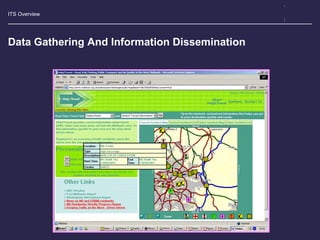
Data Gathering And Information Dissemination
ITS Overview
Data Gathering
− Data gathered automatically - in a variety of ways
− induction loops
− Cameras
− CCTV
− ANPR
− Floating Vehicle Data
− Information from RUC schemes and tolling information
ITS Overview
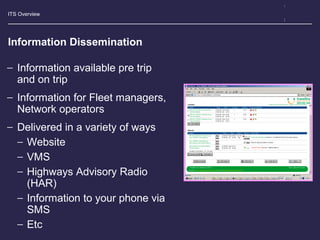
Information Dissemination
− Information available pre trip
and on trip
− Information for Fleet managers,
Network operators
− Delivered in a variety of ways
− Website
− VMS
− Highways Advisory Radio
(HAR)
− Information to your phone via
SMS
− Etc
ITS Overview
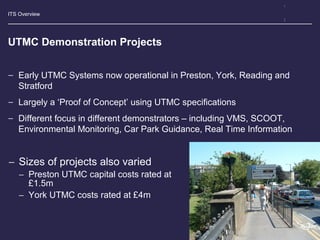
UTMC Demonstration Projects
− Early UTMC Systems now operational in Preston, York, Reading and
Stratford
− Largely a ‘Proof of Concept’ using UTMC specifications
− Different focus in different demonstrators – including VMS, SCOOT,
Environmental Monitoring, Car Park Guidance, Real Time Information
− Sizes of projects also varied
− Preston UTMC capital costs rated at
£1.5m
− York UTMC costs rated at £4m
ITS Overview
Speed Limit Enforcement
− Old style speed enforcement including Gatso wet film cameras is being
superseded
− Digital Photography
− Eliminates the need to remove and replace film
− Cheaper to operate
− ANPR systems
− Allows “Distance over time” enforcement
− IR photography
− Encourage compliance
− “Secret Signage”
− Intelligent Road Studs to measure speeds and advise drivers
ITS Overview
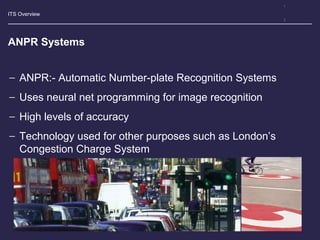
ANPR Systems
− ANPR:- Automatic Number-plate Recognition Systems
− Uses neural net programming for image recognition
− High levels of accuracy
− Technology used for other purposes such as London’s
Congestion Charge System
ITS Overview
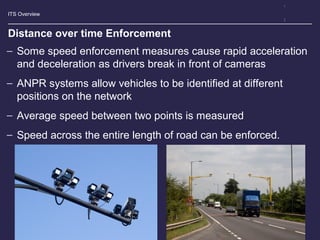
Distance over time Enforcement
− Some speed enforcement measures cause rapid acceleration
and deceleration as drivers break in front of cameras
− ANPR systems allow vehicles to be identified at different
positions on the network
− Average speed between two points is measured
− Speed across the entire length of road can be enforced.
ITS Overview
Speed Warning Devices
− ITS provides speed control devices that are not aimed at
prosecutions
− Speed activated signs,
− Displaying registration of speeding vehicle
− Maximum appropriate and safe speed may be significantly
below signed speed limit
− Variable Speed Limit applications now being used
ITS Overview
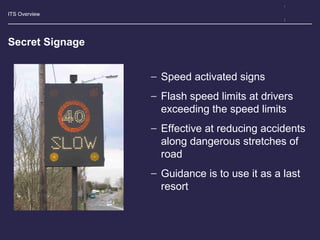
Secret Signage
− Speed activated signs
− Flash speed limits at drivers
exceeding the speed limits
− Effective at reducing accidents
along dangerous stretches of
road
− Guidance is to use it as a last
resort
Inter-Urban ITS
Improving Capacity and Preserving the Asset
ITS Overview
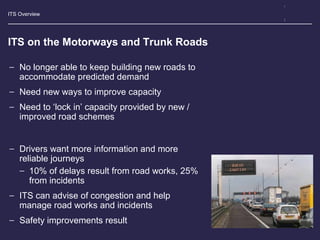
ITS on the Motorways and Trunk Roads
− No longer able to keep building new roads to
accommodate predicted demand
− Need new ways to improve capacity
− Need to ‘lock in’ capacity provided by new /
improved road schemes
− Drivers want more information and more
reliable journeys
− 10% of delays result from road works, 25%
from incidents
− ITS can advise of congestion and help
manage road works and incidents
− Safety improvements result
ITS Overview
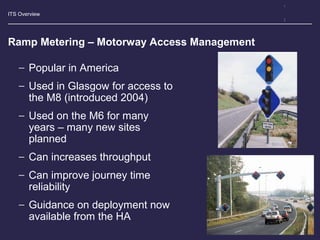
Ramp Metering – Motorway Access Management
− Popular in America
− Used in Glasgow for access to
the M8 (introduced 2004)
− Used on the M6 for many
years – many new sites
planned
− Can increases throughput
− Can improve journey time
reliability
− Guidance on deployment now
available from the HA
ITS Overview
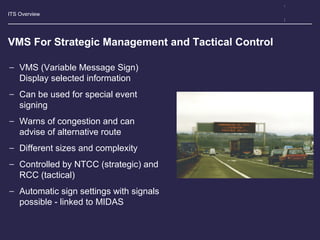
VMS For Strategic Management and Tactical Control
− VMS (Variable Message Sign)
Display selected information
− Can be used for special event
signing
− Warns of congestion and can
advise of alternative route
− Different sizes and complexity
− Controlled by NTCC (strategic) and
RCC (tactical)
− Automatic sign settings with signals
possible - linked to MIDAS
ITS Overview
MIDAS and VMS
− MIDAS - Motorway Incident Detection and Automated Signalling
− Uses induction loops to monitor traffic flow on strategic road
network
− Predominantly for queue protection
− Automatically sets signals and signs, including variable speed limits
− Good response: Average time till the system displays signs
appropriate to an incident is routinely before RCC is aware of
incident
− Signs and signals clears down automatically when flow returns to
‘normal’
ITS Overview
Hazard Warning Systems
− Companion System
− Intelligent Road Studs (IRS)
ITS Overview
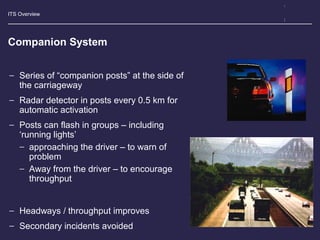
Companion System
− Series of “companion posts” at the side of
the carriageway
− Radar detector in posts every 0.5 km for
automatic activation
− Posts can flash in groups – including
‘running lights’
− approaching the driver – to warn of
problem
− Away from the driver – to encourage
throughput
− Headways / throughput improves
− Secondary incidents avoided
ITS Overview
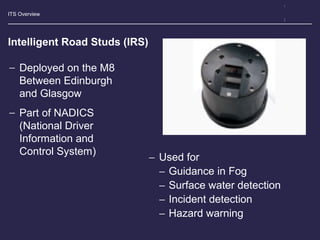
Intelligent Road Studs (IRS)
− Deployed on the M8
Between Edinburgh
and Glasgow
− Part of NADICS
(National Driver
Information and
Control System)
− Used for
− Guidance in Fog
− Surface water detection
− Incident detection
− Hazard warning
ITS Overview
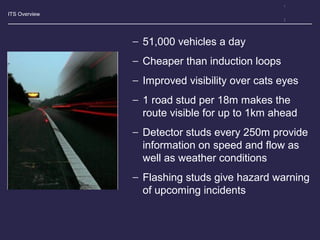
− 51,000 vehicles a day
− Cheaper than induction loops
− Improved visibility over cats eyes
− 1 road stud per 18m makes the
route visible for up to 1km ahead
− Detector studs every 250m provide
information on speed and flow as
well as weather conditions
− Flashing studs give hazard warning
of upcoming incidents
ITS Overview
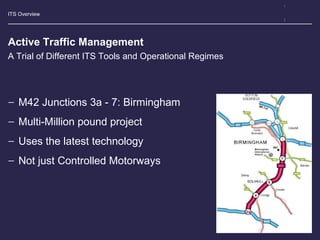
Active Traffic Management
− M42 Junctions 3a - 7: Birmingham
− Multi-Million pound project
− Uses the latest technology
− Not just Controlled Motorways
A Trial of Different ITS Tools and Operational Regimes
M42 J3a-7
ITS Overview
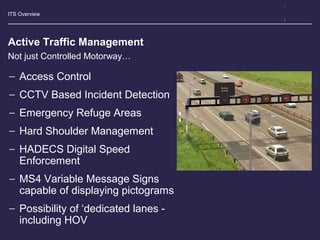
Active Traffic Management
− Access Control
− CCTV Based Incident Detection
− Emergency Refuge Areas
− Hard Shoulder Management
− HADECS Digital Speed
Enforcement
− MS4 Variable Message Signs
capable of displaying pictograms
− Possibility of ‘dedicated lanes -
including HOV
Not just Controlled Motorway…
ITS Overview
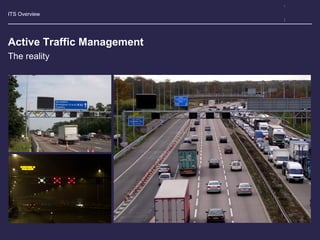
Active Traffic Management
The reality
ATM Picture
ITS Overview
Active Traffic Management
− Installation works now complete
− Three Lane Variable Speed Limits from Late 2005
− Four Lane Hard Shoulder Running from Autumn 2006
− Access Control: still to be determined
Timetable
ITS Overview
Active Traffic Management
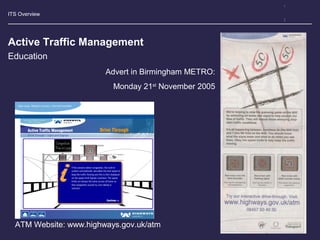
Advert in Birmingham METRO:
Monday 21st
November 2005
ATM Website: www.highways.gov.uk/atm
Education
ITS Overview
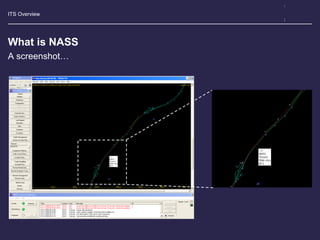
Network Advisory Assessment Tool (NASS)
− Computer modelling tool developed by IPL
− Will be used by ATM Operators in the Control Room
− Predicts traffic conditions an hour ahead
− Match conditions to a library of traffic patterns
− Decide which one of three associated plans will have the most
benefit
Summary
ITS Overview
What is NASS
A screenshot…
Image
ITS Overview
What is NASS
− Working for WSP in Basingstoke
− Ultimate client is the Highways Agency
− Testing Phase B of the system completed
− “Offline” testing / proof of concept
− Phase C to be installed in the Control Room
− FM to develop strategies / plans to address incidents
Faber Maunsell involvement
ITS Overview
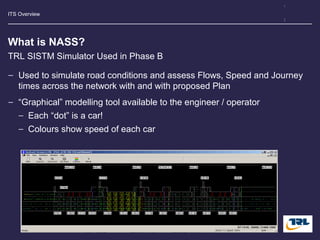
What is NASS?
− Used to simulate road conditions and assess Flows, Speed and Journey
times across the network with and with proposed Plan
− “Graphical” modelling tool available to the engineer / operator
− Each “dot” is a car!
− Colours show speed of each car
TRL SISTM Simulator Used in Phase B
Image
ITS Overview
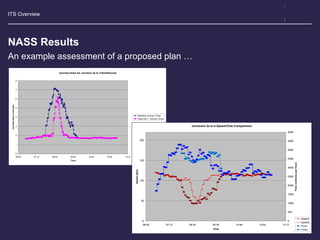
NASS Results
An example assessment of a proposed plan …
Journey times for Junction 3a to 4 Northbound
0
1
2
3
4
5
6
7
8
06:00 07:12 08:24 09:36 10:48 12:00 13:12
Time
Journeytimeinminutes
Baseline Journey Times
Nass Run 1 Journey Times
Junctions 3a to 4 Speed-Flow Comparision
0
50
100
150
200
06:00 07:12 08:24 09:36 10:48 12:00 13:12
Time
Speed(kph)
0
500
1000
1500
2000
2500
3000
3500
4000
4500
5000
Flow(vehiclesperhour)
Speed1
Speed2
Flow1
Flow2
ITS Overview
Integrated use of ITS – The Key to Success
− Better management / more efficient operation
− Sharing data – collect once, use many times
− Standardising equipment and protocols – using the best IT
can offer
− Reducing cost / achieving operational targets
− Dealing with information overload - highlighting what is
important
− Presentation in a digestible format and there when you need it
− Coordinating effort – knowing what is happening and who is
dealing with it
ITS Overview
REFERENCES:
− FABER MAUNSELL – ITS OVERVIEW
− AECOM.COM
− BUILDING.CO.UK
− WASHINGTON.EDU
− STUDYMAFIA.ORG
− SLIDESHARE REFERENCES
ITS Overview

ITS - Intelligent Transport System - An Overview

  • 1.
  • 2.
    ITS Overview What areITS? −Intelligent Transport Systems (ITS) involve the collection and processing of data: − to provide information; − to advise or control the actions of: − travellers; − drivers; − fleet operators; and − network managers − using computers with multi-media communications and other technology.
  • 3.
    ITS Overview What DoesITS Offer? − Allows improved use of existing infrastructure by: − Providing a better understanding of the transport network − Live traffic and travel information – quick response − Providing new methods to manage the network − Improved traffic signals and vehicle priority − Improved intra/inter organisational communications − Providing new services to the public − Travel Information to make journeys easier and more pleasant
  • 4.
  • 5.
    ITS Overview How DoesITS Help? − ITS is a tool to implement transport (and other) policy − Not an end in itself − Not a panacea − ITS can be beneficial − On its own − Supporting other measures − ITS builds on what is there − Not all new − SCOOT UTC − Flexibility to respond to changing priorities
  • 6.
    ITS Overview The UnderlyingProcesses Data Sources Central Processing Unit Information Destination Communication Link Communication Link Monitor Acquisition Processing Distribution Information & Management
  • 7.
    ITS Overview ITS Applications −Two Main Categories − Urban − Inter-Urban − ITS can also help co-ordinate actions across authorities and networks − Sharing data − Enhanced strategies
  • 8.
    Urban ITS Improving TransportWithin Towns and Cities
  • 9.
    ITS Overview What ChallengesCan ITS Address? − Congestion − Poor safety − Integrated services − Accessibility − Environmental impact − Urban regeneration − UTMC systems − Speed limit enforcement − Real time information − Bus Priority systems − Alternative vehicle routes − Parking management What are those ITS solutions?
  • 10.
    ITS Overview UTMC − Basedon a common database − Can fulfil many objectives − Costs vary depending upon the complexity of the system and its requirements − Designed for interoperability with non proprietary systems − May include, for example − SCOOT Urban traffic control − Variable message signs − Bus priority measures at traffic signals − Real time travel information Urban Traffic Management and Control
  • 11.
    ITS Overview Integration -Sharing Data UTMC COMMUNICATIONS NETWORK Operators Terminals Signal Control VMS Public Transport Priority Emissions Monitoring Road Pricing Other Functions as Required Common Database Other Systems & Services Other Users of Information
  • 12.
    ITS Overview Data GatheringAnd Information Dissemination
  • 13.
    ITS Overview Data Gathering −Data gathered automatically - in a variety of ways − induction loops − Cameras − CCTV − ANPR − Floating Vehicle Data − Information from RUC schemes and tolling information
  • 14.
    ITS Overview Information Dissemination −Information available pre trip and on trip − Information for Fleet managers, Network operators − Delivered in a variety of ways − Website − VMS − Highways Advisory Radio (HAR) − Information to your phone via SMS − Etc
  • 15.
    ITS Overview UTMC DemonstrationProjects − Early UTMC Systems now operational in Preston, York, Reading and Stratford − Largely a ‘Proof of Concept’ using UTMC specifications − Different focus in different demonstrators – including VMS, SCOOT, Environmental Monitoring, Car Park Guidance, Real Time Information − Sizes of projects also varied − Preston UTMC capital costs rated at £1.5m − York UTMC costs rated at £4m
  • 16.
    ITS Overview Speed LimitEnforcement − Old style speed enforcement including Gatso wet film cameras is being superseded − Digital Photography − Eliminates the need to remove and replace film − Cheaper to operate − ANPR systems − Allows “Distance over time” enforcement − IR photography − Encourage compliance − “Secret Signage” − Intelligent Road Studs to measure speeds and advise drivers
  • 17.
    ITS Overview ANPR Systems −ANPR:- Automatic Number-plate Recognition Systems − Uses neural net programming for image recognition − High levels of accuracy − Technology used for other purposes such as London’s Congestion Charge System
  • 18.
    ITS Overview Distance overtime Enforcement − Some speed enforcement measures cause rapid acceleration and deceleration as drivers break in front of cameras − ANPR systems allow vehicles to be identified at different positions on the network − Average speed between two points is measured − Speed across the entire length of road can be enforced.
  • 19.
    ITS Overview Speed WarningDevices − ITS provides speed control devices that are not aimed at prosecutions − Speed activated signs, − Displaying registration of speeding vehicle − Maximum appropriate and safe speed may be significantly below signed speed limit − Variable Speed Limit applications now being used
  • 20.
    ITS Overview Secret Signage −Speed activated signs − Flash speed limits at drivers exceeding the speed limits − Effective at reducing accidents along dangerous stretches of road − Guidance is to use it as a last resort
  • 21.
    Inter-Urban ITS Improving Capacityand Preserving the Asset
  • 22.
    ITS Overview ITS onthe Motorways and Trunk Roads − No longer able to keep building new roads to accommodate predicted demand − Need new ways to improve capacity − Need to ‘lock in’ capacity provided by new / improved road schemes − Drivers want more information and more reliable journeys − 10% of delays result from road works, 25% from incidents − ITS can advise of congestion and help manage road works and incidents − Safety improvements result
  • 23.
    ITS Overview Ramp Metering– Motorway Access Management − Popular in America − Used in Glasgow for access to the M8 (introduced 2004) − Used on the M6 for many years – many new sites planned − Can increases throughput − Can improve journey time reliability − Guidance on deployment now available from the HA
  • 24.
    ITS Overview VMS ForStrategic Management and Tactical Control − VMS (Variable Message Sign) Display selected information − Can be used for special event signing − Warns of congestion and can advise of alternative route − Different sizes and complexity − Controlled by NTCC (strategic) and RCC (tactical) − Automatic sign settings with signals possible - linked to MIDAS
  • 25.
    ITS Overview MIDAS andVMS − MIDAS - Motorway Incident Detection and Automated Signalling − Uses induction loops to monitor traffic flow on strategic road network − Predominantly for queue protection − Automatically sets signals and signs, including variable speed limits − Good response: Average time till the system displays signs appropriate to an incident is routinely before RCC is aware of incident − Signs and signals clears down automatically when flow returns to ‘normal’
  • 26.
    ITS Overview Hazard WarningSystems − Companion System − Intelligent Road Studs (IRS)
  • 27.
    ITS Overview Companion System −Series of “companion posts” at the side of the carriageway − Radar detector in posts every 0.5 km for automatic activation − Posts can flash in groups – including ‘running lights’ − approaching the driver – to warn of problem − Away from the driver – to encourage throughput − Headways / throughput improves − Secondary incidents avoided
  • 28.
    ITS Overview Intelligent RoadStuds (IRS) − Deployed on the M8 Between Edinburgh and Glasgow − Part of NADICS (National Driver Information and Control System) − Used for − Guidance in Fog − Surface water detection − Incident detection − Hazard warning
  • 29.
    ITS Overview − 51,000vehicles a day − Cheaper than induction loops − Improved visibility over cats eyes − 1 road stud per 18m makes the route visible for up to 1km ahead − Detector studs every 250m provide information on speed and flow as well as weather conditions − Flashing studs give hazard warning of upcoming incidents
  • 30.
    ITS Overview Active TrafficManagement − M42 Junctions 3a - 7: Birmingham − Multi-Million pound project − Uses the latest technology − Not just Controlled Motorways A Trial of Different ITS Tools and Operational Regimes M42 J3a-7
  • 31.
    ITS Overview Active TrafficManagement − Access Control − CCTV Based Incident Detection − Emergency Refuge Areas − Hard Shoulder Management − HADECS Digital Speed Enforcement − MS4 Variable Message Signs capable of displaying pictograms − Possibility of ‘dedicated lanes - including HOV Not just Controlled Motorway…
  • 32.
    ITS Overview Active TrafficManagement The reality ATM Picture
  • 33.
    ITS Overview Active TrafficManagement − Installation works now complete − Three Lane Variable Speed Limits from Late 2005 − Four Lane Hard Shoulder Running from Autumn 2006 − Access Control: still to be determined Timetable
  • 34.
    ITS Overview Active TrafficManagement Advert in Birmingham METRO: Monday 21st November 2005 ATM Website: www.highways.gov.uk/atm Education
  • 35.
    ITS Overview Network AdvisoryAssessment Tool (NASS) − Computer modelling tool developed by IPL − Will be used by ATM Operators in the Control Room − Predicts traffic conditions an hour ahead − Match conditions to a library of traffic patterns − Decide which one of three associated plans will have the most benefit Summary
  • 36.
    ITS Overview What isNASS A screenshot… Image
  • 37.
    ITS Overview What isNASS − Working for WSP in Basingstoke − Ultimate client is the Highways Agency − Testing Phase B of the system completed − “Offline” testing / proof of concept − Phase C to be installed in the Control Room − FM to develop strategies / plans to address incidents Faber Maunsell involvement
  • 38.
    ITS Overview What isNASS? − Used to simulate road conditions and assess Flows, Speed and Journey times across the network with and with proposed Plan − “Graphical” modelling tool available to the engineer / operator − Each “dot” is a car! − Colours show speed of each car TRL SISTM Simulator Used in Phase B Image
  • 39.
    ITS Overview NASS Results Anexample assessment of a proposed plan … Journey times for Junction 3a to 4 Northbound 0 1 2 3 4 5 6 7 8 06:00 07:12 08:24 09:36 10:48 12:00 13:12 Time Journeytimeinminutes Baseline Journey Times Nass Run 1 Journey Times Junctions 3a to 4 Speed-Flow Comparision 0 50 100 150 200 06:00 07:12 08:24 09:36 10:48 12:00 13:12 Time Speed(kph) 0 500 1000 1500 2000 2500 3000 3500 4000 4500 5000 Flow(vehiclesperhour) Speed1 Speed2 Flow1 Flow2
  • 40.
    ITS Overview Integrated useof ITS – The Key to Success − Better management / more efficient operation − Sharing data – collect once, use many times − Standardising equipment and protocols – using the best IT can offer − Reducing cost / achieving operational targets − Dealing with information overload - highlighting what is important − Presentation in a digestible format and there when you need it − Coordinating effort – knowing what is happening and who is dealing with it
  • 41.
    ITS Overview REFERENCES: − FABERMAUNSELL – ITS OVERVIEW − AECOM.COM − BUILDING.CO.UK − WASHINGTON.EDU − STUDYMAFIA.ORG − SLIDESHARE REFERENCES
  • 42.