INTELLIGENT TRANSPORTATION
SYSTEM
INTELLIGENT TRANSPORTATION
SYSTEM (ITS)
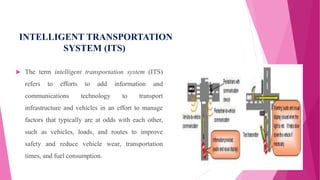
 The term intelligent transportation system (ITS)
refers to efforts to add information and
communications technology to transport
infrastructure and vehicles in an effort to manage
factors that typically are at odds with each other,
such as vehicles, loads, and routes to improve
safety and reduce vehicle wear, transportation
times, and fuel consumption.
NEED OF I.T.S
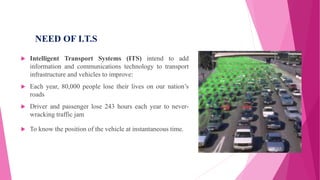
 Intelligent Transport Systems (ITS) intend to add
information and communications technology to transport
infrastructure and vehicles to improve:
 Each year, 80,000 people lose their lives on our nation’s
roads
 Driver and passenger lose 243 hours each year to never-
wracking traffic jam
 To know the position of the vehicle at instantaneous time.
INTELLIGENT TRANSPORTATION TECHNOLOGIES
NEW METHODS
 Wireless communications
 Computational technologies
 Sensing technologies
 Probe & smart vehicles
 In vehicle information & route guide
OLD METHODS
 Video vehicle detection
 Inductive loop detection:
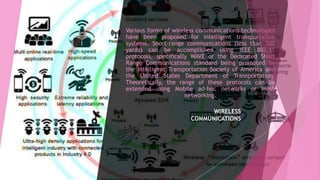
Various forms of wireless communications technologies
have been proposed for intelligent transportation
systems. Short-range communications (less than 500
yards) can be accomplished using IEEE 802.11
protocols, specifically WAVE or the Dedicated Short
Range Communications standard being promoted by
the Intelligent Transportation Society of America and
the United States Department of Transportation.
Theoretically, the range of these protocols can be
extended using Mobile ad-hoc networks or Mesh
networking.
WIRELESS
COMMUNICATIONS
COMPUTATIONAL
TECHNOLOGIES
Recent advances in vehicle electronics have led to a move
toward fewer, more capable computer processors on a
vehicle. A typical vehicle in the early 2000s would have
between 20 and 100 individual networked
microcontroller/Programmable logic controller modules with
non-real-time operating systems. The current trend is toward
fewer, more costly microprocessor modules with hardware
memory management and Real-Time Operating Systems.
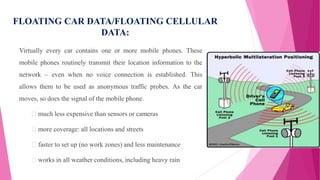
Virtually every car contains one or more mobile phones. These
mobile phones routinely transmit their location information to the
network – even when no voice connection is established. This
allows them to be used as anonymous traffic probes. As the car
moves, so does the signal of the mobile phone.
much less expensive than sensors or cameras
more coverage: all locations and streets
faster to set up (no work zones) and less maintenance
works in all weather conditions, including heavy rain
FLOATING CAR DATA/FLOATING CELLULAR
DATA:
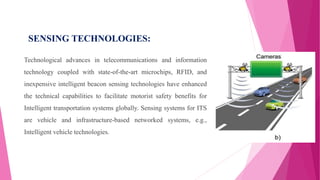
SENSING TECHNOLOGIES:
Technological advances in telecommunications and information
technology coupled with state-of-the-art microchips, RFID, and
inexpensive intelligent beacon sensing technologies have enhanced
the technical capabilities to facilitate motorist safety benefits for
Intelligent transportation systems globally. Sensing systems for ITS
are vehicle and infrastructure-based networked systems, e.g.,
Intelligent vehicle technologies.
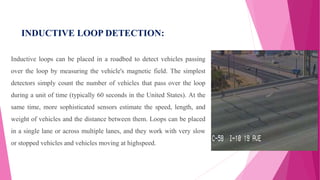
Inductive loops can be placed in a roadbed to detect vehicles passing
over the loop by measuring the vehicle's magnetic field. The simplest
detectors simply count the number of vehicles that pass over the loop
during a unit of time (typically 60 seconds in the United States). At the
same time, more sophisticated sensors estimate the speed, length, and
weight of vehicles and the distance between them. Loops can be placed
in a single lane or across multiple lanes, and they work with very slow
or stopped vehicles and vehicles moving at highspeed.
INDUCTIVE LOOP DETECTION:
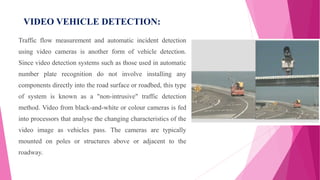
VIDEO VEHICLE DETECTION:
Traffic flow measurement and automatic incident detection
using video cameras is another form of vehicle detection.
Since video detection systems such as those used in automatic
number plate recognition do not involve installing any
components directly into the road surface or roadbed, this type
of system is known as a "non-intrusive" traffic detection
method. Video from black-and-white or colour cameras is fed
into processors that analyse the changing characteristics of the
video image as vehicles pass. The cameras are typically
mounted on poles or structures above or adjacent to the
roadway.
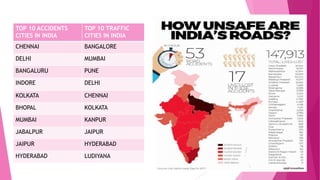
TOP 10 ACCIDENTS
CITIES IN INDIA
TOP 10 TRAFFIC
CITIES IN INDIA
CHENNAI BANGALORE
DELHI MUMBAI
BANGALURU PUNE
INDORE DELHI
KOLKATA CHENNAI
BHOPAL KOLKATA
MUMBAI KANPUR
JABALPUR JAIPUR
JAIPUR HYDERABAD
HYDERABAD LUDIYANA
INTELLIGENT TRANSPORTATION
APPLICATIONS
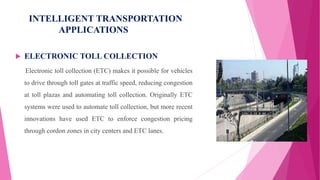
 ELECTRONIC TOLL COLLECTION
Electronic toll collection (ETC) makes it possible for vehicles
to drive through toll gates at traffic speed, reducing congestion
at toll plazas and automating toll collection. Originally ETC
systems were used to automate toll collection, but more recent
innovations have used ETC to enforce congestion pricing
through cordon zones in city centers and ETC lanes.
EMERGENCY VEHICLE NOTIFICATION
SYSTEMS
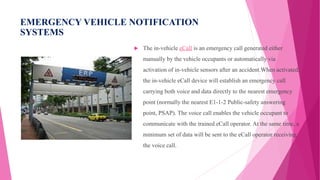
 The in-vehicle eCall is an emergency call generated either
manually by the vehicle occupants or automatically via
activation of in-vehicle sensors after an accident.When activated,
the in-vehicle eCall device will establish an emergency call
carrying both voice and data directly to the nearest emergency
point (normally the nearest E1-1-2 Public-safety answering
point, PSAP). The voice call enables the vehicle occupant to
communicate with the trained eCall operator. At the same time, a
minimum set of data will be sent to the eCall operator receiving
the voice call.
AUTOMATIC ROAD ENFORCEMENT
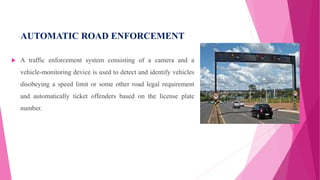
 A traffic enforcement system consisting of a camera and a
vehicle-monitoring device is used to detect and identify vehicles
disobeying a speed limit or some other road legal requirement
and automatically ticket offenders based on the license plate
number.
DYNAMIC TRAFFIC
LIGHT SEQUENCE
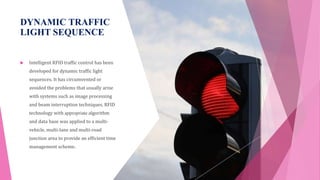
 Intelligent RFID traffic control has been
developed for dynamic traffic light
sequences. It has circumvented or
avoided the problems that usually arise
with systems such as image processing
and beam interruption techniques. RFID
technology with appropriate algorithm
and data base was applied to a multi-
vehicle, multi-lane and multi-road
junction area to provide an efficient time
management scheme.
I.T.S REQUIREMENTS IN INDIA
 The number of vehicles has risen; hence, road accidents have also increased.
 World’s highest annual road fatalities - 80,000 persons killed on Indian roads every year.
 IT.S India project .–
To improve road safety and the efficiency of transportation systems.
Close cooperation between European and Indian stakeholders, defining key issues for ITS
deployment, particularly Intelligent Integrated Safety Systems.
ROAD SAFETY IN INDIA
Ownership of cars in India - 6 per thousand of the population as against 500 in
developed economies.
Number of fatalities per 10,000 vehicles - 14.39 in India, compared to 1.0 to 2.50 in
many high-income countries
Causes Of Road Accidents
➢ Driver’s fault -83.5%
➢ Pedestrian fault/fault of passengers -4.7%
➢ Mechanical defect in vehicles -3%
➢ Bad roads -1.1%
➢ Bad weather -0.9%
➢ Other factors-6.8%
Eg: cattle, fallen trees, road blockages, non-functioning of signals and
absence of rear reflectors/road signs
Electronic Toll Collection in India
 Electronic toll collection (ETC) is a wireless system to automatically collect the usage fee
or toll charged to vehicles using toll roads, HOV lanes, toll bridges, and toll tunnels. It is a faster
alternative which is replacing toll booths, where vehicles must Stop and the driver manually pays
the toll with cash or a card. In most systems, vehicles using the system are equipped with an
automated radio transponder device. When the vehicle passes a roadside toll reader device, a radio
signal from the reader triggers the transponder, which transmits back an identifying number which
registers the vehicle's use of the road, and an electronic payment system charges the user the toll. A
major advantage is the driver does not have to stop, reducing traffic delays.
CONCLUSION
 Road safety has become a pressing issue in India.
 The number of deaths has reached up to 80,000
 The rapid increase in e-safety is in growing demand today.
 The making of new vehicles should be well-equipped with the necessary
technologies.
 To change the road user culture. This includes more robust levels of traffic
regulation and enforcement
THANK YOU

INTELLIGENT TRANSPORTATION SYSTEM .pptx

  • 1.
  • 2.
    INTELLIGENT TRANSPORTATION SYSTEM (ITS) The term intelligent transportation system (ITS) refers to efforts to add information and communications technology to transport infrastructure and vehicles in an effort to manage factors that typically are at odds with each other, such as vehicles, loads, and routes to improve safety and reduce vehicle wear, transportation times, and fuel consumption.
  • 3.
    NEED OF I.T.S Intelligent Transport Systems (ITS) intend to add information and communications technology to transport infrastructure and vehicles to improve:  Each year, 80,000 people lose their lives on our nation’s roads  Driver and passenger lose 243 hours each year to never- wracking traffic jam  To know the position of the vehicle at instantaneous time.
  • 4.
    INTELLIGENT TRANSPORTATION TECHNOLOGIES NEWMETHODS  Wireless communications  Computational technologies  Sensing technologies  Probe & smart vehicles  In vehicle information & route guide OLD METHODS  Video vehicle detection  Inductive loop detection:
  • 5.
    Various forms ofwireless communications technologies have been proposed for intelligent transportation systems. Short-range communications (less than 500 yards) can be accomplished using IEEE 802.11 protocols, specifically WAVE or the Dedicated Short Range Communications standard being promoted by the Intelligent Transportation Society of America and the United States Department of Transportation. Theoretically, the range of these protocols can be extended using Mobile ad-hoc networks or Mesh networking. WIRELESS COMMUNICATIONS
  • 6.
    COMPUTATIONAL TECHNOLOGIES Recent advances invehicle electronics have led to a move toward fewer, more capable computer processors on a vehicle. A typical vehicle in the early 2000s would have between 20 and 100 individual networked microcontroller/Programmable logic controller modules with non-real-time operating systems. The current trend is toward fewer, more costly microprocessor modules with hardware memory management and Real-Time Operating Systems.
  • 7.
    Virtually every carcontains one or more mobile phones. These mobile phones routinely transmit their location information to the network – even when no voice connection is established. This allows them to be used as anonymous traffic probes. As the car moves, so does the signal of the mobile phone. much less expensive than sensors or cameras more coverage: all locations and streets faster to set up (no work zones) and less maintenance works in all weather conditions, including heavy rain FLOATING CAR DATA/FLOATING CELLULAR DATA:
  • 8.
    SENSING TECHNOLOGIES: Technological advancesin telecommunications and information technology coupled with state-of-the-art microchips, RFID, and inexpensive intelligent beacon sensing technologies have enhanced the technical capabilities to facilitate motorist safety benefits for Intelligent transportation systems globally. Sensing systems for ITS are vehicle and infrastructure-based networked systems, e.g., Intelligent vehicle technologies.
  • 9.
    Inductive loops canbe placed in a roadbed to detect vehicles passing over the loop by measuring the vehicle's magnetic field. The simplest detectors simply count the number of vehicles that pass over the loop during a unit of time (typically 60 seconds in the United States). At the same time, more sophisticated sensors estimate the speed, length, and weight of vehicles and the distance between them. Loops can be placed in a single lane or across multiple lanes, and they work with very slow or stopped vehicles and vehicles moving at highspeed. INDUCTIVE LOOP DETECTION:
  • 10.
    VIDEO VEHICLE DETECTION: Trafficflow measurement and automatic incident detection using video cameras is another form of vehicle detection. Since video detection systems such as those used in automatic number plate recognition do not involve installing any components directly into the road surface or roadbed, this type of system is known as a "non-intrusive" traffic detection method. Video from black-and-white or colour cameras is fed into processors that analyse the changing characteristics of the video image as vehicles pass. The cameras are typically mounted on poles or structures above or adjacent to the roadway.
  • 11.
    TOP 10 ACCIDENTS CITIESIN INDIA TOP 10 TRAFFIC CITIES IN INDIA CHENNAI BANGALORE DELHI MUMBAI BANGALURU PUNE INDORE DELHI KOLKATA CHENNAI BHOPAL KOLKATA MUMBAI KANPUR JABALPUR JAIPUR JAIPUR HYDERABAD HYDERABAD LUDIYANA
  • 12.
    INTELLIGENT TRANSPORTATION APPLICATIONS  ELECTRONICTOLL COLLECTION Electronic toll collection (ETC) makes it possible for vehicles to drive through toll gates at traffic speed, reducing congestion at toll plazas and automating toll collection. Originally ETC systems were used to automate toll collection, but more recent innovations have used ETC to enforce congestion pricing through cordon zones in city centers and ETC lanes.
  • 13.
    EMERGENCY VEHICLE NOTIFICATION SYSTEMS The in-vehicle eCall is an emergency call generated either manually by the vehicle occupants or automatically via activation of in-vehicle sensors after an accident.When activated, the in-vehicle eCall device will establish an emergency call carrying both voice and data directly to the nearest emergency point (normally the nearest E1-1-2 Public-safety answering point, PSAP). The voice call enables the vehicle occupant to communicate with the trained eCall operator. At the same time, a minimum set of data will be sent to the eCall operator receiving the voice call.
  • 14.
    AUTOMATIC ROAD ENFORCEMENT A traffic enforcement system consisting of a camera and a vehicle-monitoring device is used to detect and identify vehicles disobeying a speed limit or some other road legal requirement and automatically ticket offenders based on the license plate number.
  • 15.
    DYNAMIC TRAFFIC LIGHT SEQUENCE Intelligent RFID traffic control has been developed for dynamic traffic light sequences. It has circumvented or avoided the problems that usually arise with systems such as image processing and beam interruption techniques. RFID technology with appropriate algorithm and data base was applied to a multi- vehicle, multi-lane and multi-road junction area to provide an efficient time management scheme.
  • 16.
    I.T.S REQUIREMENTS ININDIA  The number of vehicles has risen; hence, road accidents have also increased.  World’s highest annual road fatalities - 80,000 persons killed on Indian roads every year.  IT.S India project .– To improve road safety and the efficiency of transportation systems. Close cooperation between European and Indian stakeholders, defining key issues for ITS deployment, particularly Intelligent Integrated Safety Systems.
  • 17.
    ROAD SAFETY ININDIA Ownership of cars in India - 6 per thousand of the population as against 500 in developed economies. Number of fatalities per 10,000 vehicles - 14.39 in India, compared to 1.0 to 2.50 in many high-income countries Causes Of Road Accidents ➢ Driver’s fault -83.5% ➢ Pedestrian fault/fault of passengers -4.7% ➢ Mechanical defect in vehicles -3% ➢ Bad roads -1.1% ➢ Bad weather -0.9% ➢ Other factors-6.8% Eg: cattle, fallen trees, road blockages, non-functioning of signals and absence of rear reflectors/road signs
  • 18.
    Electronic Toll Collectionin India  Electronic toll collection (ETC) is a wireless system to automatically collect the usage fee or toll charged to vehicles using toll roads, HOV lanes, toll bridges, and toll tunnels. It is a faster alternative which is replacing toll booths, where vehicles must Stop and the driver manually pays the toll with cash or a card. In most systems, vehicles using the system are equipped with an automated radio transponder device. When the vehicle passes a roadside toll reader device, a radio signal from the reader triggers the transponder, which transmits back an identifying number which registers the vehicle's use of the road, and an electronic payment system charges the user the toll. A major advantage is the driver does not have to stop, reducing traffic delays.
  • 19.
    CONCLUSION  Road safetyhas become a pressing issue in India.  The number of deaths has reached up to 80,000  The rapid increase in e-safety is in growing demand today.  The making of new vehicles should be well-equipped with the necessary technologies.  To change the road user culture. This includes more robust levels of traffic regulation and enforcement
  • 20.