ELISA,MICRO-ARRAY
TECHNIQUE,SDS PAGE,
WESTERN BLOTTING
M.SHALIMA,
M.PHARMACY 1ST YEAR,
DEPARTMENT OF PHARMACOLOGY,
COP,SRIPMS.
PRESENTED BY,
1
CONTENTS
▪ PRINCIPLE
▪ TYPES OF ELISA
▪ LIMITATIONS OF ELISA
▪ APPLICATIONS
▪ PRINCIPLE
▪ PROCEDURE
▪ APPLICATIONS
ELISA
MICRO ARRAY
TECHNIQUE
WESTERN BLOTTING
▪ PRINCIPLE
▪ PROCEDURE
▪ APPLICATIONS
SDS PAGE
▪ PRINCIPLE
▪ PROCEDURE
▪ APPLICATIONS
2
ELISA
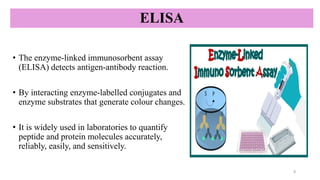
• The enzyme-linked immunosorbent assay
(ELISA) detects antigen-antibody reaction.
• By interacting enzyme-labelled conjugates and
enzyme substrates that generate colour changes.
• It is widely used in laboratories to quantify
peptide and protein molecules accurately,
reliably, easily, and sensitively.
3
PRINCIPLE OF ELISA
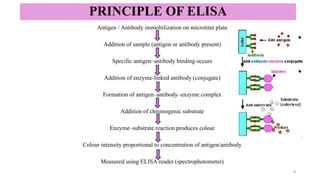
Antigen / Antibody immobilization on microtiter plate
Addition of sample (antigen or antibody present)
Specific antigen–antibody binding occurs
Addition of enzyme-linked antibody (conjugate)
Formation of antigen–antibody–enzyme complex
Addition of chromogenic substrate
Enzyme–substrate reaction produces colour
Colour intensity proportional to concentration of antigen/antibody
Measured using ELISA reader (spectrophotometer)
4
TYPES OF ELISA
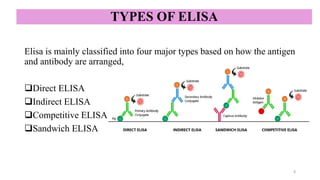
Elisa is mainly classified into four major types based on how the antigen
and antibody are arranged,
❑Direct ELISA
❑Indirect ELISA
❑Competitive ELISA
❑Sandwich ELISA
5
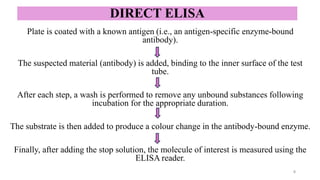
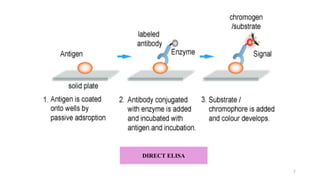
DIRECT ELISA
Plate is coated with a known antigen (i.e., an antigen-specific enzyme-bound
antibody).
The suspected material (antibody) is added, binding to the inner surface of the test
tube.
After each step, a wash is performed to remove any unbound substances following
incubation for the appropriate duration.
The substrate is then added to produce a colour change in the antibody-bound enzyme.
Finally, after adding the stop solution, the molecule of interest is measured using the
ELISA reader.
6
DIRECT ELISA
7
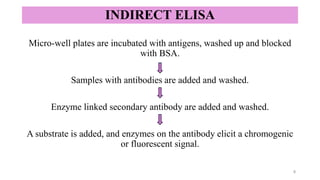
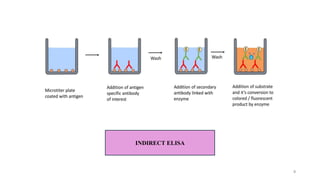
INDIRECT ELISA
Micro-well plates are incubated with antigens, washed up and blocked
with BSA.
Samples with antibodies are added and washed.
Enzyme linked secondary antibody are added and washed.
A substrate is added, and enzymes on the antibody elicit a chromogenic
or fluorescent signal.
8
INDIRECT ELISA
9
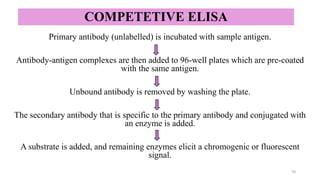
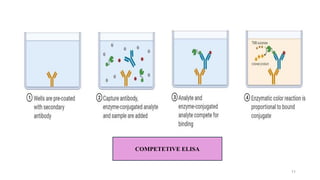
COMPETETIVE ELISA
Primary antibody (unlabelled) is incubated with sample antigen.
Antibody-antigen complexes are then added to 96-well plates which are pre-coated
with the same antigen.
Unbound antibody is removed by washing the plate.
The secondary antibody that is specific to the primary antibody and conjugated with
an enzyme is added.
A substrate is added, and remaining enzymes elicit a chromogenic or fluorescent
signal.
10
COMPETETIVE ELISA
11
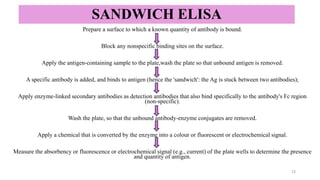
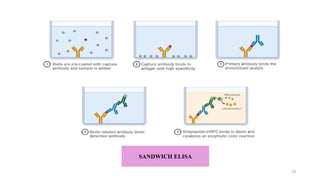
SANDWICH ELISA
Prepare a surface to which a known quantity of antibody is bound.
Block any nonspecific binding sites on the surface.
Apply the antigen-containing sample to the plate,wash the plate so that unbound antigen is removed.
A specific antibody is added, and binds to antigen (hence the 'sandwich': the Ag is stuck between two antibodies);
Apply enzyme-linked secondary antibodies as detection antibodies that also bind specifically to the antibody's Fc region
(non-specific).
Wash the plate, so that the unbound antibody-enzyme conjugates are removed.
Apply a chemical that is converted by the enzyme into a colour or fluorescent or electrochemical signal.
Measure the absorbency or fluorescence or electrochemical signal (e.g., current) of the plate wells to determine the presence
and quantity of antigen.
12
SANDWICH ELISA
13
LIMITATIONS OF ELISA
✓ Sensitivity
✓ Antibody availability
✓ Single analyte detection
✓ Background noise
✓ Restricted dynamic range
✓ Cross-reactivity
✓ Time consuming
14
APPLICATIONS OF ELISA
✓Detection of antigens or antibodies in biological samples.
✓Diagnosis of infectious diseases (e.g., HIV, hepatitis, malaria).
✓Measurement of hormones and serum antibody levels.
✓Pregnancy testing (hCG detection).
✓Detection of food allergens (milk, peanuts, eggs, nuts).
✓Drug and toxin screening in toxicology.
15
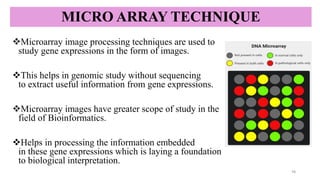
MICRO ARRAY TECHNIQUE
❖Microarray image processing techniques are used to
study gene expressions in the form of images.
❖This helps in genomic study without sequencing
to extract useful information from gene expressions.
❖Microarray images have greater scope of study in the
field of Bioinformatics.
❖Helps in processing the information embedded
in these gene expressions which is laying a foundation
to biological interpretation.
16
PRINCIPLE
Isolation of nucleic acid (DNA / RNA) from sample.
Labelling of sample with fluorescent dye.
Preparation of microarray slide with immobilized probes.
Hybridization of labelled sample with complementary probes on array.
Washing to remove unbound sequences.
Scanning of microarray using laser scanner.
Detection of fluorescent signals.
Signal intensity proportional to gene expression / target quantity.
Data analysis using software.
17
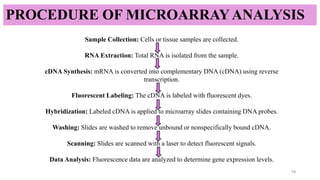
PROCEDURE OF MICROARRAYANALYSIS
Sample Collection: Cells or tissue samples are collected.
RNA Extraction: Total RNA is isolated from the sample.
cDNA Synthesis: mRNA is converted into complementary DNA (cDNA) using reverse
transcription.
Fluorescent Labeling: The cDNA is labeled with fluorescent dyes.
Hybridization: Labeled cDNA is applied to microarray slides containing DNA probes.
Washing: Slides are washed to remove unbound or nonspecifically bound cDNA.
Scanning: Slides are scanned with a laser to detect fluorescent signals.
Data Analysis: Fluorescence data are analyzed to determine gene expression levels.
18
APPLICATIONS OF MICROARRAY TECHNOLOGY
Genetic & Mutation Analysis:
➢Detects gene polymorphisms, mutations, and single base differences.
➢Used in comparative genomics, virulence factor identification, diagnostics, and vaccine development.
Gene Expression Analysis:
➢Studies gene expression patterns to identify new genes, pathways, and functions.
➢Applied in organisms like humans, yeast, Arabidopsis, and in drug studies.
Diagnostic Tool:
➢Detects pathogen-specific DNA/RNA directly.
➢Faster and more accurate than conventional culture-based methods.
Drug Discovery:
➢Identifies drug targets and protein effects.
➢Assesses drug toxicity and functional impact via gene expression changes.
19
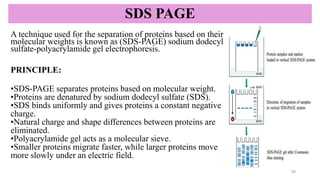
SDS PAGE
A technique used for the separation of proteins based on their
molecular weights is known as (SDS-PAGE) sodium dodecyl
sulfate-polyacrylamide gel electrophoresis.
PRINCIPLE:
•SDS-PAGE separates proteins based on molecular weight.
•Proteins are denatured by sodium dodecyl sulfate (SDS).
•SDS binds uniformly and gives proteins a constant negative
charge.
•Natural charge and shape differences between proteins are
eliminated.
•Polyacrylamide gel acts as a molecular sieve.
•Smaller proteins migrate faster, while larger proteins move
more slowly under an electric field.
20
STEPS INVOLVED IN SDS-PAGE
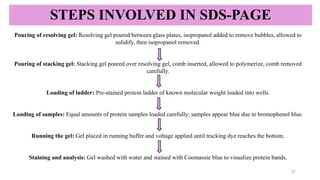
Pouring of resolving gel: Resolving gel poured between glass plates, isopropanol added to remove bubbles, allowed to
solidify, then isopropanol removed.
Pouring of stacking gel: Stacking gel poured over resolving gel, comb inserted, allowed to polymerize, comb removed
carefully.
Loading of ladder: Pre-stained protein ladder of known molecular weight loaded into wells.
Loading of samples: Equal amounts of protein samples loaded carefully; samples appear blue due to bromophenol blue.
Running the gel: Gel placed in running buffer and voltage applied until tracking dye reaches the bottom.
Staining and analysis: Gel washed with water and stained with Coomassie blue to visualize protein bands.
21
APPLICATIONS OF SDS-PAGE ELECTROPHORESIS
• SDS-PAGE electrophoresis is employed in peptide mapping.
• It investigates post-translational changes.
• It is used in HIV tests to separate the HIV proteins.
• SDS-PAGE electrophoresis is used to determine the size of a protein.
• It’s used to calculate the molecular weight of molecules.
• It is used to calculate the protein’s size.
22
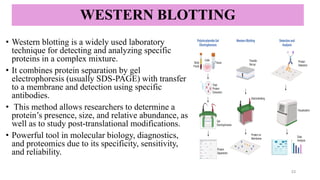
WESTERN BLOTTING
• Western blotting is a widely used laboratory
technique for detecting and analyzing specific
proteins in a complex mixture.
• It combines protein separation by gel
electrophoresis (usually SDS-PAGE) with transfer
to a membrane and detection using specific
antibodies.
• This method allows researchers to determine a
protein’s presence, size, and relative abundance, as
well as to study post-translational modifications.
• Powerful tool in molecular biology, diagnostics,
and proteomics due to its specificity, sensitivity,
and reliability.
23
PRINCIPLE OF WESTERN BLOTTING
Western blotting is an analytical technique used to identify a specific protein in a complex sample.
Proteins are first denatured with SDS and separated by polyacrylamide gel electrophoresis based on molecular
weight.
The separated proteins are then transferred from the gel onto a nitrocellulose or PVDF membrane.
This transfer, immobilizes the proteins and makes them accessible for antibody binding.
The membrane is blocked to prevent nonspecific interactions.
A primary antibody specifically binds to the target protein on the membrane.
A labelled secondary antibody binds to the primary antibody.
Upon addition of a suitable substrate, a detectable signal is produced, confirming the presence of the protein.
24
25
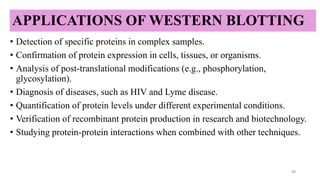
APPLICATIONS OF WESTERN BLOTTING
• Detection of specific proteins in complex samples.
• Confirmation of protein expression in cells, tissues, or organisms.
• Analysis of post-translational modifications (e.g., phosphorylation,
glycosylation).
• Diagnosis of diseases, such as HIV and Lyme disease.
• Quantification of protein levels under different experimental conditions.
• Verification of recombinant protein production in research and biotechnology.
• Studying protein-protein interactions when combined with other techniques.
26
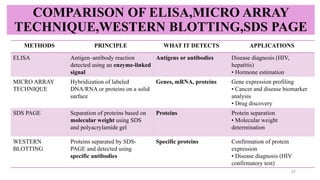
COMPARISON OF ELISA,MICRO ARRAY
TECHNIQUE,WESTERN BLOTTING,SDS PAGE
METHODS PRINCIPLE WHAT IT DETECTS APPLICATIONS
ELISA Antigen–antibody reaction
detected using an enzyme-linked
signal
Antigens or antibodies Disease diagnosis (HIV,
hepatitis)
• Hormone estimation
MICRO ARRAY
TECHNIQUE
Hybridization of labeled
DNA/RNA or proteins on a solid
surface
Genes, mRNA, proteins Gene expression profiling
• Cancer and disease biomarker
analysis
• Drug discovery
SDS PAGE Separation of proteins based on
molecular weight using SDS
and polyacrylamide gel
Proteins Protein separation
• Molecular weight
determination
WESTERN
BLOTTING
Proteins separated by SDS-
PAGE and detected using
specific antibodies
Specific proteins Confirmation of protein
expression
• Disease diagnosis (HIV
confirmatory test)
27
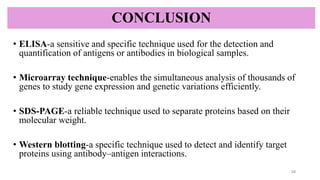
CONCLUSION
• ELISA-a sensitive and specific technique used for the detection and
quantification of antigens or antibodies in biological samples.
• Microarray technique-enables the simultaneous analysis of thousands of
genes to study gene expression and genetic variations efficiently.
• SDS-PAGE-a reliable technique used to separate proteins based on their
molecular weight.
• Western blotting-a specific technique used to detect and identify target
proteins using antibody–antigen interactions.
28
REFERENCE
• Kurien & Scofield; Scofield, RH (2006). "Western Blotting". Methods 38 (4): 283–293. Burnette WN. (1981). "'Western
blotting': electrophoretic transfer of proteins from sodium dodecyl sulfate—polyacrylamide gels to unmodified
nitrocellulose and radiographic detection with antibody and radio iodinated protein A". Analytical Biochemistry 112 (2):
195 203.
• Fajriyah R. Paper review: An overview on microarray technologies. Bulletin of Applied Mathematics and Mathematics
Education. 2021;1(1):21–30. doi:10.12928/bamme.v1i1.3854.
• Kumar A, Goel G, Fahrenbach E, Puniya AK, Singh K. Microarrays: the technology, analysis and application.
Engineering in Life Sciences. 2006;6(5):451–459.
• Kurien BT, Scofield RH. Western blotting: an introduction. In: Kurien BT, Scofield RH, editors. Western blotting:
methods and protocols. New York (NY): Humana Press; 2015. p. 17–30.
• Aydin S, Emre E, Ugur K, Ata M, Aydin I, Sahin I, et al. An overview of ELISA: A review and update on best laboratory
practices for quantifying peptides and proteins in biological fluids. Journal of International Medical Research.
2025;53(2):1–18. doi:10.1177/03000605251315193.
• Idowu OS, Loko DO, Ogundipe SO, Mensah E. Optimizing SDS-PAGE for accurate protein characterization in
nutritional research and food quality assessment. Int J Innov Sci Res Technol. 2025;10(1).
doi:10.5281/zenodo.14744563.
• Sedighi A, Li PCH. Challenges and future trends in DNA microarray analysis. In: Li PCH, editor. Microarray
technology: methods and applications. New York (NY): Springer; 2010. p. 25–44.
• ELISA-Antibody.com. ELISA introduction: ELISA principle [Internet]. ELISA-Antibody; [cited 2026 Jan 31]. Available
from: http://elisa-antibody.com/ELISA-Introduction/ELISA-Principle.html
• Vayanaperumal K. Western blotting: a review: principle, protocol and problem solving. GSC Advanced Research and
Reviews. 2023;16(3):178–187. doi:10.30574/gscarr.2023.16.3.0324
29
30

ELISA, MICRO ARRAY TECHNIQUE, SDS PAGE, WESTERN BLOTIING

  • 1.
    ELISA,MICRO-ARRAY TECHNIQUE,SDS PAGE, WESTERN BLOTTING M.SHALIMA, M.PHARMACY1ST YEAR, DEPARTMENT OF PHARMACOLOGY, COP,SRIPMS. PRESENTED BY, 1
  • 2.
    CONTENTS ▪ PRINCIPLE ▪ TYPESOF ELISA ▪ LIMITATIONS OF ELISA ▪ APPLICATIONS ▪ PRINCIPLE ▪ PROCEDURE ▪ APPLICATIONS ELISA MICRO ARRAY TECHNIQUE WESTERN BLOTTING ▪ PRINCIPLE ▪ PROCEDURE ▪ APPLICATIONS SDS PAGE ▪ PRINCIPLE ▪ PROCEDURE ▪ APPLICATIONS 2
  • 3.
    ELISA • The enzyme-linkedimmunosorbent assay (ELISA) detects antigen-antibody reaction. • By interacting enzyme-labelled conjugates and enzyme substrates that generate colour changes. • It is widely used in laboratories to quantify peptide and protein molecules accurately, reliably, easily, and sensitively. 3
  • 4.
    PRINCIPLE OF ELISA Antigen/ Antibody immobilization on microtiter plate Addition of sample (antigen or antibody present) Specific antigen–antibody binding occurs Addition of enzyme-linked antibody (conjugate) Formation of antigen–antibody–enzyme complex Addition of chromogenic substrate Enzyme–substrate reaction produces colour Colour intensity proportional to concentration of antigen/antibody Measured using ELISA reader (spectrophotometer) 4
  • 5.
    TYPES OF ELISA Elisais mainly classified into four major types based on how the antigen and antibody are arranged, ❑Direct ELISA ❑Indirect ELISA ❑Competitive ELISA ❑Sandwich ELISA 5
  • 6.
    DIRECT ELISA Plate iscoated with a known antigen (i.e., an antigen-specific enzyme-bound antibody). The suspected material (antibody) is added, binding to the inner surface of the test tube. After each step, a wash is performed to remove any unbound substances following incubation for the appropriate duration. The substrate is then added to produce a colour change in the antibody-bound enzyme. Finally, after adding the stop solution, the molecule of interest is measured using the ELISA reader. 6
  • 7.
  • 8.
    INDIRECT ELISA Micro-well platesare incubated with antigens, washed up and blocked with BSA. Samples with antibodies are added and washed. Enzyme linked secondary antibody are added and washed. A substrate is added, and enzymes on the antibody elicit a chromogenic or fluorescent signal. 8
  • 9.
  • 10.
    COMPETETIVE ELISA Primary antibody(unlabelled) is incubated with sample antigen. Antibody-antigen complexes are then added to 96-well plates which are pre-coated with the same antigen. Unbound antibody is removed by washing the plate. The secondary antibody that is specific to the primary antibody and conjugated with an enzyme is added. A substrate is added, and remaining enzymes elicit a chromogenic or fluorescent signal. 10
  • 11.
  • 12.
    SANDWICH ELISA Prepare asurface to which a known quantity of antibody is bound. Block any nonspecific binding sites on the surface. Apply the antigen-containing sample to the plate,wash the plate so that unbound antigen is removed. A specific antibody is added, and binds to antigen (hence the 'sandwich': the Ag is stuck between two antibodies); Apply enzyme-linked secondary antibodies as detection antibodies that also bind specifically to the antibody's Fc region (non-specific). Wash the plate, so that the unbound antibody-enzyme conjugates are removed. Apply a chemical that is converted by the enzyme into a colour or fluorescent or electrochemical signal. Measure the absorbency or fluorescence or electrochemical signal (e.g., current) of the plate wells to determine the presence and quantity of antigen. 12
  • 13.
  • 14.
    LIMITATIONS OF ELISA ✓Sensitivity ✓ Antibody availability ✓ Single analyte detection ✓ Background noise ✓ Restricted dynamic range ✓ Cross-reactivity ✓ Time consuming 14
  • 15.
    APPLICATIONS OF ELISA ✓Detectionof antigens or antibodies in biological samples. ✓Diagnosis of infectious diseases (e.g., HIV, hepatitis, malaria). ✓Measurement of hormones and serum antibody levels. ✓Pregnancy testing (hCG detection). ✓Detection of food allergens (milk, peanuts, eggs, nuts). ✓Drug and toxin screening in toxicology. 15
  • 16.
    MICRO ARRAY TECHNIQUE ❖Microarrayimage processing techniques are used to study gene expressions in the form of images. ❖This helps in genomic study without sequencing to extract useful information from gene expressions. ❖Microarray images have greater scope of study in the field of Bioinformatics. ❖Helps in processing the information embedded in these gene expressions which is laying a foundation to biological interpretation. 16
  • 17.
    PRINCIPLE Isolation of nucleicacid (DNA / RNA) from sample. Labelling of sample with fluorescent dye. Preparation of microarray slide with immobilized probes. Hybridization of labelled sample with complementary probes on array. Washing to remove unbound sequences. Scanning of microarray using laser scanner. Detection of fluorescent signals. Signal intensity proportional to gene expression / target quantity. Data analysis using software. 17
  • 18.
    PROCEDURE OF MICROARRAYANALYSIS SampleCollection: Cells or tissue samples are collected. RNA Extraction: Total RNA is isolated from the sample. cDNA Synthesis: mRNA is converted into complementary DNA (cDNA) using reverse transcription. Fluorescent Labeling: The cDNA is labeled with fluorescent dyes. Hybridization: Labeled cDNA is applied to microarray slides containing DNA probes. Washing: Slides are washed to remove unbound or nonspecifically bound cDNA. Scanning: Slides are scanned with a laser to detect fluorescent signals. Data Analysis: Fluorescence data are analyzed to determine gene expression levels. 18
  • 19.
    APPLICATIONS OF MICROARRAYTECHNOLOGY Genetic & Mutation Analysis: ➢Detects gene polymorphisms, mutations, and single base differences. ➢Used in comparative genomics, virulence factor identification, diagnostics, and vaccine development. Gene Expression Analysis: ➢Studies gene expression patterns to identify new genes, pathways, and functions. ➢Applied in organisms like humans, yeast, Arabidopsis, and in drug studies. Diagnostic Tool: ➢Detects pathogen-specific DNA/RNA directly. ➢Faster and more accurate than conventional culture-based methods. Drug Discovery: ➢Identifies drug targets and protein effects. ➢Assesses drug toxicity and functional impact via gene expression changes. 19
  • 20.
    SDS PAGE A techniqueused for the separation of proteins based on their molecular weights is known as (SDS-PAGE) sodium dodecyl sulfate-polyacrylamide gel electrophoresis. PRINCIPLE: •SDS-PAGE separates proteins based on molecular weight. •Proteins are denatured by sodium dodecyl sulfate (SDS). •SDS binds uniformly and gives proteins a constant negative charge. •Natural charge and shape differences between proteins are eliminated. •Polyacrylamide gel acts as a molecular sieve. •Smaller proteins migrate faster, while larger proteins move more slowly under an electric field. 20
  • 21.
    STEPS INVOLVED INSDS-PAGE Pouring of resolving gel: Resolving gel poured between glass plates, isopropanol added to remove bubbles, allowed to solidify, then isopropanol removed. Pouring of stacking gel: Stacking gel poured over resolving gel, comb inserted, allowed to polymerize, comb removed carefully. Loading of ladder: Pre-stained protein ladder of known molecular weight loaded into wells. Loading of samples: Equal amounts of protein samples loaded carefully; samples appear blue due to bromophenol blue. Running the gel: Gel placed in running buffer and voltage applied until tracking dye reaches the bottom. Staining and analysis: Gel washed with water and stained with Coomassie blue to visualize protein bands. 21
  • 22.
    APPLICATIONS OF SDS-PAGEELECTROPHORESIS • SDS-PAGE electrophoresis is employed in peptide mapping. • It investigates post-translational changes. • It is used in HIV tests to separate the HIV proteins. • SDS-PAGE electrophoresis is used to determine the size of a protein. • It’s used to calculate the molecular weight of molecules. • It is used to calculate the protein’s size. 22
  • 23.
    WESTERN BLOTTING • Westernblotting is a widely used laboratory technique for detecting and analyzing specific proteins in a complex mixture. • It combines protein separation by gel electrophoresis (usually SDS-PAGE) with transfer to a membrane and detection using specific antibodies. • This method allows researchers to determine a protein’s presence, size, and relative abundance, as well as to study post-translational modifications. • Powerful tool in molecular biology, diagnostics, and proteomics due to its specificity, sensitivity, and reliability. 23
  • 24.
    PRINCIPLE OF WESTERNBLOTTING Western blotting is an analytical technique used to identify a specific protein in a complex sample. Proteins are first denatured with SDS and separated by polyacrylamide gel electrophoresis based on molecular weight. The separated proteins are then transferred from the gel onto a nitrocellulose or PVDF membrane. This transfer, immobilizes the proteins and makes them accessible for antibody binding. The membrane is blocked to prevent nonspecific interactions. A primary antibody specifically binds to the target protein on the membrane. A labelled secondary antibody binds to the primary antibody. Upon addition of a suitable substrate, a detectable signal is produced, confirming the presence of the protein. 24
  • 25.
  • 26.
    APPLICATIONS OF WESTERNBLOTTING • Detection of specific proteins in complex samples. • Confirmation of protein expression in cells, tissues, or organisms. • Analysis of post-translational modifications (e.g., phosphorylation, glycosylation). • Diagnosis of diseases, such as HIV and Lyme disease. • Quantification of protein levels under different experimental conditions. • Verification of recombinant protein production in research and biotechnology. • Studying protein-protein interactions when combined with other techniques. 26
  • 27.
    COMPARISON OF ELISA,MICROARRAY TECHNIQUE,WESTERN BLOTTING,SDS PAGE METHODS PRINCIPLE WHAT IT DETECTS APPLICATIONS ELISA Antigen–antibody reaction detected using an enzyme-linked signal Antigens or antibodies Disease diagnosis (HIV, hepatitis) • Hormone estimation MICRO ARRAY TECHNIQUE Hybridization of labeled DNA/RNA or proteins on a solid surface Genes, mRNA, proteins Gene expression profiling • Cancer and disease biomarker analysis • Drug discovery SDS PAGE Separation of proteins based on molecular weight using SDS and polyacrylamide gel Proteins Protein separation • Molecular weight determination WESTERN BLOTTING Proteins separated by SDS- PAGE and detected using specific antibodies Specific proteins Confirmation of protein expression • Disease diagnosis (HIV confirmatory test) 27
  • 28.
    CONCLUSION • ELISA-a sensitiveand specific technique used for the detection and quantification of antigens or antibodies in biological samples. • Microarray technique-enables the simultaneous analysis of thousands of genes to study gene expression and genetic variations efficiently. • SDS-PAGE-a reliable technique used to separate proteins based on their molecular weight. • Western blotting-a specific technique used to detect and identify target proteins using antibody–antigen interactions. 28
  • 29.
    REFERENCE • Kurien &Scofield; Scofield, RH (2006). "Western Blotting". Methods 38 (4): 283–293. Burnette WN. (1981). "'Western blotting': electrophoretic transfer of proteins from sodium dodecyl sulfate—polyacrylamide gels to unmodified nitrocellulose and radiographic detection with antibody and radio iodinated protein A". Analytical Biochemistry 112 (2): 195 203. • Fajriyah R. Paper review: An overview on microarray technologies. Bulletin of Applied Mathematics and Mathematics Education. 2021;1(1):21–30. doi:10.12928/bamme.v1i1.3854. • Kumar A, Goel G, Fahrenbach E, Puniya AK, Singh K. Microarrays: the technology, analysis and application. Engineering in Life Sciences. 2006;6(5):451–459. • Kurien BT, Scofield RH. Western blotting: an introduction. In: Kurien BT, Scofield RH, editors. Western blotting: methods and protocols. New York (NY): Humana Press; 2015. p. 17–30. • Aydin S, Emre E, Ugur K, Ata M, Aydin I, Sahin I, et al. An overview of ELISA: A review and update on best laboratory practices for quantifying peptides and proteins in biological fluids. Journal of International Medical Research. 2025;53(2):1–18. doi:10.1177/03000605251315193. • Idowu OS, Loko DO, Ogundipe SO, Mensah E. Optimizing SDS-PAGE for accurate protein characterization in nutritional research and food quality assessment. Int J Innov Sci Res Technol. 2025;10(1). doi:10.5281/zenodo.14744563. • Sedighi A, Li PCH. Challenges and future trends in DNA microarray analysis. In: Li PCH, editor. Microarray technology: methods and applications. New York (NY): Springer; 2010. p. 25–44. • ELISA-Antibody.com. ELISA introduction: ELISA principle [Internet]. ELISA-Antibody; [cited 2026 Jan 31]. Available from: http://elisa-antibody.com/ELISA-Introduction/ELISA-Principle.html • Vayanaperumal K. Western blotting: a review: principle, protocol and problem solving. GSC Advanced Research and Reviews. 2023;16(3):178–187. doi:10.30574/gscarr.2023.16.3.0324 29
  • 30.