REWARD CHARTS &
REINFORCEMENT SYSTEMS
By: Kristen Maki
SOE 115
2/14/18
Overview
 Reward charts are motivational tools to promote good behavior in the
classroom or at home and to eliminate undesired behaviors.They also
provide a system for children to follow directions and routines provided to
them.
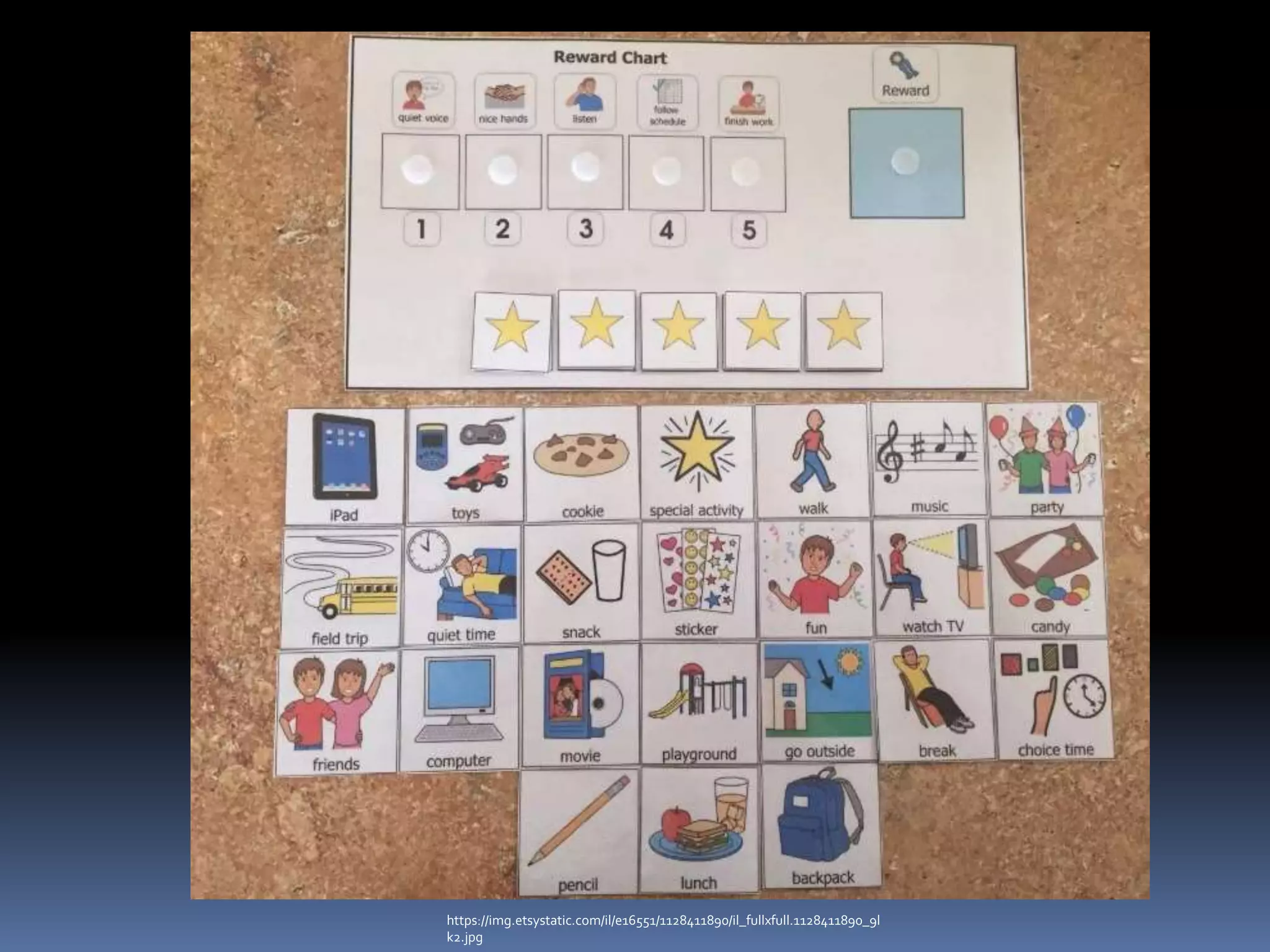
 The children are recommended to choose their own rewards as they will be
more eager to work for them (ex: toy car, computer, playground).
 Start off with a low number of expectations you want them to accomplish.
(ex: 5 starsreward).
 Be consistent.
 Rewards need to be given immediately to the child following directions
and/or the routine.
http://kidmechanix.com/wp-
content/uploads/2017/10/token-board-
template.png
Overview cont’d
 I relate to this specific strategy because being a paraprofessional working
with children with disabilities, specifically behavior issues, one successful
system that is implemented in our classroom is reward charts and “work-
for” boards.There is one child for example that uses a work-for board that
allows him to choose his reward he wants for the day. He is required to
follow the schedule that all the other children perform (ex: for circle time he
has to; sit down, do welcome song, answer the question of the day, and
then write his name on Smart board). After that, he is able to get his reward
for a couple minutes and then it is back to work for what he wants again.
After an undesired behavior presents itself, the student is required to
comply with the teacher’s directions to be able to follow back to the reward
chart. After trial and error with different behavior management tools,
reward charts and work-for boards are the ones that I swear by only because
I have seen it work successfully with my own eyes. FromAugust until
presently, I have seen tremendous progress with his behavior because of
these charts.
https://img.etsystatic.com/il/e16551/1128411890/il_fullxfull.1128411890_9l
k2.jpg
Credible Source #1
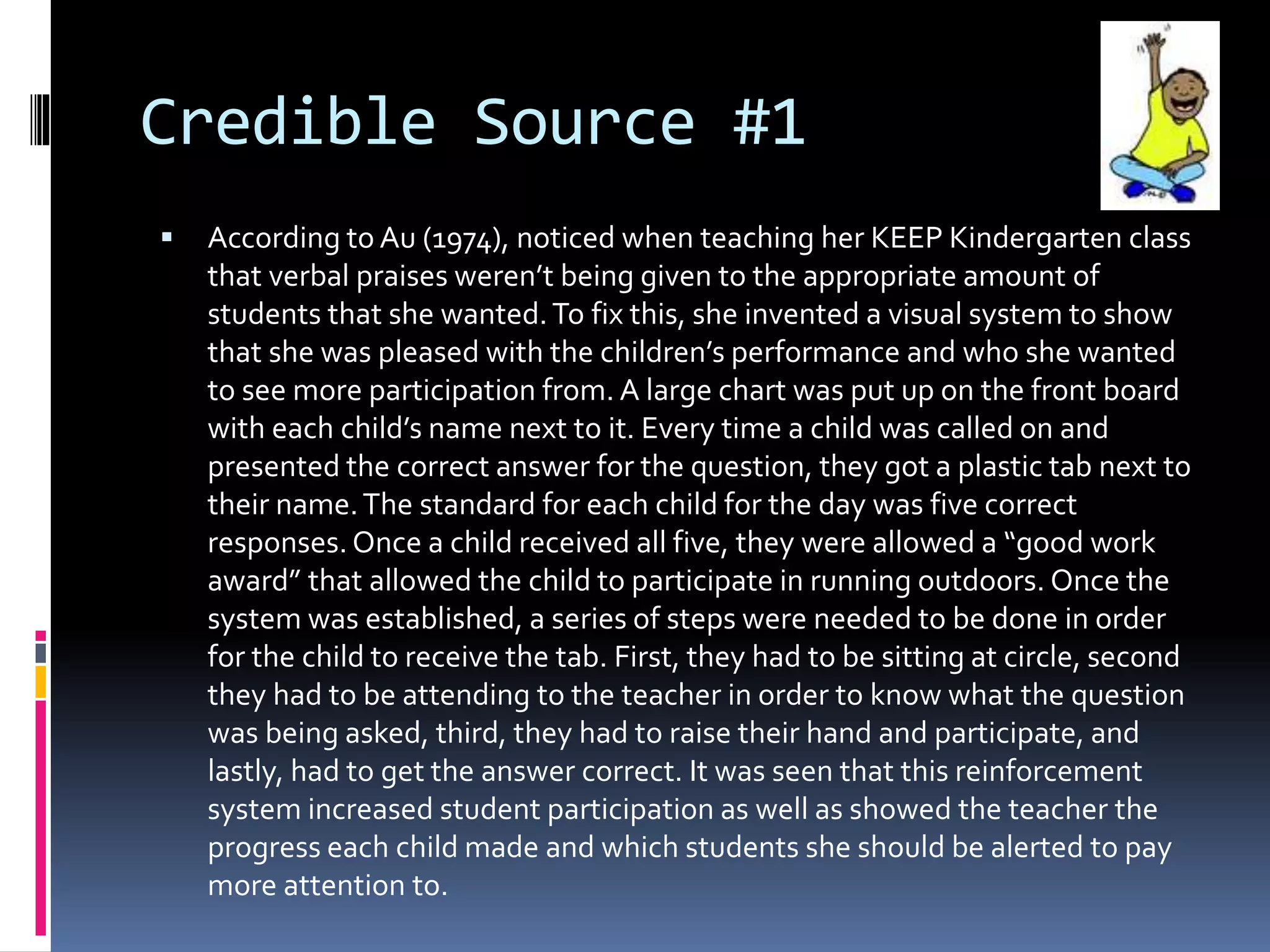
 According to Au (1974), noticed when teaching her KEEP Kindergarten class
that verbal praises weren’t being given to the appropriate amount of
students that she wanted.To fix this, she invented a visual system to show
that she was pleased with the children’s performance and who she wanted
to see more participation from. A large chart was put up on the front board
with each child’s name next to it. Every time a child was called on and
presented the correct answer for the question, they got a plastic tab next to
their name.The standard for each child for the day was five correct
responses.Once a child received all five, they were allowed a “good work
award” that allowed the child to participate in running outdoors. Once the
system was established, a series of steps were needed to be done in order
for the child to receive the tab. First, they had to be sitting at circle, second
they had to be attending to the teacher in order to know what the question
was being asked, third, they had to raise their hand and participate, and
lastly, had to get the answer correct. It was seen that this reinforcement
system increased student participation as well as showed the teacher the
progress each child made and which students she should be alerted to pay
more attention to.
Credible Source #2
 According to Bushell (1970), behavior analysis uses positive reinforcement
to eliminate all bad behaviors in the classroom. Providing heavy
reinforcement to a child that is actively attending the task is required.Then,
when the behavioral child starts to work at the same task that is being
given, IMMEDIATE rewards are given. Positive reinforcements and rewards
are given immediately to simple tasks the child does. Following directions in
the most simplest of ways (saying “Good morning” or raising your hand to
speak out loud) results in an enthusiastic and immediate form of reward.
When appropriate behavior is shown, allowing access to preferred choices
or activities results in low motivation and behavioral problems to be
eliminated. In order for most of this to work, increased adult support in the
classroom along with frequent attention and reinforcement will result in
desirable behaviors. Basically, the overall idea of this approach is to ignore
inappropriate behavior while providing heavy and frequent reinforcement
for desirable behavior.
Credible Source #3
 According to Shiller (2008), teachers reliance on extrinsic rewards such as
stickers or privileges are being looked at as “inappropriate practice”. But,
many professionals that work directly with children who can’t follow basic
rules for behavior do not share this view at all. Special education teachers,
child psychologists, and speech, occupational, and physical therapists
reward plans are being used repeatedly for behavior modification to
children three and older. Alfie Kohn, not a stranger to the educational
community, opposes the use of rewards in academic settings because he
believes rewards lead to children feeling controlled and that they weaken
children’s fundamental motivation to learn and achieve. However,
researchers go beyond basic research and laboratory studies and consider a
variety of factors that may persuade how the impact of rewards is helpful in
schools. Reward plans in an early childhood setting should consist of three
steps: first, the teacher decides on one or more goals that the child can
realistically meet, second, the teacher spells out the goals concretely either
on a chart or in a conversation, and finally, while introducing the reward
plan, the teacher offers the reward for meeting the goal.
Credible Source #3 cont’d
 Successful reward plans consist of one or more of these components listed:
 Encouraging children to be active participants in their ability to change (ex:
invite students to help choose goals or suggest strategies)
 Communicate why it is important to help children develop and master these
skills so they see this as a caring learning experience versus a controlled and
manipulated situation.
 Choose incentives that can contribute positively to student’s development or
self-worth.
 Design reward charts significantly for that certain child to show ownership.
(include a picture of themselves on it, or decorate with their favorite things)
 Emphasize the positive behaviors and keep the punishment or negative behavior
attentions to a minimum.
 With all this being said, Shiller (2008) states that even though verbal praise, good
teacher-student communication, and empathy is being performed, rewards
provide an additional element that increase the impact of desirable behaviors in
the classroom.
Analysis
 Overall, I think the general idea of all three of these sources was the
importance of reward systems in the classroom and how the systems made
can contribute to desirable behaviors and student progress.The first two
sources talked about the positive outcomes to reward systems used in
classrooms while the third, in the beginning, talked about how reward
systems can be an inappropriate approach to student success. Researchers
were convinced students wouldn’t benefit from a type of incentive program
like this, but the article states in order to set up a good reward chart, you
must follow specific steps to ensure you are doing it correctly.All in all, all
sources let it be known that with immediate, consistent awareness to
following directions, it is known that reward systems will positively increase
good behaviors in the classroom.
Connections
 Reward systems most commonly relate to the learning process
called operant conditioning where it is said that we learn to behave
in certain ways as we operate on the environment.
 The Premack principle named after David Premack (1965) is a high-
frequency behavior (preferred activity) can be an effective reinforcer
for a low-frequency behavior (less-preferred activity). It basically
states that first you do what I want you to do, then you may do what
you want.
 Contingency contract program where the teacher draws up an
individual contract for each student describing exactly what to do to
earn the privilege or reward.
 (Woolfolk 2016)
Conclusions
 It is said in Shiller’s article (2008), that the student’s ,Billy and Juanita, their
reward plans were successful if done correctly. For Billy, the plan was visible
and gave him a sense of ownership.When Billy told another child to “use
your words we don’t hit in class” it is clear he had understood and followed
the goals of the plan. For Juanita, because of her deprived background, her
high motivation for collecting a set of stickers specifically for her resulted in
her following the plan.With it being known that her teacher recognized her
special interests, she followed through with the plan along side her peers. In
my opinion, with these two examples being displayed, and with my own
experiences to contribute to, I believe that reward systems that are carefully
thought out and designed for the specific child are systems that will 100%
promote student achievement in the classroom.
Communication to Families
 Letting parents know that with behavior
modified reward systems being implemented at
home, it will lead to the student being that much
more successful in their academic setting. It all
starts at home. Simple reward charts for doing
the chores, finishing their homework, or getting
ready for bed can help children decipher the true
meaning behind good behaviors and what it is to
act as socially competent.
References
 Au, K., & Kamehameha Schools, H. P. (1974).The
Development of aToken Reinforcement System for a
Specific Lesson.Technical Report #11.
 Bushell, D. J., & Kansas Univ., L. D. (1970). The Behavior
Analysis Classroom.
 Shiller,V. M., & O'Flynn, J. C. (2008). Using Rewards in
the Early Childhood Classroom: A Reexamination of
the Issues. YC:Young Children, 63(6), 88-93.
 Woolfolk, A. E. (2016). Educational Psychology for
teachers (13th ed.). Pearson.


Reward system

  • 1.
    REWARD CHARTS & REINFORCEMENTSYSTEMS By: Kristen Maki SOE 115 2/14/18
  • 2.
    Overview  Reward chartsare motivational tools to promote good behavior in the classroom or at home and to eliminate undesired behaviors.They also provide a system for children to follow directions and routines provided to them.  The children are recommended to choose their own rewards as they will be more eager to work for them (ex: toy car, computer, playground).  Start off with a low number of expectations you want them to accomplish. (ex: 5 starsreward).  Be consistent.  Rewards need to be given immediately to the child following directions and/or the routine. http://kidmechanix.com/wp- content/uploads/2017/10/token-board- template.png
  • 3.
    Overview cont’d  Irelate to this specific strategy because being a paraprofessional working with children with disabilities, specifically behavior issues, one successful system that is implemented in our classroom is reward charts and “work- for” boards.There is one child for example that uses a work-for board that allows him to choose his reward he wants for the day. He is required to follow the schedule that all the other children perform (ex: for circle time he has to; sit down, do welcome song, answer the question of the day, and then write his name on Smart board). After that, he is able to get his reward for a couple minutes and then it is back to work for what he wants again. After an undesired behavior presents itself, the student is required to comply with the teacher’s directions to be able to follow back to the reward chart. After trial and error with different behavior management tools, reward charts and work-for boards are the ones that I swear by only because I have seen it work successfully with my own eyes. FromAugust until presently, I have seen tremendous progress with his behavior because of these charts.
  • 4.
  • 5.
    Credible Source #1 According to Au (1974), noticed when teaching her KEEP Kindergarten class that verbal praises weren’t being given to the appropriate amount of students that she wanted.To fix this, she invented a visual system to show that she was pleased with the children’s performance and who she wanted to see more participation from. A large chart was put up on the front board with each child’s name next to it. Every time a child was called on and presented the correct answer for the question, they got a plastic tab next to their name.The standard for each child for the day was five correct responses.Once a child received all five, they were allowed a “good work award” that allowed the child to participate in running outdoors. Once the system was established, a series of steps were needed to be done in order for the child to receive the tab. First, they had to be sitting at circle, second they had to be attending to the teacher in order to know what the question was being asked, third, they had to raise their hand and participate, and lastly, had to get the answer correct. It was seen that this reinforcement system increased student participation as well as showed the teacher the progress each child made and which students she should be alerted to pay more attention to.
  • 6.
    Credible Source #2 According to Bushell (1970), behavior analysis uses positive reinforcement to eliminate all bad behaviors in the classroom. Providing heavy reinforcement to a child that is actively attending the task is required.Then, when the behavioral child starts to work at the same task that is being given, IMMEDIATE rewards are given. Positive reinforcements and rewards are given immediately to simple tasks the child does. Following directions in the most simplest of ways (saying “Good morning” or raising your hand to speak out loud) results in an enthusiastic and immediate form of reward. When appropriate behavior is shown, allowing access to preferred choices or activities results in low motivation and behavioral problems to be eliminated. In order for most of this to work, increased adult support in the classroom along with frequent attention and reinforcement will result in desirable behaviors. Basically, the overall idea of this approach is to ignore inappropriate behavior while providing heavy and frequent reinforcement for desirable behavior.
  • 7.
    Credible Source #3 According to Shiller (2008), teachers reliance on extrinsic rewards such as stickers or privileges are being looked at as “inappropriate practice”. But, many professionals that work directly with children who can’t follow basic rules for behavior do not share this view at all. Special education teachers, child psychologists, and speech, occupational, and physical therapists reward plans are being used repeatedly for behavior modification to children three and older. Alfie Kohn, not a stranger to the educational community, opposes the use of rewards in academic settings because he believes rewards lead to children feeling controlled and that they weaken children’s fundamental motivation to learn and achieve. However, researchers go beyond basic research and laboratory studies and consider a variety of factors that may persuade how the impact of rewards is helpful in schools. Reward plans in an early childhood setting should consist of three steps: first, the teacher decides on one or more goals that the child can realistically meet, second, the teacher spells out the goals concretely either on a chart or in a conversation, and finally, while introducing the reward plan, the teacher offers the reward for meeting the goal.
  • 8.
    Credible Source #3cont’d  Successful reward plans consist of one or more of these components listed:  Encouraging children to be active participants in their ability to change (ex: invite students to help choose goals or suggest strategies)  Communicate why it is important to help children develop and master these skills so they see this as a caring learning experience versus a controlled and manipulated situation.  Choose incentives that can contribute positively to student’s development or self-worth.  Design reward charts significantly for that certain child to show ownership. (include a picture of themselves on it, or decorate with their favorite things)  Emphasize the positive behaviors and keep the punishment or negative behavior attentions to a minimum.  With all this being said, Shiller (2008) states that even though verbal praise, good teacher-student communication, and empathy is being performed, rewards provide an additional element that increase the impact of desirable behaviors in the classroom.
  • 9.
    Analysis  Overall, Ithink the general idea of all three of these sources was the importance of reward systems in the classroom and how the systems made can contribute to desirable behaviors and student progress.The first two sources talked about the positive outcomes to reward systems used in classrooms while the third, in the beginning, talked about how reward systems can be an inappropriate approach to student success. Researchers were convinced students wouldn’t benefit from a type of incentive program like this, but the article states in order to set up a good reward chart, you must follow specific steps to ensure you are doing it correctly.All in all, all sources let it be known that with immediate, consistent awareness to following directions, it is known that reward systems will positively increase good behaviors in the classroom.
  • 10.
    Connections  Reward systemsmost commonly relate to the learning process called operant conditioning where it is said that we learn to behave in certain ways as we operate on the environment.  The Premack principle named after David Premack (1965) is a high- frequency behavior (preferred activity) can be an effective reinforcer for a low-frequency behavior (less-preferred activity). It basically states that first you do what I want you to do, then you may do what you want.  Contingency contract program where the teacher draws up an individual contract for each student describing exactly what to do to earn the privilege or reward.  (Woolfolk 2016)
  • 11.
    Conclusions  It issaid in Shiller’s article (2008), that the student’s ,Billy and Juanita, their reward plans were successful if done correctly. For Billy, the plan was visible and gave him a sense of ownership.When Billy told another child to “use your words we don’t hit in class” it is clear he had understood and followed the goals of the plan. For Juanita, because of her deprived background, her high motivation for collecting a set of stickers specifically for her resulted in her following the plan.With it being known that her teacher recognized her special interests, she followed through with the plan along side her peers. In my opinion, with these two examples being displayed, and with my own experiences to contribute to, I believe that reward systems that are carefully thought out and designed for the specific child are systems that will 100% promote student achievement in the classroom.
  • 12.
    Communication to Families Letting parents know that with behavior modified reward systems being implemented at home, it will lead to the student being that much more successful in their academic setting. It all starts at home. Simple reward charts for doing the chores, finishing their homework, or getting ready for bed can help children decipher the true meaning behind good behaviors and what it is to act as socially competent.
  • 13.
    References  Au, K.,& Kamehameha Schools, H. P. (1974).The Development of aToken Reinforcement System for a Specific Lesson.Technical Report #11.  Bushell, D. J., & Kansas Univ., L. D. (1970). The Behavior Analysis Classroom.  Shiller,V. M., & O'Flynn, J. C. (2008). Using Rewards in the Early Childhood Classroom: A Reexamination of the Issues. YC:Young Children, 63(6), 88-93.  Woolfolk, A. E. (2016). Educational Psychology for teachers (13th ed.). Pearson. 