




![CreditsPrinciples based on: Bandura A. Social foundations of thought and action: A social cognitive theory. Englewood Cliffs, NJ: Prentice-Hall Inc, 1986. Cover photo: The Great Wave off Kanagawa. [http://commons.wikimedia.org/wiki/File:The_Great_Wave_off_Kanagawa.jpg]How people learn most of the time photo: Orb of life by Jaxxon. [http://www.flickr.com/photos/jaxxon/72032259]New technologies photo: Learning Muggu by srinivasakrishna. [ttp://www.flickr.com/photos/srinivasakrishna/2261211468/]Why do people pay attention? photo: Confusion by Dave Nitsche. [http://www.flickr.com/photos/60486745@N00/390044745].Why do people remember it? photo: I can taste summer!byBitzi. [http://www.flickr.com/photos/bitzi/176304506]Why do people act or not? photo: Stage rehearsal for performance by _dai_. [http://www.flickr.com/photos/daiharuki/484522382]But they have to be motivated! photo: A little push by Stephaniedan. [http://www.flickr.com/photos/stephaniedan/2615420737]It’s ALL about matching! photo: Imitation of life by Ko_An. [http://www.flickr.com/photos/ko_an/173692337]Closing photo: Kenyan weekend marketplace by Craig Lefebvre.](https://image.slidesharecdn.com/introtobehavioraldesign-090728144656-phpapp02/85/Introduction-To-Behavioral-Design-17-320.jpg)

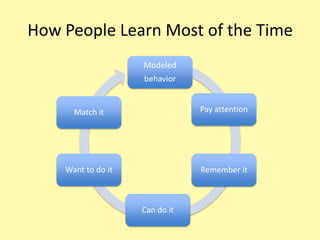
The document discusses design thinking as a framework for facilitating behavior change by emphasizing learning new behaviors rather than modifying existing ones, shaped by various influencing factors. Key points include the importance of motivation, opportunities for practice, and the alignment of behaviors with individuals' lives. It suggests leveraging observational learning, feedback, and a matching approach to optimize the effectiveness of behavior change strategies.


