Disability Assessment in
Psychiatric Patient
Chairperson: Prof. Th. Bihari
Singh
Presenter: Dr. Misso Yubey
Outlines
 Introduction
 Definition
 IDEAS
 Intellectual disability
 Specific learning disability
 General guidelines
 Assessment
 Reference
Introduction
 Disability associated with psychiatric disorders is
considered an important public health problem in
developing countries like India.
 Psychiatric disorders cause disability in individuals and
pose significant burden on their families.
 Disability due to psychiatric illness refers to dysfunction
or inadequate performance in specific activities of daily
living which are normally expected from a person
according to his age, sex and societal role.
 About one-third of patients having Major Depressive
Disorder (MDD) and Bipolar Affective Disorder
(BPAD) have a severe disability.
 About 16-17% OCD and anxiety disorders result in
significant disability.
 Indian Disability Evaluation and Assessment Scale
(IDEAS) has been recommended for assessment and
certification of disability by the Government of India
(GOI).
Definition
 Impairment: Any loss or abnormality of psychological,
physiological or anatomical structure or function.
 Disability: Any restriction or lack (resulting from an
impairment) of ability to perform an activity in the
manner or within the range considered normal for a
human being.
 Handicap: A disadvantage for a given individual that
limits or prevents the fulfilment of a role that is normal.
Mental illness
 Mental illness has been recognized as one of the
disabilities under Section 2 (i) of the Persons with
Disabilities (Equal Opportunities, Protection of Rights
and Full Participation) Act, 1995. “Mental illness” has
been defined under Section 2(q) of the said Act as any
mental disorder other than mental retardation.
 Assessment of Permanent Physical Impairment in
Mental Illness based on Indian Disability Evaluation
and Assessment Scale (IDEAS).
 A scale for measuring and quantifying disability in
mental disorders, developed by the Rehabilitation
Committee of Indian Psychiatry Society, December
2000.
 As traditionally used, impairment refers to a problem
with a structure or organ of the body; disability is a
functional limitation with regard to a particular activity;
and handicap refers to a disadvantage in filling a role in
life relative to a peer group.
 Renewed guidelines for evaluation of following
disabilities and procedure for certification was notified
vide Section 56 of the Rights of Persons with
Disabilities Act,2016 (49 of 2016), the Central
Government hereby notifies the guidelines for the
purpose of assessing the extent of following specified
disabilities in a person after having considered the
recommendations of the Ministry of Health and Family
Welfare:
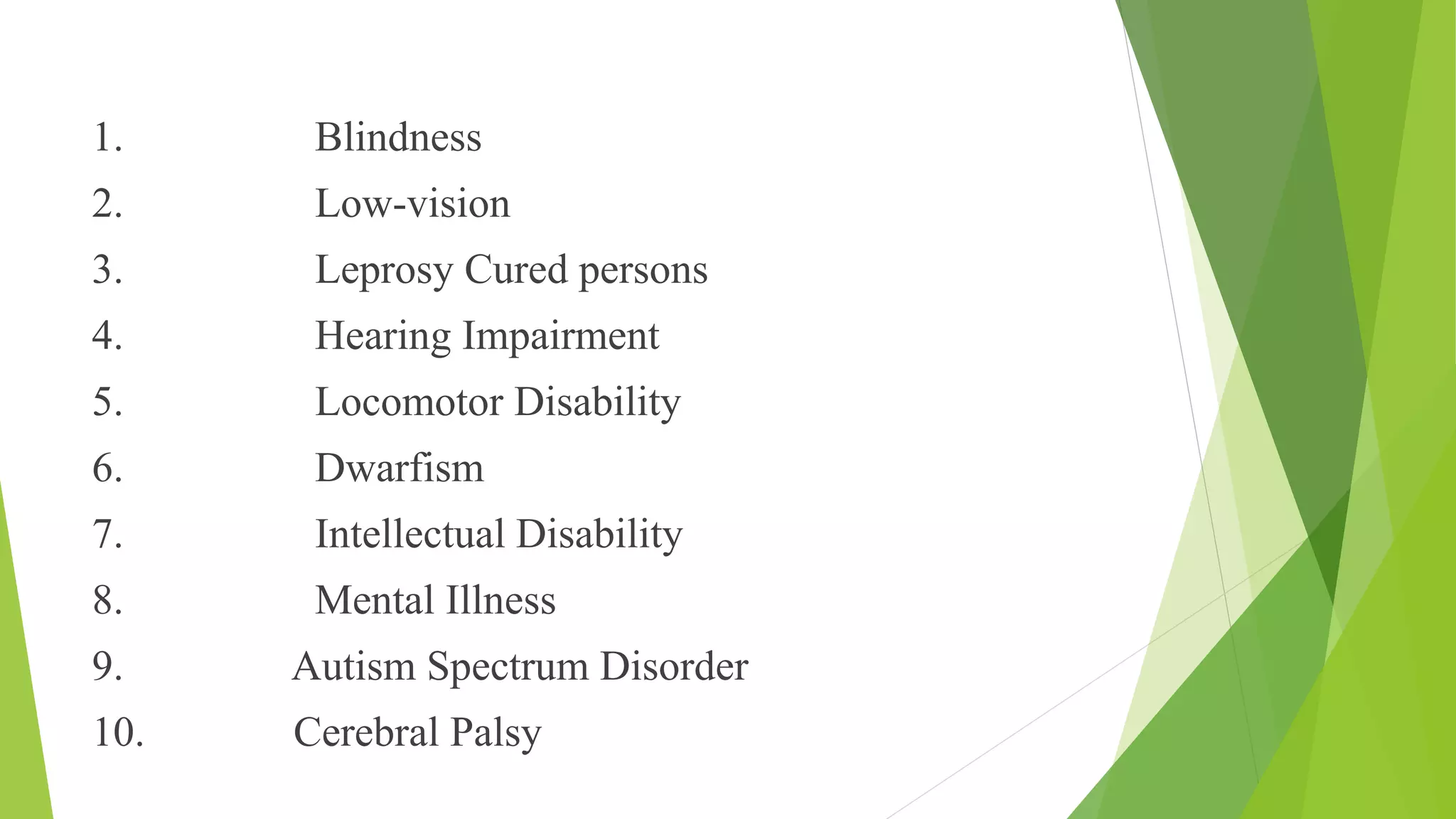
1. Blindness
2. Low-vision
3. Leprosy Cured persons
4. Hearing Impairment
5. Locomotor Disability
6. Dwarfism
7. Intellectual Disability
8. Mental Illness
9. Autism Spectrum Disorder
10. Cerebral Palsy
11. Muscular Dystrophy
12. Chronic Neurological conditions
13. Specific Learning Disabilities
14. Multiple Sclerosis
15. Speech and Language disability
16. Thalassemia
17. Hemophilia
18. Sickle Cell disease
19. Multiple Disabilities including deaf and
blindness
20. Acid Attack victim
21. Parkinson's disease
General guidelines
 To measure and certify Disability
 Only on out patients & those in community
 Interview the primary care givers
 Probe questions to identify dysfunction
 Eligibility for disability benefits – Pts with
Schizophrenia, BPAD, Dementia and OCD
 Duration of illness – minimum 2 years
Assessment Criteria
 Diagnosis & certification by Psychiatrist
 Administration of IDEAS by social workers,
psychologists or occupational therapists
 Frequency of certification – every 2 years
 Certificate has to be signed by unit consultants
psychiatry & SW,
HOD-psychiatry & member of medical board
 As per the Act, authorities to give a disability certificate
will be a medical board duly constituted by the central
and state government. The medical board should consist
of at least three members, out of which one shall be a
specialist (psychiatrist)in the concerned disability
subject.
 Validity- 5years (for temporary disabilities and those
under the age 18) other wise permanent.
 The minimum degree of disability should be 40% in
order to be eligible for any concession/ benefits.
Items in the scale
 I. Self Care (body hygiene, grooming, bathing, toileting,
dressing, eating, taking care one’s health)
 II. Interpersonal Activities (Social relationships)
 III. Communication and Understanding
 IV. Work performance (Employment, Housework,
Education)
I. Self Care
a. Maintenance of personal hygiene and physical health.
b. Eating habits.
c. Maintenance of personal belongings and living space.
d. Does s/he look after himself, wash his clothes regularly,
take a bath and brush his teeth?
e. Does s/he have regular meals?
f. Does s/he take food of right quality and quantity?
g. What about her/his table manners?
h. Does s/he take care of personal belongings with
reasonable standard of cleanliness and orderliness?
Scoring
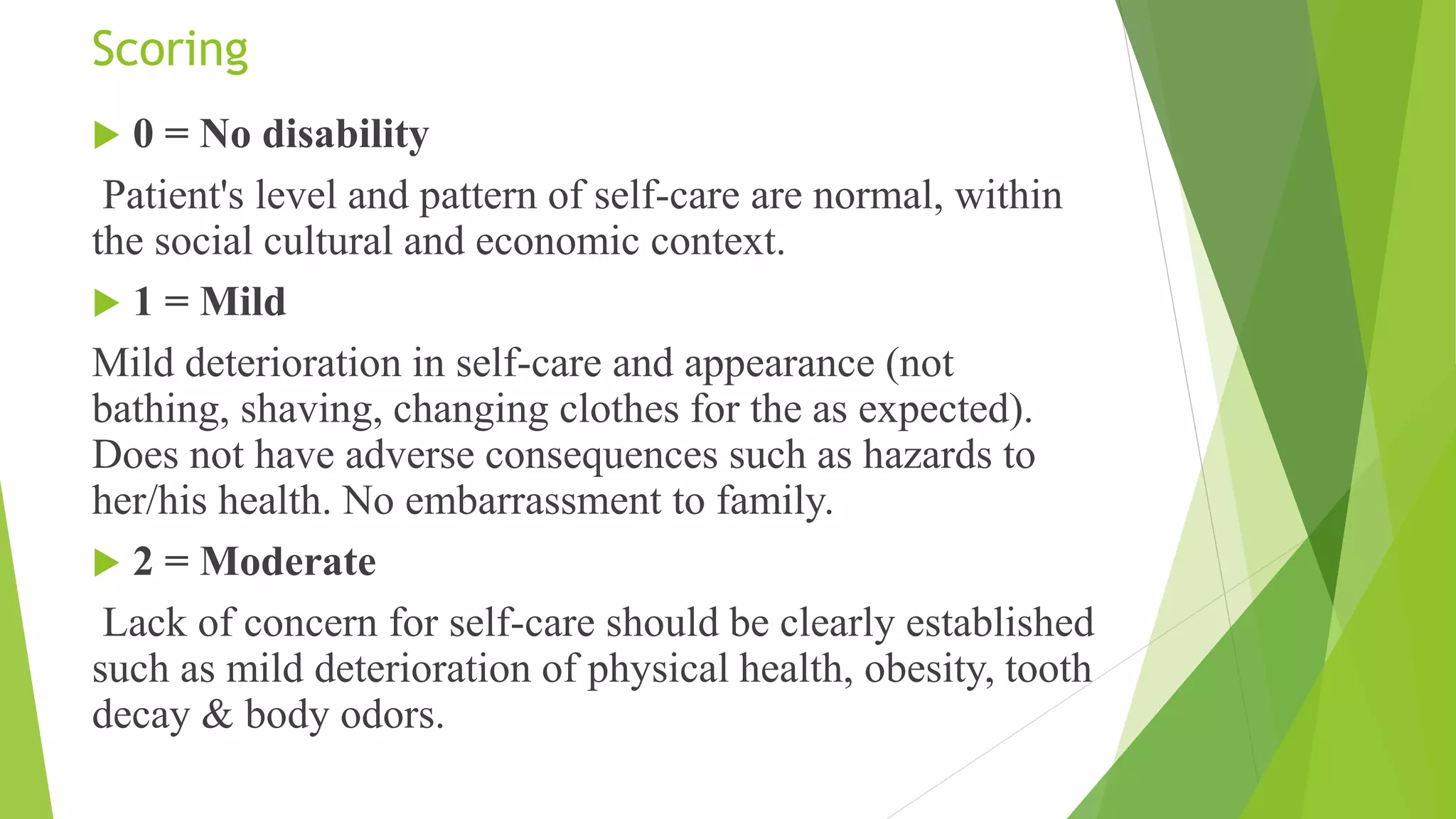
 0 = No disability
Patient's level and pattern of self-care are normal, within
the social cultural and economic context.
 1 = Mild
Mild deterioration in self-care and appearance (not
bathing, shaving, changing clothes for the as expected).
Does not have adverse consequences such as hazards to
her/his health. No embarrassment to family.
 2 = Moderate
Lack of concern for self-care should be clearly established
such as mild deterioration of physical health, obesity, tooth
decay & body odors.
 3 = Severe
Decline in self-care should be marked in all areas. Patient
wearing torn clothes would only wash if made to and
would only care if told. Evidence of serious hazards to
physical health.
 4 = Profound
Total or near total lack of self-care.
II. Interpersonal Activities
a. What is her/his behaviour with others?
b. Is s/he polite?
c. Does s/he respond to questions!
d. Is s/he able to regulate verbal and physical aggression?
e. Is s/he able to act independently in social interactions?
f. How does s/he behave with strangers?
g. Is s/he able to maintain friendship?
h. Does s/he show physical expression of affection and
desire?
Scoring
 0= No
Patient gets along reasonably well with people, personal
relationships. No friction in inter-personal relationships.
 1= Mild
Some friction on isolated occasions. Patient known to be
nervous or irritable but generally tolerated by others.
 2= Moderate
Factual evidence that pattern of response to people is
unhealthy. May be seen or more than few occasions. Could
isolate herself/himself from others and avoid company.
 3= Severe
Behaviour in social situations is undesirable and
generalized. Causes serious problems in daily living/or
work. Patient is socially ostracized.
 4= Profound
Patient in serious and lasting conflict, serious danger to
problems of others. Family afraid of potential
consequences.
III. Communication and Understanding
Understanding spoken messages as well as written and
non-verbal messages and ability to deduce messages in
order to communicate with others.
a. Does s/he avoid talking to people?
b. When people come home what does s/he do?
c. Does s/he ever visit others?
d. Is s/he able to start, maintain and end a conversation?
e. Does s/he understand body language and emotions of
others such as smiling, crying, screaming, etc.,
f. Does s/he indulge in reading and writing?
g. Do you encourage her/him to be more sociable?
Scoring
 0 = No disability
Patient mixes, talks and generally interacts with people as
much as can be expected in her/his socio-cultural context.
No evidence of avoiding people.
 1= Mild
Patient described as uncommunicative or solitary in social
situations. Signs of social anxiety might be reported.
 2= Moderate
A very narrow range of social contacts, evidence of active
avoidance of people on some occasions and interference
with performance of social rules causes concern to family.
 3= Severe
Evidence of more generalized, active avoidance of contact
with people (leave the room when visitors arrive and
would not answer the door or phone).
 4= Profound
Hardly has any contacts and actively avoids people nearly
all the time. e.g. - may lock herself/himself inside the
room. Verbal communication is nil or a bare minimum.
IV. Work performance
Includes employment, housework and educational
performance. Score only one category in case of an
overlap.
 Employment:
a. Is s/he employed/unemployed?
b. If employed, does s/he go to work regularly?
c. Does s/he like his job and coping well with it?
d. Can you rely on her/him financially?
e. If unemployed, does s/he make efforts to find job?
 Housewives should be rated on the amount, regularity
and efficiency in which tasks in the following areas are
completed.
 Acquiring daily necessities, making, storing and serving
of food, cleaning the house, working with those helping
with domestic duties such as maids, cooks etc., looking
after possessions and valuable in the house.
 Students - Assess a score on performance in
school/college, regularity, discipline, interest in future
studies, behaviour at the educational institution.
 Those discontinuing education on account of mental
disability and unable to continue further should be given
a score of 4.
Score
 0= No disability
Patient goes to work regularly and output and quality of
work performance are within acceptable levels for the job.
 1= Mild
Noticeable decline in patient's ability to work, to cope
with it and meet the demands of work. May threaten to
quit.
 2= Moderate
Declining work performance, frequent absences, lack of
concern about all this. Financial difficulties foreseen.
 3= Severe
Marked decline in work performance, disruptive at work,
unwilling to adhere to disciplines of work. Threat of losing
his job.
 4= Profound
Has been largely absent from work, termination imminent.
Unemployed and making no efforts to find jobs.
Scoring Sheet
Items 0 1 2 3 4
Self Care
Interpersonal Activities
Communication & Understanding
Work
A. Total Score
B. D O I Score
C. Global score (A+B)
TOTAL SCORE -Add scores of the 4 items and obtain a
total score
 Additional Weightage for Duration of illness (DOI):
 < 2 years: score to be added is 1
 2-5 years: add 2
 6-10 years: add 3
 > 10 years: add 4
Scoring
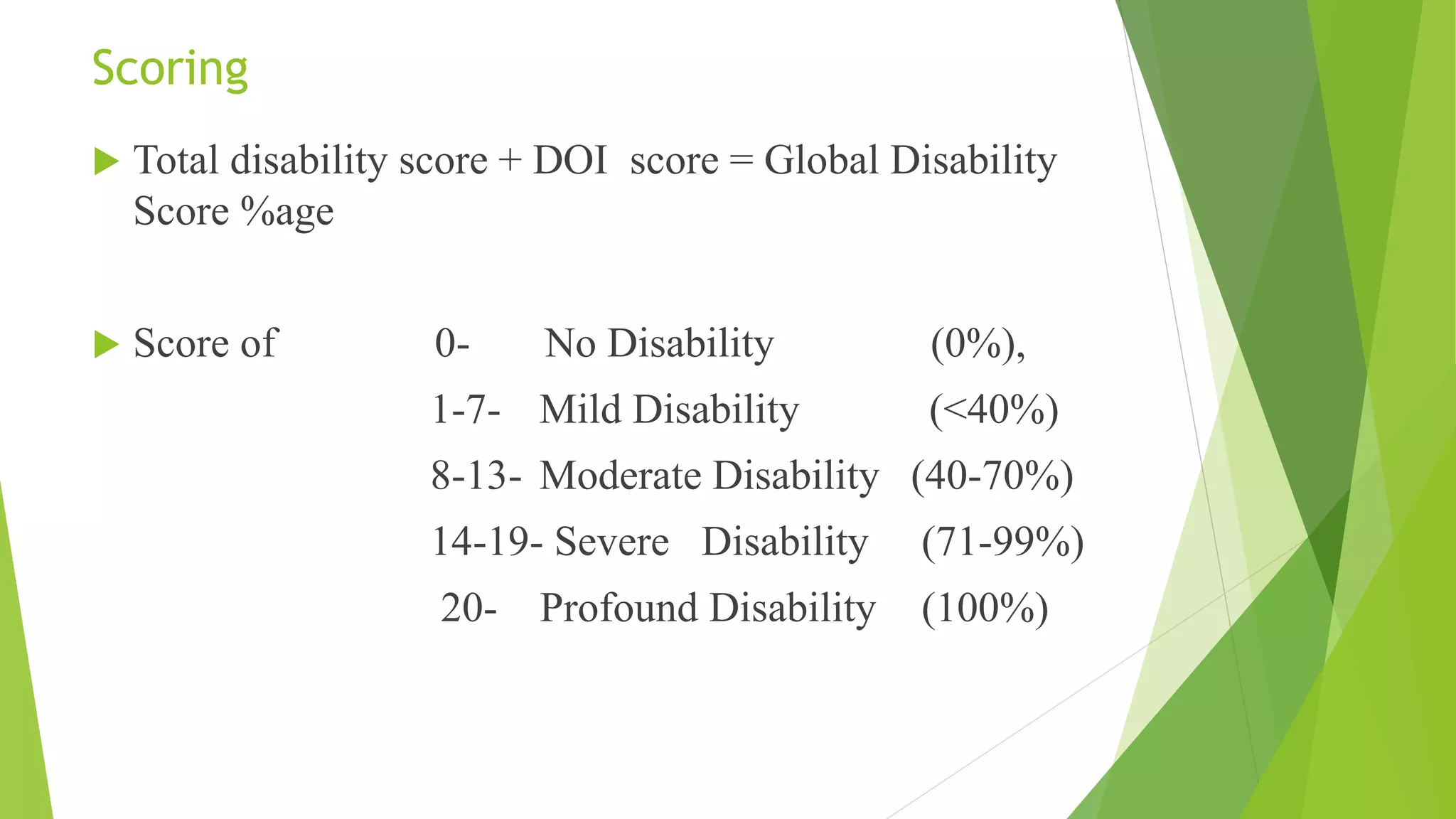
 Total disability score + DOI score = Global Disability
Score %age
 Score of 0- No Disability (0%),
1-7- Mild Disability (<40%)
8-13- Moderate Disability (40-70%)
14-19- Severe Disability (71-99%)
20- Profound Disability (100%)
Intellectual Disability
 Characterized by significant limitation both in
intellectual functioning (reasoning, learning, problem
solving) and in adaptive behaviour which covers a range
of every day, social and practical skills.
Screening
 Presented to Pediatricians
as developmental delay.
Diagnosis
 Child/ clinical psychologists for Adaptive functioning
and IQ testing. The tools used:
(i) Adaptive functioning: Vineland Social Maturity Scale
(ii) IQ testing: Binet Kamat Test/ MISIC (Malin’s
Intelligence Scale for Indian Children)
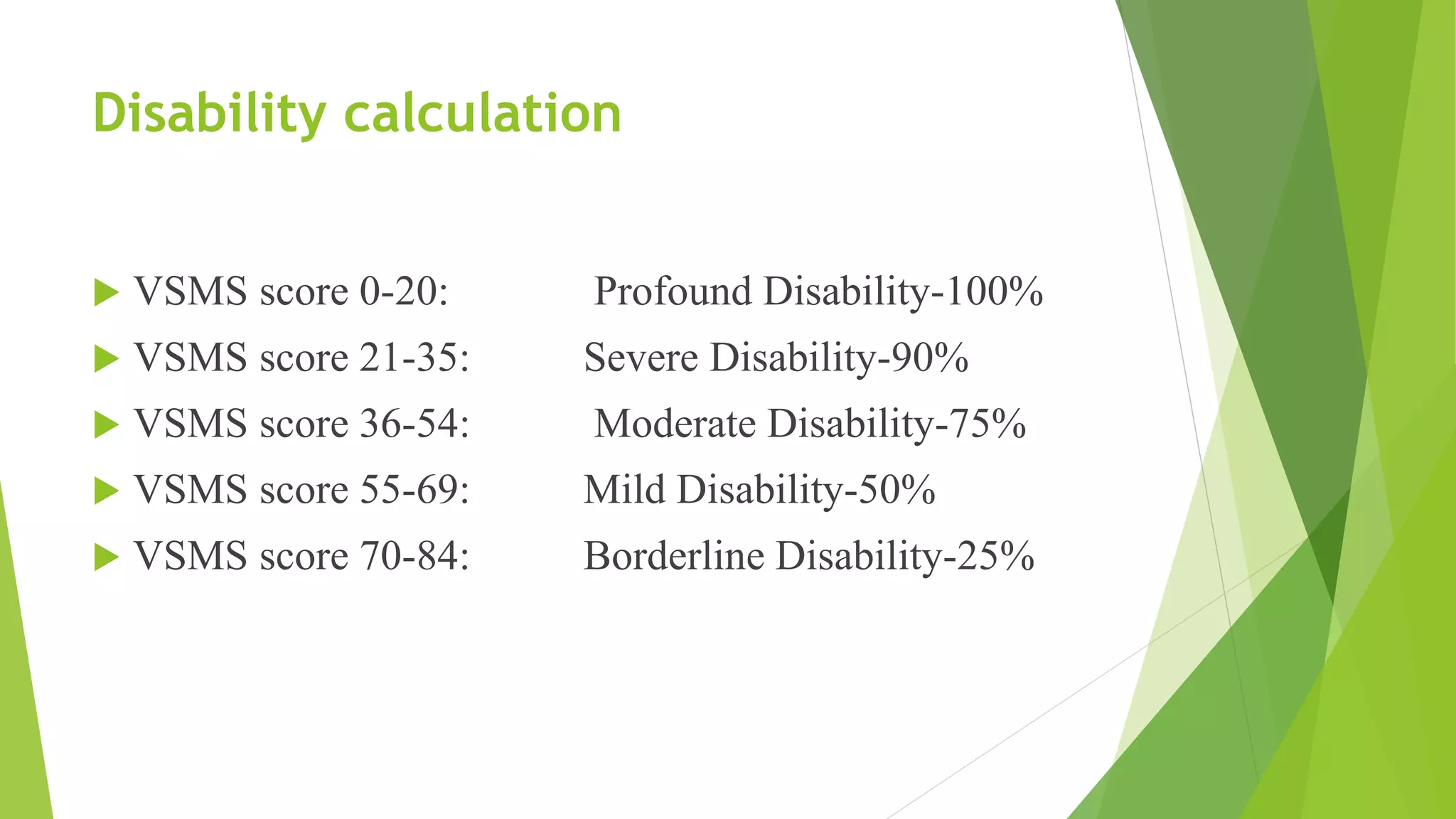
Disability calculation
 VSMS score 0-20: Profound Disability-100%
 VSMS score 21-35: Severe Disability-90%
 VSMS score 36-54: Moderate Disability-75%
 VSMS score 55-69: Mild Disability-50%
 VSMS score 70-84: Borderline Disability-25%
Age for certification
 Minimum age for certification= one completed year.
 Children above one year and up to the age of 5 years
shall be given a diagnosis as Global Development Delay
(GDD).
Medical Authority
 Medical Superintendent/ Chief Medical Officer or Civil
Surgeon or any other equivalent authority -Head of
Medical Board.
 The Authority shall comprise of:
(a) The Medical Superintendent or Chief Medical Officer
or Civil Surgeon or any other equivalent
(b) Pediatrician or Pediatric Neurologist (where available)/
Psychiatrist or Physician (if age >18years)
(c) Clinical or Rehabilitation Psychologist
Validity of Certificate
i) Temporary certificate for children less than 5 years:
Valid for maximum 3 years/ 5 years age (whichever is
earlier).
(ii) For children >5 years: To be renewed at age of 5 years,
10 years and 18 years.
Certificate issued at 18 years age will be valid lifelong.
Specific Learning Disability (SLD)
 “Specific learning disabilities" means a heterogeneous
group of conditions wherein there is a deficit in
processing language, spoken or written, that may
manifest itself as a difficulty to comprehend, speak,
read, write, spell, or to do mathematical calculations and
includes such conditions as perceptual disabilities,
dyslexia, dysgraphia, dyscalculia, dyspraxia and
developmental aphasia.
Screening
 Teachers of the public and private school shall carry out
the screening in Class III or at eight years of age.
 Every school (public and private) shall have a screening
committee headed by the principal of the school.
 Child shall be referred to pediatrician for SLD
assessment by the principal of the school with the
recommendations of the screening committee endorsed.
Diagnosis
(i) Step 1- Assessment of pediatrician: The pediatrician
will do the initial assessment. This will involve
 a detailed neurological examination including vision and
hearing assessment.
(ii) Step 2: IQ Assessment: Child/ clinical psychologist
will do the IQ assessment using MISIC or WISCIII.
 If the IQ is determined to be >85, then step 3 will be
applied.
(iii) Step 3- SLD Assessment: This would involve
application of specific psychometric tests for diagnosing
SLD.
Diagnostic Tool
 NIMHANS battery shall be applied for diagnostic test
for SLD.
Medical Authority
 Medical Superintendent / Chief Medical Officer / Civil
Surgeon or any other equivalent -Head the certification
authority.
 The medical authority will comprise of:
(a) The MS or CMO or Civil Surgeon or any other
equivalent authority as notified by the State Government
(b) Pediatrician or Pediatric Neurologist
(c) Clinical or Réhabilitation Psychologist
(d) Occupational therapist or Special Educator or Teacher
trained for assessment of SLD.
Validity of Certificate
 Certification will be done for children aged eight years
and above only.
 Repeat certification at the age of 14 years and at the age
of 18 years.
 The certificate issued at 18 years will be valid life-long.
References
 World Health Organization (1980) in The International Classification of
Impairments, Disabilities, and Handicaps.
 Mohan, I., Tandon, R., Kalra, H. and Trivedi, J.K., 2005. Disability assessment
in mental illnesses using Indian disability evaluation assessment scale
(IDEAS). Indian Journal of Medical Research, 121(6), p.759.
 Üstün TB, Kostanjsek N, Chatterji S, Rehm J, editors. Measuring Health and
Disability: Manual for WHO Disability Assessment Schedule (WHODAS
2.0) Malta: World Health Organization; 2010.
 Grover, S., Shah, R., Kulhara, P. and Malhotra, R., 2014. Internal consistency
& validity of Indian Disability Evaluation and Assessment Scale (IDEAS) in
patients with schizophrenia. The Indian journal of medical research, 140(5),
p.637.
 Gazette Government Extraordinary, New Delhi, Friday, January 5, 2018.
Thank you

Disability assessment in psychiatric patient

  • 1.
    Disability Assessment in PsychiatricPatient Chairperson: Prof. Th. Bihari Singh Presenter: Dr. Misso Yubey
  • 2.
    Outlines  Introduction  Definition IDEAS  Intellectual disability  Specific learning disability  General guidelines  Assessment  Reference
  • 3.
    Introduction  Disability associatedwith psychiatric disorders is considered an important public health problem in developing countries like India.  Psychiatric disorders cause disability in individuals and pose significant burden on their families.  Disability due to psychiatric illness refers to dysfunction or inadequate performance in specific activities of daily living which are normally expected from a person according to his age, sex and societal role.
  • 4.
     About one-thirdof patients having Major Depressive Disorder (MDD) and Bipolar Affective Disorder (BPAD) have a severe disability.  About 16-17% OCD and anxiety disorders result in significant disability.  Indian Disability Evaluation and Assessment Scale (IDEAS) has been recommended for assessment and certification of disability by the Government of India (GOI).
  • 5.
    Definition  Impairment: Anyloss or abnormality of psychological, physiological or anatomical structure or function.  Disability: Any restriction or lack (resulting from an impairment) of ability to perform an activity in the manner or within the range considered normal for a human being.  Handicap: A disadvantage for a given individual that limits or prevents the fulfilment of a role that is normal.
  • 6.
    Mental illness  Mentalillness has been recognized as one of the disabilities under Section 2 (i) of the Persons with Disabilities (Equal Opportunities, Protection of Rights and Full Participation) Act, 1995. “Mental illness” has been defined under Section 2(q) of the said Act as any mental disorder other than mental retardation.
  • 7.
     Assessment ofPermanent Physical Impairment in Mental Illness based on Indian Disability Evaluation and Assessment Scale (IDEAS).  A scale for measuring and quantifying disability in mental disorders, developed by the Rehabilitation Committee of Indian Psychiatry Society, December 2000.
  • 8.
     As traditionallyused, impairment refers to a problem with a structure or organ of the body; disability is a functional limitation with regard to a particular activity; and handicap refers to a disadvantage in filling a role in life relative to a peer group.
  • 9.
     Renewed guidelinesfor evaluation of following disabilities and procedure for certification was notified vide Section 56 of the Rights of Persons with Disabilities Act,2016 (49 of 2016), the Central Government hereby notifies the guidelines for the purpose of assessing the extent of following specified disabilities in a person after having considered the recommendations of the Ministry of Health and Family Welfare:
  • 10.
    1. Blindness 2. Low-vision 3.Leprosy Cured persons 4. Hearing Impairment 5. Locomotor Disability 6. Dwarfism 7. Intellectual Disability 8. Mental Illness 9. Autism Spectrum Disorder 10. Cerebral Palsy
  • 11.
    11. Muscular Dystrophy 12.Chronic Neurological conditions 13. Specific Learning Disabilities 14. Multiple Sclerosis 15. Speech and Language disability 16. Thalassemia 17. Hemophilia 18. Sickle Cell disease 19. Multiple Disabilities including deaf and blindness 20. Acid Attack victim 21. Parkinson's disease
  • 12.
    General guidelines  Tomeasure and certify Disability  Only on out patients & those in community  Interview the primary care givers  Probe questions to identify dysfunction  Eligibility for disability benefits – Pts with Schizophrenia, BPAD, Dementia and OCD  Duration of illness – minimum 2 years
  • 13.
    Assessment Criteria  Diagnosis& certification by Psychiatrist  Administration of IDEAS by social workers, psychologists or occupational therapists  Frequency of certification – every 2 years  Certificate has to be signed by unit consultants psychiatry & SW, HOD-psychiatry & member of medical board
  • 14.
     As perthe Act, authorities to give a disability certificate will be a medical board duly constituted by the central and state government. The medical board should consist of at least three members, out of which one shall be a specialist (psychiatrist)in the concerned disability subject.  Validity- 5years (for temporary disabilities and those under the age 18) other wise permanent.  The minimum degree of disability should be 40% in order to be eligible for any concession/ benefits.
  • 15.
    Items in thescale  I. Self Care (body hygiene, grooming, bathing, toileting, dressing, eating, taking care one’s health)  II. Interpersonal Activities (Social relationships)  III. Communication and Understanding  IV. Work performance (Employment, Housework, Education)
  • 16.
    I. Self Care a.Maintenance of personal hygiene and physical health. b. Eating habits. c. Maintenance of personal belongings and living space. d. Does s/he look after himself, wash his clothes regularly, take a bath and brush his teeth? e. Does s/he have regular meals? f. Does s/he take food of right quality and quantity? g. What about her/his table manners? h. Does s/he take care of personal belongings with reasonable standard of cleanliness and orderliness?
  • 17.
    Scoring  0 =No disability Patient's level and pattern of self-care are normal, within the social cultural and economic context.  1 = Mild Mild deterioration in self-care and appearance (not bathing, shaving, changing clothes for the as expected). Does not have adverse consequences such as hazards to her/his health. No embarrassment to family.  2 = Moderate Lack of concern for self-care should be clearly established such as mild deterioration of physical health, obesity, tooth decay & body odors.
  • 18.
     3 =Severe Decline in self-care should be marked in all areas. Patient wearing torn clothes would only wash if made to and would only care if told. Evidence of serious hazards to physical health.  4 = Profound Total or near total lack of self-care.
  • 19.
    II. Interpersonal Activities a.What is her/his behaviour with others? b. Is s/he polite? c. Does s/he respond to questions! d. Is s/he able to regulate verbal and physical aggression? e. Is s/he able to act independently in social interactions? f. How does s/he behave with strangers? g. Is s/he able to maintain friendship? h. Does s/he show physical expression of affection and desire?
  • 20.
    Scoring  0= No Patientgets along reasonably well with people, personal relationships. No friction in inter-personal relationships.  1= Mild Some friction on isolated occasions. Patient known to be nervous or irritable but generally tolerated by others.  2= Moderate Factual evidence that pattern of response to people is unhealthy. May be seen or more than few occasions. Could isolate herself/himself from others and avoid company.
  • 21.
     3= Severe Behaviourin social situations is undesirable and generalized. Causes serious problems in daily living/or work. Patient is socially ostracized.  4= Profound Patient in serious and lasting conflict, serious danger to problems of others. Family afraid of potential consequences.
  • 22.
    III. Communication andUnderstanding Understanding spoken messages as well as written and non-verbal messages and ability to deduce messages in order to communicate with others. a. Does s/he avoid talking to people? b. When people come home what does s/he do? c. Does s/he ever visit others? d. Is s/he able to start, maintain and end a conversation?
  • 23.
    e. Does s/heunderstand body language and emotions of others such as smiling, crying, screaming, etc., f. Does s/he indulge in reading and writing? g. Do you encourage her/him to be more sociable?
  • 24.
    Scoring  0 =No disability Patient mixes, talks and generally interacts with people as much as can be expected in her/his socio-cultural context. No evidence of avoiding people.  1= Mild Patient described as uncommunicative or solitary in social situations. Signs of social anxiety might be reported.  2= Moderate A very narrow range of social contacts, evidence of active avoidance of people on some occasions and interference with performance of social rules causes concern to family.
  • 25.
     3= Severe Evidenceof more generalized, active avoidance of contact with people (leave the room when visitors arrive and would not answer the door or phone).  4= Profound Hardly has any contacts and actively avoids people nearly all the time. e.g. - may lock herself/himself inside the room. Verbal communication is nil or a bare minimum.
  • 26.
    IV. Work performance Includesemployment, housework and educational performance. Score only one category in case of an overlap.  Employment: a. Is s/he employed/unemployed? b. If employed, does s/he go to work regularly? c. Does s/he like his job and coping well with it? d. Can you rely on her/him financially? e. If unemployed, does s/he make efforts to find job?
  • 27.
     Housewives shouldbe rated on the amount, regularity and efficiency in which tasks in the following areas are completed.  Acquiring daily necessities, making, storing and serving of food, cleaning the house, working with those helping with domestic duties such as maids, cooks etc., looking after possessions and valuable in the house.  Students - Assess a score on performance in school/college, regularity, discipline, interest in future studies, behaviour at the educational institution.  Those discontinuing education on account of mental disability and unable to continue further should be given a score of 4.
  • 28.
    Score  0= Nodisability Patient goes to work regularly and output and quality of work performance are within acceptable levels for the job.  1= Mild Noticeable decline in patient's ability to work, to cope with it and meet the demands of work. May threaten to quit.  2= Moderate Declining work performance, frequent absences, lack of concern about all this. Financial difficulties foreseen.
  • 29.
     3= Severe Markeddecline in work performance, disruptive at work, unwilling to adhere to disciplines of work. Threat of losing his job.  4= Profound Has been largely absent from work, termination imminent. Unemployed and making no efforts to find jobs.
  • 30.
    Scoring Sheet Items 01 2 3 4 Self Care Interpersonal Activities Communication & Understanding Work A. Total Score B. D O I Score C. Global score (A+B)
  • 31.
    TOTAL SCORE -Addscores of the 4 items and obtain a total score  Additional Weightage for Duration of illness (DOI):  < 2 years: score to be added is 1  2-5 years: add 2  6-10 years: add 3  > 10 years: add 4
  • 32.
    Scoring  Total disabilityscore + DOI score = Global Disability Score %age  Score of 0- No Disability (0%), 1-7- Mild Disability (<40%) 8-13- Moderate Disability (40-70%) 14-19- Severe Disability (71-99%) 20- Profound Disability (100%)
  • 33.
    Intellectual Disability  Characterizedby significant limitation both in intellectual functioning (reasoning, learning, problem solving) and in adaptive behaviour which covers a range of every day, social and practical skills.
  • 34.
    Screening  Presented toPediatricians as developmental delay.
  • 35.
    Diagnosis  Child/ clinicalpsychologists for Adaptive functioning and IQ testing. The tools used: (i) Adaptive functioning: Vineland Social Maturity Scale (ii) IQ testing: Binet Kamat Test/ MISIC (Malin’s Intelligence Scale for Indian Children)
  • 36.
    Disability calculation  VSMSscore 0-20: Profound Disability-100%  VSMS score 21-35: Severe Disability-90%  VSMS score 36-54: Moderate Disability-75%  VSMS score 55-69: Mild Disability-50%  VSMS score 70-84: Borderline Disability-25%
  • 37.
    Age for certification Minimum age for certification= one completed year.  Children above one year and up to the age of 5 years shall be given a diagnosis as Global Development Delay (GDD).
  • 38.
    Medical Authority  MedicalSuperintendent/ Chief Medical Officer or Civil Surgeon or any other equivalent authority -Head of Medical Board.  The Authority shall comprise of: (a) The Medical Superintendent or Chief Medical Officer or Civil Surgeon or any other equivalent (b) Pediatrician or Pediatric Neurologist (where available)/ Psychiatrist or Physician (if age >18years) (c) Clinical or Rehabilitation Psychologist
  • 39.
    Validity of Certificate i)Temporary certificate for children less than 5 years: Valid for maximum 3 years/ 5 years age (whichever is earlier). (ii) For children >5 years: To be renewed at age of 5 years, 10 years and 18 years. Certificate issued at 18 years age will be valid lifelong.
  • 40.
    Specific Learning Disability(SLD)  “Specific learning disabilities" means a heterogeneous group of conditions wherein there is a deficit in processing language, spoken or written, that may manifest itself as a difficulty to comprehend, speak, read, write, spell, or to do mathematical calculations and includes such conditions as perceptual disabilities, dyslexia, dysgraphia, dyscalculia, dyspraxia and developmental aphasia.
  • 41.
    Screening  Teachers ofthe public and private school shall carry out the screening in Class III or at eight years of age.  Every school (public and private) shall have a screening committee headed by the principal of the school.  Child shall be referred to pediatrician for SLD assessment by the principal of the school with the recommendations of the screening committee endorsed.
  • 42.
    Diagnosis (i) Step 1-Assessment of pediatrician: The pediatrician will do the initial assessment. This will involve  a detailed neurological examination including vision and hearing assessment. (ii) Step 2: IQ Assessment: Child/ clinical psychologist will do the IQ assessment using MISIC or WISCIII.  If the IQ is determined to be >85, then step 3 will be applied. (iii) Step 3- SLD Assessment: This would involve application of specific psychometric tests for diagnosing SLD.
  • 43.
    Diagnostic Tool  NIMHANSbattery shall be applied for diagnostic test for SLD.
  • 44.
    Medical Authority  MedicalSuperintendent / Chief Medical Officer / Civil Surgeon or any other equivalent -Head the certification authority.  The medical authority will comprise of: (a) The MS or CMO or Civil Surgeon or any other equivalent authority as notified by the State Government (b) Pediatrician or Pediatric Neurologist (c) Clinical or Réhabilitation Psychologist (d) Occupational therapist or Special Educator or Teacher trained for assessment of SLD.
  • 45.
    Validity of Certificate Certification will be done for children aged eight years and above only.  Repeat certification at the age of 14 years and at the age of 18 years.  The certificate issued at 18 years will be valid life-long.
  • 46.
    References  World HealthOrganization (1980) in The International Classification of Impairments, Disabilities, and Handicaps.  Mohan, I., Tandon, R., Kalra, H. and Trivedi, J.K., 2005. Disability assessment in mental illnesses using Indian disability evaluation assessment scale (IDEAS). Indian Journal of Medical Research, 121(6), p.759.  Üstün TB, Kostanjsek N, Chatterji S, Rehm J, editors. Measuring Health and Disability: Manual for WHO Disability Assessment Schedule (WHODAS 2.0) Malta: World Health Organization; 2010.  Grover, S., Shah, R., Kulhara, P. and Malhotra, R., 2014. Internal consistency & validity of Indian Disability Evaluation and Assessment Scale (IDEAS) in patients with schizophrenia. The Indian journal of medical research, 140(5), p.637.  Gazette Government Extraordinary, New Delhi, Friday, January 5, 2018.
  • 47.