By
Sudarshan Kadariya
JMC
But, the process of reaching to the
stability is difference as per Monetary
and Keynesian approach.
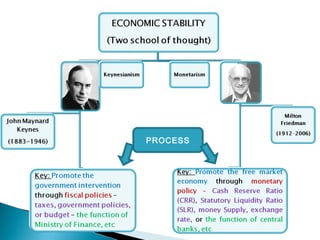
PROCESS
 The root of the monetarism is from the classical
economist.
 Monetarism began with the Milton Friedman’s article
“The Quantity Theory of Money: A Restatement”
in 1956.
 The major concern is “role of money” in the economy
for stability of aggregate demand.
 “Money does matter”
 Limited sectors like - note issue, peace and security,
judiciary function, etc should be controled by the
government.
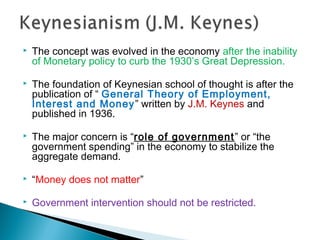
 The concept was evolved in the economy after the inability
of Monetary policy to curb the 1930’s Great Depression.
 The foundation of Keynesian school of thought is after the
publication of “ General Theory of Employment,
Interest and Money” written by J.M. Keynes and
published in 1936.
 The major concern is “role of government” or “the
government spending” in the economy to stabilize the
aggregate demand.
 “Money does not matter”
 Government intervention should not be restricted.
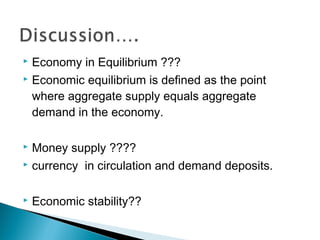
 Economy in Equilibrium ???
 Economic equilibrium is defined as the point
where aggregate supply equals aggregate
demand in the economy.
 Money supply ????
 currency  in circulation and demand deposits.
 Economic stability??
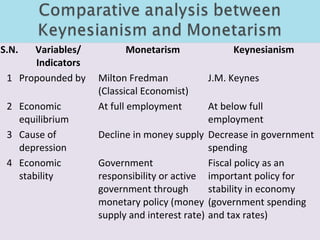
S.N. Variables/
Indicators
Monetarism Keynesianism
1 Propounded by Milton Fredman
(Classical Economist)
J.M. Keynes
2 Economic
equilibrium
At full employment At below full
employment
3 Cause of
depression
Decline in money supply Decrease in government
spending
4 Economic
stability
Government
responsibility or active
government through
monetary policy (money
supply and interest rate)
Fiscal policy as an
important policy for
stability in economy
(government spending
and tax rates)
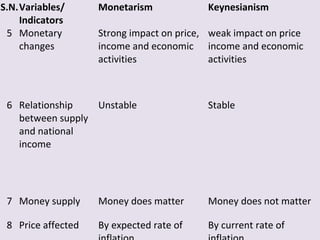
S.N.Variables/
Indicators
Monetarism Keynesianism
5 Monetary
changes
Strong impact on price,
income and economic
activities
weak impact on price
income and economic
activities
6 Relationship
between supply
and national
income
Unstable Stable
7 Money supply Money does matter Money does not matter
8 Price affected By expected rate of By current rate of
S.N.Variables/
Indicators
Monetarism Keynesianism
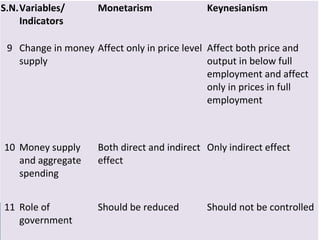
9 Change in money
supply
Affect only in price level Affect both price and
output in below full
employment and affect
only in prices in full
employment
10 Money supply
and aggregate
spending
Both direct and indirect
effect
Only indirect effect
11 Role of
government
Should be reduced Should not be controlled
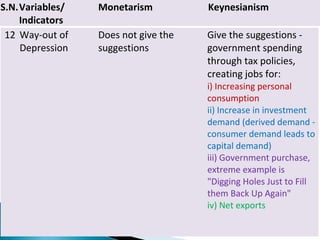
12 Way-out of
Depression
Does not give the
suggestions
Give the suggestions -
government spending
through tax policies,
creating jobs for:
i) Increasing personal
consumption
ii) Increase in investment
demand (derived demand -
consumer demand leads to
capital demand)
iii) Government purchase,
extreme example is
"Digging Holes Just to Fill
them Back Up Again"
iv) Net exports
S.N.Variables/
Indicators
Monetarism Keynesianism
keynesianism vs monetarism

keynesianism vs monetarism

  • 1.
  • 2.
    But, the processof reaching to the stability is difference as per Monetary and Keynesian approach.
  • 3.
  • 4.
     The rootof the monetarism is from the classical economist.  Monetarism began with the Milton Friedman’s article “The Quantity Theory of Money: A Restatement” in 1956.  The major concern is “role of money” in the economy for stability of aggregate demand.  “Money does matter”  Limited sectors like - note issue, peace and security, judiciary function, etc should be controled by the government.
  • 5.
     The conceptwas evolved in the economy after the inability of Monetary policy to curb the 1930’s Great Depression.  The foundation of Keynesian school of thought is after the publication of “ General Theory of Employment, Interest and Money” written by J.M. Keynes and published in 1936.  The major concern is “role of government” or “the government spending” in the economy to stabilize the aggregate demand.  “Money does not matter”  Government intervention should not be restricted.
  • 6.
     Economy inEquilibrium ???  Economic equilibrium is defined as the point where aggregate supply equals aggregate demand in the economy.  Money supply ????  currency  in circulation and demand deposits.  Economic stability??
  • 7.
    S.N. Variables/ Indicators Monetarism Keynesianism 1Propounded by Milton Fredman (Classical Economist) J.M. Keynes 2 Economic equilibrium At full employment At below full employment 3 Cause of depression Decline in money supply Decrease in government spending 4 Economic stability Government responsibility or active government through monetary policy (money supply and interest rate) Fiscal policy as an important policy for stability in economy (government spending and tax rates)
  • 8.
    S.N.Variables/ Indicators Monetarism Keynesianism 5 Monetary changes Strongimpact on price, income and economic activities weak impact on price income and economic activities 6 Relationship between supply and national income Unstable Stable 7 Money supply Money does matter Money does not matter 8 Price affected By expected rate of By current rate of
  • 9.
    S.N.Variables/ Indicators Monetarism Keynesianism 9 Changein money supply Affect only in price level Affect both price and output in below full employment and affect only in prices in full employment 10 Money supply and aggregate spending Both direct and indirect effect Only indirect effect 11 Role of government Should be reduced Should not be controlled
  • 10.
    12 Way-out of Depression Doesnot give the suggestions Give the suggestions - government spending through tax policies, creating jobs for: i) Increasing personal consumption ii) Increase in investment demand (derived demand - consumer demand leads to capital demand) iii) Government purchase, extreme example is "Digging Holes Just to Fill them Back Up Again" iv) Net exports S.N.Variables/ Indicators Monetarism Keynesianism