How to Interpret TMT Dr. B. K. Iyer
Key Points of Exercise Testing Manual SBP measurement (not automated) most important for safety Adjust to clinical history (couch potatoes) No Age predicted Heart Rate Targets The BORG Scale of Perceived Exertion METs not Minutes Fit protocol to patient (RAMP) Avoid HV and cool down walk Use standard ECG analysis/ 3 minute recovery/ use scores Heart rate recovery  Expired Gas Analysis?
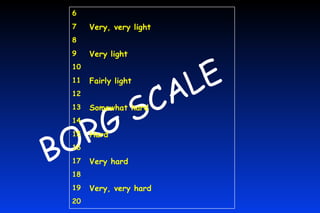
BORG SCALE 20 Very, very hard 19 18 Very hard 17 16 Hard 15 14 Somewhat hard 13 12 Fairly light 11 10 Very light 9 8 Very, very light 7 6
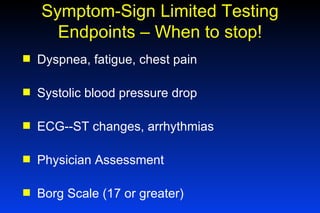
Symptom-Sign Limited Testing Endpoints – When to stop! Dyspnea, fatigue, chest pain Systolic blood pressure drop ECG--ST changes, arrhythmias Physician Assessment Borg Scale (17 or greater)
How to interpret a TMT ECG Good skin prep PR isoelectric line Not one beat Three consistent complexes Averages can help Garbage in, garbage out Three minute recovery
Types of Exercise Isometric (Static) weight-lifting pressure work for heart, limited cardiac output, proportional to effort Isotonic (Dynamic) walking, running, swimming, cycling Flow work for heart, proportional to external work Mixed
Oxygen Consumption During Dynamic Exercise Testing There are 2 types to consider: Myocardial (MO2) Internal, Cardiac Ventilatory (VO2) External, Total Body
Myocardial (MO2) Coronary Flow x Coronary a - VO2  difference Wall Tension (Pressure x Volume, Contractility, Stroke Work, HR) Systolic Blood Pressure x HR Angina and ST Depression usually occurs at  same Double Product in an individual ** Direct relationship to VO2  is altered by beta-blockers, training,...
Myocardial (MO2) Systolic Blood Pressure x HR SBP should rise > 40 mmHg Drops are ominous (Exertional Hypotension) Diastolic BP should decline
Problems with Age-Predicted Maximal Heart Rate Which Regression Formula?  (2YY - .Y x Age) Big scatter around the regression line  poor correlation [-0.4 to -0.6]  One SD is plus/minus 12 bpm Confounded by Beta Blockers A percent value target will be maximal for some and sub-max for others Borg scale is better for evaluating Effort Do Not Use Target Heart Rate to Terminate the Test or as the Only Indicator of Effort or adequacy of test
Ventilatory (VO2) Cardiac Output  x a-VO2 Difference VE x (% Inspired Air Oxygen Content - Expired Air Oxygen Content) External Work Performed ****Direct relationship with Myocardial O2 demand and Work is altered by beta-blockers, training,...
Key Points of Exercise Testing Manual SBP measurement (not automated) most important for safety Adjust to clinical history (couch potatoes) No Age predicted Heart Rate Targets The BORG Scale of Perceived Exertion METs not Minutes Fit protocol to patient (RAMP) Avoid HV and cool down walk Use standard ECG analysis/ 3 minute recovery/ use scores Heart rate recovery  Expired Gas Analysis?
Question 1 What is the most important prognostic measurement from the exercise test? 1. BORG scale estimate 2. ST depression 3. Exercise time 4. Exercise capacity
Question 2 What is the most appropriate indicator of a maximal effort? 1. BORG scale estimate 2. ST depression 3. Exercise time 4. Exercise capacity
Questions???

TMT interpretation

  • 1.
    How to InterpretTMT Dr. B. K. Iyer
  • 2.
    Key Points ofExercise Testing Manual SBP measurement (not automated) most important for safety Adjust to clinical history (couch potatoes) No Age predicted Heart Rate Targets The BORG Scale of Perceived Exertion METs not Minutes Fit protocol to patient (RAMP) Avoid HV and cool down walk Use standard ECG analysis/ 3 minute recovery/ use scores Heart rate recovery Expired Gas Analysis?
  • 3.
    BORG SCALE 20Very, very hard 19 18 Very hard 17 16 Hard 15 14 Somewhat hard 13 12 Fairly light 11 10 Very light 9 8 Very, very light 7 6
  • 4.
    Symptom-Sign Limited TestingEndpoints – When to stop! Dyspnea, fatigue, chest pain Systolic blood pressure drop ECG--ST changes, arrhythmias Physician Assessment Borg Scale (17 or greater)
  • 5.
    How to interpreta TMT ECG Good skin prep PR isoelectric line Not one beat Three consistent complexes Averages can help Garbage in, garbage out Three minute recovery
  • 6.
    Types of ExerciseIsometric (Static) weight-lifting pressure work for heart, limited cardiac output, proportional to effort Isotonic (Dynamic) walking, running, swimming, cycling Flow work for heart, proportional to external work Mixed
  • 7.
    Oxygen Consumption DuringDynamic Exercise Testing There are 2 types to consider: Myocardial (MO2) Internal, Cardiac Ventilatory (VO2) External, Total Body
  • 8.
    Myocardial (MO2) CoronaryFlow x Coronary a - VO2 difference Wall Tension (Pressure x Volume, Contractility, Stroke Work, HR) Systolic Blood Pressure x HR Angina and ST Depression usually occurs at same Double Product in an individual ** Direct relationship to VO2 is altered by beta-blockers, training,...
  • 9.
    Myocardial (MO2) SystolicBlood Pressure x HR SBP should rise > 40 mmHg Drops are ominous (Exertional Hypotension) Diastolic BP should decline
  • 10.
    Problems with Age-PredictedMaximal Heart Rate Which Regression Formula? (2YY - .Y x Age) Big scatter around the regression line poor correlation [-0.4 to -0.6] One SD is plus/minus 12 bpm Confounded by Beta Blockers A percent value target will be maximal for some and sub-max for others Borg scale is better for evaluating Effort Do Not Use Target Heart Rate to Terminate the Test or as the Only Indicator of Effort or adequacy of test
  • 11.
    Ventilatory (VO2) CardiacOutput x a-VO2 Difference VE x (% Inspired Air Oxygen Content - Expired Air Oxygen Content) External Work Performed ****Direct relationship with Myocardial O2 demand and Work is altered by beta-blockers, training,...
  • 12.
    Key Points ofExercise Testing Manual SBP measurement (not automated) most important for safety Adjust to clinical history (couch potatoes) No Age predicted Heart Rate Targets The BORG Scale of Perceived Exertion METs not Minutes Fit protocol to patient (RAMP) Avoid HV and cool down walk Use standard ECG analysis/ 3 minute recovery/ use scores Heart rate recovery Expired Gas Analysis?
  • 13.
    Question 1 Whatis the most important prognostic measurement from the exercise test? 1. BORG scale estimate 2. ST depression 3. Exercise time 4. Exercise capacity
  • 14.
    Question 2 Whatis the most appropriate indicator of a maximal effort? 1. BORG scale estimate 2. ST depression 3. Exercise time 4. Exercise capacity
  • 15.