A Two for One Bargain:‐ ‐
Cilnidipine
To treat hypertension & its comorbidities
Dr. B. K. Iyer
Cilnidipine - historyCilnidipine - history
• Cilnidipine, the novel, 3rd
generation CCB was
jointly developed in 1995 by Fuji Viscera
Pharmaceutical Company, Japan and
Ajinomoto, Japan & used as anti-hypertensive.
• Cilnidipine is a dihydropyridine CCB with slow
onset
• It is vasoselective, and has
– a weak direct dromotropic effect,
– a strong vasodepressor effect, and
– an arrhythmia-inhibiting effect.
Cilnidipine - what is it?Cilnidipine - what is it?
• It is available as Atelec in Japan and as
Cilaheart, Cilacar in India.
• In India, JB chemicals & pharmaceuticals ltd
launched it first.
• Voltage-dependent calcium channels are of 6
subtypes= L-, N-, T- and P/Q/R-type, of which 5
are present within the vasculature
• Cilnidipine is a dual blocker with L-type and N-
type calcium channel blocking function. What is
this dual blockade?
Background - calcium channelsBackground - calcium channels
1. L-type voltage-gated calcium channels are
present in vascular smooth muscle, and
2. N-type calcium channels are predominantly
distributed in the sympathetic nervous system
and present in sympathetic nerve terminals
that supply blood vessels.
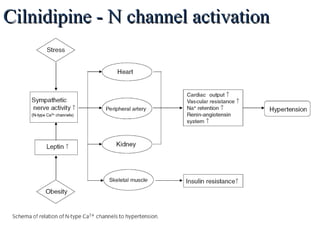
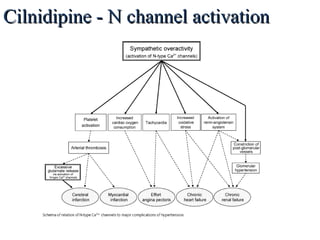
• N-type calcium channels regulate the
release of noradrenaline from sympathetic
nerve endings.
Background -Background - calcium channel blockadecalcium channel blockade
• Afferent = bringing to / leading toward an organ
• Efferent = bringing away /leading away from
organ
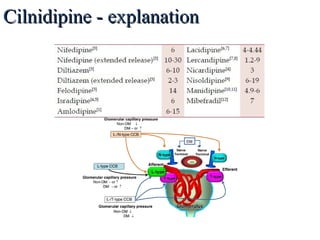
– Although L-type CCBs have a small effect in
glomerular efferent arterioles; L- and N-type CCBs
and L-and T-type CCBs dilate both the afferent and
efferent arterioles.
– Dual blockades of L + N-type calcium channels & L
+T-type calcium channels have ↑ renoprotective
effects than mono blockade of L-type channels.
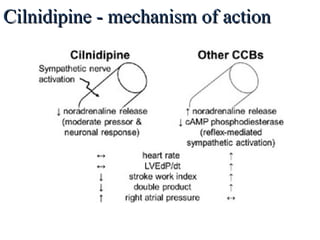
Cilnidipine - mechanism of actionCilnidipine - mechanism of action
Cilnidipine - N channel activationCilnidipine - N channel activation
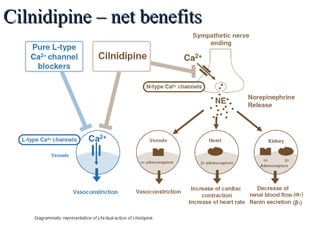
Cilnidipine – net benefitsCilnidipine – net benefits
Cilnidipine - add+vantagesCilnidipine - add+vantages
• L-type Ca2+ channel blockade as with
amlodipine produces vasodilation of peripheral
resistance vessels
• Inhibition of neuronal N-type Ca2+ channels
disrupts sympathetic nervous outflow, lowering
plasma catecholamine levels, and thereby
produces vasodilation of both pre- and post-
capillary resistance vessels reducing capillary
hypertension and consequent hyperfiltration of
fluid into the interstitium..
Cilinidpine - add+vantagesCilinidpine - add+vantages
• Like all other CCBs, Cilinidipine acts on L-type
calcium-channel.
• But, due to its N-type calcium-channel blocking
properties, it has more advantages compared
to conventional calcium-channel blockers.
Cilinidpine - add+vantagesCilinidpine - add+vantages
• Cilnidipine has similar BP lowering efficacy as
compared to amlodipine, BUT.
– A distinct property is that it does not cause reflex
tachycardia.
– It has lower incidence of Pedal edema, one of the
major adverse effects of other CCBs.
• Thus, the dual mechanisms of cilnidipine
explain both the low incidence of ankle edema
and the excellent antihypertensive action
without the reflex tachycardia.
Cilnidipine - explanationCilnidipine - explanation
Cilnidipine - net resultCilnidipine - net result
Cilnidipine studies
Cilnidipine vs. amlodipine - study 1Cilnidipine vs. amlodipine - study 1
• A prospective study was performed on 27
patients with essential hypertension with
amlodipine-induced edema.
– Concomitant nephropathy, cardiac failure, hepatic
cirrhosis, or other causes of edema, and secondary
hypertension were excluded by appropriate tests.
• Amlodipine therapy was substituted with an
efficacy-equivalent dose of cilnidipine.
– After 4 weeks of cilnidipine therapy, clinical
assessment was done.
– Results?
N Am J Med Sci. 2013 January; 5(1): 47–50.N Am J Med Sci. 2013 January; 5(1): 47–50.
Excellent Tolerance to Cilnidipine in Hypertensives with Amlodipine - Induced Edema by Ranjan Shetty et al.Excellent Tolerance to Cilnidipine in Hypertensives with Amlodipine - Induced Edema by Ranjan Shetty et al.
Cilnidipine vs. amlodipine - study 1Cilnidipine vs. amlodipine - study 1
• Results at completion of the study at the
Kasturba Hospital, Manipal:
• Oedema had resolved in all the patients.
• There was a significant decrease in bilateral
ankle circumference and body weight (P <
0.001).
• There was no significant change in mean
arterial blood pressure and pulse rate.
N Am J Med Sci. 2013 January; 5(1): 47–50.N Am J Med Sci. 2013 January; 5(1): 47–50.
Excellent Tolerance to Cilnidipine in Hypertensives with Amlodipine - Induced Edema by Ranjan Shetty et al.Excellent Tolerance to Cilnidipine in Hypertensives with Amlodipine - Induced Edema by Ranjan Shetty et al.
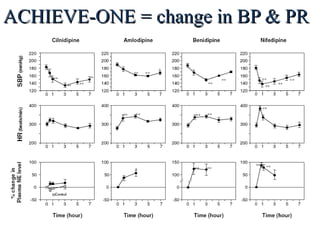
Cilnidipine &ACHIEVE-ONECilnidipine &ACHIEVE-ONE - study 2- study 2
• The Ambulatory Blood Pressure Control and
Home Blood Pressure (Morning and Evening)
Lowering By N-Channel Blocker Cilnidipine
(ACHIEVE-ONE) trial is a large-scale clinical
study on blood pressure (BP) and pulse rate
(PR) with use of cilnidipine
– In this study, the effects of cilnidipine on morning
hypertension were examined in 2319 patients
treated with cilnidipine for 12 weeks.
J Clin Hypertens (Greenwich). 2013 Feb;15(2):133-42. The effects of the L/N-type calcium channel blocker
(cilnidipine) on sympathetic hyperactive morning hypertension: results from ACHIEVE-ONE by Kario K et al.
Cilnidipine &ACHIEVE-ONECilnidipine &ACHIEVE-ONE - study 2- study 2
• The following was observed at end of study:
– Clinic systolic BP (SBP) decreased by 19.6 mm
Hg from 155.0 mm Hg.
– Morning SBP decreased by 17.0 mm Hg from
152.9 mm Hg.
• Cilnidipine also significantly reduced the
morning PR in patients with higher baseline
morning PR
– 0.6 beats per minute in <70 beats per minute
– 9.7 beats per minute in ≥85 beats per minute.
J Clin Hypertens (Greenwich). 2013 Feb;15(2):133-42. The effects of the L/N-type calcium channel blocker
(cilnidipine) on sympathetic hyperactive morning hypertension: results from ACHIEVE-ONE by Kario K et al.
ACHIEVE-ONE = change in BP & PRACHIEVE-ONE = change in BP & PR
J Clin Hypertens (Greenwich). 2013 Feb;15(2):133-42. The effects of the L/N-type calcium channel blocker
(cilnidipine) on sympathetic hyperactive morning hypertension: results from ACHIEVE-ONE by Kario K et al.
Cilnidipine vs. amlodipine - study 3Cilnidipine vs. amlodipine - study 3
Cilnidipine +ARB - study 4Cilnidipine +ARB - study 4
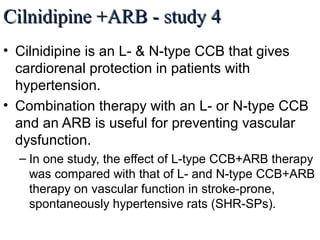
• Cilnidipine is an L- & N-type CCB that gives
cardiorenal protection in patients with
hypertension.
• Combination therapy with an L- or N-type CCB
and an ARB is useful for preventing vascular
dysfunction.
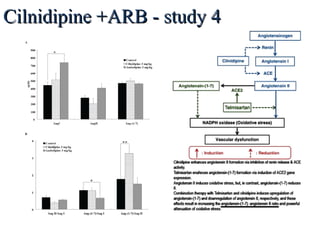
– In one study, the effect of L-type CCB+ARB therapy
was compared with that of L- and N-type CCB+ARB
therapy on vascular function in stroke-prone,
spontaneously hypertensive rats (SHR-SPs).
Int. J. Mol. Sci. 2013, 14, L/N-Type calcium channel blocker cilnidipine added to RAAS inhibition improves ambulatory blood pressure
profile and suppresses cardiac hypertrophy in hypertension with CKD by Tomohiko Kanaoka et al.
Cilnidipine +ARB - study 4Cilnidipine +ARB - study 4
Cilnidipine, An L-/N-Type Calcium Channel Blocker, Changes the Circulating Angiotensin–(1-7)/Angiotensin II Ratio by Shizuka Aritomi et
al, J Hypertens Open Access, 2012
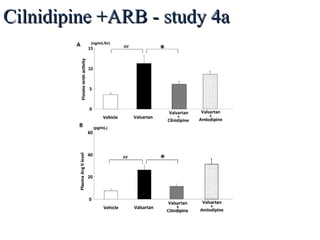
Cilnidipine +ARB - study 4aCilnidipine +ARB - study 4a
Cilnidipine, An L-/N-Type Calcium Channel Blocker, Changes the Circulating Angiotensin–(1-7)/Angiotensin II Ratio by Shizuka Aritomi et
al, J Hypertens Open Access, 2012
Cilnidipine +RAAS inhibiton - study 5Cilnidipine +RAAS inhibiton - study 5
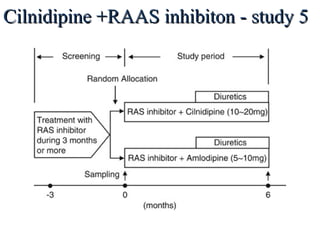
• 45 patients were randomly assigned to the
cilnidipine replacement group (n = 21) or the
control CCBs group (n = 24) for a 24-week
active treatment period. After the study:
– Clinical BP values were similar in the cilnidipine and
control CCBs groups after the treatment period,
– But, results of ambulatory BP monitoring showed
that the 24-h and daytime systolic BP levels in the
cilnidipine group were significantly lower compared
with the control group after the study.
Int. J. Mol. Sci. 2013, 14, L/N-Type calcium channel blocker cilnidipine added to RAAS inhibition improves ambulatory blood pressure
profile and suppresses cardiac hypertrophy in hypertension with CKD by Tomohiko Kanaoka et al.
Cilnidipine +RAAS inhibiton - study 5Cilnidipine +RAAS inhibiton - study 5
Int. J. Mol. Sci. 2013, 14, L/N-Type calcium channel blocker cilnidipine added to RAAS inhibition improves ambulatory blood pressure
profile and suppresses cardiac hypertrophy in hypertension with CKD by Tomohiko Kanaoka et al.
Cilnidipine +RAAS inhibiton - study 5Cilnidipine +RAAS inhibiton - study 5
• 45 patients were randomly assigned to the
cilnidipine replacement group (n = 21) or the
control CCBs group (n = 24) for a 24-week
active treatment period. After the study:
– Left ventricular mass index (LVMI) significantly ↓ in
the cilnidipine group compared to the control group.
– These results indicate that cilnidipine is beneficial
for the suppression of pathological cardiac
remodeling, at least partly, via a superior improving
effect on ambulatory BP profile compared with
control CCBs in hypertensive CKD patients.
Int. J. Mol. Sci. 2013, 14, L/N-Type calcium channel blocker cilnidipine added to RAAS inhibition improves ambulatory blood pressure
profile and suppresses cardiac hypertrophy in hypertension with CKD by Tomohiko Kanaoka et al.
Cilnidipine +Leptin inhibiton - study 6Cilnidipine +Leptin inhibiton - study 6
• N-type channel blockade, instead of an L-type
channel blockade on adipocytes, have a
regulatory function in leptin secretion.
• Thus, the dual blockade action of cilnidipine
has not only a BP lowering action but also a
reduction in leptin induced athersclerosis in
obese hypertensive patients.
Watanabe M, Tamaoka A, Morishita Y, Noguchi M (2012) Cilnidipine Lowers Plasma Leptin of Patients with Obese Hypertension
associated with cerebrovascular disorder. Open Access Scientific Reports, Vol 1, Issue 2, 2012
Cilnidipine antioxidant effect - study 7Cilnidipine antioxidant effect - study 7
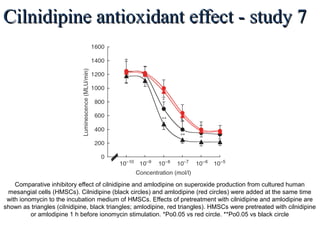
• Cilnidipine shows stronger lipophilicity than
amlodipine. Results suggest that differences in
antioxidant activity and lipophilicity may
determine antiproteinuric effect.
• Antioxidant activity of cilnidipine and amlodipine
by measuring ionomycin-stimulated superoxide
production in cultured human mesangial cells
was measured.
• Cilnidipine showed a significantly higher
antioxidant activity than amlodipine
Comparison of antioxidant activity of cilnidipine and amlodipine, Kidney International (2009) 76, 229–231
Cilnidipine antioxidant effect - study 7Cilnidipine antioxidant effect - study 7
Comparative inhibitory effect of cilnidipine and amlodipine on superoxide production from cultured human
mesangial cells (HMSCs). Cilnidipine (black circles) and amlodipine (red circles) were added at the same time
with ionomycin to the incubation medium of HMSCs. Effects of pretreatment with cilnidipine and amlodipine are
shown as triangles (cilnidipine, black triangles; amlodipine, red triangles). HMSCs were pretreated with cilnidipine
or amlodipine 1 h before ionomycin stimulation. *Po0.05 vs red circle. **Po0.05 vs black circle
Comparison of antioxidant activity of cilnidipine and amlodipine, Kidney International (2009) 76, 229–231
Cilnidipine proteinuria effect - study 8Cilnidipine proteinuria effect - study 8
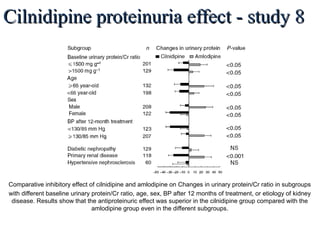
Comparative inhibitory effect of cilnidipine and amlodipine on Changes in urinary protein/Cr ratio in subgroups
with different baseline urinary protein/Cr ratio, age, sex, BP after 12 months of treatment, or etiology of kidney
disease. Results show that the antiproteinuric effect was superior in the cilnidipine group compared with the
amlodipine group even in the different subgroups.
T Fujita et al.: Antiproteinuric effect of cilnidipine, Kidney International (2007) 72, 1543–1549
Cilnidipine proteinuria effect - study 8Cilnidipine proteinuria effect - study 8
T Fujita et al.: Antiproteinuric effect of cilnidipine, Kidney International (2007) 72, 1543–1549
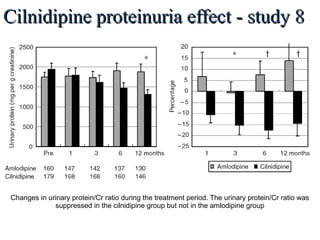
Changes in urinary protein/Cr ratio during the treatment period. The urinary protein/Cr ratio was
suppressed in the cilnidipine group but not in the amlodipine group
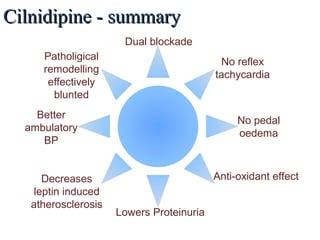
Cilnidipine - summaryCilnidipine - summary
Patholigical
remodelling
effectively
blunted
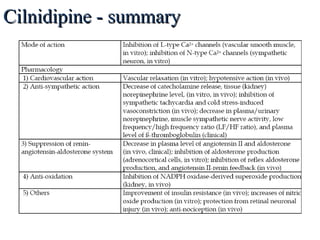
Dual blockade
No reflex
tachycardia
No pedal
oedema
Anti-oxidant effect
Lowers Proteinuria
Decreases
leptin induced
atherosclerosis
Better
ambulatory
BP

Cilnidipine

  • 1.
    A Two forOne Bargain:‐ ‐ Cilnidipine To treat hypertension & its comorbidities Dr. B. K. Iyer
  • 2.
    Cilnidipine - historyCilnidipine- history • Cilnidipine, the novel, 3rd generation CCB was jointly developed in 1995 by Fuji Viscera Pharmaceutical Company, Japan and Ajinomoto, Japan & used as anti-hypertensive. • Cilnidipine is a dihydropyridine CCB with slow onset • It is vasoselective, and has – a weak direct dromotropic effect, – a strong vasodepressor effect, and – an arrhythmia-inhibiting effect.
  • 3.
    Cilnidipine - whatis it?Cilnidipine - what is it? • It is available as Atelec in Japan and as Cilaheart, Cilacar in India. • In India, JB chemicals & pharmaceuticals ltd launched it first. • Voltage-dependent calcium channels are of 6 subtypes= L-, N-, T- and P/Q/R-type, of which 5 are present within the vasculature • Cilnidipine is a dual blocker with L-type and N- type calcium channel blocking function. What is this dual blockade?
  • 4.
    Background - calciumchannelsBackground - calcium channels 1. L-type voltage-gated calcium channels are present in vascular smooth muscle, and 2. N-type calcium channels are predominantly distributed in the sympathetic nervous system and present in sympathetic nerve terminals that supply blood vessels. • N-type calcium channels regulate the release of noradrenaline from sympathetic nerve endings.
  • 5.
    Background -Background -calcium channel blockadecalcium channel blockade • Afferent = bringing to / leading toward an organ • Efferent = bringing away /leading away from organ – Although L-type CCBs have a small effect in glomerular efferent arterioles; L- and N-type CCBs and L-and T-type CCBs dilate both the afferent and efferent arterioles. – Dual blockades of L + N-type calcium channels & L +T-type calcium channels have ↑ renoprotective effects than mono blockade of L-type channels.
  • 6.
    Cilnidipine - mechanismof actionCilnidipine - mechanism of action
  • 7.
    Cilnidipine - Nchannel activationCilnidipine - N channel activation
  • 8.
    Cilnidipine - Nchannel activationCilnidipine - N channel activation
  • 9.
    Cilnidipine – netbenefitsCilnidipine – net benefits
  • 10.
    Cilnidipine - add+vantagesCilnidipine- add+vantages • L-type Ca2+ channel blockade as with amlodipine produces vasodilation of peripheral resistance vessels • Inhibition of neuronal N-type Ca2+ channels disrupts sympathetic nervous outflow, lowering plasma catecholamine levels, and thereby produces vasodilation of both pre- and post- capillary resistance vessels reducing capillary hypertension and consequent hyperfiltration of fluid into the interstitium..
  • 11.
    Cilinidpine - add+vantagesCilinidpine- add+vantages • Like all other CCBs, Cilinidipine acts on L-type calcium-channel. • But, due to its N-type calcium-channel blocking properties, it has more advantages compared to conventional calcium-channel blockers.
  • 12.
    Cilinidpine - add+vantagesCilinidpine- add+vantages • Cilnidipine has similar BP lowering efficacy as compared to amlodipine, BUT. – A distinct property is that it does not cause reflex tachycardia. – It has lower incidence of Pedal edema, one of the major adverse effects of other CCBs. • Thus, the dual mechanisms of cilnidipine explain both the low incidence of ankle edema and the excellent antihypertensive action without the reflex tachycardia.
  • 13.
  • 14.
    Cilnidipine - netresultCilnidipine - net result
  • 15.
  • 16.
    Cilnidipine vs. amlodipine- study 1Cilnidipine vs. amlodipine - study 1 • A prospective study was performed on 27 patients with essential hypertension with amlodipine-induced edema. – Concomitant nephropathy, cardiac failure, hepatic cirrhosis, or other causes of edema, and secondary hypertension were excluded by appropriate tests. • Amlodipine therapy was substituted with an efficacy-equivalent dose of cilnidipine. – After 4 weeks of cilnidipine therapy, clinical assessment was done. – Results? N Am J Med Sci. 2013 January; 5(1): 47–50.N Am J Med Sci. 2013 January; 5(1): 47–50. Excellent Tolerance to Cilnidipine in Hypertensives with Amlodipine - Induced Edema by Ranjan Shetty et al.Excellent Tolerance to Cilnidipine in Hypertensives with Amlodipine - Induced Edema by Ranjan Shetty et al.
  • 17.
    Cilnidipine vs. amlodipine- study 1Cilnidipine vs. amlodipine - study 1 • Results at completion of the study at the Kasturba Hospital, Manipal: • Oedema had resolved in all the patients. • There was a significant decrease in bilateral ankle circumference and body weight (P < 0.001). • There was no significant change in mean arterial blood pressure and pulse rate. N Am J Med Sci. 2013 January; 5(1): 47–50.N Am J Med Sci. 2013 January; 5(1): 47–50. Excellent Tolerance to Cilnidipine in Hypertensives with Amlodipine - Induced Edema by Ranjan Shetty et al.Excellent Tolerance to Cilnidipine in Hypertensives with Amlodipine - Induced Edema by Ranjan Shetty et al.
  • 18.
    Cilnidipine &ACHIEVE-ONECilnidipine &ACHIEVE-ONE- study 2- study 2 • The Ambulatory Blood Pressure Control and Home Blood Pressure (Morning and Evening) Lowering By N-Channel Blocker Cilnidipine (ACHIEVE-ONE) trial is a large-scale clinical study on blood pressure (BP) and pulse rate (PR) with use of cilnidipine – In this study, the effects of cilnidipine on morning hypertension were examined in 2319 patients treated with cilnidipine for 12 weeks. J Clin Hypertens (Greenwich). 2013 Feb;15(2):133-42. The effects of the L/N-type calcium channel blocker (cilnidipine) on sympathetic hyperactive morning hypertension: results from ACHIEVE-ONE by Kario K et al.
  • 19.
    Cilnidipine &ACHIEVE-ONECilnidipine &ACHIEVE-ONE- study 2- study 2 • The following was observed at end of study: – Clinic systolic BP (SBP) decreased by 19.6 mm Hg from 155.0 mm Hg. – Morning SBP decreased by 17.0 mm Hg from 152.9 mm Hg. • Cilnidipine also significantly reduced the morning PR in patients with higher baseline morning PR – 0.6 beats per minute in <70 beats per minute – 9.7 beats per minute in ≥85 beats per minute. J Clin Hypertens (Greenwich). 2013 Feb;15(2):133-42. The effects of the L/N-type calcium channel blocker (cilnidipine) on sympathetic hyperactive morning hypertension: results from ACHIEVE-ONE by Kario K et al.
  • 20.
    ACHIEVE-ONE = changein BP & PRACHIEVE-ONE = change in BP & PR J Clin Hypertens (Greenwich). 2013 Feb;15(2):133-42. The effects of the L/N-type calcium channel blocker (cilnidipine) on sympathetic hyperactive morning hypertension: results from ACHIEVE-ONE by Kario K et al.
  • 21.
    Cilnidipine vs. amlodipine- study 3Cilnidipine vs. amlodipine - study 3
  • 22.
    Cilnidipine +ARB -study 4Cilnidipine +ARB - study 4 • Cilnidipine is an L- & N-type CCB that gives cardiorenal protection in patients with hypertension. • Combination therapy with an L- or N-type CCB and an ARB is useful for preventing vascular dysfunction. – In one study, the effect of L-type CCB+ARB therapy was compared with that of L- and N-type CCB+ARB therapy on vascular function in stroke-prone, spontaneously hypertensive rats (SHR-SPs). Int. J. Mol. Sci. 2013, 14, L/N-Type calcium channel blocker cilnidipine added to RAAS inhibition improves ambulatory blood pressure profile and suppresses cardiac hypertrophy in hypertension with CKD by Tomohiko Kanaoka et al.
  • 23.
    Cilnidipine +ARB -study 4Cilnidipine +ARB - study 4 Cilnidipine, An L-/N-Type Calcium Channel Blocker, Changes the Circulating Angiotensin–(1-7)/Angiotensin II Ratio by Shizuka Aritomi et al, J Hypertens Open Access, 2012
  • 24.
    Cilnidipine +ARB -study 4aCilnidipine +ARB - study 4a Cilnidipine, An L-/N-Type Calcium Channel Blocker, Changes the Circulating Angiotensin–(1-7)/Angiotensin II Ratio by Shizuka Aritomi et al, J Hypertens Open Access, 2012
  • 25.
    Cilnidipine +RAAS inhibiton- study 5Cilnidipine +RAAS inhibiton - study 5 • 45 patients were randomly assigned to the cilnidipine replacement group (n = 21) or the control CCBs group (n = 24) for a 24-week active treatment period. After the study: – Clinical BP values were similar in the cilnidipine and control CCBs groups after the treatment period, – But, results of ambulatory BP monitoring showed that the 24-h and daytime systolic BP levels in the cilnidipine group were significantly lower compared with the control group after the study. Int. J. Mol. Sci. 2013, 14, L/N-Type calcium channel blocker cilnidipine added to RAAS inhibition improves ambulatory blood pressure profile and suppresses cardiac hypertrophy in hypertension with CKD by Tomohiko Kanaoka et al.
  • 26.
    Cilnidipine +RAAS inhibiton- study 5Cilnidipine +RAAS inhibiton - study 5 Int. J. Mol. Sci. 2013, 14, L/N-Type calcium channel blocker cilnidipine added to RAAS inhibition improves ambulatory blood pressure profile and suppresses cardiac hypertrophy in hypertension with CKD by Tomohiko Kanaoka et al.
  • 27.
    Cilnidipine +RAAS inhibiton- study 5Cilnidipine +RAAS inhibiton - study 5 • 45 patients were randomly assigned to the cilnidipine replacement group (n = 21) or the control CCBs group (n = 24) for a 24-week active treatment period. After the study: – Left ventricular mass index (LVMI) significantly ↓ in the cilnidipine group compared to the control group. – These results indicate that cilnidipine is beneficial for the suppression of pathological cardiac remodeling, at least partly, via a superior improving effect on ambulatory BP profile compared with control CCBs in hypertensive CKD patients. Int. J. Mol. Sci. 2013, 14, L/N-Type calcium channel blocker cilnidipine added to RAAS inhibition improves ambulatory blood pressure profile and suppresses cardiac hypertrophy in hypertension with CKD by Tomohiko Kanaoka et al.
  • 28.
    Cilnidipine +Leptin inhibiton- study 6Cilnidipine +Leptin inhibiton - study 6 • N-type channel blockade, instead of an L-type channel blockade on adipocytes, have a regulatory function in leptin secretion. • Thus, the dual blockade action of cilnidipine has not only a BP lowering action but also a reduction in leptin induced athersclerosis in obese hypertensive patients. Watanabe M, Tamaoka A, Morishita Y, Noguchi M (2012) Cilnidipine Lowers Plasma Leptin of Patients with Obese Hypertension associated with cerebrovascular disorder. Open Access Scientific Reports, Vol 1, Issue 2, 2012
  • 29.
    Cilnidipine antioxidant effect- study 7Cilnidipine antioxidant effect - study 7 • Cilnidipine shows stronger lipophilicity than amlodipine. Results suggest that differences in antioxidant activity and lipophilicity may determine antiproteinuric effect. • Antioxidant activity of cilnidipine and amlodipine by measuring ionomycin-stimulated superoxide production in cultured human mesangial cells was measured. • Cilnidipine showed a significantly higher antioxidant activity than amlodipine Comparison of antioxidant activity of cilnidipine and amlodipine, Kidney International (2009) 76, 229–231
  • 30.
    Cilnidipine antioxidant effect- study 7Cilnidipine antioxidant effect - study 7 Comparative inhibitory effect of cilnidipine and amlodipine on superoxide production from cultured human mesangial cells (HMSCs). Cilnidipine (black circles) and amlodipine (red circles) were added at the same time with ionomycin to the incubation medium of HMSCs. Effects of pretreatment with cilnidipine and amlodipine are shown as triangles (cilnidipine, black triangles; amlodipine, red triangles). HMSCs were pretreated with cilnidipine or amlodipine 1 h before ionomycin stimulation. *Po0.05 vs red circle. **Po0.05 vs black circle Comparison of antioxidant activity of cilnidipine and amlodipine, Kidney International (2009) 76, 229–231
  • 31.
    Cilnidipine proteinuria effect- study 8Cilnidipine proteinuria effect - study 8 Comparative inhibitory effect of cilnidipine and amlodipine on Changes in urinary protein/Cr ratio in subgroups with different baseline urinary protein/Cr ratio, age, sex, BP after 12 months of treatment, or etiology of kidney disease. Results show that the antiproteinuric effect was superior in the cilnidipine group compared with the amlodipine group even in the different subgroups. T Fujita et al.: Antiproteinuric effect of cilnidipine, Kidney International (2007) 72, 1543–1549
  • 32.
    Cilnidipine proteinuria effect- study 8Cilnidipine proteinuria effect - study 8 T Fujita et al.: Antiproteinuric effect of cilnidipine, Kidney International (2007) 72, 1543–1549 Changes in urinary protein/Cr ratio during the treatment period. The urinary protein/Cr ratio was suppressed in the cilnidipine group but not in the amlodipine group
  • 33.
  • 34.
  • 35.
    Cilnidipine - summaryCilnidipine- summary Patholigical remodelling effectively blunted Dual blockade No reflex tachycardia No pedal oedema Anti-oxidant effect Lowers Proteinuria Decreases leptin induced atherosclerosis Better ambulatory BP