Choosing a diuretic combination 
therapy in hypertension 
Follow the crowd 
Or 
Follow evidence? 
http://www.medscape.com/viewarticle/728684
The agenda for discussion 
• Recalling the basics 
• Hypertension therapy: principles 
• Diuretics 
• All about Chlorthalidone 
• Time reflected evidence 
• Summary 
• Combination
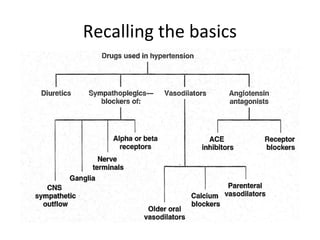
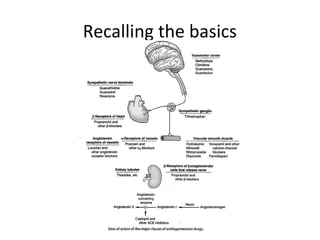
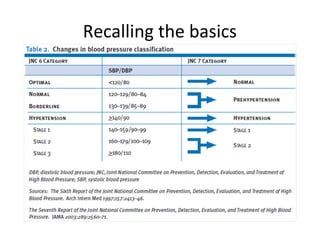
Recalling the basics
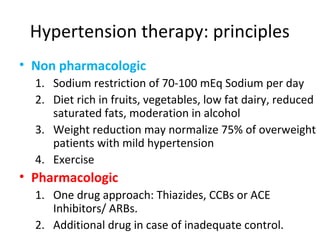
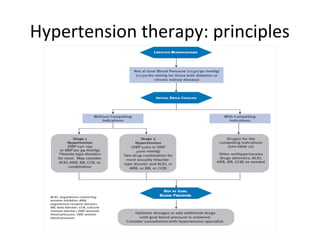
Hypertension therapy: principles 
• Non pharmacologic 
1. Sodium restriction of 70-100 mEq Sodium per day 
2. Diet rich in fruits, vegetables, low fat dairy, reduced 
saturated fats, moderation in alcohol 
3. Weight reduction may normalize 75% of overweight 
patients with mild hypertension 
4. Exercise 
• Pharmacologic 
1. One drug approach: Thiazides, CCBs or ACE 
Inhibitors/ ARBs. 
2. Additional drug in case of inadequate control.
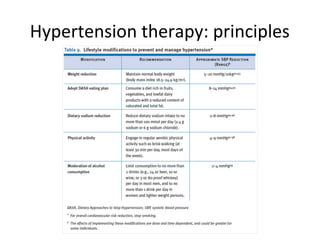
Hypertension therapy: principles
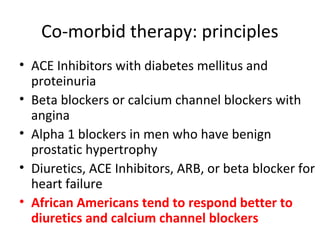
Co-morbid therapy: principles 
• ACE Inhibitors with diabetes mellitus and 
proteinuria 
• Beta blockers or calcium channel blockers with 
angina 
• Alpha 1 blockers in men who have benign 
prostatic hypertrophy 
• Diuretics, ACE Inhibitors, ARB, or beta blocker for 
heart failure 
• African Americans tend to respond better to 
diuretics and calcium channel blockers
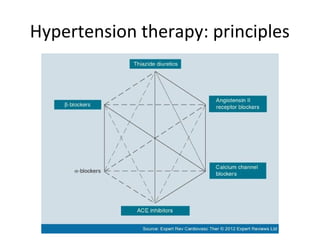
Hypertension therapy: principles
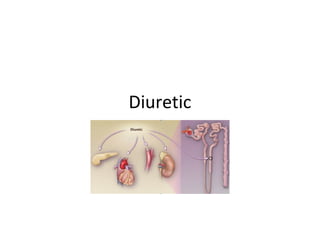
Diuretic
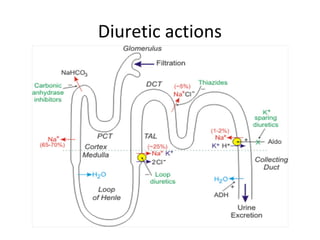
Diuretic actions
Diuretics: Conclusions 
• Diuretics are the only class of drugs that directly 
deals with the fundamental cause of hypertension: 
Sodium retention 
• Considered first line therapy for most forms of 
hypertension as a standard of care 
• Inexpensive 
• Longstanding history of use, efficacy and tolerance 
• Often necessary in combination therapy with other 
classes of anti hypertensives that may cause salt and 
water retention as compensatory response.
Sodium and water regulation by the 
nephron: distal convoluted tubule 
• The urine flows into the distal convoluted tubule 
(DCT) where another 5% of the sodium is 
reabsorbed by the sodium chloride co 
transporter 
• Thiazide diuretics (hydrochorothiazide) inhibit 
this co transporter. 
• Orally absorbed well. 
– Chlorothiazide is the only parenteral form. 
– Indapamide is excreted by the biliary system
Clarity on diuretics 
• Are thiazide diuretics the first-choice drug or one 
of the first-choice drugs? 
• Do all thiazide diuretics give the same benefit? 
• Is hydrochlorothiazide (HCTZ) a better choice 
than chlorthalidone for hypertension? 
• Optimal dose? 
• Negative effects of thiazide diuretics?
Thiazide diuretics - first-choice? 
• Thiazide diuretics are first-line for hypertensive 
patients without compelling indications for 
alternate drugs. 
• The advantage of HCTZ is its availability in many 
combination preparations, which can improve 
adherence. 
• Indapamide is another thiazide-like diuretic with 
good evidence for reduction in cardiovascular end 
points as first- or second-line antihypertensive 
therapy.
All about Chlorthalidone
Chlorthalidone - first-choice? 
• Chlorthalidone has a longer half-life than HCTZ (50 
to 60 vs 9 to 10 hours), which might explain the 
superior BP control, especially at night time. 
• Meta-analysis of 19 trials found 24-hour BP was 
higher with 12.5- to 25-mg doses of HCTZ compared 
with other antihypertensive drugs (systolic BP 4.5 to 
6.2 mm Hg higher, diastolic BP 2.9 to 6.7 mm Hg 
higher). 
• Not many trials have compared HCTZ with other 
thiazide diuretics in terms of cardiovascular or 
mortality outcomes. 
• Hence, there is a need to rely on less rigorous study 
designs and other outcomes.
Chlorthalidone - first-choice? 
• Chlorthalidone reduces systolic blood pressure (BP) 
better than HCTZ at equivalent doses with similar 
effects on potassium levels: 
– -25 mg of chlorthalidone, compared with 50 mg of HCTZ, 
provided superior BP reduction overall (12 vs 7 mm Hg on 
24-hour monitor) and at nighttime (13 vs 6 mm Hg).2 
• Retrospective (and thus not definitive) analysis of 
the MRFIT trial found that the chlorthalidone-based 
regimen reduced mortality compared with the 
HCTZ-based regimen (hazard ratio 0.79, 95% CI 0.68 
to 0.92, P = .0016).
Chlorthalidone - first-choice? 
• Large trials using chlorthalidone (like ALLHAT and 
SHEP) have demonstrated reductions in 
cardiovascular end points; evidence for HCTZ is less 
robust. 
• A network meta-analysis of 5 trials comparing 
chlorthalidone with other thiazides did not find 
differences in cardiovascular outcomes. However, 
– These were indirect comparisons and 
– The “other thiazides” were not just HCTZ, as many 
reviewers assumed: 
– 2 were HCTZ combined with potassium-sparing diuretics; 
– 1 was indapamide (not HCTZ).
Chlorthalidone - first-choice? 
• Patients requiring antihypertensives should be 
reminded that dietary sodium restriction (< 1500 
mg/d)16 remains key to BP management— 
handouts could be given with each prescription. 
• Available data suggest HCTZ is at best equal to 
and very likely inferior to chlorthalidone for 
improving BP and clinical outcomes.
Chlorthalidone - dosage 
• Consider chlorthalidone when initiating thiazide 
diuretics for hypertension. 
• Prescribe 12.5 mg of chlorthalidone daily and 
increase to 25 mg daily. 
• Higher doses tend to cause more side effects 
(including hypokalemia) but minimal further BP 
reduction. 
• Precautions and bloodwork monitoring for 
chlorthalidone are similar to those for HCTZ.
Chlorthalidone - first-choice? 
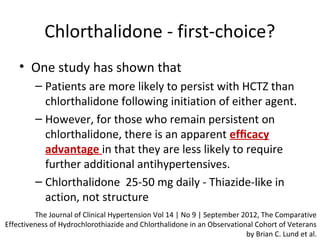
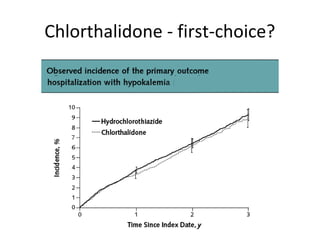
• One study has shown that 
– Patients are more likely to persist with HCTZ than 
chlorthalidone following initiation of either agent. 
– However, for those who remain persistent on 
chlorthalidone, there is an apparent efficacy 
advantage in that they are less likely to require 
further additional antihypertensives. 
– Chlorthalidone 25-50 mg daily - Thiazide-like in 
action, not structure 
The Journal of Clinical Hypertension Vol 14 | No 9 | September 2012, The Comparative 
Effectiveness of Hydrochlorothiazide and Chlorthalidone in an Observational Cohort of Veterans 
by Brian C. Lund et al.
Chlorthalidone - first-choice? 
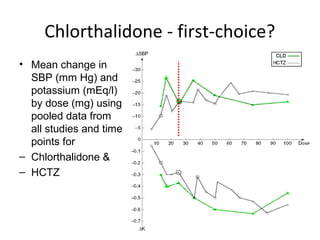
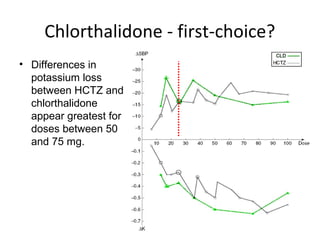
• Mean change in 
SBP (mm Hg) and 
potassium (mEq/l) 
by dose (mg) using 
pooled data from 
all studies and time 
points for 
– Chlorthalidone & 
– HCTZ
Chlorthalidone - first-choice? 
• Differences in 
potassium loss 
between HCTZ and 
chlorthalidone 
appear greatest for 
doses between 50 
and 75 mg.
Chlorthalidone - first-choice?
Chlorthalidone – usage over time
Current medical diagnosis and 
treatment 
• Chlorthalidone has 
the advantage of 
better 24-hour BP 
control than 
hydrochlorthiazide
Cardiovascular Therapeutics - A 
Companion to Braunwald's Heart Disease , 4th Edition 
• The pharmacokinetic and 
pharmacodynamic profile 
of chlorthalidone is 
distinctly different from 
that of hydrochlorthiazide. 
• On a milligram-per-milligram 
basis, 
chlorthalidone is 1-5-2 
times more potent. 
• In recommended doses, 
chlorthalidone is more 
effective in loweing systolic 
BP than HCTZ.
Cardiovascular Therapeutics - A 
Companion to Braunwald's Heart Disease , 4th Edition 
• This is likely because 
chlorthalidone has a 
longer half life than 
HCTZ. [50-60 hours 
vs. 9-10 hours]
Cardiovascular Therapeutics - A 
Companion to Braunwald's Heart Disease , 4th Edition 
• Chlorthalidone has had a 
more consistent pattern 
of favorable outcomes. 
• Chlorthalidone has more 
favorable pleiotropic 
effects relating to platelt 
aggregation and 
angiogenesis than does 
the thiazide diuretic, 
bendroflumethiazide.
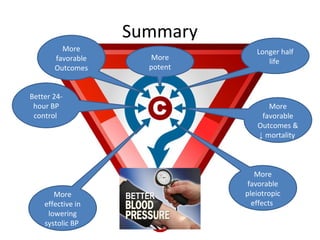
Summary 
Longer half 
life 
More 
favorable 
Outcomes & 
↓ mortality 
More 
favorable 
pleiotropic 
effects 
More 
favorable 
Outcomes 
More 
effective in 
lowering 
systolic BP 
More 
potent 
Better 24- 
hour BP 
control
Combination therapy 
• Ideal ARB – Telmisartan 
• Ideal diuretic for hypertension – Chlorthalidone 
• Ideal combination – Telmisartan + Chlorthalidone

Temisartan + chlorthalidone

  • 1.
    Choosing a diureticcombination therapy in hypertension Follow the crowd Or Follow evidence? http://www.medscape.com/viewarticle/728684
  • 2.
    The agenda fordiscussion • Recalling the basics • Hypertension therapy: principles • Diuretics • All about Chlorthalidone • Time reflected evidence • Summary • Combination
  • 3.
  • 4.
  • 5.
  • 6.
  • 7.
    Hypertension therapy: principles • Non pharmacologic 1. Sodium restriction of 70-100 mEq Sodium per day 2. Diet rich in fruits, vegetables, low fat dairy, reduced saturated fats, moderation in alcohol 3. Weight reduction may normalize 75% of overweight patients with mild hypertension 4. Exercise • Pharmacologic 1. One drug approach: Thiazides, CCBs or ACE Inhibitors/ ARBs. 2. Additional drug in case of inadequate control.
  • 8.
  • 9.
    Co-morbid therapy: principles • ACE Inhibitors with diabetes mellitus and proteinuria • Beta blockers or calcium channel blockers with angina • Alpha 1 blockers in men who have benign prostatic hypertrophy • Diuretics, ACE Inhibitors, ARB, or beta blocker for heart failure • African Americans tend to respond better to diuretics and calcium channel blockers
  • 10.
  • 11.
  • 12.
  • 13.
  • 14.
    Diuretics: Conclusions •Diuretics are the only class of drugs that directly deals with the fundamental cause of hypertension: Sodium retention • Considered first line therapy for most forms of hypertension as a standard of care • Inexpensive • Longstanding history of use, efficacy and tolerance • Often necessary in combination therapy with other classes of anti hypertensives that may cause salt and water retention as compensatory response.
  • 15.
    Sodium and waterregulation by the nephron: distal convoluted tubule • The urine flows into the distal convoluted tubule (DCT) where another 5% of the sodium is reabsorbed by the sodium chloride co transporter • Thiazide diuretics (hydrochorothiazide) inhibit this co transporter. • Orally absorbed well. – Chlorothiazide is the only parenteral form. – Indapamide is excreted by the biliary system
  • 16.
    Clarity on diuretics • Are thiazide diuretics the first-choice drug or one of the first-choice drugs? • Do all thiazide diuretics give the same benefit? • Is hydrochlorothiazide (HCTZ) a better choice than chlorthalidone for hypertension? • Optimal dose? • Negative effects of thiazide diuretics?
  • 17.
    Thiazide diuretics -first-choice? • Thiazide diuretics are first-line for hypertensive patients without compelling indications for alternate drugs. • The advantage of HCTZ is its availability in many combination preparations, which can improve adherence. • Indapamide is another thiazide-like diuretic with good evidence for reduction in cardiovascular end points as first- or second-line antihypertensive therapy.
  • 18.
  • 19.
    Chlorthalidone - first-choice? • Chlorthalidone has a longer half-life than HCTZ (50 to 60 vs 9 to 10 hours), which might explain the superior BP control, especially at night time. • Meta-analysis of 19 trials found 24-hour BP was higher with 12.5- to 25-mg doses of HCTZ compared with other antihypertensive drugs (systolic BP 4.5 to 6.2 mm Hg higher, diastolic BP 2.9 to 6.7 mm Hg higher). • Not many trials have compared HCTZ with other thiazide diuretics in terms of cardiovascular or mortality outcomes. • Hence, there is a need to rely on less rigorous study designs and other outcomes.
  • 20.
    Chlorthalidone - first-choice? • Chlorthalidone reduces systolic blood pressure (BP) better than HCTZ at equivalent doses with similar effects on potassium levels: – -25 mg of chlorthalidone, compared with 50 mg of HCTZ, provided superior BP reduction overall (12 vs 7 mm Hg on 24-hour monitor) and at nighttime (13 vs 6 mm Hg).2 • Retrospective (and thus not definitive) analysis of the MRFIT trial found that the chlorthalidone-based regimen reduced mortality compared with the HCTZ-based regimen (hazard ratio 0.79, 95% CI 0.68 to 0.92, P = .0016).
  • 21.
    Chlorthalidone - first-choice? • Large trials using chlorthalidone (like ALLHAT and SHEP) have demonstrated reductions in cardiovascular end points; evidence for HCTZ is less robust. • A network meta-analysis of 5 trials comparing chlorthalidone with other thiazides did not find differences in cardiovascular outcomes. However, – These were indirect comparisons and – The “other thiazides” were not just HCTZ, as many reviewers assumed: – 2 were HCTZ combined with potassium-sparing diuretics; – 1 was indapamide (not HCTZ).
  • 22.
    Chlorthalidone - first-choice? • Patients requiring antihypertensives should be reminded that dietary sodium restriction (< 1500 mg/d)16 remains key to BP management— handouts could be given with each prescription. • Available data suggest HCTZ is at best equal to and very likely inferior to chlorthalidone for improving BP and clinical outcomes.
  • 23.
    Chlorthalidone - dosage • Consider chlorthalidone when initiating thiazide diuretics for hypertension. • Prescribe 12.5 mg of chlorthalidone daily and increase to 25 mg daily. • Higher doses tend to cause more side effects (including hypokalemia) but minimal further BP reduction. • Precautions and bloodwork monitoring for chlorthalidone are similar to those for HCTZ.
  • 24.
    Chlorthalidone - first-choice? • One study has shown that – Patients are more likely to persist with HCTZ than chlorthalidone following initiation of either agent. – However, for those who remain persistent on chlorthalidone, there is an apparent efficacy advantage in that they are less likely to require further additional antihypertensives. – Chlorthalidone 25-50 mg daily - Thiazide-like in action, not structure The Journal of Clinical Hypertension Vol 14 | No 9 | September 2012, The Comparative Effectiveness of Hydrochlorothiazide and Chlorthalidone in an Observational Cohort of Veterans by Brian C. Lund et al.
  • 25.
    Chlorthalidone - first-choice? • Mean change in SBP (mm Hg) and potassium (mEq/l) by dose (mg) using pooled data from all studies and time points for – Chlorthalidone & – HCTZ
  • 26.
    Chlorthalidone - first-choice? • Differences in potassium loss between HCTZ and chlorthalidone appear greatest for doses between 50 and 75 mg.
  • 27.
  • 28.
  • 29.
    Current medical diagnosisand treatment • Chlorthalidone has the advantage of better 24-hour BP control than hydrochlorthiazide
  • 30.
    Cardiovascular Therapeutics -A Companion to Braunwald's Heart Disease , 4th Edition • The pharmacokinetic and pharmacodynamic profile of chlorthalidone is distinctly different from that of hydrochlorthiazide. • On a milligram-per-milligram basis, chlorthalidone is 1-5-2 times more potent. • In recommended doses, chlorthalidone is more effective in loweing systolic BP than HCTZ.
  • 31.
    Cardiovascular Therapeutics -A Companion to Braunwald's Heart Disease , 4th Edition • This is likely because chlorthalidone has a longer half life than HCTZ. [50-60 hours vs. 9-10 hours]
  • 32.
    Cardiovascular Therapeutics -A Companion to Braunwald's Heart Disease , 4th Edition • Chlorthalidone has had a more consistent pattern of favorable outcomes. • Chlorthalidone has more favorable pleiotropic effects relating to platelt aggregation and angiogenesis than does the thiazide diuretic, bendroflumethiazide.
  • 33.
    Summary Longer half life More favorable Outcomes & ↓ mortality More favorable pleiotropic effects More favorable Outcomes More effective in lowering systolic BP More potent Better 24- hour BP control
  • 34.
    Combination therapy •Ideal ARB – Telmisartan • Ideal diuretic for hypertension – Chlorthalidone • Ideal combination – Telmisartan + Chlorthalidone