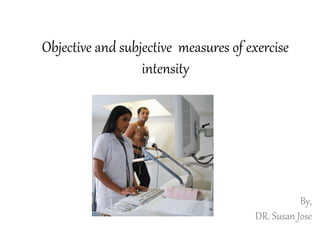
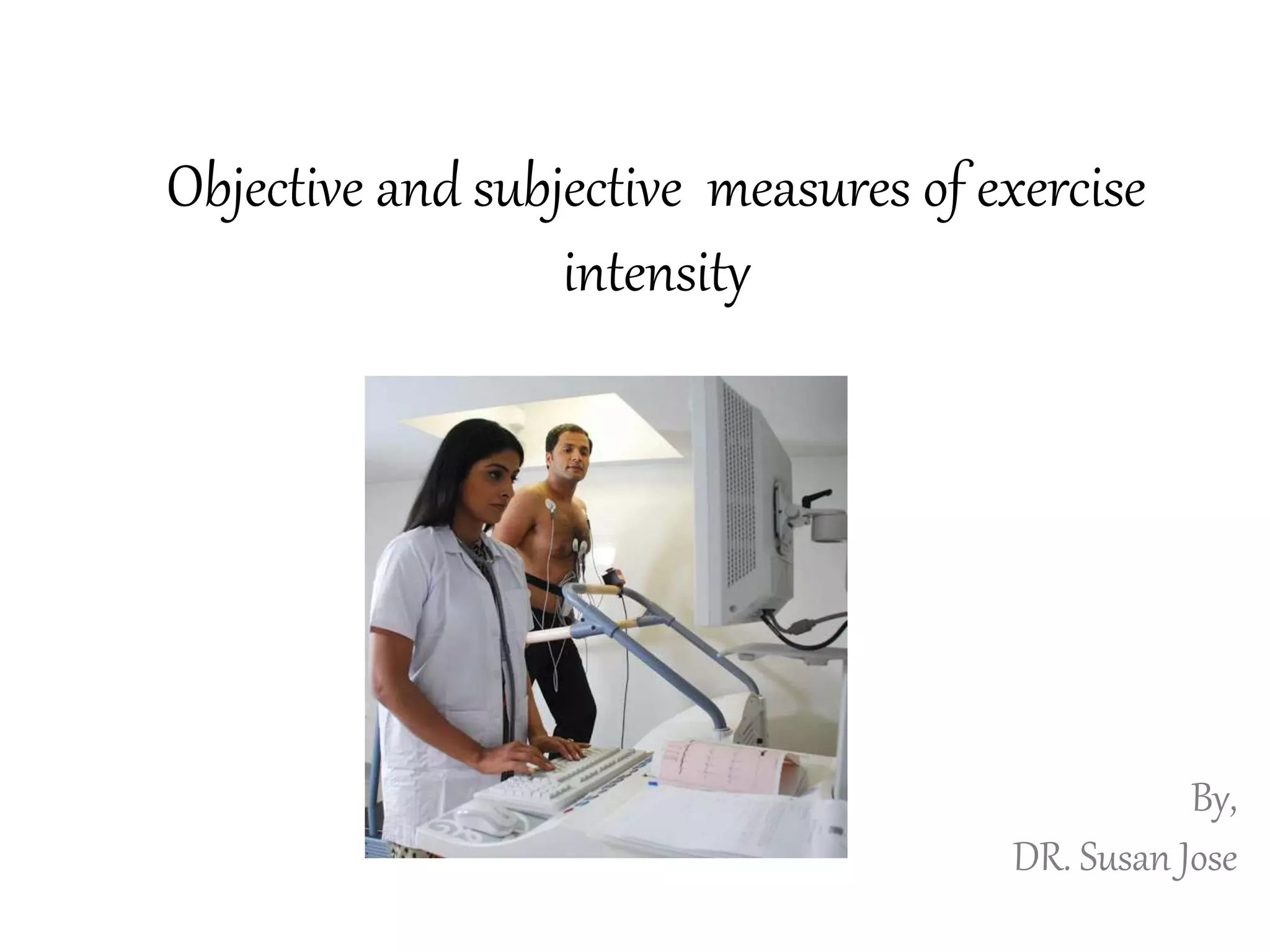
Objective and subjective measures of exercise
intensity
By,
DR. Susan Jose
VO2 max
• VO2max can be defined as the maximal volume of oxygen
uptake by the muscles during physical exertion.
• VO2 max is directly proportional to the capacity of the
– pulmonary
– cardiovascular
– muscular systems
• Measurement- by an ergospirometer test
• In this procedure, the subject breathes through a low-resistance
valve with his nose occluded while performing a maximal
exercise testing
– Flow volume loops
– expired fractions of oxygen (O2) and carbon dioxide (CO2)
– heart rate
are measured that is used for the computerized calculation of
Vo2 max.
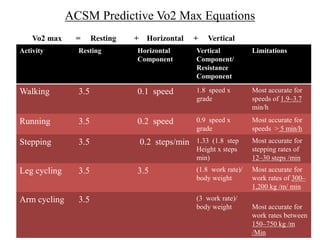
Activity Resting Horizontal
Component
Vertical
Component/
Resistance
Component
Limitations
Walking 3.5 0.1 speed 1.8 speed x
grade
Most accurate for
speeds of 1.9–3.7
min/h
Running 3.5 0.2 speed 0.9 speed x
grade
Most accurate for
speeds > 5 min/h
Stepping 3.5 0.2 steps/min 1.33 (1.8 step
Height x steps
min)
Most accurate for
stepping rates of
12–30 steps /min
Leg cycling 3.5 3.5 (1.8 work rate)/
body weight
Most accurate for
work rates of 300–
1,200 kg /m/ min
Arm cycling 3.5 (3 work rate)/
body weight Most accurate for
work rates between
150–750 kg /m
/Min
Vo2 max = Resting + Horizontal + Vertical
ACSM Predictive Vo2 Max Equations
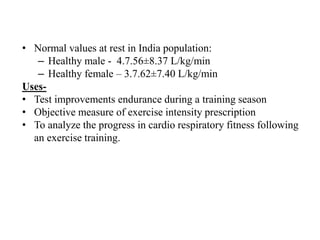
• Normal values at rest in India population:
– Healthy male - 4.7.56±8.37 L/kg/min
– Healthy female – 3.7.62±7.40 L/kg/min
Uses-
• Test improvements endurance during a training season
• Objective measure of exercise intensity prescription
• To analyze the progress in cardio respiratory fitness following
an exercise training.
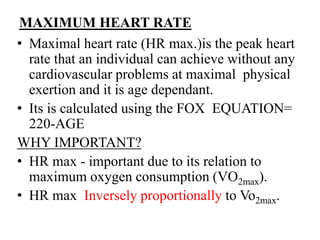
MAXIMUM HEART RATE
• Maximal heart rate (HR max.)is the peak heart
rate that an individual can achieve without any
cardiovascular problems at maximal physical
exertion and it is age dependant.
• Its is calculated using the FOX EQUATION=
220-AGE
WHY IMPORTANT?
• HR max - important due to its relation to
maximum oxygen consumption (VO2max).
• HR max Inversely proportionally to Vo2max.
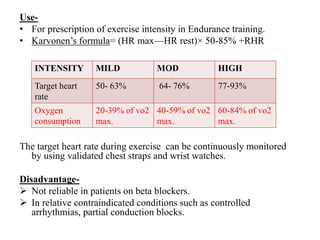
Use-
• For prescription of exercise intensity in Endurance training.
• Karvonen’s formula= (HR max—HR rest)× 50-85% +RHR
The target heart rate during exercise can be continuously monitored
by using validated chest straps and wrist watches.
Disadvantage-
 Not reliable in patients on beta blockers.
 In relative contraindicated conditions such as controlled
arrhythmias, partial conduction blocks.
INTENSITY MILD MOD HIGH
Target heart
rate
50- 63% 64- 76% 77-93%
Oxygen
consumption
20-39% of vo2
max.
40-59% of vo2
max.
60-84% of vo2
max.
Subjective measure of exercise intensity
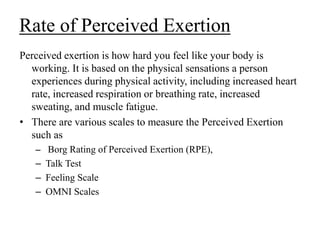
Rate of Perceived Exertion
Perceived exertion is how hard you feel like your body is
working. It is based on the physical sensations a person
experiences during physical activity, including increased heart
rate, increased respiration or breathing rate, increased
sweating, and muscle fatigue.
• There are various scales to measure the Perceived Exertion
such as
– Borg Rating of Perceived Exertion (RPE),
– Talk Test
– Feeling Scale
– OMNI Scales
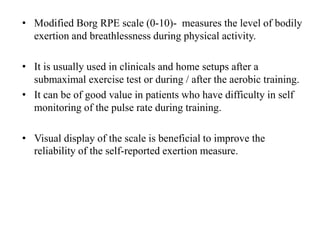
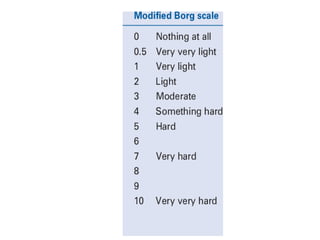
• Modified Borg RPE scale (0-10)- measures the level of bodily
exertion and breathlessness during physical activity.
• It is usually used in clinicals and home setups after a
submaximal exercise test or during / after the aerobic training.
• It can be of good value in patients who have difficulty in self
monitoring of the pulse rate during training.
• Visual display of the scale is beneficial to improve the
reliability of the self-reported exertion measure.
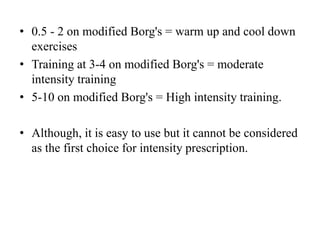
• 0.5 - 2 on modified Borg's = warm up and cool down
exercises
• Training at 3-4 on modified Borg's = moderate
intensity training
• 5-10 on modified Borg's = High intensity training.
• Although, it is easy to use but it cannot be considered
as the first choice for intensity prescription.
Uses-
• Patients on beta blockers.
• Patients with the a heart transplantation as the
autonomic nervous system is disrupted.
REFERENCES
1. ROY S, MCCRORY J. Validation of Maximal Heart Rate Prediction Equations
Based on Sex and Physical Activity Status. Int J Exerc Sci. 2015 Oct
1;8(4):318–30.
2. MAXIMUM HEART RATE MEASURED VERSUS ESTIMATED BY DIFFERENT
EQUATIONS DURING THE CARDIOPULMONARY EXERCISE TEST IN OBESE
ADOLESCENTS [Internet]. [cited 2020 Apr 21]. Available from:
https://www.ncbi.nlm.nih.gov/pmc/articles/PMC6202885/
3. Karvonen method [Internet]. Oxford Reference. [cited 2020 Apr 22].
Available from:
https://www.oxfordreference.com/view/10.1093/oi/authority.201108101
05207569
4. Rate Perceived Exertion as a Measure of Exercise Intensity [Internet].
[cited 2020 Apr 22]. Available from:
//www.nursingcenter.com/journalarticle?Article_ID=4388376&Journal_ID
=2695880&Issue_ID=4388241
5.ACSM GUIDELINES 2019
THANK YOU

SUBJECTIVE AND OBJECTIVE MEASURE OF EXERCISE TESTING

  • 1.
    Objective and subjectivemeasures of exercise intensity By, DR. Susan Jose
  • 2.
    VO2 max • VO2maxcan be defined as the maximal volume of oxygen uptake by the muscles during physical exertion. • VO2 max is directly proportional to the capacity of the – pulmonary – cardiovascular – muscular systems • Measurement- by an ergospirometer test • In this procedure, the subject breathes through a low-resistance valve with his nose occluded while performing a maximal exercise testing – Flow volume loops – expired fractions of oxygen (O2) and carbon dioxide (CO2) – heart rate are measured that is used for the computerized calculation of Vo2 max.
  • 3.
    Activity Resting Horizontal Component Vertical Component/ Resistance Component Limitations Walking3.5 0.1 speed 1.8 speed x grade Most accurate for speeds of 1.9–3.7 min/h Running 3.5 0.2 speed 0.9 speed x grade Most accurate for speeds > 5 min/h Stepping 3.5 0.2 steps/min 1.33 (1.8 step Height x steps min) Most accurate for stepping rates of 12–30 steps /min Leg cycling 3.5 3.5 (1.8 work rate)/ body weight Most accurate for work rates of 300– 1,200 kg /m/ min Arm cycling 3.5 (3 work rate)/ body weight Most accurate for work rates between 150–750 kg /m /Min Vo2 max = Resting + Horizontal + Vertical ACSM Predictive Vo2 Max Equations
  • 4.
    • Normal valuesat rest in India population: – Healthy male - 4.7.56±8.37 L/kg/min – Healthy female – 3.7.62±7.40 L/kg/min Uses- • Test improvements endurance during a training season • Objective measure of exercise intensity prescription • To analyze the progress in cardio respiratory fitness following an exercise training.
  • 5.
    MAXIMUM HEART RATE •Maximal heart rate (HR max.)is the peak heart rate that an individual can achieve without any cardiovascular problems at maximal physical exertion and it is age dependant. • Its is calculated using the FOX EQUATION= 220-AGE WHY IMPORTANT? • HR max - important due to its relation to maximum oxygen consumption (VO2max). • HR max Inversely proportionally to Vo2max.
  • 6.
    Use- • For prescriptionof exercise intensity in Endurance training. • Karvonen’s formula= (HR max—HR rest)× 50-85% +RHR The target heart rate during exercise can be continuously monitored by using validated chest straps and wrist watches. Disadvantage-  Not reliable in patients on beta blockers.  In relative contraindicated conditions such as controlled arrhythmias, partial conduction blocks. INTENSITY MILD MOD HIGH Target heart rate 50- 63% 64- 76% 77-93% Oxygen consumption 20-39% of vo2 max. 40-59% of vo2 max. 60-84% of vo2 max.
  • 7.
    Subjective measure ofexercise intensity
  • 8.
    Rate of PerceivedExertion Perceived exertion is how hard you feel like your body is working. It is based on the physical sensations a person experiences during physical activity, including increased heart rate, increased respiration or breathing rate, increased sweating, and muscle fatigue. • There are various scales to measure the Perceived Exertion such as – Borg Rating of Perceived Exertion (RPE), – Talk Test – Feeling Scale – OMNI Scales
  • 9.
    • Modified BorgRPE scale (0-10)- measures the level of bodily exertion and breathlessness during physical activity. • It is usually used in clinicals and home setups after a submaximal exercise test or during / after the aerobic training. • It can be of good value in patients who have difficulty in self monitoring of the pulse rate during training. • Visual display of the scale is beneficial to improve the reliability of the self-reported exertion measure.
  • 11.
    • 0.5 -2 on modified Borg's = warm up and cool down exercises • Training at 3-4 on modified Borg's = moderate intensity training • 5-10 on modified Borg's = High intensity training. • Although, it is easy to use but it cannot be considered as the first choice for intensity prescription.
  • 12.
    Uses- • Patients onbeta blockers. • Patients with the a heart transplantation as the autonomic nervous system is disrupted.
  • 13.
    REFERENCES 1. ROY S,MCCRORY J. Validation of Maximal Heart Rate Prediction Equations Based on Sex and Physical Activity Status. Int J Exerc Sci. 2015 Oct 1;8(4):318–30. 2. MAXIMUM HEART RATE MEASURED VERSUS ESTIMATED BY DIFFERENT EQUATIONS DURING THE CARDIOPULMONARY EXERCISE TEST IN OBESE ADOLESCENTS [Internet]. [cited 2020 Apr 21]. Available from: https://www.ncbi.nlm.nih.gov/pmc/articles/PMC6202885/ 3. Karvonen method [Internet]. Oxford Reference. [cited 2020 Apr 22]. Available from: https://www.oxfordreference.com/view/10.1093/oi/authority.201108101 05207569 4. Rate Perceived Exertion as a Measure of Exercise Intensity [Internet]. [cited 2020 Apr 22]. Available from: //www.nursingcenter.com/journalarticle?Article_ID=4388376&Journal_ID =2695880&Issue_ID=4388241 5.ACSM GUIDELINES 2019
  • 14.