TMJ MOTION MEASUREMENTS
Dr Maher FOUDA
Reference:
TMJ Muscle
Range of
Motion
Measurements
A patient’s
range of
motion
measurements
should be
recorded as
part of every
new patient
exam.
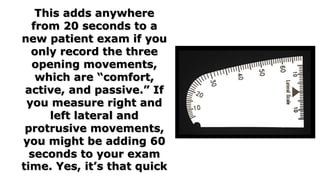
TheraBite range-of-motion
(ROM) scale. When measuring
mouth opening, the notch at
the lower left portion of the
scale is stabilized on the
superior aspect of the lower
incisors. Once stabilized, the
instrument is rotated up toward
the inferior aspect of upper
incisors until contact is made
between the scale and the
upper incisors. The instrument’s
scale is then read and the
opening range obtained.
This adds anywhere
from 20 seconds to a
new patient exam if you
only record the three
opening movements,
which are “comfort,
active, and passive.” If
you measure right and
left lateral and
protrusive movements,
you might be adding 60
seconds to your exam
time. Yes, it’s that quick
Normal Range
of Motion
Opening: 40 to
60 mm. If a
patient opens to
55 mm with
either the
comfort or
active opening,
there is no need
to obtain the
Passive
opening.
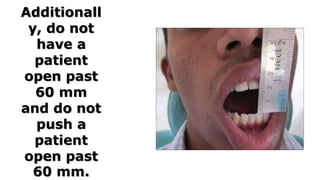
Additionall
y, do not
have a
patient
open past
60 mm
and do not
push a
patient
open past
60 mm.
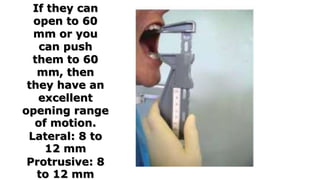
If they can
open to 60
mm or you
can push
them to 60
mm, then
they have an
excellent
opening range
of motion.
Lateral: 8 to
12 mm
Protrusive: 8
to 12 mm
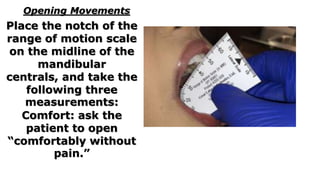
Place the notch of the
range of motion scale
on the midline of the
mandibular
centrals, and take the
following three
measurements:
Comfort: ask the
patient to open
“comfortably without
pain.”
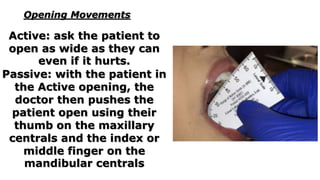
Opening Movements
Active: ask the patient to
open as wide as they can
even if it hurts.
Passive: with the patient in
the Active opening, the
doctor then pushes the
patient open using their
thumb on the maxillary
centrals and the index or
middle finger on the
mandibular centrals
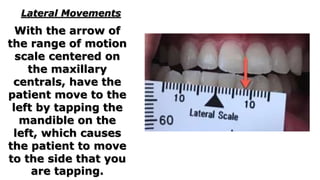
Opening Movements
With the arrow of
the range of motion
scale centered on
the maxillary
centrals, have the
patient move to the
left by tapping the
mandible on the
left, which causes
the patient to move
to the side that you
are tapping.
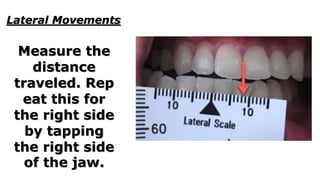
Lateral Movements
Measure the
distance
traveled. Rep
eat this for
the right side
by tapping
the right side
of the jaw.
Lateral Movements
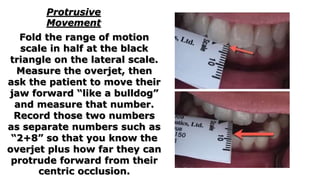
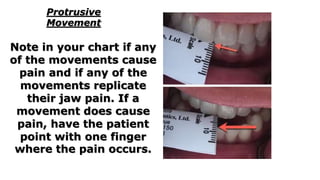
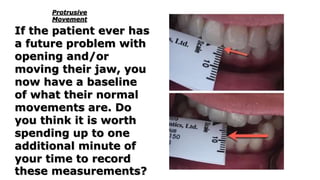
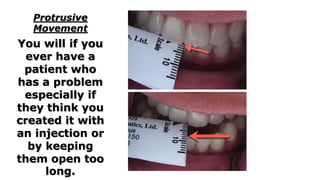
Protrusive
Movement
Fold the range of motion
scale in half at the black
triangle on the lateral scale.
Measure the overjet, then
ask the patient to move their
jaw forward “like a bulldog”
and measure that number.
Record those two numbers
as separate numbers such as
“2+8” so that you know the
overjet plus how far they can
protrude forward from their
centric occlusion.
Protrusive
Movement
Note in your chart if any
of the movements cause
pain and if any of the
movements replicate
their jaw pain. If a
movement does cause
pain, have the patient
point with one finger
where the pain occurs.
Protrusive
Movement
If the patient ever has
a future problem with
opening and/or
moving their jaw, you
now have a baseline
of what their normal
movements are. Do
you think it is worth
spending up to one
additional minute of
your time to record
these measurements?
Protrusive
Movement
You will if you
ever have a
patient who
has a problem
especially if
they think you
created it with
an injection or
by keeping
them open too
long.
TMJ MOTION MEASUREMENTS

TMJ MOTION MEASUREMENTS

  • 1.
  • 2.
  • 3.
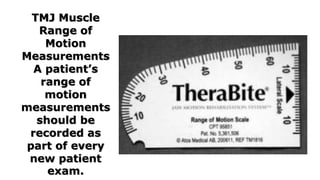
    TMJ Muscle Range of Motion Measurements Apatient’s range of motion measurements should be recorded as part of every new patient exam.
  • 4.
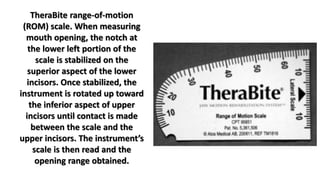
    TheraBite range-of-motion (ROM) scale.When measuring mouth opening, the notch at the lower left portion of the scale is stabilized on the superior aspect of the lower incisors. Once stabilized, the instrument is rotated up toward the inferior aspect of upper incisors until contact is made between the scale and the upper incisors. The instrument’s scale is then read and the opening range obtained.
  • 5.
    This adds anywhere from20 seconds to a new patient exam if you only record the three opening movements, which are “comfort, active, and passive.” If you measure right and left lateral and protrusive movements, you might be adding 60 seconds to your exam time. Yes, it’s that quick
  • 6.
    Normal Range of Motion Opening:40 to 60 mm. If a patient opens to 55 mm with either the comfort or active opening, there is no need to obtain the Passive opening.
  • 7.
    Additionall y, do not havea patient open past 60 mm and do not push a patient open past 60 mm.
  • 8.
    If they can opento 60 mm or you can push them to 60 mm, then they have an excellent opening range of motion. Lateral: 8 to 12 mm Protrusive: 8 to 12 mm
  • 9.
    Place the notchof the range of motion scale on the midline of the mandibular centrals, and take the following three measurements: Comfort: ask the patient to open “comfortably without pain.” Opening Movements
  • 10.
    Active: ask thepatient to open as wide as they can even if it hurts. Passive: with the patient in the Active opening, the doctor then pushes the patient open using their thumb on the maxillary centrals and the index or middle finger on the mandibular centrals Opening Movements
  • 11.
    With the arrowof the range of motion scale centered on the maxillary centrals, have the patient move to the left by tapping the mandible on the left, which causes the patient to move to the side that you are tapping. Lateral Movements
  • 12.
    Measure the distance traveled. Rep eatthis for the right side by tapping the right side of the jaw. Lateral Movements
  • 13.
    Protrusive Movement Fold the rangeof motion scale in half at the black triangle on the lateral scale. Measure the overjet, then ask the patient to move their jaw forward “like a bulldog” and measure that number. Record those two numbers as separate numbers such as “2+8” so that you know the overjet plus how far they can protrude forward from their centric occlusion.
  • 14.
    Protrusive Movement Note in yourchart if any of the movements cause pain and if any of the movements replicate their jaw pain. If a movement does cause pain, have the patient point with one finger where the pain occurs.
  • 15.
    Protrusive Movement If the patientever has a future problem with opening and/or moving their jaw, you now have a baseline of what their normal movements are. Do you think it is worth spending up to one additional minute of your time to record these measurements?
  • 16.
    Protrusive Movement You will ifyou ever have a patient who has a problem especially if they think you created it with an injection or by keeping them open too long.