MANDIBULAR MOVEMENTS
Presented By :-Dr. KAVAN Y. DOSHI
Maxillofacial Prosthodontist &
Implantologist
CONTENTS
• Introduction
• Classification
• Hinge movement
• Protrusive and Retrusive movement
• Lateral movement
• Border movements in Sagittal plane
• Border movements in Horizontal plane
• Border movements in Vertical plane
• Envelope of Motion
• Functional and parafunctional movement
• Importance of Mandibular Movements
• Summary
• References
• The movements are influenced by the TMJ, muscle of mastication, opposing
tooth contact and neuromuscular regulation
• Mandibular movement occur around the TMJ
• MANDIBULAR MOVEMENT OCCURS as a complex series of interrelated
three-dimensional rotational and translational activities.
• It is determined by the combined and simultaneous activities of both
temporomandibular joints (TMJs).
INTRODUCTION
1) According to Sharry:-
a) According to direction - Opening and closing movements (hinge movement)
Protrusion and Retrusion
Lateral gliding movements
b) According to tooth contact - Movements with tooth contact
Movements without tooth contact
CLASSIFICATION
Sharry JJ. Complete denture prosthodontics. McGraw-Hill Companies; 1974.
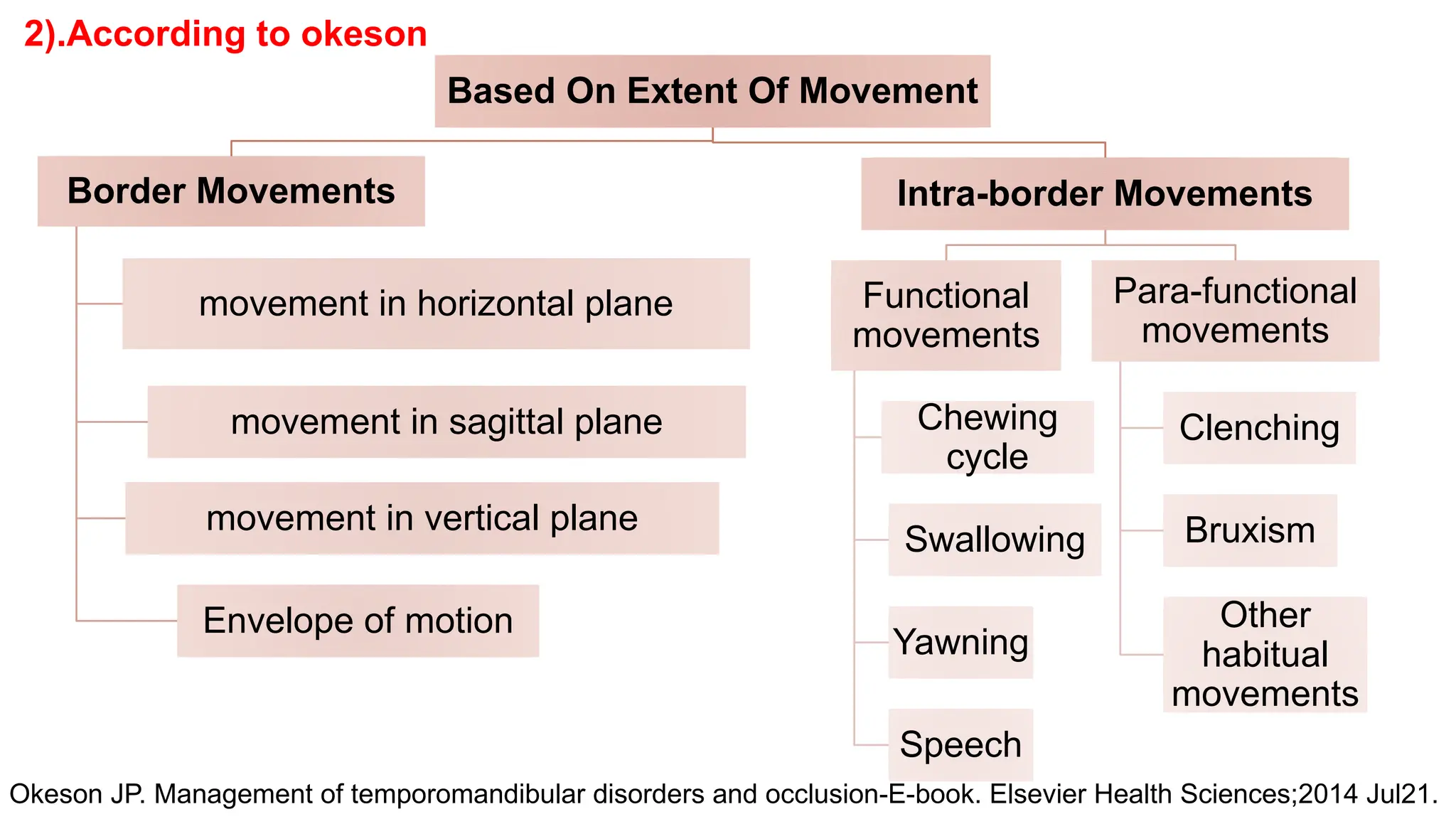
Based On Extent Of Movement
Border Movements
movement in horizontal plane
movement in sagittal plane
movement in vertical plane
Envelope of motion
Intra-border Movements
Functional
movements
Chewing
cycle
Swallowing
Yawning
Speech
Para-functional
movements
Clenching
Bruxism
Other
habitual
movements
Okeson JP. Management of temporomandibular disorders and occlusion-E-book. Elsevier Health Sciences;2014 Jul21.
2).According to okeson
Based on the type of movement occuring in TMJ:-
a) Rotational b) Translation
Okeson JP. Management of temporomandibular disorders and occlusion-E-book. Elsevier Health Sciences;2014 Jul21.
Sagittal plane Horizontal plane Frontal plane
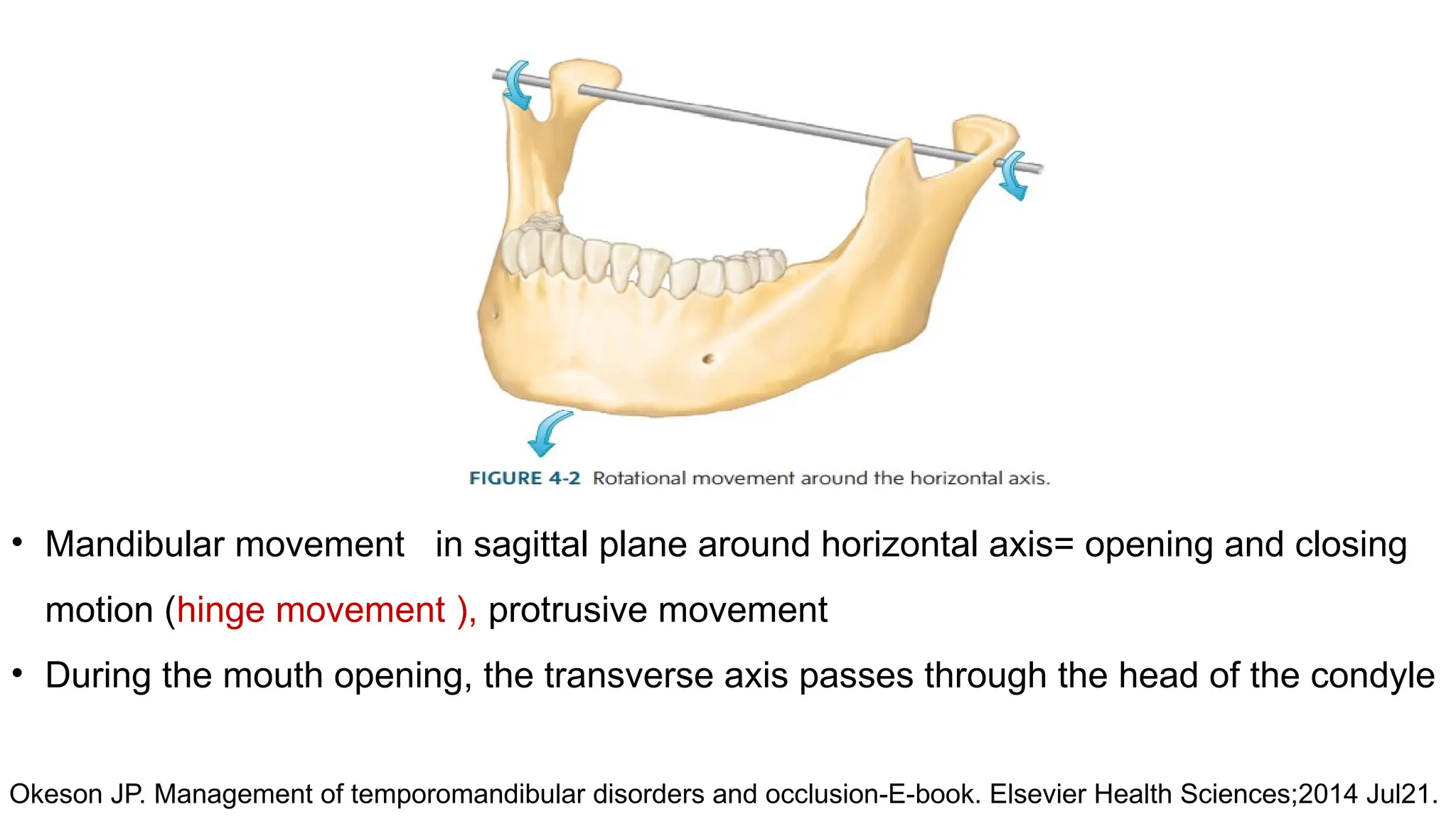
• Mandibular movement in sagittal plane around horizontal axis= opening and closing
motion (hinge movement ), protrusive movement
• During the mouth opening, the transverse axis passes through the head of the condyle
Okeson JP. Management of temporomandibular disorders and occlusion-E-book. Elsevier Health Sciences;2014 Jul21.
• Mandibular movement in horizontal plane
around vertical axis
• Vertical axis runs through the condyle and the
posterior border of the ramus of the mandible
• Occurs when one condyle moves anteriorly out
of the terminal hinge position and the opposite
condyle remains in the terminal hinge position
• Mandibular movement in frontal
plane around sagittal axis
• Sagittal axis runs through the centre
of condyle
• Occurs when one condyle moves
inferiorly while the other remains in
the terminal hinge position
Okeson JP. Management of temporomandibular disorders and occlusion-E-book. Elsevier Health Sciences;2014 Jul21.
Rotational Movement
Dorland’s Medical Dictionary defines rotation as
“the process of turning around an axis:
movement of a body about its axis.”
• In the masticatory system, rotation occurs when the mouth opens and closes around
a fixed point or axis within the condyles.
• In other words, the teeth can be separated and then occluded with no positional
change of the condyles.
Okeson JP. Management of temporomandibular disorders and occlusion-E-book. Elsevier Health Sciences;2014 Jul21.
• In the TMJ, rotation occurs as movement within
the inferior cavity of the joint.
• It is thus movement between the superior
surface of the condyle and the inferior surface
of the articular disc.
TRANSLATIONAL MOVEMENT
• Translation can be defined as a movement in
which every point of the moving object
simultaneously has the same direction and
velocity.
• In the masticatory system, it occurs when the
mandible moves forward, as in protrusion.
• The teeth, condyles, and rami all move in
the same direction and to the same degree.
Okeson JP. Management of temporomandibular disorders and occlusion-E-book. Elsevier Health Sciences;2014 Jul21.
• Translation occurs within the superior cavity of the joint between the superior
surface of the articular disc and the inferior surface of the articular fossa
Okeson JP. Management of temporomandibular disorders and occlusion-E-book. Elsevier Health Sciences;2014 Jul21.
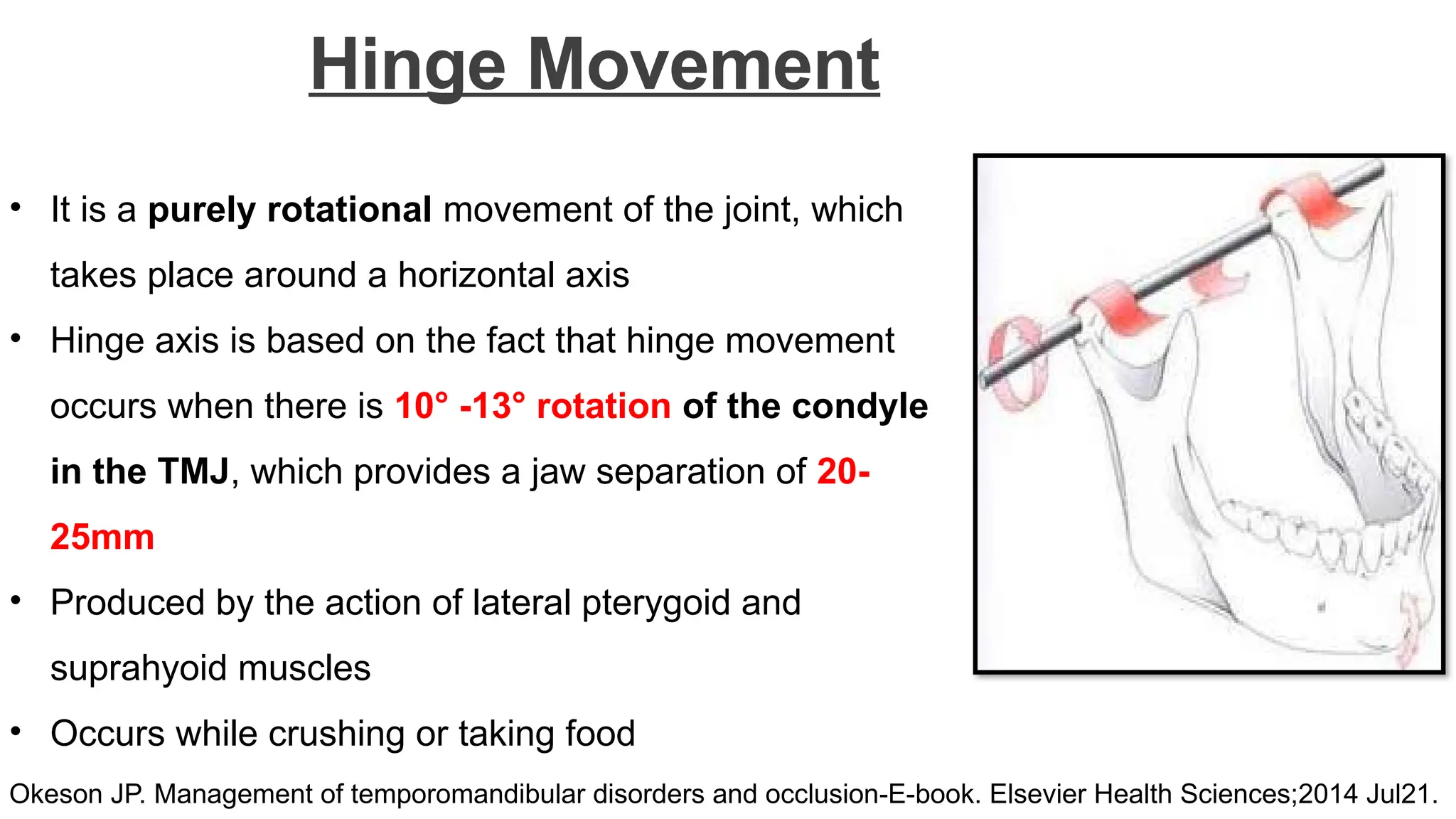
Hinge Movement
• It is a purely rotational movement of the joint, which
takes place around a horizontal axis
• Hinge axis is based on the fact that hinge movement
occurs when there is 10° -13° rotation of the condyle
in the TMJ, which provides a jaw separation of 20-
25mm
• Produced by the action of lateral pterygoid and
suprahyoid muscles
• Occurs while crushing or taking food
Okeson JP. Management of temporomandibular disorders and occlusion-E-book. Elsevier Health Sciences;2014 Jul21.
Open mouth
Protrusive Movement
• Occurs while incising and grasping food
• Movement occurs after the condyle rotates for more than 13° in the TMJ
• The mandible move forward and downwards while rotating in its hinge axis
Okeson JP. Management of temporomandibular disorders and occlusion-E-book. Elsevier Health Sciences;2014 Jul21.
(A) Protrusive movement brings the anterior teeth edge-to-edge. Condyle translates downwards and forwards
(B) During maximal protrusion F, condyle shows maximal movement as dictated by the contours of glenoid
fossa.
In a natural dentition, the edge-to-edge
protrusive contact will create a gap between the
posterior teeth.
This is called the Christensen’s phenomenon.
While fabricating complete dentures, it is essential to eliminate this gap by allowing
simultaneous contact of posterior teeth also, when the anterior teeth contact in
protrusion.
This stabilizes the denture during protrusive movement.
The average path of the advancing condyle makes
an angle with the frontal plane called the
‘protrusive condylar guidance
angle/inclination’.
It is determined using protrusive records.
Retrusive Movement
• Occurs when the mandible is forcefully moved behind.
• Achieved by fibres of temporalis, digastric and deeper
fibres of masseter
• Determined by fibres of bilamina, contour of posterior
slope of glenoid fossa
Okeson JP. Management of temporomandibular disorders and occlusion-E-book. Elsevier Health Sciences;2014 Jul21.
Lateral excursion
Movement produced when the mandible moves laterally (side to side or right and left).
This movement is used for the reduction in fibrous and other types of foods while
chewing.
Preiskel HW. Lateral translatory movements of the mandible: Critical review of investigations. The Journal of Prosthetic Dentistry. 1972 Jul 1;28(1):46-57.
• it is defined as “ the bodily lateral movement / lateral shift of mandible resulting from
movement of condyles along lateral inclines of mandibular fossa during lateral jaw
movement” Dr. Norman bennett
• When the mandible moves laterally (side to side), the side to which it moves is
termed as the ‘working side’ or ‘functional side’ and the other side is termed as the
‘nonworking side’, ‘balancing side’ or ‘nonfunctional side’.
• The condyle on the side to which the mandible moves (working side) is termed as the
working condyle or rotating condyle and the condyle on the other side is termed as
orbiting condyle or nonworking condyle .
Bennett movement and Bennett angle
Preiskel HW. Lateral translatory movements of the mandible: Critical review of investigations. The Journal of Prosthetic Dentistry. 1972 Jul 1;28(1):46-57.
When the mandible is moved to the right, the right side condyle is the working
condyle and the opposite condyle is the nonworking condyle. The working condyle
rotates with or without a lateral shift (Bennett shift – CR to B), while the nonworking
condyle translates forwards, downwards and medially (from CR to A).
Preiskel HW. Lateral translatory movements of the mandible: Critical review of investigations. The Journal of Prosthetic Dentistry. 1972 Jul 1;28(1):46-57.
• It has also been termed previously as ‘Bennett shift’ or ‘mandibular side shift’.
• If the temporomandibular ligament of rotating condyle is very tight, there is no
bodily side shift of the mandible and therefore no Bennett movement occurs.
• A definite timing may also be involved in Bennett movement.
• It can occur immediately, take place at the beginning, or be distributed
throughout the lateral deflection.
• This is termed as immediate, early or progressive side shift respectively.
Preiskel HW. Lateral translatory movements of the mandible: Critical review of investigations. The Journal of Prosthetic Dentistry. 1972 Jul 1;28(1):46-57.
• The nonworking side condyle moves forwards, downwards and medially
(inwards). The medial movement is termed as ‘mediotrusion’.
• The average path of this advancing condyle forms an angle with the sagittal
plane called the ‘Bennett angle’ or ‘lateral condylar guidance angle’.
• This angle is determined using lateral records or using the Hanau formula, L = H/8 +
12. It can range from 2° to 44° with a mean value of 16°.
Preiskel HW. Lateral translatory movements of the mandible: Critical review of investigations. The Journal of Prosthetic Dentistry. 1972 Jul 1;28(1):46-57.
Based On Extent Of Movement
Border Movements
movement in horizontal plane
movement in sagittal plane
movement in vertical plane
Envelope of motion
Intra-border Movements
Functional
movements
Chewing
cycle
Swallowing
Yawning
Speech
Para-functional
movements
Clenching
Bruxism
Other
habitual
movements
Okeson JP. Management of temporomandibular disorders and occlusion-E-book. Elsevier Health Sciences;2014 Jul21.
2).According to okeson
BORDER MOVEMENT
Border Movements
• When the mandible moves through the outer range of motion, reproducible
describable limits result, which are called border movements.
• Mandibular movement is limited by the ligaments and the articular surfaces
of the TMJs as well as by the morphology and alignment of the teeth.
• The border and typical functional movements of the mandible are described for
each reference plane.
Okeson JP. Management of temporomandibular disorders and occlusion-E-book. Elsevier Health Sciences;2014 Jul21.
SAGITTALPLANEBORDER MOVEMENTS
• Mandibular motion viewed in the sagittal plane can be seen to have distinct
movement components :
1. Posterior opening border
2. Anterior opening border
3. Superior contact border
4. Functional
Okeson JP. Management of temporomandibular disorders and occlusion-E-book. Elsevier Health Sciences;2014 Jul21.
1. Posterior opening border
2. Anterior opening border
3. Superior contact border
4. Functional
determined, or limited, primarily by ligaments
and the morphology of the TMJs.
determined by the occlusal and incisal surfaces
of the teeth.
• Functional movements are not considered border movements since they are not
determined by an outer range of motion.
• They are determined by the conditional responses of the neuromuscular system.
Okeson JP. Management of temporomandibular disorders and occlusion-E-book. Elsevier Health Sciences;2014 Jul21.
Posterior opening border movements
Okeson JP. Management of temporomandibular disorders and occlusion-E-book. Elsevier Health Sciences;2014 Jul21.
o occur as two-stage hinging movements.
o In the first stage
• the condyles are stabilized in their most superior
positions in the articular fossae
• The mandible can be lowered (mouth opening) in
a pure rotational movement without translation of
the condyles.
• This pure rotational opening can occur until the
anterior teeth are some 20 – 25 mm apart.
o Second stage
• At this point of opening, the TM ligaments
tighten, after which continued opening
results in an anterior and inferior
translation of the condyles.
• As the condyles translate, the axis of
rotation of the mandible shifts into the
bodies of the rami.
Okeson JP. Management of temporomandibular disorders and occlusion-E-book. Elsevier Health Sciences;2014 Jul21.
• The exact location of the axes of rotation in the rami is likely to be the area of
attachment of the sphenomandibular ligaments.
• During this stage, in which the mandible is rotating around a horizontal axis
passing through the rami, the condyles are moving anteriorly and inferiorly and
the anterior portion of the mandible is moving posteriorly and inferiorly.
• Maximum opening is reached when the capsular ligaments prevent further
movement at the condyles.
• Maximum opening at this stage is 40-60mm
Okeson JP. Management of temporomandibular disorders and occlusion-E-book. Elsevier Health Sciences;2014 Jul21.
Anterior Closing border movements
• With the mandible maximally opened,
closure accompanied by contraction
of the inferior lateral pterygoids
(which keep the condyles positioned
anteriorly) will generate the anterior
closing border movement.
Okeson JP. Management of temporomandibular disorders and occlusion-E-book. Elsevier Health Sciences;2014 Jul21.
• Theoretically, if the condyles were stabilized in this anterior position, a pure
hinge movement could occur as the mandible was closing from the maximally
opened to the maximally protruded position.
• Since the maximum protrusive position is determined in part by the
stylomandibular ligaments, as closure occurs, tightening of the ligaments
produces a posterior movement of the condyles.
Okeson JP. Management of temporomandibular disorders and occlusion-E-book. Elsevier Health Sciences;2014 Jul21.
Superior contact border movements
• determined by the characteristics of the occluding surfaces of the teeth.
• Throughout this entire movement, tooth contact is present.
• its depends on
(1) the amount of variation between CR and maximum intercuspation
(2) the steepness of the cuspal inclines of the posterior teeth
(3) the amount of vertical and horizontal overlap of the anterior teeth
(4) the lingual morphology of the maxillary anterior teeth
(5) the general interarch relationships of the teeth.
Okeson JP. Management of temporomandibular disorders and occlusion-E-book. Elsevier Health Sciences;2014 Jul21.
• In the CR position, initial tooth contact
occurs between the mesial inclines of the
maxillary tooth and the distal inclines of
the mandibular teeth
Okeson JP. Management of temporomandibular disorders and occlusion-E-book. Elsevier Health Sciences;2014 Jul21.
• When muscular force is applied,
supero-anterior movement or shift
results until the intercuspal position is
reached.
• The slide from CR to ICP is present in approximately 90% of the population, and
the average distance is 1 to 1.25 mm.
• When the mandible is protruded from maximum intercuspation, contact between
the incisal edges of the mandibular anterior teeth and the lingual inclines of the
maxillary anterior teeth results in an antero-inferior movement of the mandible.
Okeson JP. Management of temporomandibular disorders and occlusion-E-book. Elsevier Health Sciences;2014 Jul21.
• This continues until the maxillary and
mandibular anterior teeth are in edge to
edge relationship, at which a horizontal
movement continues until incisal edges of
mandibular teeth pass beyond the edges of
maxillary teeth.
• At this point the mandible moves in a
superior direction until the posterior
teeth come into contact.
Okeson JP. Management of temporomandibular disorders and occlusion-E-book. Elsevier Health Sciences;2014 Jul21.
• The occlusal surfaces of the posterior teeth then dictate the remaining
pathway to the maximum protrusive movement, which joins with the most
superior position of the anterior Closing border movement.
Okeson JP. Management of temporomandibular disorders and occlusion-E-book. Elsevier Health Sciences;2014 Jul21.
FRONTAL (VERTICAL) BORDER MOVEMENTS
• When mandibular motion is viewed in the frontal plane, a shield shaped pattern
can be seen that has four distinct movement components along with the functional
component:
1. Left lateral superior border
2. Left lateral opening border
3. Right lateral superior border
4. Right lateral opening border
Okeson JP. Management of temporomandibular disorders and occlusion-E-book. Elsevier Health Sciences;2014 Jul21.
Left lateral superior border movements
• With the mandible in maximum
inter-cuspation, a lateral movement
is made to the left.
• Left lateral superior border
movement recorded in the frontal
plane
Okeson JP. Management of temporomandibular disorders and occlusion-E-book. Elsevier Health Sciences;2014 Jul21.
• The precise nature of this path is primarily determined by
• morphology and interarch relationships of the maxillary and
mandibular teeth that are in contact during this movement.
• the condyle-disc-fossa relationships and morphology of the working or
rotating side TMJ.
• The maximum lateral extent of this movement is determined by the
ligaments of the rotating joint.
Okeson JP. Management of temporomandibular disorders and occlusion-E-book. Elsevier Health Sciences;2014 Jul21.
Left lateral opening border movements
• From the maximum left lateral superior border
position, an opening movement of the mandible
produces a laterally convex path.
• As maximum opening is approached,
ligaments tighten and produce a medially
directed movement, which causes a shift back in
the mandibular midline coinciding with the midline
of the face.
Okeson JP. Management of temporomandibular disorders and occlusion-E-book. Elsevier Health Sciences;2014 Jul21.
Right lateral superior border
movements
• Once the left frontal border movements are
recorded, the mandible is returned to maximum
inter-cuspation.
• From this position a lateral movement is made to
the right, which is similar to the left lateral superior
border movement.
• Slight differences may occur because of the tooth
contacts involved.
Okeson JP. Management of temporomandibular disorders and occlusion-E-book. Elsevier Health Sciences;2014 Jul21.
Right lateral opening border movements
• From the maximum right lateral border position, an opening movement of the
mandible produces a laterally convex path similar to that of the left opening
movement.
Okeson JP. Management of temporomandibular disorders and occlusion-E-book. Elsevier Health Sciences;2014 Jul21.
• As maximum opening is approached, ligaments
tighten and produce a medially directed
movement that causes a shift back in the
mandibular midline to coincide with the midline of
the face, thus ending this left opening movement.
HORIZONTAL PLANE BORDER MOVEMENTS
• Traditionally a device known as a Gothic arch tracer has been used to record
mandibular movement in the horizontal plane.
• It consists of a recording plate and a recording stylus.
• As the mandible moves, the stylus generates a line on the recording plate that
coincides with this movement.
• The border movements of the mandible in the horizontal plane can therefore be
easily recorded and examined.
Okeson JP. Management of temporomandibular disorders and occlusion-E-book. Elsevier Health Sciences;2014 Jul21.
• When mandibular movements are viewed in the horizontal plane, a
rhomboid pattern can be seen that has four distinct movement components
plus a functional component:
1. Left lateral border
2. Continued left lateral border with protrusion
3. Right lateral border
4. Continued right lateral border with protrusion
Okeson JP. Management of temporomandibular disorders and occlusion-E-book. Elsevier Health Sciences;2014 Jul21.
Left lateral border movements
• With the condyles in the CR position, contraction of the right inferior lateral
pterygoid will cause the right condyle to move anteriorly and medially (also
inferiorly).
• If the left inferior lateral pterygoid stays relaxed, the left condyle will remain situated
in CR and the result will be a left lateral border movement (i.e., the right condyle
orbiting around the frontal axis of the left condyle).
• Left condyle - rotating condyle, working condyle
• Right condyle - orbiting condyle, non-working condyle
Okeson JP. Management of temporomandibular disorders and occlusion-E-book. Elsevier Health Sciences;2014 Jul21.
• Likewise the right condyle is called the
nonworking condyle, since it is located
on the nonworking side.
• During this movement the stylus will
generate a line on the recording plate
that coincides with the left border
movement.
Okeson JP. Management of temporomandibular disorders and occlusion-E-book. Elsevier Health Sciences;2014 Jul21.
Continued left lateral border movements with protrusion
• With the mandible in the left lateral
border position, contraction of the left
inferior lateral pterygoid muscle along
with continued contraction of the right
inferior lateral pterygoid muscle will
cause the left condyle to move
anteriorly and to the right.
Okeson JP. Management of temporomandibular disorders and occlusion-E-book. Elsevier Health Sciences;2014 Jul21.
Right lateral border movements
• Once the left border movements have been recorded on the tracing, the mandible
is returned to CR and the right lateral border movements are recorded.
• Contraction of the left inferior lateral pterygoid muscle will cause the left
condyle to move anteriorly and medially (also inferiorly).
• If the right inferior lateral pterygoid muscle stays relaxed, the right condyle will
remain in the CR position.
Okeson JP. Management of temporomandibular disorders and occlusion-E-book. Elsevier Health Sciences;2014 Jul21.
• The resultant mandibular movement will be a right lateral border movement (e.g., the
left condyle orbiting around the frontal axis of the right condyle).
• Right Condyle – Rotating Condyle
• Left Condyle – Orbiting Condyle
Okeson JP. Management of temporomandibular disorders and occlusion-E-book. Elsevier Health Sciences;2014 Jul21.
• During this movement the stylus will
generate a line on the recording plate
that coincides with the right lateral
border movement.
Continued right lateral border movements with protrusion
• With the mandible in the right lateral border position, contraction of the right inferior
lateral pterygoid muscle along with continued contraction of the left inferior
lateral pterygoid will cause the right condyle to move anteriorly and to the left.
Okeson JP. Management of temporomandibular disorders and occlusion-E-book. Elsevier Health Sciences;2014 Jul21.
• Since the left condyle is already in its
maximum anterior position, the
movement of the right condyle to its
maximum anterior position will cause a
shift back in the mandibular midline
to coincide with the midline of the
face.
• Lateral movements can be generated by varying levels of mandibular opening.
• The border movements generated with each increasing degree of opening will
result in successively smaller tracings until, at the maximally open position, little
or no lateral movement can occur.
Okeson JP. Management of temporomandibular disorders and occlusion-E-book. Elsevier Health Sciences;2014 Jul21.
Envelope of Motion
• Given by Posselt (1952)
• By combining mandibular border
movements in the three planes
(sagittal, horizontal, and frontal), a
three-dimensional (3D) envelope of
motion can be produced
• This represents the maximum range of
movement of the mandible.
Okeson JP. Management of temporomandibular disorders and occlusion-E-book. Elsevier Health Sciences;2014 Jul21.
Functional Movements
• Functional movement occurs during functional activity of the
mandible. They usually take place within the border movements &
therefore, considered as free movements
• Most functional movements require maximum intercuspation &
therefore typically begin at & below the intercuspal position.
• During chewing, the movement begins at the ICP and drop
downwards and slightly forward to the position of desired opening.
Okeson JP. Management of temporomandibular disorders and occlusion-E-book. Elsevier Health Sciences;2014 Jul21.
Postural Effects Of Functional Movements
• When the head is positioned erect and upright
the postural position of the mandible is located
2-4 mm below the intercuspal position
• If the elevator muscles contract, the mandible
will be elevated directly into the intercuspal
position.
Okeson JP. Management of temporomandibular disorders and occlusion-E-book. Elsevier Health Sciences;2014 Jul21.
• A 45° head extension is the position during
drinking
• In this position the mandible is maintained more
posterior to maximum intercuspation, therefore
closure with the head back often results in tooth
contacts posterior to the intercuspal position
Okeson JP. Management of temporomandibular disorders and occlusion-E-book. Elsevier Health Sciences;2014 Jul21.
• Normal head position during eating is with the face
directed 30°, referred to as Alert Feeding Position
• In this the mandible shifts slightly anteriorly to the
upright postural position.
• If elevator muscles contract with the head in this
position, the path of closure will be slightly anterior to
that in the upright position,
• Therefore tooth contact will occur anteriorly or to
the maximum intercuspal position
Okeson JP. Management of temporomandibular disorders and occlusion-E-book. Elsevier Health Sciences;2014 Jul21.
• Chewing, swallowing, speaking, yawning and associated movements
constitute the functional movements of the mandible.
• These take place within the border movements.
• The movements are variable, within the borders and are influenced by:
 Consistency, bulk and type of food
 Size, number and form of teeth
 Excess or lack of saliva
 The musculature and force of chewing
Okeson JP. Management of temporomandibular disorders and occlusion-E-book. Elsevier Health Sciences;2014 Jul21.
Parafunctional movements
• These are sustained movements of the mandible that occur other than normal,
manifested by long periods of increased muscle activity.
• They are almost impossible for the patient to control.
• The most common parafunctional activities are bruxism and clenching, Habits
(pipe smoking, pencil biting, bobby pin opening and other habits).
• Parafunctional movements of the mandible are activities that serve no useful
function and are potentially harmful to the dentition and its contiguous structures.
• They can cause restricted mandibular movements.
Okeson JP. Management of temporomandibular disorders and occlusion-E-book. Elsevier Health Sciences;2014 Jul21.
 Importance of Mandibular Movements
• A prosthodontist designs a prosthesis for replacement of missing teeth and
restoring function.
• Knowledge of mandibular movements is essential as it helps the dentist in:
 selecting and programming of articulators
 understanding the occlusion
 treating TMJ disorders
 development of tooth for dental restorations
 arranging artificial teeth
• Mandibular movement at the limits dictated by anatomic structures, as viewed in
a given plane (GPT8).
• These are extreme positions of the mandible in any direction limited by nerves,
muscles and ligaments
• These border positions are invaluable in recording jaw relations, as they are
consistently repeatable.
• Most mandibular movements occur as intra-border movements. Parafunctional
activities such as bruxism or wide opening during yawning may occur in the
borders.
SUMMARY
Border movement in the sagittal plane. Border movement in the horizontal plane
Border movement in the frontal plane
Envelope of motion as described by Posselt.
A combination of border movements in all three planes.
REFERENCES
• Sharry JJ. Complete denture prosthodontics. McGraw-Hill Companies; 1974.
• Hickey JC, Zarb GA, Bolender CL. Prosthodontic treatment for edentulous patients.
St. Louis: CV Mosby Company; 1975.
• Okeson JP. Management of temporomandibular disorders and occlusion-E-book.
Elsevier Health Sciences; 2014 Jul 21.
• Heartwell, Charles M. Syllabus of complete dentures. 4th
ed. Philedelphia. Lea &
Febiger-1992.
THANK YOU

MANDIBULAR MOVEMENTS in Prosthodontics By Dr kavan doshi

  • 1.
    MANDIBULAR MOVEMENTS Presented By:-Dr. KAVAN Y. DOSHI Maxillofacial Prosthodontist & Implantologist
  • 2.
    CONTENTS • Introduction • Classification •Hinge movement • Protrusive and Retrusive movement • Lateral movement • Border movements in Sagittal plane • Border movements in Horizontal plane • Border movements in Vertical plane • Envelope of Motion • Functional and parafunctional movement • Importance of Mandibular Movements • Summary • References
  • 3.
    • The movementsare influenced by the TMJ, muscle of mastication, opposing tooth contact and neuromuscular regulation • Mandibular movement occur around the TMJ • MANDIBULAR MOVEMENT OCCURS as a complex series of interrelated three-dimensional rotational and translational activities. • It is determined by the combined and simultaneous activities of both temporomandibular joints (TMJs). INTRODUCTION
  • 4.
    1) According toSharry:- a) According to direction - Opening and closing movements (hinge movement) Protrusion and Retrusion Lateral gliding movements b) According to tooth contact - Movements with tooth contact Movements without tooth contact CLASSIFICATION Sharry JJ. Complete denture prosthodontics. McGraw-Hill Companies; 1974.
  • 5.
    Based On ExtentOf Movement Border Movements movement in horizontal plane movement in sagittal plane movement in vertical plane Envelope of motion Intra-border Movements Functional movements Chewing cycle Swallowing Yawning Speech Para-functional movements Clenching Bruxism Other habitual movements Okeson JP. Management of temporomandibular disorders and occlusion-E-book. Elsevier Health Sciences;2014 Jul21. 2).According to okeson
  • 6.
    Based on thetype of movement occuring in TMJ:- a) Rotational b) Translation Okeson JP. Management of temporomandibular disorders and occlusion-E-book. Elsevier Health Sciences;2014 Jul21.
  • 7.
    Sagittal plane Horizontalplane Frontal plane
  • 8.
    • Mandibular movementin sagittal plane around horizontal axis= opening and closing motion (hinge movement ), protrusive movement • During the mouth opening, the transverse axis passes through the head of the condyle Okeson JP. Management of temporomandibular disorders and occlusion-E-book. Elsevier Health Sciences;2014 Jul21.
  • 9.
    • Mandibular movementin horizontal plane around vertical axis • Vertical axis runs through the condyle and the posterior border of the ramus of the mandible • Occurs when one condyle moves anteriorly out of the terminal hinge position and the opposite condyle remains in the terminal hinge position • Mandibular movement in frontal plane around sagittal axis • Sagittal axis runs through the centre of condyle • Occurs when one condyle moves inferiorly while the other remains in the terminal hinge position Okeson JP. Management of temporomandibular disorders and occlusion-E-book. Elsevier Health Sciences;2014 Jul21.
  • 10.
    Rotational Movement Dorland’s MedicalDictionary defines rotation as “the process of turning around an axis: movement of a body about its axis.” • In the masticatory system, rotation occurs when the mouth opens and closes around a fixed point or axis within the condyles. • In other words, the teeth can be separated and then occluded with no positional change of the condyles. Okeson JP. Management of temporomandibular disorders and occlusion-E-book. Elsevier Health Sciences;2014 Jul21.
  • 11.
    Okeson JP. Managementof temporomandibular disorders and occlusion-E-book. Elsevier Health Sciences;2014 Jul21. • In the TMJ, rotation occurs as movement within the inferior cavity of the joint. • It is thus movement between the superior surface of the condyle and the inferior surface of the articular disc.
  • 12.
    TRANSLATIONAL MOVEMENT • Translationcan be defined as a movement in which every point of the moving object simultaneously has the same direction and velocity. • In the masticatory system, it occurs when the mandible moves forward, as in protrusion. • The teeth, condyles, and rami all move in the same direction and to the same degree. Okeson JP. Management of temporomandibular disorders and occlusion-E-book. Elsevier Health Sciences;2014 Jul21.
  • 13.
    • Translation occurswithin the superior cavity of the joint between the superior surface of the articular disc and the inferior surface of the articular fossa Okeson JP. Management of temporomandibular disorders and occlusion-E-book. Elsevier Health Sciences;2014 Jul21.
  • 14.
    Hinge Movement • Itis a purely rotational movement of the joint, which takes place around a horizontal axis • Hinge axis is based on the fact that hinge movement occurs when there is 10° -13° rotation of the condyle in the TMJ, which provides a jaw separation of 20- 25mm • Produced by the action of lateral pterygoid and suprahyoid muscles • Occurs while crushing or taking food Okeson JP. Management of temporomandibular disorders and occlusion-E-book. Elsevier Health Sciences;2014 Jul21.
  • 15.
  • 16.
    Protrusive Movement • Occurswhile incising and grasping food • Movement occurs after the condyle rotates for more than 13° in the TMJ • The mandible move forward and downwards while rotating in its hinge axis Okeson JP. Management of temporomandibular disorders and occlusion-E-book. Elsevier Health Sciences;2014 Jul21.
  • 17.
    (A) Protrusive movementbrings the anterior teeth edge-to-edge. Condyle translates downwards and forwards (B) During maximal protrusion F, condyle shows maximal movement as dictated by the contours of glenoid fossa.
  • 18.
    In a naturaldentition, the edge-to-edge protrusive contact will create a gap between the posterior teeth. This is called the Christensen’s phenomenon.
  • 19.
    While fabricating completedentures, it is essential to eliminate this gap by allowing simultaneous contact of posterior teeth also, when the anterior teeth contact in protrusion. This stabilizes the denture during protrusive movement.
  • 20.
    The average pathof the advancing condyle makes an angle with the frontal plane called the ‘protrusive condylar guidance angle/inclination’. It is determined using protrusive records.
  • 21.
    Retrusive Movement • Occurswhen the mandible is forcefully moved behind. • Achieved by fibres of temporalis, digastric and deeper fibres of masseter • Determined by fibres of bilamina, contour of posterior slope of glenoid fossa Okeson JP. Management of temporomandibular disorders and occlusion-E-book. Elsevier Health Sciences;2014 Jul21.
  • 22.
    Lateral excursion Movement producedwhen the mandible moves laterally (side to side or right and left). This movement is used for the reduction in fibrous and other types of foods while chewing. Preiskel HW. Lateral translatory movements of the mandible: Critical review of investigations. The Journal of Prosthetic Dentistry. 1972 Jul 1;28(1):46-57.
  • 23.
    • it isdefined as “ the bodily lateral movement / lateral shift of mandible resulting from movement of condyles along lateral inclines of mandibular fossa during lateral jaw movement” Dr. Norman bennett • When the mandible moves laterally (side to side), the side to which it moves is termed as the ‘working side’ or ‘functional side’ and the other side is termed as the ‘nonworking side’, ‘balancing side’ or ‘nonfunctional side’. • The condyle on the side to which the mandible moves (working side) is termed as the working condyle or rotating condyle and the condyle on the other side is termed as orbiting condyle or nonworking condyle . Bennett movement and Bennett angle Preiskel HW. Lateral translatory movements of the mandible: Critical review of investigations. The Journal of Prosthetic Dentistry. 1972 Jul 1;28(1):46-57.
  • 24.
    When the mandibleis moved to the right, the right side condyle is the working condyle and the opposite condyle is the nonworking condyle. The working condyle rotates with or without a lateral shift (Bennett shift – CR to B), while the nonworking condyle translates forwards, downwards and medially (from CR to A). Preiskel HW. Lateral translatory movements of the mandible: Critical review of investigations. The Journal of Prosthetic Dentistry. 1972 Jul 1;28(1):46-57.
  • 25.
    • It hasalso been termed previously as ‘Bennett shift’ or ‘mandibular side shift’. • If the temporomandibular ligament of rotating condyle is very tight, there is no bodily side shift of the mandible and therefore no Bennett movement occurs. • A definite timing may also be involved in Bennett movement. • It can occur immediately, take place at the beginning, or be distributed throughout the lateral deflection. • This is termed as immediate, early or progressive side shift respectively. Preiskel HW. Lateral translatory movements of the mandible: Critical review of investigations. The Journal of Prosthetic Dentistry. 1972 Jul 1;28(1):46-57.
  • 26.
    Preiskel HW. Lateraltranslatory movements of the mandible: Critical review of investigations. The Journal of Prosthetic Dentistry. 1972 Jul 1;28(1):46-57.
  • 27.
    Preiskel HW. Lateraltranslatory movements of the mandible: Critical review of investigations. The Journal of Prosthetic Dentistry. 1972 Jul 1;28(1):46-57.
  • 28.
    Preiskel HW. Lateraltranslatory movements of the mandible: Critical review of investigations. The Journal of Prosthetic Dentistry. 1972 Jul 1;28(1):46-57.
  • 29.
    • The nonworkingside condyle moves forwards, downwards and medially (inwards). The medial movement is termed as ‘mediotrusion’. • The average path of this advancing condyle forms an angle with the sagittal plane called the ‘Bennett angle’ or ‘lateral condylar guidance angle’. • This angle is determined using lateral records or using the Hanau formula, L = H/8 + 12. It can range from 2° to 44° with a mean value of 16°. Preiskel HW. Lateral translatory movements of the mandible: Critical review of investigations. The Journal of Prosthetic Dentistry. 1972 Jul 1;28(1):46-57.
  • 30.
    Based On ExtentOf Movement Border Movements movement in horizontal plane movement in sagittal plane movement in vertical plane Envelope of motion Intra-border Movements Functional movements Chewing cycle Swallowing Yawning Speech Para-functional movements Clenching Bruxism Other habitual movements Okeson JP. Management of temporomandibular disorders and occlusion-E-book. Elsevier Health Sciences;2014 Jul21. 2).According to okeson
  • 31.
  • 32.
    Border Movements • Whenthe mandible moves through the outer range of motion, reproducible describable limits result, which are called border movements. • Mandibular movement is limited by the ligaments and the articular surfaces of the TMJs as well as by the morphology and alignment of the teeth. • The border and typical functional movements of the mandible are described for each reference plane. Okeson JP. Management of temporomandibular disorders and occlusion-E-book. Elsevier Health Sciences;2014 Jul21.
  • 33.
    SAGITTALPLANEBORDER MOVEMENTS • Mandibularmotion viewed in the sagittal plane can be seen to have distinct movement components : 1. Posterior opening border 2. Anterior opening border 3. Superior contact border 4. Functional Okeson JP. Management of temporomandibular disorders and occlusion-E-book. Elsevier Health Sciences;2014 Jul21.
  • 34.
    1. Posterior openingborder 2. Anterior opening border 3. Superior contact border 4. Functional determined, or limited, primarily by ligaments and the morphology of the TMJs. determined by the occlusal and incisal surfaces of the teeth. • Functional movements are not considered border movements since they are not determined by an outer range of motion. • They are determined by the conditional responses of the neuromuscular system. Okeson JP. Management of temporomandibular disorders and occlusion-E-book. Elsevier Health Sciences;2014 Jul21.
  • 35.
    Posterior opening bordermovements Okeson JP. Management of temporomandibular disorders and occlusion-E-book. Elsevier Health Sciences;2014 Jul21. o occur as two-stage hinging movements. o In the first stage • the condyles are stabilized in their most superior positions in the articular fossae • The mandible can be lowered (mouth opening) in a pure rotational movement without translation of the condyles. • This pure rotational opening can occur until the anterior teeth are some 20 – 25 mm apart.
  • 37.
    o Second stage •At this point of opening, the TM ligaments tighten, after which continued opening results in an anterior and inferior translation of the condyles. • As the condyles translate, the axis of rotation of the mandible shifts into the bodies of the rami. Okeson JP. Management of temporomandibular disorders and occlusion-E-book. Elsevier Health Sciences;2014 Jul21.
  • 39.
    • The exactlocation of the axes of rotation in the rami is likely to be the area of attachment of the sphenomandibular ligaments. • During this stage, in which the mandible is rotating around a horizontal axis passing through the rami, the condyles are moving anteriorly and inferiorly and the anterior portion of the mandible is moving posteriorly and inferiorly. • Maximum opening is reached when the capsular ligaments prevent further movement at the condyles. • Maximum opening at this stage is 40-60mm Okeson JP. Management of temporomandibular disorders and occlusion-E-book. Elsevier Health Sciences;2014 Jul21.
  • 40.
    Anterior Closing bordermovements • With the mandible maximally opened, closure accompanied by contraction of the inferior lateral pterygoids (which keep the condyles positioned anteriorly) will generate the anterior closing border movement. Okeson JP. Management of temporomandibular disorders and occlusion-E-book. Elsevier Health Sciences;2014 Jul21.
  • 41.
    • Theoretically, ifthe condyles were stabilized in this anterior position, a pure hinge movement could occur as the mandible was closing from the maximally opened to the maximally protruded position. • Since the maximum protrusive position is determined in part by the stylomandibular ligaments, as closure occurs, tightening of the ligaments produces a posterior movement of the condyles. Okeson JP. Management of temporomandibular disorders and occlusion-E-book. Elsevier Health Sciences;2014 Jul21.
  • 43.
    Superior contact bordermovements • determined by the characteristics of the occluding surfaces of the teeth. • Throughout this entire movement, tooth contact is present. • its depends on (1) the amount of variation between CR and maximum intercuspation (2) the steepness of the cuspal inclines of the posterior teeth (3) the amount of vertical and horizontal overlap of the anterior teeth (4) the lingual morphology of the maxillary anterior teeth (5) the general interarch relationships of the teeth. Okeson JP. Management of temporomandibular disorders and occlusion-E-book. Elsevier Health Sciences;2014 Jul21.
  • 44.
    • In theCR position, initial tooth contact occurs between the mesial inclines of the maxillary tooth and the distal inclines of the mandibular teeth Okeson JP. Management of temporomandibular disorders and occlusion-E-book. Elsevier Health Sciences;2014 Jul21. • When muscular force is applied, supero-anterior movement or shift results until the intercuspal position is reached.
  • 45.
    • The slidefrom CR to ICP is present in approximately 90% of the population, and the average distance is 1 to 1.25 mm. • When the mandible is protruded from maximum intercuspation, contact between the incisal edges of the mandibular anterior teeth and the lingual inclines of the maxillary anterior teeth results in an antero-inferior movement of the mandible. Okeson JP. Management of temporomandibular disorders and occlusion-E-book. Elsevier Health Sciences;2014 Jul21.
  • 46.
    • This continuesuntil the maxillary and mandibular anterior teeth are in edge to edge relationship, at which a horizontal movement continues until incisal edges of mandibular teeth pass beyond the edges of maxillary teeth. • At this point the mandible moves in a superior direction until the posterior teeth come into contact. Okeson JP. Management of temporomandibular disorders and occlusion-E-book. Elsevier Health Sciences;2014 Jul21.
  • 47.
    • The occlusalsurfaces of the posterior teeth then dictate the remaining pathway to the maximum protrusive movement, which joins with the most superior position of the anterior Closing border movement. Okeson JP. Management of temporomandibular disorders and occlusion-E-book. Elsevier Health Sciences;2014 Jul21.
  • 50.
    FRONTAL (VERTICAL) BORDERMOVEMENTS • When mandibular motion is viewed in the frontal plane, a shield shaped pattern can be seen that has four distinct movement components along with the functional component: 1. Left lateral superior border 2. Left lateral opening border 3. Right lateral superior border 4. Right lateral opening border Okeson JP. Management of temporomandibular disorders and occlusion-E-book. Elsevier Health Sciences;2014 Jul21.
  • 51.
    Left lateral superiorborder movements • With the mandible in maximum inter-cuspation, a lateral movement is made to the left. • Left lateral superior border movement recorded in the frontal plane Okeson JP. Management of temporomandibular disorders and occlusion-E-book. Elsevier Health Sciences;2014 Jul21.
  • 52.
    • The precisenature of this path is primarily determined by • morphology and interarch relationships of the maxillary and mandibular teeth that are in contact during this movement. • the condyle-disc-fossa relationships and morphology of the working or rotating side TMJ. • The maximum lateral extent of this movement is determined by the ligaments of the rotating joint. Okeson JP. Management of temporomandibular disorders and occlusion-E-book. Elsevier Health Sciences;2014 Jul21.
  • 53.
    Left lateral openingborder movements • From the maximum left lateral superior border position, an opening movement of the mandible produces a laterally convex path. • As maximum opening is approached, ligaments tighten and produce a medially directed movement, which causes a shift back in the mandibular midline coinciding with the midline of the face. Okeson JP. Management of temporomandibular disorders and occlusion-E-book. Elsevier Health Sciences;2014 Jul21.
  • 54.
    Right lateral superiorborder movements • Once the left frontal border movements are recorded, the mandible is returned to maximum inter-cuspation. • From this position a lateral movement is made to the right, which is similar to the left lateral superior border movement. • Slight differences may occur because of the tooth contacts involved. Okeson JP. Management of temporomandibular disorders and occlusion-E-book. Elsevier Health Sciences;2014 Jul21.
  • 55.
    Right lateral openingborder movements • From the maximum right lateral border position, an opening movement of the mandible produces a laterally convex path similar to that of the left opening movement. Okeson JP. Management of temporomandibular disorders and occlusion-E-book. Elsevier Health Sciences;2014 Jul21. • As maximum opening is approached, ligaments tighten and produce a medially directed movement that causes a shift back in the mandibular midline to coincide with the midline of the face, thus ending this left opening movement.
  • 57.
    HORIZONTAL PLANE BORDERMOVEMENTS • Traditionally a device known as a Gothic arch tracer has been used to record mandibular movement in the horizontal plane. • It consists of a recording plate and a recording stylus. • As the mandible moves, the stylus generates a line on the recording plate that coincides with this movement. • The border movements of the mandible in the horizontal plane can therefore be easily recorded and examined. Okeson JP. Management of temporomandibular disorders and occlusion-E-book. Elsevier Health Sciences;2014 Jul21.
  • 58.
    • When mandibularmovements are viewed in the horizontal plane, a rhomboid pattern can be seen that has four distinct movement components plus a functional component: 1. Left lateral border 2. Continued left lateral border with protrusion 3. Right lateral border 4. Continued right lateral border with protrusion Okeson JP. Management of temporomandibular disorders and occlusion-E-book. Elsevier Health Sciences;2014 Jul21.
  • 59.
    Left lateral bordermovements • With the condyles in the CR position, contraction of the right inferior lateral pterygoid will cause the right condyle to move anteriorly and medially (also inferiorly). • If the left inferior lateral pterygoid stays relaxed, the left condyle will remain situated in CR and the result will be a left lateral border movement (i.e., the right condyle orbiting around the frontal axis of the left condyle). • Left condyle - rotating condyle, working condyle • Right condyle - orbiting condyle, non-working condyle Okeson JP. Management of temporomandibular disorders and occlusion-E-book. Elsevier Health Sciences;2014 Jul21.
  • 60.
    • Likewise theright condyle is called the nonworking condyle, since it is located on the nonworking side. • During this movement the stylus will generate a line on the recording plate that coincides with the left border movement. Okeson JP. Management of temporomandibular disorders and occlusion-E-book. Elsevier Health Sciences;2014 Jul21.
  • 61.
    Continued left lateralborder movements with protrusion • With the mandible in the left lateral border position, contraction of the left inferior lateral pterygoid muscle along with continued contraction of the right inferior lateral pterygoid muscle will cause the left condyle to move anteriorly and to the right. Okeson JP. Management of temporomandibular disorders and occlusion-E-book. Elsevier Health Sciences;2014 Jul21.
  • 62.
    Right lateral bordermovements • Once the left border movements have been recorded on the tracing, the mandible is returned to CR and the right lateral border movements are recorded. • Contraction of the left inferior lateral pterygoid muscle will cause the left condyle to move anteriorly and medially (also inferiorly). • If the right inferior lateral pterygoid muscle stays relaxed, the right condyle will remain in the CR position. Okeson JP. Management of temporomandibular disorders and occlusion-E-book. Elsevier Health Sciences;2014 Jul21.
  • 63.
    • The resultantmandibular movement will be a right lateral border movement (e.g., the left condyle orbiting around the frontal axis of the right condyle). • Right Condyle – Rotating Condyle • Left Condyle – Orbiting Condyle Okeson JP. Management of temporomandibular disorders and occlusion-E-book. Elsevier Health Sciences;2014 Jul21. • During this movement the stylus will generate a line on the recording plate that coincides with the right lateral border movement.
  • 64.
    Continued right lateralborder movements with protrusion • With the mandible in the right lateral border position, contraction of the right inferior lateral pterygoid muscle along with continued contraction of the left inferior lateral pterygoid will cause the right condyle to move anteriorly and to the left. Okeson JP. Management of temporomandibular disorders and occlusion-E-book. Elsevier Health Sciences;2014 Jul21. • Since the left condyle is already in its maximum anterior position, the movement of the right condyle to its maximum anterior position will cause a shift back in the mandibular midline to coincide with the midline of the face.
  • 66.
    • Lateral movementscan be generated by varying levels of mandibular opening. • The border movements generated with each increasing degree of opening will result in successively smaller tracings until, at the maximally open position, little or no lateral movement can occur. Okeson JP. Management of temporomandibular disorders and occlusion-E-book. Elsevier Health Sciences;2014 Jul21.
  • 67.
    Envelope of Motion •Given by Posselt (1952) • By combining mandibular border movements in the three planes (sagittal, horizontal, and frontal), a three-dimensional (3D) envelope of motion can be produced • This represents the maximum range of movement of the mandible. Okeson JP. Management of temporomandibular disorders and occlusion-E-book. Elsevier Health Sciences;2014 Jul21.
  • 68.
    Functional Movements • Functionalmovement occurs during functional activity of the mandible. They usually take place within the border movements & therefore, considered as free movements • Most functional movements require maximum intercuspation & therefore typically begin at & below the intercuspal position. • During chewing, the movement begins at the ICP and drop downwards and slightly forward to the position of desired opening. Okeson JP. Management of temporomandibular disorders and occlusion-E-book. Elsevier Health Sciences;2014 Jul21.
  • 69.
    Postural Effects OfFunctional Movements • When the head is positioned erect and upright the postural position of the mandible is located 2-4 mm below the intercuspal position • If the elevator muscles contract, the mandible will be elevated directly into the intercuspal position. Okeson JP. Management of temporomandibular disorders and occlusion-E-book. Elsevier Health Sciences;2014 Jul21.
  • 70.
    • A 45°head extension is the position during drinking • In this position the mandible is maintained more posterior to maximum intercuspation, therefore closure with the head back often results in tooth contacts posterior to the intercuspal position Okeson JP. Management of temporomandibular disorders and occlusion-E-book. Elsevier Health Sciences;2014 Jul21.
  • 71.
    • Normal headposition during eating is with the face directed 30°, referred to as Alert Feeding Position • In this the mandible shifts slightly anteriorly to the upright postural position. • If elevator muscles contract with the head in this position, the path of closure will be slightly anterior to that in the upright position, • Therefore tooth contact will occur anteriorly or to the maximum intercuspal position Okeson JP. Management of temporomandibular disorders and occlusion-E-book. Elsevier Health Sciences;2014 Jul21.
  • 72.
    • Chewing, swallowing,speaking, yawning and associated movements constitute the functional movements of the mandible. • These take place within the border movements. • The movements are variable, within the borders and are influenced by:  Consistency, bulk and type of food  Size, number and form of teeth  Excess or lack of saliva  The musculature and force of chewing Okeson JP. Management of temporomandibular disorders and occlusion-E-book. Elsevier Health Sciences;2014 Jul21.
  • 73.
    Parafunctional movements • Theseare sustained movements of the mandible that occur other than normal, manifested by long periods of increased muscle activity. • They are almost impossible for the patient to control. • The most common parafunctional activities are bruxism and clenching, Habits (pipe smoking, pencil biting, bobby pin opening and other habits). • Parafunctional movements of the mandible are activities that serve no useful function and are potentially harmful to the dentition and its contiguous structures. • They can cause restricted mandibular movements. Okeson JP. Management of temporomandibular disorders and occlusion-E-book. Elsevier Health Sciences;2014 Jul21.
  • 74.
     Importance ofMandibular Movements • A prosthodontist designs a prosthesis for replacement of missing teeth and restoring function. • Knowledge of mandibular movements is essential as it helps the dentist in:  selecting and programming of articulators  understanding the occlusion  treating TMJ disorders  development of tooth for dental restorations  arranging artificial teeth
  • 75.
    • Mandibular movementat the limits dictated by anatomic structures, as viewed in a given plane (GPT8). • These are extreme positions of the mandible in any direction limited by nerves, muscles and ligaments • These border positions are invaluable in recording jaw relations, as they are consistently repeatable. • Most mandibular movements occur as intra-border movements. Parafunctional activities such as bruxism or wide opening during yawning may occur in the borders. SUMMARY
  • 76.
    Border movement inthe sagittal plane. Border movement in the horizontal plane
  • 77.
    Border movement inthe frontal plane
  • 78.
    Envelope of motionas described by Posselt. A combination of border movements in all three planes.
  • 79.
    REFERENCES • Sharry JJ.Complete denture prosthodontics. McGraw-Hill Companies; 1974. • Hickey JC, Zarb GA, Bolender CL. Prosthodontic treatment for edentulous patients. St. Louis: CV Mosby Company; 1975. • Okeson JP. Management of temporomandibular disorders and occlusion-E-book. Elsevier Health Sciences; 2014 Jul 21. • Heartwell, Charles M. Syllabus of complete dentures. 4th ed. Philedelphia. Lea & Febiger-1992.
  • 80.

Editor's Notes

  • #3 Normal anatomy of mandible and tmj are describe in detail in previous lecture, Although the TMJs cannot function entirely independently of each other, they also rarely function with identical concurrent movements. To better understand the complexities of mandibular movement, it is beneficial first to isolate the movements that occur within a single TMJ
  • #4 Sharry classified mandibular movement according to direction ,tooth conact,
  • #5 okenso
  • #6 Frist we see antamic plane and axis of body
  • #7  In each plane movement is occurs around a fix point called the axis. we discussed all plane ,one by one Sagittal palne divide into right and left, Horizontal plane dived body in upper and lower half, Frontal plane divide into anterior and posterior plan when movement take place in sagittal plan we are see orientation around perpendicular to plan , called as transvers axis or frontal axis.when see movement in horizontal plan we are describing movement around logitudnal axis , When see movement in frontal plane we are describing orientation around sagittal axis
  • #8  opening and closing type movement occur in sagittal plane so axis of this plane is horizontal Rotation around this axis is seen during protrusive movement, During the initial mouth opening, the transverse axis passes through the head of the condyle Same way in mandible, later stage in mandibulsr foss
  • #9 Seen in association with the lateral movements 2= side to side movement Because the ligaments and musculature of the TMJ prevent an inferior displacement of the condyle (dislocation), this type of isolated movement does not occur naturally. It does occur in conjunction with other movements, however, when the orbiting condyle moves downward and forward across the articular eminence
  • #10 Movemnt occure around fix point / axis horizontal Axis / sagittal plane/ openin and closing
  • #11  transllatory type movement occur in Superior joint cavity
  • #13  during opening and closeing , protusive and Retrusive all type normal movements of the mandible, occur in both rotation and translation simultaneously.
  • #14 See individual movement first is hinge movement , opening and closing Movement around glenoid foss condyle just rotated around it fo movemnt
  • #15  condyle move anteriorly in maximam opening movement occur up to 40 -60mm, in range
  • #16 con
  • #21 The retrodiscal (bilaminar) zone is located between the posterior band of the TMJ disc and the posterior portion of the TMJ capsule. The 'bilaminar' refers to the two posterior attachments of the disc: superior layer: elastic to allow anterior translation of the disc over the articular eminence.
  • #27 Sicher in 1954 for definite timing
  • #31  l =lateral movement , h = horizontal movementBennett angle – angle formed by the average path of balancing condyle, with the sagittal plane when lateral movement is made. A, end of lateral movement; CR, centric relation. Fischer's angle was defined as the difference between the sagittal condylar inclinations during protrusive and lateral excursions on the non-working side, by keeping the corresponding horizontal distance from the intercuspal position (ICP) equivalent at the incisal point.
  • #32 okenso
  • #33 Up to this movement occr around in tmj rotation or tralation ,NOW SEE BODER MOVEMNT IN VARIOUS PLAN LIKE SAGITAL FRONTAL HORIZONTAL AND ENVOLPMOTION
  • #37 Condyles are stabilized in the terminal hinge position////In CR, the mandible can be rotated around the horizontal axis to a distance of only 20 to 25 mm as measured between the incisal edges of the maxillary and mandibular incisors Posterior opening border movements in the sagittal plane occur as two-stage hinging movements. Stage1 Condyles are stabilized in the terminal hinge position
  • #38  up to this called terminal hinge axis and pure rotational movement condyle is not move forward position at articular emineces , condyle only rotate in inferior joit space around horizontal axis aand sagittal plan
  • #39  after 20 25 mm opening tmj ligament tighten and move condyle forward / anterior position at articular eminaess .so During maximum opening Axis of roation shift into bodies of rami and
  • #40 hinge axis to maximum opening
  • #41 Maximum opening is in the range of 40 to 60 mm as measured between the incisal edges of the maxillary and mandibular teeth. Spenoid bone to lingula of mandibular foramen
  • #44  stylomandibular ligament attached styloid processs to posterior medial surface of mandible. Ligament move mandible backwad and condyle place agaian at region articlar foss Maximum opening tomaximum prosive potion
  • #45 Whereas the border movements previously ( anterior / posterior ) discussed are limited by ligaments, the superior contact border movement is determined by the characteristics of the occluding surfaces of the teeth. Since this border movement is solely tooth-determined, changes in the teeth will result in changes in the nature of the border movement.
  • #46 In the CR position, tooth contacts are normally found on one or more opposing pairs of posterior teeth.
  • #47 Additionally, this CR to maximum intercuspation slide may have a lateral component.
  • #48 1 Horizontal movement of the mandible as the incisal edges of maxillary and mandibular teeth pass across each other.
  • #49 Continued forward movement is determined by the posterior tooth surfaces until the maximum protrusive movement, as established by the ligaments, is reached. This maximum forward position joins the most superior point of the anterior opening border movement.
  • #50 Superior suface boder contact
  • #53 As move left lateral an inferiorly concave path being generated
  • #54 Non working / orbiting condyle
  • #56 As move right lateral an inferiorly concave path being generated
  • #61 The left condyle is therefore called the rotating condyle, since the mandible is rotating around it. The left condyle is also called the working condyle, since it is on the working side. The right condyle is called the orbiting condyle, since it is orbiting around the rotating condyle
  • #65 The right condyle in this movement is therefore called the rotating condyle, since the mandible is rotating around it. The left condyle during this movement is called the orbiting condyle, since it is orbiting around the rotating condyle.
  • #66 This completes the mandibular border movement in the horizontal plane.
  • #69 The envelope has this characteristic shape, differences will be found from person to person. The superior surface of the envelope is determined by tooth contacts, whereas the other borders are primarily determined by ligaments and joint anatomy that restrict or limit movement.
  • #71 It then returns in a straighter pathway, slightly posterior to the opening movement
  • #72 A, With the head upright, the teeth are elevated directly into maximum intercuspation from the postural position
  • #73 With the head raised 45 degrees, the postural position of the mandible becomes more posterior. When the teeth occlude, tooth contacts occur posterior to the intercuspal position.
  • #74 With the head angled forward 30 degrees (alert feeding position), the postural position of the mandible becomes more anterior. When the teeth occlude, tooth contacts occur anterior to maximum intercuspation.
  • #75 The envelope of motion recorded during chewing appears as a characteristic ‘tear drop’ and can be viewed in all three planes.
  • #76 These have to be diagnosed and appropriate remedial measures need to be initiated, as they might affect jaw relation records and prognosis of the prosthesis.
  • #77 Why Do We Need To Understand The Mandibular Movements???
  • #79  determined, or limited, primarily by ligaments and the morphology of the TMJs. determined by the occlusal and incisal surfaces of the teeth Functional movements are not considered border movements since they are not determined by an outer range of motion. They are determined by the conditional responses of the neuromuscular system. determined, or limited, primarily by ligaments and the morphology of the TMJs. determined by the occlusal and incisal surfaces of the teeth Functional movements are not considered border movements since they are not determined by an outer range of motion. They are determined by the conditional responses of the neuromuscular system.
  • #81 The envelope has this characteristic shape, differences will be found from person to person. The superior surface of the envelope is determined by tooth contacts, whereas the other borders are primarily determined by ligaments and joint anatomy that restrict or limit movement.