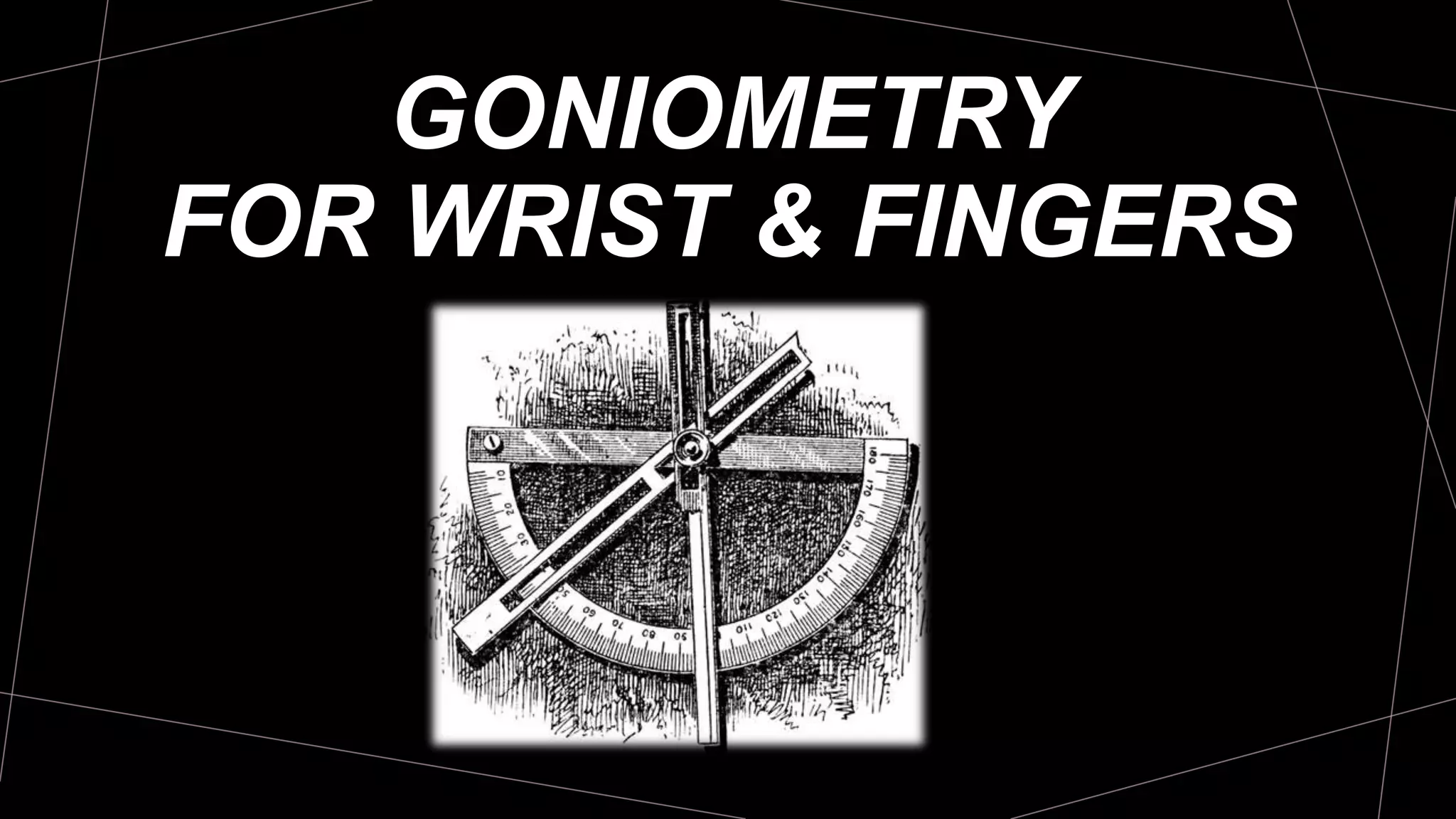
GONIOMETRY
FOR WRIST & FINGERS
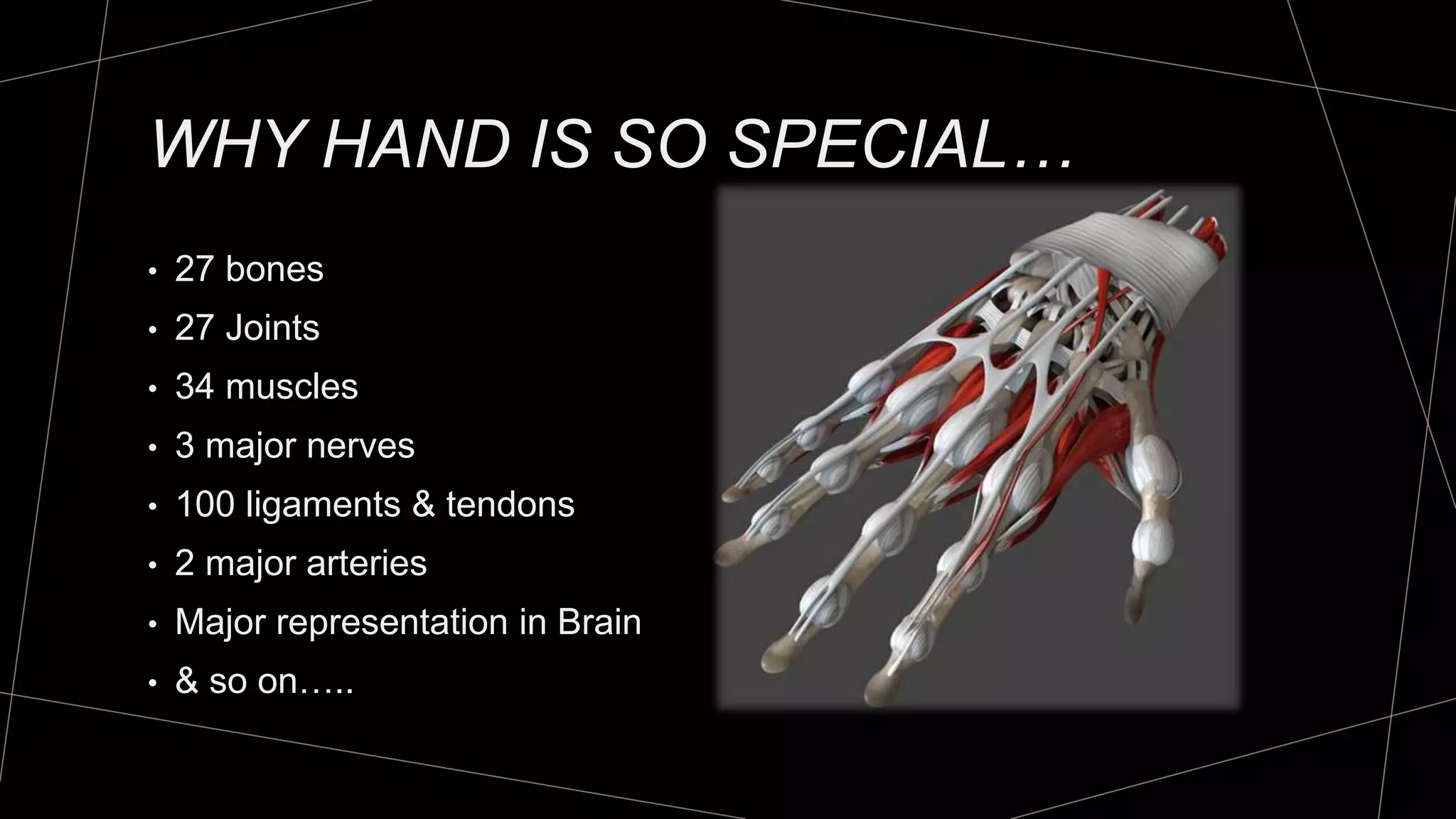
WHY HAND IS SO SPECIAL…
• 27 bones
• 27 Joints
• 34 muscles
• 3 major nerves
• 100 ligaments & tendons
• 2 major arteries
• Major representation in Brain
• & so on…..
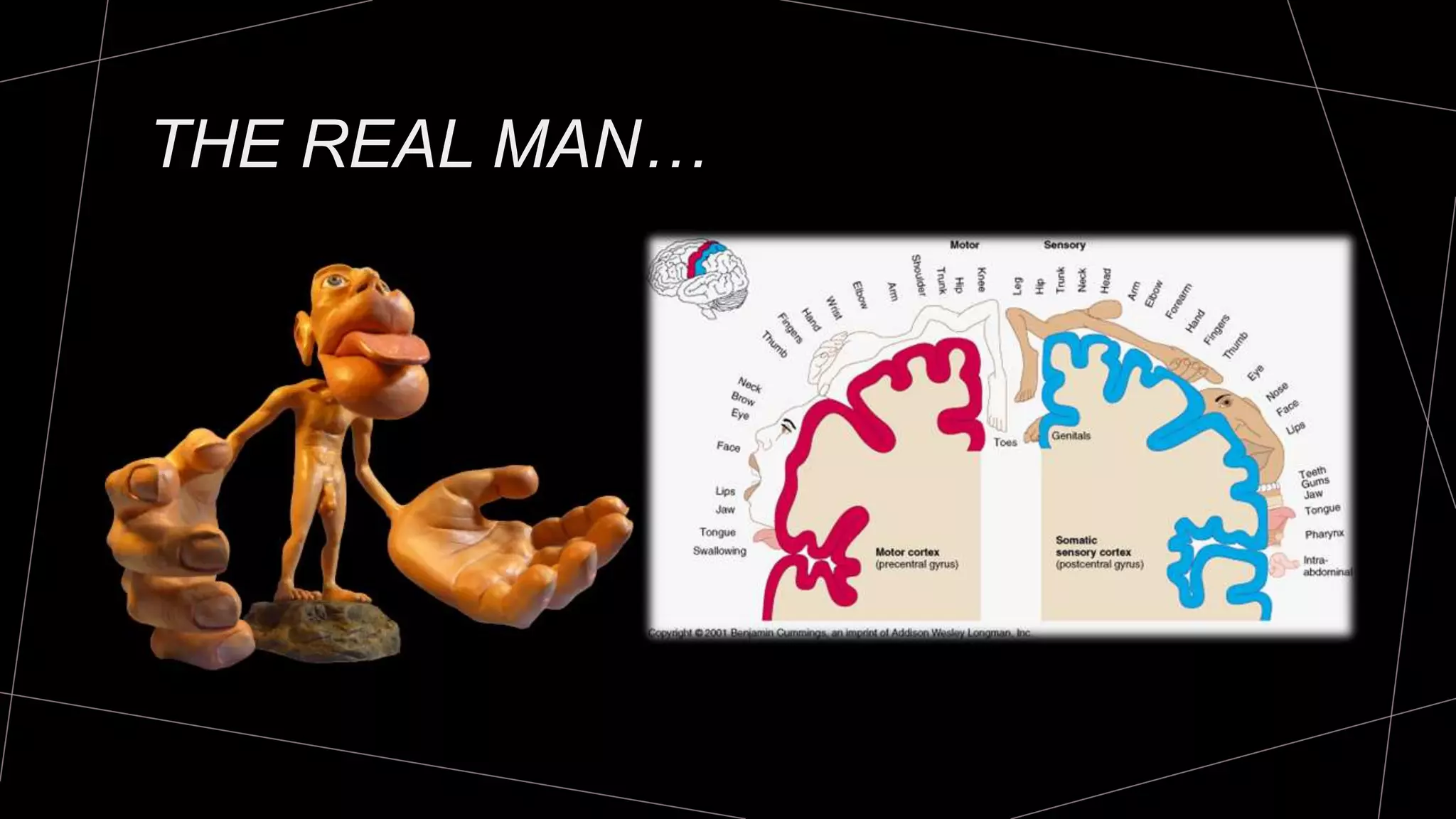
THE REAL MAN…
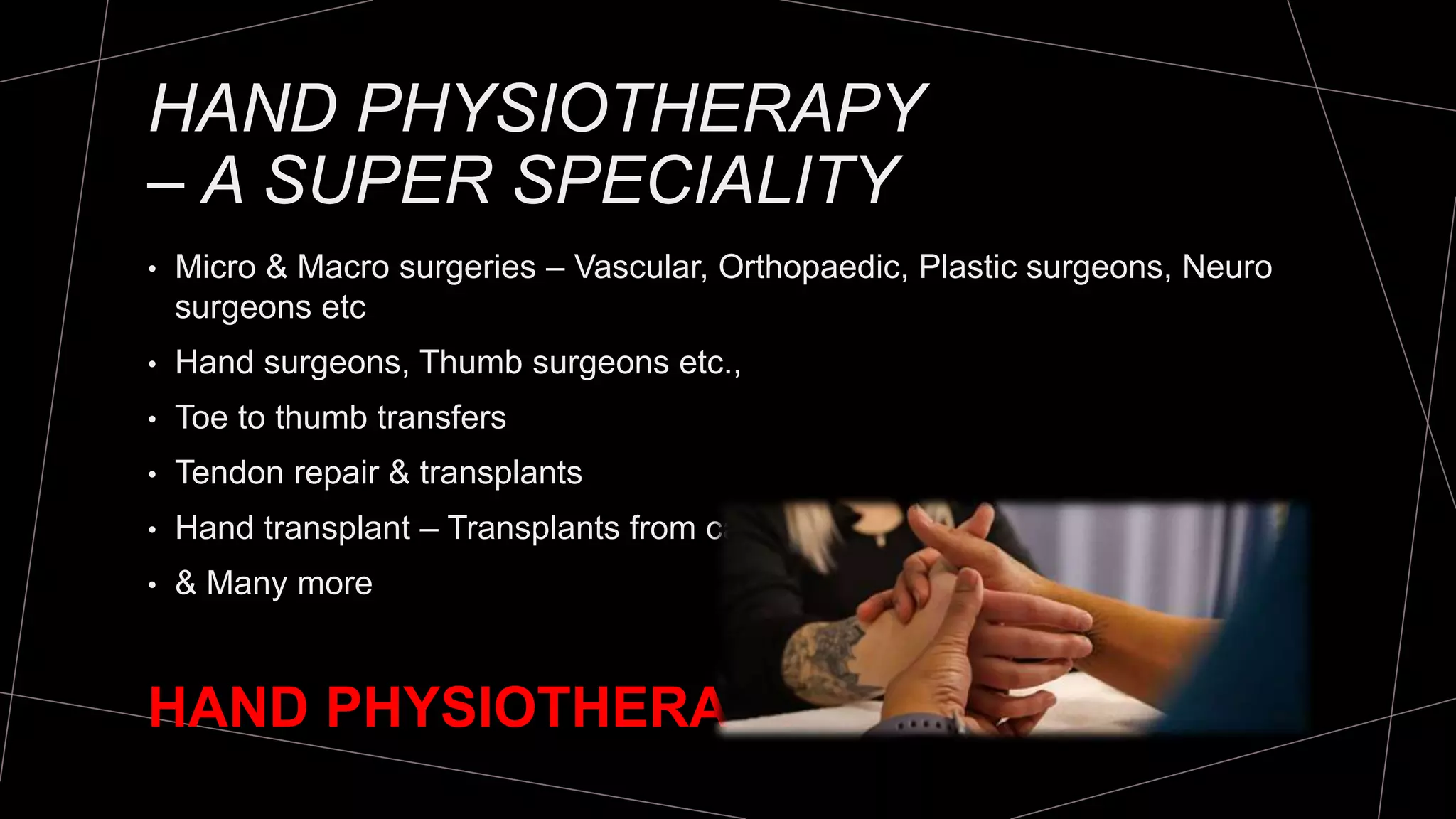
HAND PHYSIOTHERAPY
– A SUPER SPECIALITY
• Micro & Macro surgeries – Vascular, Orthopaedic, Plastic surgeons, Neuro
surgeons etc
• Hand surgeons, Thumb surgeons etc.,
• Toe to thumb transfers
• Tendon repair & transplants
• Hand transplant – Transplants from cadaver.
• & Many more
HAND PHYSIOTHERAPY
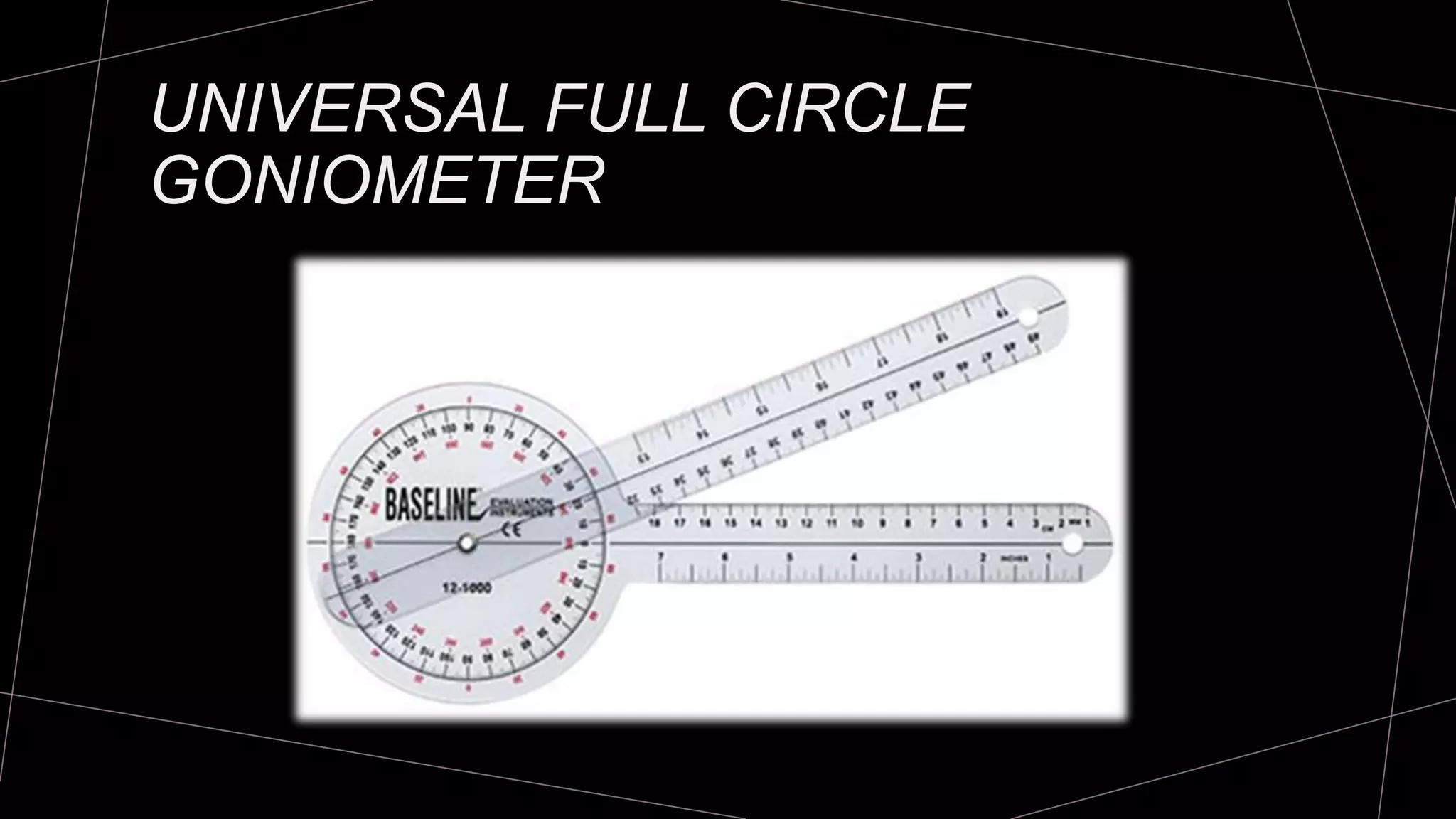
UNIVERSAL FULL CIRCLE
GONIOMETER
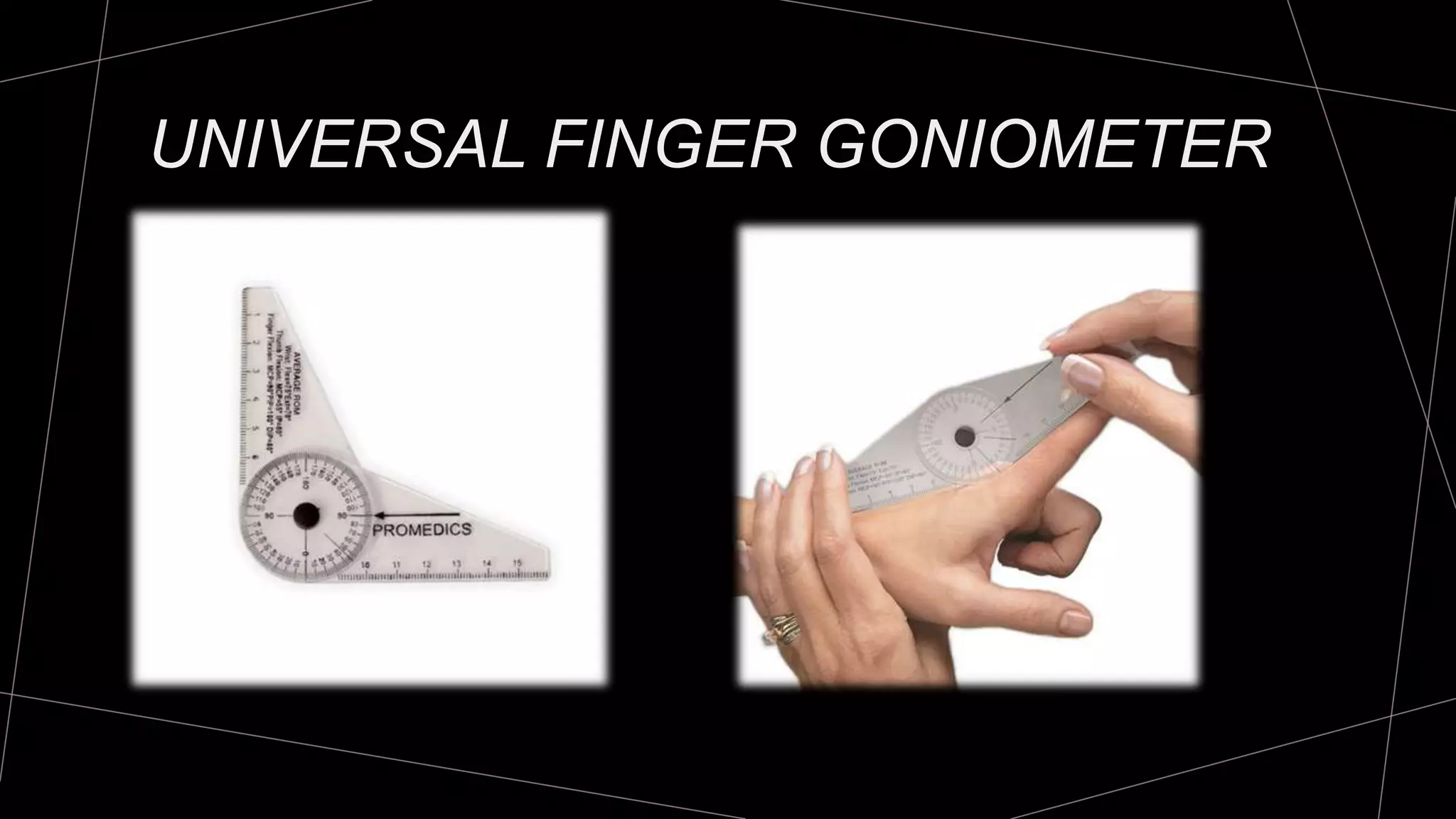
UNIVERSAL FINGER GONIOMETER
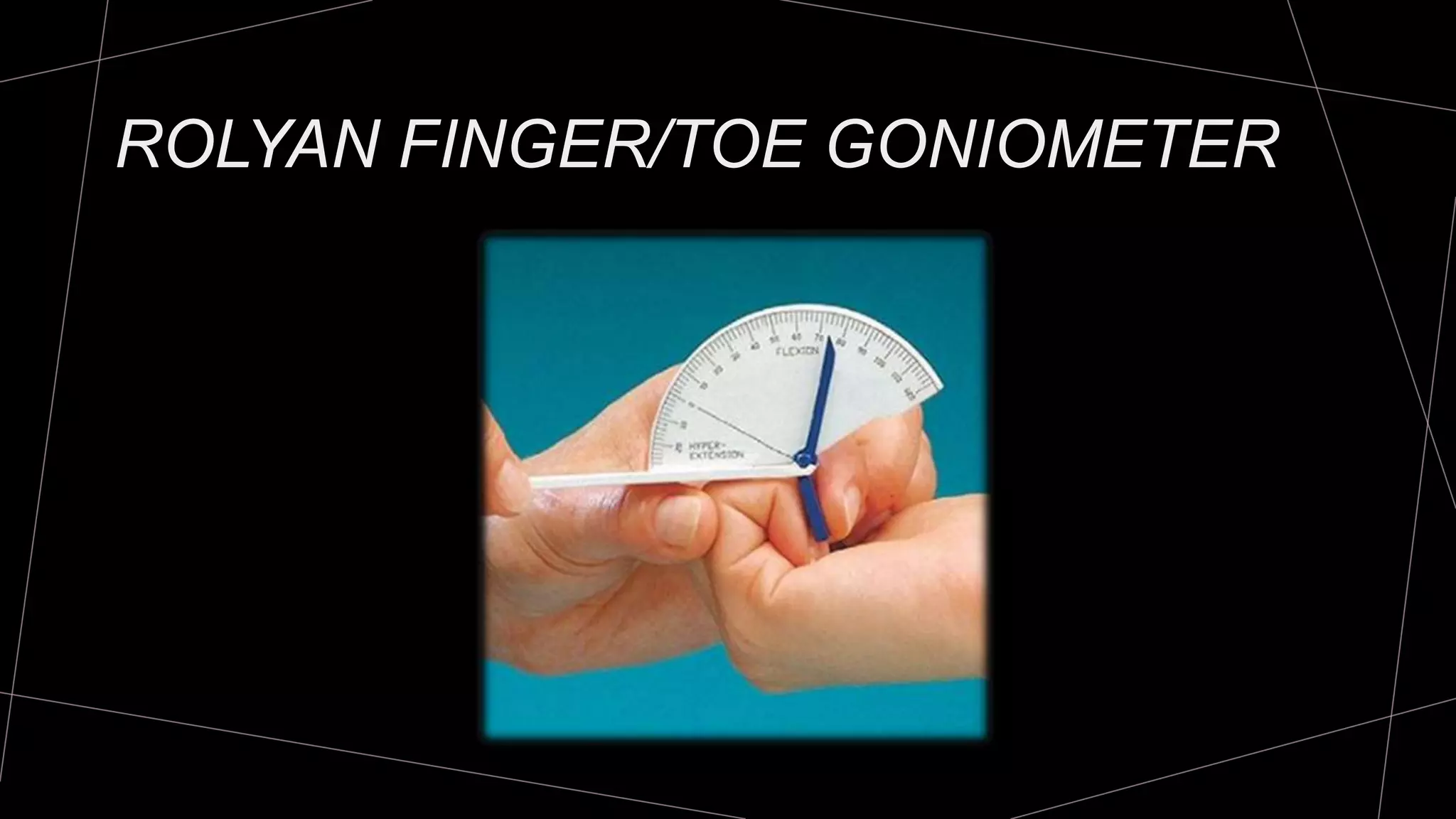
ROLYAN FINGER/TOE GONIOMETER
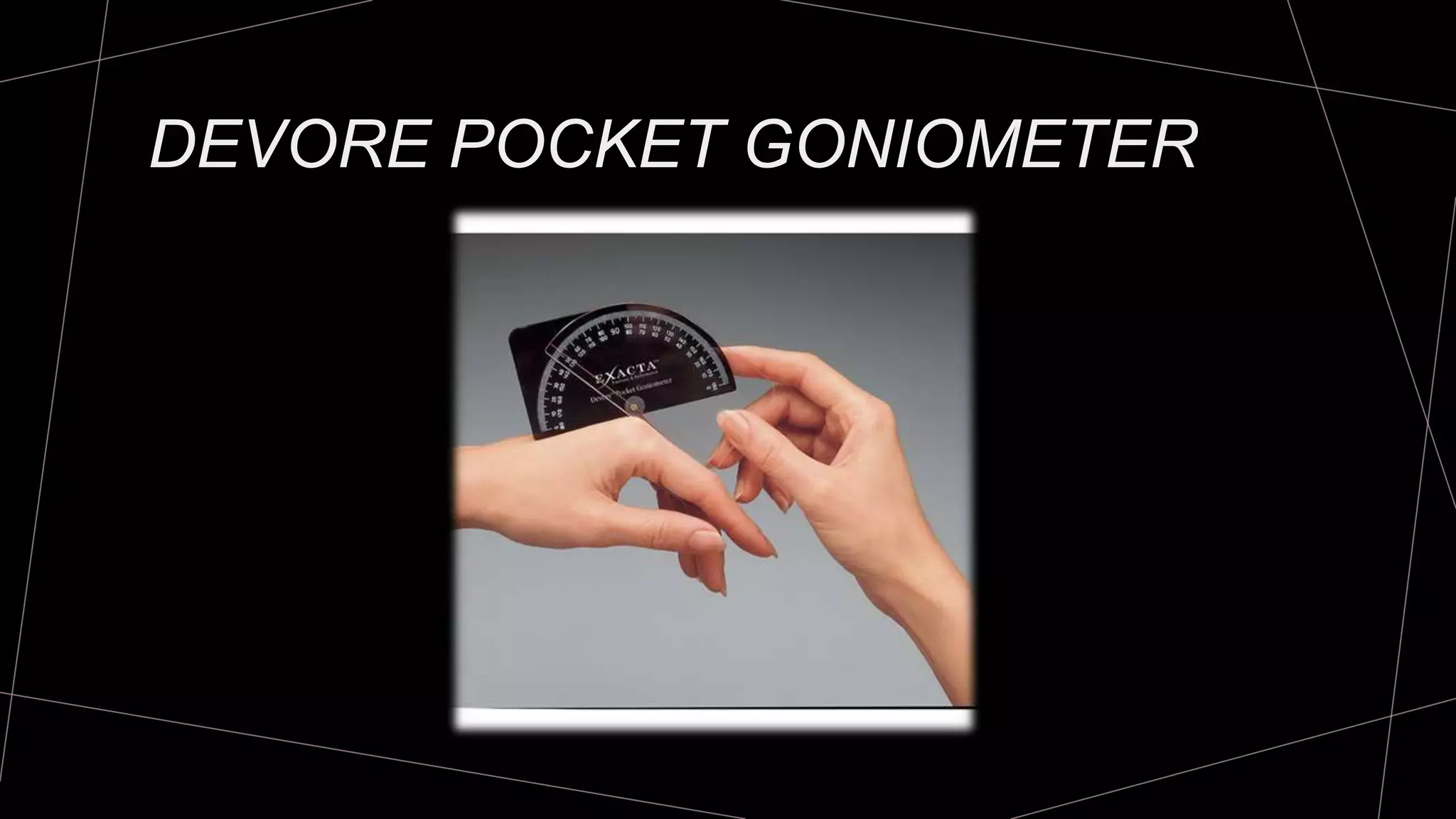
DEVORE POCKET GONIOMETER
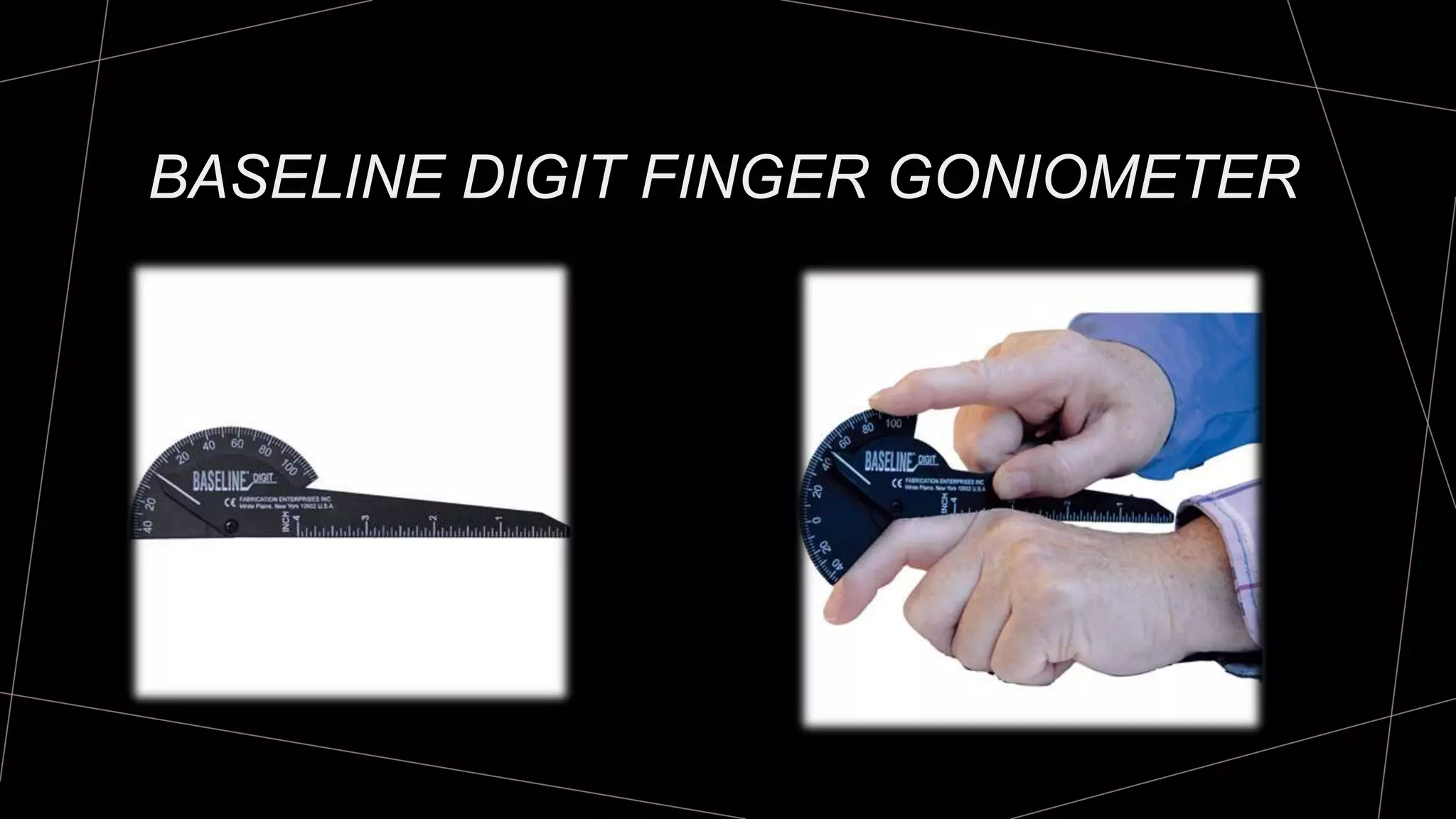
BASELINE DIGIT FINGER GONIOMETER
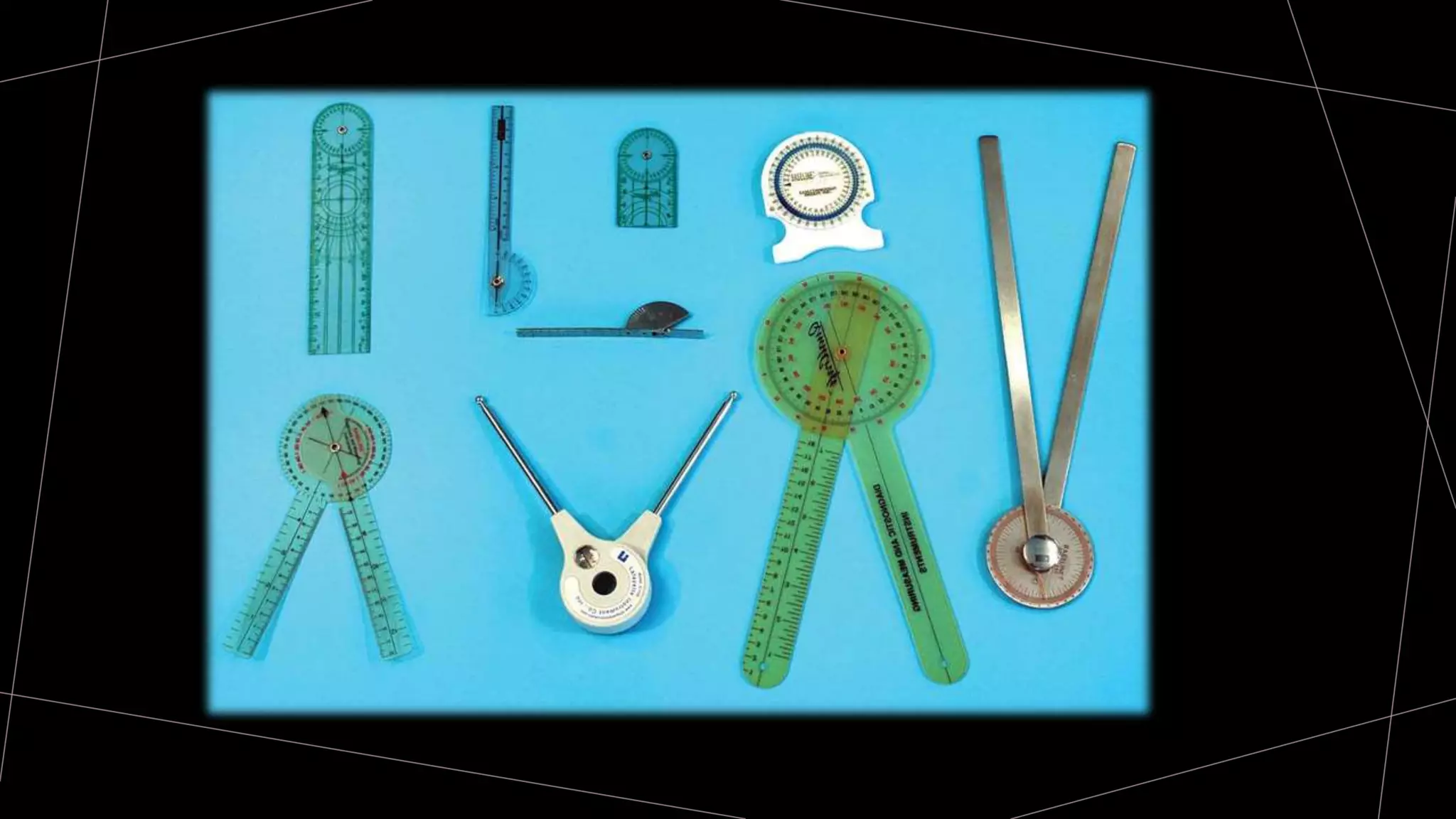
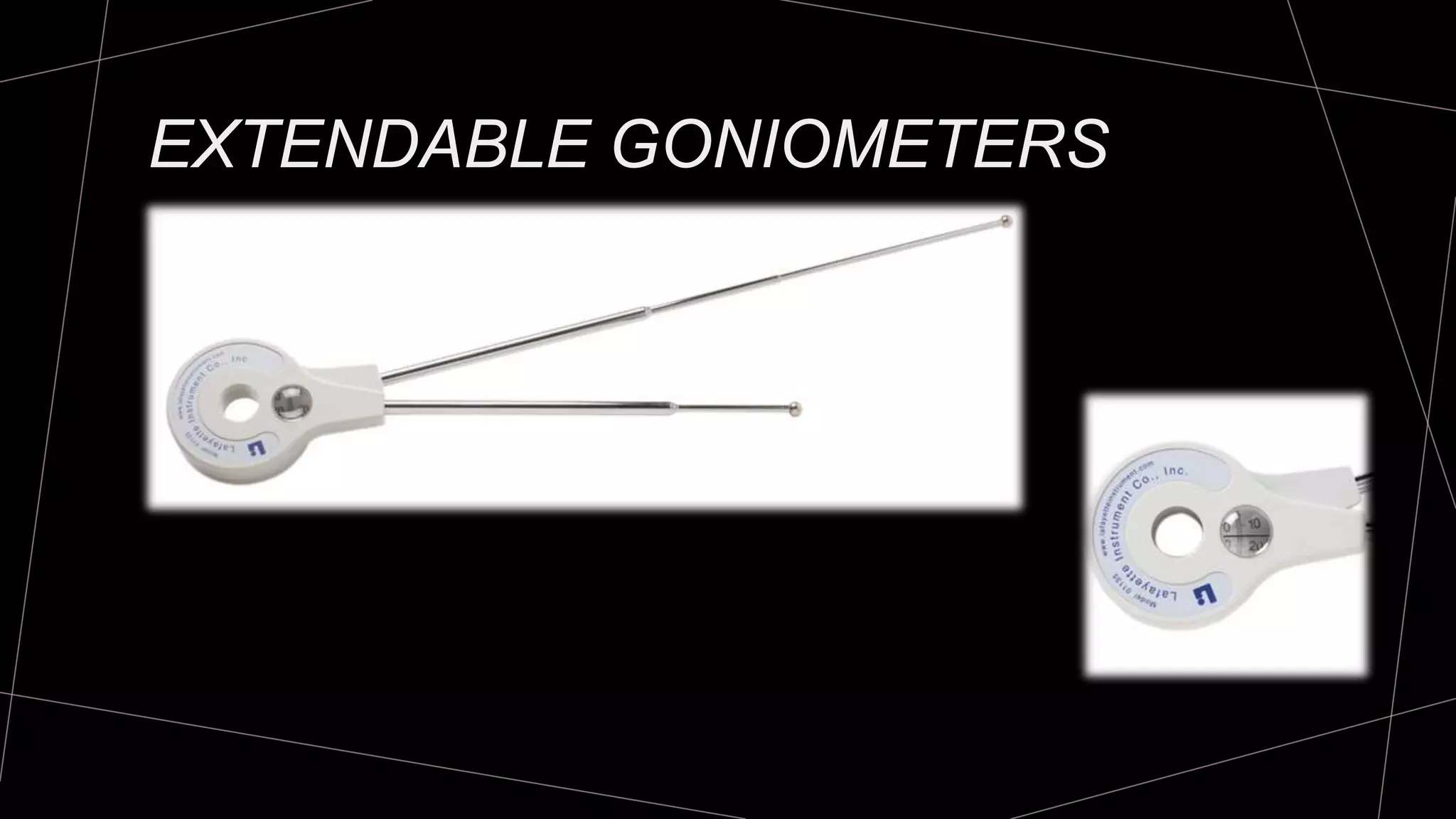
EXTENDABLE GONIOMETERS
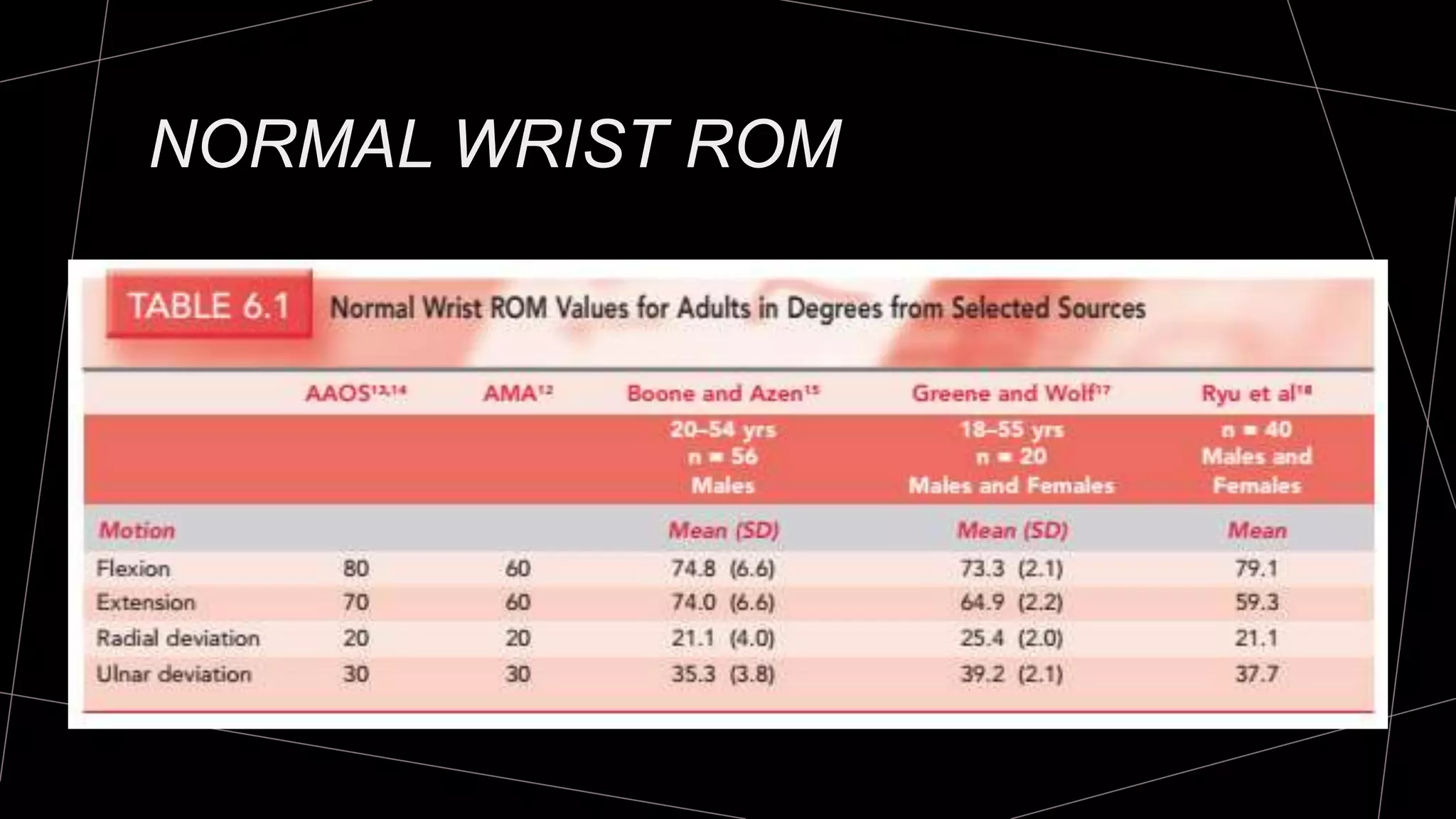
NORMAL WRIST ROM
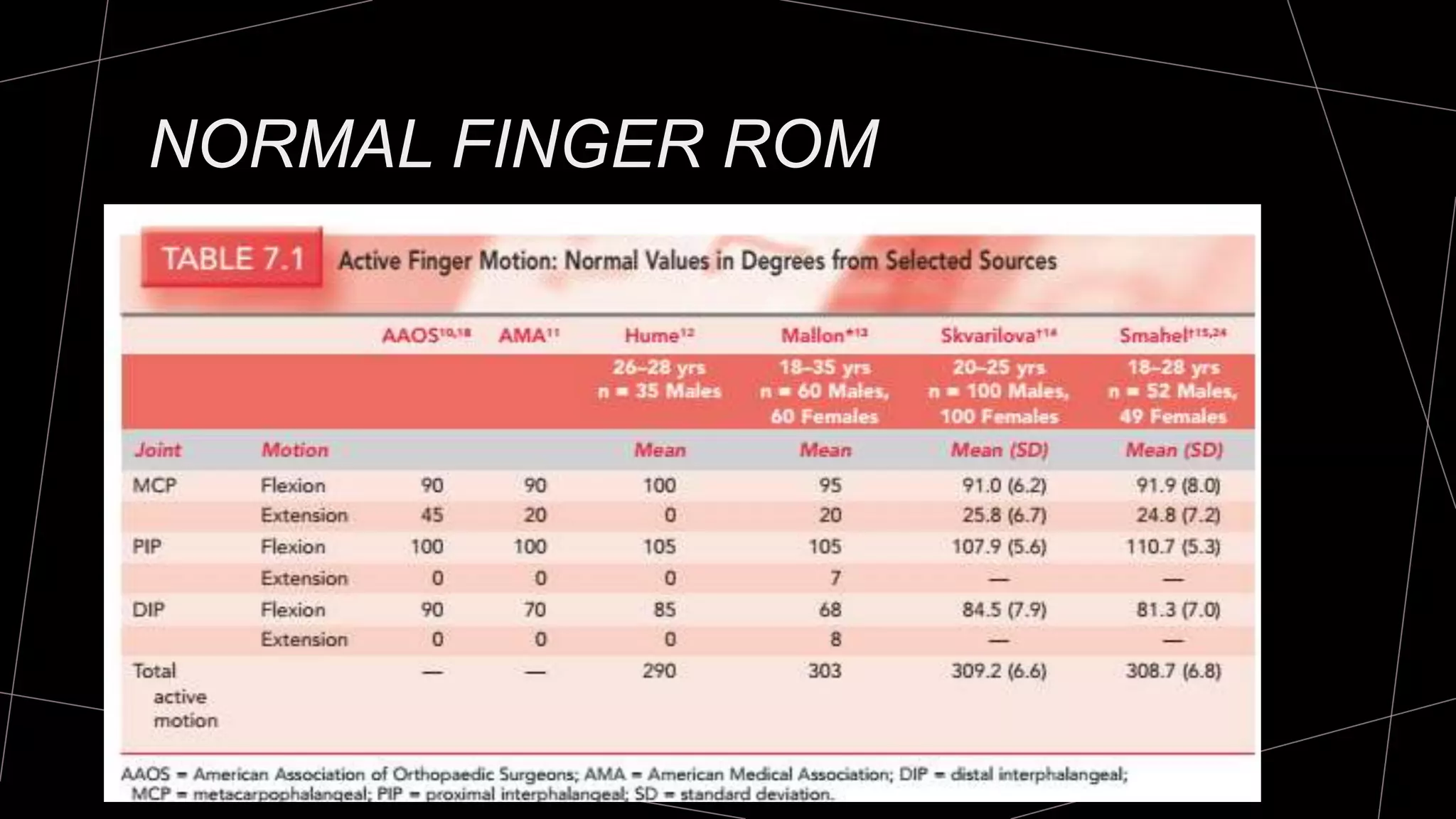
NORMAL FINGER ROM
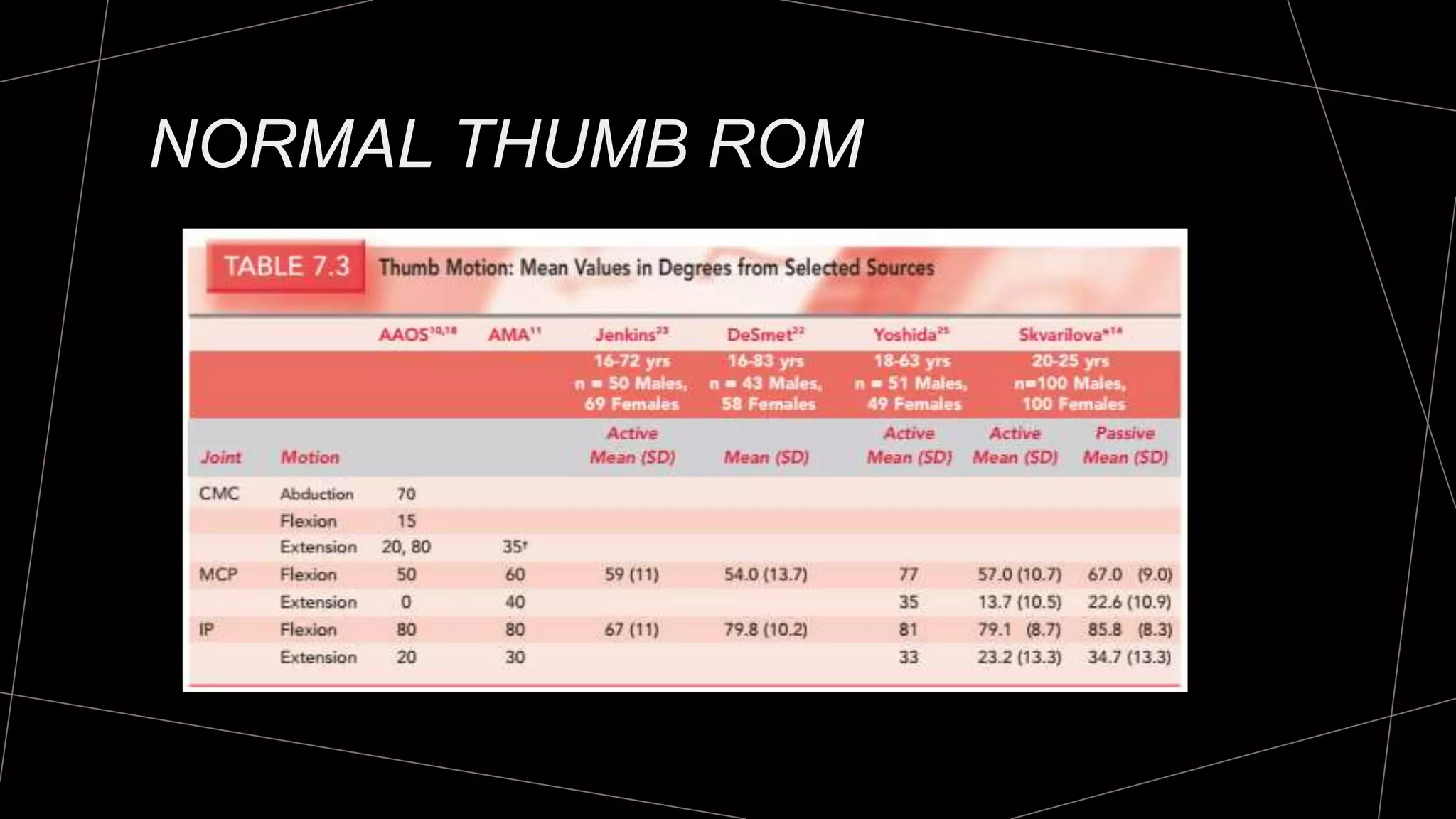
NORMAL THUMB ROM
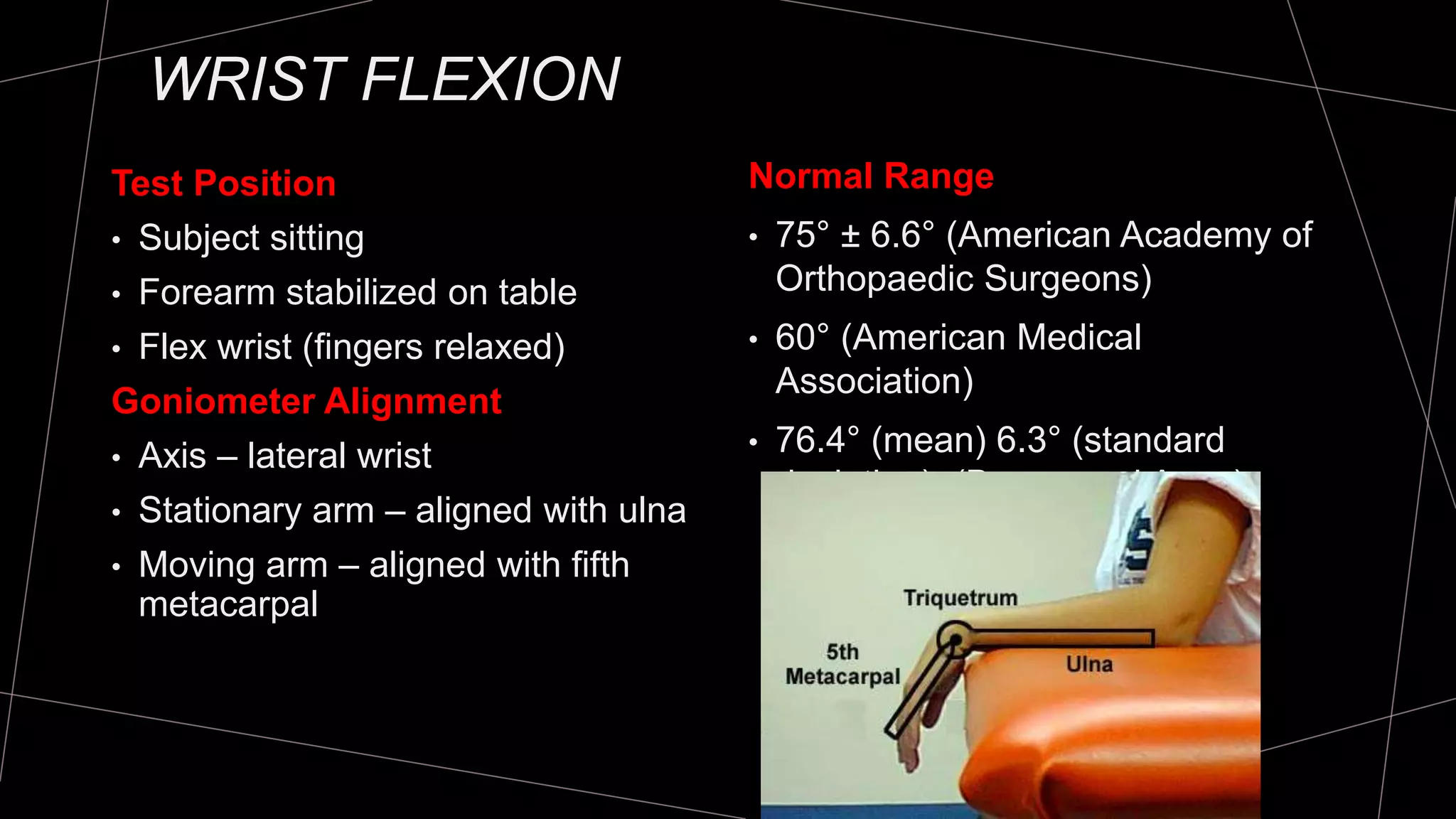
WRIST FLEXION
Test Position
• Subject sitting
• Forearm stabilized on table
• Flex wrist (fingers relaxed)
Goniometer Alignment
• Axis – lateral wrist
• Stationary arm – aligned with ulna
• Moving arm – aligned with fifth
metacarpal
Normal Range
• 75° ± 6.6° (American Academy of
Orthopaedic Surgeons)
• 60° (American Medical
Association)
• 76.4° (mean) 6.3° (standard
deviation), (Boone and Azen)
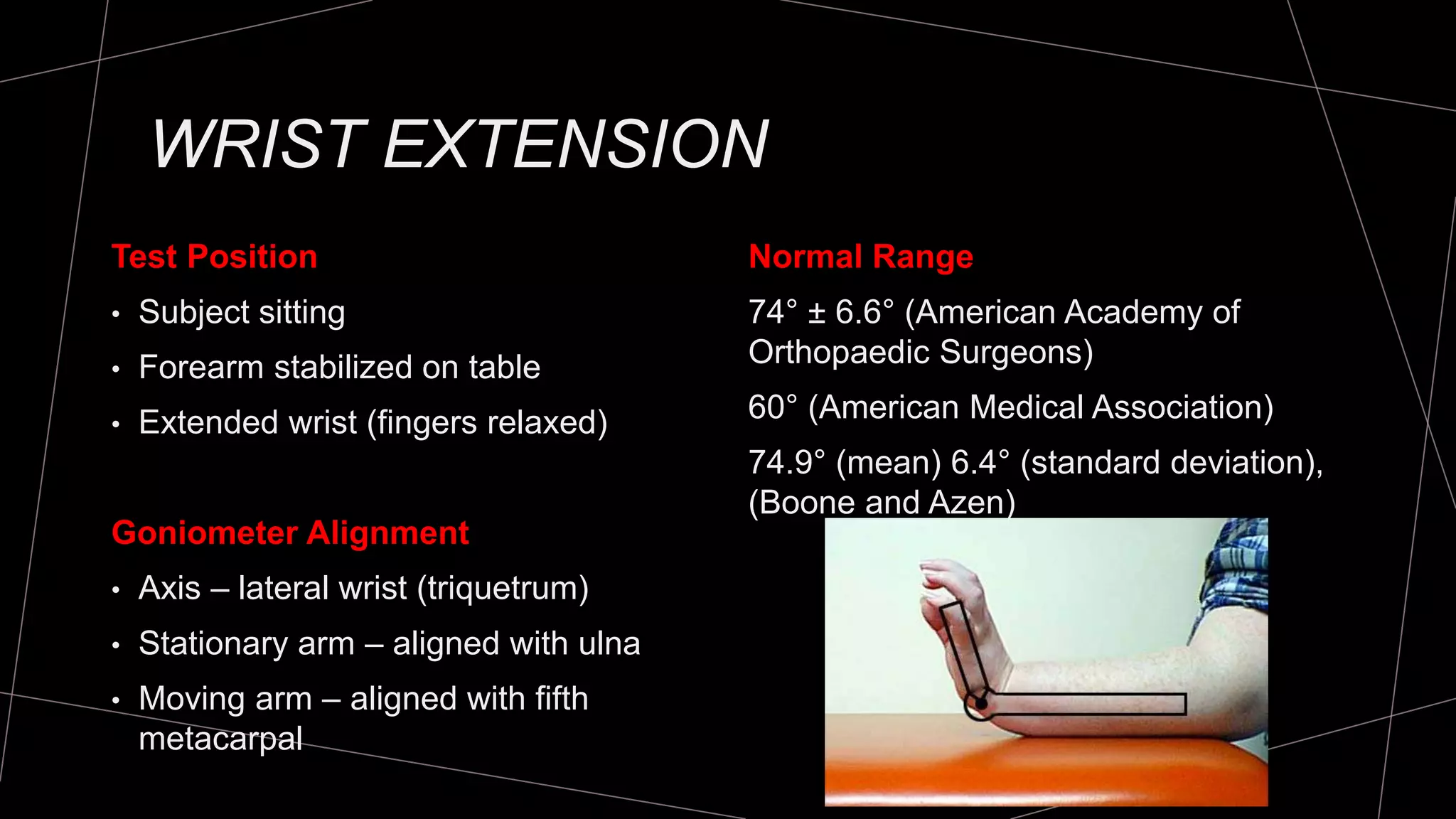
WRIST EXTENSION
Test Position
• Subject sitting
• Forearm stabilized on table
• Extended wrist (fingers relaxed)
Goniometer Alignment
• Axis – lateral wrist (triquetrum)
• Stationary arm – aligned with ulna
• Moving arm – aligned with fifth
metacarpal
Normal Range
74° ± 6.6° (American Academy of
Orthopaedic Surgeons)
60° (American Medical Association)
74.9° (mean) 6.4° (standard deviation),
(Boone and Azen)
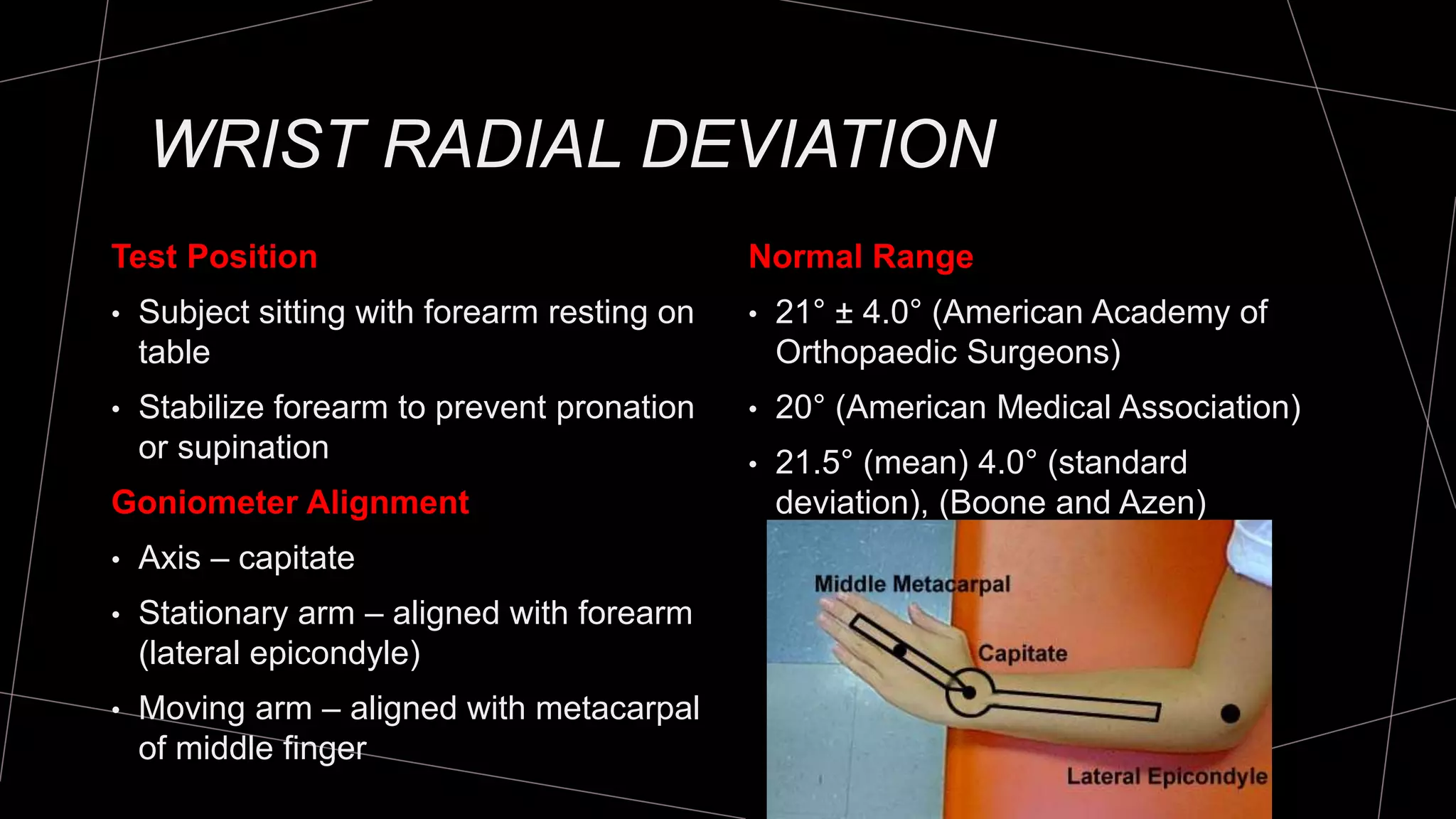
WRIST RADIAL DEVIATION
Test Position
• Subject sitting with forearm resting on
table
• Stabilize forearm to prevent pronation
or supination
Goniometer Alignment
• Axis – capitate
• Stationary arm – aligned with forearm
(lateral epicondyle)
• Moving arm – aligned with metacarpal
of middle finger
Normal Range
• 21° ± 4.0° (American Academy of
Orthopaedic Surgeons)
• 20° (American Medical Association)
• 21.5° (mean) 4.0° (standard
deviation), (Boone and Azen)
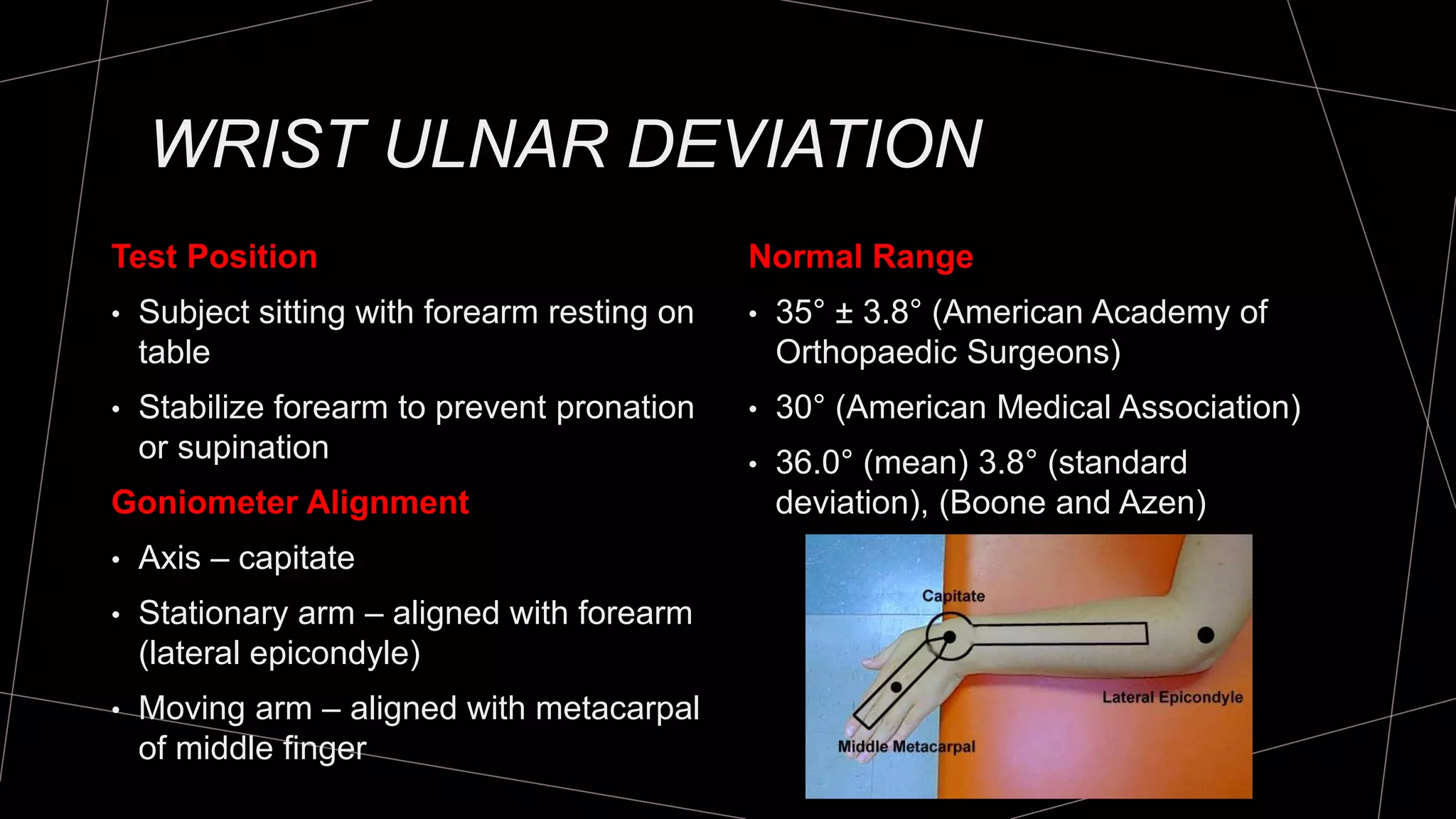
WRIST ULNAR DEVIATION
Test Position
• Subject sitting with forearm resting on
table
• Stabilize forearm to prevent pronation
or supination
Goniometer Alignment
• Axis – capitate
• Stationary arm – aligned with forearm
(lateral epicondyle)
• Moving arm – aligned with metacarpal
of middle finger
Normal Range
• 35° ± 3.8° (American Academy of
Orthopaedic Surgeons)
• 30° (American Medical Association)
• 36.0° (mean) 3.8° (standard
deviation), (Boone and Azen)
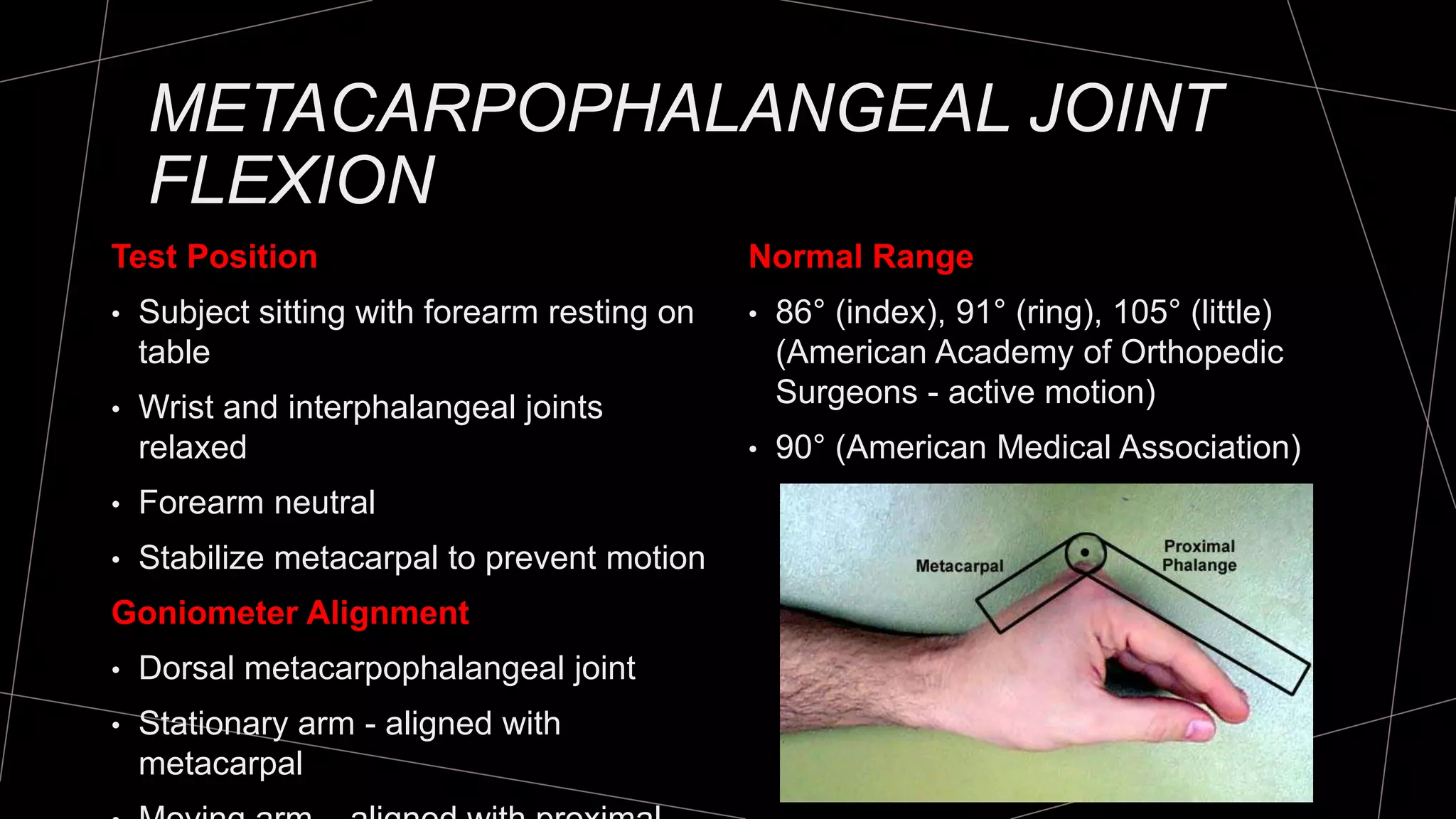
METACARPOPHALANGEAL JOINT
FLEXION
Test Position
• Subject sitting with forearm resting on
table
• Wrist and interphalangeal joints
relaxed
• Forearm neutral
• Stabilize metacarpal to prevent motion
Goniometer Alignment
• Dorsal metacarpophalangeal joint
• Stationary arm - aligned with
metacarpal
Normal Range
• 86° (index), 91° (ring), 105° (little)
(American Academy of Orthopedic
Surgeons - active motion)
• 90° (American Medical Association)
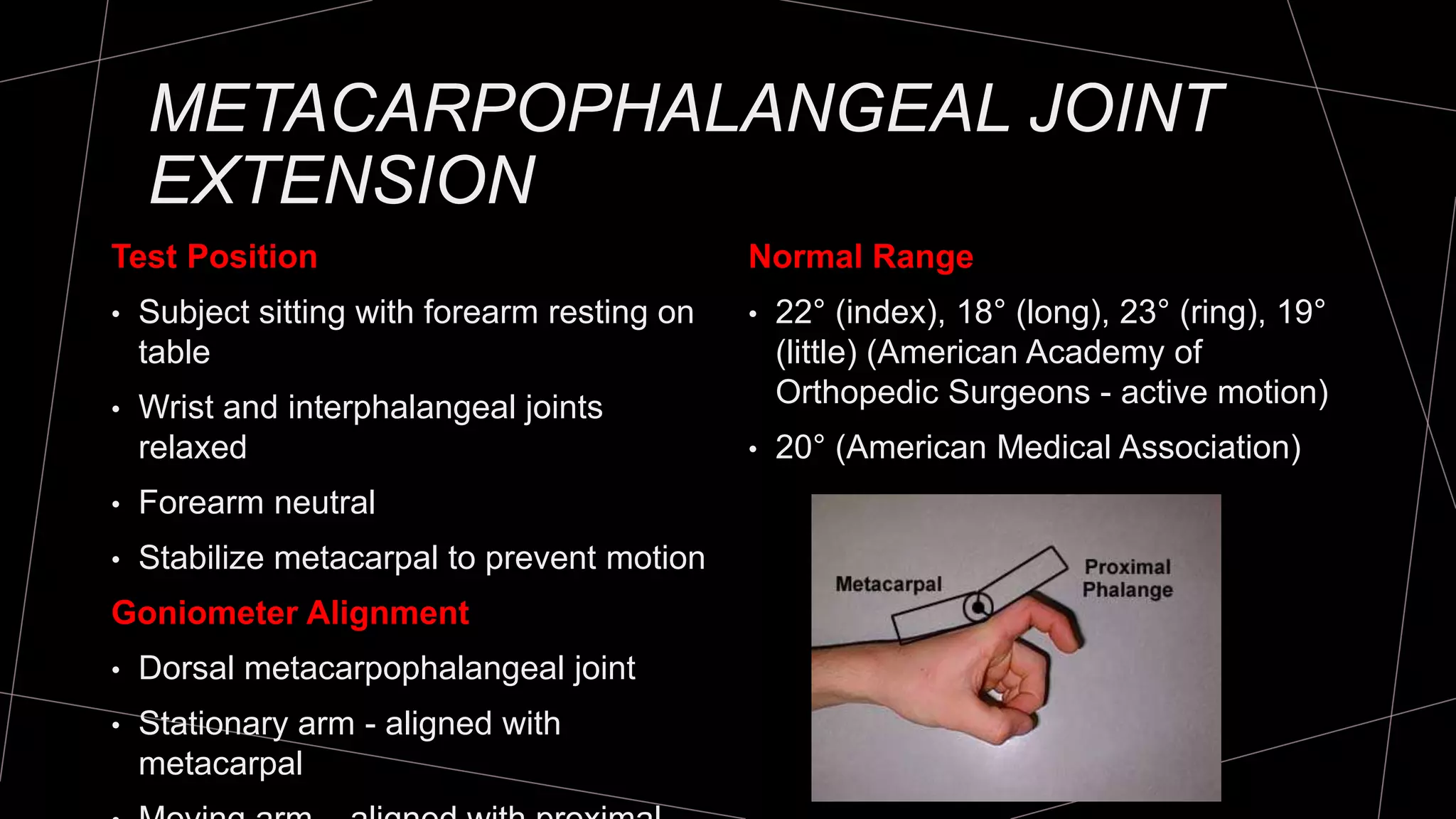
METACARPOPHALANGEAL JOINT
EXTENSION
Test Position
• Subject sitting with forearm resting on
table
• Wrist and interphalangeal joints
relaxed
• Forearm neutral
• Stabilize metacarpal to prevent motion
Goniometer Alignment
• Dorsal metacarpophalangeal joint
• Stationary arm - aligned with
metacarpal
Normal Range
• 22° (index), 18° (long), 23° (ring), 19°
(little) (American Academy of
Orthopedic Surgeons - active motion)
• 20° (American Medical Association)
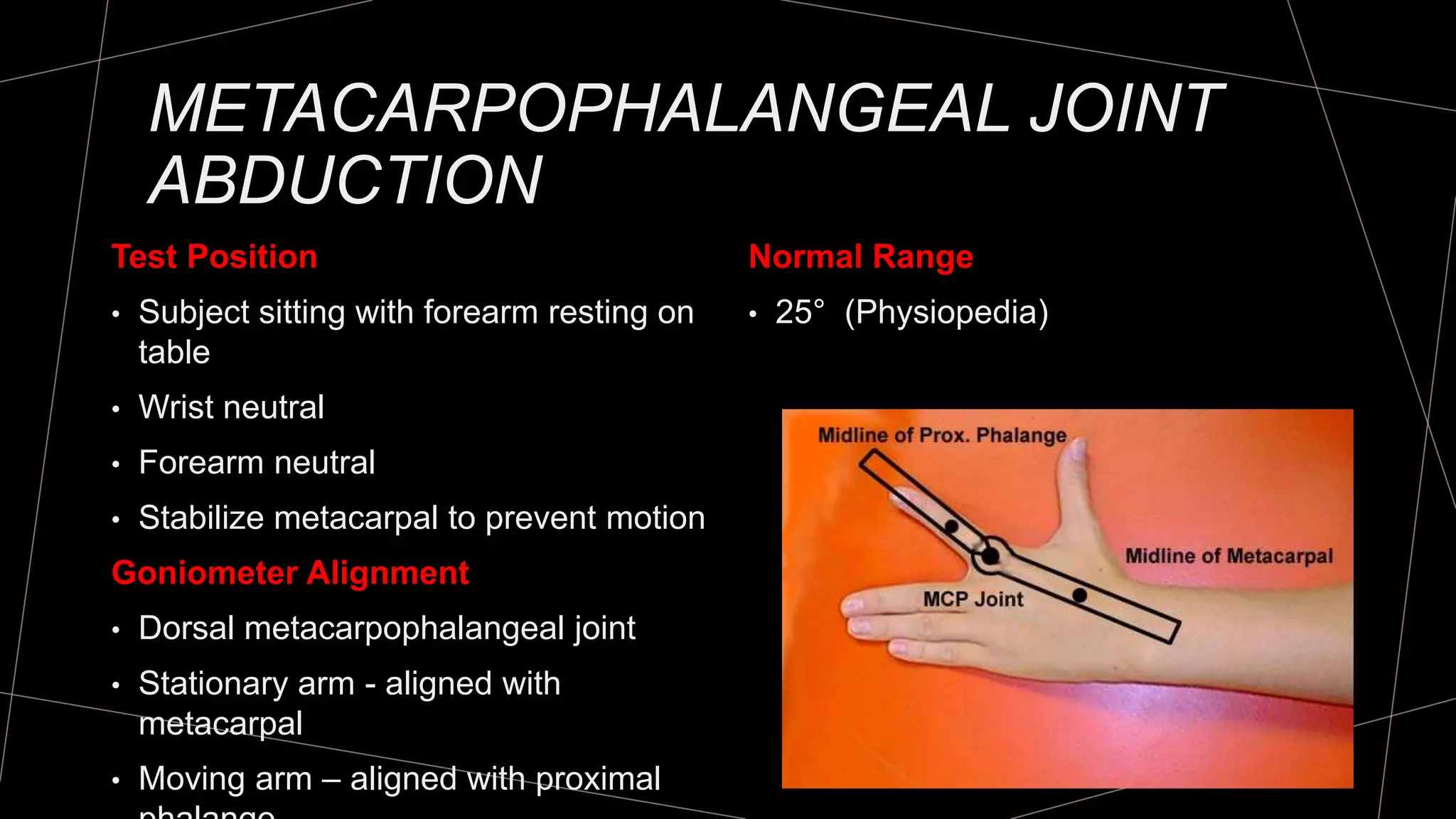
METACARPOPHALANGEAL JOINT
ABDUCTION
Test Position
• Subject sitting with forearm resting on
table
• Wrist neutral
• Forearm neutral
• Stabilize metacarpal to prevent motion
Goniometer Alignment
• Dorsal metacarpophalangeal joint
• Stationary arm - aligned with
metacarpal
• Moving arm – aligned with proximal
Normal Range
• 25° (Physiopedia)
METACARPOPHALANGEAL JOINT
ADDUCTION
Test Position
• Subject sitting with forearm resting on
table
• Wrist neutral
• Forearm neutral
• Stabilize metacarpal to prevent motion
Goniometer Alignment
• Dorsal metacarpophalangeal joint
• Stationary arm - aligned with
metacarpal
• Moving arm – aligned with proximal
Normal Range
• Either 0° or usually not measured.
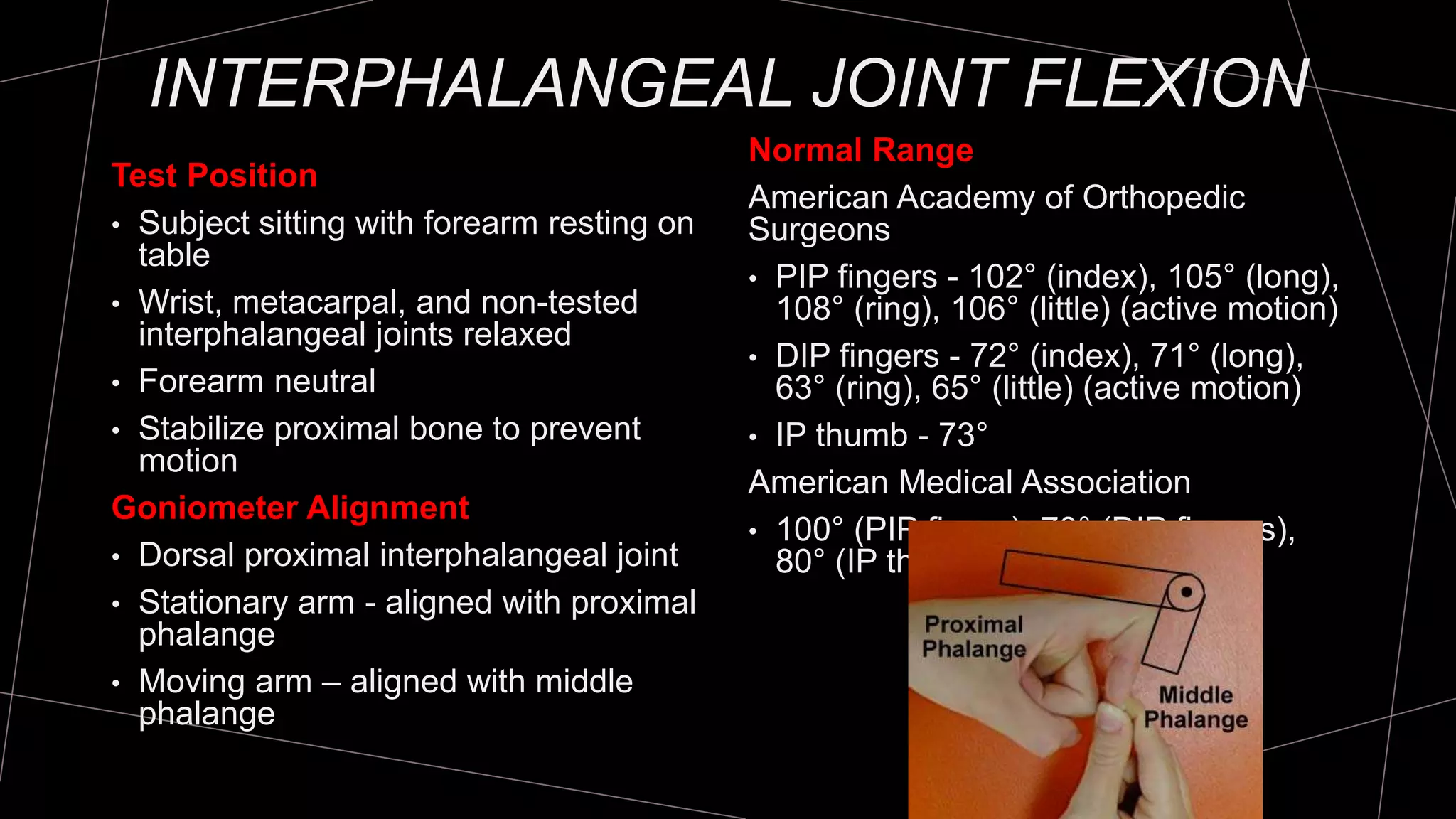
INTERPHALANGEAL JOINT FLEXION
Test Position
• Subject sitting with forearm resting on
table
• Wrist, metacarpal, and non-tested
interphalangeal joints relaxed
• Forearm neutral
• Stabilize proximal bone to prevent
motion
Goniometer Alignment
• Dorsal proximal interphalangeal joint
• Stationary arm - aligned with proximal
phalange
• Moving arm – aligned with middle
phalange
Normal Range
American Academy of Orthopedic
Surgeons
• PIP fingers - 102° (index), 105° (long),
108° (ring), 106° (little) (active motion)
• DIP fingers - 72° (index), 71° (long),
63° (ring), 65° (little) (active motion)
• IP thumb - 73°
American Medical Association
• 100° (PIP finger), 70° (DIP fingers),
80° (IP thumb)
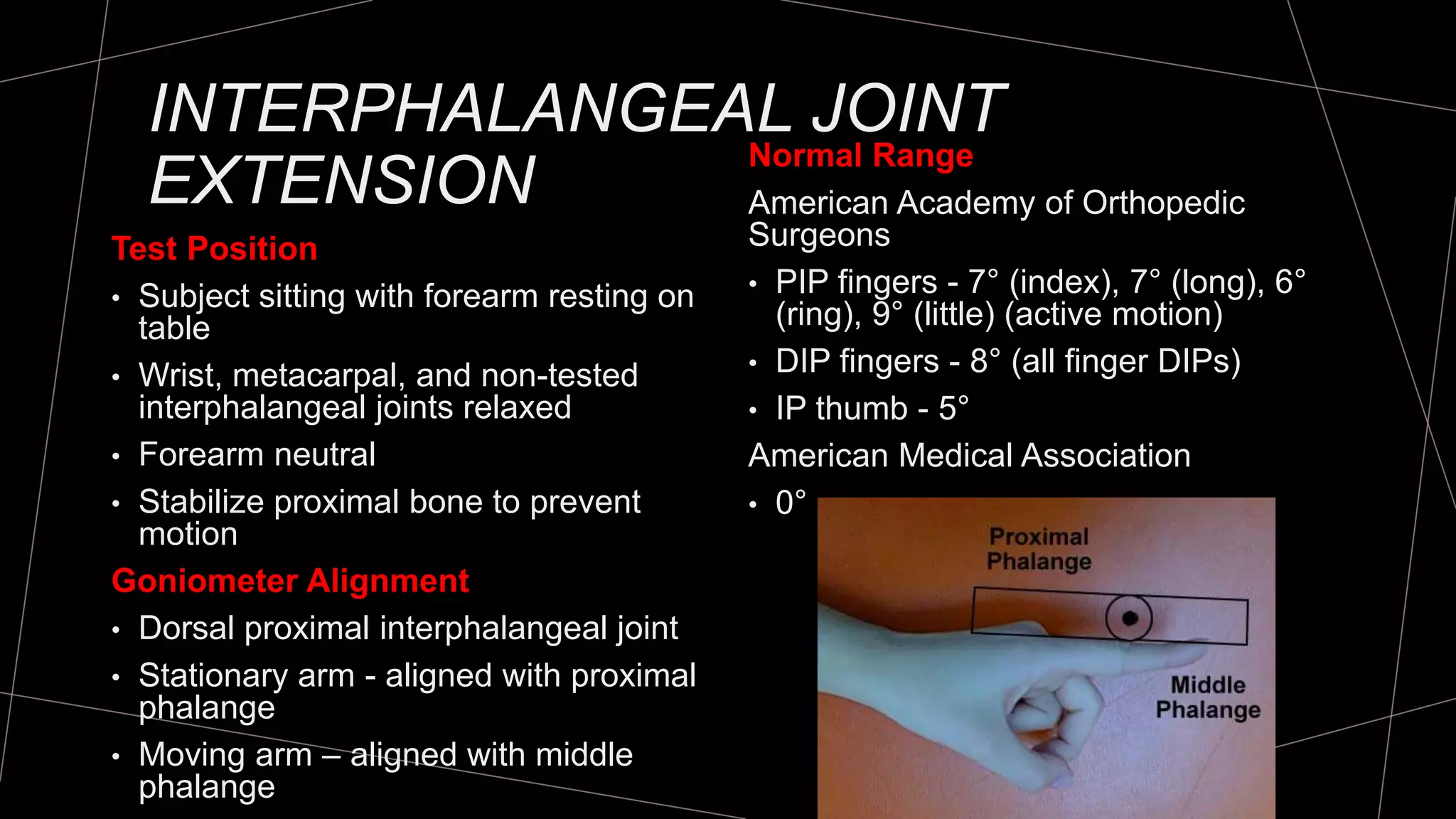
INTERPHALANGEAL JOINT
EXTENSION
Test Position
• Subject sitting with forearm resting on
table
• Wrist, metacarpal, and non-tested
interphalangeal joints relaxed
• Forearm neutral
• Stabilize proximal bone to prevent
motion
Goniometer Alignment
• Dorsal proximal interphalangeal joint
• Stationary arm - aligned with proximal
phalange
• Moving arm – aligned with middle
phalange
Normal Range
American Academy of Orthopedic
Surgeons
• PIP fingers - 7° (index), 7° (long), 6°
(ring), 9° (little) (active motion)
• DIP fingers - 8° (all finger DIPs)
• IP thumb - 5°
American Medical Association
• 0°
THUMB CARPOMETACARPAL JOINT
FLEXION
Test Position
• Subject sitting with forearm resting on
table
• Wrist neutral
• Stabilize carpals to prevent wrist motion
Goniometer Alignment
• Axis - carpometacarpal joint
• Stationary arm - aligned with radius
• Moving arm – aligned with metacarpal of
thumb
Normal Range
• 15° (American Academy of Orthopedic
Surgeons)
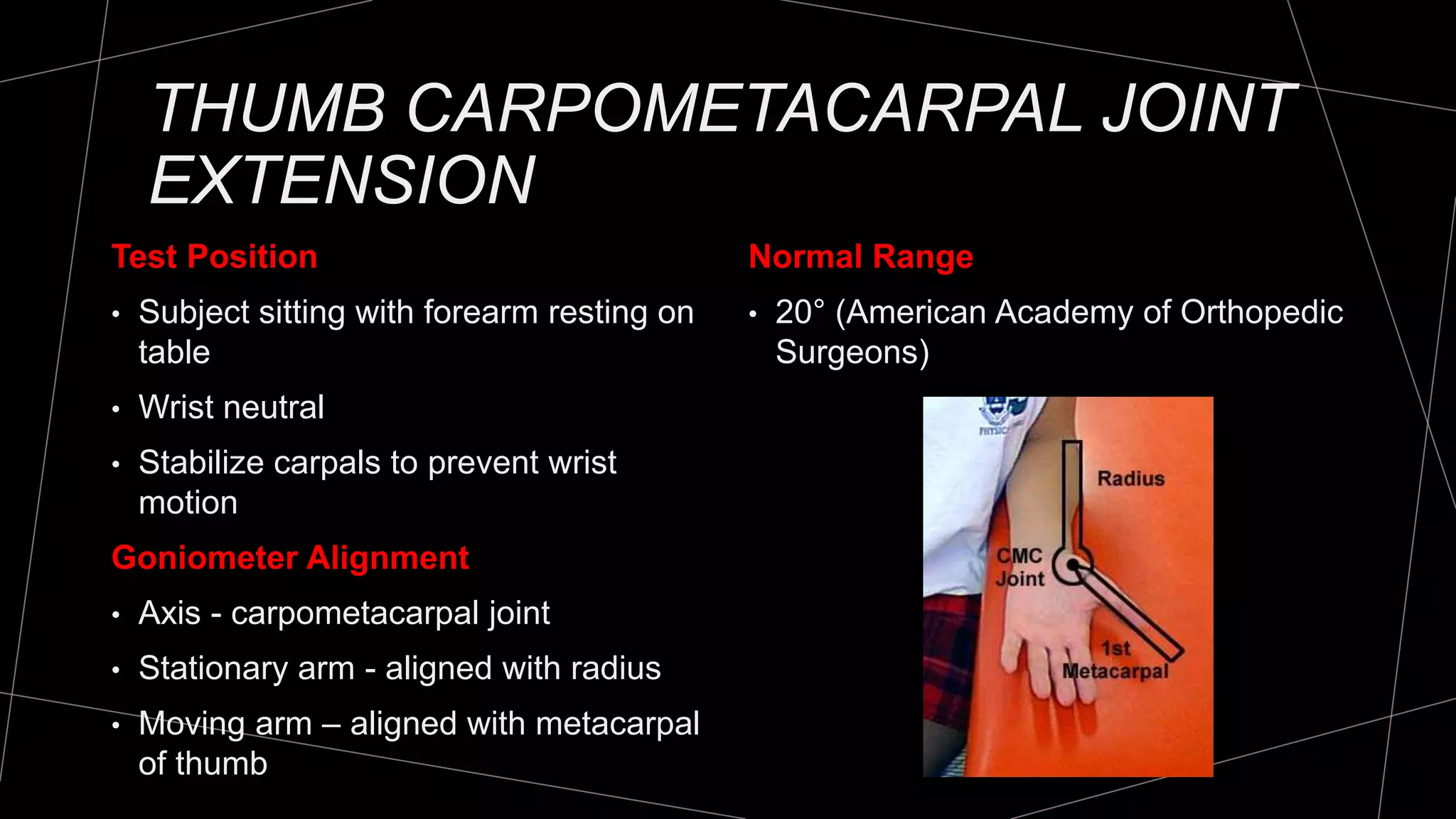
THUMB CARPOMETACARPAL JOINT
EXTENSION
Test Position
• Subject sitting with forearm resting on
table
• Wrist neutral
• Stabilize carpals to prevent wrist
motion
Goniometer Alignment
• Axis - carpometacarpal joint
• Stationary arm - aligned with radius
• Moving arm – aligned with metacarpal
of thumb
Normal Range
• 20° (American Academy of Orthopedic
Surgeons)
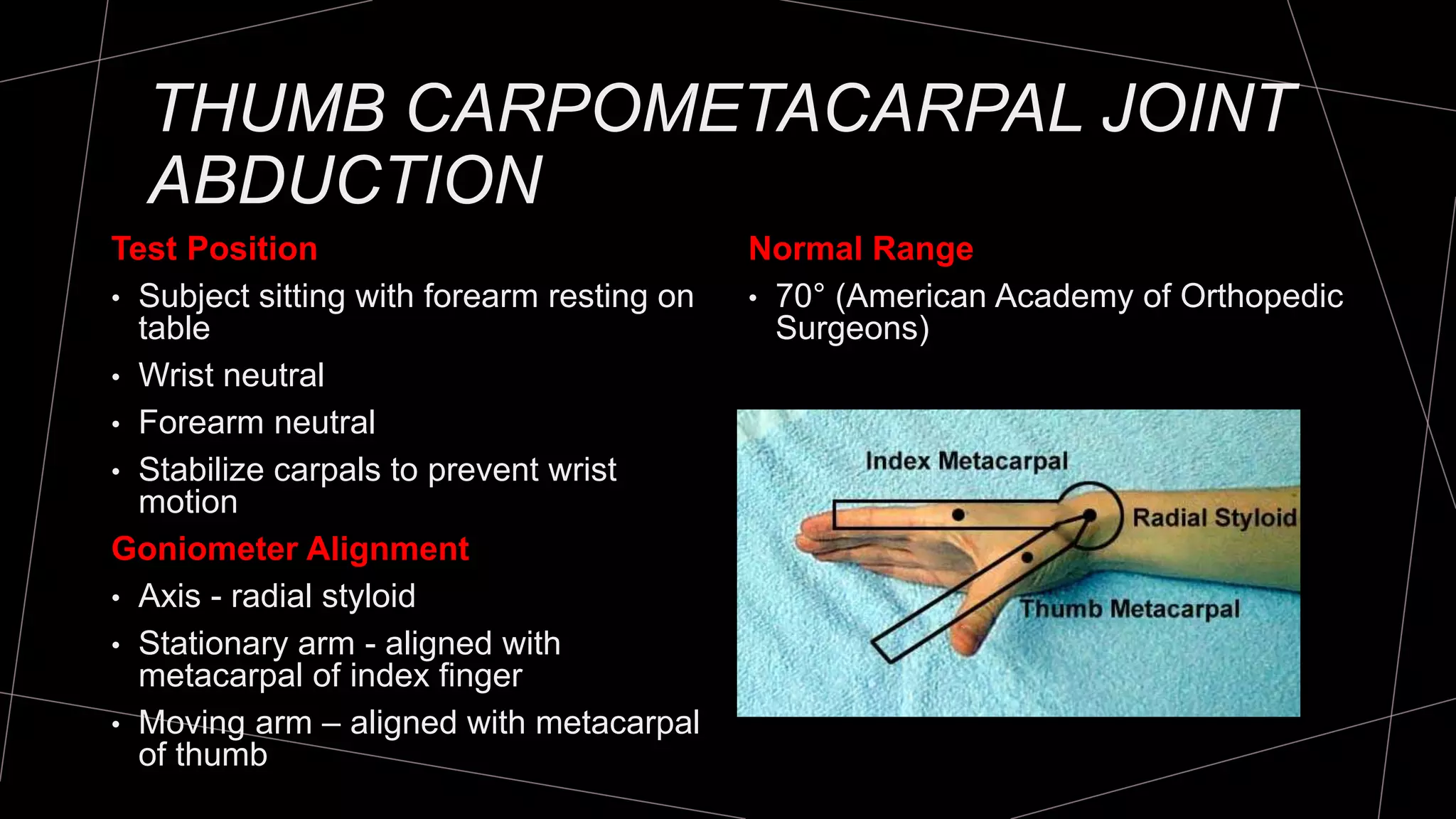
THUMB CARPOMETACARPAL JOINT
ABDUCTION
Test Position
• Subject sitting with forearm resting on
table
• Wrist neutral
• Forearm neutral
• Stabilize carpals to prevent wrist
motion
Goniometer Alignment
• Axis - radial styloid
• Stationary arm - aligned with
metacarpal of index finger
• Moving arm – aligned with metacarpal
of thumb
Normal Range
• 70° (American Academy of Orthopedic
Surgeons)
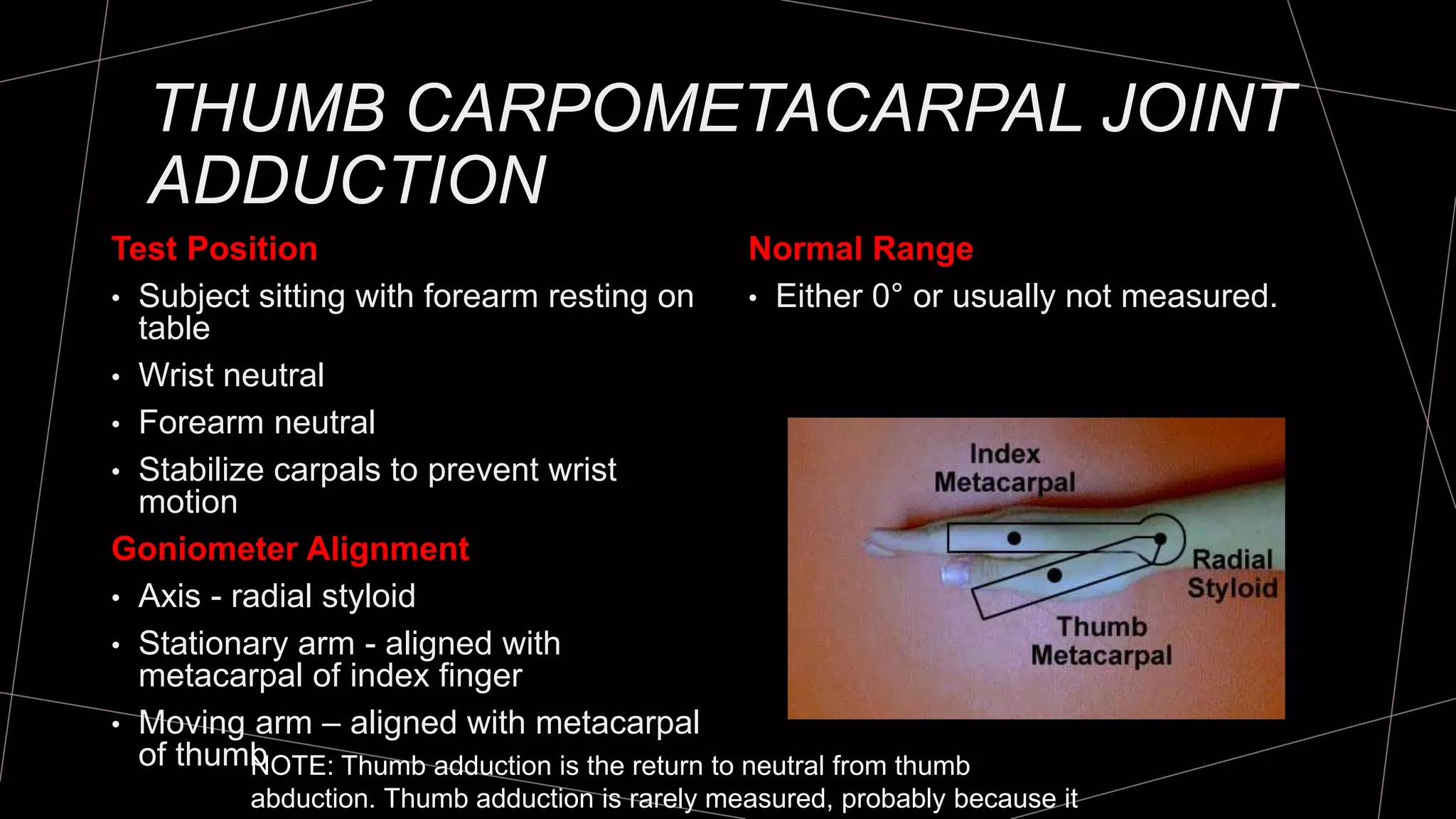
THUMB CARPOMETACARPAL JOINT
ADDUCTION
Test Position
• Subject sitting with forearm resting on
table
• Wrist neutral
• Forearm neutral
• Stabilize carpals to prevent wrist
motion
Goniometer Alignment
• Axis - radial styloid
• Stationary arm - aligned with
metacarpal of index finger
• Moving arm – aligned with metacarpal
of thumb
Normal Range
• Either 0° or usually not measured.
NOTE: Thumb adduction is the return to neutral from thumb
abduction. Thumb adduction is rarely measured, probably because it
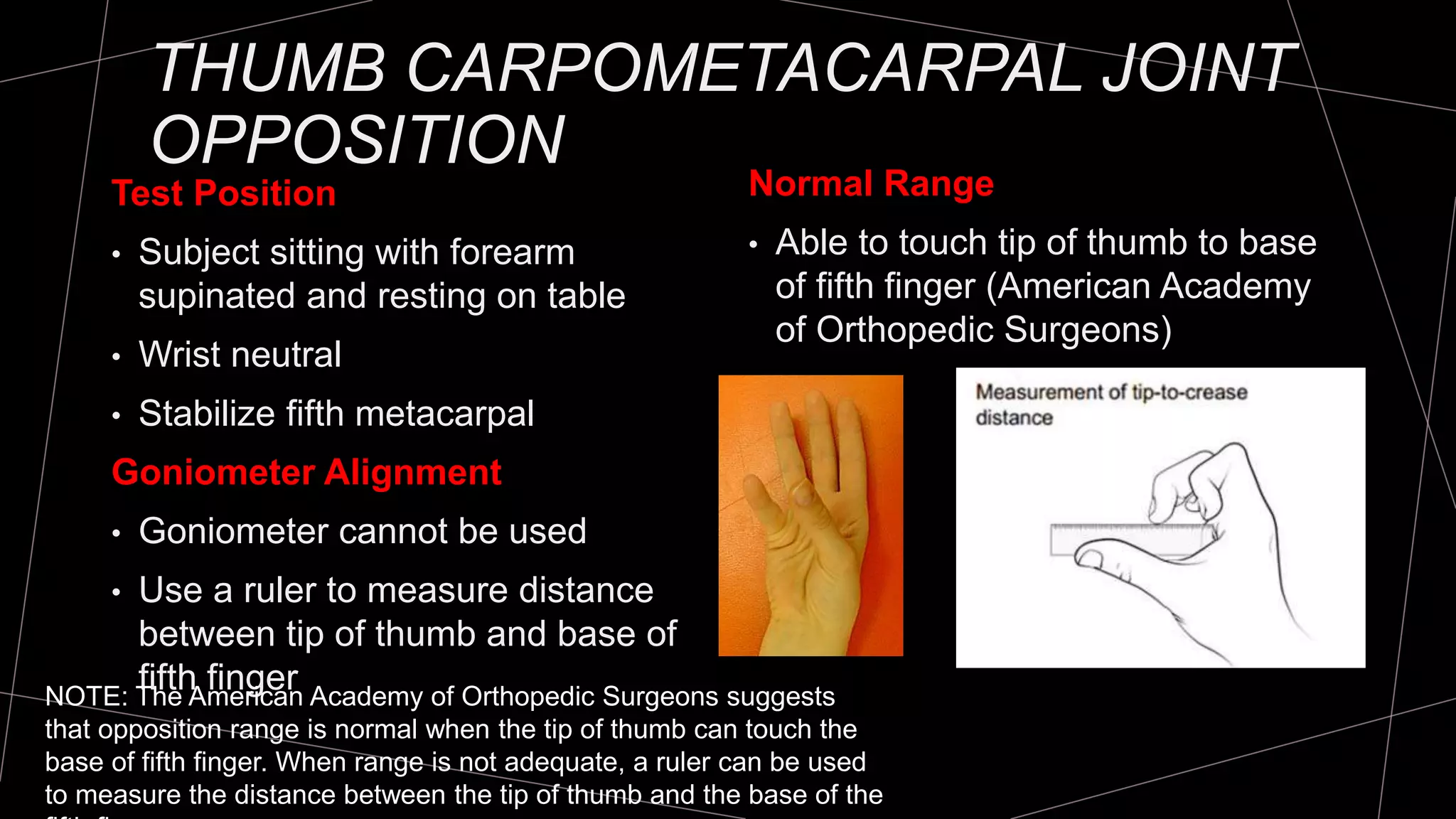
THUMB CARPOMETACARPAL JOINT
OPPOSITION
Test Position
• Subject sitting with forearm
supinated and resting on table
• Wrist neutral
• Stabilize fifth metacarpal
Goniometer Alignment
• Goniometer cannot be used
• Use a ruler to measure distance
between tip of thumb and base of
fifth finger
Normal Range
• Able to touch tip of thumb to base
of fifth finger (American Academy
of Orthopedic Surgeons)
NOTE: The American Academy of Orthopedic Surgeons suggests
that opposition range is normal when the tip of thumb can touch the
base of fifth finger. When range is not adequate, a ruler can be used
to measure the distance between the tip of thumb and the base of the
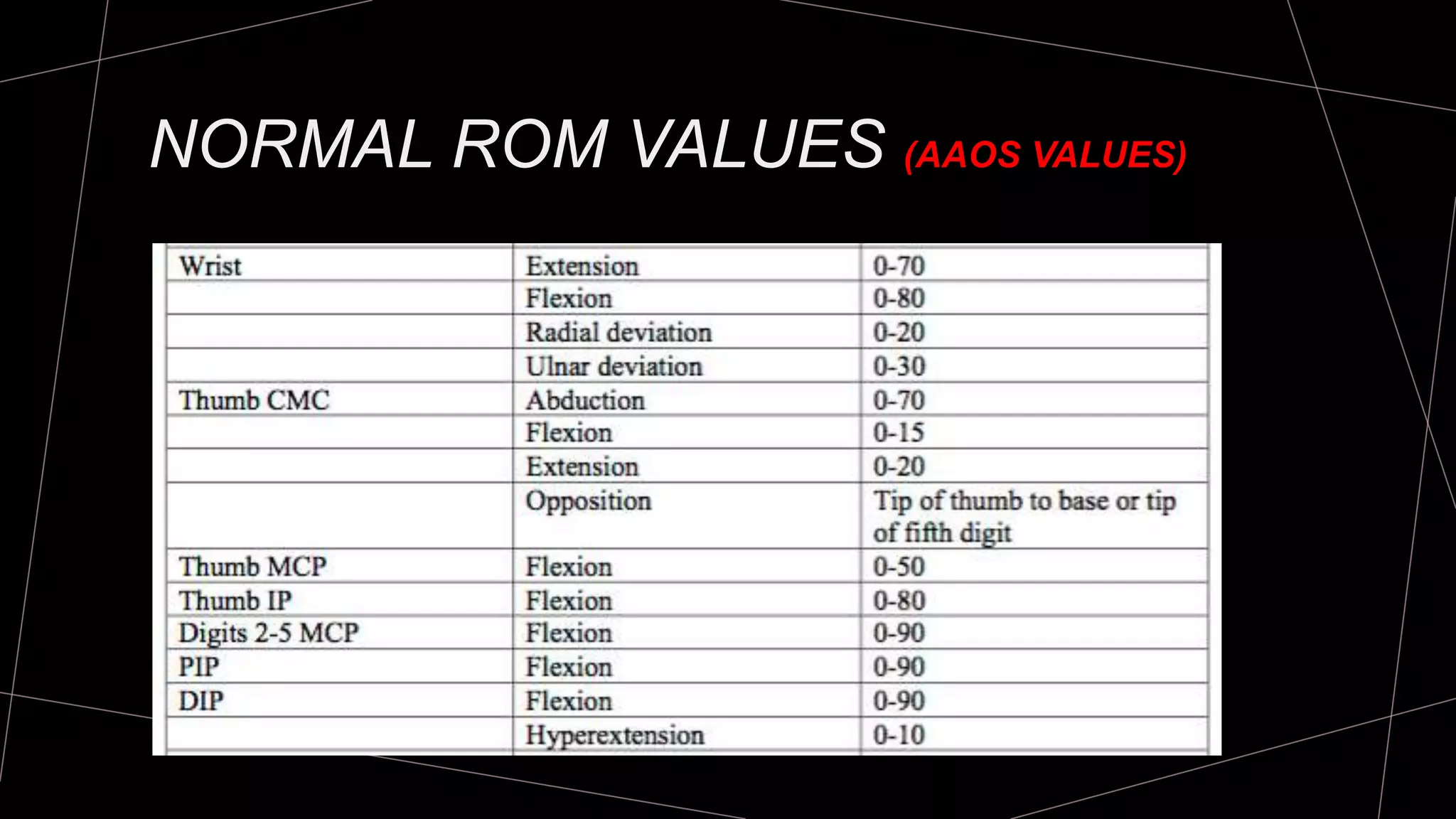
NORMAL ROM VALUES (AAOS VALUES)
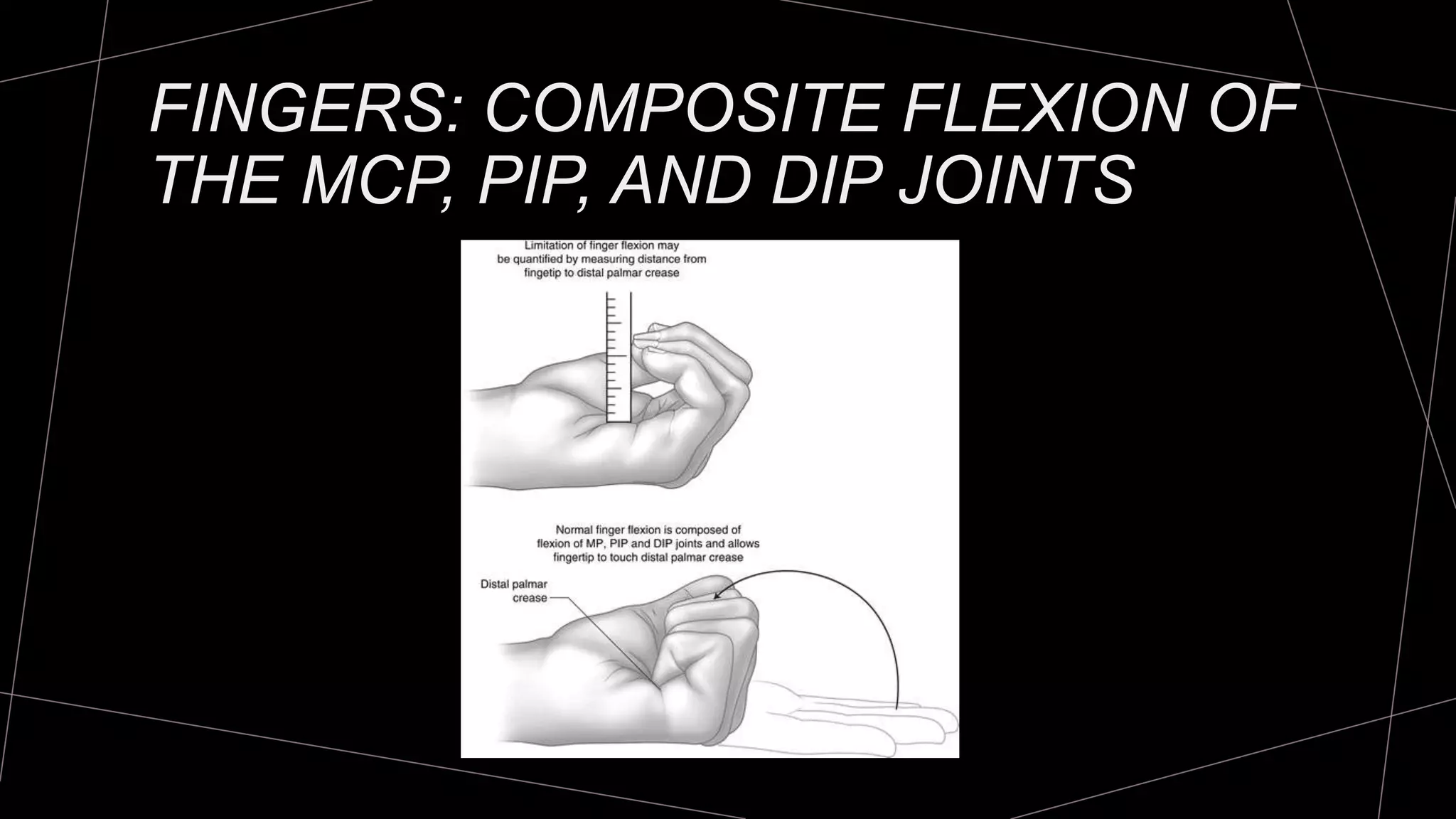
FINGERS: COMPOSITE FLEXION OF
THE MCP, PIP, AND DIP JOINTS
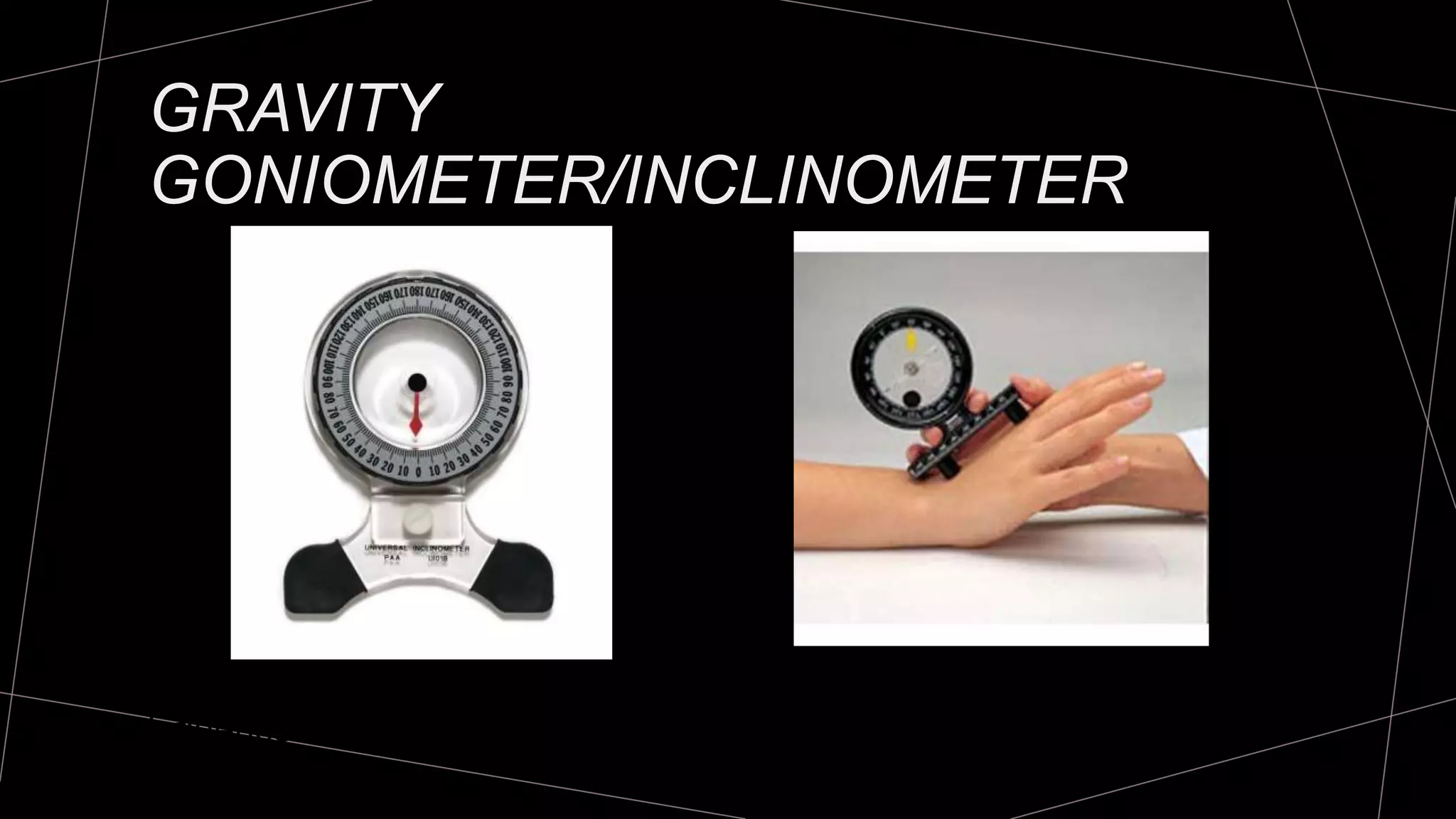
GRAVITY
GONIOMETER/INCLINOMETER
One arm has a weighted pointer that remains vertical under the
influence of gravity
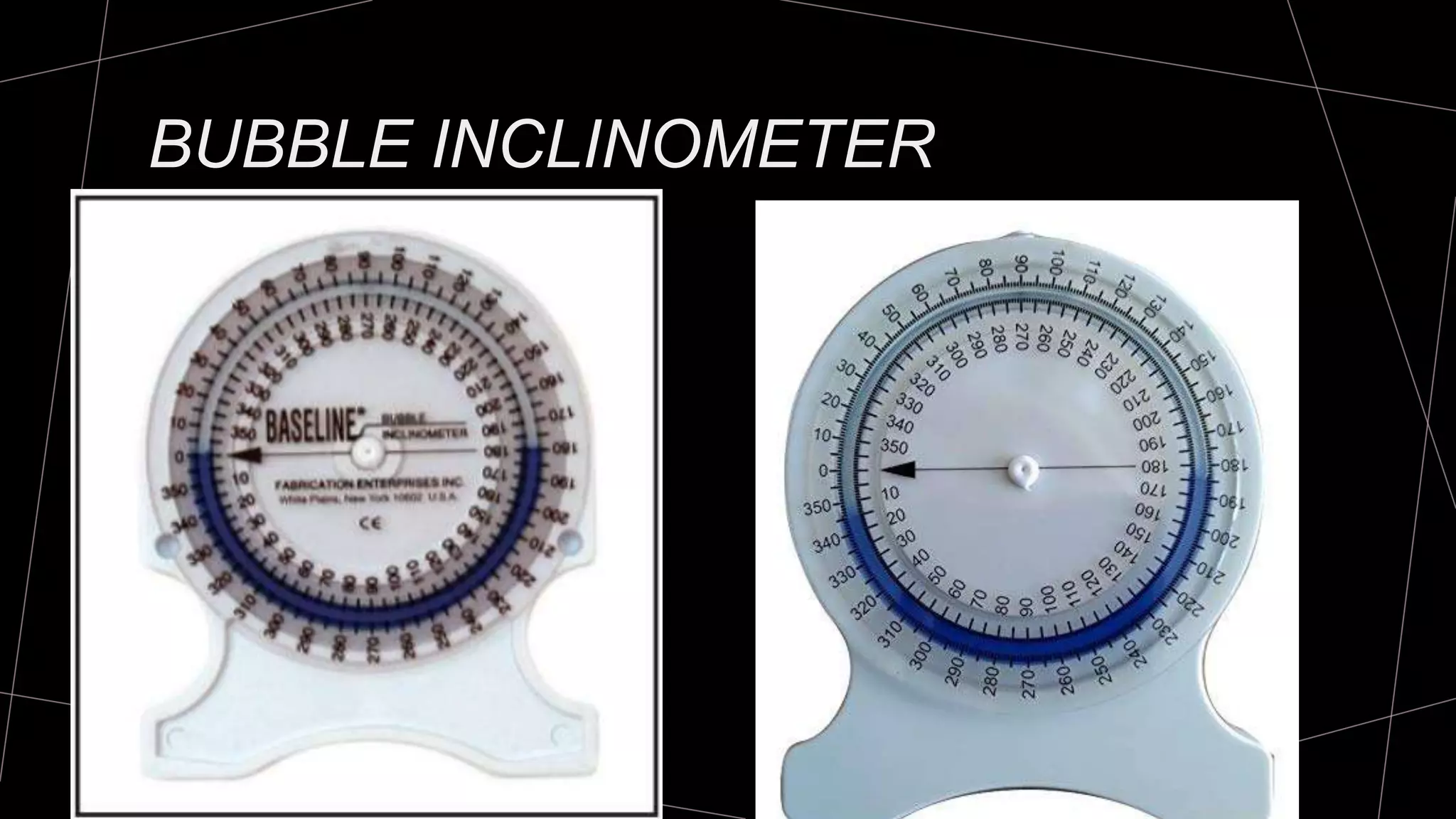
BUBBLE INCLINOMETER
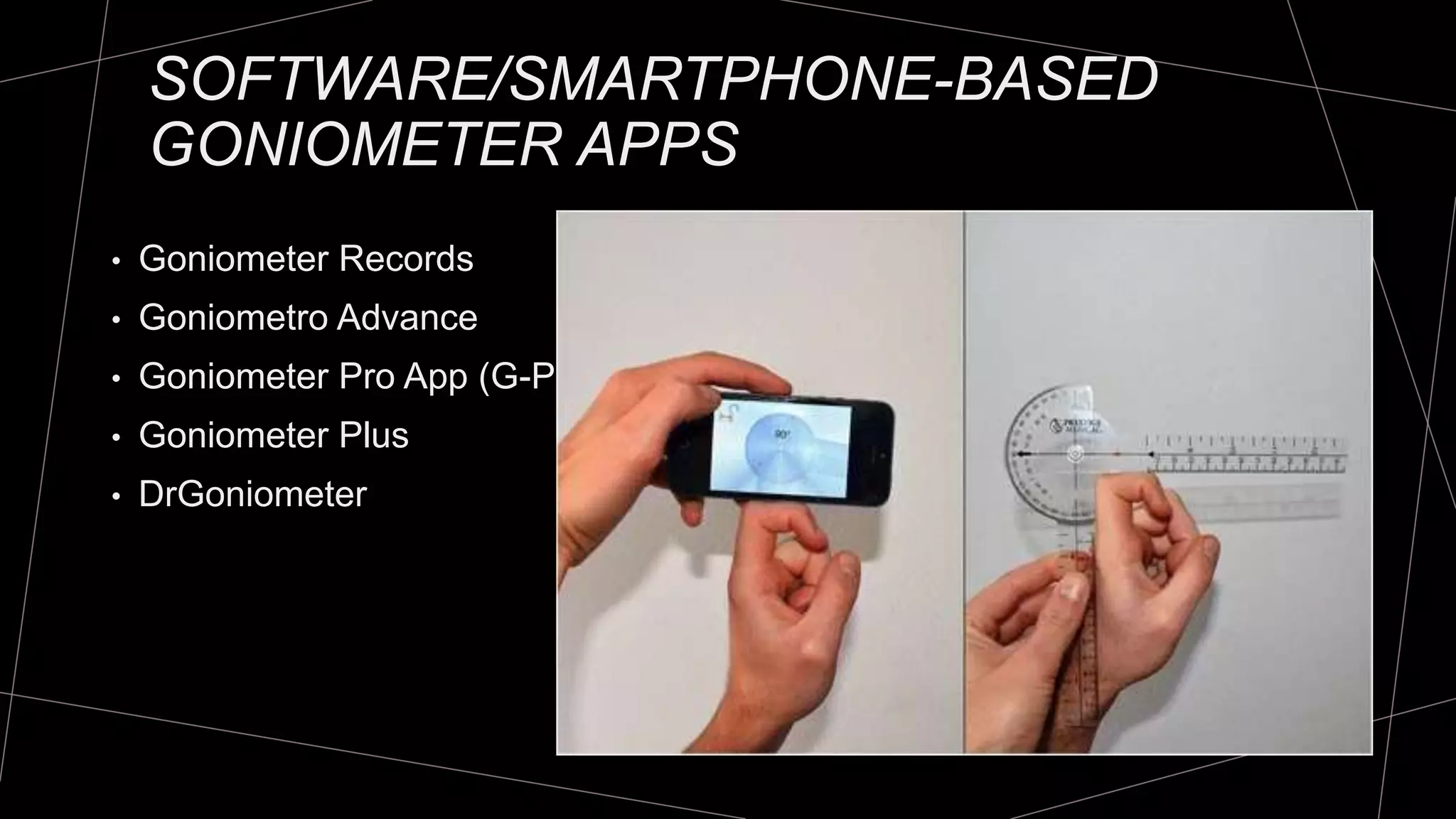
SOFTWARE/SMARTPHONE-BASED
GONIOMETER APPS
• Goniometer Records
• Goniometro Advance
• Goniometer Pro App (G-Pro)
• Goniometer Plus
• DrGoniometer
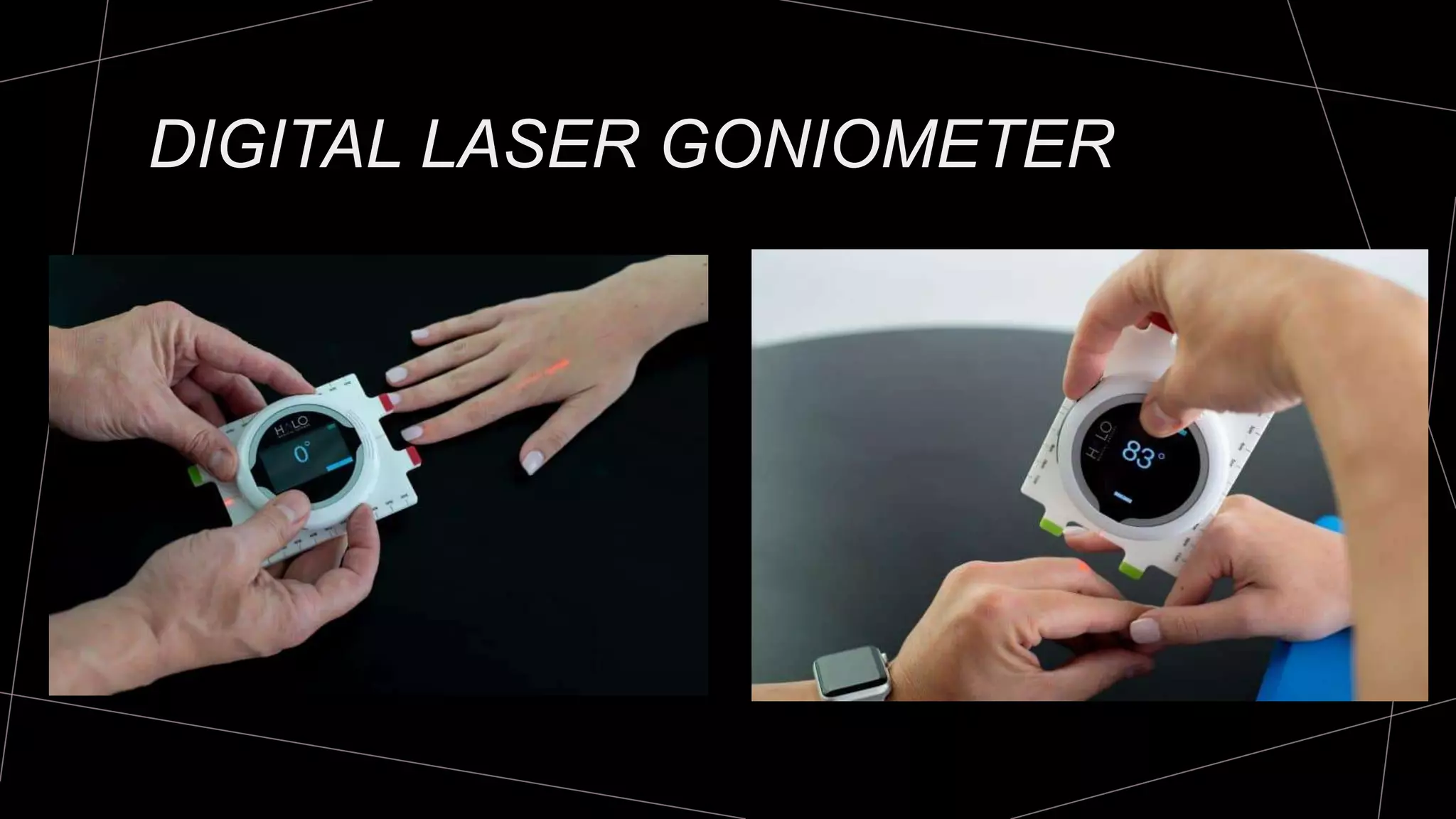
DIGITAL LASER GONIOMETER
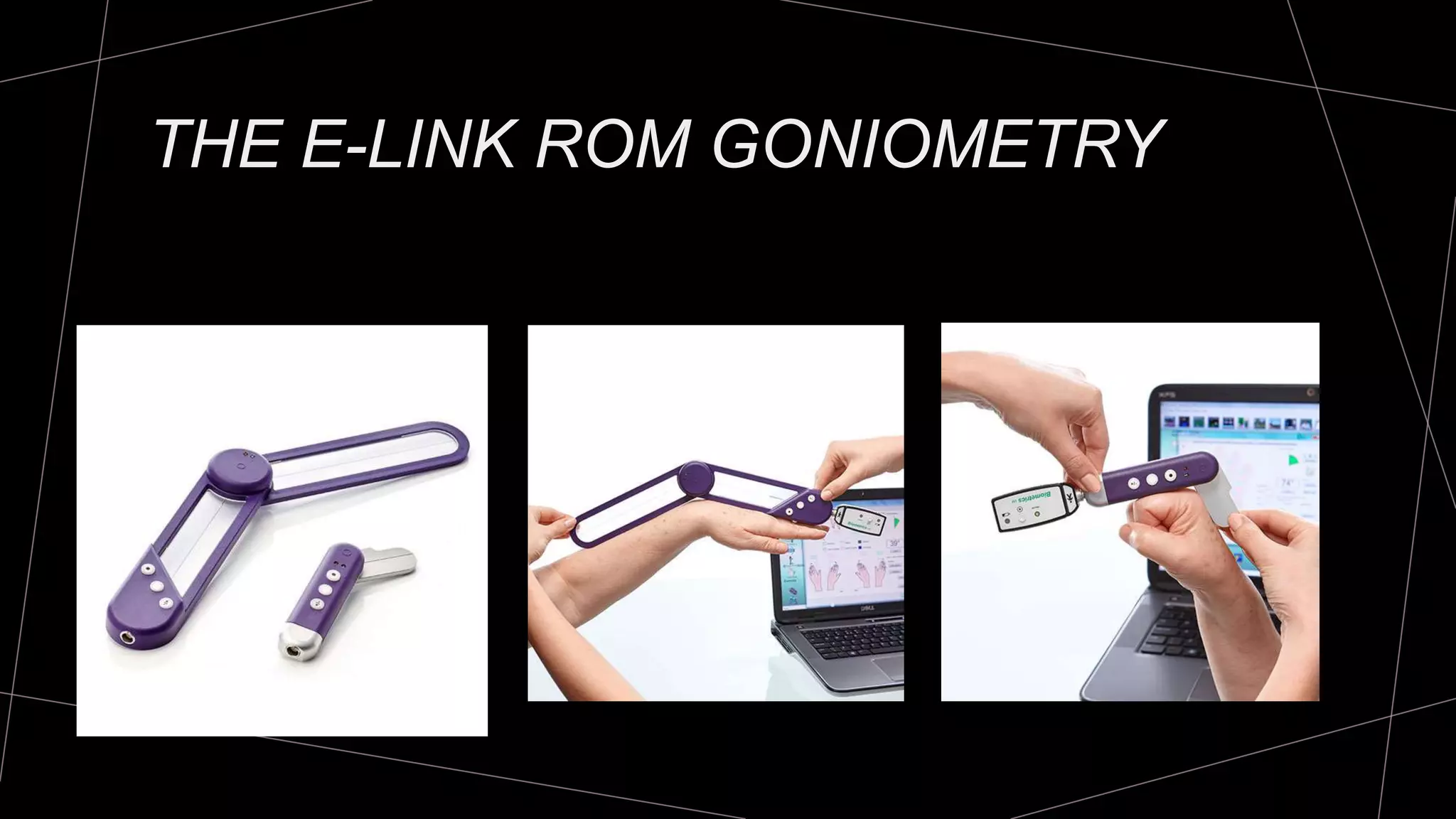
THE E-LINK ROM GONIOMETRY
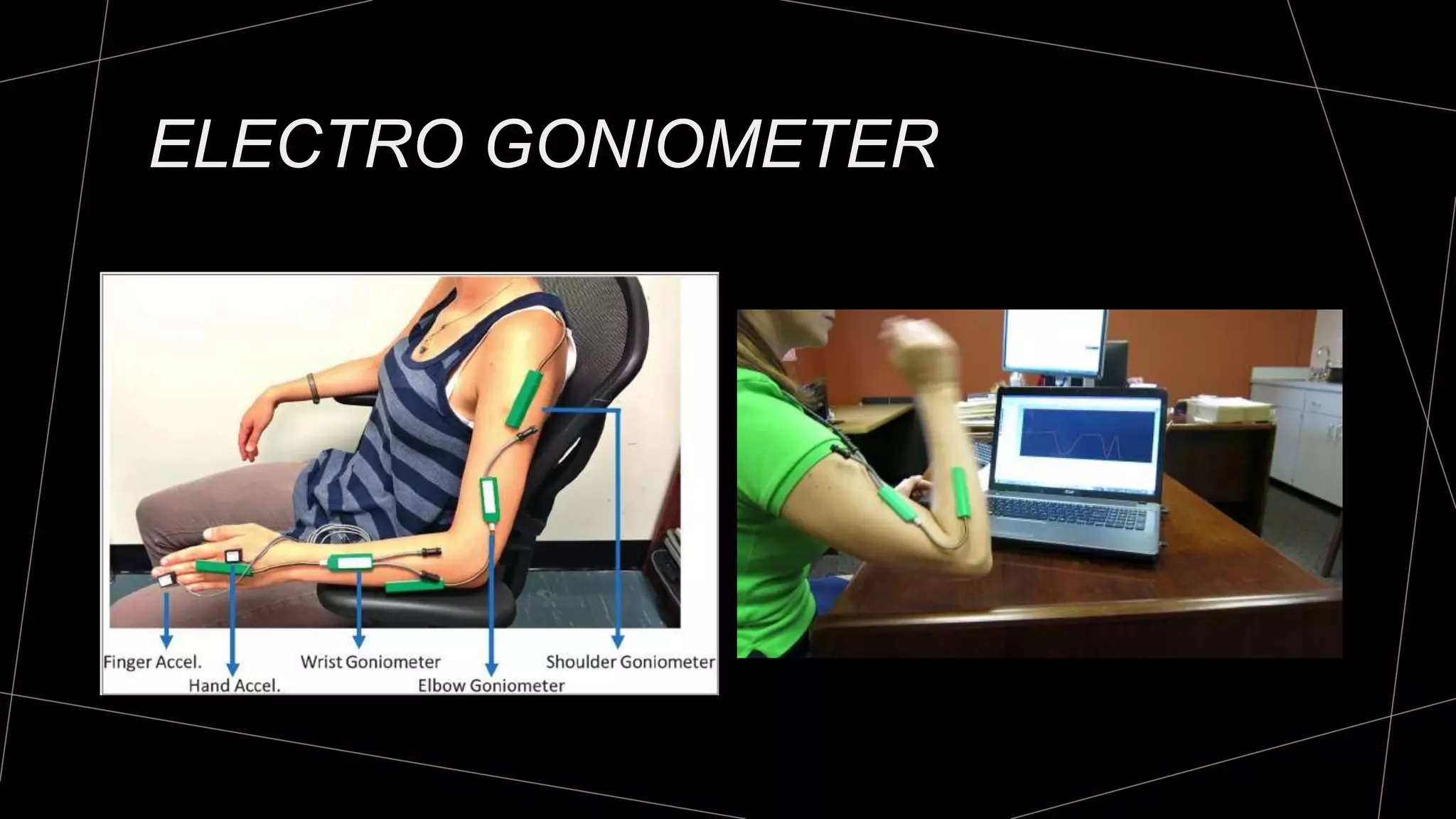
ELECTRO GONIOMETER
(Fariborz et al.,
2015)
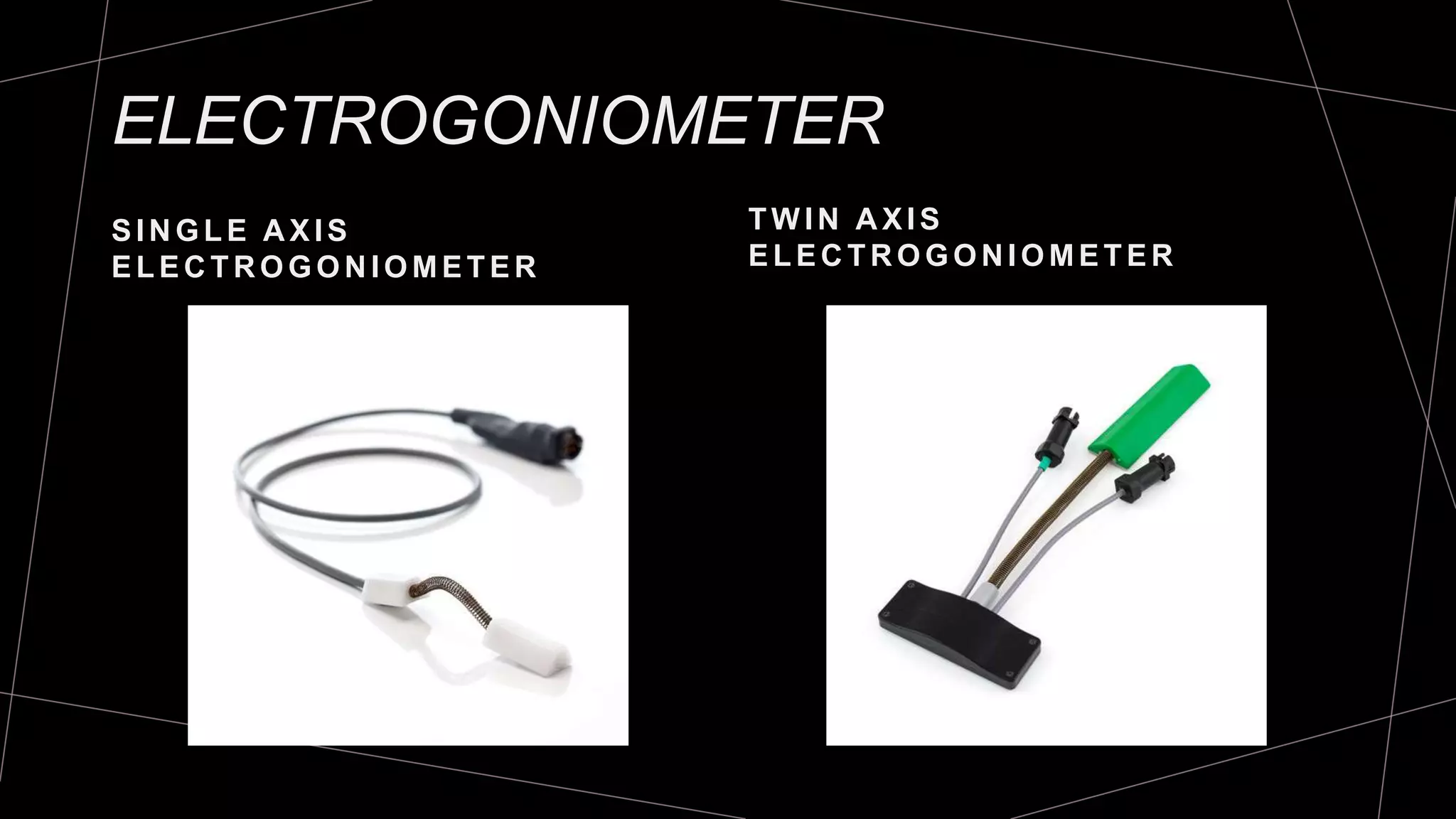
ELECTROGONIOMETER
SIN GLE A XIS
ELEC TR OGON IOMETER
TW IN A XIS
ELEC TR OGON IOMETER
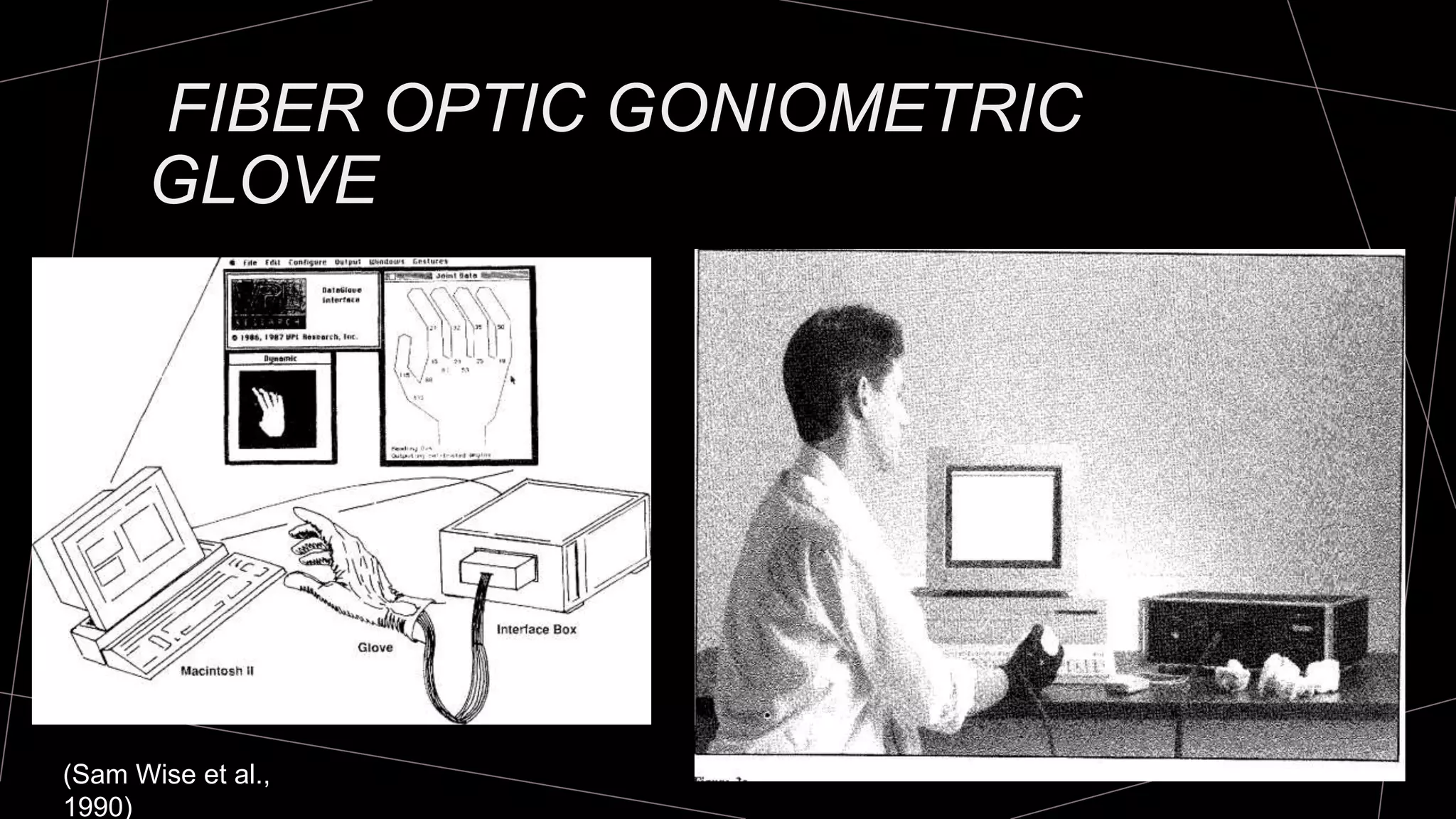
FIBER OPTIC GONIOMETRIC
GLOVE
(Sam Wise et al.,
1990)
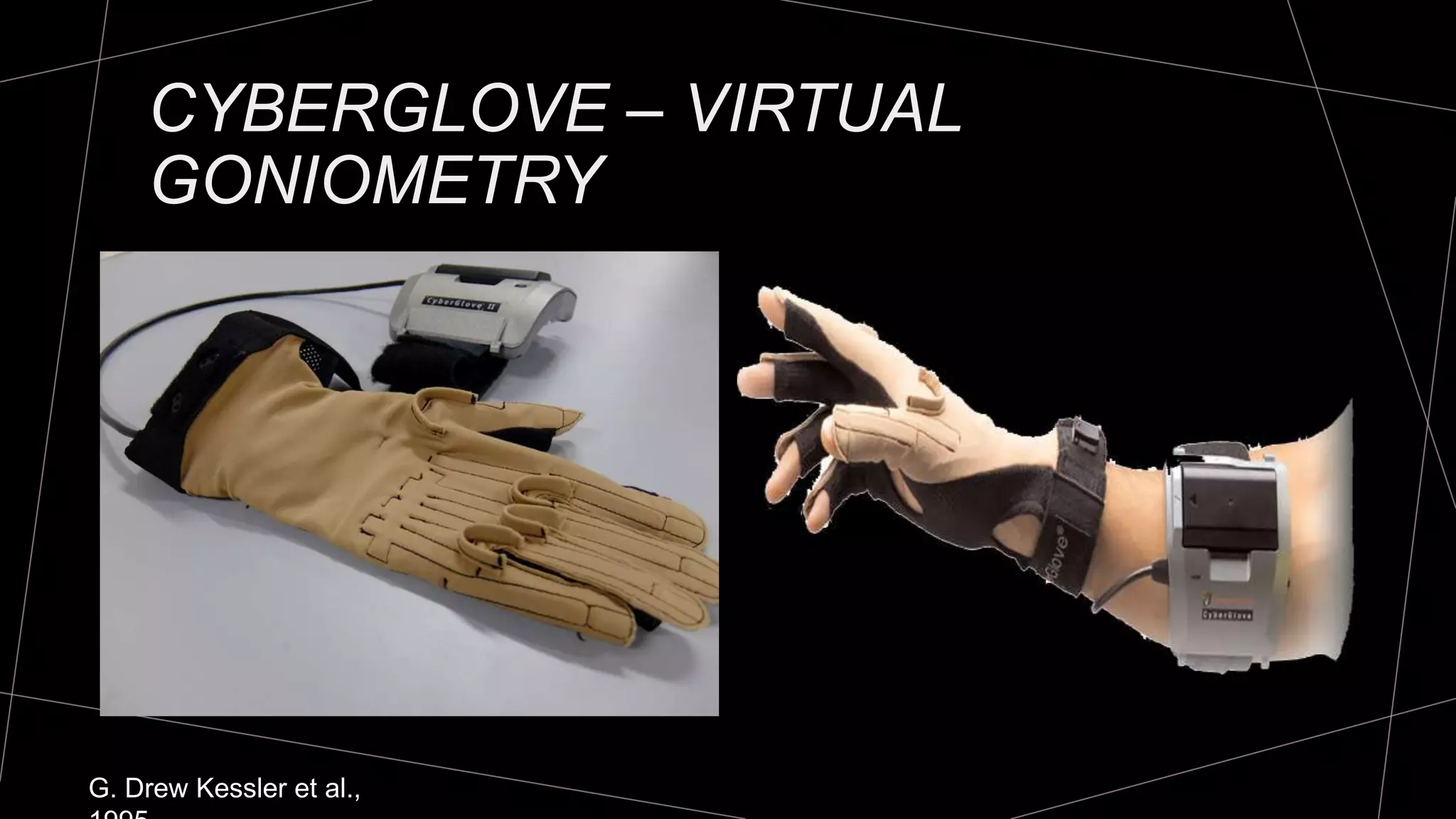
CYBERGLOVE – VIRTUAL
GONIOMETRY
G. Drew Kessler et al.,
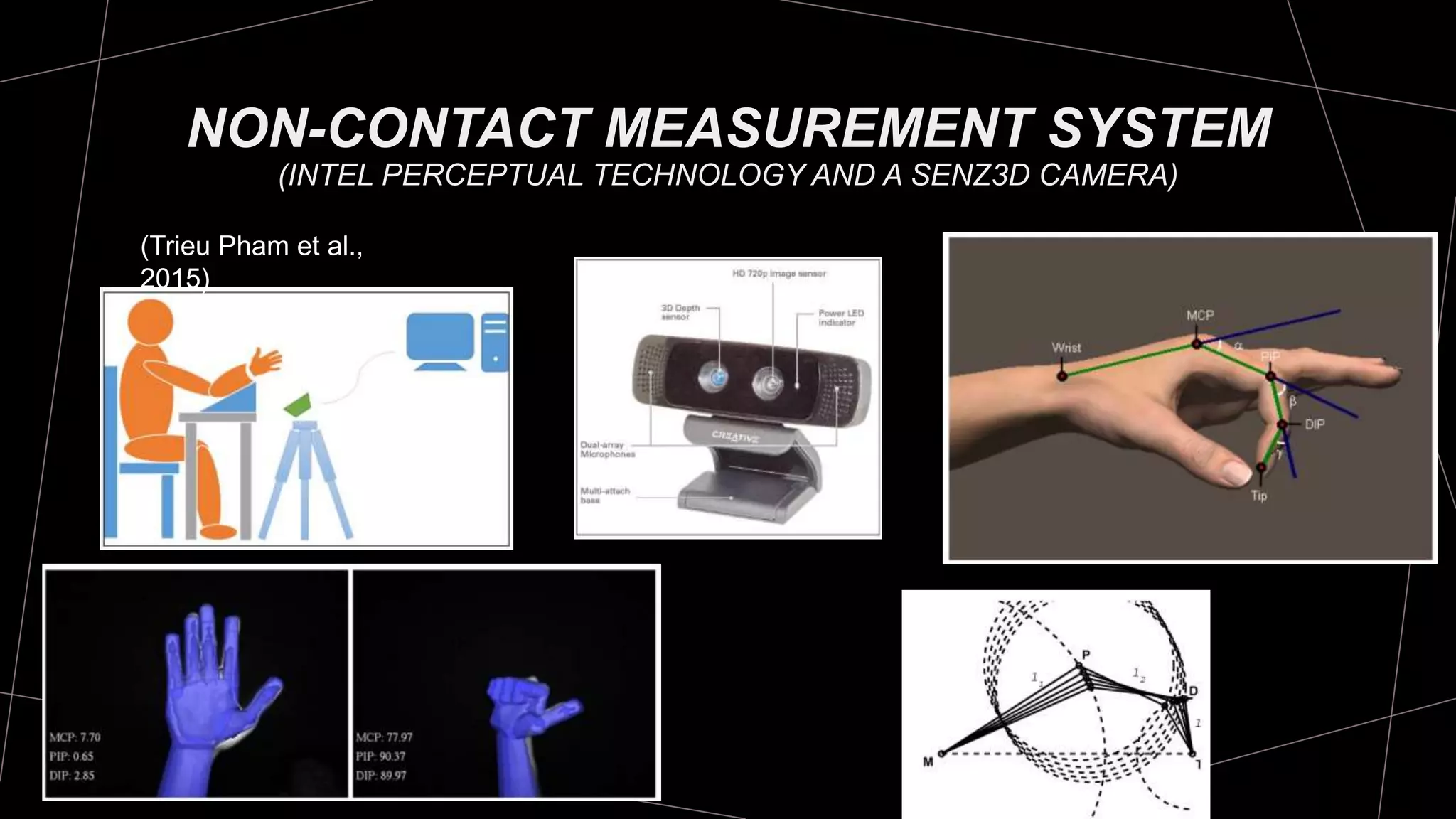
NON-CONTACT MEASUREMENT SYSTEM
(INTEL PERCEPTUAL TECHNOLOGY AND A SENZ3D CAMERA)
(Trieu Pham et al.,
2015)
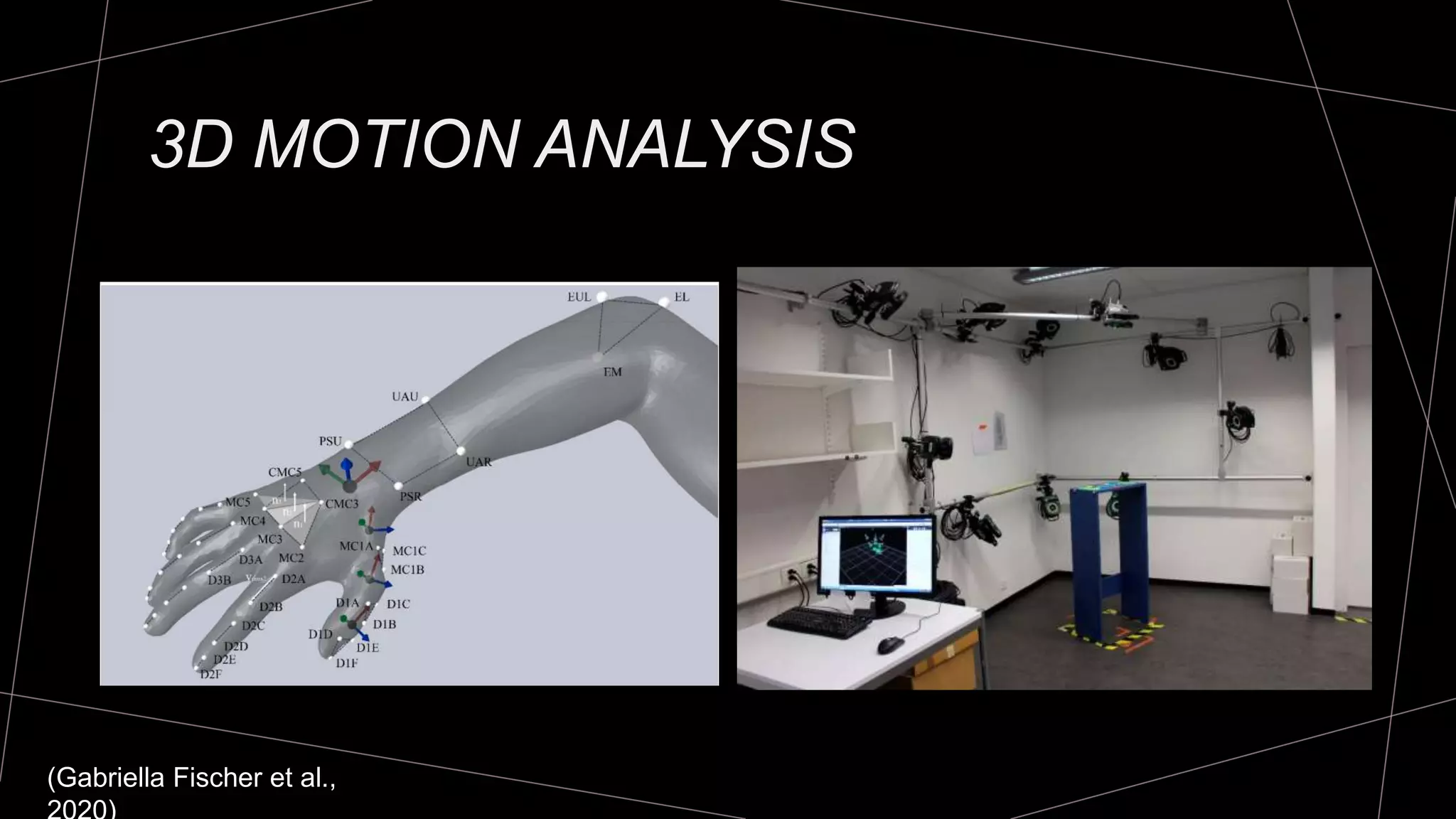
3D MOTION ANALYSIS
(Gabriella Fischer et al.,
REFERENCES
• American Academy of Orthopedic Surgeons (Green WB, Heckman JD eds.): The Clinical Measurement
of Joint Motion. 6300 North River Road, Rosemont, IL 60018, 1994, ISBN 0-89203-090-9.
• American Medical Association: Guide to the Evaluation of Permanent Impairment. AMA, Chicago, 1988.
• Boone DC, Azen SP: Normal range of motion of joints in male subjects. Journal of Bone and Joint
Surgery 1979;61A:756-759.
• Magee DJ: Orthopedic Physical Assessment, 3rd ed. WB Saunders Co, Philadelphia, 1997, ISBN 0-
7216-6290-0.
• Norkin CC, White DJ: Measurement of Joint Motion: A Guide to Goniometry, 2nd ed. FA Davis Co,
Philadelphia, 1995, ISBN 0-8036-6579-2.
• Physiopedia

Goniometry for Wrist & Fingers

  • 1.
  • 2.
    WHY HAND ISSO SPECIAL… • 27 bones • 27 Joints • 34 muscles • 3 major nerves • 100 ligaments & tendons • 2 major arteries • Major representation in Brain • & so on…..
  • 3.
  • 4.
    HAND PHYSIOTHERAPY – ASUPER SPECIALITY • Micro & Macro surgeries – Vascular, Orthopaedic, Plastic surgeons, Neuro surgeons etc • Hand surgeons, Thumb surgeons etc., • Toe to thumb transfers • Tendon repair & transplants • Hand transplant – Transplants from cadaver. • & Many more HAND PHYSIOTHERAPY
  • 7.
  • 8.
  • 9.
  • 10.
  • 11.
  • 12.
  • 13.
  • 14.
  • 15.
  • 16.
    WRIST FLEXION Test Position •Subject sitting • Forearm stabilized on table • Flex wrist (fingers relaxed) Goniometer Alignment • Axis – lateral wrist • Stationary arm – aligned with ulna • Moving arm – aligned with fifth metacarpal Normal Range • 75° ± 6.6° (American Academy of Orthopaedic Surgeons) • 60° (American Medical Association) • 76.4° (mean) 6.3° (standard deviation), (Boone and Azen)
  • 17.
    WRIST EXTENSION Test Position •Subject sitting • Forearm stabilized on table • Extended wrist (fingers relaxed) Goniometer Alignment • Axis – lateral wrist (triquetrum) • Stationary arm – aligned with ulna • Moving arm – aligned with fifth metacarpal Normal Range 74° ± 6.6° (American Academy of Orthopaedic Surgeons) 60° (American Medical Association) 74.9° (mean) 6.4° (standard deviation), (Boone and Azen)
  • 18.
    WRIST RADIAL DEVIATION TestPosition • Subject sitting with forearm resting on table • Stabilize forearm to prevent pronation or supination Goniometer Alignment • Axis – capitate • Stationary arm – aligned with forearm (lateral epicondyle) • Moving arm – aligned with metacarpal of middle finger Normal Range • 21° ± 4.0° (American Academy of Orthopaedic Surgeons) • 20° (American Medical Association) • 21.5° (mean) 4.0° (standard deviation), (Boone and Azen)
  • 19.
    WRIST ULNAR DEVIATION TestPosition • Subject sitting with forearm resting on table • Stabilize forearm to prevent pronation or supination Goniometer Alignment • Axis – capitate • Stationary arm – aligned with forearm (lateral epicondyle) • Moving arm – aligned with metacarpal of middle finger Normal Range • 35° ± 3.8° (American Academy of Orthopaedic Surgeons) • 30° (American Medical Association) • 36.0° (mean) 3.8° (standard deviation), (Boone and Azen)
  • 20.
    METACARPOPHALANGEAL JOINT FLEXION Test Position •Subject sitting with forearm resting on table • Wrist and interphalangeal joints relaxed • Forearm neutral • Stabilize metacarpal to prevent motion Goniometer Alignment • Dorsal metacarpophalangeal joint • Stationary arm - aligned with metacarpal Normal Range • 86° (index), 91° (ring), 105° (little) (American Academy of Orthopedic Surgeons - active motion) • 90° (American Medical Association)
  • 21.
    METACARPOPHALANGEAL JOINT EXTENSION Test Position •Subject sitting with forearm resting on table • Wrist and interphalangeal joints relaxed • Forearm neutral • Stabilize metacarpal to prevent motion Goniometer Alignment • Dorsal metacarpophalangeal joint • Stationary arm - aligned with metacarpal Normal Range • 22° (index), 18° (long), 23° (ring), 19° (little) (American Academy of Orthopedic Surgeons - active motion) • 20° (American Medical Association)
  • 22.
    METACARPOPHALANGEAL JOINT ABDUCTION Test Position •Subject sitting with forearm resting on table • Wrist neutral • Forearm neutral • Stabilize metacarpal to prevent motion Goniometer Alignment • Dorsal metacarpophalangeal joint • Stationary arm - aligned with metacarpal • Moving arm – aligned with proximal Normal Range • 25° (Physiopedia)
  • 23.
    METACARPOPHALANGEAL JOINT ADDUCTION Test Position •Subject sitting with forearm resting on table • Wrist neutral • Forearm neutral • Stabilize metacarpal to prevent motion Goniometer Alignment • Dorsal metacarpophalangeal joint • Stationary arm - aligned with metacarpal • Moving arm – aligned with proximal Normal Range • Either 0° or usually not measured.
  • 24.
    INTERPHALANGEAL JOINT FLEXION TestPosition • Subject sitting with forearm resting on table • Wrist, metacarpal, and non-tested interphalangeal joints relaxed • Forearm neutral • Stabilize proximal bone to prevent motion Goniometer Alignment • Dorsal proximal interphalangeal joint • Stationary arm - aligned with proximal phalange • Moving arm – aligned with middle phalange Normal Range American Academy of Orthopedic Surgeons • PIP fingers - 102° (index), 105° (long), 108° (ring), 106° (little) (active motion) • DIP fingers - 72° (index), 71° (long), 63° (ring), 65° (little) (active motion) • IP thumb - 73° American Medical Association • 100° (PIP finger), 70° (DIP fingers), 80° (IP thumb)
  • 25.
    INTERPHALANGEAL JOINT EXTENSION Test Position •Subject sitting with forearm resting on table • Wrist, metacarpal, and non-tested interphalangeal joints relaxed • Forearm neutral • Stabilize proximal bone to prevent motion Goniometer Alignment • Dorsal proximal interphalangeal joint • Stationary arm - aligned with proximal phalange • Moving arm – aligned with middle phalange Normal Range American Academy of Orthopedic Surgeons • PIP fingers - 7° (index), 7° (long), 6° (ring), 9° (little) (active motion) • DIP fingers - 8° (all finger DIPs) • IP thumb - 5° American Medical Association • 0°
  • 26.
    THUMB CARPOMETACARPAL JOINT FLEXION TestPosition • Subject sitting with forearm resting on table • Wrist neutral • Stabilize carpals to prevent wrist motion Goniometer Alignment • Axis - carpometacarpal joint • Stationary arm - aligned with radius • Moving arm – aligned with metacarpal of thumb Normal Range • 15° (American Academy of Orthopedic Surgeons)
  • 27.
    THUMB CARPOMETACARPAL JOINT EXTENSION TestPosition • Subject sitting with forearm resting on table • Wrist neutral • Stabilize carpals to prevent wrist motion Goniometer Alignment • Axis - carpometacarpal joint • Stationary arm - aligned with radius • Moving arm – aligned with metacarpal of thumb Normal Range • 20° (American Academy of Orthopedic Surgeons)
  • 28.
    THUMB CARPOMETACARPAL JOINT ABDUCTION TestPosition • Subject sitting with forearm resting on table • Wrist neutral • Forearm neutral • Stabilize carpals to prevent wrist motion Goniometer Alignment • Axis - radial styloid • Stationary arm - aligned with metacarpal of index finger • Moving arm – aligned with metacarpal of thumb Normal Range • 70° (American Academy of Orthopedic Surgeons)
  • 29.
    THUMB CARPOMETACARPAL JOINT ADDUCTION TestPosition • Subject sitting with forearm resting on table • Wrist neutral • Forearm neutral • Stabilize carpals to prevent wrist motion Goniometer Alignment • Axis - radial styloid • Stationary arm - aligned with metacarpal of index finger • Moving arm – aligned with metacarpal of thumb Normal Range • Either 0° or usually not measured. NOTE: Thumb adduction is the return to neutral from thumb abduction. Thumb adduction is rarely measured, probably because it
  • 30.
    THUMB CARPOMETACARPAL JOINT OPPOSITION TestPosition • Subject sitting with forearm supinated and resting on table • Wrist neutral • Stabilize fifth metacarpal Goniometer Alignment • Goniometer cannot be used • Use a ruler to measure distance between tip of thumb and base of fifth finger Normal Range • Able to touch tip of thumb to base of fifth finger (American Academy of Orthopedic Surgeons) NOTE: The American Academy of Orthopedic Surgeons suggests that opposition range is normal when the tip of thumb can touch the base of fifth finger. When range is not adequate, a ruler can be used to measure the distance between the tip of thumb and the base of the
  • 31.
    NORMAL ROM VALUES(AAOS VALUES)
  • 32.
    FINGERS: COMPOSITE FLEXIONOF THE MCP, PIP, AND DIP JOINTS
  • 33.
    GRAVITY GONIOMETER/INCLINOMETER One arm hasa weighted pointer that remains vertical under the influence of gravity
  • 34.
  • 36.
    SOFTWARE/SMARTPHONE-BASED GONIOMETER APPS • GoniometerRecords • Goniometro Advance • Goniometer Pro App (G-Pro) • Goniometer Plus • DrGoniometer
  • 37.
  • 38.
    THE E-LINK ROMGONIOMETRY
  • 39.
  • 40.
    ELECTROGONIOMETER SIN GLE AXIS ELEC TR OGON IOMETER TW IN A XIS ELEC TR OGON IOMETER
  • 41.
  • 42.
  • 43.
    NON-CONTACT MEASUREMENT SYSTEM (INTELPERCEPTUAL TECHNOLOGY AND A SENZ3D CAMERA) (Trieu Pham et al., 2015)
  • 44.
  • 45.
    REFERENCES • American Academyof Orthopedic Surgeons (Green WB, Heckman JD eds.): The Clinical Measurement of Joint Motion. 6300 North River Road, Rosemont, IL 60018, 1994, ISBN 0-89203-090-9. • American Medical Association: Guide to the Evaluation of Permanent Impairment. AMA, Chicago, 1988. • Boone DC, Azen SP: Normal range of motion of joints in male subjects. Journal of Bone and Joint Surgery 1979;61A:756-759. • Magee DJ: Orthopedic Physical Assessment, 3rd ed. WB Saunders Co, Philadelphia, 1997, ISBN 0- 7216-6290-0. • Norkin CC, White DJ: Measurement of Joint Motion: A Guide to Goniometry, 2nd ed. FA Davis Co, Philadelphia, 1995, ISBN 0-8036-6579-2. • Physiopedia