


TEMPOROMANDIBULAR
JOINT DYSFUNCTION
THE ARTICULATING JOINT!
What’s TMJ/ The temporomandibular joint (TMJ)
is where the jaw bone (mandible) connects to
the skull (temporal bone).
The joint is very complex, perhaps the most
complex joint in the body.
The joint was crucial in our evolution as it allows
us to do movements other than just vertical
chewing. As with every joint, there is a pad or
disc that separates and cushions the two
articulating bones.
Just imagine how this little disc has to move
around to keep up with the movements of the
jaw.
Adduction of the mandible, or mouth closing, is
performed by the actions of the masseter,
temporalis, and medial pterygoid muscles.
Abduction, or mouth opening, is performed by
the lateral pterygoids and digastrics
musculature.
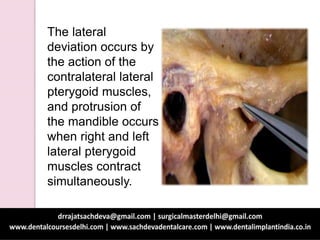
The lateral
deviation occurs by
the action of the
contralateral lateral
pterygoid muscles,
and protrusion of
the mandible occurs
when right and left
lateral pterygoid
muscles contract
simultaneously.
THE PROBLEM!!!!
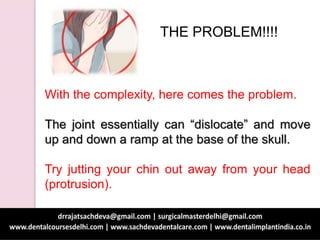
With the complexity, here comes the problem.
The joint essentially can “dislocate” and move
up and down a ramp at the base of the skull.
Try jutting your chin out away from your head
(protrusion).
Even though there are just two joints at each
side of our heads, we can wiggle our jaw back
and forth.
When people say TMJ, they are often referring
to pain or discomfort anywhere along the jaw,
which may also include some neck muscles.
But because the pain is not just located at the
joint, a more accurate term for the condition
may actually be Temporomandibular Disorders
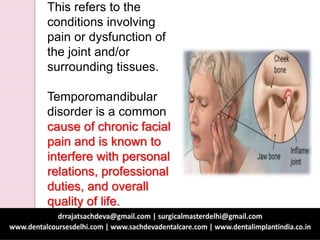
This refers to the
conditions involving
pain or dysfunction of
the joint and/or
surrounding tissues.
Temporomandibular
disorder is a common
cause of chronic facial
pain and is known to
interfere with personal
relations, professional
duties, and overall
quality of life.
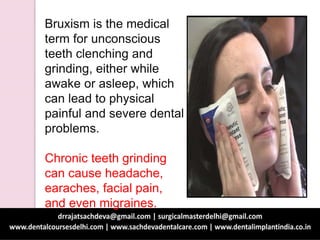
Bruxism is the medical
term for unconscious
teeth clenching and
grinding, either while
awake or asleep, which
can lead to physical
painful and severe dental
problems.
Chronic teeth grinding
can cause headache,
earaches, facial pain,
and even migraines.
Dental problems from bruxism include lose of
tooth enamel, increased tooth sensitivity, and
flattening and/or chipping of the teeth.
The cause is believed to stem from brain
signals that lead to involuntary and forceful
contraction of jaw muscles.
Some evidence suggests a genetic
predisposition, but bruxism may also stem from
stress and anxiety, an abnormal bite or crooked
or missing teeth.
In addition, the effects of some drugs,
including caffeine, may play a role.
Bruxism sufferers who grind and clench their
teeth while sleeping frequently wake up with a
sore jaw.
Hypertrophy of the masseter muscle, which
may lead to the appearance of a severe
square jaw, is another side effect of bruxism.
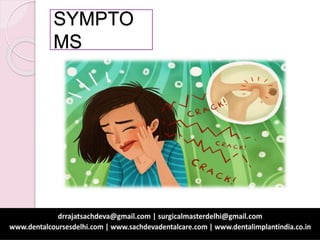
SYMPTO
MS
•Teeth grinding or clenching, which may be
loud enough to awaken you
•Increased tooth sensitivity
•Jaw or face pain or soreness
•Tired or tight jaw muscles
•Teeth that are flattened, fractured, chipped or
loose
•Worn tooth enamel, exposing deeper layers
of your tooth
•Pain that feels like an earache, though it's
actually not a problem with your ear
•Dull headache originating in the temples
•Damage from chewing on the inside of your
cheek
•Indentations on your tongue
THE
SOLUTION
Treatments for TMD range from non-
pharmacologic therapy, conservative
pharmicotherapy and open surgery.
Botulinum toxin injection has therefore become an
attractive choice as adjuvant therapy in patients
with TMD who do not achieve a complete
response with conservative management and
pharmacotherapy.
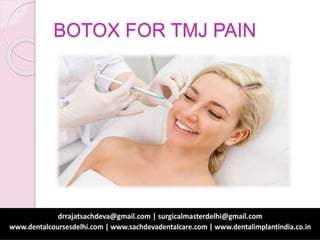
Botox injections for TMJ uses botulin toxin
type A injected into the joint or the affected
muscles to essentially paralyze whichever
areas are causing pain and damage.
TMJ patients who clench and grind their
teeth, for example, will no longer be able to
clench or grind their teeth because the Botox
injection causes partial paralysis.
Because the muscles that receive Botox injections are larger than
the small muscles that are treated for wrinkles, patients receiving
Botox injections for TMJ may not notice relief for two weeks or
more
BOTOX FOR TMJ PAIN
By injecting small doses of botulinum toxin directly
into the masseter muscle (the large muscle that
moves the jaw), the muscle is weakened enough to
stop involuntary grinding of the teeth and
clenching of the jaw.
This significantly relaxes the muscle and reduces
the wear and tear on the teeth due to grinding.
Damage to the TMJ (temporomandibular joint) and
headaches should be reduced or eliminated as
well.
Voluntary movements, such as chewing and facial expressions,
are not effected at all by botox.
THE side effects!!
•Headache
•Respiratory infection
•Flu-like illness
•Nausea
•Temporary eyelid droop
•Fatigue
•Double vision
•Skin irritation
•Rash at injection site
Other side effects that are related to the injection
itself may occur within the first week after
treatment before gradually disappearing.
These include:
•Pain
•Redness at the site of injection
•Muscle weakness
•Bruising at the injection site
SUITABLE PATIENTS FOR
BOTOX
Botox is not suitable for every patient.
Care must be taken as to when to use it, how to
use it, and who is a good candidate.
There are times when muscles hurt even
though they have not been overused.
When life circumstances, emotions or thoughts
cause your muscles to tighten and ultimately
ache, then Botox injections for TMJ will not likely
help.
Instead, counseling, talk
therapy, cognitive
behavioral therapy, may
be better options.
If you’re considering
Botox as part of your
treatment for TMJ
problems, jaw pain, pain
in or around your teeth, or
because of a change in
the shape of your jaw -
see if you fit into the
following categories.
If One Currently Wears a Night Guard, and
still have morning symptoms of muscle pain or
tightness, joint noises, locking, and/or pain,
they may be a good candidate for Botox.
If You Can’t Tolerate A Night Guard and have
tried various types, with your dentist’s
guidance, Botox injections for TMJ may
provide meaningful benefit.
If your jaw muscles are just too big and visibly
over-built, Botox may be an option.
One of the predictable things that Botox does is
reduce muscle bulk when used over time.
Botox has been shown to be effective in
producing a flatter and more natural-looking
profile.
You will likely need three Botox sessions in
three-month intervals to achieve the best
results.
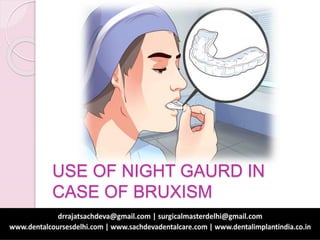
USE OF NIGHT GAURD IN
CASE OF BRUXISM
Q: How does Botox help lessen grinding teeth at
night?
A: Because teeth grinding occurs as a result of a
clenched jaw muscle, Botox helps to lessen the
muscles ability to clench tightly, therefore resulting
in a decrease in the amount of grinding.
Q. What is the cost of Botox for teeth grinding?
A: Though the cost is very dependent upon the
individual, seriousness of your teeth grinding will
play a part in determining how many injections
you’ll need.
Q. Can anyone perform Botox Injections?
A.No, It’s ideal to have an experienced Botox injector
perform your treatment, probably a board certified
dentist.
Q. Where is Botox injected?
A: To help prevent Bruxism, Botox is injected into
the masseter muscles located in the jaw and the
temporalis muscle in the scalp. This helps reduce the
amount of grinding while sleeping.
Q. Why to prefer Botox over Conventional
Therapy?
The best part about using Botox for either
conditions is that the toxin doesn’t interfere with
voluntary jaw movements; patients can speak, eat,
and make the same facial expressions just as they
normally would without the treatment. Along with
the diminished appearance of wrinkles and a
slimmer jawline
CONNECT WITH US AT
@surgicalmasterrajat
@dentalcoursesdelhi
drrajatsachdeva
drrajatsachdeva
drrajatsachdeva
To book an appmt.
contact :
Dr.Rajat Sachdeva
Dr Sachdeva’s Dental
Aesthetic & Implant Institute
I 101, Ashok Vihar Phase 1,
Delhi- 110052
THANK YOU

Temporomandibular joint dysfunction/disorders

  • 1.
  • 2.
    What’s TMJ/ Thetemporomandibular joint (TMJ) is where the jaw bone (mandible) connects to the skull (temporal bone). The joint is very complex, perhaps the most complex joint in the body. The joint was crucial in our evolution as it allows us to do movements other than just vertical chewing. As with every joint, there is a pad or disc that separates and cushions the two articulating bones.
  • 3.
    Just imagine howthis little disc has to move around to keep up with the movements of the jaw. Adduction of the mandible, or mouth closing, is performed by the actions of the masseter, temporalis, and medial pterygoid muscles. Abduction, or mouth opening, is performed by the lateral pterygoids and digastrics musculature.
  • 4.
    The lateral deviation occursby the action of the contralateral lateral pterygoid muscles, and protrusion of the mandible occurs when right and left lateral pterygoid muscles contract simultaneously.
  • 5.
    THE PROBLEM!!!! With thecomplexity, here comes the problem. The joint essentially can “dislocate” and move up and down a ramp at the base of the skull. Try jutting your chin out away from your head (protrusion).
  • 6.
    Even though thereare just two joints at each side of our heads, we can wiggle our jaw back and forth. When people say TMJ, they are often referring to pain or discomfort anywhere along the jaw, which may also include some neck muscles. But because the pain is not just located at the joint, a more accurate term for the condition may actually be Temporomandibular Disorders
  • 7.
    This refers tothe conditions involving pain or dysfunction of the joint and/or surrounding tissues. Temporomandibular disorder is a common cause of chronic facial pain and is known to interfere with personal relations, professional duties, and overall quality of life.
  • 8.
    Bruxism is themedical term for unconscious teeth clenching and grinding, either while awake or asleep, which can lead to physical painful and severe dental problems. Chronic teeth grinding can cause headache, earaches, facial pain, and even migraines.
  • 9.
    Dental problems frombruxism include lose of tooth enamel, increased tooth sensitivity, and flattening and/or chipping of the teeth. The cause is believed to stem from brain signals that lead to involuntary and forceful contraction of jaw muscles. Some evidence suggests a genetic predisposition, but bruxism may also stem from stress and anxiety, an abnormal bite or crooked or missing teeth.
  • 10.
    In addition, theeffects of some drugs, including caffeine, may play a role. Bruxism sufferers who grind and clench their teeth while sleeping frequently wake up with a sore jaw. Hypertrophy of the masseter muscle, which may lead to the appearance of a severe square jaw, is another side effect of bruxism.
  • 11.
  • 12.
    •Teeth grinding orclenching, which may be loud enough to awaken you •Increased tooth sensitivity •Jaw or face pain or soreness •Tired or tight jaw muscles •Teeth that are flattened, fractured, chipped or loose
  • 13.
    •Worn tooth enamel,exposing deeper layers of your tooth •Pain that feels like an earache, though it's actually not a problem with your ear •Dull headache originating in the temples •Damage from chewing on the inside of your cheek •Indentations on your tongue
  • 14.
    THE SOLUTION Treatments for TMDrange from non- pharmacologic therapy, conservative pharmicotherapy and open surgery. Botulinum toxin injection has therefore become an attractive choice as adjuvant therapy in patients with TMD who do not achieve a complete response with conservative management and pharmacotherapy.
  • 15.
    Botox injections forTMJ uses botulin toxin type A injected into the joint or the affected muscles to essentially paralyze whichever areas are causing pain and damage. TMJ patients who clench and grind their teeth, for example, will no longer be able to clench or grind their teeth because the Botox injection causes partial paralysis.
  • 16.
    Because the musclesthat receive Botox injections are larger than the small muscles that are treated for wrinkles, patients receiving Botox injections for TMJ may not notice relief for two weeks or more
  • 17.
  • 18.
    By injecting smalldoses of botulinum toxin directly into the masseter muscle (the large muscle that moves the jaw), the muscle is weakened enough to stop involuntary grinding of the teeth and clenching of the jaw. This significantly relaxes the muscle and reduces the wear and tear on the teeth due to grinding. Damage to the TMJ (temporomandibular joint) and headaches should be reduced or eliminated as well.
  • 19.
    Voluntary movements, suchas chewing and facial expressions, are not effected at all by botox.
  • 20.
    THE side effects!! •Headache •Respiratoryinfection •Flu-like illness •Nausea •Temporary eyelid droop •Fatigue •Double vision •Skin irritation •Rash at injection site
  • 21.
    Other side effectsthat are related to the injection itself may occur within the first week after treatment before gradually disappearing. These include: •Pain •Redness at the site of injection •Muscle weakness •Bruising at the injection site
  • 22.
    SUITABLE PATIENTS FOR BOTOX Botoxis not suitable for every patient. Care must be taken as to when to use it, how to use it, and who is a good candidate. There are times when muscles hurt even though they have not been overused. When life circumstances, emotions or thoughts cause your muscles to tighten and ultimately ache, then Botox injections for TMJ will not likely help.
  • 23.
    Instead, counseling, talk therapy,cognitive behavioral therapy, may be better options. If you’re considering Botox as part of your treatment for TMJ problems, jaw pain, pain in or around your teeth, or because of a change in the shape of your jaw - see if you fit into the following categories.
  • 24.
    If One CurrentlyWears a Night Guard, and still have morning symptoms of muscle pain or tightness, joint noises, locking, and/or pain, they may be a good candidate for Botox. If You Can’t Tolerate A Night Guard and have tried various types, with your dentist’s guidance, Botox injections for TMJ may provide meaningful benefit.
  • 25.
    If your jawmuscles are just too big and visibly over-built, Botox may be an option. One of the predictable things that Botox does is reduce muscle bulk when used over time. Botox has been shown to be effective in producing a flatter and more natural-looking profile. You will likely need three Botox sessions in three-month intervals to achieve the best results.
  • 26.
    USE OF NIGHTGAURD IN CASE OF BRUXISM
  • 27.
    Q: How doesBotox help lessen grinding teeth at night? A: Because teeth grinding occurs as a result of a clenched jaw muscle, Botox helps to lessen the muscles ability to clench tightly, therefore resulting in a decrease in the amount of grinding. Q. What is the cost of Botox for teeth grinding? A: Though the cost is very dependent upon the individual, seriousness of your teeth grinding will play a part in determining how many injections you’ll need.
  • 28.
    Q. Can anyoneperform Botox Injections? A.No, It’s ideal to have an experienced Botox injector perform your treatment, probably a board certified dentist. Q. Where is Botox injected? A: To help prevent Bruxism, Botox is injected into the masseter muscles located in the jaw and the temporalis muscle in the scalp. This helps reduce the amount of grinding while sleeping.
  • 29.
    Q. Why toprefer Botox over Conventional Therapy? The best part about using Botox for either conditions is that the toxin doesn’t interfere with voluntary jaw movements; patients can speak, eat, and make the same facial expressions just as they normally would without the treatment. Along with the diminished appearance of wrinkles and a slimmer jawline
  • 30.
    CONNECT WITH USAT @surgicalmasterrajat @dentalcoursesdelhi drrajatsachdeva drrajatsachdeva drrajatsachdeva
  • 31.
    To book anappmt. contact : Dr.Rajat Sachdeva Dr Sachdeva’s Dental Aesthetic & Implant Institute I 101, Ashok Vihar Phase 1, Delhi- 110052
  • 32.