OCCLUSION EVALUATION
&
THERAPY
Guided by
Dr.K.P.Ashok sir
Presented by
Ch.Bhavya
(Intern)
CONTENTS
INTRODUCTION
TERMINOLOGIES
MANDIBULAR MOVEMENTS
OCCLUSAL FUNCTION
OCCLUSAL DYSFUNCTION
PARAFUNCTION
CLINICAL EVALUATION PROCEDURES
OCCLUSAL THERAPY
OCCLUSAL APPLIANCE THERAPY
CONCLUSION
INTRODUCTION
In the healthy person, the periodontium around teeth subject to excessive
occlusal forces experiences adaptation and repair or remodelling with no
loss of attachment ,as often occurs with orthodontics.
No or minimal occlusal contact on a tooth results in disuse atrophy of
periodontium ,which may result in instability of teeth.
Forces that exceed the tolerance of the periodontium result in resorption of
bone and disruption of attachment.
occlusion
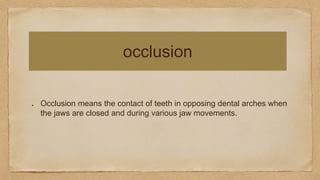
Occlusion means the contact of teeth in opposing dental arches when
the jaws are closed and during various jaw movements.
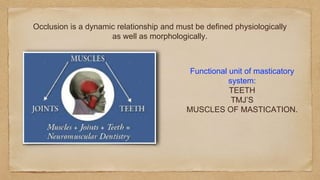
Occlusion is a dynamic relationship and must be defined physiologically
as well as morphologically.
Functional unit of masticatory
system:
TEETH
TMJ’S
MUSCLES OF MASTICATION.
The non functional cusp relation -cusp to groove
NORMAL OCCLUSION
RELATION
IDEAL OCCLUSION :
The functional cusps (or) supporting cusps relation -cusp to fossa (or) cusp to
marginal ridge.
TERMINOLOGIES
Intercuspal position(ICP): the position of the mandible when there is
maximum Inetrcuspation between maxillary and mandibular teeth.
MUSCULAR CONTACT POSITION(MCP) : the position of the mandible
when lifted into contact from resting position.
EXCURSIVE MOVEMENT : Any movement Of mandible away from
ICP.
LATEROTRUSION:Movement of the mandible laterally to the right or
left from ICP.
PROTRUSION: Movement of the mandible anteriorly from ICP.
RETRUSION:Movement of the mandible posteriorly from ICP.
WORKING SIDE:The side of either dental arch corresponding to
the side of mandible moving away from the midline during a
lateral excursion.
NONWORKING SIDE:the side of either arch corresponding to
the side of mandible moving toward the midline during a lateral
excursion.
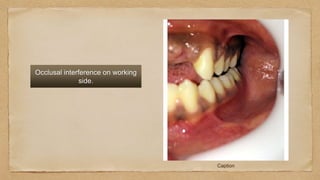
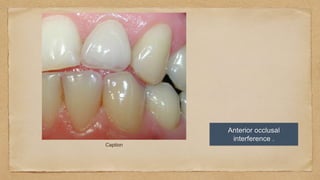
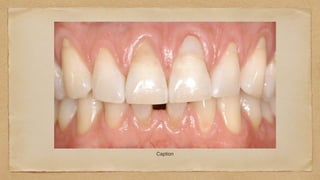
INTERFERENCE: Any occlusal contact that inhibits the
remaining occlusal surfaces from achieving stable and
harmonious contacts.
DISCLUSION:The separation of certain teeth caused by
guidance provided by other teeth during an excursion.
Caption
Occlusal interference on working
side.
Caption
Anterior occlusal
interference .
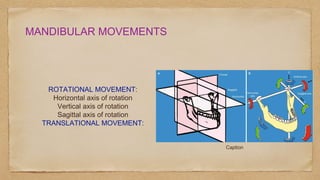
MANDIBULAR MOVEMENTS
ROTATIONAL MOVEMENT:
Horizontal axis of rotation
Vertical axis of rotation
Sagittal axis of rotation
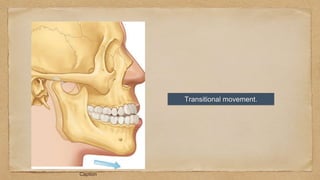
TRANSLATIONAL MOVEMENT:
Caption
Caption
Transitional movement.
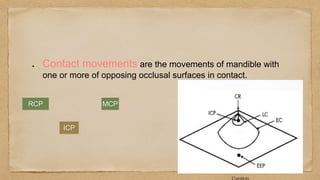
Contact movements are the movements of mandible with
one or more of opposing occlusal surfaces in contact.
RCP
ICP
MCP
BORDER
MOVEMENTS
Caption
POSSELT ,1952
PR=PROTRUSION
ICP=INTERCUSPAL
POSITION
RCP=RETRUDED
CONTACT POSITION
R[HA]=HINGE AXIS
T[MO]=MAXIMUM OPENING
OCCLUSAL FUNCTION
CENTRIC RELATION is a term used to describe the position of
condyles when they are fully seated in the fossa of their
respective TMJs .
Rotation of mandible around an axis through both condyles is
called CENTRIC RELATION CLOSURE ARC
Maximum intercuspation occur when opposing teeth make
contact ,with optimal interdigitation ,the most stable endpoint of
mandibular closure .
Stability is enhanced by simultaneous bilateral contact of
multiple posterior teeth with occlusal forces in the long axis of
most posterior teeth.
If the teeth are firm and any contact occurs before maximum
intercuspation,then incline relationship of opposing occlusal
surfaces will guide mandible in to position ,requiring one or both
condyles to become dislocate from their fossa.
If teeth are mobile and contact first in the centric relation closure
arc, then they may move away from opposing teeth rather than
cause condylar displacement.
Biological basis of occlusal function
Capacity to adapt through a wide range of functional
requirements.
Constant turn over and adjustment of supporting bone and the
connective tissue elements of periodontium.
The masticatory apparatus is a dynamic system
Contacts disruptive to mandibular movement or stressful to
individual teeth are called OCCLUSAL INTERFERENCES OR
DISCREPANCIES.
OCCLUSAL DISFUNCTION
Caption
Inflammation disrupts the integrity of the attachment apparatus
resulting in less resistance to force from opposing teeth.
When bone loss has occurred ,there is less root surface area
supported and fewer sensory fibers in periodontal ligament
,limiting protective muscle modulation of occlusive forces.
The clinician must differentiate between inflammation caused
intolerance to occlusal forces ,normal forces on teeth with
reduced periodontal support ,excessive occlusal forces on teeth
affected by periodontitis.
PARA FUNCTION
These are the habits that are performed at a subconscious
reflex level &the patient may be unaware of their exercise
SORRIN classified it into 3 groups
Neurosis
Occupational habits
Miscellaneous habits
Occupational habits : thread biting by tailors ,hair clip opening by
hair dresser and the holding of nails by cobblers.
Miscellaneous habits : incorrect teeth cleaning habits ,thumb
sucking and pipe smoking .
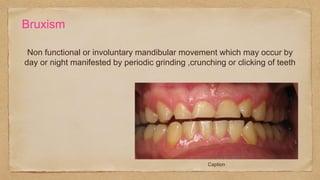
Bruxism
Non functional or involuntary mandibular movement which may occur by
day or night manifested by periodic grinding ,crunching or clicking of teeth
Caption
Karolyi:
. Occlusal interference
. Psychic factors
. Other local factors
.may occur in centric occlusion or in eccentric position of
mandible
Bruxing is associated with greater frequency and persistence of
TMJ dysfunction ,orofacial pain and possibly periodontal
attachment loss
CLINICAL EVALUATION
PROCEDURES
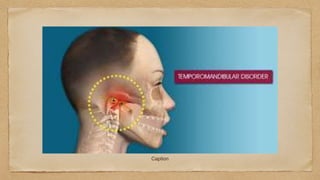
TEMPOROMANDIBULAR DISORDERS SCREENIG FUNCTION :
It should be a part of patients initial comprehensive examination.
Patients range of motion is observed ,maximal opening and both lateral and protrusive
excursions are measured and any deviation from the midline during opening and closing is
defined.
Tenderness on palpation may indicate a TMJ capsulitis.
Palpation of the muscles of mastication and related head and neck musculature may reveal
muscle tension or spasm related to occlusal and tmj disharmonies .
Caption
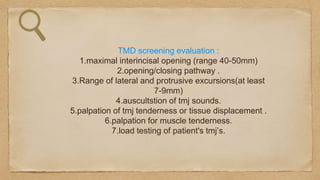
TMD screening evaluation :
1.maximal interincisal opening (range 40-50mm)
2.opening/closing pathway .
3.Range of lateral and protrusive excursions(at least
7-9mm)
4.auscultstion of tmj sounds.
5.palpation of tmj tenderness or tissue displacement .
6.palpation for muscle tenderness.
7.load testing of patient's tmj’s.
TESTING FOR MOBILITY OF TEETH :
THERE ARE TWO BASIC METHODS TO ASSES THE FIRMNESS OR LOOSENESS OF A
TOOTH.
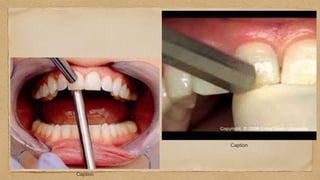
A dental instrument is used to exert pressure in facial or lingual direction and dentist places
his or her finger on the opposite side of the tooth to both feel and see movement if it occurs.
The other method is to test for movement of teeth subject to pressure the patient generates
.Fremitus,vibration or micro movement of tooth can be felt when patients tap their teeth
together.
If the mobility of teeth exceeds that expected based on the loss of support or the level of
inflammation observed, then trauma from occlusion is included in diagnosis.
Caption
Caption
CENTRIC RELATION ASSESSMENT :
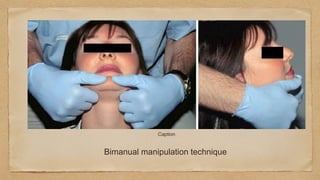
Bimanual manipulation of the mandible in the axis of rotation of the condyles in their
respective glenoid fossa has become a standard method of assessing Centric relation .
This technique is essential to load testing of the TMJ’s and is effective in generating centric
relation records for mounting diagnostic casts.
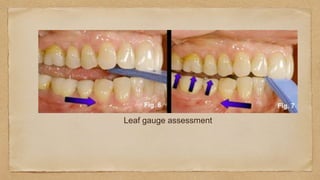
Other methods for guiding the condyles toward a seated position, such as leaf gauges or
anterior bite stops can also be effective.
Caption
Bimanual manipulation technique
Leaf gauge assessment
EVALUATION OF EXCURSIONS:
Marking of the teeth in all excursions will reveal the pathways of contact of opposing occlusal
or incised surfaces during function and may identify interference to harmonious function.
Vectors of force and the steepness of the opposing incliner are studied to determine if force
is excessive.
Interpreting those contacts on a tooth by tooth basis can suggest or deny occlusal trauma as
a contributing factor to the loss of attachment of each affected tooth.
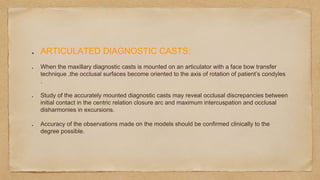
ARTICULATED DIAGNOSTIC CASTS:
When the maxillary diagnostic casts is mounted on an articulator with a face bow transfer
technique ,the occlusal surfaces become oriented to the axis of rotation of patient’s condyles
.
Study of the accurately mounted diagnostic casts may reveal occlusal discrepancies between
initial contact in the centric relation closure arc and maximum intercuspation and occlusal
disharmonies in excursions.
Accuracy of the observations made on the models should be confirmed clinically to the
degree possible.
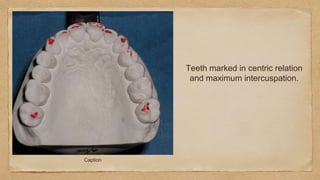
Caption
Teeth marked in centric relation
and maximum intercuspation.
OCCLUSAL THERAPY
Effective nonsurgical therapy usually reduces the inflammation
within the periodontium and results in some healing of
attachment, often resulting in mobile teeth becoming more
stable.
Harmonious function of both TMJ’s and associated muscles is
required for occlusal stability.
When there is sufficient evidence of excessive occlusal forces
on the patients teeth and/or masticatory system disharmony
exists and the patients desires a more stable occlusion ,then a
occlusal appliance is indicated.
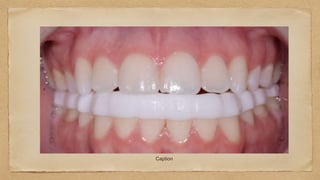
OCCLUSAL APPLIANCE THERAPY
A well designed ,accurately fitted appliance can benefit masticatory
system function while encouraging loose teeth in both arches to tighten
as supporting periodontium heals.
Teeth opposing an appliance should be loaded as close as possible to
their long axis .
Maxillary appliances engage a portion of hard palate,which provide
substantial bracing of teeth and resistance to vertical and lateral forces.
A horseshoe shaped maxillary appliance relies on other
,possibly compromised teeth to attempt to protect the most
mobile teeth.
Soft or partial coverage appliances are contraindicated for long
term protection and stabilisation.
Occlusal appliances are not expected to cure bruxism but often
are prescribed for a patient with habitual parafunction .
Caption
As teeth tighten from the consistent use of the appliance
,occlusal interference may become more evident and greater
discreprancy between the initial dental contact and maximum
intercuspation may be observed .
The clinician analysis of the occlusion should be combined with
detailed analysis of diagnostic casts mounted in centric relation
on an adjustable articulator.
OCCLUSAL ADJUSTMENT:
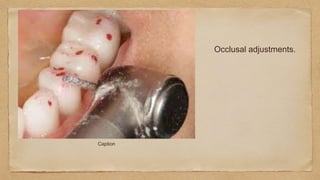
Teeth will usually progressively tighten with continued
compliance with the appliance and repeated careful occlusal
adjustment .
Caption
Occlusal adjustments.
Forces on individual teeth that do not exceed the support and
resistance of that tooth’s periodontium and are vertically
oriented to the Long axis of each tooth as much as possible .
Simultaneous contact of all posterior teeth in the centric relation
closure arc or in maximum intercuspation with minimal
difference between the two.
REQUIREMENTS OF OCCLUSAL STABILITY:
Little or no contact of anterior teeth in centric occlusion,
although readily available to provide guidance in any excursion
and produce posterior disclusion
Harmonious excursive movement of the mandible with in the
patients envelope of function with complete absence of occlusal
interferences.
Conclusion
Confirmation of appropriateness of occlusal therapy is the
product of thorough and complete evaluation of both the
patients occlusion and their masticatory system.
The sequence of occlusal treatment begins with anti-
inflammatory therapy and progresses through reversible
appliance therapy before considering any of irreversible options.
REFERENCES
Carranza's CLINICAL PERIODONTOLOGY-11th Edition
Wheeler's Dental anatomy,physiology And occlusion-first South
Asian edition.
Occlusal evaluation.pptx

Occlusal evaluation.pptx

  • 2.
    OCCLUSION EVALUATION & THERAPY Guided by Dr.K.P.Ashoksir Presented by Ch.Bhavya (Intern)
  • 3.
    CONTENTS INTRODUCTION TERMINOLOGIES MANDIBULAR MOVEMENTS OCCLUSAL FUNCTION OCCLUSALDYSFUNCTION PARAFUNCTION CLINICAL EVALUATION PROCEDURES OCCLUSAL THERAPY OCCLUSAL APPLIANCE THERAPY CONCLUSION
  • 4.
    INTRODUCTION In the healthyperson, the periodontium around teeth subject to excessive occlusal forces experiences adaptation and repair or remodelling with no loss of attachment ,as often occurs with orthodontics. No or minimal occlusal contact on a tooth results in disuse atrophy of periodontium ,which may result in instability of teeth. Forces that exceed the tolerance of the periodontium result in resorption of bone and disruption of attachment.
  • 5.
    occlusion Occlusion means thecontact of teeth in opposing dental arches when the jaws are closed and during various jaw movements.
  • 6.
    Occlusion is adynamic relationship and must be defined physiologically as well as morphologically. Functional unit of masticatory system: TEETH TMJ’S MUSCLES OF MASTICATION.
  • 7.
    The non functionalcusp relation -cusp to groove NORMAL OCCLUSION RELATION IDEAL OCCLUSION : The functional cusps (or) supporting cusps relation -cusp to fossa (or) cusp to marginal ridge.
  • 8.
    TERMINOLOGIES Intercuspal position(ICP): theposition of the mandible when there is maximum Inetrcuspation between maxillary and mandibular teeth. MUSCULAR CONTACT POSITION(MCP) : the position of the mandible when lifted into contact from resting position. EXCURSIVE MOVEMENT : Any movement Of mandible away from ICP. LATEROTRUSION:Movement of the mandible laterally to the right or left from ICP.
  • 9.
    PROTRUSION: Movement ofthe mandible anteriorly from ICP. RETRUSION:Movement of the mandible posteriorly from ICP. WORKING SIDE:The side of either dental arch corresponding to the side of mandible moving away from the midline during a lateral excursion. NONWORKING SIDE:the side of either arch corresponding to the side of mandible moving toward the midline during a lateral excursion.
  • 10.
    INTERFERENCE: Any occlusalcontact that inhibits the remaining occlusal surfaces from achieving stable and harmonious contacts. DISCLUSION:The separation of certain teeth caused by guidance provided by other teeth during an excursion.
  • 11.
  • 12.
  • 13.
    MANDIBULAR MOVEMENTS ROTATIONAL MOVEMENT: Horizontalaxis of rotation Vertical axis of rotation Sagittal axis of rotation TRANSLATIONAL MOVEMENT: Caption
  • 14.
  • 15.
    Contact movements arethe movements of mandible with one or more of opposing occlusal surfaces in contact. RCP ICP MCP
  • 16.
  • 17.
    OCCLUSAL FUNCTION CENTRIC RELATIONis a term used to describe the position of condyles when they are fully seated in the fossa of their respective TMJs . Rotation of mandible around an axis through both condyles is called CENTRIC RELATION CLOSURE ARC
  • 18.
    Maximum intercuspation occurwhen opposing teeth make contact ,with optimal interdigitation ,the most stable endpoint of mandibular closure . Stability is enhanced by simultaneous bilateral contact of multiple posterior teeth with occlusal forces in the long axis of most posterior teeth.
  • 19.
    If the teethare firm and any contact occurs before maximum intercuspation,then incline relationship of opposing occlusal surfaces will guide mandible in to position ,requiring one or both condyles to become dislocate from their fossa. If teeth are mobile and contact first in the centric relation closure arc, then they may move away from opposing teeth rather than cause condylar displacement.
  • 20.
    Biological basis ofocclusal function Capacity to adapt through a wide range of functional requirements. Constant turn over and adjustment of supporting bone and the connective tissue elements of periodontium. The masticatory apparatus is a dynamic system
  • 21.
    Contacts disruptive tomandibular movement or stressful to individual teeth are called OCCLUSAL INTERFERENCES OR DISCREPANCIES. OCCLUSAL DISFUNCTION
  • 22.
  • 23.
    Inflammation disrupts theintegrity of the attachment apparatus resulting in less resistance to force from opposing teeth. When bone loss has occurred ,there is less root surface area supported and fewer sensory fibers in periodontal ligament ,limiting protective muscle modulation of occlusive forces.
  • 24.
    The clinician mustdifferentiate between inflammation caused intolerance to occlusal forces ,normal forces on teeth with reduced periodontal support ,excessive occlusal forces on teeth affected by periodontitis.
  • 25.
    PARA FUNCTION These arethe habits that are performed at a subconscious reflex level &the patient may be unaware of their exercise SORRIN classified it into 3 groups Neurosis Occupational habits Miscellaneous habits
  • 26.
    Occupational habits :thread biting by tailors ,hair clip opening by hair dresser and the holding of nails by cobblers. Miscellaneous habits : incorrect teeth cleaning habits ,thumb sucking and pipe smoking .
  • 27.
    Bruxism Non functional orinvoluntary mandibular movement which may occur by day or night manifested by periodic grinding ,crunching or clicking of teeth Caption
  • 28.
    Karolyi: . Occlusal interference .Psychic factors . Other local factors .may occur in centric occlusion or in eccentric position of mandible
  • 29.
    Bruxing is associatedwith greater frequency and persistence of TMJ dysfunction ,orofacial pain and possibly periodontal attachment loss
  • 30.
    CLINICAL EVALUATION PROCEDURES TEMPOROMANDIBULAR DISORDERSSCREENIG FUNCTION : It should be a part of patients initial comprehensive examination. Patients range of motion is observed ,maximal opening and both lateral and protrusive excursions are measured and any deviation from the midline during opening and closing is defined. Tenderness on palpation may indicate a TMJ capsulitis. Palpation of the muscles of mastication and related head and neck musculature may reveal muscle tension or spasm related to occlusal and tmj disharmonies .
  • 31.
  • 32.
    TMD screening evaluation: 1.maximal interincisal opening (range 40-50mm) 2.opening/closing pathway . 3.Range of lateral and protrusive excursions(at least 7-9mm) 4.auscultstion of tmj sounds. 5.palpation of tmj tenderness or tissue displacement . 6.palpation for muscle tenderness. 7.load testing of patient's tmj’s.
  • 33.
    TESTING FOR MOBILITYOF TEETH : THERE ARE TWO BASIC METHODS TO ASSES THE FIRMNESS OR LOOSENESS OF A TOOTH. A dental instrument is used to exert pressure in facial or lingual direction and dentist places his or her finger on the opposite side of the tooth to both feel and see movement if it occurs. The other method is to test for movement of teeth subject to pressure the patient generates .Fremitus,vibration or micro movement of tooth can be felt when patients tap their teeth together. If the mobility of teeth exceeds that expected based on the loss of support or the level of inflammation observed, then trauma from occlusion is included in diagnosis.
  • 34.
  • 35.
    CENTRIC RELATION ASSESSMENT: Bimanual manipulation of the mandible in the axis of rotation of the condyles in their respective glenoid fossa has become a standard method of assessing Centric relation . This technique is essential to load testing of the TMJ’s and is effective in generating centric relation records for mounting diagnostic casts. Other methods for guiding the condyles toward a seated position, such as leaf gauges or anterior bite stops can also be effective.
  • 36.
  • 37.
  • 38.
    EVALUATION OF EXCURSIONS: Markingof the teeth in all excursions will reveal the pathways of contact of opposing occlusal or incised surfaces during function and may identify interference to harmonious function. Vectors of force and the steepness of the opposing incliner are studied to determine if force is excessive. Interpreting those contacts on a tooth by tooth basis can suggest or deny occlusal trauma as a contributing factor to the loss of attachment of each affected tooth.
  • 39.
    ARTICULATED DIAGNOSTIC CASTS: Whenthe maxillary diagnostic casts is mounted on an articulator with a face bow transfer technique ,the occlusal surfaces become oriented to the axis of rotation of patient’s condyles . Study of the accurately mounted diagnostic casts may reveal occlusal discrepancies between initial contact in the centric relation closure arc and maximum intercuspation and occlusal disharmonies in excursions. Accuracy of the observations made on the models should be confirmed clinically to the degree possible.
  • 40.
    Caption Teeth marked incentric relation and maximum intercuspation.
  • 41.
    OCCLUSAL THERAPY Effective nonsurgicaltherapy usually reduces the inflammation within the periodontium and results in some healing of attachment, often resulting in mobile teeth becoming more stable. Harmonious function of both TMJ’s and associated muscles is required for occlusal stability.
  • 42.
    When there issufficient evidence of excessive occlusal forces on the patients teeth and/or masticatory system disharmony exists and the patients desires a more stable occlusion ,then a occlusal appliance is indicated.
  • 43.
    OCCLUSAL APPLIANCE THERAPY Awell designed ,accurately fitted appliance can benefit masticatory system function while encouraging loose teeth in both arches to tighten as supporting periodontium heals. Teeth opposing an appliance should be loaded as close as possible to their long axis . Maxillary appliances engage a portion of hard palate,which provide substantial bracing of teeth and resistance to vertical and lateral forces.
  • 44.
    A horseshoe shapedmaxillary appliance relies on other ,possibly compromised teeth to attempt to protect the most mobile teeth. Soft or partial coverage appliances are contraindicated for long term protection and stabilisation. Occlusal appliances are not expected to cure bruxism but often are prescribed for a patient with habitual parafunction .
  • 45.
  • 46.
    As teeth tightenfrom the consistent use of the appliance ,occlusal interference may become more evident and greater discreprancy between the initial dental contact and maximum intercuspation may be observed . The clinician analysis of the occlusion should be combined with detailed analysis of diagnostic casts mounted in centric relation on an adjustable articulator. OCCLUSAL ADJUSTMENT:
  • 47.
    Teeth will usuallyprogressively tighten with continued compliance with the appliance and repeated careful occlusal adjustment .
  • 48.
  • 49.
    Forces on individualteeth that do not exceed the support and resistance of that tooth’s periodontium and are vertically oriented to the Long axis of each tooth as much as possible . Simultaneous contact of all posterior teeth in the centric relation closure arc or in maximum intercuspation with minimal difference between the two. REQUIREMENTS OF OCCLUSAL STABILITY:
  • 50.
    Little or nocontact of anterior teeth in centric occlusion, although readily available to provide guidance in any excursion and produce posterior disclusion Harmonious excursive movement of the mandible with in the patients envelope of function with complete absence of occlusal interferences.
  • 51.
    Conclusion Confirmation of appropriatenessof occlusal therapy is the product of thorough and complete evaluation of both the patients occlusion and their masticatory system. The sequence of occlusal treatment begins with anti- inflammatory therapy and progresses through reversible appliance therapy before considering any of irreversible options.
  • 52.
    REFERENCES Carranza's CLINICAL PERIODONTOLOGY-11thEdition Wheeler's Dental anatomy,physiology And occlusion-first South Asian edition.