TLR


Done by Dr Anees Alsaadi
      Nov . 2008
What are Toll-like receptors ?
• Are receptors involved in the innate immune
  system .

• Recognize specific molecular patterns that are
  present in microbial components.
Stimulation of different TLRs
          induces distinct patterns of
               gene expression.


   Instructs the
  development of               Activation of
  antigen-specific           innate immunity
acquired immunity.
Discovery of TLR ?
• Named for their similarity to Toll, a receptor first
  identified in the fruit fly Drosophila melanogaster.


• The first reported human Toll-like receptor was
  described by Nomura and colleagues in 1994.

• 1997, Charles Janeway and Ruslan Medzhitov
  showed that a Toll-like receptor now known as TLR4
  could, induce the activation of an adaptive immune
  response.
Where are TLR receptors found ?
• TLR family members are expressed by:
  – Neutrophils.
  – Macrophages.
  – Dendritic cells.
  – Dermal endothelial cells.
  – Mucosal epithelial cells.
  – TLR2 and TLR4 expressed on B and T cells.
Are they intracellular or extracellular?
• Most TLRs are on the cell surface except of
  TLR9, which is an intracellular

• In MQ TLR4 expressed on cell surface and is
  internalized following engagement of the ligand.

• In TLR4 epithelial cells it resides in the Golgi
  apparatus.
What are the structure of TLR ?
What are the functions of TLR receptors ?
  • Engagement of TLRs with their ligands leads
    to:
    – Pro-inflammatory cytokines,
    – Chemokines,
    – Effector molecules.

  • TLR2 Staphylococcus aureus . Haemophilus
    influenzae or with RSV persist longer in the
    lungs of TLR4-deficient mice .
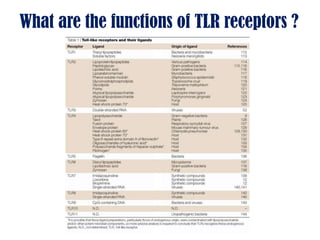
What are the functions of TLR receptors ?
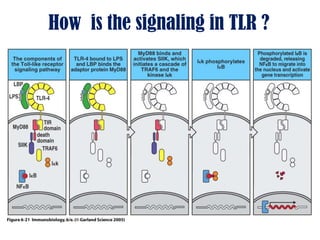
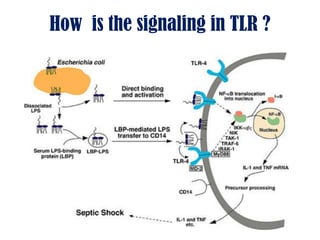
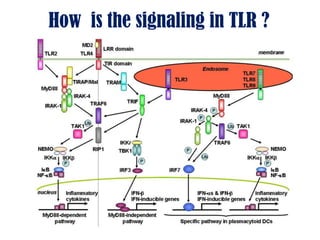
How is the signaling in TLR ?
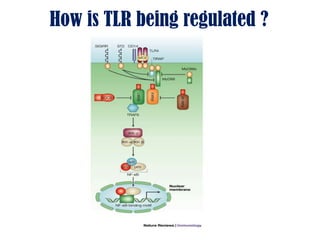
How is TLR being regulated ?
Thank
 you

TLR

  • 1.
    TLR Done by DrAnees Alsaadi Nov . 2008
  • 2.
    What are Toll-likereceptors ? • Are receptors involved in the innate immune system . • Recognize specific molecular patterns that are present in microbial components.
  • 3.
    Stimulation of differentTLRs induces distinct patterns of gene expression. Instructs the development of Activation of antigen-specific innate immunity acquired immunity.
  • 4.
    Discovery of TLR? • Named for their similarity to Toll, a receptor first identified in the fruit fly Drosophila melanogaster. • The first reported human Toll-like receptor was described by Nomura and colleagues in 1994. • 1997, Charles Janeway and Ruslan Medzhitov showed that a Toll-like receptor now known as TLR4 could, induce the activation of an adaptive immune response.
  • 5.
    Where are TLRreceptors found ? • TLR family members are expressed by: – Neutrophils. – Macrophages. – Dendritic cells. – Dermal endothelial cells. – Mucosal epithelial cells. – TLR2 and TLR4 expressed on B and T cells.
  • 6.
    Are they intracellularor extracellular? • Most TLRs are on the cell surface except of TLR9, which is an intracellular • In MQ TLR4 expressed on cell surface and is internalized following engagement of the ligand. • In TLR4 epithelial cells it resides in the Golgi apparatus.
  • 7.
    What are thestructure of TLR ?
  • 8.
    What are thefunctions of TLR receptors ? • Engagement of TLRs with their ligands leads to: – Pro-inflammatory cytokines, – Chemokines, – Effector molecules. • TLR2 Staphylococcus aureus . Haemophilus influenzae or with RSV persist longer in the lungs of TLR4-deficient mice .
  • 9.
    What are thefunctions of TLR receptors ?
  • 10.
    What are thefunctions of TLR receptors ?
  • 11.
    How is thesignaling in TLR ?
  • 12.
    How is thesignaling in TLR ?
  • 13.
    How is thesignaling in TLR ?
  • 14.
    How is TLRbeing regulated ?
  • 15.