Disaster Management inDisaster Management in
IndiaIndia
Past, Present and FuturePast, Present and Future
N. Vinod Chandra MenonN. Vinod Chandra Menon
Member,Member,
National Disaster Management AuthorityNational Disaster Management Authority
(NDMA)(NDMA)
Government of IndiaGovernment of India
Disasters in IndiaDisasters in India
 Moving away from the Great Bengal famineMoving away from the Great Bengal famine
of 1769-1770 in which a third of theof 1769-1770 in which a third of the
population perished.population perished.
 The Chalisa famine of 1783, the Doji Bara orThe Chalisa famine of 1783, the Doji Bara or
Skull famine of 1790 to 1792, the NorthSkull famine of 1790 to 1792, the North
West Provinces famine of 1838, the NorthWest Provinces famine of 1838, the North
West India Famine of 1861, the Bengal andWest India Famine of 1861, the Bengal and
Orissa famine of 1866, the Rajputana famineOrissa famine of 1866, the Rajputana famine
of 1869, the famine of 1899 to 1901, theof 1869, the famine of 1899 to 1901, the
Bengal famine of 1943…Bengal famine of 1943…
 The drought years of 1965, 1972, 1979,The drought years of 1965, 1972, 1979,
1987, 20021987, 2002
India’s Vulnerability to DisastersIndia’s Vulnerability to Disasters
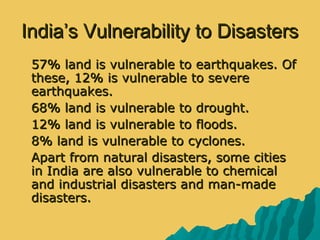
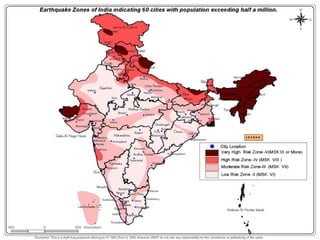
 57% land is vulnerable to earthquakes. Of57% land is vulnerable to earthquakes. Of
these, 12% is vulnerable to severethese, 12% is vulnerable to severe
earthquakes.earthquakes.
 68% land is vulnerable to drought.68% land is vulnerable to drought.
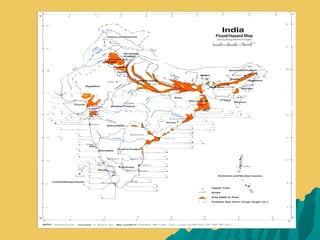
 12% land is vulnerable to floods.12% land is vulnerable to floods.
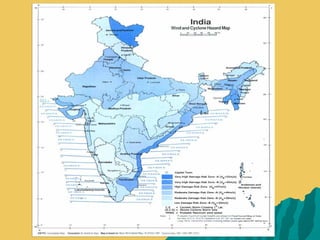
 8% land is vulnerable to cyclones.8% land is vulnerable to cyclones.
 Apart from natural disasters, some citiesApart from natural disasters, some cities
in India are also vulnerable to chemicalin India are also vulnerable to chemical
and industrial disasters and man-madeand industrial disasters and man-made
disasters.disasters.
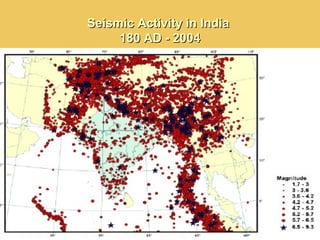
Seismic Activity in IndiaSeismic Activity in India
180 AD - 2004180 AD - 2004
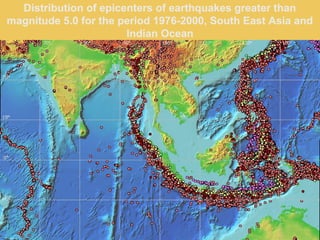
Distribution of epicenters of earthquakes greater than
magnitude 5.0 for the period 1976-2000, South East Asia and
Indian Ocean
Areas of ConcernAreas of Concern
 Activating an Early Warning SystemActivating an Early Warning System
network and its close monitoringnetwork and its close monitoring
 Mechanisms for integrating the scientific,Mechanisms for integrating the scientific,
technological and administrative agenciestechnological and administrative agencies
for effective disaster managementfor effective disaster management
 Terrestrial communication links whichTerrestrial communication links which
collapse in the event of a rapid onsetcollapse in the event of a rapid onset
disasterdisaster
 Vulnerability of critical infrastructuresVulnerability of critical infrastructures
(power supply, communication, water(power supply, communication, water
supply, transport, etc.) to disaster eventssupply, transport, etc.) to disaster events
Areas of ConcernAreas of Concern
 Funding : Primacy of relief as disasterFunding : Primacy of relief as disaster
response.response.
 Preparedness and Mitigation very often ignored.Preparedness and Mitigation very often ignored.
 Lack of integrated efforts to collect and compileLack of integrated efforts to collect and compile
data, information and local knowledge ondata, information and local knowledge on
disaster history and traditional responsedisaster history and traditional response
patterns.patterns.
 Need for standardised efforts in compiling andNeed for standardised efforts in compiling and
interpreting geo-spatial data, satellite imageryinterpreting geo-spatial data, satellite imagery
and early warning signals.and early warning signals.
 Weak areas continue to be forecasting,Weak areas continue to be forecasting,
modelling, risk prediction, simulation andmodelling, risk prediction, simulation and
scenario analysis, etc.scenario analysis, etc.
Areas of ConcernAreas of Concern
 Absence of a national level, state level, andAbsence of a national level, state level, and
district level directory of experts anddistrict level directory of experts and
inventory of resources.inventory of resources.
 Absence of a National Disaster ManagementAbsence of a National Disaster Management
Plan, and State level and district level disasterPlan, and State level and district level disaster
management plans.management plans.
 Sustainability of effortsSustainability of efforts
 Effective Inter Agency Co-ordination andEffective Inter Agency Co-ordination and
Standard Operating Procedures forStandard Operating Procedures for
stakeholder groups, especially critical firststakeholder groups, especially critical first
responder agencies.responder agencies.
 Emergency medicine, critical care medicine,Emergency medicine, critical care medicine,
triage, first aidtriage, first aid
Nodal Agencies for Disaster ManagementNodal Agencies for Disaster Management
 Floods : Ministry of Water Resources, CWCFloods : Ministry of Water Resources, CWC
 Cyclones : Indian Meteorological DepartmentCyclones : Indian Meteorological Department
1.1. Earthquakes : Indian Meteorological DepartmentEarthquakes : Indian Meteorological Department
 Epidemics : Ministry of Health and Family WelfareEpidemics : Ministry of Health and Family Welfare
 Avian Flu: Ministry of Health, Ministry ofAvian Flu: Ministry of Health, Ministry of
Environment, Ministry of Agriculture and AnimalEnvironment, Ministry of Agriculture and Animal
HusbandryHusbandry
 Chemical Disasters : Ministry of Environment andChemical Disasters : Ministry of Environment and
ForestsForests
 Industrial Disasters : Ministry of LabourIndustrial Disasters : Ministry of Labour
 Rail Accidents : Ministry of RailwaysRail Accidents : Ministry of Railways
 Air Accidents : Ministry of Civil AviationAir Accidents : Ministry of Civil Aviation
 Fire : Ministry of Home AffairsFire : Ministry of Home Affairs
 Nuclear Incidents : Department of Atomic EnergyNuclear Incidents : Department of Atomic Energy
 Mine Disasters : Department of MinesMine Disasters : Department of Mines
Dynamics of DisastersDynamics of Disasters
 There is a high probability of a lowThere is a high probability of a low
probability event happening somewhereprobability event happening somewhere
sometime soon…sometime soon…
 The unpredictability of disaster events andThe unpredictability of disaster events and
the high risk and vulnerability profilesthe high risk and vulnerability profiles
make it imperative to strengthen disastermake it imperative to strengthen disaster
preparedness, mitigation and enforcementpreparedness, mitigation and enforcement
of guidelines, building codes andof guidelines, building codes and
restrictions on construction of buildings inrestrictions on construction of buildings in
flood-prone areas and storm surge proneflood-prone areas and storm surge prone
coastal areas.coastal areas.
New Directions for DisasterNew Directions for Disaster
Management in IndiaManagement in India
 The National Disaster ManagementThe National Disaster Management
Authority (NDMA) has been set up as theAuthority (NDMA) has been set up as the
apex body for Disaster Management inapex body for Disaster Management in
India, with the Prime Minister as itsIndia, with the Prime Minister as its
Chairman.Chairman.
 Disaster Management Authorities will beDisaster Management Authorities will be
set up at the State and District Levels toset up at the State and District Levels to
be headed by the Chief Ministers andbe headed by the Chief Ministers and
Collectors/Zilla Parishad ChairmenCollectors/Zilla Parishad Chairmen
respectively.respectively.
New Directions for DisasterNew Directions for Disaster
Management in IndiaManagement in India
 AA National Disaster Mitigation FundNational Disaster Mitigation Fund will bewill be
administerd by NDMA. States and districts willadministerd by NDMA. States and districts will
administer mitigation funds.administer mitigation funds.
 AA National Disaster Response FundNational Disaster Response Fund will bewill be
administerd by NDMA through the Nationaladministerd by NDMA through the National
Executive Committee. States and Districts willExecutive Committee. States and Districts will
administer state Disaster Response Fund andadminister state Disaster Response Fund and
Disaster Response Fund respectively.Disaster Response Fund respectively.
 8 Battalions of8 Battalions of National Disaster Response ForceNational Disaster Response Force
(NDRF) are being trained and deployed with(NDRF) are being trained and deployed with
CSSR and MFR equipments and tools in eightCSSR and MFR equipments and tools in eight
strategic locations.strategic locations.
 AA National Disaster Management PolicyNational Disaster Management Policy andand
National Disaster Response PlanNational Disaster Response Plan will also bewill also be
drawn up.drawn up.
Lessons LearntLessons Learnt
 Be Prepared : Preparedness andBe Prepared : Preparedness and
Mitigation is bound to yield moreMitigation is bound to yield more
effective returns than distributingeffective returns than distributing
relief after a disaster.relief after a disaster.
 Create a Culture of Preparedness andCreate a Culture of Preparedness and
Prevention.Prevention.
 Evolve a code of conduct for all stake-Evolve a code of conduct for all stake-
holdersholders
Future DirectionsFuture Directions
 Encourage and consolidate knowledgeEncourage and consolidate knowledge
networksnetworks
 Mobilise and train disaster volunteers forMobilise and train disaster volunteers for
more effective preparedness, mitigation andmore effective preparedness, mitigation and
response (NSS, NCC, Scouts and Guides,response (NSS, NCC, Scouts and Guides,
NYK, Civil Defence, Homeguards)NYK, Civil Defence, Homeguards)
 Increased capacity building leads to fasterIncreased capacity building leads to faster
vulnerability reduction.vulnerability reduction.
 Learn from best practices in disasterLearn from best practices in disaster
preparedness, mitigation and disasterpreparedness, mitigation and disaster
responseresponse
Future DirectionsFuture Directions
 Mobilising stakeholder participation of Self HelpMobilising stakeholder participation of Self Help
Groups, Women’s Groups, Youth Groups,Groups, Women’s Groups, Youth Groups,
Panchayati Raj InstitutionsPanchayati Raj Institutions
 Anticipatory Governance: Simulation exercises,Anticipatory Governance: Simulation exercises,
Mock drills and Scenario AnalysisMock drills and Scenario Analysis
 Indigenous knowledge systems and copingIndigenous knowledge systems and coping
practicespractices
 Living with Risk: Community Based Disaster RiskLiving with Risk: Community Based Disaster Risk
ManagementManagement
 Inclusive, participatory, gender sensitive, childInclusive, participatory, gender sensitive, child
friendly, eco-friendly and disabled friendly disasterfriendly, eco-friendly and disabled friendly disaster
managementmanagement
 Technology driven but people ownedTechnology driven but people owned
 Knowledge Management: Documentation andKnowledge Management: Documentation and
dissemination of good practicesdissemination of good practices
 Public Private PartnershipPublic Private Partnership
Invest in PreparednessInvest in Preparedness
 Investments in Preparedness andInvestments in Preparedness and
Prevention (Mitigation) will yieldPrevention (Mitigation) will yield
sustainable results, rather than spendingsustainable results, rather than spending
money on relief after a disaster.money on relief after a disaster.
 Most disasters are predictable, especiallyMost disasters are predictable, especially
in their seasonality and the disaster-in their seasonality and the disaster-
prone areas which are vulnerable.prone areas which are vulnerable.
 Communities must be involved inCommunities must be involved in
disaster preparedness.disaster preparedness.
Best PracticesBest Practices
 On 12 November, 1970 a major cyclone hitOn 12 November, 1970 a major cyclone hit
the coastal belt of Bangladesh at 223 km/hr.the coastal belt of Bangladesh at 223 km/hr.
with a storm surge of six to nine meterswith a storm surge of six to nine meters
height, killing an estimatedheight, killing an estimated 500,000500,000 people.people.
 Due to the Cyclone Preparedness Program,Due to the Cyclone Preparedness Program,
the April 1991 cyclone with wind speed of 225the April 1991 cyclone with wind speed of 225
km/hr. killed onlykm/hr. killed only 138,000138,000 people evenpeople even
though the coastal population had doubled bythough the coastal population had doubled by
that time.that time.
 In May 1994, in a similar cyclone with a windIn May 1994, in a similar cyclone with a wind
speed of 250 km/hr. onlyspeed of 250 km/hr. only 127127 people lostpeople lost
their lives.their lives.
 In May 1997, in a cyclone with wind speed ofIn May 1997, in a cyclone with wind speed of
200 km/hr. only200 km/hr. only 111111 people lost their lives.people lost their lives.
New possibilitiesNew possibilities
 National Urban Renewal MissionNational Urban Renewal Mission for 70for 70
cities: recent experience ofcities: recent experience of
“unprecedented” extreme weather“unprecedented” extreme weather
conditions in a few major metros andconditions in a few major metros and
megacitiesmegacities
 100,000100,000 Rural Knowledge CentresRural Knowledge Centres
( IT Kiosks): Need for Spatial e-( IT Kiosks): Need for Spatial e-
Governance for informed decision makingGovernance for informed decision making
in disaster-prone areas: before, duringin disaster-prone areas: before, during
and after disastersand after disasters
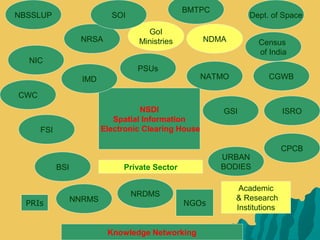
Academic
& Research
Institutions
NSDI
Spatial Information
Electronic Clearing House
NATMO
NDMA
FSI
NRSA
NIC
URBAN
BODIESBSI
NRDMS
NNRMS
GSI
PSUs
GoI
Ministries
CGWB
NBSSLUP
Census
of India
CPCB
Private Sector
IMD
CWC
ISRO
Dept. of SpaceSOI
Knowledge Networking
BMTPC
NGOsPRIs

3 ndma vinod.ppt

  • 1.
    Disaster Management inDisasterManagement in IndiaIndia Past, Present and FuturePast, Present and Future N. Vinod Chandra MenonN. Vinod Chandra Menon Member,Member, National Disaster Management AuthorityNational Disaster Management Authority (NDMA)(NDMA) Government of IndiaGovernment of India
  • 2.
    Disasters in IndiaDisastersin India  Moving away from the Great Bengal famineMoving away from the Great Bengal famine of 1769-1770 in which a third of theof 1769-1770 in which a third of the population perished.population perished.  The Chalisa famine of 1783, the Doji Bara orThe Chalisa famine of 1783, the Doji Bara or Skull famine of 1790 to 1792, the NorthSkull famine of 1790 to 1792, the North West Provinces famine of 1838, the NorthWest Provinces famine of 1838, the North West India Famine of 1861, the Bengal andWest India Famine of 1861, the Bengal and Orissa famine of 1866, the Rajputana famineOrissa famine of 1866, the Rajputana famine of 1869, the famine of 1899 to 1901, theof 1869, the famine of 1899 to 1901, the Bengal famine of 1943…Bengal famine of 1943…  The drought years of 1965, 1972, 1979,The drought years of 1965, 1972, 1979, 1987, 20021987, 2002
  • 3.
    India’s Vulnerability toDisastersIndia’s Vulnerability to Disasters  57% land is vulnerable to earthquakes. Of57% land is vulnerable to earthquakes. Of these, 12% is vulnerable to severethese, 12% is vulnerable to severe earthquakes.earthquakes.  68% land is vulnerable to drought.68% land is vulnerable to drought.  12% land is vulnerable to floods.12% land is vulnerable to floods.  8% land is vulnerable to cyclones.8% land is vulnerable to cyclones.  Apart from natural disasters, some citiesApart from natural disasters, some cities in India are also vulnerable to chemicalin India are also vulnerable to chemical and industrial disasters and man-madeand industrial disasters and man-made disasters.disasters.
  • 6.
    Seismic Activity inIndiaSeismic Activity in India 180 AD - 2004180 AD - 2004
  • 8.
    Distribution of epicentersof earthquakes greater than magnitude 5.0 for the period 1976-2000, South East Asia and Indian Ocean
  • 9.
    Areas of ConcernAreasof Concern  Activating an Early Warning SystemActivating an Early Warning System network and its close monitoringnetwork and its close monitoring  Mechanisms for integrating the scientific,Mechanisms for integrating the scientific, technological and administrative agenciestechnological and administrative agencies for effective disaster managementfor effective disaster management  Terrestrial communication links whichTerrestrial communication links which collapse in the event of a rapid onsetcollapse in the event of a rapid onset disasterdisaster  Vulnerability of critical infrastructuresVulnerability of critical infrastructures (power supply, communication, water(power supply, communication, water supply, transport, etc.) to disaster eventssupply, transport, etc.) to disaster events
  • 10.
    Areas of ConcernAreasof Concern  Funding : Primacy of relief as disasterFunding : Primacy of relief as disaster response.response.  Preparedness and Mitigation very often ignored.Preparedness and Mitigation very often ignored.  Lack of integrated efforts to collect and compileLack of integrated efforts to collect and compile data, information and local knowledge ondata, information and local knowledge on disaster history and traditional responsedisaster history and traditional response patterns.patterns.  Need for standardised efforts in compiling andNeed for standardised efforts in compiling and interpreting geo-spatial data, satellite imageryinterpreting geo-spatial data, satellite imagery and early warning signals.and early warning signals.  Weak areas continue to be forecasting,Weak areas continue to be forecasting, modelling, risk prediction, simulation andmodelling, risk prediction, simulation and scenario analysis, etc.scenario analysis, etc.
  • 11.
    Areas of ConcernAreasof Concern  Absence of a national level, state level, andAbsence of a national level, state level, and district level directory of experts anddistrict level directory of experts and inventory of resources.inventory of resources.  Absence of a National Disaster ManagementAbsence of a National Disaster Management Plan, and State level and district level disasterPlan, and State level and district level disaster management plans.management plans.  Sustainability of effortsSustainability of efforts  Effective Inter Agency Co-ordination andEffective Inter Agency Co-ordination and Standard Operating Procedures forStandard Operating Procedures for stakeholder groups, especially critical firststakeholder groups, especially critical first responder agencies.responder agencies.  Emergency medicine, critical care medicine,Emergency medicine, critical care medicine, triage, first aidtriage, first aid
  • 12.
    Nodal Agencies forDisaster ManagementNodal Agencies for Disaster Management  Floods : Ministry of Water Resources, CWCFloods : Ministry of Water Resources, CWC  Cyclones : Indian Meteorological DepartmentCyclones : Indian Meteorological Department 1.1. Earthquakes : Indian Meteorological DepartmentEarthquakes : Indian Meteorological Department  Epidemics : Ministry of Health and Family WelfareEpidemics : Ministry of Health and Family Welfare  Avian Flu: Ministry of Health, Ministry ofAvian Flu: Ministry of Health, Ministry of Environment, Ministry of Agriculture and AnimalEnvironment, Ministry of Agriculture and Animal HusbandryHusbandry  Chemical Disasters : Ministry of Environment andChemical Disasters : Ministry of Environment and ForestsForests  Industrial Disasters : Ministry of LabourIndustrial Disasters : Ministry of Labour  Rail Accidents : Ministry of RailwaysRail Accidents : Ministry of Railways  Air Accidents : Ministry of Civil AviationAir Accidents : Ministry of Civil Aviation  Fire : Ministry of Home AffairsFire : Ministry of Home Affairs  Nuclear Incidents : Department of Atomic EnergyNuclear Incidents : Department of Atomic Energy  Mine Disasters : Department of MinesMine Disasters : Department of Mines
  • 13.
    Dynamics of DisastersDynamicsof Disasters  There is a high probability of a lowThere is a high probability of a low probability event happening somewhereprobability event happening somewhere sometime soon…sometime soon…  The unpredictability of disaster events andThe unpredictability of disaster events and the high risk and vulnerability profilesthe high risk and vulnerability profiles make it imperative to strengthen disastermake it imperative to strengthen disaster preparedness, mitigation and enforcementpreparedness, mitigation and enforcement of guidelines, building codes andof guidelines, building codes and restrictions on construction of buildings inrestrictions on construction of buildings in flood-prone areas and storm surge proneflood-prone areas and storm surge prone coastal areas.coastal areas.
  • 14.
    New Directions forDisasterNew Directions for Disaster Management in IndiaManagement in India  The National Disaster ManagementThe National Disaster Management Authority (NDMA) has been set up as theAuthority (NDMA) has been set up as the apex body for Disaster Management inapex body for Disaster Management in India, with the Prime Minister as itsIndia, with the Prime Minister as its Chairman.Chairman.  Disaster Management Authorities will beDisaster Management Authorities will be set up at the State and District Levels toset up at the State and District Levels to be headed by the Chief Ministers andbe headed by the Chief Ministers and Collectors/Zilla Parishad ChairmenCollectors/Zilla Parishad Chairmen respectively.respectively.
  • 15.
    New Directions forDisasterNew Directions for Disaster Management in IndiaManagement in India  AA National Disaster Mitigation FundNational Disaster Mitigation Fund will bewill be administerd by NDMA. States and districts willadministerd by NDMA. States and districts will administer mitigation funds.administer mitigation funds.  AA National Disaster Response FundNational Disaster Response Fund will bewill be administerd by NDMA through the Nationaladministerd by NDMA through the National Executive Committee. States and Districts willExecutive Committee. States and Districts will administer state Disaster Response Fund andadminister state Disaster Response Fund and Disaster Response Fund respectively.Disaster Response Fund respectively.  8 Battalions of8 Battalions of National Disaster Response ForceNational Disaster Response Force (NDRF) are being trained and deployed with(NDRF) are being trained and deployed with CSSR and MFR equipments and tools in eightCSSR and MFR equipments and tools in eight strategic locations.strategic locations.  AA National Disaster Management PolicyNational Disaster Management Policy andand National Disaster Response PlanNational Disaster Response Plan will also bewill also be drawn up.drawn up.
  • 16.
    Lessons LearntLessons Learnt Be Prepared : Preparedness andBe Prepared : Preparedness and Mitigation is bound to yield moreMitigation is bound to yield more effective returns than distributingeffective returns than distributing relief after a disaster.relief after a disaster.  Create a Culture of Preparedness andCreate a Culture of Preparedness and Prevention.Prevention.  Evolve a code of conduct for all stake-Evolve a code of conduct for all stake- holdersholders
  • 17.
    Future DirectionsFuture Directions Encourage and consolidate knowledgeEncourage and consolidate knowledge networksnetworks  Mobilise and train disaster volunteers forMobilise and train disaster volunteers for more effective preparedness, mitigation andmore effective preparedness, mitigation and response (NSS, NCC, Scouts and Guides,response (NSS, NCC, Scouts and Guides, NYK, Civil Defence, Homeguards)NYK, Civil Defence, Homeguards)  Increased capacity building leads to fasterIncreased capacity building leads to faster vulnerability reduction.vulnerability reduction.  Learn from best practices in disasterLearn from best practices in disaster preparedness, mitigation and disasterpreparedness, mitigation and disaster responseresponse
  • 18.
    Future DirectionsFuture Directions Mobilising stakeholder participation of Self HelpMobilising stakeholder participation of Self Help Groups, Women’s Groups, Youth Groups,Groups, Women’s Groups, Youth Groups, Panchayati Raj InstitutionsPanchayati Raj Institutions  Anticipatory Governance: Simulation exercises,Anticipatory Governance: Simulation exercises, Mock drills and Scenario AnalysisMock drills and Scenario Analysis  Indigenous knowledge systems and copingIndigenous knowledge systems and coping practicespractices  Living with Risk: Community Based Disaster RiskLiving with Risk: Community Based Disaster Risk ManagementManagement  Inclusive, participatory, gender sensitive, childInclusive, participatory, gender sensitive, child friendly, eco-friendly and disabled friendly disasterfriendly, eco-friendly and disabled friendly disaster managementmanagement  Technology driven but people ownedTechnology driven but people owned  Knowledge Management: Documentation andKnowledge Management: Documentation and dissemination of good practicesdissemination of good practices  Public Private PartnershipPublic Private Partnership
  • 19.
    Invest in PreparednessInvestin Preparedness  Investments in Preparedness andInvestments in Preparedness and Prevention (Mitigation) will yieldPrevention (Mitigation) will yield sustainable results, rather than spendingsustainable results, rather than spending money on relief after a disaster.money on relief after a disaster.  Most disasters are predictable, especiallyMost disasters are predictable, especially in their seasonality and the disaster-in their seasonality and the disaster- prone areas which are vulnerable.prone areas which are vulnerable.  Communities must be involved inCommunities must be involved in disaster preparedness.disaster preparedness.
  • 20.
    Best PracticesBest Practices On 12 November, 1970 a major cyclone hitOn 12 November, 1970 a major cyclone hit the coastal belt of Bangladesh at 223 km/hr.the coastal belt of Bangladesh at 223 km/hr. with a storm surge of six to nine meterswith a storm surge of six to nine meters height, killing an estimatedheight, killing an estimated 500,000500,000 people.people.  Due to the Cyclone Preparedness Program,Due to the Cyclone Preparedness Program, the April 1991 cyclone with wind speed of 225the April 1991 cyclone with wind speed of 225 km/hr. killed onlykm/hr. killed only 138,000138,000 people evenpeople even though the coastal population had doubled bythough the coastal population had doubled by that time.that time.  In May 1994, in a similar cyclone with a windIn May 1994, in a similar cyclone with a wind speed of 250 km/hr. onlyspeed of 250 km/hr. only 127127 people lostpeople lost their lives.their lives.  In May 1997, in a cyclone with wind speed ofIn May 1997, in a cyclone with wind speed of 200 km/hr. only200 km/hr. only 111111 people lost their lives.people lost their lives.
  • 21.
    New possibilitiesNew possibilities National Urban Renewal MissionNational Urban Renewal Mission for 70for 70 cities: recent experience ofcities: recent experience of “unprecedented” extreme weather“unprecedented” extreme weather conditions in a few major metros andconditions in a few major metros and megacitiesmegacities  100,000100,000 Rural Knowledge CentresRural Knowledge Centres ( IT Kiosks): Need for Spatial e-( IT Kiosks): Need for Spatial e- Governance for informed decision makingGovernance for informed decision making in disaster-prone areas: before, duringin disaster-prone areas: before, during and after disastersand after disasters
  • 22.
    Academic & Research Institutions NSDI Spatial Information ElectronicClearing House NATMO NDMA FSI NRSA NIC URBAN BODIESBSI NRDMS NNRMS GSI PSUs GoI Ministries CGWB NBSSLUP Census of India CPCB Private Sector IMD CWC ISRO Dept. of SpaceSOI Knowledge Networking BMTPC NGOsPRIs