Disaster Management Act & its
provisions – Sethupathi Siva, 2016632004.
Disaster Management Act & Its Provisions 2016632004.
3/3/2017 Sethupathi Siva, 1st M.Sc
3/3/2017
Sethupathi Siva, 1st M.Sc.,(SoilScience)
3/3/2017 Sethupathi Siva, 1st M.Sc.,(SoilScience)
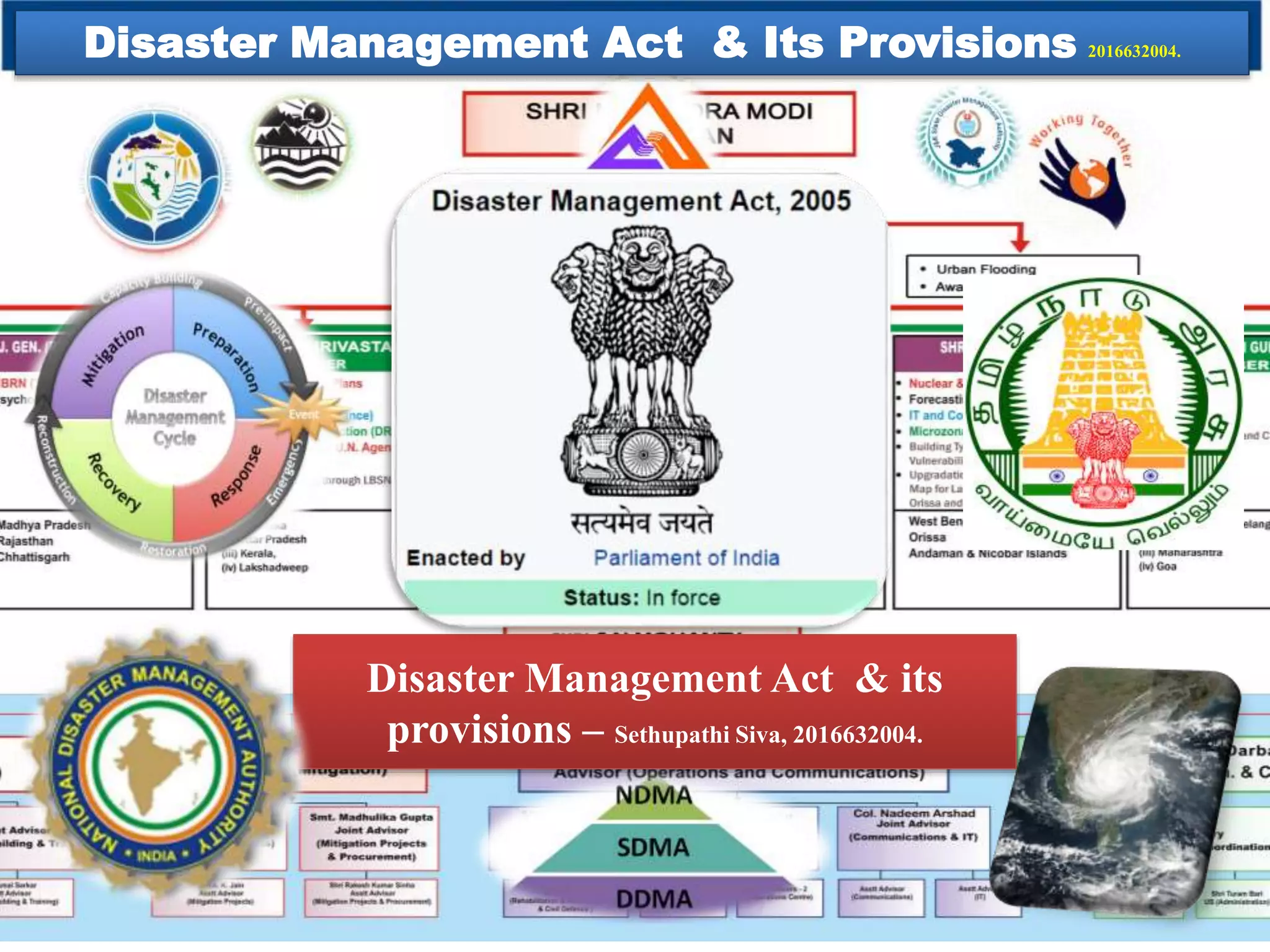
 The Disaster Management Act, 2005, (23 December 2005) No.
53 of 2005, was passed by the Rajya Sabha, the upper house of
the Parliament of India on 28 November, and by the Lok Sabha,
the lower house of the Parliament, on 12 December 2005.
 It received the assent of The President of India on 9 January
2006. The Disaster Management Act, 2005 has 11 chapters and
79 sections.
 The Act extends to the whole of India. The Act provides for "the
effective management of disasters and for matters connected
therewith or incidental thereto
3/3/2017 Sethupathi Siva, 1st M.ScSethupathi Siva, 1st M.Sc.,(SoilScience)
 HPC on Disaster Management set up in August 1999.
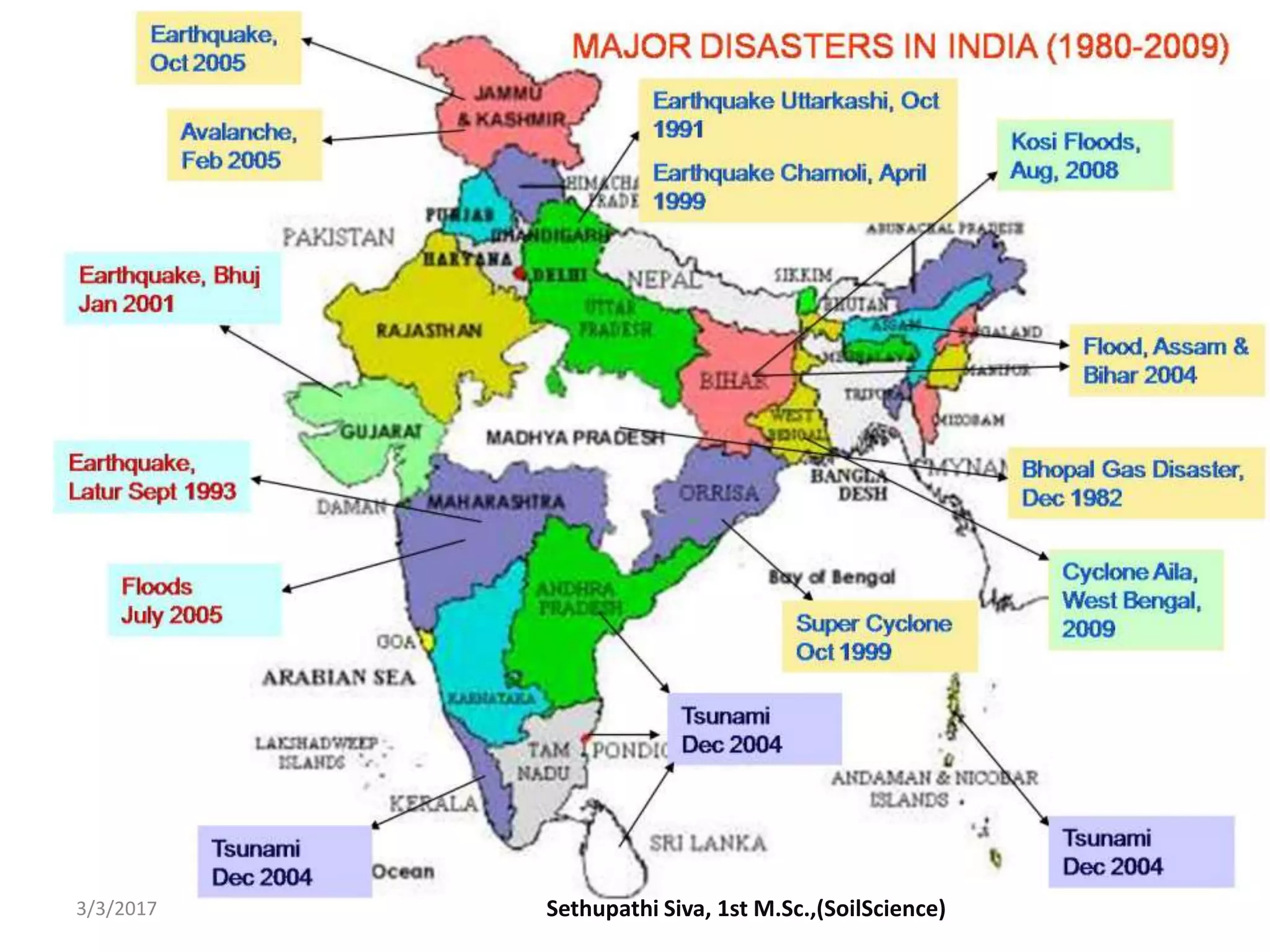
 Disaster cause Innumerable loss of human life and property;
retardation of developmental growth of the nation Orissa Cyclone
was happen at 29thOctober 1999, Gujarat Earthquake (26th
January 2001),Tsunami(26th December 2004),Kashmir
Earthquake (8th October 2005) so the disaster Management Act
was started at 2005 (23rd December 2005)
3/3/2017 Sethupathi Siva, 1st M.Sc
Objectives of DMA
 Preparedness
 Prevention
 Mitigation
 Response
3/3/2017 Sethupathi Siva, 1st M.Sc
Authorities
 National Authority
 State Disaster Management Authority
 District Disaster Management Authority
 National Disaster Response Force (NDRF)
3/3/2017 Sethupathi Siva, 1st M.Sc
3/3/2017 Sethupathi Siva, 1st M.ScSethupathi Siva, 1st M.Sc.,(SoilScience)
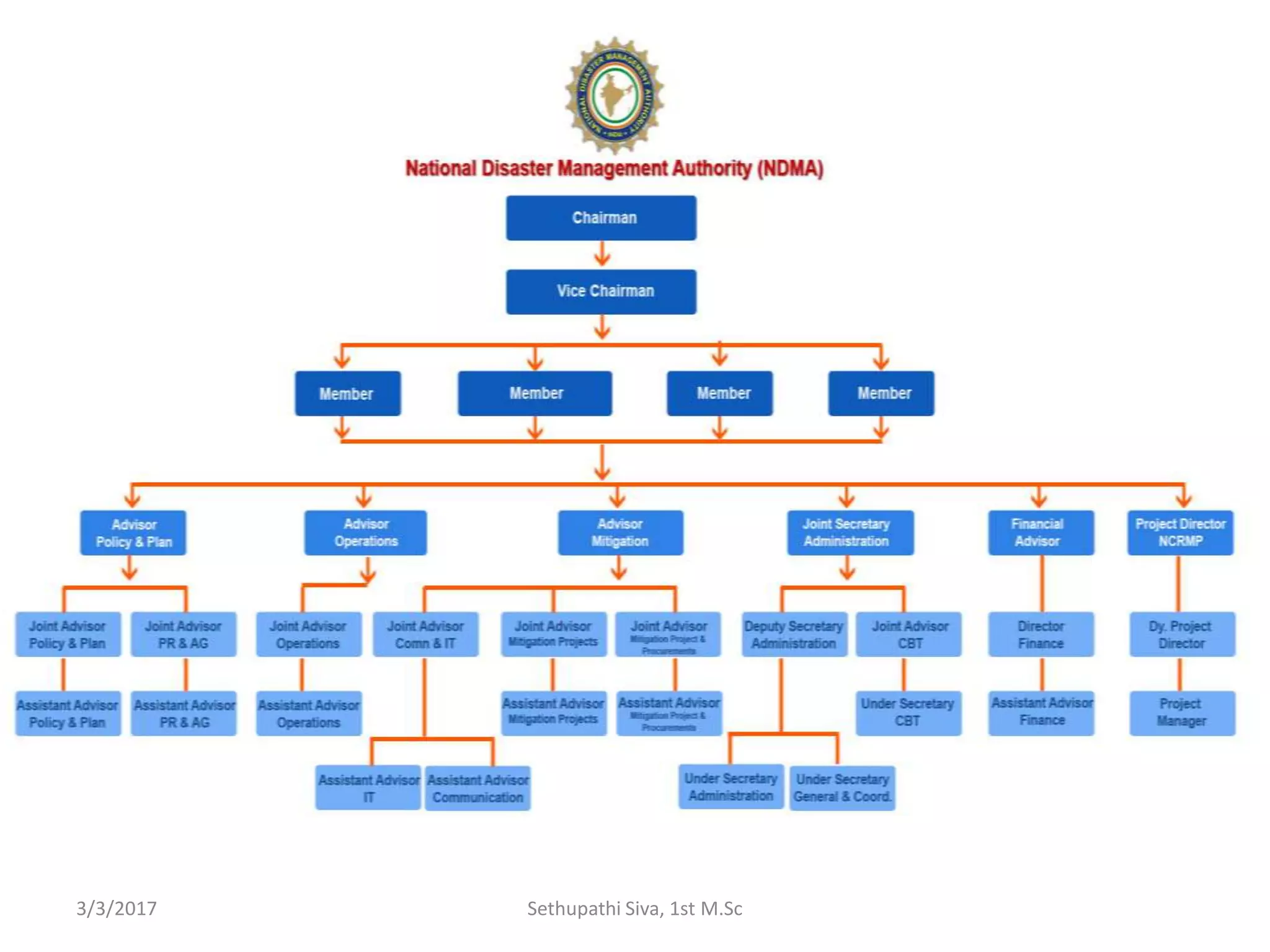
 . The NDMA which was initially established on 30 May 2005 by
an executive order, was constituted under Section-3(1) of the
Disaster Management Act, on 27 September 2006.
 The NDMA is responsible for "laying down the policies, plans
and guidelines for disaster management" and to ensure "timely
and effective response to disaster". Under section 6 of the Act it
is responsible for laying "down guidelines to be followed by the
State Authorities in drawing up the State Plans".
3/3/2017 Sethupathi Siva, 1st M.Sc
National Disaster Management Guidelines
 Earthquakes
 Chemical (Industrial) Disasters
 Medical Preparedness and Mass Casualty Management
 Floods
 Cyclones
 Biological Disasters
 Nuclear and Radiological Disasters
 Chemical Terrorism Disasters
 Landslide and Avalanches
3/3/2017 Sethupathi Siva, 1st M.Sc
State Disaster Management Authority
• All State Governments are mandated under Section 14 of the act
to establish a State Disaster Management Authority (SDMA).
• ter. State Executive Committee is responsible (Section 22) for
drawing up the state disaster management plan, and
implementing the National Plan.
• The SDMA is mandated under section 28 to ensure that all the
departments of the State prepare disaster management plans as
prescribed by the National and State Authoritie.
• Recently in september 2014 kashmir-floods NDRF played a vital
role in rescuing the armed forces and tourists, for which NDRF
was awaded by the govt of India.
3/3/2017 Sethupathi Siva, 1st M.Sc
District Disaster Management Authority
 The Chairperson of District Disaster Management Authority
(DDMA) will be the Collector or District Magistrate or Deputy
Commissioner of the district. The elected
3/3/2017 Sethupathi Siva, 1st M.Sc
National Disaster Response Force (NDRF)
 The Section 44-45 of the Act provides for constituting a National
Disaster Response Force "for the purpose of specialist response
to a threatening disaster situation or disaster" under a Director
General to be appointed by the Central Government.
Other Provisions
 Section 42 of the Act calls for establishing a National Institute of
Disaster Management. Section 46-50, mandates funds for
Disaster Mitigation at various levels. The Act provides for civil
and criminal liabilities for those who violate the provision of the
Act.
3/3/2017 Sethupathi Siva, 1st M.Sc
PSSMHS in Disasters
 PSSMHS in disaster was first time initiated in Bangalore circus
fire.
 ICMR studied the psychological impact and intervention.After the
lattur earth quake more importance was given to the PSSMHS. In
Bhopal medical model. No mental health resources
 GP were trained to Provide PSC Identification and referral of the
victims with mental health problems.
National Guidelines on PSSMHS
 The present status of the management of PSSMHS during the
disasters in the country was discussed and important gaps were
identified
 Identified priority areas for prevention, mitigation and
preparedness for PSSMHS in disasters
 Provided an outline of comprehensive guidelines to be formulated
as a guide for the preparation of action plans by
ministries/departments/states.
3/3/2017 Sethupathi Siva, 1st M.Sc
National Disaster Management Guidelines in progress
• PSSMHS
• Tsunami
• Community Based Disaster Management
• Role of NGOs in Disaster Management
• Post-Disaster Reconstruction
• Protection of Heritage Monuments
• Integrating Disaster Management in Education Curricula
• Nuclear and Radiological Emergencies Part II
• PSSMHS ---Final Stage
• Minimum Standards of Relief for Food, Water,
3/3/2017 Sethupathi Siva, 1st M.Sc
• Medical Cover & Sanitation during disaster
• Management and disposal of dead bodies
• Urban Flooding
• Drought
• Micro Finance
• Risk Insurance
3/3/2017 Sethupathi Siva, 1st M.Sc
Criticism of the Act
 The act has been criticized for marginalizing Non-governmental
organizations (NGOs), elected local representatives, local
communities and civic group; and for fostering a
hierarchical, bureaucratic, command and control, 'top down',
approach that gives the central, state, and district authorities
sweeping powers. It is also alleged that the "Act became a law
almost at the will of the bureaucrats who framed it."
3/3/2017 Sethupathi Siva, 1st M.Sc
References
1. Parliament of India (23 December 2005). "Disaster
Management Act, 2005, [23rd December, 2005.] NO. 53 OF
2005" (PDF). Ministry of Home. Retrieved 30 July 2013.
2. Aparna Meduri (2006). "The Disaster Management Act,
2005". The ICFAI Journal of Environmental Law. The ICFAI
University Press,. pp. 9–11. Retrieved 30 July 2013.
3. Ministry of Home (27 September 2006). "Notification for
constituting National Executive Committee (NEC)" (PDF).
The Gazette of India. Ministry of Home. p. Section 3, sub
section (ii). Retrieved 30 July 2013.
4. Max Martin (8 February 2007). "DISASTER MANAGEMENT
ACT Farce follows disaster". Retrieved 30 July 2013.
3/3/2017 Sethupathi Siva, 1st M.Sc
June 8, 2017 Sethupathi S, M.Sc.,(soil Science). 23

Disaster management act & its provisions

  • 1.
    Disaster Management Act& its provisions – Sethupathi Siva, 2016632004. Disaster Management Act & Its Provisions 2016632004.
  • 2.
  • 3.
    3/3/2017 Sethupathi Siva, 1stM.Sc.,(SoilScience)
  • 4.
    3/3/2017 Sethupathi Siva,1st M.Sc.,(SoilScience)
  • 5.
     The DisasterManagement Act, 2005, (23 December 2005) No. 53 of 2005, was passed by the Rajya Sabha, the upper house of the Parliament of India on 28 November, and by the Lok Sabha, the lower house of the Parliament, on 12 December 2005.  It received the assent of The President of India on 9 January 2006. The Disaster Management Act, 2005 has 11 chapters and 79 sections.  The Act extends to the whole of India. The Act provides for "the effective management of disasters and for matters connected therewith or incidental thereto 3/3/2017 Sethupathi Siva, 1st M.ScSethupathi Siva, 1st M.Sc.,(SoilScience)
  • 6.
     HPC onDisaster Management set up in August 1999.  Disaster cause Innumerable loss of human life and property; retardation of developmental growth of the nation Orissa Cyclone was happen at 29thOctober 1999, Gujarat Earthquake (26th January 2001),Tsunami(26th December 2004),Kashmir Earthquake (8th October 2005) so the disaster Management Act was started at 2005 (23rd December 2005) 3/3/2017 Sethupathi Siva, 1st M.Sc
  • 7.
    Objectives of DMA Preparedness  Prevention  Mitigation  Response 3/3/2017 Sethupathi Siva, 1st M.Sc
  • 8.
    Authorities  National Authority State Disaster Management Authority  District Disaster Management Authority  National Disaster Response Force (NDRF) 3/3/2017 Sethupathi Siva, 1st M.Sc
  • 9.
    3/3/2017 Sethupathi Siva,1st M.ScSethupathi Siva, 1st M.Sc.,(SoilScience)
  • 10.
     . TheNDMA which was initially established on 30 May 2005 by an executive order, was constituted under Section-3(1) of the Disaster Management Act, on 27 September 2006.  The NDMA is responsible for "laying down the policies, plans and guidelines for disaster management" and to ensure "timely and effective response to disaster". Under section 6 of the Act it is responsible for laying "down guidelines to be followed by the State Authorities in drawing up the State Plans". 3/3/2017 Sethupathi Siva, 1st M.Sc
  • 11.
  • 12.
    National Disaster ManagementGuidelines  Earthquakes  Chemical (Industrial) Disasters  Medical Preparedness and Mass Casualty Management  Floods  Cyclones  Biological Disasters  Nuclear and Radiological Disasters  Chemical Terrorism Disasters  Landslide and Avalanches 3/3/2017 Sethupathi Siva, 1st M.Sc
  • 13.
    State Disaster ManagementAuthority • All State Governments are mandated under Section 14 of the act to establish a State Disaster Management Authority (SDMA). • ter. State Executive Committee is responsible (Section 22) for drawing up the state disaster management plan, and implementing the National Plan. • The SDMA is mandated under section 28 to ensure that all the departments of the State prepare disaster management plans as prescribed by the National and State Authoritie. • Recently in september 2014 kashmir-floods NDRF played a vital role in rescuing the armed forces and tourists, for which NDRF was awaded by the govt of India. 3/3/2017 Sethupathi Siva, 1st M.Sc
  • 14.
  • 15.
    District Disaster ManagementAuthority  The Chairperson of District Disaster Management Authority (DDMA) will be the Collector or District Magistrate or Deputy Commissioner of the district. The elected 3/3/2017 Sethupathi Siva, 1st M.Sc
  • 16.
  • 17.
    National Disaster ResponseForce (NDRF)  The Section 44-45 of the Act provides for constituting a National Disaster Response Force "for the purpose of specialist response to a threatening disaster situation or disaster" under a Director General to be appointed by the Central Government. Other Provisions  Section 42 of the Act calls for establishing a National Institute of Disaster Management. Section 46-50, mandates funds for Disaster Mitigation at various levels. The Act provides for civil and criminal liabilities for those who violate the provision of the Act. 3/3/2017 Sethupathi Siva, 1st M.Sc
  • 18.
    PSSMHS in Disasters PSSMHS in disaster was first time initiated in Bangalore circus fire.  ICMR studied the psychological impact and intervention.After the lattur earth quake more importance was given to the PSSMHS. In Bhopal medical model. No mental health resources  GP were trained to Provide PSC Identification and referral of the victims with mental health problems. National Guidelines on PSSMHS  The present status of the management of PSSMHS during the disasters in the country was discussed and important gaps were identified  Identified priority areas for prevention, mitigation and preparedness for PSSMHS in disasters  Provided an outline of comprehensive guidelines to be formulated as a guide for the preparation of action plans by ministries/departments/states. 3/3/2017 Sethupathi Siva, 1st M.Sc
  • 19.
    National Disaster ManagementGuidelines in progress • PSSMHS • Tsunami • Community Based Disaster Management • Role of NGOs in Disaster Management • Post-Disaster Reconstruction • Protection of Heritage Monuments • Integrating Disaster Management in Education Curricula • Nuclear and Radiological Emergencies Part II • PSSMHS ---Final Stage • Minimum Standards of Relief for Food, Water, 3/3/2017 Sethupathi Siva, 1st M.Sc
  • 20.
    • Medical Cover& Sanitation during disaster • Management and disposal of dead bodies • Urban Flooding • Drought • Micro Finance • Risk Insurance 3/3/2017 Sethupathi Siva, 1st M.Sc
  • 21.
    Criticism of theAct  The act has been criticized for marginalizing Non-governmental organizations (NGOs), elected local representatives, local communities and civic group; and for fostering a hierarchical, bureaucratic, command and control, 'top down', approach that gives the central, state, and district authorities sweeping powers. It is also alleged that the "Act became a law almost at the will of the bureaucrats who framed it." 3/3/2017 Sethupathi Siva, 1st M.Sc
  • 22.
    References 1. Parliament ofIndia (23 December 2005). "Disaster Management Act, 2005, [23rd December, 2005.] NO. 53 OF 2005" (PDF). Ministry of Home. Retrieved 30 July 2013. 2. Aparna Meduri (2006). "The Disaster Management Act, 2005". The ICFAI Journal of Environmental Law. The ICFAI University Press,. pp. 9–11. Retrieved 30 July 2013. 3. Ministry of Home (27 September 2006). "Notification for constituting National Executive Committee (NEC)" (PDF). The Gazette of India. Ministry of Home. p. Section 3, sub section (ii). Retrieved 30 July 2013. 4. Max Martin (8 February 2007). "DISASTER MANAGEMENT ACT Farce follows disaster". Retrieved 30 July 2013. 3/3/2017 Sethupathi Siva, 1st M.Sc
  • 23.
    June 8, 2017Sethupathi S, M.Sc.,(soil Science). 23