1
Dr.N.VIJAYANAND, MBA (SET),PhD
Assistant Professor,
Department of Business Administration,
Mannar Thirumalai Naicker College,
Madurai.
Introduction
Value of Time
Need of Time Management
How to use Time Effectively
Time Management Techniques
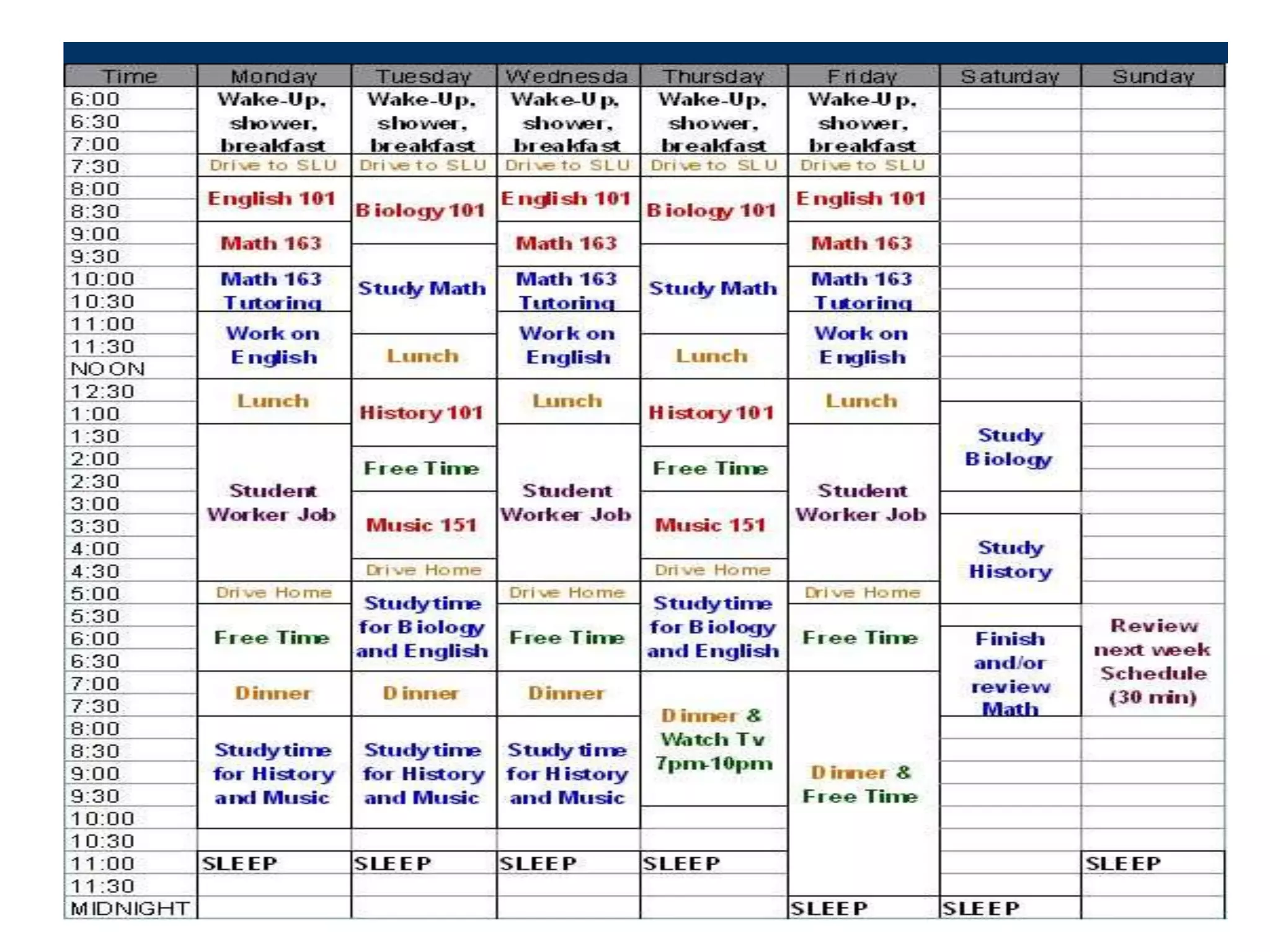
Ideal Task Plan
Self Assessment
Consequences of Good & Poor TM
Common Time Management Mistakes
Wasting Time In Day Today Life
2
TIME MANAGEMENT
Managing the time effectively So
that the right time is allocated to the
right activity.
3
4
You can make money; you can’t make time.
An inch of gold cannot buy an inch of time
(Chinese proverb).
5
6
Eighty Six Thousand
Four HundredVisualize this:
Each day your bank deposits
Rs. 86,400 in your account.
You have to spend it all in one
day.
You can’t carry over any money
to the next day.
7
24 hours per day
X
60 minutes per hour
X
60 seconds per minute
=
86,400 Seconds
8
To Realize the Value of TIME
ONE YEAR, ask a student who failed .
ONE MONTH, ask a mother who gave birth to a premature baby.
ONE WEEK, ask the editor of a weekly newspaper.
ONE DAY, ask a daily wage laborer with kids to feed.
ONE HOUR, ask the student who is waiting for the result.
ONE MINUTE, ask a person who missed the train.
ONE SECOND, ask a person who just avoided an accident.
ONE MILLISECOND, ask the person who won a silver medal in the
Olympics.
9
10
Time Management
Time is life, do not waste it
Identify major thieves of time and eject them
Make a realistic list of things to do and act on it
Eliminate unnecessary activities
Memory aids such as diaries and reminders are useful
Analyze how time is spent
Never take on more than is necessary, learn to say no
Analyze yourself and operate within your strengths
Get on by being organized
Employ a programme of physical and mental fitness
Manage backlog
Employ a schedule or planner to chart the way ahead
Never cease striving to become more efficient and effective
Treat each day as your last, maximize it.
11
Why Do We Need Time Management
To Save Time
To Reduce Stress
To increase Productivity
To function More Effectively
To Achieve More
12
HOW TO USE TIME EFFECTIVELY
1. Effective Planning
2. Setting goals and objectives
3. Setting deadlines
4. Delegation of responsibilities
5. Prioritizing activities as per their
importance
6. Spending the right time on the right
13
1- Effective Planning
Plan your day well in advance.
1. Prepare a ToDo List or a “TASK PLAN”.
2. Order activities according to their
priority.
3. Allocate suitable time to each activity.
Complete pending tasks one by one.
– Do not begin fresh work unless you have
finished your previous task.
Tick the ones you have already
completed.
Ensure you finish tasks within the
stipulated time frame.
14
2- Setting Goals and Objectives
Working without goals and targets
in an organization would be
similar to a situation where the
captain of the ship loses his way in
the sea.
Set targets for yourself and make
sure they are realistic and
achievable.
15
3- Setting Deadlines
Ask yourself “how much time
needs to be devoted to a
particular task?”
Set deadlines for every task, and
be committed to.
– Do not wait for your superiors to
ask you every time.
– Learn to be self driven.
16
4- Delegation of Responsibilities
Don’t do everything on your own,
there are other people as well.
Roles and responsibilities should be
delegated to employees according to
their interest and specialization to
ensure they would finish within
deadlines.
An employee who does not have
enough knowledge needs more time
than someone who knows the work
well.
17
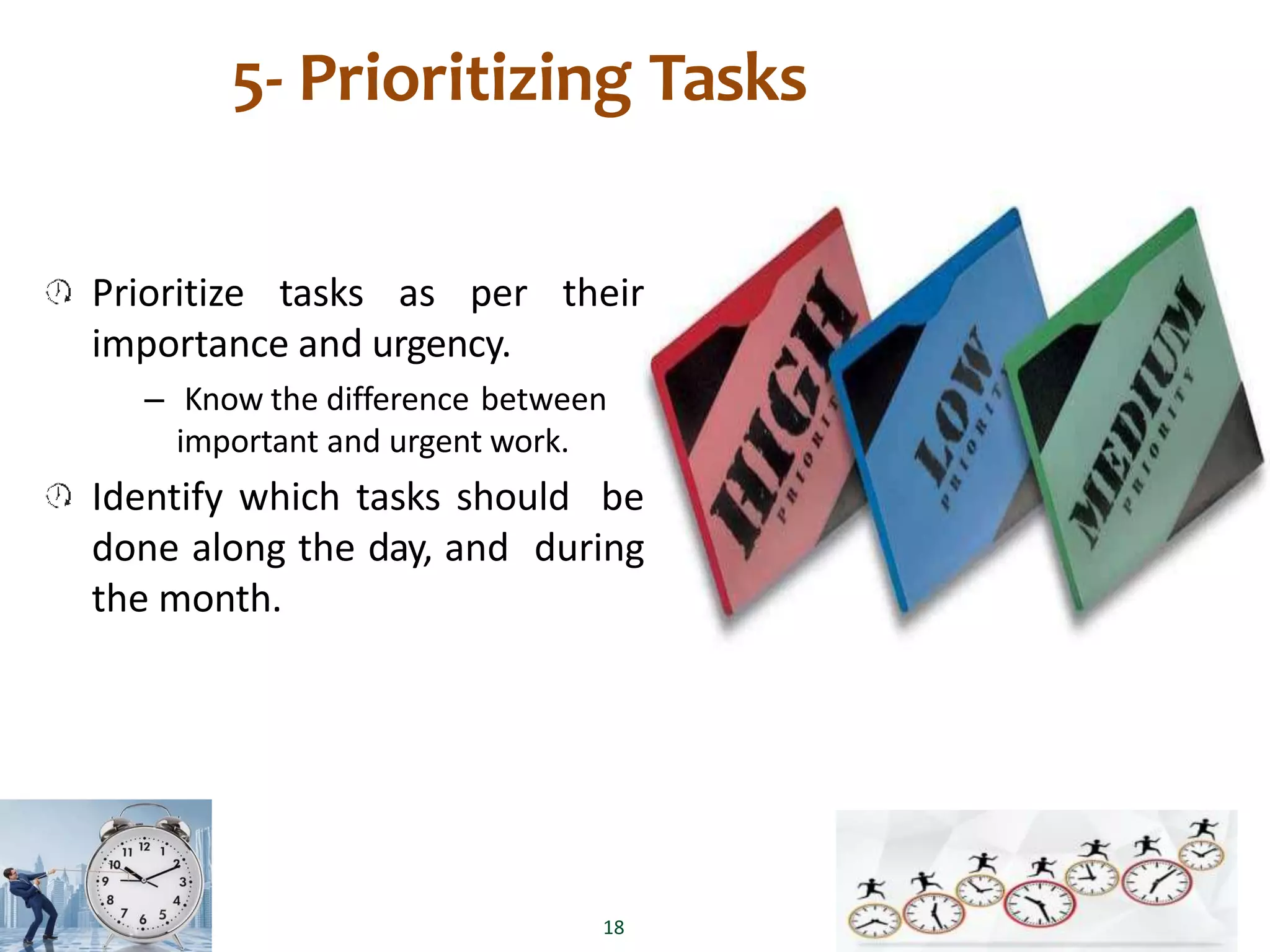
5- Prioritizing Tasks
Prioritize tasks as per their
importance and urgency.
– Know the difference between
important and urgent work.
Identify which tasks should be
done along the day, and during
the month.
18
19
URGENCY/
IMPORTANCE
URGENT NOT URGENT
IMPORTANT 1 2
NOT
IMPORTANT
3 4
6- Spending the Right Time on
Right Activity
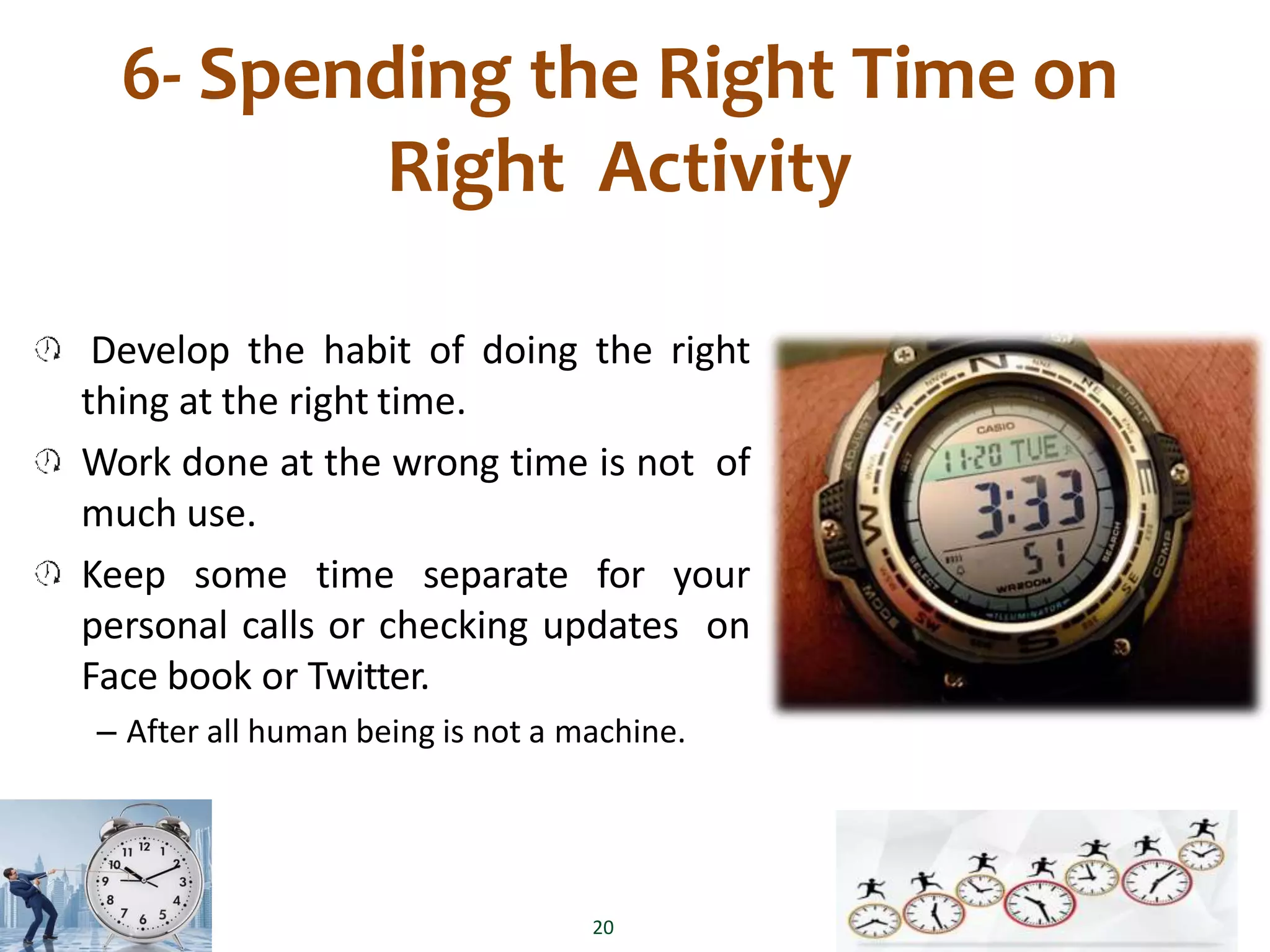
Develop the habit of doing the right
thing at the right time.
Work done at the wrong time is not of
much use.
Keep some time separate for your
personal calls or checking updates on
Face book or Twitter.
– After all human being is not a machine.
20
Time Management Techniques
21
1. Set Your Priorities
2. Finish YourAssignments on Time
3. Differentiate Between Urgent and Important
4. StayFocused
5. Add Life to Work
6. Set Realistic Targets
7. Don’t Overload Yourself
8. Be Disciplined and Punctual
9. Be organized
10. Enjoy your work
22
Time Management Techniques
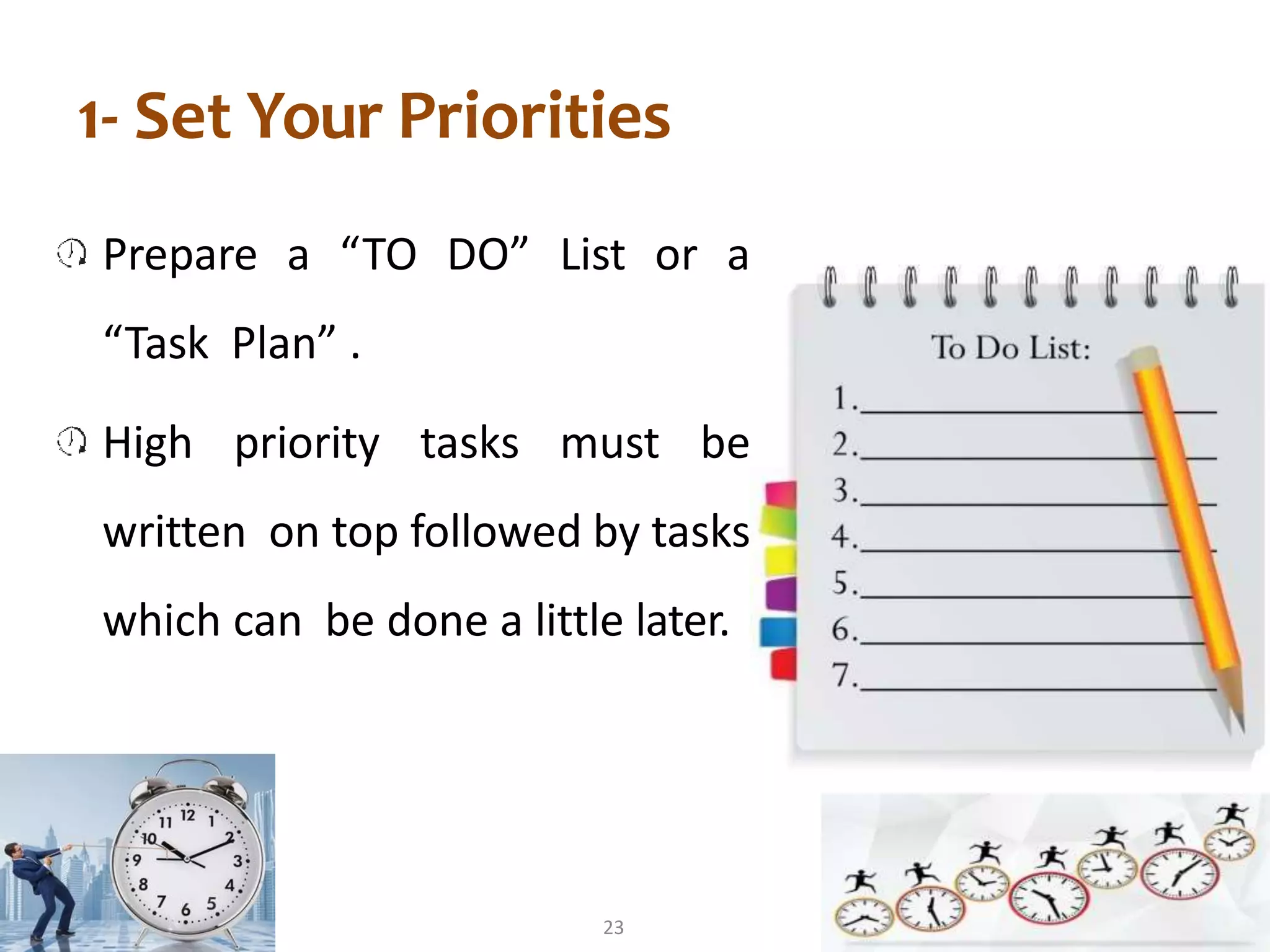
1- Set Your Priorities
Prepare a “TO DO” List or a
“Task Plan” .
High priority tasks must be
written on top followed by tasks
which can be done a little later.
23
2- Finish Your Assignments on Time
Tick the tasks you have already
finished.
24
3- Differentiate Between Urgent and
Important
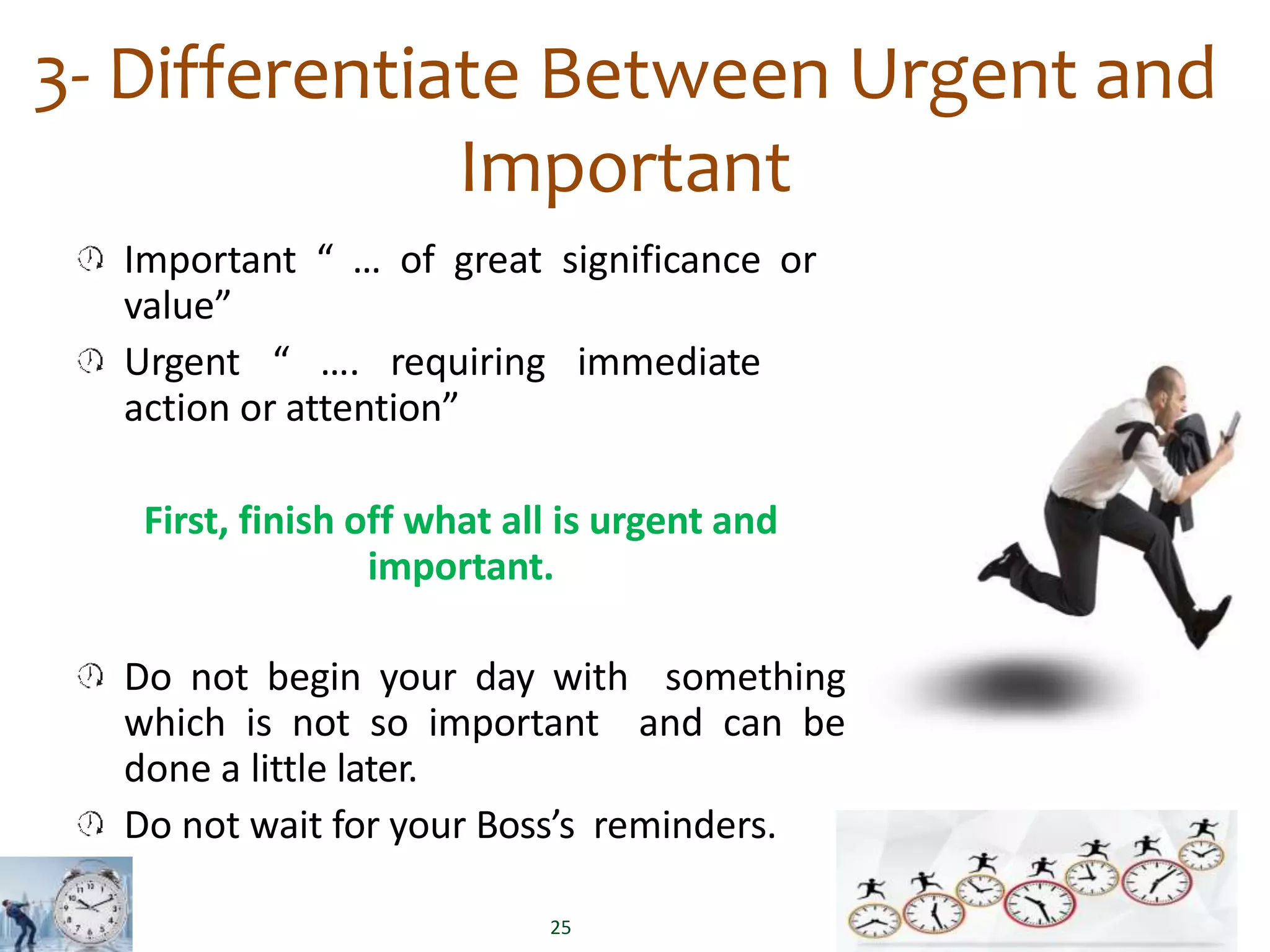
Important “ … of great significance or
value”
Urgent “ …. requiring immediate
action or attention”
First, finish off what all is urgent and
important.
Do not begin your day with something
which is not so important and can be
done a little later.
Do not wait for your Boss’s reminders.
25
4- Stay Focused
While doing an urgent job, do
not leave your work station.
Going for strolls in the middle
of an urgent work breaks
continuity and makes you
loose focus.
26
5- Add Life to Work
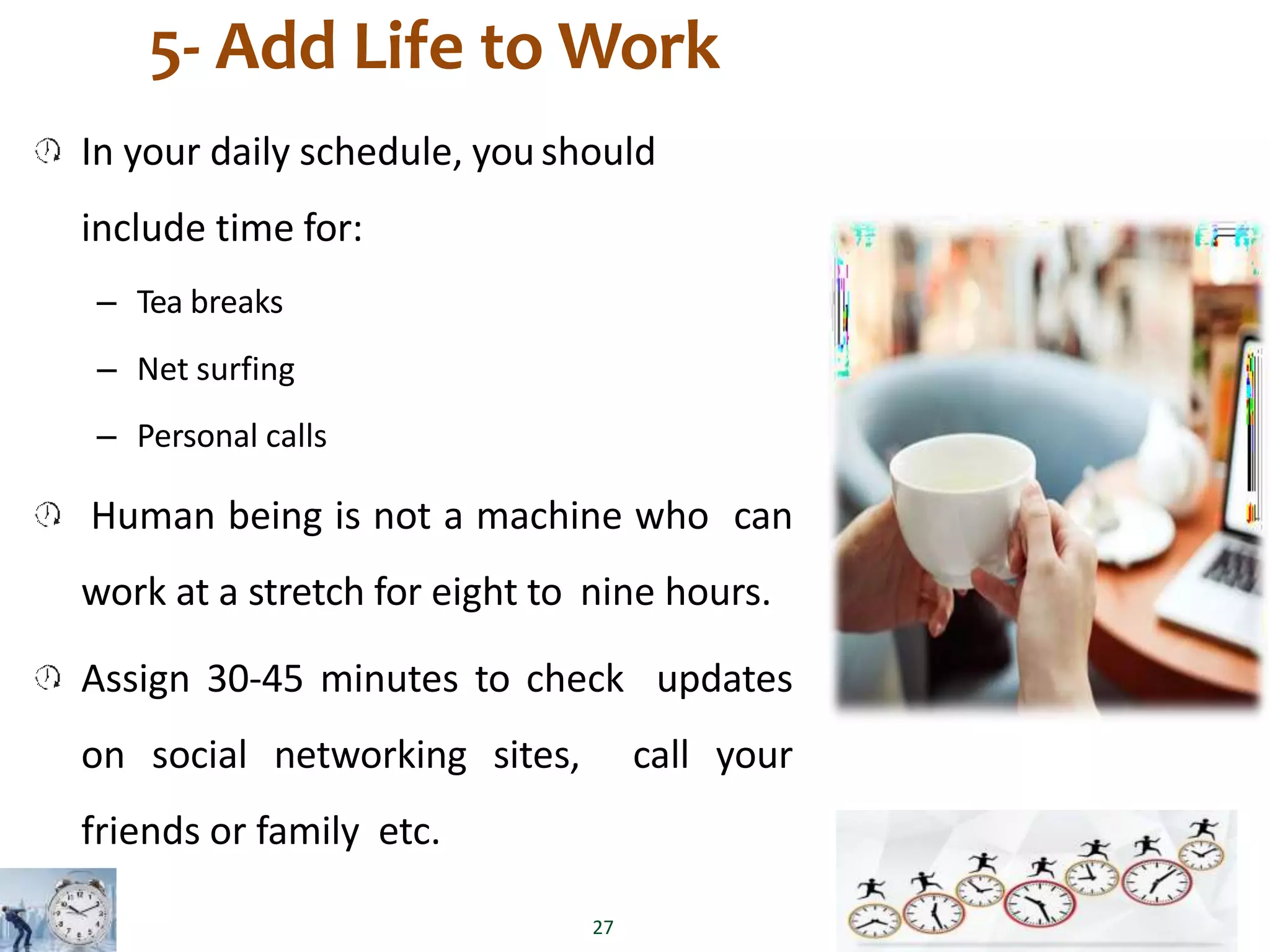
In your daily schedule, youshould
include time for:
– Tea breaks
– Net surfing
– Personal calls
Human being is not a machine who can
work at a stretch for eight to nine hours.
Assign 30-45 minutes to check updates
on social networking sites, call your
friends or family etc.
27
6- Set Realistic Targets
Know what you need to achieve and
in what duration?
Do not lie to yourself.
Assigning one hour to a task which
you yourself know would require
much more time does not make
sense.
28
7- Don’t Overload Yourself
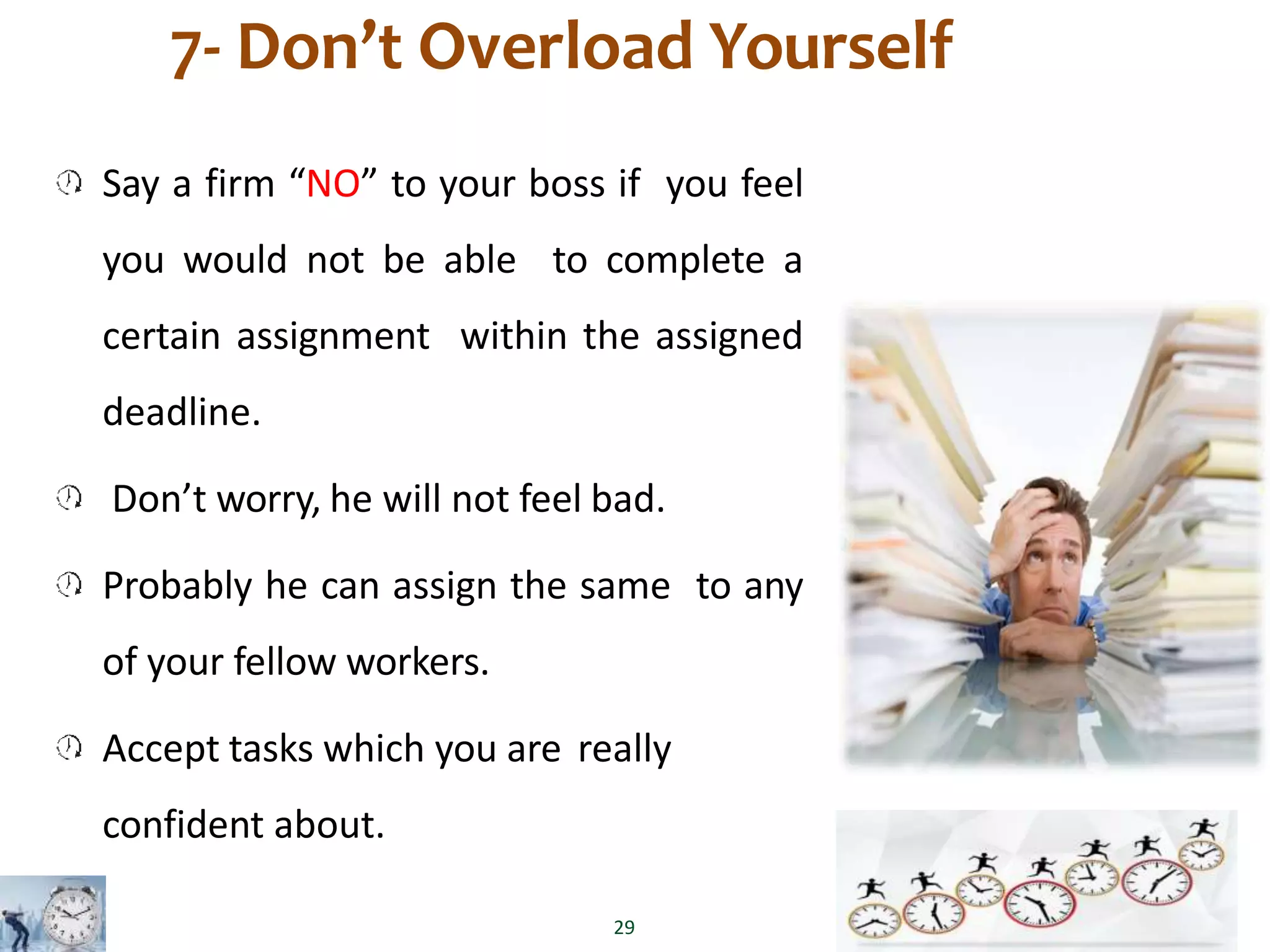
Say a firm “NO” to your boss if you feel
you would not be able to complete a
certain assignment within the assigned
deadline.
Don’t worry, he will not feel bad.
Probably he can assign the same to any
of your fellow workers.
Accept tasks which you are really
confident about.
29
8- Be Disciplined and Punctual
Avoid taking unnecessary
leaves from work.
Reach work on time as it
helps you to plan your day
better.
30
9- Be organized
Keep things at their proper places.
– Files must be kept at their respective drawers.
– Staple important documents and put them in a proper folder.
– Learn to be a little more organized, this will save your time which goes
on unnecessary searching.
Develop the habit of using an organizer
– It helps you plan things better.
– Keep a notepad and a pen handy.
– Do not write contact numbers or email IDs on loose papers. You will
waste half of your time searching them.
– Manage your emails, create separate folders for each client.
31
10- Enjoy your work
Avoid playing games on computer or
cell phones during office hours, it is
unprofessional.
Do not work only when your boss is
around, taking ownership of work
pays you in the long run.
32
33
34
35
Answer “Yes” or “No” to the following questions
1. Have you estimated how many hours you need to study this semester?
2. Do you tend to complete your assignments on time?
3. Have you estimated how long it takes to read one chapter in your textbooks?
4. Do you begin working on long-term assignments at the early in the
semester?
5. Do you make lists of things to do in your head, rather than on paper?
6. Do you participate in social activities when you know you should be
studying?
7. Do you schedule time to study for exams?
8. Do you have a job that requires more than 20 hours a week?
9. Do you know what tasks you are going to do when you sit down to study?
10.Do you do the assignments from your favorite class first?
 Give yourself 1 point for each YES answer to
questions 1,2,3,4,7,9
Give yourself 1 point for each NO answer to
questions 5, 6, 8, 10.
 Calculate the Total your points you scored.
 A low score indicates a need for help with time
management and a high score indicates use of
effective time management techniques.36
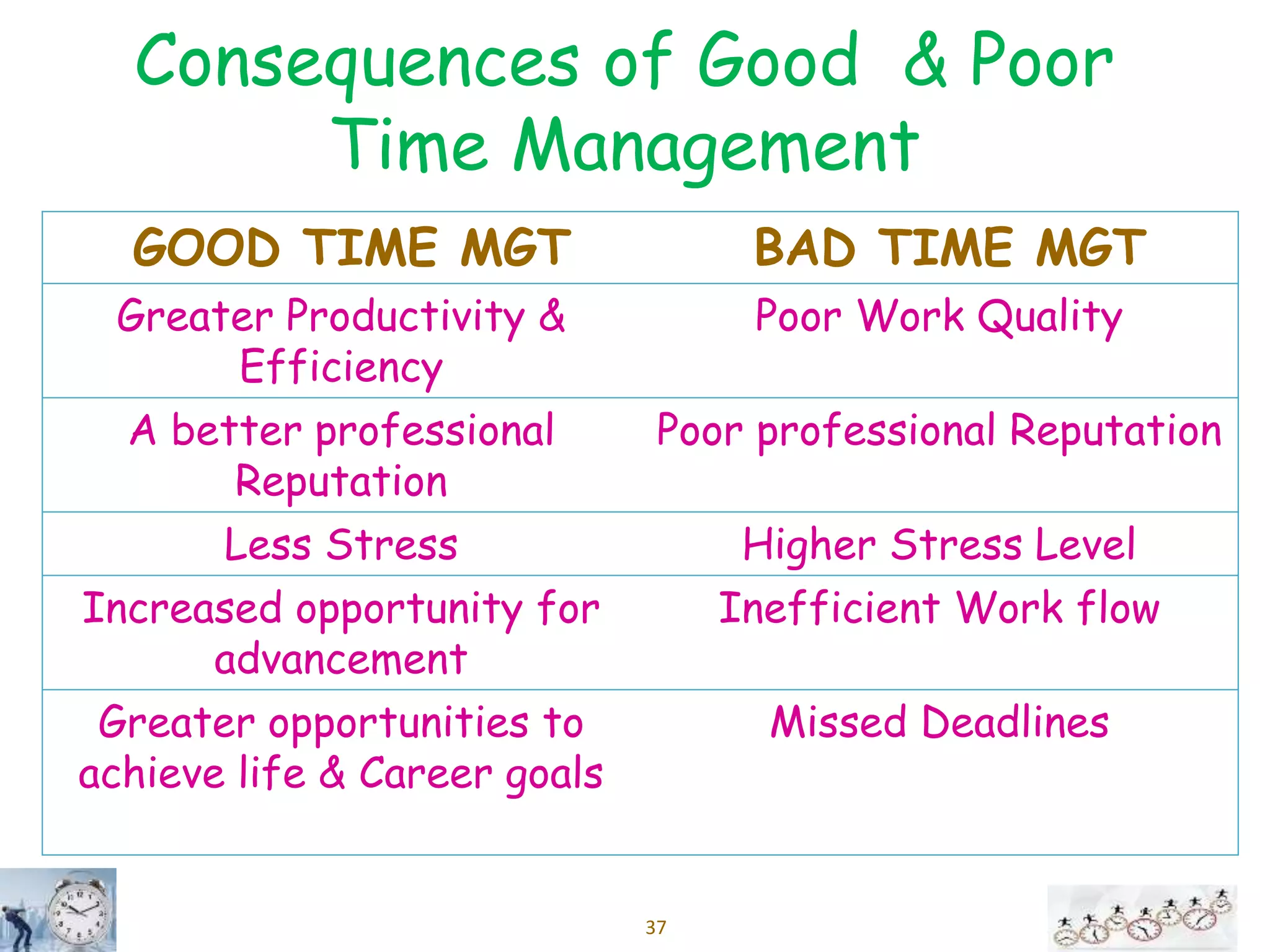
Consequences of Good & Poor
Time Management
37
GOOD TIME MGT BAD TIME MGT
Greater Productivity &
Efficiency
Poor Work Quality
A better professional
Reputation
Poor professional Reputation
Less Stress Higher Stress Level
Increased opportunity for
advancement
Inefficient Work flow
Greater opportunities to
achieve life & Career goals
Missed Deadlines
COMMON TIME MANANGMENT MISTAKES
Failing to keep a To- do List
Not Setting personal goals
Not Prioritizing
Failing to Mange Distractions
Procrastination
Taking on too much
Thriving on ”Busy”
Multitasking
Not Taking breaks
Ineffectively scheduling tasks
38
WASTING TIME IN DAY TODAY LIFE
Doingotherpeople’s work
Watching TV
Indecision
Playing video games
Constantlyupdatingyour social mediastatus
Complaining
Hangingout withnegative people
Waitingfor somethingto happen
Reading Email.
Attendingunnecessarymeetings
Not lookingat yourto-do list
“ Time is life , To
waste your time is to
waste your life.”
“Manage your time well,
Manage your life well”
40
41
42
 Yesterday is a cancelled cheque, Tomorrow is a
promissory note, Today is ready cash. Use it.
 Do not postpone work.
 Identify your time waster and resolve to eliminate
them.
 Add times for relaxation and recreation in your
schedule.
 Learn to say “NO.” It is not a crime.
 Plan the day.
RECAP
43

Time management

  • 1.
    1 Dr.N.VIJAYANAND, MBA (SET),PhD AssistantProfessor, Department of Business Administration, Mannar Thirumalai Naicker College, Madurai.
  • 2.
    Introduction Value of Time Needof Time Management How to use Time Effectively Time Management Techniques Ideal Task Plan Self Assessment Consequences of Good & Poor TM Common Time Management Mistakes Wasting Time In Day Today Life 2
  • 3.
    TIME MANAGEMENT Managing thetime effectively So that the right time is allocated to the right activity. 3
  • 4.
    4 You can makemoney; you can’t make time. An inch of gold cannot buy an inch of time (Chinese proverb).
  • 5.
  • 6.
  • 7.
    Eighty Six Thousand FourHundredVisualize this: Each day your bank deposits Rs. 86,400 in your account. You have to spend it all in one day. You can’t carry over any money to the next day. 7
  • 8.
    24 hours perday X 60 minutes per hour X 60 seconds per minute = 86,400 Seconds 8
  • 9.
    To Realize theValue of TIME ONE YEAR, ask a student who failed . ONE MONTH, ask a mother who gave birth to a premature baby. ONE WEEK, ask the editor of a weekly newspaper. ONE DAY, ask a daily wage laborer with kids to feed. ONE HOUR, ask the student who is waiting for the result. ONE MINUTE, ask a person who missed the train. ONE SECOND, ask a person who just avoided an accident. ONE MILLISECOND, ask the person who won a silver medal in the Olympics. 9
  • 10.
  • 11.
    Time Management Time islife, do not waste it Identify major thieves of time and eject them Make a realistic list of things to do and act on it Eliminate unnecessary activities Memory aids such as diaries and reminders are useful Analyze how time is spent Never take on more than is necessary, learn to say no Analyze yourself and operate within your strengths Get on by being organized Employ a programme of physical and mental fitness Manage backlog Employ a schedule or planner to chart the way ahead Never cease striving to become more efficient and effective Treat each day as your last, maximize it. 11
  • 12.
    Why Do WeNeed Time Management To Save Time To Reduce Stress To increase Productivity To function More Effectively To Achieve More 12
  • 13.
    HOW TO USETIME EFFECTIVELY 1. Effective Planning 2. Setting goals and objectives 3. Setting deadlines 4. Delegation of responsibilities 5. Prioritizing activities as per their importance 6. Spending the right time on the right 13
  • 14.
    1- Effective Planning Planyour day well in advance. 1. Prepare a ToDo List or a “TASK PLAN”. 2. Order activities according to their priority. 3. Allocate suitable time to each activity. Complete pending tasks one by one. – Do not begin fresh work unless you have finished your previous task. Tick the ones you have already completed. Ensure you finish tasks within the stipulated time frame. 14
  • 15.
    2- Setting Goalsand Objectives Working without goals and targets in an organization would be similar to a situation where the captain of the ship loses his way in the sea. Set targets for yourself and make sure they are realistic and achievable. 15
  • 16.
    3- Setting Deadlines Askyourself “how much time needs to be devoted to a particular task?” Set deadlines for every task, and be committed to. – Do not wait for your superiors to ask you every time. – Learn to be self driven. 16
  • 17.
    4- Delegation ofResponsibilities Don’t do everything on your own, there are other people as well. Roles and responsibilities should be delegated to employees according to their interest and specialization to ensure they would finish within deadlines. An employee who does not have enough knowledge needs more time than someone who knows the work well. 17
  • 18.
    5- Prioritizing Tasks Prioritizetasks as per their importance and urgency. – Know the difference between important and urgent work. Identify which tasks should be done along the day, and during the month. 18
  • 19.
  • 20.
    6- Spending theRight Time on Right Activity Develop the habit of doing the right thing at the right time. Work done at the wrong time is not of much use. Keep some time separate for your personal calls or checking updates on Face book or Twitter. – After all human being is not a machine. 20
  • 21.
  • 22.
    1. Set YourPriorities 2. Finish YourAssignments on Time 3. Differentiate Between Urgent and Important 4. StayFocused 5. Add Life to Work 6. Set Realistic Targets 7. Don’t Overload Yourself 8. Be Disciplined and Punctual 9. Be organized 10. Enjoy your work 22 Time Management Techniques
  • 23.
    1- Set YourPriorities Prepare a “TO DO” List or a “Task Plan” . High priority tasks must be written on top followed by tasks which can be done a little later. 23
  • 24.
    2- Finish YourAssignments on Time Tick the tasks you have already finished. 24
  • 25.
    3- Differentiate BetweenUrgent and Important Important “ … of great significance or value” Urgent “ …. requiring immediate action or attention” First, finish off what all is urgent and important. Do not begin your day with something which is not so important and can be done a little later. Do not wait for your Boss’s reminders. 25
  • 26.
    4- Stay Focused Whiledoing an urgent job, do not leave your work station. Going for strolls in the middle of an urgent work breaks continuity and makes you loose focus. 26
  • 27.
    5- Add Lifeto Work In your daily schedule, youshould include time for: – Tea breaks – Net surfing – Personal calls Human being is not a machine who can work at a stretch for eight to nine hours. Assign 30-45 minutes to check updates on social networking sites, call your friends or family etc. 27
  • 28.
    6- Set RealisticTargets Know what you need to achieve and in what duration? Do not lie to yourself. Assigning one hour to a task which you yourself know would require much more time does not make sense. 28
  • 29.
    7- Don’t OverloadYourself Say a firm “NO” to your boss if you feel you would not be able to complete a certain assignment within the assigned deadline. Don’t worry, he will not feel bad. Probably he can assign the same to any of your fellow workers. Accept tasks which you are really confident about. 29
  • 30.
    8- Be Disciplinedand Punctual Avoid taking unnecessary leaves from work. Reach work on time as it helps you to plan your day better. 30
  • 31.
    9- Be organized Keepthings at their proper places. – Files must be kept at their respective drawers. – Staple important documents and put them in a proper folder. – Learn to be a little more organized, this will save your time which goes on unnecessary searching. Develop the habit of using an organizer – It helps you plan things better. – Keep a notepad and a pen handy. – Do not write contact numbers or email IDs on loose papers. You will waste half of your time searching them. – Manage your emails, create separate folders for each client. 31
  • 32.
    10- Enjoy yourwork Avoid playing games on computer or cell phones during office hours, it is unprofessional. Do not work only when your boss is around, taking ownership of work pays you in the long run. 32
  • 33.
  • 34.
  • 35.
    35 Answer “Yes” or“No” to the following questions 1. Have you estimated how many hours you need to study this semester? 2. Do you tend to complete your assignments on time? 3. Have you estimated how long it takes to read one chapter in your textbooks? 4. Do you begin working on long-term assignments at the early in the semester? 5. Do you make lists of things to do in your head, rather than on paper? 6. Do you participate in social activities when you know you should be studying? 7. Do you schedule time to study for exams? 8. Do you have a job that requires more than 20 hours a week? 9. Do you know what tasks you are going to do when you sit down to study? 10.Do you do the assignments from your favorite class first?
  • 36.
     Give yourself1 point for each YES answer to questions 1,2,3,4,7,9 Give yourself 1 point for each NO answer to questions 5, 6, 8, 10.  Calculate the Total your points you scored.  A low score indicates a need for help with time management and a high score indicates use of effective time management techniques.36
  • 37.
    Consequences of Good& Poor Time Management 37 GOOD TIME MGT BAD TIME MGT Greater Productivity & Efficiency Poor Work Quality A better professional Reputation Poor professional Reputation Less Stress Higher Stress Level Increased opportunity for advancement Inefficient Work flow Greater opportunities to achieve life & Career goals Missed Deadlines
  • 38.
    COMMON TIME MANANGMENTMISTAKES Failing to keep a To- do List Not Setting personal goals Not Prioritizing Failing to Mange Distractions Procrastination Taking on too much Thriving on ”Busy” Multitasking Not Taking breaks Ineffectively scheduling tasks 38
  • 39.
    WASTING TIME INDAY TODAY LIFE Doingotherpeople’s work Watching TV Indecision Playing video games Constantlyupdatingyour social mediastatus Complaining Hangingout withnegative people Waitingfor somethingto happen Reading Email. Attendingunnecessarymeetings Not lookingat yourto-do list
  • 40.
    “ Time islife , To waste your time is to waste your life.” “Manage your time well, Manage your life well” 40
  • 41.
  • 42.
    42  Yesterday isa cancelled cheque, Tomorrow is a promissory note, Today is ready cash. Use it.  Do not postpone work.  Identify your time waster and resolve to eliminate them.  Add times for relaxation and recreation in your schedule.  Learn to say “NO.” It is not a crime.  Plan the day. RECAP
  • 43.