Time Multiplexed Time Switch
• Unlike time multiplexed space switches, it
permits time slot interchange (TSI) of
sample values.
• Such an operation necessarily implies a
delay between the reception and the
transmission of a sample.
• Illustration in next graph.
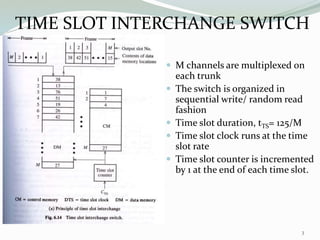
 M channels are multiplexed on
each trunk
 The switch is organized in
sequential write/ random read
fashion
 Time slot duration, tTS= 125/M
 Time slot clock runs at the time
slot rate
 Time slot counter is incremented
by 1 at the end of each time slot.
3
TIME SLOT INTERCHANGE SWITCH
COMPONENTS
 Contents of counter provides location addresses
for the data memory and the control memory.
 Data memory and control memory access take
place simultaneously at the starting of the time
slot.
 Contents of the control memory are used as the
address of the data memory and the data read out
to the output trunk
4
 Even if there is no time slot interchange, a sample
is delayed by a minimum of one time slot in action.
 Depending on the output time slot, delay range is
tTS to MtTS microsec.
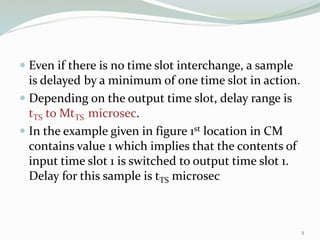
 In the example given in figure 1st location in CM
contains value 1 which implies that the contents of
input time slot 1 is switched to output time slot 1.
Delay for this sample is tTS microsec
5
 Location 2 contains 7. Therefore, input time slot 7
is switched to output time slot 2.
Delay for this sample: (M – (7-2) + 1)tTS μ s
=(M – 4)tTS μ s
 Location 3 contains 4. Therefore, input time slot 4
is switched to output time slot 3.
Delay for this sample: (M – (4-3) + 1)tTS μ s
=MtTS μ s = 125 μ s
There are two sequential memory access per time
slot. So, time constraint may be stated as
tTS = 2tm, 125 = 2Mtm
6
Cost estimation
 No switching elements!
 Cost is equal to the number of memory locations.
 There are M locations each in the control and data
memory
 So, total cost is given by
C = 2M units
7
EXAMPLE
 Suppose there is a TSI switch with a single input and single
output trunk multiplexing 2500 channels.
So,
tm =125µs/2M=(125*10-6)/(2500*2) = 25 ns
and C = 2 * 2500 = 5000 units
This switch is non-blocking and fully available.
 An equivalent single stage Space Division Switch uses a
matrix of 2500 X 2500. So, cost is 6.25 million units!
Cost advantage of time switch = (6.25*106)/5000 = 1250
Thus a TSI switch is a lot cheaper.
8
THANK YOU

Time multiplexed time switch

  • 2.
    Time Multiplexed TimeSwitch • Unlike time multiplexed space switches, it permits time slot interchange (TSI) of sample values. • Such an operation necessarily implies a delay between the reception and the transmission of a sample. • Illustration in next graph.
  • 3.
     M channelsare multiplexed on each trunk  The switch is organized in sequential write/ random read fashion  Time slot duration, tTS= 125/M  Time slot clock runs at the time slot rate  Time slot counter is incremented by 1 at the end of each time slot. 3 TIME SLOT INTERCHANGE SWITCH
  • 4.
    COMPONENTS  Contents ofcounter provides location addresses for the data memory and the control memory.  Data memory and control memory access take place simultaneously at the starting of the time slot.  Contents of the control memory are used as the address of the data memory and the data read out to the output trunk 4
  • 5.
     Even ifthere is no time slot interchange, a sample is delayed by a minimum of one time slot in action.  Depending on the output time slot, delay range is tTS to MtTS microsec.  In the example given in figure 1st location in CM contains value 1 which implies that the contents of input time slot 1 is switched to output time slot 1. Delay for this sample is tTS microsec 5
  • 6.
     Location 2contains 7. Therefore, input time slot 7 is switched to output time slot 2. Delay for this sample: (M – (7-2) + 1)tTS μ s =(M – 4)tTS μ s  Location 3 contains 4. Therefore, input time slot 4 is switched to output time slot 3. Delay for this sample: (M – (4-3) + 1)tTS μ s =MtTS μ s = 125 μ s There are two sequential memory access per time slot. So, time constraint may be stated as tTS = 2tm, 125 = 2Mtm 6
  • 7.
    Cost estimation  Noswitching elements!  Cost is equal to the number of memory locations.  There are M locations each in the control and data memory  So, total cost is given by C = 2M units 7
  • 8.
    EXAMPLE  Suppose thereis a TSI switch with a single input and single output trunk multiplexing 2500 channels. So, tm =125µs/2M=(125*10-6)/(2500*2) = 25 ns and C = 2 * 2500 = 5000 units This switch is non-blocking and fully available.  An equivalent single stage Space Division Switch uses a matrix of 2500 X 2500. So, cost is 6.25 million units! Cost advantage of time switch = (6.25*106)/5000 = 1250 Thus a TSI switch is a lot cheaper. 8
  • 9.