Timing and Synchronization
Prepared by :
Mr. Muhammad Ahsan
Lecturer Computer Science, Preston University Peshawar
Pakistan.
 It is important to detect signals accurately at
the receiver side in terms of digital signals
0/1
 Digital signals transmits in the form of pulses
or clocks
 The ideal system is that in which the receiver
section knows exact the time the signal
brought in its self at the receiver interface
 This synchronization between between
transmitter and receiver is achieved because
each machine knows about each others
“clock”
 Clock : at which frequency on a specific time
sending machine sends its traffic to receiver
 The receiver can determine this time
because of pulses arrived at receiver end.
 An Error can be passed to the customer end
without having clock mechanism
 This error create problem and can be passed
among different nodes
 The error generated depend on thetraffic
being transmitted
Type of Traffic
 Digital Data
 Encrtpted Data
 Fax
 Video
 Voice
 Voice band Data
Result of Error
 Reduce throughput
 Resend Key
 Missing lines
 Picture freeze
 Audible click
 Carrier drop
 It carries information about time
 The signal is represented by a crossing mark
 To define clocking signals we use term unit
interval UI(corresponds to 1 cycle of clocking
signal)
 1 UI = 2 radian
 For achieving synchronization between the
machines we use different (5) methods of
clock exchange.
 1) Free Running
 2)Line-Timed
 3)Loop-Timed
 4)External
 5)Through Timed
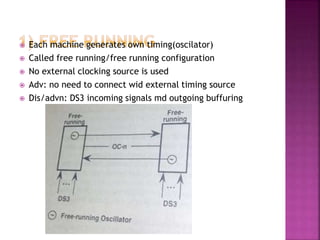
 Each machine generates own timing(oscilator)
 Called free running/free running configuration
 No external clocking source is used
 Adv: no need to connect wid external timing source
 Dis/advn: DS3 incoming signals md outgoing buffuring
 Derives clocking on line from incoming signals
 Generator module fed these signals into local time nd provide timing to
outgoing signals
 Advn: simple
 Dis/advn: when several machines are connected where linearly to each
other
 Also called gateway or Master/Slave mode
 Used where different timing generators are deployed/ where
machins must intract with eachother
 Here the frequency sent from the running machine used to derive
clock at slave unit
 The slave unit may loop the clock back
across the line or may employ an externel
clock
 Machine times their transmitted signals from internel
oscillator that is locked with an externel
 Here synchronixation also known as plesiochronoius
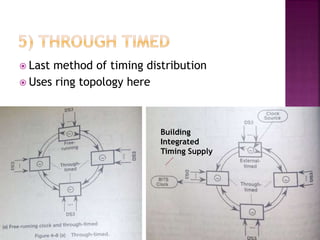
 Last method of timing distribution
 Uses ring topology here
Building
Integrated
Timing Supply

timing and synchronization

  • 1.
    Timing and Synchronization Preparedby : Mr. Muhammad Ahsan Lecturer Computer Science, Preston University Peshawar Pakistan.
  • 2.
     It isimportant to detect signals accurately at the receiver side in terms of digital signals 0/1  Digital signals transmits in the form of pulses or clocks  The ideal system is that in which the receiver section knows exact the time the signal brought in its self at the receiver interface
  • 3.
     This synchronizationbetween between transmitter and receiver is achieved because each machine knows about each others “clock”  Clock : at which frequency on a specific time sending machine sends its traffic to receiver  The receiver can determine this time because of pulses arrived at receiver end.
  • 4.
     An Errorcan be passed to the customer end without having clock mechanism  This error create problem and can be passed among different nodes  The error generated depend on thetraffic being transmitted
  • 5.
    Type of Traffic Digital Data  Encrtpted Data  Fax  Video  Voice  Voice band Data Result of Error  Reduce throughput  Resend Key  Missing lines  Picture freeze  Audible click  Carrier drop
  • 6.
     It carriesinformation about time  The signal is represented by a crossing mark  To define clocking signals we use term unit interval UI(corresponds to 1 cycle of clocking signal)  1 UI = 2 radian
  • 7.
     For achievingsynchronization between the machines we use different (5) methods of clock exchange.  1) Free Running  2)Line-Timed  3)Loop-Timed  4)External  5)Through Timed
  • 8.
     Each machinegenerates own timing(oscilator)  Called free running/free running configuration  No external clocking source is used  Adv: no need to connect wid external timing source  Dis/advn: DS3 incoming signals md outgoing buffuring
  • 9.
     Derives clockingon line from incoming signals  Generator module fed these signals into local time nd provide timing to outgoing signals  Advn: simple  Dis/advn: when several machines are connected where linearly to each other
  • 10.
     Also calledgateway or Master/Slave mode  Used where different timing generators are deployed/ where machins must intract with eachother  Here the frequency sent from the running machine used to derive clock at slave unit
  • 11.
     The slaveunit may loop the clock back across the line or may employ an externel clock
  • 12.
     Machine timestheir transmitted signals from internel oscillator that is locked with an externel  Here synchronixation also known as plesiochronoius
  • 13.
     Last methodof timing distribution  Uses ring topology here Building Integrated Timing Supply