SWITCHING HIERARCHY
TELECOMUNICATION SWITCHING NETWORKS
PRESENTED BY-
KRISHNENDU KARMAKAR (L.E.-12)
SUJOY MUKHERJEE (L.E.-02)
SAMYA SHANTI ADAK (L.E.-05)
RAJIB PATRA (L.E.- 09)
RAJESH HANSDA (L.E.-10)
AVIJIT ROY (L.E.-16)
ECE, 3RD YEAR, 6TH SEMESTER
KALYANI GOVERNMENT
ENGINEERING COLLEGE
CONTENTS
1. INTRODUCTION
2. HISTORY
3. NEED FOR SWITCHING
SYSTEM
4. CLASSIFICATION
5. BASICS ELEMENTS OF
SWITCHING SYSTEM
6. STROWGER SWITCHING
7. CROSSBAR SWITCHING
8. STORED PROGRAM
CONTROL
9. SPACE DIVISION
SWITCHING
10. TIME DIVISION
SWITCHING
11. CONCLUSION
12. REFERENCE
NEEDS OF SWITCHING
 1ST Telephone network was point to point dedicated
connection.
 This type of network provided high reliability, security, but with
the increase in subscriber become very costly, complex.
 for n entities, we need n(n-1)/2 links made a fully connected
network.
 As the number of subscriber and distance increases it fails to
provide efficient service.
 On the other end manual switching very prone to errors and
lack of privacy made telephone service very poor.
 For these specific reasons we had to invented the automatic
switching system.
Fig: point to point connection network of 5
Nodes.
INTRODUCTION
 The word tele is a Greek word which means distance.
 Telecommunication means the exchange of information between two distant places.
 Telecommunications represent the transfer of information, can be in the form of data, voice or symbol.
 who initiates the call is referred to as the Calling Subscriber and the one for whom the call is destined
is the Called Subscriber.
 when the number of caller and called subscriber become large we needed switching
technique which would establish proper connection between subscriber and provide safe
data transfer.
 To perform switching between large and various distance callers, telecomm engineers have deployed
switching exchange center which different types of switching methods such as step by step,
crossbar, time and space division etc.
HISTORY
 In March 1876, Alexander Graham Bell invented and demonstrated his telephone set and
the possibility of long distance voice communication.
 In 1889 Almon Strowger invented the 1st telephone switching system which was
electromechanical.
 In 1896 Alexander Keith and his associates invented 1st dial telephone.
 The strowger switching became famous with the dial telephone in Europe and USA.
 In 1913 AT&T invented crossbar switching decreasing the complexity of strowger system.
 In 1965 AT&T started installing electronic switching ends the era of electromechanical switches.
CLASSIFICATIONS/HIERERCHY
SWITCHING SYSTEM
AUTOMATIC
ELECTRONIC
SPACE DIVISION TIME DIVISION
DIGITAL
SPACE SWITCH TIME SWITCH
COMBINATIONAL
SWITCH
ANALOG
ELECTROMECHANICAL
STROWGER CROSSBAR
MANUAL
BASIC ELEMENTS OF SWITCHING SYSTEM
1. Inlets and Outlets
The set of input circuits of an exchange are called Inlets and the set of output circuits are
called the Outlets. The primary function of a switching system is to establish an electrical path
between a given inlet-outlet pair.
2. Switching Matrix
The hardware used to establish connection between inlets and outlets is called the
Switching Matrix or the Switching Network. This switching network is the group of connections
formed in the process of connecting inlets and outlets.
3. Usually, N indicates the inlets and the outlets are indicated by M. So, a switching network
has N inlets and M outlets
STROWGER SWITCHING
UNI-SELECTOR TWO MOTION SELECTOR
These are electromechanical switches means they are made of mechanical parts and works
on the principal of electromagnetism which came of electric pulses from rotary dial telephone.
For each different pulse connector would connect with the different contact bank
and perform switching as per dialling.
CROSSBAR SWITCHING
 Here we use cross points as a switching point.
 For N element user we can have N/2 simultaneous
conversations.
 The connection is established by energizing by
horizontal bar then vertical bar.
 Large number of elements requirements makes it very
costly.
 Mini switches and relay switches are mostly used in this
configuration.
 For large area coverage it also have crossbar exchange
organization.
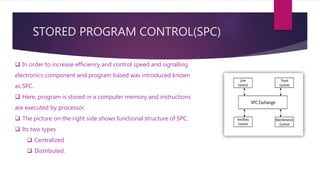
STORED PROGRAM CONTROL(SPC)
 In order to increase efficiency and control speed and signalling
electronics component and program based was introduced known
as SPC.
 Here, program is stored in a computer memory and instructions
are executed by processor.
 The picture on the right side shows functional structure of SPC.
 Its two types
 Centralized
 Distributed.
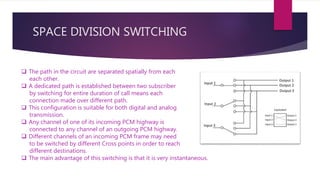
SPACE DIVISION SWITCHING
 The path in the circuit are separated spatially from each
each other.
 A dedicated path is established between two subscriber
by switching for entire duration of call means each
connection made over different path.
 This configuration is suitable for both digital and analog
transmission.
 Any channel of one of its incoming PCM highway is
connected to any channel of an outgoing PCM highway.
 Different channels of an incoming PCM frame may need
to be switched by different Cross points in order to reach
different destinations.
 The main advantage of this switching is that it is very instantaneous.
TIME DIVISION SWITCHING
 The sharing of cross points for a fixed period of time is the
basic concept here.
 The sampled valued signals are transferred at fixed interval
of time.
 It has two significant features –
1) TDM(time division multiplexing)
2) TSI(time slot interchange)
 PAM and PCM used for digital transmission.
 The TSI interchange the switching path according to our
desire.
 Frame length is 125us, makes the channel rate 64 kbps.
 The channel bandwidth is 4kHZ.
 Number of bits per symbol is 8 bits.
 Sampling rate 8kHz.
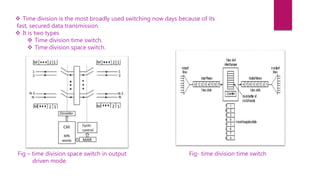
 Time division is the most broadly used switching now days because of its
fast, secured data transmission.
 It is two types
 Time division time switch.
 Time division space switch.
Fig – time division space switch in output
driven mode.
Fig- time division time switch
CONCLUSION
 Here we have begun with point to point dedicated link applied in mesh network with n*(n-
1)/2 links
 As the primitive telephone network lacked security so with the advent of automatic switching
system like strowger, crossbar and SPC solved this problem.
 Then in later stage we witnessed time and space division switching which are even faster and
easier to implement.
 In the near future we will be noticing advancement in the program control switching
techniques centring the processor architecture and computing .
REFERENCES
1. TELECOMMUNICATION SWITCHING SYSTEMS AND NETWORKS WRITTEN BY
MANAV BHATNAGAR AND THIAGARAJAN VISWANATHAN. PUBLISHER
NAME – PHI LEARNING PRIVATE LIMITED
2. https://www.tutorialspoint.com/telecommunication_switching_systems_and_netwo
rks/telecommunication_switching_systems_and_networks_useful_resources.htm

Switching

  • 1.
  • 2.
    PRESENTED BY- KRISHNENDU KARMAKAR(L.E.-12) SUJOY MUKHERJEE (L.E.-02) SAMYA SHANTI ADAK (L.E.-05) RAJIB PATRA (L.E.- 09) RAJESH HANSDA (L.E.-10) AVIJIT ROY (L.E.-16) ECE, 3RD YEAR, 6TH SEMESTER KALYANI GOVERNMENT ENGINEERING COLLEGE
  • 3.
    CONTENTS 1. INTRODUCTION 2. HISTORY 3.NEED FOR SWITCHING SYSTEM 4. CLASSIFICATION 5. BASICS ELEMENTS OF SWITCHING SYSTEM 6. STROWGER SWITCHING 7. CROSSBAR SWITCHING 8. STORED PROGRAM CONTROL 9. SPACE DIVISION SWITCHING 10. TIME DIVISION SWITCHING 11. CONCLUSION 12. REFERENCE
  • 4.
    NEEDS OF SWITCHING 1ST Telephone network was point to point dedicated connection.  This type of network provided high reliability, security, but with the increase in subscriber become very costly, complex.  for n entities, we need n(n-1)/2 links made a fully connected network.  As the number of subscriber and distance increases it fails to provide efficient service.  On the other end manual switching very prone to errors and lack of privacy made telephone service very poor.  For these specific reasons we had to invented the automatic switching system. Fig: point to point connection network of 5 Nodes.
  • 5.
    INTRODUCTION  The wordtele is a Greek word which means distance.  Telecommunication means the exchange of information between two distant places.  Telecommunications represent the transfer of information, can be in the form of data, voice or symbol.  who initiates the call is referred to as the Calling Subscriber and the one for whom the call is destined is the Called Subscriber.  when the number of caller and called subscriber become large we needed switching technique which would establish proper connection between subscriber and provide safe data transfer.  To perform switching between large and various distance callers, telecomm engineers have deployed switching exchange center which different types of switching methods such as step by step, crossbar, time and space division etc.
  • 6.
    HISTORY  In March1876, Alexander Graham Bell invented and demonstrated his telephone set and the possibility of long distance voice communication.  In 1889 Almon Strowger invented the 1st telephone switching system which was electromechanical.  In 1896 Alexander Keith and his associates invented 1st dial telephone.  The strowger switching became famous with the dial telephone in Europe and USA.  In 1913 AT&T invented crossbar switching decreasing the complexity of strowger system.  In 1965 AT&T started installing electronic switching ends the era of electromechanical switches.
  • 7.
    CLASSIFICATIONS/HIERERCHY SWITCHING SYSTEM AUTOMATIC ELECTRONIC SPACE DIVISIONTIME DIVISION DIGITAL SPACE SWITCH TIME SWITCH COMBINATIONAL SWITCH ANALOG ELECTROMECHANICAL STROWGER CROSSBAR MANUAL
  • 8.
    BASIC ELEMENTS OFSWITCHING SYSTEM 1. Inlets and Outlets The set of input circuits of an exchange are called Inlets and the set of output circuits are called the Outlets. The primary function of a switching system is to establish an electrical path between a given inlet-outlet pair. 2. Switching Matrix The hardware used to establish connection between inlets and outlets is called the Switching Matrix or the Switching Network. This switching network is the group of connections formed in the process of connecting inlets and outlets. 3. Usually, N indicates the inlets and the outlets are indicated by M. So, a switching network has N inlets and M outlets
  • 9.
    STROWGER SWITCHING UNI-SELECTOR TWOMOTION SELECTOR These are electromechanical switches means they are made of mechanical parts and works on the principal of electromagnetism which came of electric pulses from rotary dial telephone. For each different pulse connector would connect with the different contact bank and perform switching as per dialling.
  • 10.
    CROSSBAR SWITCHING  Herewe use cross points as a switching point.  For N element user we can have N/2 simultaneous conversations.  The connection is established by energizing by horizontal bar then vertical bar.  Large number of elements requirements makes it very costly.  Mini switches and relay switches are mostly used in this configuration.  For large area coverage it also have crossbar exchange organization.
  • 11.
    STORED PROGRAM CONTROL(SPC) In order to increase efficiency and control speed and signalling electronics component and program based was introduced known as SPC.  Here, program is stored in a computer memory and instructions are executed by processor.  The picture on the right side shows functional structure of SPC.  Its two types  Centralized  Distributed.
  • 12.
    SPACE DIVISION SWITCHING The path in the circuit are separated spatially from each each other.  A dedicated path is established between two subscriber by switching for entire duration of call means each connection made over different path.  This configuration is suitable for both digital and analog transmission.  Any channel of one of its incoming PCM highway is connected to any channel of an outgoing PCM highway.  Different channels of an incoming PCM frame may need to be switched by different Cross points in order to reach different destinations.  The main advantage of this switching is that it is very instantaneous.
  • 13.
    TIME DIVISION SWITCHING The sharing of cross points for a fixed period of time is the basic concept here.  The sampled valued signals are transferred at fixed interval of time.  It has two significant features – 1) TDM(time division multiplexing) 2) TSI(time slot interchange)  PAM and PCM used for digital transmission.  The TSI interchange the switching path according to our desire.  Frame length is 125us, makes the channel rate 64 kbps.  The channel bandwidth is 4kHZ.  Number of bits per symbol is 8 bits.  Sampling rate 8kHz.
  • 14.
     Time divisionis the most broadly used switching now days because of its fast, secured data transmission.  It is two types  Time division time switch.  Time division space switch. Fig – time division space switch in output driven mode. Fig- time division time switch
  • 15.
    CONCLUSION  Here wehave begun with point to point dedicated link applied in mesh network with n*(n- 1)/2 links  As the primitive telephone network lacked security so with the advent of automatic switching system like strowger, crossbar and SPC solved this problem.  Then in later stage we witnessed time and space division switching which are even faster and easier to implement.  In the near future we will be noticing advancement in the program control switching techniques centring the processor architecture and computing .
  • 16.
    REFERENCES 1. TELECOMMUNICATION SWITCHINGSYSTEMS AND NETWORKS WRITTEN BY MANAV BHATNAGAR AND THIAGARAJAN VISWANATHAN. PUBLISHER NAME – PHI LEARNING PRIVATE LIMITED 2. https://www.tutorialspoint.com/telecommunication_switching_systems_and_netwo rks/telecommunication_switching_systems_and_networks_useful_resources.htm