
Time and Pressure
  Management
Presented by:


 Rizwan    Qamar
What is Time?


   Time is a Precious commodity.
   It is the basis of SUCCESS
   Every one has the same amount of
    this resource 24 hours.
   Time simply is Zig Ziggler
   It is always feel LITTLE
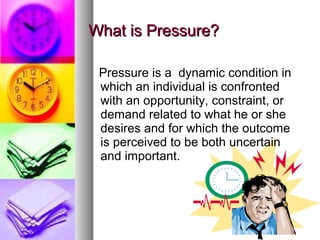
What is Pressure?

 Pressure is a dynamic condition in
 which an individual is confronted
 with an opportunity, constraint, or
 demand related to what he or she
 desires and for which the outcome
 is perceived to be both uncertain
 and important.
Management


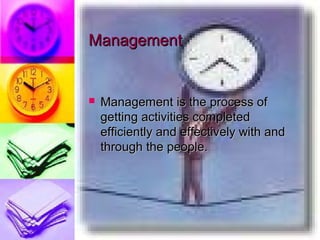
   Management is the process of
    getting activities completed
    efficiently and effectively with and
    through the people.
Time Management
   Time Management is the self
    Management.
   Habits are the key to good time
    Management
   Time Management does not
    necessarily means that you have to
    work more and socialize less.
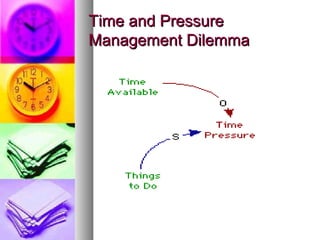
Time and Pressure
Management Dilemma
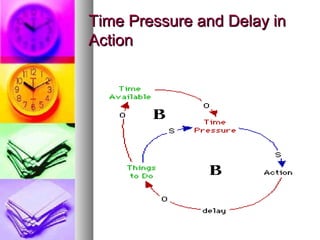
Time Pressure and Delay in
Action
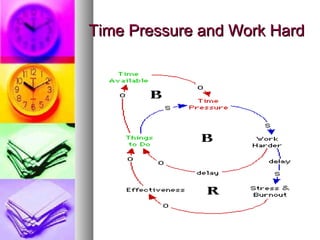
Time Pressure and Work Hard
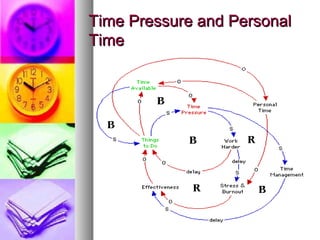
Time Pressure and Personal
Time
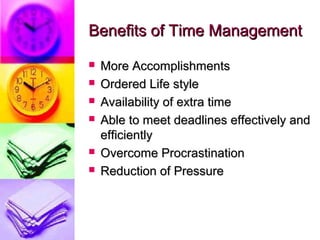
Benefits of Time Management
   More Accomplishments
   Ordered Life style
   Availability of extra time
   Able to meet deadlines effectively and
    efficiently
   Overcome Procrastination
   Reduction of Pressure
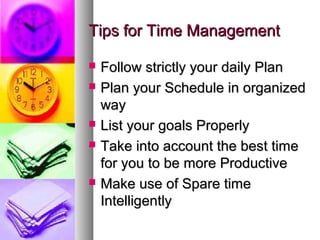
Tips for Time Management

   Follow strictly your daily Plan
   Plan your Schedule in organized
    way
   List your goals Properly
   Take into account the best time
    for you to be more Productive
   Make use of Spare time
    Intelligently
Tips for Time Management
(cont’d)
   Make it a habit to say “NO”
   Having a good night sleep is
    very important
   Be the best “task holder master”
   Don’t Waste time in worry
   Be calm always
   It is very important to be flexible
Tips for Time Management
(cont’d)
   Make use of calendar for your
    schedule
   Be a fast reader and selective
WHY A PERSON FEEL
PRESSURE


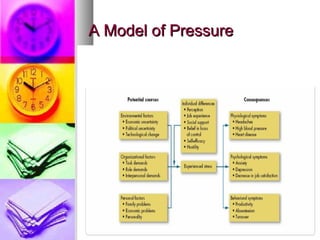
   Environmental Factors
   Organizational Factors
    Individual Factors
   Individual Differences
Environmental Factors
   Economic uncertainty of the business
   Political uncertainty of the country
   Technologic uncertainty
    Terrorism in threats to physical safety
    and security
Organizational Factors
   Task demands
   Role demands
   Interpersonal demands
   Organizational structure
   Organizational leadership
   Organizational cycle
   Downsizing
   Competitive pressure
Organizational Factors
(cont’d)
   Line-staff conflicts
   No opportunity for advancement
   Restrictive, untrusting culture
   Only downward communication
   Little performance feedback
   Working conditions
Individual Factors
   Family and personal relationships
   Economic problem from exceeding
    earning capacity
   Inherited personality problems
Individual Differences
   Perception
   Job experience
   Social support
   Belief on locus of control
   Self-efficiency
   Hostility
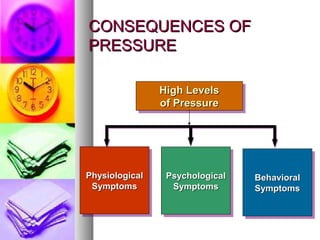
CONSEQUENCES OF
PRESSURE

                High Levels
                High Levels
                of Pressure
                of Pressure


Physiological
Physiological    Psychological
                 Psychological   Behavioral
                                 Behavioral
 Symptoms
 Symptoms         Symptoms
                   Symptoms      Symptoms
                                 Symptoms
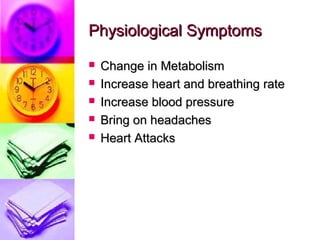
Physiological Symptoms
   Change in Metabolism
   Increase heart and breathing rate
   Increase blood pressure
   Bring on headaches
   Heart Attacks
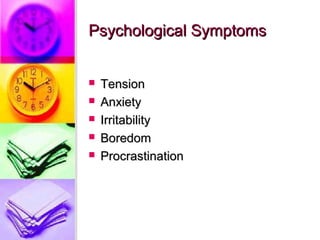
Psychological Symptoms


   Tension
   Anxiety
   Irritability
   Boredom
   Procrastination
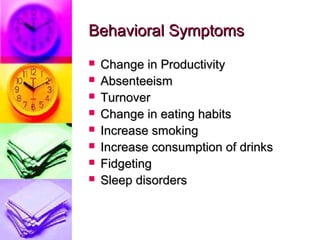
Behavioral Symptoms
   Change in Productivity
   Absenteeism
   Turnover
   Change in eating habits
   Increase smoking
   Increase consumption of drinks
   Fidgeting
   Sleep disorders
A Model of Pressure
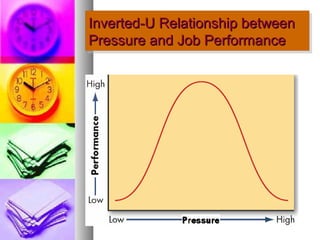
Inverted-U Relationship between
 Inverted-U Relationship between
Pressure and Job Performance
 Pressure and Job Performance
How to Manage the Pressure


   Individual Approach
   Organizational Approach
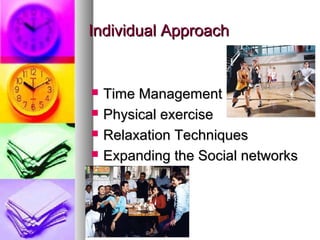
Individual Approach


   Time Management
   Physical exercise
   Relaxation Techniques
   Expanding the Social networks
Organizational Approach

   Improved personal selection
   Training of employees
   Realistic goal setting
   Redesigning of jobs
   Increase employee involvement
    Improved organizational
    communication
Organizational Approach
(cont’d)

   Offering employee sabbaticals
   Improve organizational working
    conditions
   Establish corporate wellness
    program
THANKS

Time and Pressure Management

  • 1.
  • 2.
  • 3.
    What is Time?  Time is a Precious commodity.  It is the basis of SUCCESS  Every one has the same amount of this resource 24 hours.  Time simply is Zig Ziggler  It is always feel LITTLE
  • 4.
    What is Pressure? Pressure is a dynamic condition in which an individual is confronted with an opportunity, constraint, or demand related to what he or she desires and for which the outcome is perceived to be both uncertain and important.
  • 5.
    Management  Management is the process of getting activities completed efficiently and effectively with and through the people.
  • 6.
    Time Management  Time Management is the self Management.  Habits are the key to good time Management  Time Management does not necessarily means that you have to work more and socialize less.
  • 7.
  • 8.
    Time Pressure andDelay in Action
  • 9.
  • 10.
    Time Pressure andPersonal Time
  • 11.
    Benefits of TimeManagement  More Accomplishments  Ordered Life style  Availability of extra time  Able to meet deadlines effectively and efficiently  Overcome Procrastination  Reduction of Pressure
  • 12.
    Tips for TimeManagement  Follow strictly your daily Plan  Plan your Schedule in organized way  List your goals Properly  Take into account the best time for you to be more Productive  Make use of Spare time Intelligently
  • 13.
    Tips for TimeManagement (cont’d)  Make it a habit to say “NO”  Having a good night sleep is very important  Be the best “task holder master”  Don’t Waste time in worry  Be calm always  It is very important to be flexible
  • 14.
    Tips for TimeManagement (cont’d)  Make use of calendar for your schedule  Be a fast reader and selective
  • 15.
    WHY A PERSONFEEL PRESSURE  Environmental Factors  Organizational Factors  Individual Factors  Individual Differences
  • 16.
    Environmental Factors  Economic uncertainty of the business  Political uncertainty of the country  Technologic uncertainty  Terrorism in threats to physical safety and security
  • 17.
    Organizational Factors  Task demands  Role demands  Interpersonal demands  Organizational structure  Organizational leadership  Organizational cycle  Downsizing  Competitive pressure
  • 18.
    Organizational Factors (cont’d)  Line-staff conflicts  No opportunity for advancement  Restrictive, untrusting culture  Only downward communication  Little performance feedback  Working conditions
  • 19.
    Individual Factors  Family and personal relationships  Economic problem from exceeding earning capacity  Inherited personality problems
  • 20.
    Individual Differences  Perception  Job experience  Social support  Belief on locus of control  Self-efficiency  Hostility
  • 21.
    CONSEQUENCES OF PRESSURE High Levels High Levels of Pressure of Pressure Physiological Physiological Psychological Psychological Behavioral Behavioral Symptoms Symptoms Symptoms Symptoms Symptoms Symptoms
  • 22.
    Physiological Symptoms  Change in Metabolism  Increase heart and breathing rate  Increase blood pressure  Bring on headaches  Heart Attacks
  • 23.
    Psychological Symptoms  Tension  Anxiety  Irritability  Boredom  Procrastination
  • 24.
    Behavioral Symptoms  Change in Productivity  Absenteeism  Turnover  Change in eating habits  Increase smoking  Increase consumption of drinks  Fidgeting  Sleep disorders
  • 25.
    A Model ofPressure
  • 26.
    Inverted-U Relationship between Inverted-U Relationship between Pressure and Job Performance Pressure and Job Performance
  • 27.
    How to Managethe Pressure  Individual Approach  Organizational Approach
  • 28.
    Individual Approach  Time Management  Physical exercise  Relaxation Techniques  Expanding the Social networks
  • 29.
    Organizational Approach  Improved personal selection  Training of employees  Realistic goal setting  Redesigning of jobs  Increase employee involvement  Improved organizational communication
  • 30.
    Organizational Approach (cont’d)  Offering employee sabbaticals  Improve organizational working conditions  Establish corporate wellness program
  • 31.