Stress Assessment & Management and
Promoting Mental Health in the Workplace
1. Describe the magnitude of mental health
problems
2. Discuss factors that contribute to mental
health problems
3. Discuss the definition of stress and the
factors contributing to unmanaged stress
Objectives
4. Discuss the relationship between stress
and health and well being.
5. Identify signs of stress.
6. Explain the benefits of promoting mental
health
7. Identify strategies to promote mental
health and wellness.
Objectives
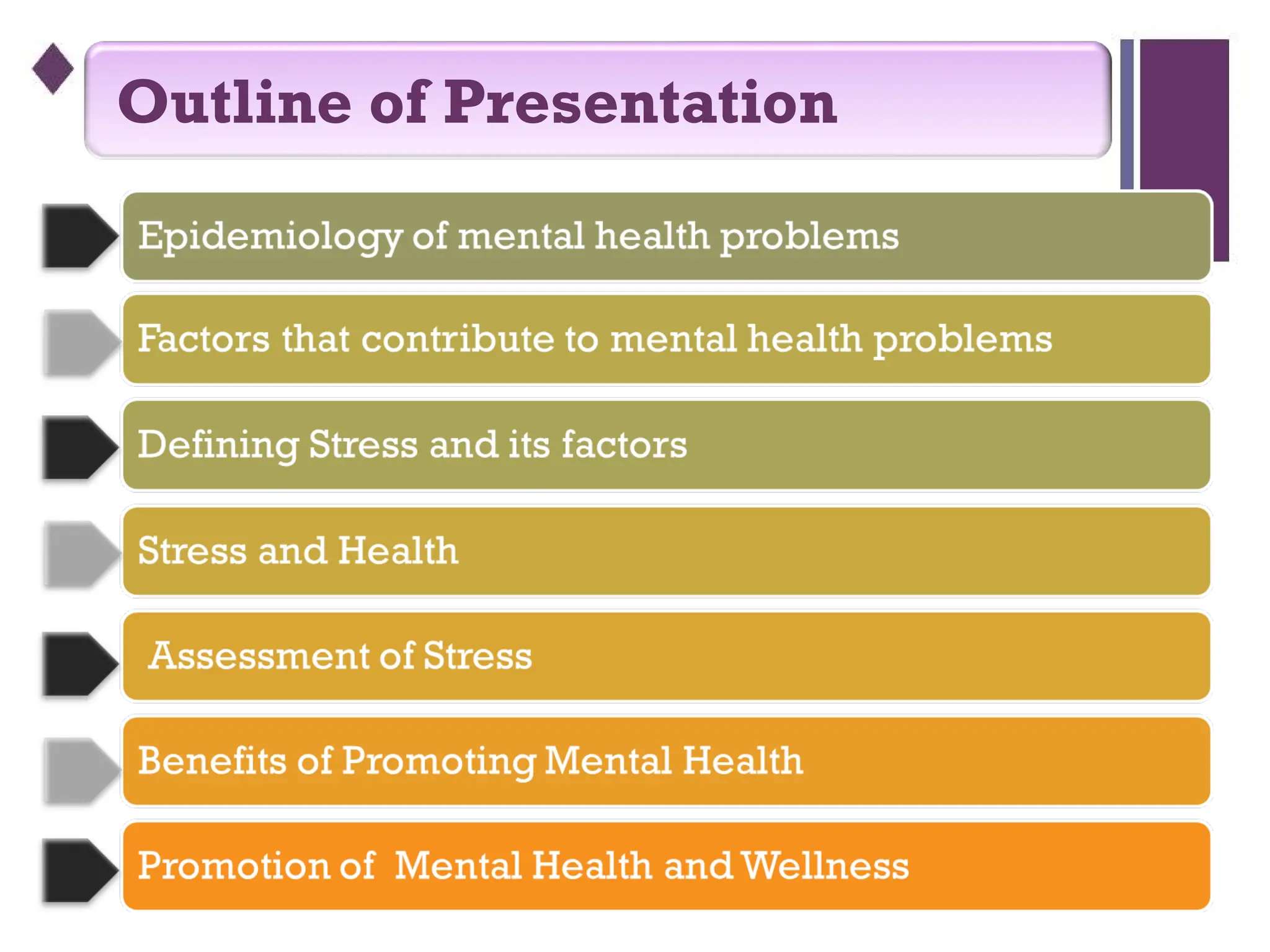
Outline of Presentation
A state of well-being in which
the individual realizes his or
her own abilities, can cope
with the normal stresses of
life, can work productively
and fruitfully, and is able to
make a contribution to his or
her community.
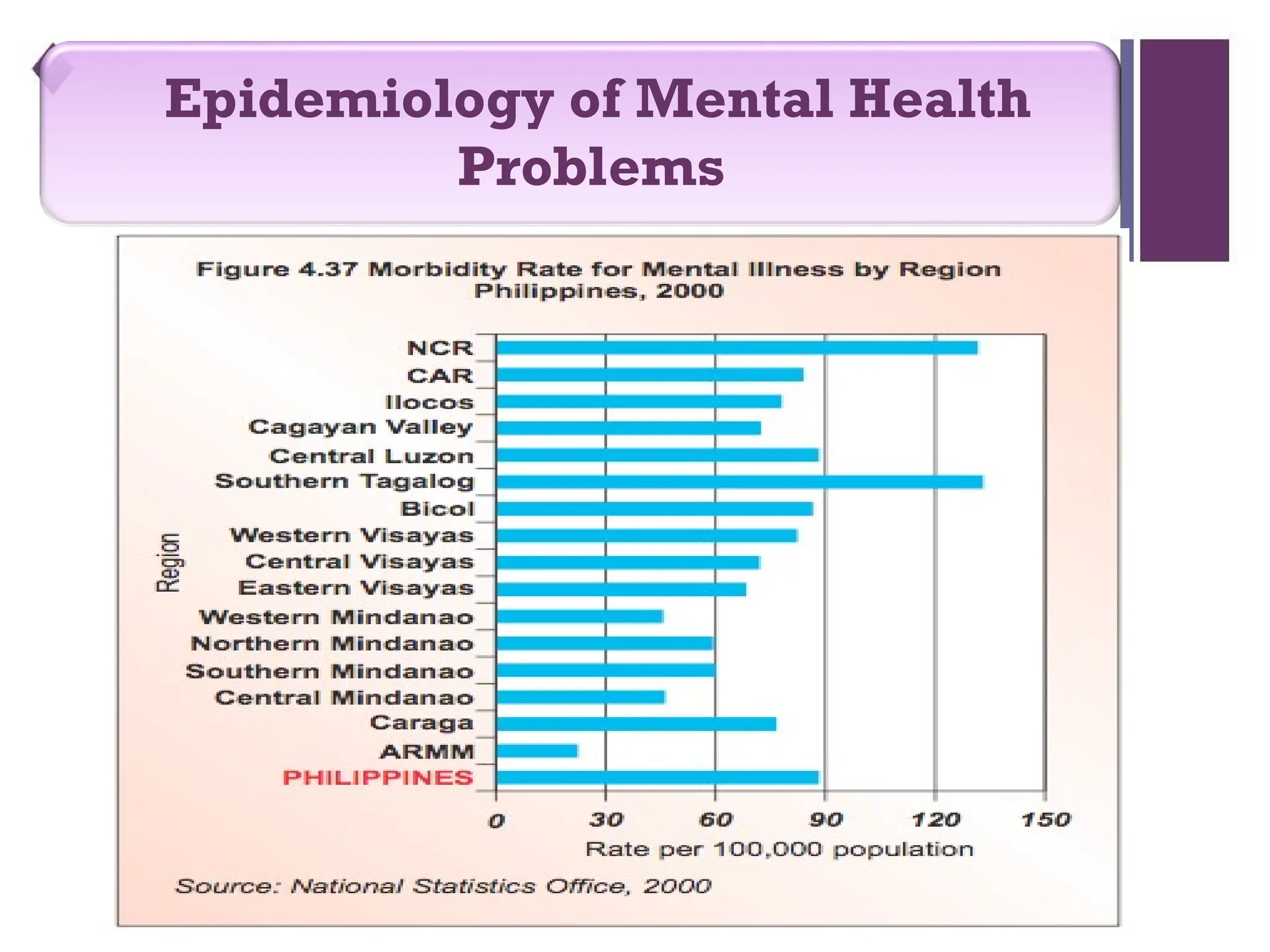
Epidemiology of Mental Health
Problems
MENTAL
HEALTH
Epidemiology of Mental Health
Problems
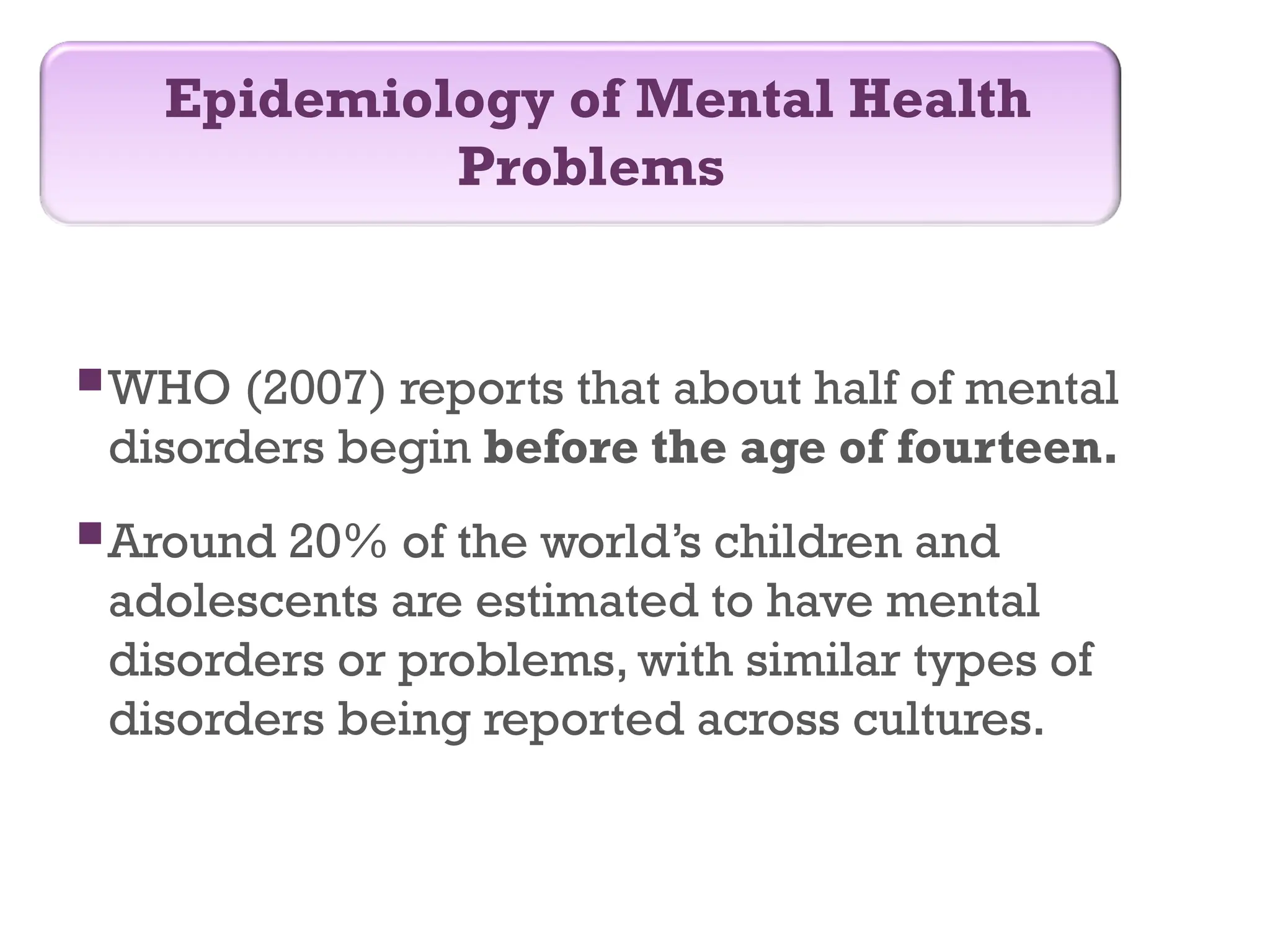
WHO (2007) reports that about half of mental
disorders begin before the age of fourteen.
Around 20% of the world’s children and
adolescents are estimated to have mental
disorders or problems, with similar types of
disorders being reported across cultures.
Epidemiology of Mental Health
Problems
Mental Health Concerns among Adolescents 13-15 y/o
Epidemiology of Mental Health
Problems
Epidemiology of Mental Health
Problems
Most frequently reported symptoms
of mental health problems
Epidemiology of Mental Health
Problems
 Drugs
 Alcohol
 Lack of education
 Poor nutrition
 Poverty
 Racial injustice
 Violence or war
 Work stress and/
or unemployment
Factors that contribute to mental
health problems
Stress?
How is your mental health and
wellness?
+
Stress is the way human beings react both
physically and mentally to changes,
events, and situations in their lives.
 2 types of stress
* eustress - moderate or normal
psychological stress interpreted as being
beneficial for the experiencer.
* distress - extreme anxiety, sorrow, or
pain
What is stress?
+
Frequency (how often)
Duration (length of experience)
How physically draining
How emotionally draining
How does stress affect your
performance?
+
Nature of stress
Conscious and unconscious meaning of
stressor
 Preexisting vulnerabilities
Factors contributing to
unmanaged stress
+
Nature of stress
- Frequency
- Intensity
- Duration
Factors contributing to
unmanaged stress
+
Conscious and unconscious meaning of
stressors
- Need to prove oneself
- Resentment
- Guilt
Factors contributing to
unmanaged stress
+
What are stressors?
- Physical environment
- Social/relational
- Financial
- Organizational
- Life events
- Lifestyle choices
- Physiological
Factors that contribute to
unmanaged stress
+
Stress is the body’s physical response to a
perceived threat or DANGER
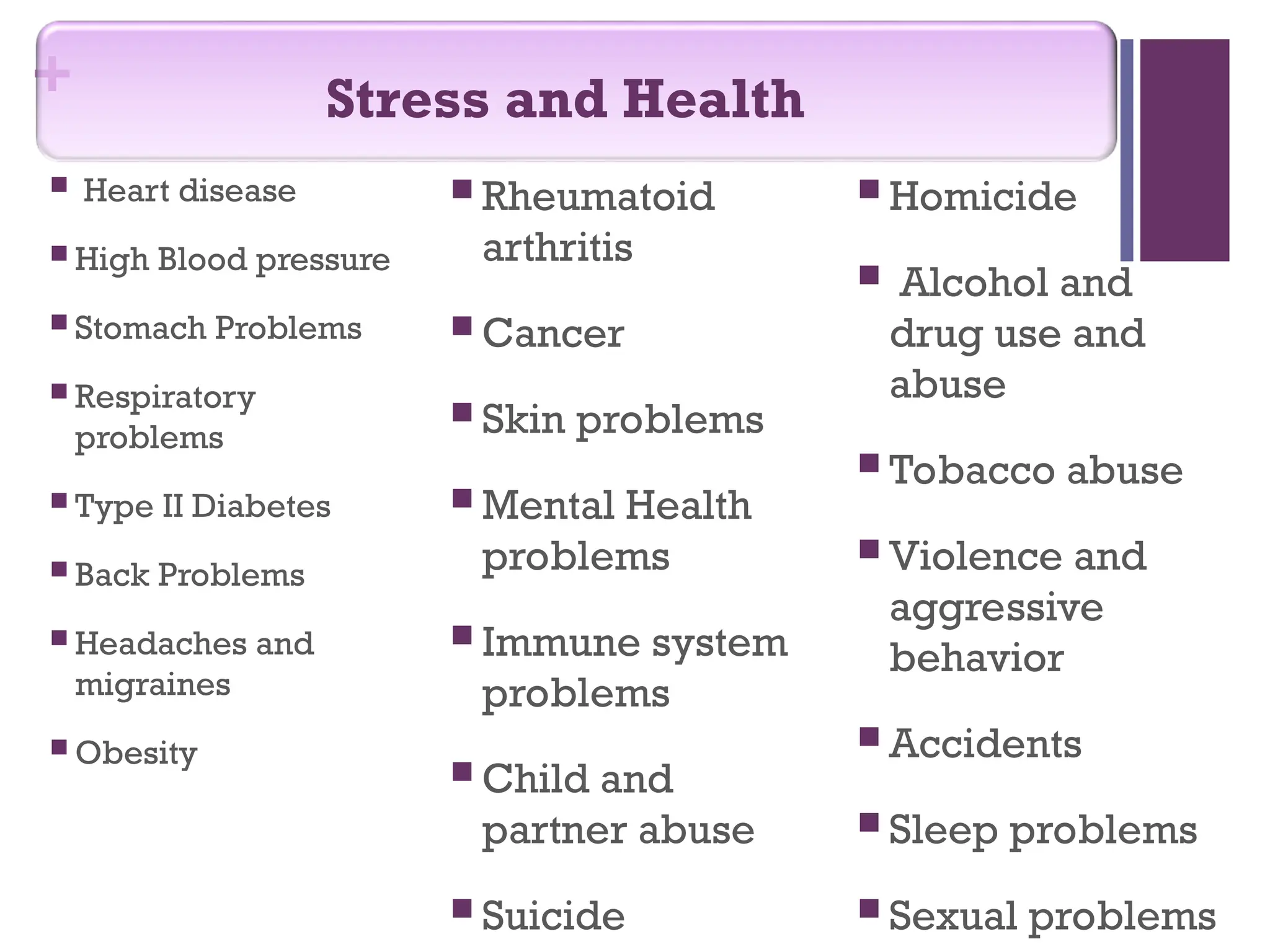
Stress and Health
Can stress make you sick?
+
“fight or flight” response – acute stress response
- increase heart rate
- increase breathing rate
- increase muscle tension
- increase BP
- increase secretion of insulin
- increase blood flow to the brain, lungs, heart and muscles
Stress and Health
+
 Heart disease
 High Blood pressure
 Stomach Problems
 Respiratory
problems
 Type II Diabetes
 Back Problems
 Headaches and
migraines
 Obesity
Stress and Health
 Rheumatoid
arthritis
 Cancer
 Skin problems
 Mental Health
problems
 Immune system
problems
 Child and
partner abuse
 Suicide
 Homicide
 Alcohol and
drug use and
abuse
 Tobacco abuse
 Violence and
aggressive
behavior
 Accidents
 Sleep problems
 Sexual problems
+
Some Signs of Stress:
PHYSICAL SIGNS
 Increased heart rate
 Dry mouth
 Muscle aches, stiffness or pain
(especially in the neck,
shoulders and lower back)
 High blood pressure
 Frequent colds or flu
 Worsening of existing illness
(asthma, skin rashes etc.)
 Chest pains
 Headaches
 Indigestion
 Constipation
 Stomach cramps
 Sweating
 Nausea
 Trembling
 Fatigue
 Weight gain or loss
+
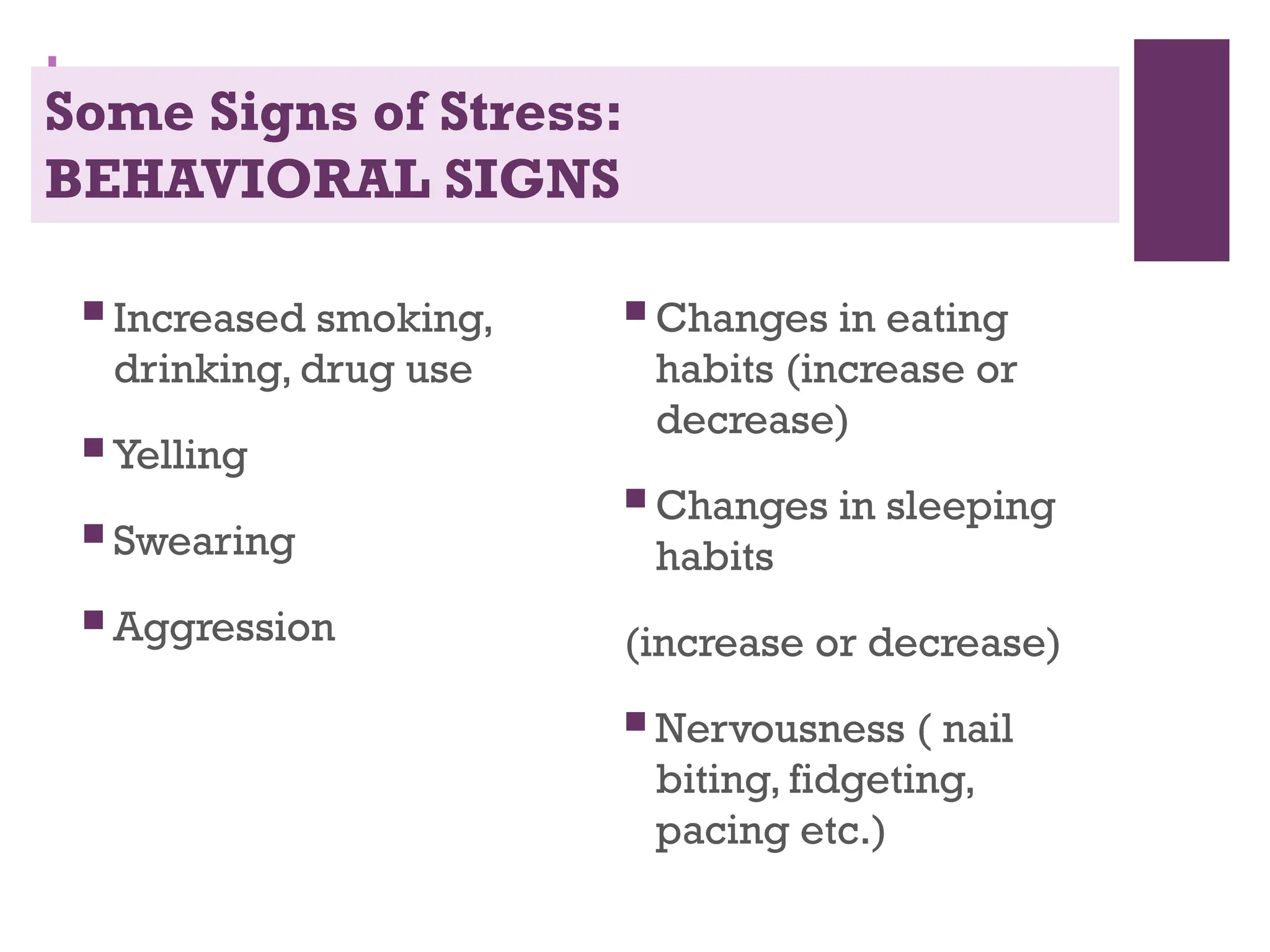
Some Signs of Stress:
BEHAVIORAL SIGNS
 Increased smoking,
drinking, drug use
 Yelling
 Swearing
 Aggression
 Changes in eating
habits (increase or
decrease)
 Changes in sleeping
habits
(increase or decrease)
 Nervousness ( nail
biting, fidgeting,
pacing etc.)
+
Some Signs of Stress:
MENTAL SIGNS
Difficulty
concentrating
Decreased memory
Difficulty making
decisions
Mind going blank
or mind racing
Confusion
Loss of sense of
humor
Inattentiveness
Bad dreams
Decreased libido
+
Some Signs of Stress:
EMOTIONAL SIGNS
Anxiety
Anger
Irritability
Impatience
Short temper
Frustration
Worry
Fear
+
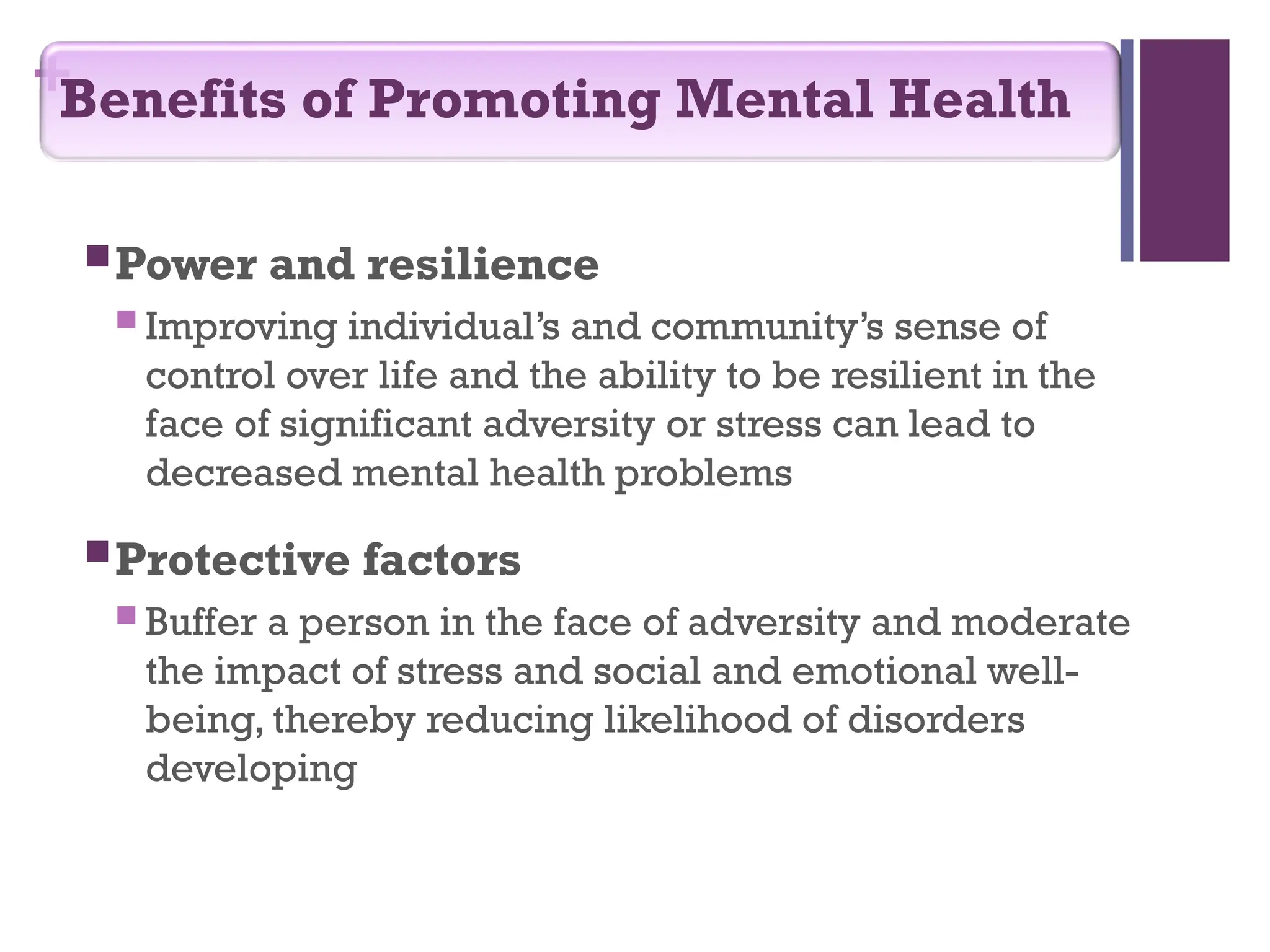
Power and resilience
 Improving individual’s and community’s sense of
control over life and the ability to be resilient in the
face of significant adversity or stress can lead to
decreased mental health problems
Protective factors
 Buffer a person in the face of adversity and moderate
the impact of stress and social and emotional well-
being, thereby reducing likelihood of disorders
developing
Benefits of Promoting Mental Health
Ways of coping with stress
Promoting Mental Health and
Wellness : Stress Management
1. The unsettling effect of change.
2. The feeling that an outside force is
challenging or threatening you.
3. The feeling that you have lost personal
control.
Stress Management:
Identify Stress Triggers
+
 I need 6 hours to finish this project
 I need P 10,000 to pay for my tuition
 I need for all my co-workers to like
me
 I need to have full control over the
work I do
 I need to have low body fat
 I need to have good health
 I need to have a girl/boyfriend
 I need my neighbors to treat with
me respectfully
 I have 2.5 hours to finish this project
 I have P6,000 to put towards my tuition
 I have a few co-workers who don’t like
me
 I have an employer who gives me little
control over the way I do my work
 I have so much fat
 I have several health problems
 I have no-one in my life
 I have a neighbor who is disrespectful
Demands Resources
Stress Management:
Identify Stress Triggers
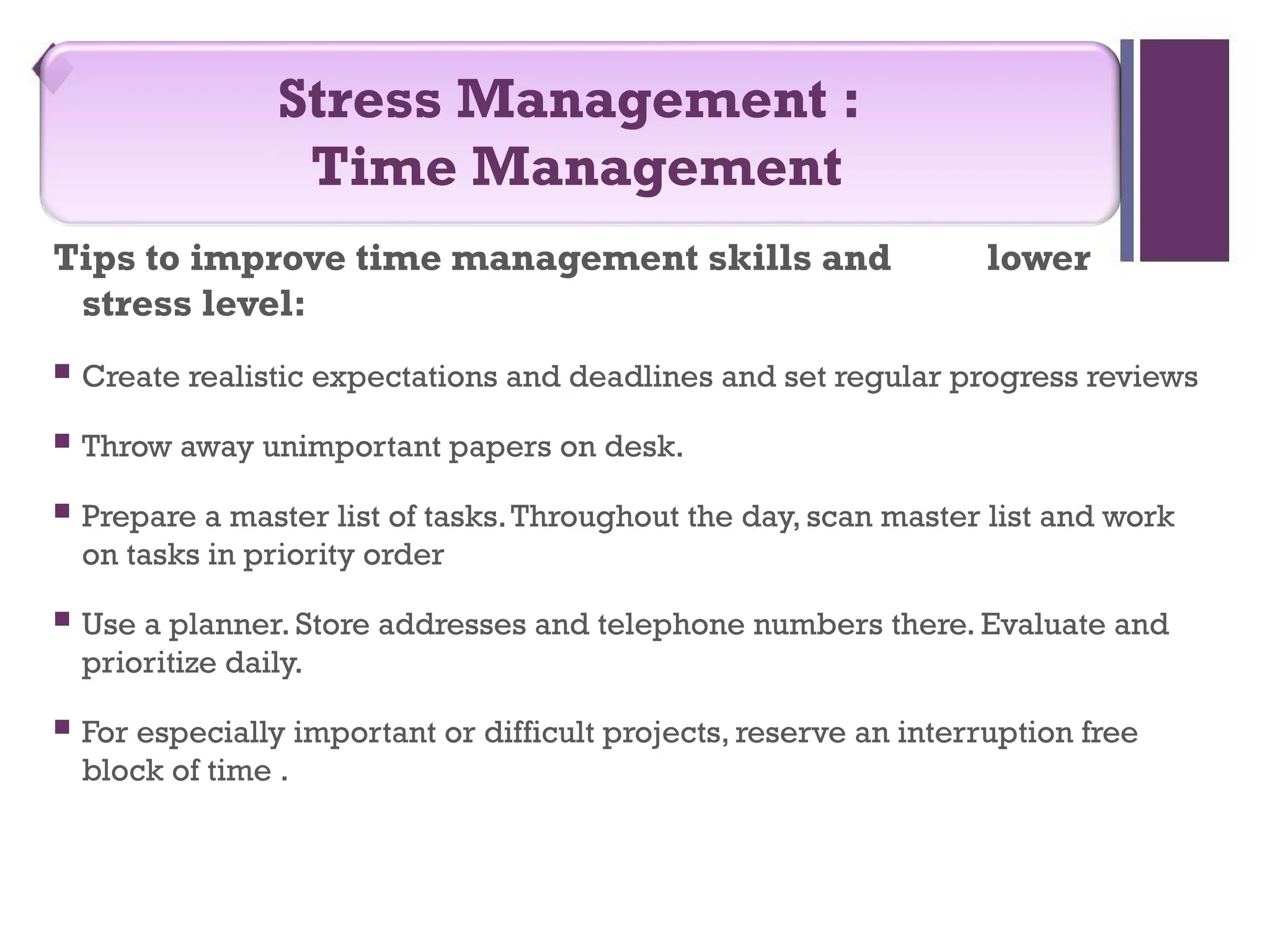
Tips to improve time management skills and lower
stress level:
 Create realistic expectations and deadlines and set regular progress reviews
 Throw away unimportant papers on desk.
 Prepare a master list of tasks.Throughout the day, scan master list and work
on tasks in priority order
 Use a planner. Store addresses and telephone numbers there. Evaluate and
prioritize daily.
 For especially important or difficult projects, reserve an interruption free
block of time .
Stress Management :
Time Management
You may be on the road to burnout, if:
Every day is a bad day.
Caring about your work or home life seems like a total
waste of energy.
You’re exhausted all the time.
The majority of your day is spent on tasks you find either
mind-numbingly dull or overwhelming.
You feel like nothing you do makes a difference or is
appreciated.
Stress Management :
Extinguish Job Burnout
Work-related causes of burnout
Feeling like you have little or no control over your work
Lack of recognition or reward for good work
Unclear or overly demanding job expectations
Doing work that’s monotonous or unchallenging
Working in a chaotic or high-pressure environment
Stress Management :
Extinguish Job Burnout
Personality traits can contribute to burnout
Perfectionistic tendencies; nothing is ever good enough
Pessimistic view of yourself and the world
The need to be in control; reluctance to delegate to others
High-achieving,Type A personality
Stress Management :
Extinguish Job Burnout
Dealing with burnout requires the “Three R” approach:
Recognize – Watch for the warning signs of burnout
Reverse – Undo the damage by seeking support and
managing stress
Resilience – Build your resilience to stress by taking care
of your physical and emotional health
Stress Management :
Extinguish Job Burnout
Reach out to those closest to you
Be more sociable with your coworkers
Limit your contact with negative people
Connect with a cause or a community group that is
personally meaningful to you
Find new friends
Stress Management :
Extinguish Job Burnout
+
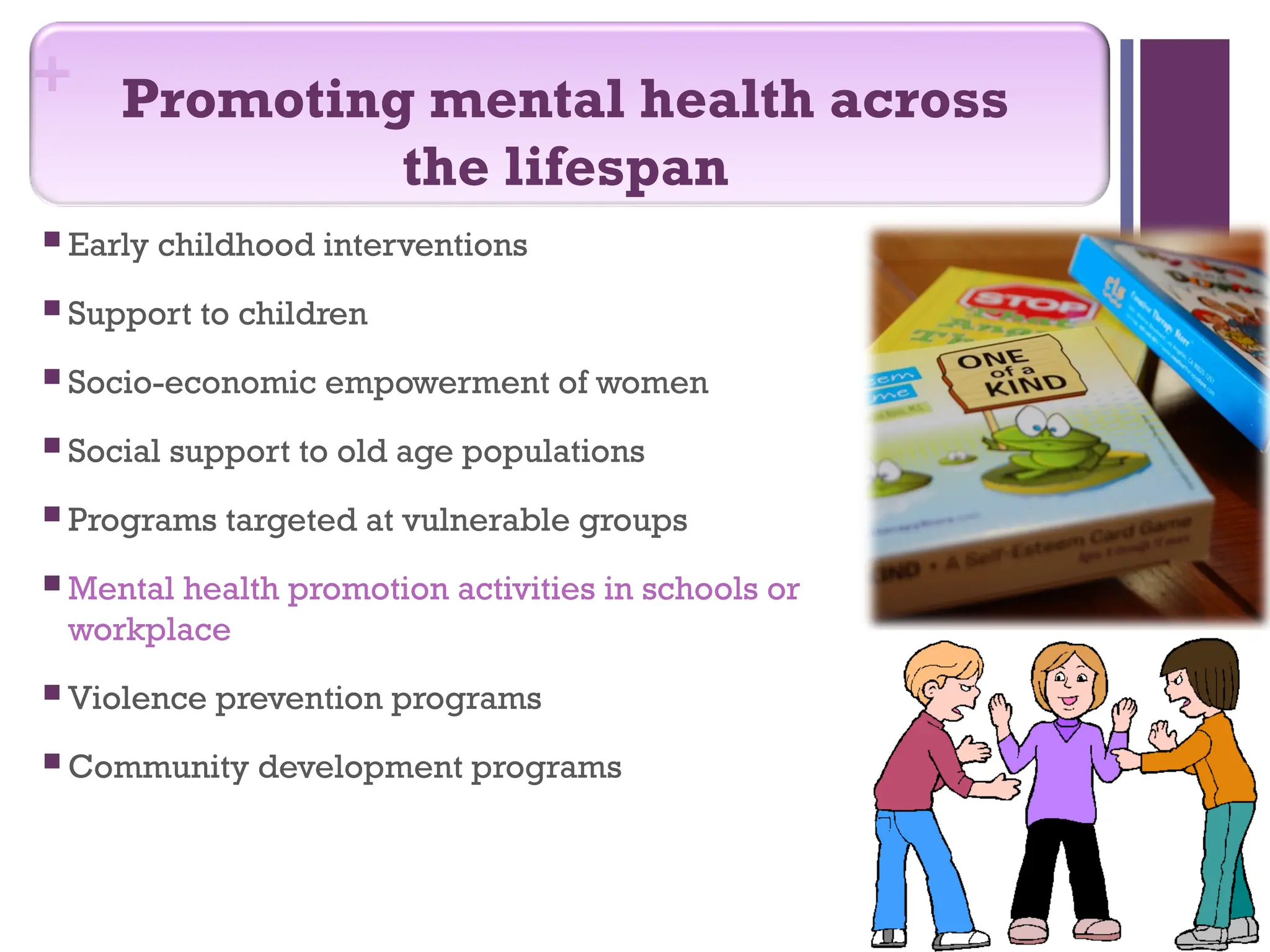
 Early childhood interventions
 Support to children
 Socio-economic empowerment of women
 Social support to old age populations
 Programs targeted at vulnerable groups
 Mental health promotion activities in schools or
workplace
 Violence prevention programs
 Community development programs
Promoting mental health across
the lifespan
+
Work policies
Interpersonal
relations
Work environment
Promoting Mental Health and
Wellness in the Workplace
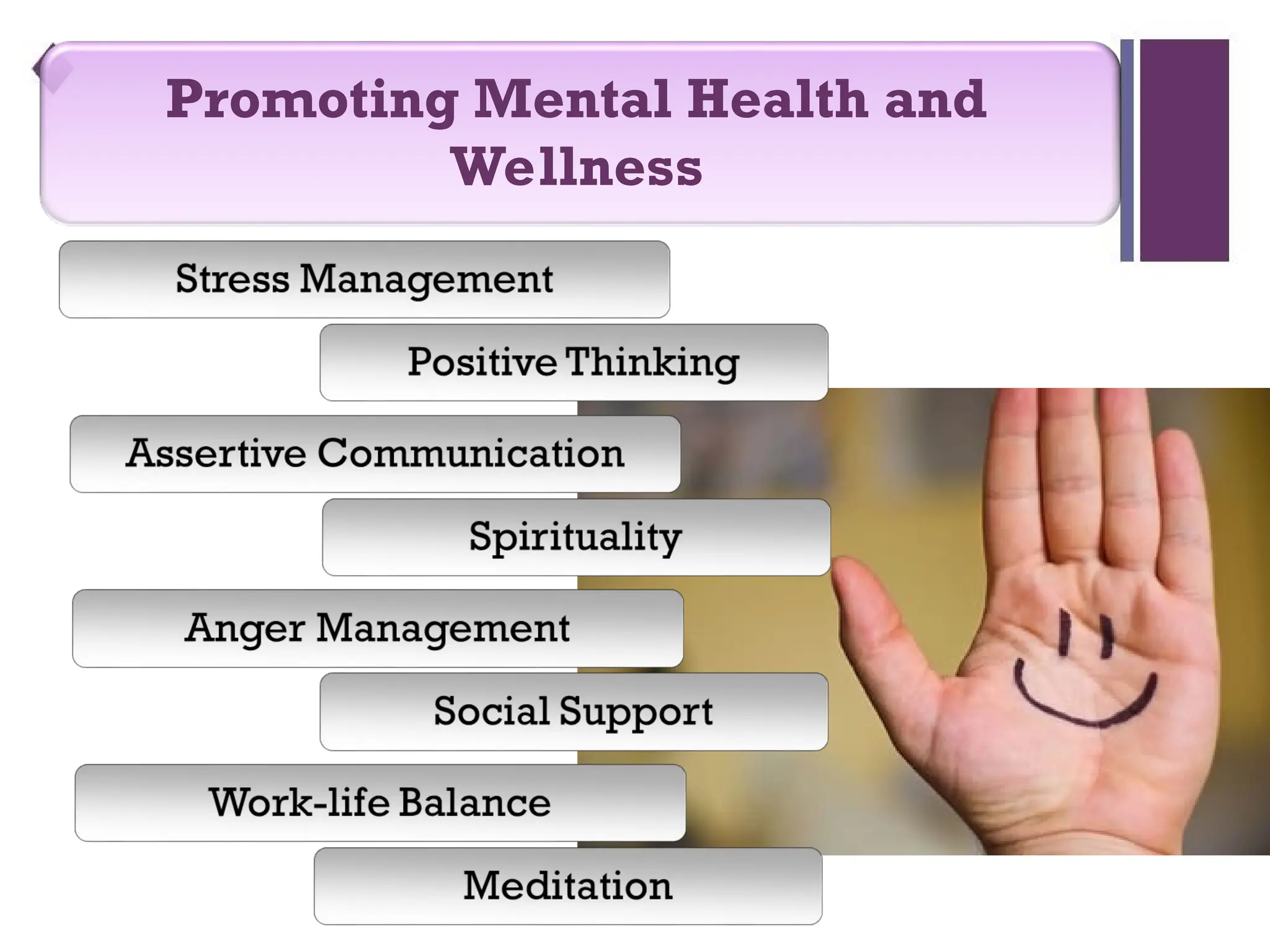
Promoting Mental Health and
Wellness
Promoting Mental health and Wellness:
Assertive Communication
Passive Aggressive Assertive
Characteristic Self-denying
Sacrificing
Avoids conflict
Apologetic
Insensitive, Blaming,
Intimidating,
Creates conflict
Open. Honest. Direct.
Respectful . Objective.
Responsible for own
feelings
Goal To please.
To be nice.
To Avoid conflict.
To dominate .
To get own way.
To communicate.
To give and get
respect.
To have control over
oneself
Result Don’t get what you
want.
Relationships
deteriorate.
Often get what you
want at the expense of
others.
Relationships
deteriorate.
May get what you want.
Build
relationships.
What you think
when you
behave this
way
I’m not OK.
You’re OK.
I’m OK.
You’re not OK.
I’m OK.
You’re OK.
Tips to become more assertive
 Assess your style
 Use “I” statements
 Practice saying “No”
 Rehearse what you want to say
 Use body language
 Keep emotions in check
 Start small
Promoting Mental health and
Wellness: Assertive Communication
Anger involves three components:
Promoting Mental Health and
Wellness: Anger Management
Ten tips to help get anger under control
 Take a timeout
 Get some space
 Once you’re calm,
express your anger
 Get some exercise
 Think carefully before
you say anything
 Identify solutions to
the situation
 Use “I” statements
when describing the
problem
 Don’t hold a grudge
 Use humor to release
tensions
 Practice relaxation
skills
Promoting Mental Health and
Wellness
+
“Anger is just anger.
It isn’t good. It isn’t bad.
It just is.
What you do with it
Is what matters.
It’s like anything else.
You can use it to build or to destroy.
You just have to make the choice.”
Promoting Mental Health and
Wellness: Anger Management
Tips to balance work and life
Keep a log.
Take advantage of your
options
Learn to say “no”
Leave work at work
Manage your time
Communicate clearly
 Fight the guilt
 Nurture yourself
 Set aside one night each
week for recreation
 Protect your day-off
 Get enough sleep
 Bolster your support
system
Promoting Mental Health and
Wellness: Work-life Balance
Health benefits of positive thinking
 Increased lifespan
 Lower rates of
depression
 Lower levels of distress
 Greater resistance to
the common cold
 Better psychological
and physical well-
being
 Reduced risk of death
from cardiovascular
diseases
 Better coping skills
during hardships and
times of stress
Promoting Mental Health and
Wellness: Positive Thinking
Reality is what we take to
be true.
What we take to be true is
what we believe.
What we believe is based
upon our perceptions.
What we perceive
depends upon what we
think.
What we think depends
upon what we perceive.
What we perceive
determines what we
believe.
What we believe determines
what we take to be true.
What we take to be true is
our reality.
Gary Zukov
Promoting Mental Health and
Wellness: Positive Thinking
Benefits of spirituality
 Focus on personal goals
 Connect to the world
 Release control
 Expand your support network
 Lead a healthier life
Promoting Mental Health and
Wellness: Spirituality
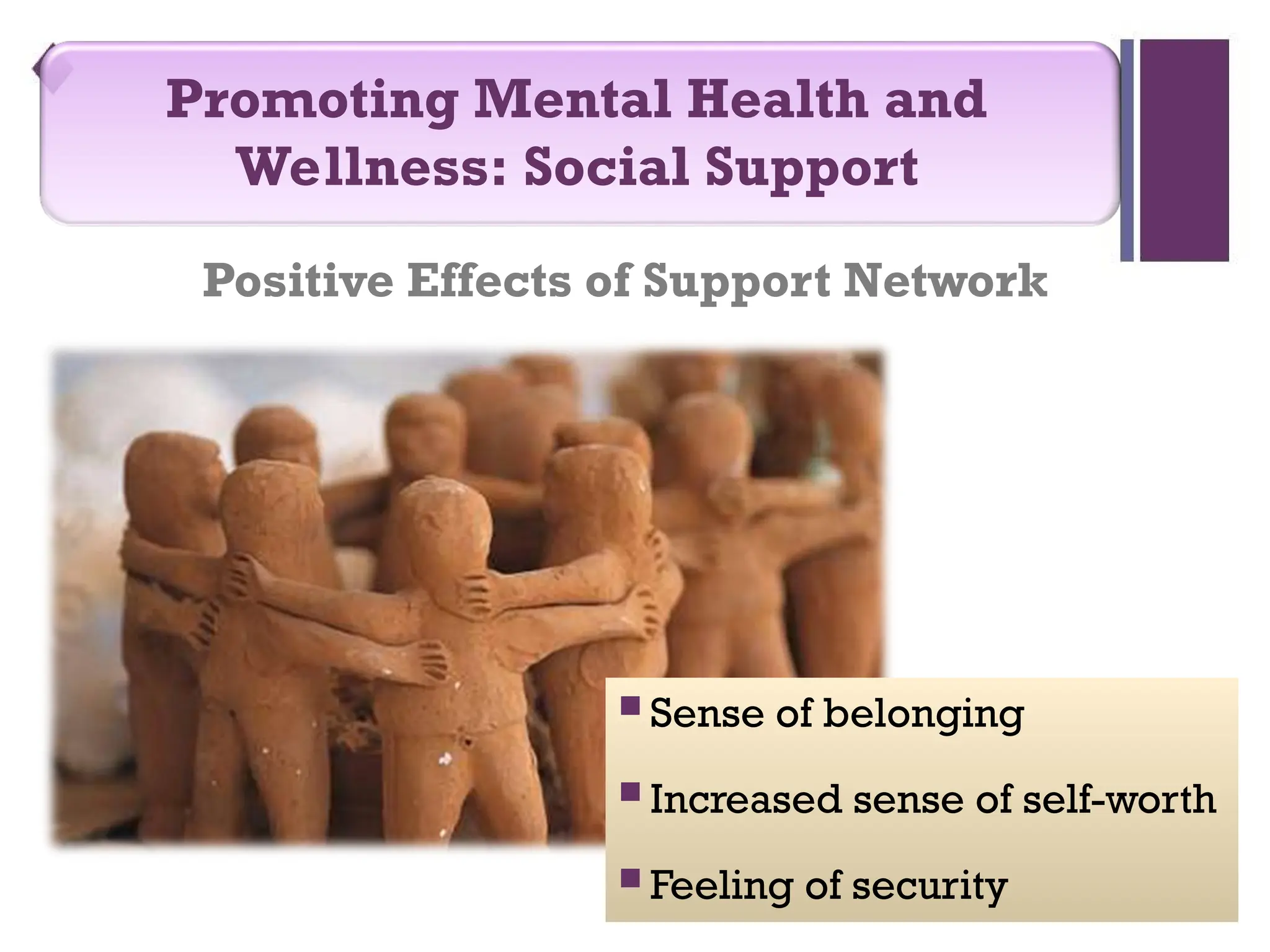
Positive Effects of Support Network
 Sense of belonging
 Increased sense of self-worth
 Feeling of security
Promoting Mental Health and
Wellness: Social Support
Tips for nurturing relationships
 Stay in touch
 Be proactive
 Know when to say “no“
and when to say “yes”
 Don’t compete
 Be a good listener
 Challenge yourself
 Don’t overdo it
 Appreciate your
friends and family
Promoting Mental Health and
Wellness: Social Support
Meditation paves the way for:
 Gaining a new perspective on
stressful situations
 Building skills to manage your stress
 Increased self-awareness
 Focusing on the present
 Reducing negative emotions
Promoting Mental Health and
Wellness: Meditation
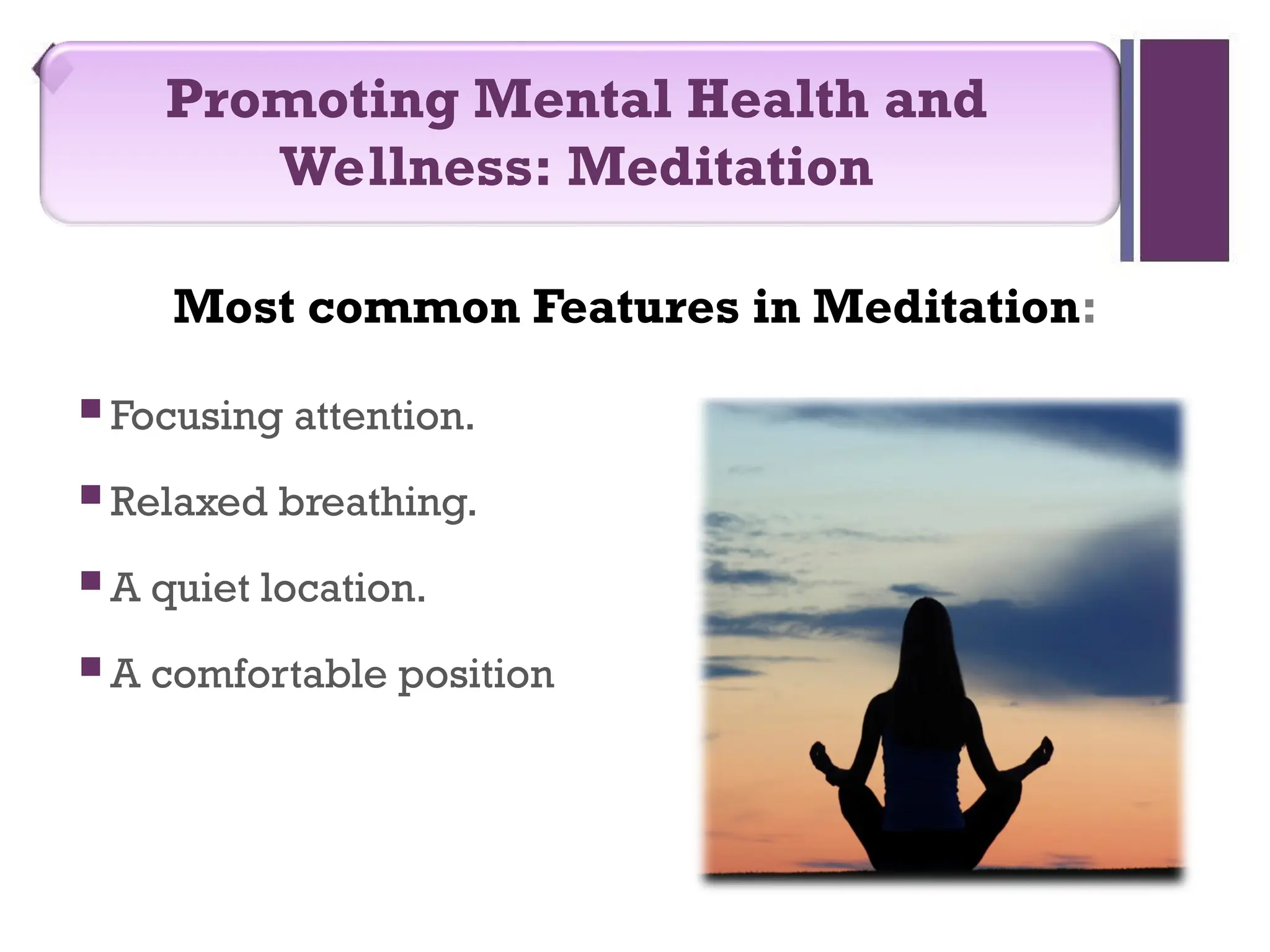
Most common Features in Meditation:
 Focusing attention.
 Relaxed breathing.
 A quiet location.
 A comfortable position
Promoting Mental Health and
Wellness: Meditation
Some Meditation methods:
 Breathe deeply
 Scan your body.
 Repeat mantra.
 Walking meditation.
 Engage in prayer.
 Read or listen and take time to reflect.
 Focus your love and gratitude.
Promoting Mental Health and
Wellness: Meditation
Eight Dimension of Wellness
Stress Assessment: Evaluating Stress Levels and Coping Mechanisms

Stress Assessment: Evaluating Stress Levels and Coping Mechanisms

  • 1.
    Stress Assessment &Management and Promoting Mental Health in the Workplace
  • 2.
    1. Describe themagnitude of mental health problems 2. Discuss factors that contribute to mental health problems 3. Discuss the definition of stress and the factors contributing to unmanaged stress Objectives
  • 3.
    4. Discuss therelationship between stress and health and well being. 5. Identify signs of stress. 6. Explain the benefits of promoting mental health 7. Identify strategies to promote mental health and wellness. Objectives
  • 4.
  • 5.
    A state ofwell-being in which the individual realizes his or her own abilities, can cope with the normal stresses of life, can work productively and fruitfully, and is able to make a contribution to his or her community. Epidemiology of Mental Health Problems MENTAL HEALTH
  • 6.
    Epidemiology of MentalHealth Problems
  • 7.
    WHO (2007) reportsthat about half of mental disorders begin before the age of fourteen. Around 20% of the world’s children and adolescents are estimated to have mental disorders or problems, with similar types of disorders being reported across cultures. Epidemiology of Mental Health Problems
  • 8.
    Mental Health Concernsamong Adolescents 13-15 y/o Epidemiology of Mental Health Problems
  • 9.
    Epidemiology of MentalHealth Problems Most frequently reported symptoms of mental health problems
  • 10.
    Epidemiology of MentalHealth Problems
  • 11.
     Drugs  Alcohol Lack of education  Poor nutrition  Poverty  Racial injustice  Violence or war  Work stress and/ or unemployment Factors that contribute to mental health problems
  • 12.
    Stress? How is yourmental health and wellness?
  • 13.
    + Stress is theway human beings react both physically and mentally to changes, events, and situations in their lives.  2 types of stress * eustress - moderate or normal psychological stress interpreted as being beneficial for the experiencer. * distress - extreme anxiety, sorrow, or pain What is stress?
  • 14.
    + Frequency (how often) Duration(length of experience) How physically draining How emotionally draining How does stress affect your performance?
  • 15.
    + Nature of stress Consciousand unconscious meaning of stressor  Preexisting vulnerabilities Factors contributing to unmanaged stress
  • 16.
    + Nature of stress -Frequency - Intensity - Duration Factors contributing to unmanaged stress
  • 17.
    + Conscious and unconsciousmeaning of stressors - Need to prove oneself - Resentment - Guilt Factors contributing to unmanaged stress
  • 18.
    + What are stressors? -Physical environment - Social/relational - Financial - Organizational - Life events - Lifestyle choices - Physiological Factors that contribute to unmanaged stress
  • 19.
    + Stress is thebody’s physical response to a perceived threat or DANGER Stress and Health Can stress make you sick?
  • 20.
    + “fight or flight”response – acute stress response - increase heart rate - increase breathing rate - increase muscle tension - increase BP - increase secretion of insulin - increase blood flow to the brain, lungs, heart and muscles Stress and Health
  • 21.
    +  Heart disease High Blood pressure  Stomach Problems  Respiratory problems  Type II Diabetes  Back Problems  Headaches and migraines  Obesity Stress and Health  Rheumatoid arthritis  Cancer  Skin problems  Mental Health problems  Immune system problems  Child and partner abuse  Suicide  Homicide  Alcohol and drug use and abuse  Tobacco abuse  Violence and aggressive behavior  Accidents  Sleep problems  Sexual problems
  • 22.
    + Some Signs ofStress: PHYSICAL SIGNS  Increased heart rate  Dry mouth  Muscle aches, stiffness or pain (especially in the neck, shoulders and lower back)  High blood pressure  Frequent colds or flu  Worsening of existing illness (asthma, skin rashes etc.)  Chest pains  Headaches  Indigestion  Constipation  Stomach cramps  Sweating  Nausea  Trembling  Fatigue  Weight gain or loss
  • 23.
    + Some Signs ofStress: BEHAVIORAL SIGNS  Increased smoking, drinking, drug use  Yelling  Swearing  Aggression  Changes in eating habits (increase or decrease)  Changes in sleeping habits (increase or decrease)  Nervousness ( nail biting, fidgeting, pacing etc.)
  • 24.
    + Some Signs ofStress: MENTAL SIGNS Difficulty concentrating Decreased memory Difficulty making decisions Mind going blank or mind racing Confusion Loss of sense of humor Inattentiveness Bad dreams Decreased libido
  • 25.
    + Some Signs ofStress: EMOTIONAL SIGNS Anxiety Anger Irritability Impatience Short temper Frustration Worry Fear
  • 26.
    + Power and resilience Improving individual’s and community’s sense of control over life and the ability to be resilient in the face of significant adversity or stress can lead to decreased mental health problems Protective factors  Buffer a person in the face of adversity and moderate the impact of stress and social and emotional well- being, thereby reducing likelihood of disorders developing Benefits of Promoting Mental Health
  • 27.
    Ways of copingwith stress Promoting Mental Health and Wellness : Stress Management
  • 28.
    1. The unsettlingeffect of change. 2. The feeling that an outside force is challenging or threatening you. 3. The feeling that you have lost personal control. Stress Management: Identify Stress Triggers
  • 29.
    +  I need6 hours to finish this project  I need P 10,000 to pay for my tuition  I need for all my co-workers to like me  I need to have full control over the work I do  I need to have low body fat  I need to have good health  I need to have a girl/boyfriend  I need my neighbors to treat with me respectfully  I have 2.5 hours to finish this project  I have P6,000 to put towards my tuition  I have a few co-workers who don’t like me  I have an employer who gives me little control over the way I do my work  I have so much fat  I have several health problems  I have no-one in my life  I have a neighbor who is disrespectful Demands Resources Stress Management: Identify Stress Triggers
  • 30.
    Tips to improvetime management skills and lower stress level:  Create realistic expectations and deadlines and set regular progress reviews  Throw away unimportant papers on desk.  Prepare a master list of tasks.Throughout the day, scan master list and work on tasks in priority order  Use a planner. Store addresses and telephone numbers there. Evaluate and prioritize daily.  For especially important or difficult projects, reserve an interruption free block of time . Stress Management : Time Management
  • 31.
    You may beon the road to burnout, if: Every day is a bad day. Caring about your work or home life seems like a total waste of energy. You’re exhausted all the time. The majority of your day is spent on tasks you find either mind-numbingly dull or overwhelming. You feel like nothing you do makes a difference or is appreciated. Stress Management : Extinguish Job Burnout
  • 32.
    Work-related causes ofburnout Feeling like you have little or no control over your work Lack of recognition or reward for good work Unclear or overly demanding job expectations Doing work that’s monotonous or unchallenging Working in a chaotic or high-pressure environment Stress Management : Extinguish Job Burnout
  • 33.
    Personality traits cancontribute to burnout Perfectionistic tendencies; nothing is ever good enough Pessimistic view of yourself and the world The need to be in control; reluctance to delegate to others High-achieving,Type A personality Stress Management : Extinguish Job Burnout
  • 34.
    Dealing with burnoutrequires the “Three R” approach: Recognize – Watch for the warning signs of burnout Reverse – Undo the damage by seeking support and managing stress Resilience – Build your resilience to stress by taking care of your physical and emotional health Stress Management : Extinguish Job Burnout
  • 35.
    Reach out tothose closest to you Be more sociable with your coworkers Limit your contact with negative people Connect with a cause or a community group that is personally meaningful to you Find new friends Stress Management : Extinguish Job Burnout
  • 36.
    +  Early childhoodinterventions  Support to children  Socio-economic empowerment of women  Social support to old age populations  Programs targeted at vulnerable groups  Mental health promotion activities in schools or workplace  Violence prevention programs  Community development programs Promoting mental health across the lifespan
  • 37.
  • 38.
  • 39.
    Promoting Mental healthand Wellness: Assertive Communication Passive Aggressive Assertive Characteristic Self-denying Sacrificing Avoids conflict Apologetic Insensitive, Blaming, Intimidating, Creates conflict Open. Honest. Direct. Respectful . Objective. Responsible for own feelings Goal To please. To be nice. To Avoid conflict. To dominate . To get own way. To communicate. To give and get respect. To have control over oneself Result Don’t get what you want. Relationships deteriorate. Often get what you want at the expense of others. Relationships deteriorate. May get what you want. Build relationships. What you think when you behave this way I’m not OK. You’re OK. I’m OK. You’re not OK. I’m OK. You’re OK.
  • 40.
    Tips to becomemore assertive  Assess your style  Use “I” statements  Practice saying “No”  Rehearse what you want to say  Use body language  Keep emotions in check  Start small Promoting Mental health and Wellness: Assertive Communication
  • 41.
    Anger involves threecomponents: Promoting Mental Health and Wellness: Anger Management
  • 42.
    Ten tips tohelp get anger under control  Take a timeout  Get some space  Once you’re calm, express your anger  Get some exercise  Think carefully before you say anything  Identify solutions to the situation  Use “I” statements when describing the problem  Don’t hold a grudge  Use humor to release tensions  Practice relaxation skills Promoting Mental Health and Wellness
  • 43.
    + “Anger is justanger. It isn’t good. It isn’t bad. It just is. What you do with it Is what matters. It’s like anything else. You can use it to build or to destroy. You just have to make the choice.” Promoting Mental Health and Wellness: Anger Management
  • 44.
    Tips to balancework and life Keep a log. Take advantage of your options Learn to say “no” Leave work at work Manage your time Communicate clearly  Fight the guilt  Nurture yourself  Set aside one night each week for recreation  Protect your day-off  Get enough sleep  Bolster your support system Promoting Mental Health and Wellness: Work-life Balance
  • 45.
    Health benefits ofpositive thinking  Increased lifespan  Lower rates of depression  Lower levels of distress  Greater resistance to the common cold  Better psychological and physical well- being  Reduced risk of death from cardiovascular diseases  Better coping skills during hardships and times of stress Promoting Mental Health and Wellness: Positive Thinking
  • 46.
    Reality is whatwe take to be true. What we take to be true is what we believe. What we believe is based upon our perceptions. What we perceive depends upon what we think. What we think depends upon what we perceive. What we perceive determines what we believe. What we believe determines what we take to be true. What we take to be true is our reality. Gary Zukov Promoting Mental Health and Wellness: Positive Thinking
  • 47.
    Benefits of spirituality Focus on personal goals  Connect to the world  Release control  Expand your support network  Lead a healthier life Promoting Mental Health and Wellness: Spirituality
  • 48.
    Positive Effects ofSupport Network  Sense of belonging  Increased sense of self-worth  Feeling of security Promoting Mental Health and Wellness: Social Support
  • 49.
    Tips for nurturingrelationships  Stay in touch  Be proactive  Know when to say “no“ and when to say “yes”  Don’t compete  Be a good listener  Challenge yourself  Don’t overdo it  Appreciate your friends and family Promoting Mental Health and Wellness: Social Support
  • 50.
    Meditation paves theway for:  Gaining a new perspective on stressful situations  Building skills to manage your stress  Increased self-awareness  Focusing on the present  Reducing negative emotions Promoting Mental Health and Wellness: Meditation
  • 51.
    Most common Featuresin Meditation:  Focusing attention.  Relaxed breathing.  A quiet location.  A comfortable position Promoting Mental Health and Wellness: Meditation
  • 52.
    Some Meditation methods: Breathe deeply  Scan your body.  Repeat mantra.  Walking meditation.  Engage in prayer.  Read or listen and take time to reflect.  Focus your love and gratitude. Promoting Mental Health and Wellness: Meditation
  • 53.