Crisis Counseling
Reviewing Mental Health Vs
Spiritual Approach
for
People in Crisis
PreparedandPresentedBy
GlenChristie,MS,EdS,ThD,CASAC
FaithBibleCollege
CrisisCounselingI
Mission and Purpose
Emotional and Spiritual Care Counselors serve initially as a calming
presence
At the place of impact and begin the process of
“Building a Stabilizing Bridge”
From all responding and supporting groups, elements and resources
To the victim who is suffering from trauma, grief and shock!
And
On to the process of being a survivor who is regaining
Their ability to cope and deal with
The tragedy and begin to move forward
On the journey
Of the reality of the
“New Normal”
How does this apply in the “Definition” of
Emotional and Spiritual Care?
EMOTIONAL CARE- Addresses the need for those in crisis to express their
fears, doubts and questions without judgment or interruption.
It is about “telling their story” to someone trained to listen.
IT IS THROUGH LISTENING- that responders can tell if a person is better
served by mental, physical or spiritual services and then serve as a
facilitator to give them access to those needed services.
SPIRITUAL CARE- is the vital connection that people need in coping with the
events from their faith perspectives and how to draw from that strength,
healing and hope- all vital components of going from victim to survivor as
their recovery unfolds.
What we ARE NOT, or at least SHOULD NOT be
We ARE NOT there to make a diagnosis
We ARE NOT there to determine that you, your
family and/or the person in crisis are “CRAZY”,
or “IN NEED OF THERAPY”.
We are there to lend a listening ear, provide
practical stress management education, and
provide referrals and interventions only when
necessary.
We are there to help everyone, including
“normal” people, experiencing normal trauma,
recover from an abnormal event.
What we ARE NOT, or at least SHOULD NOT be...
We ARE NOT there to provide
traditional therapy
We are there to provide CRISIS counseling and BRIEF
interventions and REFERRALS as appropriate and
necessary.
There ARE NO leather sofas, hand holding and/or
enabling you to remain in crisis.
We are there to give you prayer, compassion, and
guidance as Jesus practiced during His ministry
What is a Crisis?
“an emotionally charged significant event or
radical change”
 “an unstable or crucial time of affairs in which a
decisive change is impending”
 “a situation with the distinct possibility of a
highly desirable outcome”
 “a situation that has reached a critical phase”
Risk Factors
Suicide or homicide
Risk of physical or emotional harm to
others
Risk of break from reality (psychosis)
Risk of client fleeing the situation.
Characteristics of a Crisis
Time limited: Generally lasting no more than six
weeks.
Typical phases:
Traditional attempt to problem solve
Attempts to try alternative methods
Disorganization
People are more open to change
Opportunity to resolve previously unresolved
issues
Successful experience
Crisis Characteristics
Every crisis is complicated
The disequilibrium of crisis provides
impetus for change (+/-)
Brief therapy can help – but it treats the
symptoms, not the cause
Choice is essential
Crisis is “universal” because no one is
immune.
Crisis is time limited (6-8 weeks).
Reaction to Personal Crisis
Individuals in crisis can:
Cope by themselves and grow stronger
from the experience
Survive the immediate crisis, but block it
from consciousness leading to future
problems
Break down from the crisis – putting life
on hold unless they receive immediate
assistance
Crisis Intervention
Goal is to stabilize the person or family situation
and restore to their pre-crisis level of
functioning.
Opportunity to develop new ways of perceiving,
coping, and problem-solving.
The intervention is time limited and fast paced.
counselor must take an active and directive
approach.
TYPES OF EMOTIONAL CRISES
Depression
Suicidality
Anxiety / Stress
Abusive Relationships
Alcoholism & Drug Abuse
Eating Disorders
Symptoms of Depression
Feelings of hopelessness
Fatigue / exhaustion
Sleep difficulties
Eating disturbances
Poor concentration
Loss of interest in activities
Thoughts of suicide
Difficulty functioning
Suicidality
(3rd cause of death for ages 15 - 24)
Shows signs of depression
Increased use of alcohol or high risk behavior
Getting the means to kill oneself
Giving away prized possessions
Indicating a desire to get even with significant
others
Discussing suicide or issues
Have made past attempts
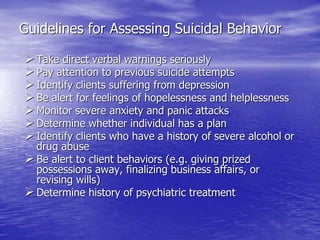
Guidelines for Assessing Suicidal Behavior
Take direct verbal warnings seriously
Pay attention to previous suicide attempts
Identify clients suffering from depression
Be alert for feelings of hopelessness and helplessness
Monitor severe anxiety and panic attacks
Determine whether individual has a plan
Identify clients who have a history of severe alcohol or
drug abuse
Be alert to client behaviors (e.g. giving prized
possessions away, finalizing business affairs, or
revising wills)
Determine history of psychiatric treatment
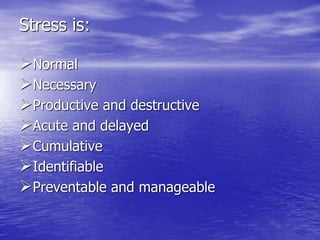
Stress is:
Normal
Necessary
Productive and destructive
Acute and delayed
Cumulative
Identifiable
Preventable and manageable
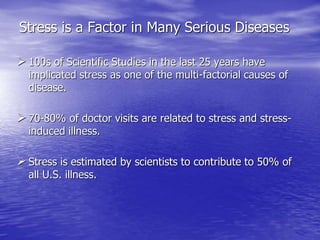
Stress is a Factor in Many Serious Diseases
100s of Scientific Studies in the last 25 years have
implicated stress as one of the multi-factorial causes of
disease.
70-80% of doctor visits are related to stress and stress-
induced illness.
Stress is estimated by scientists to contribute to 50% of
all U.S. illness.
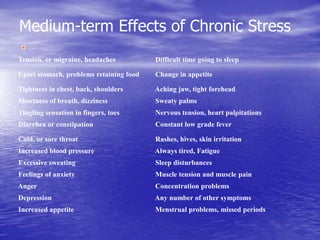
Medium-term Effects of Chronic Stress
Tension, or migraine, headaches Difficult time going to sleep
Upset stomach, problems retaining food Change in appetite
Tightness in chest, back, shoulders Aching jaw, tight forehead
Shortness of breath, dizziness Sweaty palms
Tingling sensation in fingers, toes Nervous tension, heart palpitations
Diarrhea or constipation Constant low grade fever
Cold, or sore throat Rashes, hives, skin irritation
Increased blood pressure Always tired, Fatigue
Excessive sweating Sleep disturbances
Feelings of anxiety Muscle tension and muscle pain
Anger Concentration problems
Depression Any number of other symptoms
Increased appetite Menstrual problems, missed periods
Anxiety / Stress
Anxious mood & overreacting to
situations
Inability to concentrate or pay attention
Inability to get organized
Increased procrastination
Anxiety attacks: weakness, dizziness,
shortness of breath, increased heart
rate
Difficulty making decisions
Anxiety / Stress
continued
“Going blank”: forgetting & losing
things
Frequent headaches, backaches,
tightness in stomach
Frequent indigestion or diarrhea
Overpowering urges to cry or run &
hide
Increased use of alcohol
Increased illnesses & accidents
Stress Related Diseases
• Long-Term Chronic Stress is One Cause of Disease
• Whereas the medium term effects of chronic stress are
unpleasant, the long-term effects are dangerous and
contribute to both suffering and disease:
1. Asthma
2. Diabetes
3. GI disorders - Ulcer disease
4. Myocardial Infarction
5. Cancer, breast cancer, cervical cancer
6. Viral infections
7. HIV
8. Parkinson’s Disease
9. Alzheimer’s Disease
Symptoms of Alcohol & Drug Abuse
• Odor of alcohol or marijuana
• Slurred speech
• Rapid speech
• Incoherent
• Bizarre behavior: acting out or non-
compliance to requests
• Irrational thought process, verbal or
written
• Inconsistent class/work attendance
Eating Disorders Danger Signals
• Losing a significant amount of weight
• Continuing to diet (although thin)
• Feeling fat, even after losing weight
• Fearing weight gain
• Losing monthly menstrual periods
• Preoccupation with food, calories, nutrition
and / or cooking
• Exercising compulsively
• Bingeing and purging
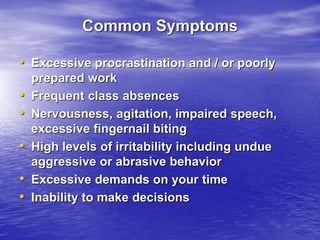
Common Symptoms
• Excessive procrastination and / or poorly
prepared work
• Frequent class absences
• Nervousness, agitation, impaired speech,
excessive fingernail biting
• High levels of irritability including undue
aggressive or abrasive behavior
• Excessive demands on your time
• Inability to make decisions
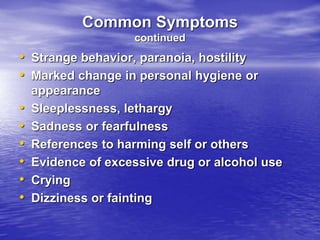
Common Symptoms
continued
• Strange behavior, paranoia, hostility
• Marked change in personal hygiene or
appearance
• Sleeplessness, lethargy
• Sadness or fearfulness
• References to harming self or others
• Evidence of excessive drug or alcohol use
• Crying
• Dizziness or fainting
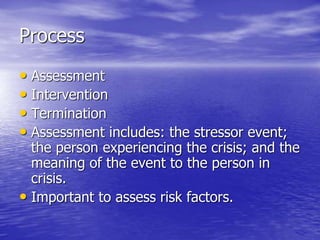
Process
• Assessment
• Intervention
• Termination
• Assessment includes: the stressor event;
the person experiencing the crisis; and the
meaning of the event to the person in
crisis.
• Important to assess risk factors.
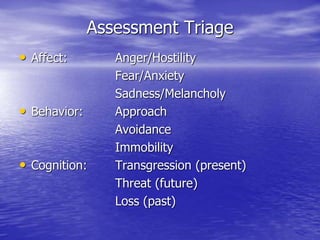
Assessment Triage
• Affect: Anger/Hostility
Fear/Anxiety
Sadness/Melancholy
• Behavior: Approach
Avoidance
Immobility
• Cognition: Transgression (present)
Threat (future)
Loss (past)
Planning for Crisis Counseling
• Ask the right questions (what, where,
when, how and, in some cases, why)
• Identify precipitating events
• Establish goals and operational definitions
• Create a crisis response plan with clearly
identified steps
• Create and implement response protocols
• Begin ongoing evaluation and mitigation
Performing the Assessment
• Conducting the interview
– History: personal and familial of risk behavior
– Any means and plans the client may have about
carrying out the risk behavior
– Controls: internal and external that are stopping the
client from undertaking the risk behavior.
• Observations during the interview
– Level of anxiety; desperation; despair; sense of
hopelessness; contact with reality.
Focusing on Issue
• The skill and technique most essential at this
stage is that of focusing while allowing the
client to ventilate and express the overwhelming
flood of emotions.
• Focusing technique can elicit more coherent
information for assessment as well as help the
client pull themselves together cognitively and
emotionally.
• A focused interview can serve as an instrument
of both assessment and intervention.
Three Types of Effective Active
Listening
• Paraphrase - Restating what individual has
said in your own words
• Open Question - A question that helps
speaker explore feelings (rather than forcing a
“yes” “no'' or other certain answer)
• Feeling Reflection - your perception of
speaker's feelings based on words, tone &
body language
Reasons for Active Listening
• Avoid saying the wrong thing
• Dissipates strong feelings
• Helps other to accept feelings
• Generates a feeling of caring
• Encourages others to start listening back
• Increase confidence in the other
• Makes other feel important & recognized
LISTEN for:
• Open-ended questions
• Closed-ended questions
• Owning feelings
• Disowned statements
• Conveying understanding
• Value judgments
• Positive reinforcement
• Empathy, genuineness, acceptance
Roadblocks to Active Listening
• Warning
• Judging
• Labeling
• Threatening
• Demanding
• Giving solutions
• Criticizing
• Name-calling
• Directing
• Lecturing
• Ordering
• Preaching
• Ridiculing
• Blaming
• Scolding
• Analyzing
Helpful Listening
• Listen to how something is said
• Be alert for what is left unsaid
• You can't hear if YOU do all the talking- Don't talk
too much
• Listen with empathy- See the situation from
speaker’s point of view-Try to put yourself in
speaker’s shoes
• Do not prepare what you are going to say in
response while the other person is speaking
Helpful Listening
• Be courteous-don't interrupt
• Take notes if you worry about forgetting a
particular point
• Avoid stereotyping individuals by making
assumptions about what you expect them to say-
avoid your biases when you listen
• Listen carefully so that you will be able to
understand, comprehend & evaluate what is said
• Use conscious effort-try to be aware of verbal &
nonverbal messages
Physical Set up for Effective Listening
• Pick a quiet location
• Ask not to be disturbed
• Put the telephone on voicemail
• Remove distractions
• Create a comfortable atmosphere e.g.
lighting, temperature, etc.
Mental Set up for Effective Listening
• Don’t prejudge
• Clear mind of other things
• Don’t formulate response while speaker is
talking
• Listen for both content & context
• If not mentally ready to listen-reschedule
conversation if possible
Warnings
• Danger of misunderstanding the client’s
nonverbal behavior as well as spoken words due
to cultural differences or the client’s state of
disorganization.
• Imperative for the counselor not to assume that
they understand what the client means by his
spoken word or non-verbal behavior and vice
versa.
• It is best to clarify and make sure.
Assigning “Meaning”
It is important for a counselor to understand the meaning a
person assigns to an event or an emotion. These can be
seen as any of the following:
•A Challenge – to be overcome
•A Loss – making change difficult or impossible
•A Gain – a sign that one is working to maximum ability
•A Punishment – penance for not doing something right (or
for doing something wrong) in the past
•A Reality – to be assessed and dealt with so that it can be
reduced to an acceptable level
Learning To Listen
• Factors that influence the way you listen
and interpret what you hear
 Age – Hear and react to things differently
 Sex – Taught to process and respond differently
 Education – Orientation likely to have diverse
meaning
 Past Experiences – Sees things through the past
 Perception of Future Expectations and Goals –
Optimistic or Pessimistic
Learning To Listen
 Personal Feeling About Individual – Different with
people they dislike
 Feeling threatened (fearful)
 Intimidated
 Stereotyped (prejudice)
 Current Emotional and Physical Feelings
 Depression
 Tired
 Anxious
 Disinterested
When To Speak – And When Not To
• Be sensible and turn off the flow
• Don’t be so hasty to talk
• Lose for words? Ask for more information
• Project genuine interest and concern
• Timing is important
• Keep confidences (build trust)
• The right words in the right manner
• Teaching, imparting, or giving information
Art of Asking Questions
• Greatly overused – Often used when you have
little idea of what to do – stalling
• Know why you are asking a question
• Careful not to send nonverbal messages
 Judgment or suspicion
 Blaming
 Condemnation
 Hopelessness
Role of Spiritual and Religious
Values in Counseling
• Spirituality refers to:
– general sensitivity to moral, ethical, humanitarian, and
existential issues without reference to any particular
religious doctrine
• Religion refers to:
– the way people express their devotion to a deity or an
ultimate reality
• Key issues:
– Can the counselor understand the religious beliefs of the
client?
– Can the counselor work within the framework of the
client?
Jesus Approach to Counseling
• Counseling is a process
 He didn’t see people as the problem, but someone who has a problem
 His drive was based on compassion
 He accepted people as they were, instead of the way they’re expected
to be
 He recognized their worth above any rules and regulations and
showing them their worth in God’s eyes
 Jesus used discernment to see the real needs of the individual, despite
what they may have brought to his attention
 The very words you will use with the individual is important
 Jesus emphasized right behavior
 Jesus sought to have people accept responsibility
Jesus Approach to Counseling
• Jesus encouraged people and gave them hope. He did not provide false
hope through minimization or denial
• Jesus placed much emphasis on peace of mind through allowing God to
take the burden
• Jesus promoted reshaping or refashioning people’s thinking by focusing
on the important issues, or, foundation issues
• Teaching was an important aspect of Jesus’ counseling
• Jesus spoke with authority, he was not hesitant, backward, or bashful
• When necessary, Jesus did not hesitate to admonish or confront and
individual
Jesus Practiced What He Preached
• Jesus talked the talk and walked the walk
 Jesus demonstrated obedience to God
 He lived a life of faith
 Jesus practiced a strong and powerful prayer life
 Jesus was not aloof, He was personal, caring, sensitive, and not afraid
to get involved
 Jesus used the power of the Holy Spirit by helping others recognize how
the Holy Spirit is active in our lives.
Giving Advice Is a Part of Counseling
• Suggestions – Draw from individual
• Options – What if you did ….?
• Consideration – Have you considered …?
• Possibility – What possibilities ….?
• Never! – This is exactly what you need to do
• Most have the ability to resolve their problem
• Teaching is an effective tool
Edifying And Helping
• Promote growth in Christian wisdom, grace,
virtue, and holiness
• Assisting in personal betterment
 Use discernment in accepting their point of view
 Don’t take sides
 Encourage appropriate behavior
 Don’t minimize situation or needed effort
 Don’t make assurances or promises for God
 Know the eight types of reassurances that can be given
Empathy
• From German word meaning “to feel unto” or
“to feel with”
• Involves discrimination
 Get inside the other person and feeling and sensing
with them
 Looking at the world through their perspective
 Getting a feel for what their world is like
 Ability to communicate this understanding to the
individual
 Go beyond factual knowledge and become involved in
the individual’s world of feeling
Confrontation
• The act of pointing out a discrepancy between
your Christian view and the individual’s manner of
viewing reality
 Is not a negative and punitive attack on individual
 May involve some unmasking of distortion
 A responsible unmasking of discrepancies, distortions, games,
and smoke screens
 Involves challenging the undeveloped, underdeveloped,
unused, and misused potentials, skills, and resources of
the individual
Confrontation
• Purpose is to help individual make better decisions
• Become more accepting of self
• To be more productive and less destructive
• Confrontation involves commitment
 Examine your own Christian beliefs
 Possibility you could be wrong
 Individual may feel misunderstood and rejected
 Even given with proper intentions, may work against what we
are trying to accomplish
 Is a constructive act of “bringing close together for comparison
or examination”
Confrontation
• Not used during the early phases of counseling
• Individual must be able to understand and see
what you are saying
• Should be made in a tentative manner
• Contraindications
 Individual may try to discredit you through attack of
character
 May try to change influence your reasoning
 May use minimization through rationalization
 May agree with you as part of a game or to
discourage further involvement
Barriers To Helping
Passivity on your part can be frustrating
 Listen with nonverbal encouragement, but little or no
verbal activity will be questioned.
 May interpret as not caring, criticism, or rejection
 Dominance can also be a significant problem
 Over zealous to show what they think they can do
 Desire power or the need to dominate
 Erroneous conclusions
 Dogmatic pronouncements or interpretations
 Inappropriate self-disclosure (ego-trip)
 Construed as interrogation or grilling
Barriers To Helping
 Create distance between you and individual
 Patterns to protect your own discomfort, fears, or anxiety
 Providing false reassurance
 Avoid exploring significant feelings –anger, despair, anxiety,
depression, or subjects that may be uncomfortable – abuse
or incest
 Emotional detachment (aloofness)
 Intellectualizing
 Theorizing
 Debating or lecturing
 Moralizing, admonishing, or passing judgment
 Patronizing or condescending behavior
 Inappropriate confrontations
Spiritual Approach to Intervention
Grace and peace be multiplied to you in the knowledge
of God and of Jesus our Lord; seeing that His divine
power has granted to us everything pertaining to life and
godliness, through the true knowledge of Him who called
us by His own glory and excellence. - 2 Peter 1:2-3
All Scripture is inspired by God and profitable for
teaching, for reproof, for correction, for training in
righteousness; so that the man of God may be adequate,
equipped for every good work. – 2 Timothy 3:16-17
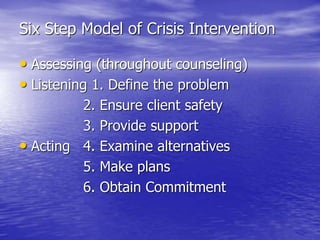
Six Step Model of Crisis Intervention
• Assessing (throughout counseling)
• Listening 1. Define the problem
2. Ensure client safety
3. Provide support
• Acting 4. Examine alternatives
5. Make plans
6. Obtain Commitment
Intervention
• The goal of intervention is to restore the person
to pre-crisis level of equilibrium, not of
personality changes.
• counselor attempts to mobilize the client’s
internal and external resources.
• Exact nature of the intervention will depend on
the client’s pre-existing strengths and supports
and the counselor’s level of creativity and
flexibility.
Intervention continued
• Planning occurs simultaneously as assessment is
made about how much time has elapsed
between the occurrence of the stressor event
and this initial interview.
• How much the crisis has interrupted the person’s
life;
• The effect of this disruption on others in the
family;
• Level of functioning prior to crisis and what
resources can be mobilized.
Crisis Intervention Models
The chosen model needs to assess and address:
• Equilibrium – disequilibrium creates a need to
regain stability
• Cognition – faulty thinking may need to be
changed
• Psychosocial Transition – internal and social
change may create a need for new internal
coping mechanisms that are adequate to the
demands of the crisis
Three Approaches
• Affective:
– Expression and management of feelings involving
techniques of ventilation; psychological support;
emotional catharsis.
• Cognitive:
– Helping the client understand the connections
between the stressor event and their response.
Techniques include clarifying the problem; identifying
and isolating the factors involved; helping the client
gain an intellectual understanding of the crisis
– Also involves giving information; discussing
alternative coping strategies and changing
perceptions.
Approaches continued
• Environmental modification:
– Pulling together needed external, environmental
resources (either familial or formal helping agencies)
Any and all three approaches may be used at any time
depending where the client is, emotionally and cognitively.
The goal is to help the client restore pre-crisis levels of
functioning.
Taking Action:
– See individual differences
– Assess yourself
– Acknowledge client safety
– Provide client support
– Define the problem
– Consider alternatives
– Plan action steps
– Use client coping strengths
– Attend to client’s immediate needs
– Use referrals (when appropriate)
– Develop and use networks
– Get a commitment
Spiritual/Christian Counseling
Problems with most traditional Counseling Methods:
• Absence of the Holy Spirit
• Lack of emphasis on prayer
• No commitment to the sufficiency of Scripture
• The renaming of sin and the omission of repentance
• Man-centered, feeling-oriented, needs-oriented
• Psychologized terminology & concepts
The Spiritual Counseling Process
• What's a worldview?
 A worldview is the framework from which we view reality
and make sense of life and the world. "[It's] any ideology,
philosophy, theology, movement or religion that provides
an overarching approach to understanding God, the world
and man's relations to God and the world
• What's a biblical worldview?
 A biblical worldview is based on the infallible Word of God.
When you believe the Bible is an inspired guidebook, then
you allow it to be the foundation of everything you say
and do.
The Spiritual Counseling Process
• Why does a biblical worldview matter?
 If we don't really believe the truth of God and live it, then our
witness will be confusing and misleading. Most of us go through
life not recognizing that our personal worldviews have been
deeply affected by the world. Through the media and other
influences, the secularized American view of history, law,
politics, science, God and man affects our thinking more than we
realize.
 By diligently learning, applying and trusting God’s truths in every
area of our lives — whether it's communicating with our
spouses, raising our children or working at the office — we can
begin to develop a deep comprehensive faith that will stand
against the unrelenting tide of our culture's secular ideas. By
capturing and embracing more of God's worldview and trust it
with unwavering faith, then we begin to make the right
decisions. It is our decisions and actions that reveal what we
really believe.
Elements of Spiritual Counseling
A Knowing of God’s Existence
a. A failure to have a knowing of God leads to:
• A toleration of sin.
• A focus on man, evidenced in teaching and
programs.
• Result: the counseling experience reflects a man-
centered ministry that attempts to please others
rather than placing trust in God’s work.
Elements of Spiritual Counseling continued
Authority & Sufficiency of Scripture
• It has authority – it speaks to every area of life.
• It has relevancy – it is totally relevant for every
situation.
• A failure to acknowledge these truths leads to:
 A pursuit of comfort rather than obedience.
 Personal experience becomes the authority rather than
God’s Word.
 Contemporary thinking becomes the guide instead of the
principles of Jesus.
Elements of Spiritual Counseling continued
A Spiritual Intervention Consists of:
• Helping the individual admit to, and
understand, powerlessness.
• Their perceived inability to let go
• Letting anger and resentment destroy relationships
• Permitting fear to control thoughts and actions
• Refusing to allow forgiveness where it is needed
• Allowing the past to dominate the present and endanger
the future
• Admit their life is unmanageable
Elements of Spiritual Counseling continued
A Spiritual Intervention Consists of:
• Helping the individual admit to, and
understand, the degree that God is absent
in their life.
• Examining the individuals beliefs
• Accepting the individual’s beliefs as a starting
point for guidance toward a more rewarding
spiritual path
• Using truth as a guide, the path will inevitably lead
to the principles espoused by Jesus
Elements of Spiritual Counseling continued
The Authority & Sufficiency of Scripture
• It has authority – it speaks to every area of life.
• It has relevancy – it is totally relevant for every
situation.
• A failure to acknowledge these truths leads to:
 A pursuit of comfort rather than obedience.
 Personal experience becomes the authority rather
than God’s Word.
 Contemporary thinking becomes the guide instead
of the principles prescribed in scripture.
Elements of Spiritual Counseling continued
An Accurate Anthropology
A sinner is alienated from God, and as a result, he
will seek fulfillment from the world’s system (1 John
2:15-17). The implications:
• Christ will not be seen as the only solution to man’s
problems.
• People will try to provide substitutes that promise
fulfillment.
• The focus is on dealing with felt needs instead of “real”
needs.
So the goal of all true counseling must be to lead
people to a greater relationship with God through
practicing the philosophy and teaching of Jesus.
Elements of Spiritual Counseling continued
Establish a relationship with God through practices and
principles modeled by Jesus
• The individual establishes an understanding that:
• God cannot rebuild you until you are willing to die to the old self
by letting go of all the hate, prejudice, anger, guilt, shame, regret,
unforgiveness, abuse and neglect issues, all of which equate to
totality of sin you have committed or been subjected to
throughout your life. Exemplified by what Jesus did for you on
the cross.
• Dying to the old self means repentance and a total commitment to
God. This means:
• Turning your will and your life over to the care of God.
• Leaving the past, in the past – allowing God to guide your future
• Using prayer and meditation to keep in constant contact with God
• Having a knowing (more than faith alone) that God is in control and will
provide what you need, not necessarily what you want.
Establishing A Counseling Process
• Must be a commitment to truthfulness. This means
minimizing and eliminating denial
• Must be a commitment to recognizing powerlessness in
managing environment (relationships, behaviors, emotions,
etc.)
• Must be a willingness to accept and understand
powerlessness and begin the process of looking at
environment and life through the eyes of reality
• Must be a willingness to participate in process of taking
personal responsibility for accepting character defects and
exploring avenues of change
• Must be a willingness to consider both positive and negative
feedback with an open mind and an attitude of initiating
positive change.
Establishing A Counseling Process
• There must be a willingness to a comprehensive examination
of current beliefs regarding personal, spiritual, relational, and
environmental beliefs
• Must be willing to examine meanings individual has assigned
to important aspects and words, along with a willingness to
redefine and revise the same
• Must be a willingness for exploration and learning contributing
to continued evolution of healthy attitudes and beliefs
• Must be a willingness to address spiritual concerns through a
comprehensive examination of their spiritual life, or absence
of
• Must be a willingness to search for and establish a spiritual
foundation for life
The Counselor as a Person
• Counselors must be aware of the influence of their own
personality and needs
• Personal needs of counselors based on unresolved personal
conflicts:
– a need to tell people what to do
– a desire to take away all pain from clients
– a need to have all the answers and to be perfect
– a need to be recognized and appreciated
– a tendency to assume too much responsibility for the
changes of clients
– a fear of doing harm, however inadvertently
Transference
• Transference is the process whereby clients project onto
their therapists past feelings or attitudes they had toward
significant people in their lives
• Transference: the “unreal” relationship in therapy
– Counselors need to be aware of their personal reactions
to a client’s transference
– All reactions of clients to a therapist are not to be
considered as transference
– Ethical issue is dealing appropriately with transference
Countertransference
• Countertransference is the counselor’s reaction to
the client’s transference response
• Examples:
– being overprotective with a client
– treating clients in benign ways
– rejecting a client
– needing constant reinforcement and approval
– seeing yourself in your clients
– developing sexual or romantic feelings for a
client
– giving advice compulsively
– desiring a social relationship with clients
Counselor Impairment
• Impaired counselors have lost the ability to resolve
stressful events and are not able to function
professionally
• Shared characteristics of impaired counselors:
– fragile self-esteem
– difficulty establishing intimacy in one’s personal life
– professional isolation
– a need to rescue clients
– a need for reassurance about one’s attractiveness
– substance abuse
Stress in the Counseling Profession
• Counseling can be a hazardous profession
• Some sources of stress for counselors are:
– Feeling they are not helping their clients
– The tendency to accept full responsibility for clients’
progress
– Feeling a pressure to quickly solve the problems of
clients
– Having extremely high personal goals and
perfectionistic strivings
Limits of Confidentiality
– When counselor consults
– When counselor is being supervised
– When client has given consent
– When client poses danger to self or others
– When client discloses intention to commit a crime
– When counselor suspects abuse or neglect of a child
or vulnerable adult
– When a court orders counselor to make records
available
Signs of Unhealthy Boundaries
• I. Intimacy distortions
– falling in love with client
– parentification of client
• II. Inadequate boundaries
– not noticing boundary invasion
– over-responsible for client
– over-involvement with client
– over-identification with client
– role confusion/reversal
– inappropriate touch
– being manipulated by client’s unreasonable demands
– responding to inappropriate personal questions
– acting on sexual attraction
Suggestions on Dealing with Sexual
Attraction to Clients
• Acknowledge the feelings
• Explore the reasons for attraction
• Never act on feelings
• Seek out experienced colleague for consultation
• Seek personal counseling if necessary
• Monitor boundaries by setting clear limits
• If unable to resolve feelings, terminate the
relationship and refer
A Definition of Spiritual Counseling
Spiritual Counseling is the practice of
working with individuals toward greater
Christ-likeness through the careful use of
the Scriptures and the philosophy and
teachings of Jesus.
A Definition of Spiritual Counseling
• Spiritual Counseling is the practice of
training believers toward greater Christ-
likeness through the careful use of the
Scriptures for the glory of God.
A. What Spiritual Counseling is NOT:
1. Spiritual Counseling is not an
autonomous ministry.
2. Spiritual Counseling is not an activity
reserved for the experts.
3. Spiritual Counseling is not an entity
separate from discipleship.
B. What Spiritual Counseling is:
1. Spiritual Counseling discerns thinking and
behavior that God wants to change.
2. Spiritual Counseling uses God’s Word, by the
Holy Spirit, to change motives, thinking, and
behavior to Christlikeness.
3. Spiritual Counseling seeks the glory of God
and the benefit of the counselee.
Counselor Attitudes in Working with
Culturally Diverse Individuals
• Overt racist
– overtly hostile, homophobic, racist, ageist, sexist,
judgmental (should stay out of the field)
• Covert prejudice
– tries to hide negative, stereotyped opinions but client
picks up cues
• Culturally ignorant
– lack of knowledge based on homogeneous
background (need to learn about other cultures
before working with them)
Dying To The Old Self
“With God, all things are possible” (Mark 10:27)
Dying to the old self means
• Making choices that reflect the teaching of Jesus
• Being non-judgmental
• Unconditional love – regardless of their shortcomings or
behavior
• A life of service – rather than a life of self-edification
• Practicing forgiveness – even when others are unable to
forgive
• Be slow to anger – understand that anger is based on fear
and pride
• View regret as missed opportunities or lessons learned and
not failures or misfortune
• View shame as a negative experience that can bring with it
greater understanding and positive outcomes
Dying To The Old Self
“With God, all things are possible” (Mark 10:27)
Dying to the old self means
• Making choices that reflect the teaching of Jesus
• Live in the present - A preoccupation with old mistakes and
failures leads to regression and separation from God
• Accept life. Don't waste time and energy fighting conditions
you cannot change.
• Roll with the punches. Refuse to indulge in self-pity. Accept
the fact that life requires some sorrow and misfortune to
promote spiritual growth and maturity.
• Cultivate the spiritual virtues - love, honor, compassion and
loyalty.
• Stay involved. Force yourself to stay involved with the living
world, but resist the temptation to withdraw and become
reclusive, or, to fall prey to the temptations of the world.
Dying To The Old Self
“With God, all things are possible” (Mark 10:27)
Dying to the old self means
• Making choices that reflect the teaching of Jesus
• Under god’s guidance, you don't need an explanation for
everything.
• Be humble - Practicing humility tames the ego and builds a
foundation based on gratitude.
• Challenge risks - by taking risks we learn to confront and
overcome fears.
•
Special Populations
• Addicts and Alcoholics
• People with Severe Anger, Guilt, and
Forgiveness
• Children and Youth with Distorted Views
• Older Adults Struggling with EOL Issues
• People with Disabilities
• People with Serious Mental Illness
• Veterans in Stages of PTSD
• People with Low Socioeconomic Status
• Cultural and Ethnic Groups
BARRIERS TO REFERRAL
• I should be able to do it myself.
• Someone will see me.
• My parents will find out.
• It will cost too much.
• I don’t have time.
• No one can understand.
• It will pass.
Surviving and Moving On
Help the individual to:
• Accept the loss(es).
• Be aware of feelings
• Externalize emotions.
• Draw on personal beliefs.
• Understand negative coping
• Utilize every resource (because there is seldom
one correct answer to most of the questions that
arise)

Crisis counseling i completed

  • 1.
    Crisis Counseling Reviewing MentalHealth Vs Spiritual Approach for People in Crisis PreparedandPresentedBy GlenChristie,MS,EdS,ThD,CASAC FaithBibleCollege CrisisCounselingI
  • 2.
    Mission and Purpose Emotionaland Spiritual Care Counselors serve initially as a calming presence At the place of impact and begin the process of “Building a Stabilizing Bridge” From all responding and supporting groups, elements and resources To the victim who is suffering from trauma, grief and shock! And On to the process of being a survivor who is regaining Their ability to cope and deal with The tragedy and begin to move forward On the journey Of the reality of the “New Normal”
  • 3.
    How does thisapply in the “Definition” of Emotional and Spiritual Care? EMOTIONAL CARE- Addresses the need for those in crisis to express their fears, doubts and questions without judgment or interruption. It is about “telling their story” to someone trained to listen. IT IS THROUGH LISTENING- that responders can tell if a person is better served by mental, physical or spiritual services and then serve as a facilitator to give them access to those needed services. SPIRITUAL CARE- is the vital connection that people need in coping with the events from their faith perspectives and how to draw from that strength, healing and hope- all vital components of going from victim to survivor as their recovery unfolds.
  • 4.
    What we ARENOT, or at least SHOULD NOT be We ARE NOT there to make a diagnosis We ARE NOT there to determine that you, your family and/or the person in crisis are “CRAZY”, or “IN NEED OF THERAPY”. We are there to lend a listening ear, provide practical stress management education, and provide referrals and interventions only when necessary. We are there to help everyone, including “normal” people, experiencing normal trauma, recover from an abnormal event.
  • 5.
    What we ARENOT, or at least SHOULD NOT be... We ARE NOT there to provide traditional therapy We are there to provide CRISIS counseling and BRIEF interventions and REFERRALS as appropriate and necessary. There ARE NO leather sofas, hand holding and/or enabling you to remain in crisis. We are there to give you prayer, compassion, and guidance as Jesus practiced during His ministry
  • 6.
    What is aCrisis? “an emotionally charged significant event or radical change”  “an unstable or crucial time of affairs in which a decisive change is impending”  “a situation with the distinct possibility of a highly desirable outcome”  “a situation that has reached a critical phase”
  • 7.
    Risk Factors Suicide orhomicide Risk of physical or emotional harm to others Risk of break from reality (psychosis) Risk of client fleeing the situation.
  • 8.
    Characteristics of aCrisis Time limited: Generally lasting no more than six weeks. Typical phases: Traditional attempt to problem solve Attempts to try alternative methods Disorganization People are more open to change Opportunity to resolve previously unresolved issues Successful experience
  • 9.
    Crisis Characteristics Every crisisis complicated The disequilibrium of crisis provides impetus for change (+/-) Brief therapy can help – but it treats the symptoms, not the cause Choice is essential Crisis is “universal” because no one is immune. Crisis is time limited (6-8 weeks).
  • 10.
    Reaction to PersonalCrisis Individuals in crisis can: Cope by themselves and grow stronger from the experience Survive the immediate crisis, but block it from consciousness leading to future problems Break down from the crisis – putting life on hold unless they receive immediate assistance
  • 11.
    Crisis Intervention Goal isto stabilize the person or family situation and restore to their pre-crisis level of functioning. Opportunity to develop new ways of perceiving, coping, and problem-solving. The intervention is time limited and fast paced. counselor must take an active and directive approach.
  • 12.
    TYPES OF EMOTIONALCRISES Depression Suicidality Anxiety / Stress Abusive Relationships Alcoholism & Drug Abuse Eating Disorders
  • 13.
    Symptoms of Depression Feelingsof hopelessness Fatigue / exhaustion Sleep difficulties Eating disturbances Poor concentration Loss of interest in activities Thoughts of suicide Difficulty functioning
  • 14.
    Suicidality (3rd cause ofdeath for ages 15 - 24) Shows signs of depression Increased use of alcohol or high risk behavior Getting the means to kill oneself Giving away prized possessions Indicating a desire to get even with significant others Discussing suicide or issues Have made past attempts
  • 15.
    Guidelines for AssessingSuicidal Behavior Take direct verbal warnings seriously Pay attention to previous suicide attempts Identify clients suffering from depression Be alert for feelings of hopelessness and helplessness Monitor severe anxiety and panic attacks Determine whether individual has a plan Identify clients who have a history of severe alcohol or drug abuse Be alert to client behaviors (e.g. giving prized possessions away, finalizing business affairs, or revising wills) Determine history of psychiatric treatment
  • 16.
    Stress is: Normal Necessary Productive anddestructive Acute and delayed Cumulative Identifiable Preventable and manageable
  • 17.
    Stress is aFactor in Many Serious Diseases 100s of Scientific Studies in the last 25 years have implicated stress as one of the multi-factorial causes of disease. 70-80% of doctor visits are related to stress and stress- induced illness. Stress is estimated by scientists to contribute to 50% of all U.S. illness.
  • 18.
    Medium-term Effects ofChronic Stress Tension, or migraine, headaches Difficult time going to sleep Upset stomach, problems retaining food Change in appetite Tightness in chest, back, shoulders Aching jaw, tight forehead Shortness of breath, dizziness Sweaty palms Tingling sensation in fingers, toes Nervous tension, heart palpitations Diarrhea or constipation Constant low grade fever Cold, or sore throat Rashes, hives, skin irritation Increased blood pressure Always tired, Fatigue Excessive sweating Sleep disturbances Feelings of anxiety Muscle tension and muscle pain Anger Concentration problems Depression Any number of other symptoms Increased appetite Menstrual problems, missed periods
  • 19.
    Anxiety / Stress Anxiousmood & overreacting to situations Inability to concentrate or pay attention Inability to get organized Increased procrastination Anxiety attacks: weakness, dizziness, shortness of breath, increased heart rate Difficulty making decisions
  • 20.
    Anxiety / Stress continued “Goingblank”: forgetting & losing things Frequent headaches, backaches, tightness in stomach Frequent indigestion or diarrhea Overpowering urges to cry or run & hide Increased use of alcohol Increased illnesses & accidents
  • 21.
    Stress Related Diseases •Long-Term Chronic Stress is One Cause of Disease • Whereas the medium term effects of chronic stress are unpleasant, the long-term effects are dangerous and contribute to both suffering and disease: 1. Asthma 2. Diabetes 3. GI disorders - Ulcer disease 4. Myocardial Infarction 5. Cancer, breast cancer, cervical cancer 6. Viral infections 7. HIV 8. Parkinson’s Disease 9. Alzheimer’s Disease
  • 22.
    Symptoms of Alcohol& Drug Abuse • Odor of alcohol or marijuana • Slurred speech • Rapid speech • Incoherent • Bizarre behavior: acting out or non- compliance to requests • Irrational thought process, verbal or written • Inconsistent class/work attendance
  • 23.
    Eating Disorders DangerSignals • Losing a significant amount of weight • Continuing to diet (although thin) • Feeling fat, even after losing weight • Fearing weight gain • Losing monthly menstrual periods • Preoccupation with food, calories, nutrition and / or cooking • Exercising compulsively • Bingeing and purging
  • 24.
    Common Symptoms • Excessiveprocrastination and / or poorly prepared work • Frequent class absences • Nervousness, agitation, impaired speech, excessive fingernail biting • High levels of irritability including undue aggressive or abrasive behavior • Excessive demands on your time • Inability to make decisions
  • 25.
    Common Symptoms continued • Strangebehavior, paranoia, hostility • Marked change in personal hygiene or appearance • Sleeplessness, lethargy • Sadness or fearfulness • References to harming self or others • Evidence of excessive drug or alcohol use • Crying • Dizziness or fainting
  • 26.
    Process • Assessment • Intervention •Termination • Assessment includes: the stressor event; the person experiencing the crisis; and the meaning of the event to the person in crisis. • Important to assess risk factors.
  • 27.
    Assessment Triage • Affect:Anger/Hostility Fear/Anxiety Sadness/Melancholy • Behavior: Approach Avoidance Immobility • Cognition: Transgression (present) Threat (future) Loss (past)
  • 28.
    Planning for CrisisCounseling • Ask the right questions (what, where, when, how and, in some cases, why) • Identify precipitating events • Establish goals and operational definitions • Create a crisis response plan with clearly identified steps • Create and implement response protocols • Begin ongoing evaluation and mitigation
  • 29.
    Performing the Assessment •Conducting the interview – History: personal and familial of risk behavior – Any means and plans the client may have about carrying out the risk behavior – Controls: internal and external that are stopping the client from undertaking the risk behavior. • Observations during the interview – Level of anxiety; desperation; despair; sense of hopelessness; contact with reality.
  • 30.
    Focusing on Issue •The skill and technique most essential at this stage is that of focusing while allowing the client to ventilate and express the overwhelming flood of emotions. • Focusing technique can elicit more coherent information for assessment as well as help the client pull themselves together cognitively and emotionally. • A focused interview can serve as an instrument of both assessment and intervention.
  • 31.
    Three Types ofEffective Active Listening • Paraphrase - Restating what individual has said in your own words • Open Question - A question that helps speaker explore feelings (rather than forcing a “yes” “no'' or other certain answer) • Feeling Reflection - your perception of speaker's feelings based on words, tone & body language
  • 32.
    Reasons for ActiveListening • Avoid saying the wrong thing • Dissipates strong feelings • Helps other to accept feelings • Generates a feeling of caring • Encourages others to start listening back • Increase confidence in the other • Makes other feel important & recognized
  • 33.
    LISTEN for: • Open-endedquestions • Closed-ended questions • Owning feelings • Disowned statements • Conveying understanding • Value judgments • Positive reinforcement • Empathy, genuineness, acceptance
  • 34.
    Roadblocks to ActiveListening • Warning • Judging • Labeling • Threatening • Demanding • Giving solutions • Criticizing • Name-calling • Directing • Lecturing • Ordering • Preaching • Ridiculing • Blaming • Scolding • Analyzing
  • 35.
    Helpful Listening • Listento how something is said • Be alert for what is left unsaid • You can't hear if YOU do all the talking- Don't talk too much • Listen with empathy- See the situation from speaker’s point of view-Try to put yourself in speaker’s shoes • Do not prepare what you are going to say in response while the other person is speaking
  • 36.
    Helpful Listening • Becourteous-don't interrupt • Take notes if you worry about forgetting a particular point • Avoid stereotyping individuals by making assumptions about what you expect them to say- avoid your biases when you listen • Listen carefully so that you will be able to understand, comprehend & evaluate what is said • Use conscious effort-try to be aware of verbal & nonverbal messages
  • 37.
    Physical Set upfor Effective Listening • Pick a quiet location • Ask not to be disturbed • Put the telephone on voicemail • Remove distractions • Create a comfortable atmosphere e.g. lighting, temperature, etc.
  • 38.
    Mental Set upfor Effective Listening • Don’t prejudge • Clear mind of other things • Don’t formulate response while speaker is talking • Listen for both content & context • If not mentally ready to listen-reschedule conversation if possible
  • 39.
    Warnings • Danger ofmisunderstanding the client’s nonverbal behavior as well as spoken words due to cultural differences or the client’s state of disorganization. • Imperative for the counselor not to assume that they understand what the client means by his spoken word or non-verbal behavior and vice versa. • It is best to clarify and make sure.
  • 40.
    Assigning “Meaning” It isimportant for a counselor to understand the meaning a person assigns to an event or an emotion. These can be seen as any of the following: •A Challenge – to be overcome •A Loss – making change difficult or impossible •A Gain – a sign that one is working to maximum ability •A Punishment – penance for not doing something right (or for doing something wrong) in the past •A Reality – to be assessed and dealt with so that it can be reduced to an acceptable level
  • 41.
    Learning To Listen •Factors that influence the way you listen and interpret what you hear  Age – Hear and react to things differently  Sex – Taught to process and respond differently  Education – Orientation likely to have diverse meaning  Past Experiences – Sees things through the past  Perception of Future Expectations and Goals – Optimistic or Pessimistic
  • 42.
    Learning To Listen Personal Feeling About Individual – Different with people they dislike  Feeling threatened (fearful)  Intimidated  Stereotyped (prejudice)  Current Emotional and Physical Feelings  Depression  Tired  Anxious  Disinterested
  • 43.
    When To Speak– And When Not To • Be sensible and turn off the flow • Don’t be so hasty to talk • Lose for words? Ask for more information • Project genuine interest and concern • Timing is important • Keep confidences (build trust) • The right words in the right manner • Teaching, imparting, or giving information
  • 44.
    Art of AskingQuestions • Greatly overused – Often used when you have little idea of what to do – stalling • Know why you are asking a question • Careful not to send nonverbal messages  Judgment or suspicion  Blaming  Condemnation  Hopelessness
  • 45.
    Role of Spiritualand Religious Values in Counseling • Spirituality refers to: – general sensitivity to moral, ethical, humanitarian, and existential issues without reference to any particular religious doctrine • Religion refers to: – the way people express their devotion to a deity or an ultimate reality • Key issues: – Can the counselor understand the religious beliefs of the client? – Can the counselor work within the framework of the client?
  • 46.
    Jesus Approach toCounseling • Counseling is a process  He didn’t see people as the problem, but someone who has a problem  His drive was based on compassion  He accepted people as they were, instead of the way they’re expected to be  He recognized their worth above any rules and regulations and showing them their worth in God’s eyes  Jesus used discernment to see the real needs of the individual, despite what they may have brought to his attention  The very words you will use with the individual is important  Jesus emphasized right behavior  Jesus sought to have people accept responsibility
  • 47.
    Jesus Approach toCounseling • Jesus encouraged people and gave them hope. He did not provide false hope through minimization or denial • Jesus placed much emphasis on peace of mind through allowing God to take the burden • Jesus promoted reshaping or refashioning people’s thinking by focusing on the important issues, or, foundation issues • Teaching was an important aspect of Jesus’ counseling • Jesus spoke with authority, he was not hesitant, backward, or bashful • When necessary, Jesus did not hesitate to admonish or confront and individual
  • 48.
    Jesus Practiced WhatHe Preached • Jesus talked the talk and walked the walk  Jesus demonstrated obedience to God  He lived a life of faith  Jesus practiced a strong and powerful prayer life  Jesus was not aloof, He was personal, caring, sensitive, and not afraid to get involved  Jesus used the power of the Holy Spirit by helping others recognize how the Holy Spirit is active in our lives.
  • 49.
    Giving Advice Isa Part of Counseling • Suggestions – Draw from individual • Options – What if you did ….? • Consideration – Have you considered …? • Possibility – What possibilities ….? • Never! – This is exactly what you need to do • Most have the ability to resolve their problem • Teaching is an effective tool
  • 50.
    Edifying And Helping •Promote growth in Christian wisdom, grace, virtue, and holiness • Assisting in personal betterment  Use discernment in accepting their point of view  Don’t take sides  Encourage appropriate behavior  Don’t minimize situation or needed effort  Don’t make assurances or promises for God  Know the eight types of reassurances that can be given
  • 51.
    Empathy • From Germanword meaning “to feel unto” or “to feel with” • Involves discrimination  Get inside the other person and feeling and sensing with them  Looking at the world through their perspective  Getting a feel for what their world is like  Ability to communicate this understanding to the individual  Go beyond factual knowledge and become involved in the individual’s world of feeling
  • 52.
    Confrontation • The actof pointing out a discrepancy between your Christian view and the individual’s manner of viewing reality  Is not a negative and punitive attack on individual  May involve some unmasking of distortion  A responsible unmasking of discrepancies, distortions, games, and smoke screens  Involves challenging the undeveloped, underdeveloped, unused, and misused potentials, skills, and resources of the individual
  • 53.
    Confrontation • Purpose isto help individual make better decisions • Become more accepting of self • To be more productive and less destructive • Confrontation involves commitment  Examine your own Christian beliefs  Possibility you could be wrong  Individual may feel misunderstood and rejected  Even given with proper intentions, may work against what we are trying to accomplish  Is a constructive act of “bringing close together for comparison or examination”
  • 54.
    Confrontation • Not usedduring the early phases of counseling • Individual must be able to understand and see what you are saying • Should be made in a tentative manner • Contraindications  Individual may try to discredit you through attack of character  May try to change influence your reasoning  May use minimization through rationalization  May agree with you as part of a game or to discourage further involvement
  • 55.
    Barriers To Helping Passivityon your part can be frustrating  Listen with nonverbal encouragement, but little or no verbal activity will be questioned.  May interpret as not caring, criticism, or rejection  Dominance can also be a significant problem  Over zealous to show what they think they can do  Desire power or the need to dominate  Erroneous conclusions  Dogmatic pronouncements or interpretations  Inappropriate self-disclosure (ego-trip)  Construed as interrogation or grilling
  • 56.
    Barriers To Helping Create distance between you and individual  Patterns to protect your own discomfort, fears, or anxiety  Providing false reassurance  Avoid exploring significant feelings –anger, despair, anxiety, depression, or subjects that may be uncomfortable – abuse or incest  Emotional detachment (aloofness)  Intellectualizing  Theorizing  Debating or lecturing  Moralizing, admonishing, or passing judgment  Patronizing or condescending behavior  Inappropriate confrontations
  • 57.
    Spiritual Approach toIntervention Grace and peace be multiplied to you in the knowledge of God and of Jesus our Lord; seeing that His divine power has granted to us everything pertaining to life and godliness, through the true knowledge of Him who called us by His own glory and excellence. - 2 Peter 1:2-3 All Scripture is inspired by God and profitable for teaching, for reproof, for correction, for training in righteousness; so that the man of God may be adequate, equipped for every good work. – 2 Timothy 3:16-17
  • 58.
    Six Step Modelof Crisis Intervention • Assessing (throughout counseling) • Listening 1. Define the problem 2. Ensure client safety 3. Provide support • Acting 4. Examine alternatives 5. Make plans 6. Obtain Commitment
  • 59.
    Intervention • The goalof intervention is to restore the person to pre-crisis level of equilibrium, not of personality changes. • counselor attempts to mobilize the client’s internal and external resources. • Exact nature of the intervention will depend on the client’s pre-existing strengths and supports and the counselor’s level of creativity and flexibility.
  • 60.
    Intervention continued • Planningoccurs simultaneously as assessment is made about how much time has elapsed between the occurrence of the stressor event and this initial interview. • How much the crisis has interrupted the person’s life; • The effect of this disruption on others in the family; • Level of functioning prior to crisis and what resources can be mobilized.
  • 61.
    Crisis Intervention Models Thechosen model needs to assess and address: • Equilibrium – disequilibrium creates a need to regain stability • Cognition – faulty thinking may need to be changed • Psychosocial Transition – internal and social change may create a need for new internal coping mechanisms that are adequate to the demands of the crisis
  • 62.
    Three Approaches • Affective: –Expression and management of feelings involving techniques of ventilation; psychological support; emotional catharsis. • Cognitive: – Helping the client understand the connections between the stressor event and their response. Techniques include clarifying the problem; identifying and isolating the factors involved; helping the client gain an intellectual understanding of the crisis – Also involves giving information; discussing alternative coping strategies and changing perceptions.
  • 63.
    Approaches continued • Environmentalmodification: – Pulling together needed external, environmental resources (either familial or formal helping agencies) Any and all three approaches may be used at any time depending where the client is, emotionally and cognitively. The goal is to help the client restore pre-crisis levels of functioning.
  • 64.
    Taking Action: – Seeindividual differences – Assess yourself – Acknowledge client safety – Provide client support – Define the problem – Consider alternatives – Plan action steps – Use client coping strengths – Attend to client’s immediate needs – Use referrals (when appropriate) – Develop and use networks – Get a commitment
  • 65.
    Spiritual/Christian Counseling Problems withmost traditional Counseling Methods: • Absence of the Holy Spirit • Lack of emphasis on prayer • No commitment to the sufficiency of Scripture • The renaming of sin and the omission of repentance • Man-centered, feeling-oriented, needs-oriented • Psychologized terminology & concepts
  • 66.
    The Spiritual CounselingProcess • What's a worldview?  A worldview is the framework from which we view reality and make sense of life and the world. "[It's] any ideology, philosophy, theology, movement or religion that provides an overarching approach to understanding God, the world and man's relations to God and the world • What's a biblical worldview?  A biblical worldview is based on the infallible Word of God. When you believe the Bible is an inspired guidebook, then you allow it to be the foundation of everything you say and do.
  • 67.
    The Spiritual CounselingProcess • Why does a biblical worldview matter?  If we don't really believe the truth of God and live it, then our witness will be confusing and misleading. Most of us go through life not recognizing that our personal worldviews have been deeply affected by the world. Through the media and other influences, the secularized American view of history, law, politics, science, God and man affects our thinking more than we realize.  By diligently learning, applying and trusting God’s truths in every area of our lives — whether it's communicating with our spouses, raising our children or working at the office — we can begin to develop a deep comprehensive faith that will stand against the unrelenting tide of our culture's secular ideas. By capturing and embracing more of God's worldview and trust it with unwavering faith, then we begin to make the right decisions. It is our decisions and actions that reveal what we really believe.
  • 68.
    Elements of SpiritualCounseling A Knowing of God’s Existence a. A failure to have a knowing of God leads to: • A toleration of sin. • A focus on man, evidenced in teaching and programs. • Result: the counseling experience reflects a man- centered ministry that attempts to please others rather than placing trust in God’s work.
  • 69.
    Elements of SpiritualCounseling continued Authority & Sufficiency of Scripture • It has authority – it speaks to every area of life. • It has relevancy – it is totally relevant for every situation. • A failure to acknowledge these truths leads to:  A pursuit of comfort rather than obedience.  Personal experience becomes the authority rather than God’s Word.  Contemporary thinking becomes the guide instead of the principles of Jesus.
  • 70.
    Elements of SpiritualCounseling continued A Spiritual Intervention Consists of: • Helping the individual admit to, and understand, powerlessness. • Their perceived inability to let go • Letting anger and resentment destroy relationships • Permitting fear to control thoughts and actions • Refusing to allow forgiveness where it is needed • Allowing the past to dominate the present and endanger the future • Admit their life is unmanageable
  • 71.
    Elements of SpiritualCounseling continued A Spiritual Intervention Consists of: • Helping the individual admit to, and understand, the degree that God is absent in their life. • Examining the individuals beliefs • Accepting the individual’s beliefs as a starting point for guidance toward a more rewarding spiritual path • Using truth as a guide, the path will inevitably lead to the principles espoused by Jesus
  • 72.
    Elements of SpiritualCounseling continued The Authority & Sufficiency of Scripture • It has authority – it speaks to every area of life. • It has relevancy – it is totally relevant for every situation. • A failure to acknowledge these truths leads to:  A pursuit of comfort rather than obedience.  Personal experience becomes the authority rather than God’s Word.  Contemporary thinking becomes the guide instead of the principles prescribed in scripture.
  • 73.
    Elements of SpiritualCounseling continued An Accurate Anthropology A sinner is alienated from God, and as a result, he will seek fulfillment from the world’s system (1 John 2:15-17). The implications: • Christ will not be seen as the only solution to man’s problems. • People will try to provide substitutes that promise fulfillment. • The focus is on dealing with felt needs instead of “real” needs. So the goal of all true counseling must be to lead people to a greater relationship with God through practicing the philosophy and teaching of Jesus.
  • 74.
    Elements of SpiritualCounseling continued Establish a relationship with God through practices and principles modeled by Jesus • The individual establishes an understanding that: • God cannot rebuild you until you are willing to die to the old self by letting go of all the hate, prejudice, anger, guilt, shame, regret, unforgiveness, abuse and neglect issues, all of which equate to totality of sin you have committed or been subjected to throughout your life. Exemplified by what Jesus did for you on the cross. • Dying to the old self means repentance and a total commitment to God. This means: • Turning your will and your life over to the care of God. • Leaving the past, in the past – allowing God to guide your future • Using prayer and meditation to keep in constant contact with God • Having a knowing (more than faith alone) that God is in control and will provide what you need, not necessarily what you want.
  • 75.
    Establishing A CounselingProcess • Must be a commitment to truthfulness. This means minimizing and eliminating denial • Must be a commitment to recognizing powerlessness in managing environment (relationships, behaviors, emotions, etc.) • Must be a willingness to accept and understand powerlessness and begin the process of looking at environment and life through the eyes of reality • Must be a willingness to participate in process of taking personal responsibility for accepting character defects and exploring avenues of change • Must be a willingness to consider both positive and negative feedback with an open mind and an attitude of initiating positive change.
  • 76.
    Establishing A CounselingProcess • There must be a willingness to a comprehensive examination of current beliefs regarding personal, spiritual, relational, and environmental beliefs • Must be willing to examine meanings individual has assigned to important aspects and words, along with a willingness to redefine and revise the same • Must be a willingness for exploration and learning contributing to continued evolution of healthy attitudes and beliefs • Must be a willingness to address spiritual concerns through a comprehensive examination of their spiritual life, or absence of • Must be a willingness to search for and establish a spiritual foundation for life
  • 77.
    The Counselor asa Person • Counselors must be aware of the influence of their own personality and needs • Personal needs of counselors based on unresolved personal conflicts: – a need to tell people what to do – a desire to take away all pain from clients – a need to have all the answers and to be perfect – a need to be recognized and appreciated – a tendency to assume too much responsibility for the changes of clients – a fear of doing harm, however inadvertently
  • 78.
    Transference • Transference isthe process whereby clients project onto their therapists past feelings or attitudes they had toward significant people in their lives • Transference: the “unreal” relationship in therapy – Counselors need to be aware of their personal reactions to a client’s transference – All reactions of clients to a therapist are not to be considered as transference – Ethical issue is dealing appropriately with transference
  • 79.
    Countertransference • Countertransference isthe counselor’s reaction to the client’s transference response • Examples: – being overprotective with a client – treating clients in benign ways – rejecting a client – needing constant reinforcement and approval – seeing yourself in your clients – developing sexual or romantic feelings for a client – giving advice compulsively – desiring a social relationship with clients
  • 80.
    Counselor Impairment • Impairedcounselors have lost the ability to resolve stressful events and are not able to function professionally • Shared characteristics of impaired counselors: – fragile self-esteem – difficulty establishing intimacy in one’s personal life – professional isolation – a need to rescue clients – a need for reassurance about one’s attractiveness – substance abuse
  • 81.
    Stress in theCounseling Profession • Counseling can be a hazardous profession • Some sources of stress for counselors are: – Feeling they are not helping their clients – The tendency to accept full responsibility for clients’ progress – Feeling a pressure to quickly solve the problems of clients – Having extremely high personal goals and perfectionistic strivings
  • 82.
    Limits of Confidentiality –When counselor consults – When counselor is being supervised – When client has given consent – When client poses danger to self or others – When client discloses intention to commit a crime – When counselor suspects abuse or neglect of a child or vulnerable adult – When a court orders counselor to make records available
  • 83.
    Signs of UnhealthyBoundaries • I. Intimacy distortions – falling in love with client – parentification of client • II. Inadequate boundaries – not noticing boundary invasion – over-responsible for client – over-involvement with client – over-identification with client – role confusion/reversal – inappropriate touch – being manipulated by client’s unreasonable demands – responding to inappropriate personal questions – acting on sexual attraction
  • 84.
    Suggestions on Dealingwith Sexual Attraction to Clients • Acknowledge the feelings • Explore the reasons for attraction • Never act on feelings • Seek out experienced colleague for consultation • Seek personal counseling if necessary • Monitor boundaries by setting clear limits • If unable to resolve feelings, terminate the relationship and refer
  • 85.
    A Definition ofSpiritual Counseling Spiritual Counseling is the practice of working with individuals toward greater Christ-likeness through the careful use of the Scriptures and the philosophy and teachings of Jesus.
  • 86.
    A Definition ofSpiritual Counseling • Spiritual Counseling is the practice of training believers toward greater Christ- likeness through the careful use of the Scriptures for the glory of God.
  • 87.
    A. What SpiritualCounseling is NOT: 1. Spiritual Counseling is not an autonomous ministry. 2. Spiritual Counseling is not an activity reserved for the experts. 3. Spiritual Counseling is not an entity separate from discipleship.
  • 88.
    B. What SpiritualCounseling is: 1. Spiritual Counseling discerns thinking and behavior that God wants to change. 2. Spiritual Counseling uses God’s Word, by the Holy Spirit, to change motives, thinking, and behavior to Christlikeness. 3. Spiritual Counseling seeks the glory of God and the benefit of the counselee.
  • 89.
    Counselor Attitudes inWorking with Culturally Diverse Individuals • Overt racist – overtly hostile, homophobic, racist, ageist, sexist, judgmental (should stay out of the field) • Covert prejudice – tries to hide negative, stereotyped opinions but client picks up cues • Culturally ignorant – lack of knowledge based on homogeneous background (need to learn about other cultures before working with them)
  • 90.
    Dying To TheOld Self “With God, all things are possible” (Mark 10:27) Dying to the old self means • Making choices that reflect the teaching of Jesus • Being non-judgmental • Unconditional love – regardless of their shortcomings or behavior • A life of service – rather than a life of self-edification • Practicing forgiveness – even when others are unable to forgive • Be slow to anger – understand that anger is based on fear and pride • View regret as missed opportunities or lessons learned and not failures or misfortune • View shame as a negative experience that can bring with it greater understanding and positive outcomes
  • 91.
    Dying To TheOld Self “With God, all things are possible” (Mark 10:27) Dying to the old self means • Making choices that reflect the teaching of Jesus • Live in the present - A preoccupation with old mistakes and failures leads to regression and separation from God • Accept life. Don't waste time and energy fighting conditions you cannot change. • Roll with the punches. Refuse to indulge in self-pity. Accept the fact that life requires some sorrow and misfortune to promote spiritual growth and maturity. • Cultivate the spiritual virtues - love, honor, compassion and loyalty. • Stay involved. Force yourself to stay involved with the living world, but resist the temptation to withdraw and become reclusive, or, to fall prey to the temptations of the world.
  • 92.
    Dying To TheOld Self “With God, all things are possible” (Mark 10:27) Dying to the old self means • Making choices that reflect the teaching of Jesus • Under god’s guidance, you don't need an explanation for everything. • Be humble - Practicing humility tames the ego and builds a foundation based on gratitude. • Challenge risks - by taking risks we learn to confront and overcome fears. •
  • 93.
    Special Populations • Addictsand Alcoholics • People with Severe Anger, Guilt, and Forgiveness • Children and Youth with Distorted Views • Older Adults Struggling with EOL Issues • People with Disabilities • People with Serious Mental Illness • Veterans in Stages of PTSD • People with Low Socioeconomic Status • Cultural and Ethnic Groups
  • 94.
    BARRIERS TO REFERRAL •I should be able to do it myself. • Someone will see me. • My parents will find out. • It will cost too much. • I don’t have time. • No one can understand. • It will pass.
  • 95.
    Surviving and MovingOn Help the individual to: • Accept the loss(es). • Be aware of feelings • Externalize emotions. • Draw on personal beliefs. • Understand negative coping • Utilize every resource (because there is seldom one correct answer to most of the questions that arise)