
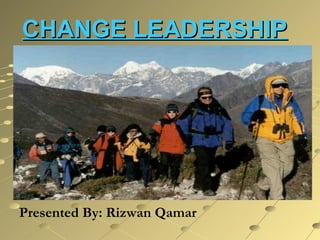


CHANGE LEADERSHIP

Presented By: Rizwan Qamar
INTRODUCTION
“Managers are people who do things right, while
leaders are people who do the right thing. - Warren
Bennis, On Becoming a leader”.
The Japanese have a term called "kaizen," which
means continual improvement. It is a never-ending
quest to do better. And you do better by changing.
Standing still allows your competitors to get ahead of
you.
CON…..
The Role of leaders in the change process does impact
significantly on the success of change (Kotter, 1990,
1996;Conner, 1992; Higgs and Rowland, 2001; Higgs,
2003)
“The leader driving the change through personal
involvement, persuasion and influence”.
(Hambrick 1996)
The leader building the capability to change in others.
(Conner, 1998)
LEADERSHIP COMPETENCY
FOR SUCCESSFUL CHANGE
IMPLEMENTATION
 Creating

the Case For Change

Creating Structural Change
 Engaging others
Implementation and Sustaining Changes
 Facilitating and Developing and Capability
NINE EMERGING THEMES
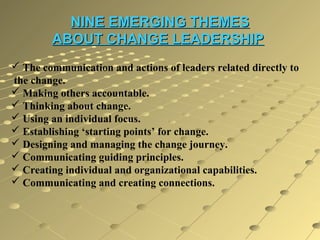
ABOUT CHANGE LEADERSHIP
 The communication and actions of leaders related directly to
the change.
 Making others accountable.
 Thinking about change.
 Using an individual focus.
 Establishing ‘starting points’ for change.
 Designing and managing the change journey.
 Communicating guiding principles.
 Creating individual and organizational capabilities.
 Communicating and creating connections.
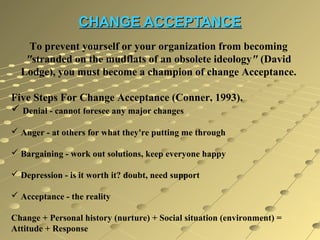
CHANGE ACCEPTANCE
To prevent yourself or your organization from becoming
"stranded on the mudflats of an obsolete ideology" (David
Lodge), you must become a champion of change Acceptance.
Five Steps For Change Acceptance (Conner, 1993).
 Denial - cannot foresee any major changes
 Anger - at others for what they're putting me through
 Bargaining - work out solutions, keep everyone happy
 Depression - is it worth it? doubt, need support
 Acceptance - the reality
Change + Personal history (nurture) + Social situation (environment) =
Attitude + Response
CON…
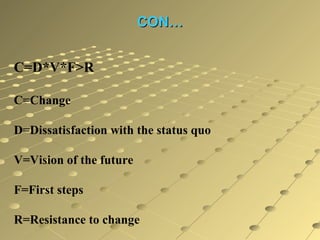
C=D*V*F>R
C=Change
D=Dissatisfaction with the status quo
V=Vision of the future
F=First steps
R=Resistance to change
JAWORSKI AND
SCHARMER (2000)
Identified Core Practices for success within this emergent view
of change.


Observing: Seeing reality with new eyes.

 Sensing: Turning the observed reality into emerging patterns
that inform future possibilities.
 Envisioning: Crystallizing vision and intent.
 Executing: Acting in an instant to capitalize on new
opportunities
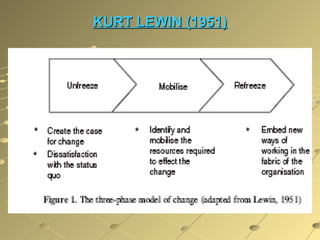
KURT LEWIN (1951)
LEADER ACHEIEVE THREE
MAJOR CHANGE RESULTS
Leader Maximize ROI and Results from Current
Change Efforts.
 CRM, ERP implementations, operational excellence, BPR, restructuring,

any systems change

Transform People and Culture.
 From distrust and victimization to full empowerment and engagement
CON….
Build Organization's Long-Term Change
Capability and Skill.
 Leader turns employee’s behavior and skills
 Build internal change consulting practice
 Establish own change methodology, customized to
organization’s needs
CHANGE & RESTRUCTURING
INITIATIVE (Case Study)
 Global

Bank of America
 National Bank of America
 In 1980 deregulation, consolidation and new technology
intensified the competition of retail banking
New technologies profoundly change the ways in which banks
conduct their business and interact with customers.

Global Bank CEO take initiative and restructuring the
organization.
 Start relationship banking and create relationship position
 Implement ATM Technology
 Telephone and Online Banking system
 External Recruiting for skilled employees and implement
new technology and services
CON…
 Training of new employees and semi skilled employees
 Job enrichment and simplification
 Segmentation and part time work of employees
 Establish complaint and investigation cells

National Bank of America CEO did not take timely
steps for change initiative
 National Bank of America one year later start ATM
technology & online banking system in 1981.
Employee turnover was 35%
They did not redesign the structure
Employee and customers dissatisfied with their services and
products
CON…
Global bank of America took the advantage of early mover
and got 25% higher market shares than National Bank of
America
 Employee turnover is less than the National Bank of America
 Employee and customers satisfied with their services and
products


National Bank of America learn two lessons
How to distribute timely new technology in workplace
 Employee should participate in new technology
implementation and should give better rewards to employees


Change Leadership

  • 2.
  • 3.
    INTRODUCTION “Managers are peoplewho do things right, while leaders are people who do the right thing. - Warren Bennis, On Becoming a leader”. The Japanese have a term called "kaizen," which means continual improvement. It is a never-ending quest to do better. And you do better by changing. Standing still allows your competitors to get ahead of you.
  • 4.
    CON….. The Role ofleaders in the change process does impact significantly on the success of change (Kotter, 1990, 1996;Conner, 1992; Higgs and Rowland, 2001; Higgs, 2003) “The leader driving the change through personal involvement, persuasion and influence”. (Hambrick 1996) The leader building the capability to change in others. (Conner, 1998)
  • 5.
    LEADERSHIP COMPETENCY FOR SUCCESSFULCHANGE IMPLEMENTATION  Creating the Case For Change Creating Structural Change  Engaging others Implementation and Sustaining Changes  Facilitating and Developing and Capability
  • 6.
    NINE EMERGING THEMES ABOUTCHANGE LEADERSHIP  The communication and actions of leaders related directly to the change.  Making others accountable.  Thinking about change.  Using an individual focus.  Establishing ‘starting points’ for change.  Designing and managing the change journey.  Communicating guiding principles.  Creating individual and organizational capabilities.  Communicating and creating connections.
  • 7.
    CHANGE ACCEPTANCE To preventyourself or your organization from becoming "stranded on the mudflats of an obsolete ideology" (David Lodge), you must become a champion of change Acceptance. Five Steps For Change Acceptance (Conner, 1993).  Denial - cannot foresee any major changes  Anger - at others for what they're putting me through  Bargaining - work out solutions, keep everyone happy  Depression - is it worth it? doubt, need support  Acceptance - the reality Change + Personal history (nurture) + Social situation (environment) = Attitude + Response
  • 8.
    CON… C=D*V*F>R C=Change D=Dissatisfaction with thestatus quo V=Vision of the future F=First steps R=Resistance to change
  • 9.
    JAWORSKI AND SCHARMER (2000) IdentifiedCore Practices for success within this emergent view of change.  Observing: Seeing reality with new eyes.  Sensing: Turning the observed reality into emerging patterns that inform future possibilities.  Envisioning: Crystallizing vision and intent.  Executing: Acting in an instant to capitalize on new opportunities
  • 10.
  • 11.
    LEADER ACHEIEVE THREE MAJORCHANGE RESULTS Leader Maximize ROI and Results from Current Change Efforts.  CRM, ERP implementations, operational excellence, BPR, restructuring, any systems change Transform People and Culture.  From distrust and victimization to full empowerment and engagement
  • 12.
    CON…. Build Organization's Long-TermChange Capability and Skill.  Leader turns employee’s behavior and skills  Build internal change consulting practice  Establish own change methodology, customized to organization’s needs
  • 13.
    CHANGE & RESTRUCTURING INITIATIVE(Case Study)  Global Bank of America  National Bank of America  In 1980 deregulation, consolidation and new technology intensified the competition of retail banking New technologies profoundly change the ways in which banks conduct their business and interact with customers. Global Bank CEO take initiative and restructuring the organization.  Start relationship banking and create relationship position  Implement ATM Technology  Telephone and Online Banking system  External Recruiting for skilled employees and implement new technology and services
  • 14.
    CON…  Training ofnew employees and semi skilled employees  Job enrichment and simplification  Segmentation and part time work of employees  Establish complaint and investigation cells National Bank of America CEO did not take timely steps for change initiative  National Bank of America one year later start ATM technology & online banking system in 1981. Employee turnover was 35% They did not redesign the structure Employee and customers dissatisfied with their services and products
  • 15.
    CON… Global bank ofAmerica took the advantage of early mover and got 25% higher market shares than National Bank of America  Employee turnover is less than the National Bank of America  Employee and customers satisfied with their services and products  National Bank of America learn two lessons How to distribute timely new technology in workplace  Employee should participate in new technology implementation and should give better rewards to employees 