Presented By :
VIVEK SINGH
ELECTRICAL & ELECTRONICS ENGINEERING
• INTRODUCTION
• VARIOUS COMPONENTS
• TURBINES
• GENERATORS
• ELECTRONIC LOAD CONTROLLER
• ADVANTAGES & DISADVANTAGES
• CONCLUSION
 Micro-hydro power is a type of Hydro
electric power that typically produced up to 100
kW of electricity using the natural flow of water.
These type of power plant can provide power to
an isolated home or a small community. Micro-
hydro system complement solar energy because
in many areas in winter the water flow is
maximum and solar energy is minimum. In such
areas micro-hydro power is used along with
photo voltaic solar energy.
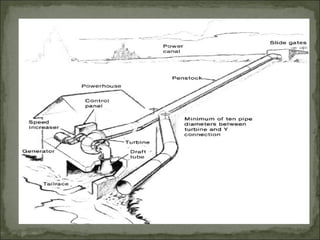
Construction of a Micro-hydro power plant is
site specific. It is made up of a number of
components. Some of them are……
 Intake
 Canal
 Penstock
 Turbine
 Generator
 Controlling unit
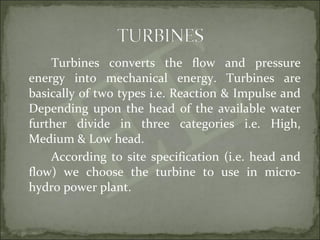
Turbines converts the flow and pressure
energy into mechanical energy. Turbines are
basically of two types i.e. Reaction & Impulse and
Depending upon the head of the available water
further divide in three categories i.e. High,
Medium & Low head.
According to site specification (i.e. head and
flow) we choose the turbine to use in micro-
hydro power plant.
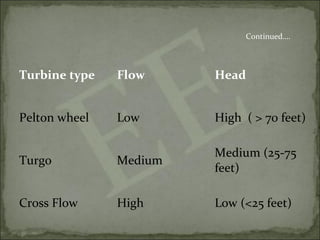
Turbine type Flow Head
Pelton wheel Low High ( > 70 feet)
Turgo Medium
Medium (25-75
feet)
Cross Flow High Low (<25 feet)
Continued….
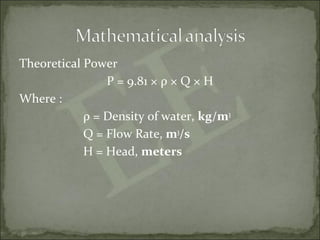
Theoretical Power
P = 9.81 × ρ × Q × H
Where :
ρ = Density of water, kg/m3
Q = Flow Rate, m3
/s
H = Head, meters
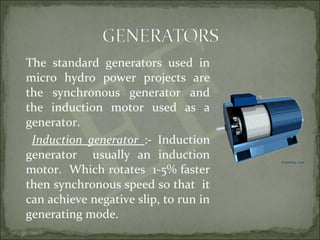
The standard generators used in
micro hydro power projects are
the synchronous generator and
the induction motor used as a
generator.
Induction generator :- Induction
generator usually an induction
motor. Which rotates 1-5% faster
then synchronous speed so that it
can achieve negative slip, to run in
generating mode.
Synchronous generator :- Salient pole
Synchronous generator or alternator are used in
micro-hydro projects. These generator supplies
its own excitation through rectifier or external
batteries system can be used for excitation.
Some times industrial pumps (i.e.
centrifugal) are use as generator.
Continued…
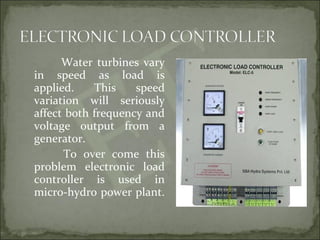
Water turbines vary
in speed as load is
applied. This speed
variation will seriously
affect both frequency and
voltage output from a
generator.
To over come this
problem electronic load
controller is used in
micro-hydro power plant.
The ELC prevents speed variations by
continuously adding or subtracting an artificial
load, so that the generator is working permanently
under full load.
A further benefit is that the ELC has no
moving parts, it is very reliable and maintenance
free.
Continued….
 Economic energy source.
 No reservoir required.
 Utilize natural flow of water.
 No harmful effect on surrounding.
 No costly equipment used.
 Low power generation during summer
months.
 Suitable site characteristics required.
 Efficiency is low .
New computerized control systems and
improved turbines may allow more electricity to
be generated from existing facilities in the future.
Small scale and low head hydro capacity will
probably increase in the future. Low head
turbines, and standardized turbine production,
lowers the costs of hydro-electric power at sites
with low heads.
Micro-hydro power plant is an important part of
world’s electricity supply. Specially in remote areas it
is providing reliable and economic source of
electricity.
As no fossil fuel required in hydro power plant, it
can help to save other source of energy.
 http://www.microhydropower.net
 http://www.ieee.org
 BOOKS.
 Micro Hydro Power Handbook vol. 1,2
by. J. D. McKinney & Prof. C. C. Warnick
 Power Plant Engg. by. P. K. NAG
 Electrical Machinery by, Dr. P. S.
Bimbhra
Micro hydro power plant final 1

Micro hydro power plant final 1

  • 1.
    Presented By : VIVEKSINGH ELECTRICAL & ELECTRONICS ENGINEERING
  • 2.
    • INTRODUCTION • VARIOUSCOMPONENTS • TURBINES • GENERATORS • ELECTRONIC LOAD CONTROLLER • ADVANTAGES & DISADVANTAGES • CONCLUSION
  • 3.
     Micro-hydro poweris a type of Hydro electric power that typically produced up to 100 kW of electricity using the natural flow of water. These type of power plant can provide power to an isolated home or a small community. Micro- hydro system complement solar energy because in many areas in winter the water flow is maximum and solar energy is minimum. In such areas micro-hydro power is used along with photo voltaic solar energy.
  • 4.
    Construction of aMicro-hydro power plant is site specific. It is made up of a number of components. Some of them are……  Intake  Canal  Penstock  Turbine  Generator  Controlling unit
  • 6.
    Turbines converts theflow and pressure energy into mechanical energy. Turbines are basically of two types i.e. Reaction & Impulse and Depending upon the head of the available water further divide in three categories i.e. High, Medium & Low head. According to site specification (i.e. head and flow) we choose the turbine to use in micro- hydro power plant.
  • 7.
    Turbine type FlowHead Pelton wheel Low High ( > 70 feet) Turgo Medium Medium (25-75 feet) Cross Flow High Low (<25 feet) Continued….
  • 8.
    Theoretical Power P =9.81 × ρ × Q × H Where : ρ = Density of water, kg/m3 Q = Flow Rate, m3 /s H = Head, meters
  • 9.
    The standard generatorsused in micro hydro power projects are the synchronous generator and the induction motor used as a generator. Induction generator :- Induction generator usually an induction motor. Which rotates 1-5% faster then synchronous speed so that it can achieve negative slip, to run in generating mode.
  • 10.
    Synchronous generator :-Salient pole Synchronous generator or alternator are used in micro-hydro projects. These generator supplies its own excitation through rectifier or external batteries system can be used for excitation. Some times industrial pumps (i.e. centrifugal) are use as generator. Continued…
  • 11.
    Water turbines vary inspeed as load is applied. This speed variation will seriously affect both frequency and voltage output from a generator. To over come this problem electronic load controller is used in micro-hydro power plant.
  • 12.
    The ELC preventsspeed variations by continuously adding or subtracting an artificial load, so that the generator is working permanently under full load. A further benefit is that the ELC has no moving parts, it is very reliable and maintenance free. Continued….
  • 14.
     Economic energysource.  No reservoir required.  Utilize natural flow of water.  No harmful effect on surrounding.  No costly equipment used.  Low power generation during summer months.  Suitable site characteristics required.  Efficiency is low .
  • 15.
    New computerized controlsystems and improved turbines may allow more electricity to be generated from existing facilities in the future. Small scale and low head hydro capacity will probably increase in the future. Low head turbines, and standardized turbine production, lowers the costs of hydro-electric power at sites with low heads.
  • 16.
    Micro-hydro power plantis an important part of world’s electricity supply. Specially in remote areas it is providing reliable and economic source of electricity. As no fossil fuel required in hydro power plant, it can help to save other source of energy.
  • 17.
     http://www.microhydropower.net  http://www.ieee.org BOOKS.  Micro Hydro Power Handbook vol. 1,2 by. J. D. McKinney & Prof. C. C. Warnick  Power Plant Engg. by. P. K. NAG  Electrical Machinery by, Dr. P. S. Bimbhra