20‐Sep‐13
1
Thyroid gland:
structure and function
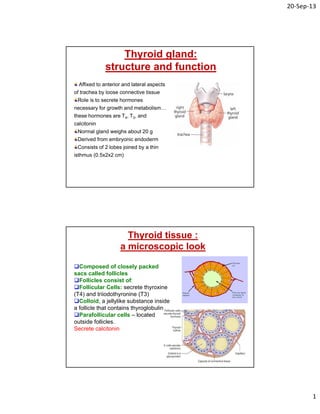
Affixed to anterior and lateral aspects
of trachea by loose connective tissue
Role is to secrete hormones
necessary for growth and metabolism…
these hormones are T4, T3, and
calcitonin
Normal gland weighs about 20 g
Derived from embryonic endoderm
Consists of 2 lobes joined by a thin
isthmus (0.5x2x2 cm)
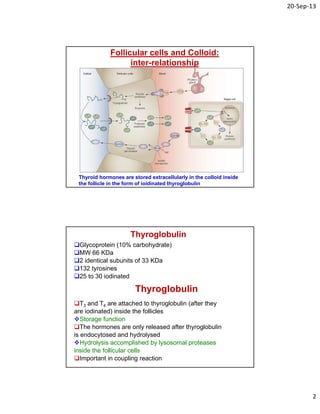
Thyroid tissue :
a microscopic look
Composed of closely packed
sacs called follicles
Follicles consist of:
Follicular Cells: secrete thyroxine
(T4) and triiodothyronine (T3)
Colloid, a jellylike substance inside
a follicle that contains thyroglobulin
Parafollicular cells – located
outside follicles.
Secrete calcitonin
20‐Sep‐13
2
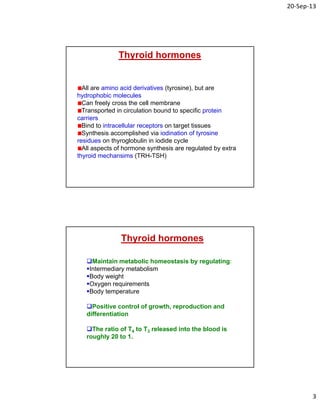
Thyroid hormones are stored extracellularly in the colloid inside
the follicle in the form of ioidinated thyroglobulin
Follicular cells and Colloid:
inter-relationship
Glycoprotein (10% carbohydrate)
MW 66 KDa
2 identical subunits of 33 KDa
132 tyrosines
25 to 30 iodinated
Thyroglobulin
T3 and T4 are attached to thyroglobulin (after they
are iodinated) inside the follicles
Storage function
The hormones are only released after thyroglobulin
is endocytosed and hydrolysed
Hydrolysis accomplished by lysosomal proteases
inside the follicular cells
Important in coupling reaction
Thyroglobulin
20‐Sep‐13
3
All are amino acid derivatives (tyrosine), but are
hydrophobic molecules
Can freely cross the cell membrane
Transported in circulation bound to specific protein
carriers
Bind to intracellular receptors on target tissues
Synthesis accomplished via iodination of tyrosine
residues on thyroglobulin in iodide cycle
All aspects of hormone synthesis are regulated by extra
thyroid mechansims (TRH-TSH)
Thyroid hormones
Maintain metabolic homeostasis by regulating:
Intermediary metabolism
Body weight
Oxygen requirements
Body temperature
Positive control of growth, reproduction and
differentiation
The ratio of T4 to T3 released into the blood is
roughly 20 to 1.
Thyroid hormones
20‐Sep‐13
4
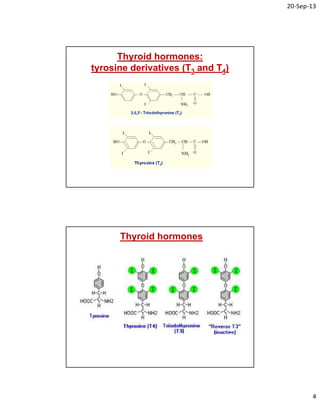
Thyroid hormones:
tyrosine derivatives (T3 and T4)
Thyroid hormones
20‐Sep‐13
5
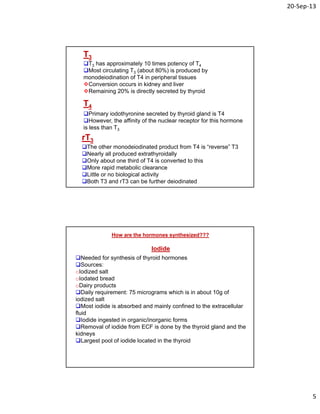
T3 has approximately 10 times potency of T4
Most circulating T3 (about 80%) is produced by
monodeiodination of T4 in peripheral tissues
Conversion occurs in kidney and liver
Remaining 20% is directly secreted by thyroid
Primary iodothyronine secreted by thyroid gland is T4
However, the affinity of the nuclear receptor for this hormone
is less than T3
The other monodeiodinated product from T4 is “reverse” T3
Nearly all produced extrathyroidally
Only about one third of T4 is converted to this
More rapid metabolic clearance
Little or no biological activity
Both T3 and rT3 can be further deiodinated
T3
T4
rT3
Needed for synthesis of thyroid hormones
Sources:
oIodized salt
oIodated bread
oDairy products
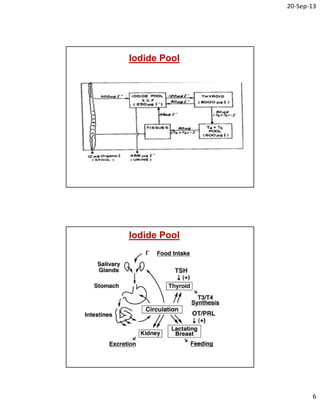
Daily requirement: 75 micrograms which is in about 10g of
iodized salt
Most iodide is absorbed and mainly confined to the extracellular
fluid
Iodide ingested in organic/inorganic forms
Removal of iodide from ECF is done by the thyroid gland and the
kidneys
Largest pool of iodide located in the thyroid
Iodide
How are the hormones synthesized???
20‐Sep‐13
6
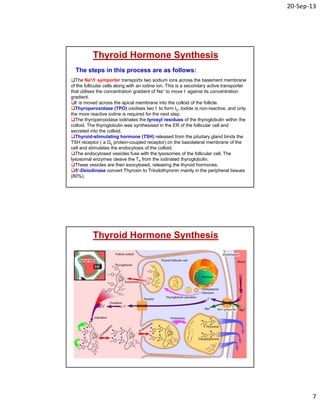
Iodide Pool
Iodide Pool
20‐Sep‐13
7
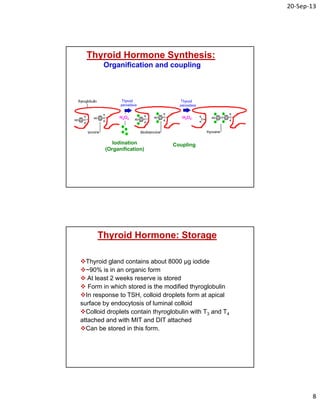
The Na+/I- symporter transports two sodium ions across the basement membrane
of the follicular cells along with an iodine ion. This is a secondary active transporter
that utilises the concentration gradient of Na+ to move I- against its concentration
gradient.
I- is moved across the apical membrane into the colloid of the follicle.
Thyroperoxidase (TPO) oxidises two I- to form I2. Iodide is non-reactive, and only
the more reactive iodine is required for the next step.
The thyroperoxidase iodinates the tyrosyl residues of the thyroglobulin within the
colloid. The thyroglobulin was synthesised in the ER of the follicular cell and
secreted into the colloid.
Thyroid-stimulating hormone (TSH) released from the pituitary gland binds the
TSH receptor ( a Gs protein-coupled receptor) on the basolateral membrane of the
cell and stimulates the endocytosis of the colloid.
The endocytosed vesicles fuse with the lysosomes of the follicular cell. The
lysosomal enzymes cleave the T4 from the iodinated thyroglobulin.
These vesicles are then exocytosed, releasing the thyroid hormones.
5’-Deiodinase convert Thyroxin to Triiodothyronin mainly in the peripheral tissues
(80%).
Thyroid Hormone Synthesis
The steps in this process are as follows:
Thyroid Hormone Synthesis
20‐Sep‐13
8
Thyroid Hormone Synthesis:
Organification and coupling
Iodination
(Organification)
Coupling
H2O2 H2O2
Thyroid gland contains about 8000 μg iodide
~90% is in an organic form
 At least 2 weeks reserve is stored
 Form in which stored is the modified thyroglobulin
In response to TSH, colloid droplets form at apical
surface by endocytosis of luminal colloid
Colloid droplets contain thyroglobulin with T3 and T4
attached and with MIT and DIT attached
Can be stored in this form.
Thyroid Hormone: Storage
20‐Sep‐13
9
Thyroid Hormone
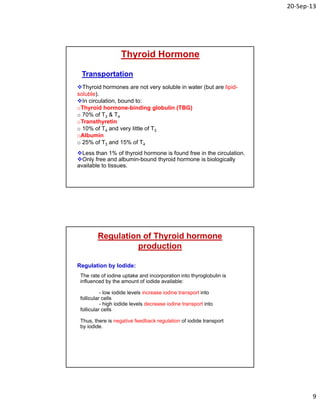
Transportation
Thyroid hormones are not very soluble in water (but are lipid-
soluble).
In circulation, bound to:
oThyroid hormone-binding globulin (TBG)
o 70% of T3 & T4
oTransthyretin
o 10% of T4 and very little of T3
oAlbumin
o 25% of T3 and 15% of T4
Less than 1% of thyroid hormone is found free in the circulation.
Only free and albumin-bound thyroid hormone is biologically
available to tissues.
Regulation of Thyroid hormone
production
Regulation by Iodide:
The rate of iodine uptake and incorporation into thyroglobulin is
influenced by the amount of iodide available:
- low iodide levels increase iodine transport into
follicular cells
- high iodide levels decrease iodine transport into
follicular cells
Thus, there is negative feedback regulation of iodide transport
by iodide.
20‐Sep‐13
10
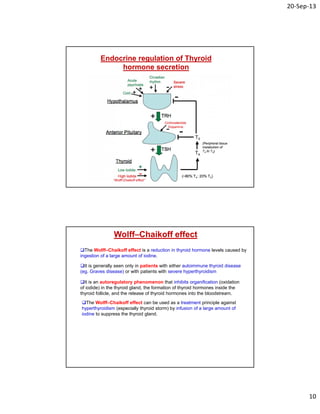
Endocrine regulation of Thyroid
hormone secretion
Wolff–Chaikoff effect
The Wolff–Chaikoff effect is a reduction in thyroid hormone levels caused by
ingestion of a large amount of iodine.
It is generally seen only in patients with either autoimmune thyroid disease
(eg. Graves disease) or with patients with severe hyperthyroidism
It is an autoregulatory phenomenon that inhibits organification (oxidation
of iodide) in the thyroid gland, the formation of thyroid hormones inside the
thyroid follicle, and the release of thyroid hormones into the bloodstream.
The Wolff–Chaikoff effect can be used as a treatment principle against
hyperthyroidism (especially thyroid storm) by infusion of a large amount of
iodine to suppress the thyroid gland.
20‐Sep‐13
11
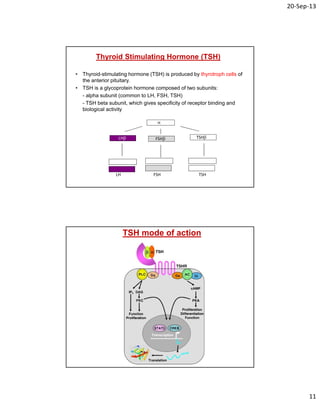
Thyroid Stimulating Hormone (TSH)
• Thyroid-stimulating hormone (TSH) is produced by thyrotroph cells of
the anterior pituitary.
• TSH is a glycoprotein hormone composed of two subunits:
- alpha subunit (common to LH, FSH, TSH)
- TSH beta subunit, which gives specificity of receptor binding and
biological activity

LH FSH TSH
LH                   FSH                    TSH
TSH mode of action
20‐Sep‐13
12
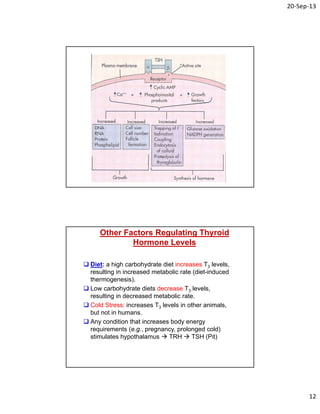
Other Factors Regulating Thyroid
Hormone Levels
 Diet: a high carbohydrate diet increases T3 levels,
resulting in increased metabolic rate (diet-induced
thermogenesis).
 Low carbohydrate diets decrease T3 levels,
resulting in decreased metabolic rate.
 Cold Stress: increases T3 levels in other animals,
but not in humans.
 Any condition that increases body energy
requirements (e.g., pregnancy, prolonged cold)
stimulates hypothalamus  TRH  TSH (Pit)
20‐Sep‐13
13
Actions of Thyroid Hormones
 Thyroid hormones are essential for normal growth of tissues,
including the nervous system.
 Lack of thyroid hormone during development results in short
stature and mental deficits (cretinism).
 Thyroid hormone stimulates basal metabolic rate.
 Required for GH and prolactin production and secretion
 Required for GH action
 Increases intestinal glucose reabsorption (glucose transporter)
 Increases mitochondrial oxidative phosphorylation (ATP
production)
One Major Target Gene of T3: The Na+/K+
ATPase Pump
Pumps sodium and potassium across cell
membranes to maintain resting membrane potential
Activity of the Na+/K+ pump uses up energy, in the
form of ATP
About 1/3 of all ATP in the body is used by the Na+/K+
ATPase
T3 increases the synthesis of Na+/K+ pumps,
markedly increasing ATP consumption.
T3 also acts on mitochondria to increase ATP
synthesis
The resulting increased metabolic rate increases
thermogenesis (heat production).
20‐Sep‐13
14
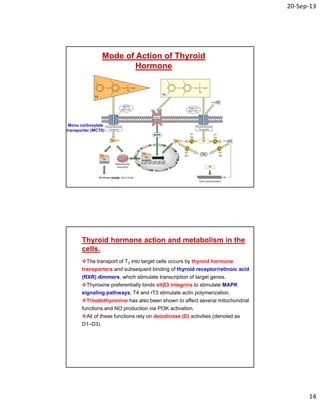
Mode of Action of Thyroid
Hormone
Mono carboxylate
transporter (MCT8)
The transport of T3 into target cells occurs by thyroid hormone
transporters and subsequent binding of thyroid receptor/retinoic acid
(RXR) dimmers, which stimulate transcription of target genes.
Thyroxine preferentially binds αVβ3 integrins to stimulate MAPK
signaling pathways; T4 and rT3 stimulate actin polymerization.
Triiodothyronine has also been shown to affect several mitochondrial
functions and NO production via PI3K activation.
All of these functions rely on deiodinase (D) activities (denoted as
D1–D3).
Thyroid hormone action and metabolism in the
cells.
20‐Sep‐13
15
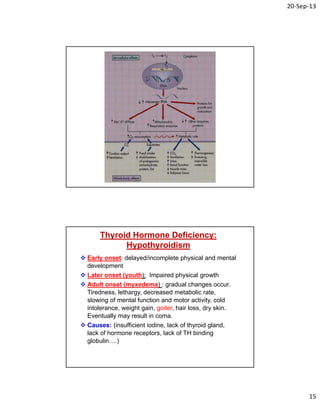
Thyroid Hormone Deficiency:
Hypothyroidism
 Early onset: delayed/incomplete physical and mental
development
 Later onset (youth): Impaired physical growth
 Adult onset (myxedema) : gradual changes occur.
Tiredness, lethargy, decreased metabolic rate,
slowing of mental function and motor activity, cold
intolerance, weight gain, goiter, hair loss, dry skin.
Eventually may result in coma.
 Causes: (insufficient iodine, lack of thyroid gland,
lack of hormone receptors, lack of TH binding
globulin….)
20‐Sep‐13
16
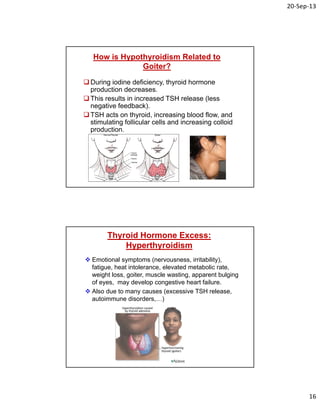
How is Hypothyroidism Related to
Goiter?
During iodine deficiency, thyroid hormone
production decreases.
This results in increased TSH release (less
negative feedback).
TSH acts on thyroid, increasing blood flow, and
stimulating follicular cells and increasing colloid
production.
Thyroid Hormone Excess:
Hyperthyroidism
 Emotional symptoms (nervousness, irritability),
fatigue, heat intolerance, elevated metabolic rate,
weight loss, goiter, muscle wasting, apparent bulging
of eyes, may develop congestive heart failure.
 Also due to many causes (excessive TSH release,
autoimmune disorders,…)

Thyroid hormone

  • 1.
    20‐Sep‐13 1 Thyroid gland: structure andfunction Affixed to anterior and lateral aspects of trachea by loose connective tissue Role is to secrete hormones necessary for growth and metabolism… these hormones are T4, T3, and calcitonin Normal gland weighs about 20 g Derived from embryonic endoderm Consists of 2 lobes joined by a thin isthmus (0.5x2x2 cm) Thyroid tissue : a microscopic look Composed of closely packed sacs called follicles Follicles consist of: Follicular Cells: secrete thyroxine (T4) and triiodothyronine (T3) Colloid, a jellylike substance inside a follicle that contains thyroglobulin Parafollicular cells – located outside follicles. Secrete calcitonin
  • 2.
    20‐Sep‐13 2 Thyroid hormones arestored extracellularly in the colloid inside the follicle in the form of ioidinated thyroglobulin Follicular cells and Colloid: inter-relationship Glycoprotein (10% carbohydrate) MW 66 KDa 2 identical subunits of 33 KDa 132 tyrosines 25 to 30 iodinated Thyroglobulin T3 and T4 are attached to thyroglobulin (after they are iodinated) inside the follicles Storage function The hormones are only released after thyroglobulin is endocytosed and hydrolysed Hydrolysis accomplished by lysosomal proteases inside the follicular cells Important in coupling reaction Thyroglobulin
  • 3.
    20‐Sep‐13 3 All are aminoacid derivatives (tyrosine), but are hydrophobic molecules Can freely cross the cell membrane Transported in circulation bound to specific protein carriers Bind to intracellular receptors on target tissues Synthesis accomplished via iodination of tyrosine residues on thyroglobulin in iodide cycle All aspects of hormone synthesis are regulated by extra thyroid mechansims (TRH-TSH) Thyroid hormones Maintain metabolic homeostasis by regulating: Intermediary metabolism Body weight Oxygen requirements Body temperature Positive control of growth, reproduction and differentiation The ratio of T4 to T3 released into the blood is roughly 20 to 1. Thyroid hormones
  • 4.
  • 5.
    20‐Sep‐13 5 T3 has approximately10 times potency of T4 Most circulating T3 (about 80%) is produced by monodeiodination of T4 in peripheral tissues Conversion occurs in kidney and liver Remaining 20% is directly secreted by thyroid Primary iodothyronine secreted by thyroid gland is T4 However, the affinity of the nuclear receptor for this hormone is less than T3 The other monodeiodinated product from T4 is “reverse” T3 Nearly all produced extrathyroidally Only about one third of T4 is converted to this More rapid metabolic clearance Little or no biological activity Both T3 and rT3 can be further deiodinated T3 T4 rT3 Needed for synthesis of thyroid hormones Sources: oIodized salt oIodated bread oDairy products Daily requirement: 75 micrograms which is in about 10g of iodized salt Most iodide is absorbed and mainly confined to the extracellular fluid Iodide ingested in organic/inorganic forms Removal of iodide from ECF is done by the thyroid gland and the kidneys Largest pool of iodide located in the thyroid Iodide How are the hormones synthesized???
  • 6.
  • 7.
    20‐Sep‐13 7 The Na+/I- symportertransports two sodium ions across the basement membrane of the follicular cells along with an iodine ion. This is a secondary active transporter that utilises the concentration gradient of Na+ to move I- against its concentration gradient. I- is moved across the apical membrane into the colloid of the follicle. Thyroperoxidase (TPO) oxidises two I- to form I2. Iodide is non-reactive, and only the more reactive iodine is required for the next step. The thyroperoxidase iodinates the tyrosyl residues of the thyroglobulin within the colloid. The thyroglobulin was synthesised in the ER of the follicular cell and secreted into the colloid. Thyroid-stimulating hormone (TSH) released from the pituitary gland binds the TSH receptor ( a Gs protein-coupled receptor) on the basolateral membrane of the cell and stimulates the endocytosis of the colloid. The endocytosed vesicles fuse with the lysosomes of the follicular cell. The lysosomal enzymes cleave the T4 from the iodinated thyroglobulin. These vesicles are then exocytosed, releasing the thyroid hormones. 5’-Deiodinase convert Thyroxin to Triiodothyronin mainly in the peripheral tissues (80%). Thyroid Hormone Synthesis The steps in this process are as follows: Thyroid Hormone Synthesis
  • 8.
    20‐Sep‐13 8 Thyroid Hormone Synthesis: Organificationand coupling Iodination (Organification) Coupling H2O2 H2O2 Thyroid gland contains about 8000 μg iodide ~90% is in an organic form  At least 2 weeks reserve is stored  Form in which stored is the modified thyroglobulin In response to TSH, colloid droplets form at apical surface by endocytosis of luminal colloid Colloid droplets contain thyroglobulin with T3 and T4 attached and with MIT and DIT attached Can be stored in this form. Thyroid Hormone: Storage
  • 9.
    20‐Sep‐13 9 Thyroid Hormone Transportation Thyroid hormonesare not very soluble in water (but are lipid- soluble). In circulation, bound to: oThyroid hormone-binding globulin (TBG) o 70% of T3 & T4 oTransthyretin o 10% of T4 and very little of T3 oAlbumin o 25% of T3 and 15% of T4 Less than 1% of thyroid hormone is found free in the circulation. Only free and albumin-bound thyroid hormone is biologically available to tissues. Regulation of Thyroid hormone production Regulation by Iodide: The rate of iodine uptake and incorporation into thyroglobulin is influenced by the amount of iodide available: - low iodide levels increase iodine transport into follicular cells - high iodide levels decrease iodine transport into follicular cells Thus, there is negative feedback regulation of iodide transport by iodide.
  • 10.
    20‐Sep‐13 10 Endocrine regulation ofThyroid hormone secretion Wolff–Chaikoff effect The Wolff–Chaikoff effect is a reduction in thyroid hormone levels caused by ingestion of a large amount of iodine. It is generally seen only in patients with either autoimmune thyroid disease (eg. Graves disease) or with patients with severe hyperthyroidism It is an autoregulatory phenomenon that inhibits organification (oxidation of iodide) in the thyroid gland, the formation of thyroid hormones inside the thyroid follicle, and the release of thyroid hormones into the bloodstream. The Wolff–Chaikoff effect can be used as a treatment principle against hyperthyroidism (especially thyroid storm) by infusion of a large amount of iodine to suppress the thyroid gland.
  • 11.
    20‐Sep‐13 11 Thyroid Stimulating Hormone(TSH) • Thyroid-stimulating hormone (TSH) is produced by thyrotroph cells of the anterior pituitary. • TSH is a glycoprotein hormone composed of two subunits: - alpha subunit (common to LH, FSH, TSH) - TSH beta subunit, which gives specificity of receptor binding and biological activity  LH FSH TSH LH                   FSH                    TSH TSH mode of action
  • 12.
    20‐Sep‐13 12 Other Factors RegulatingThyroid Hormone Levels  Diet: a high carbohydrate diet increases T3 levels, resulting in increased metabolic rate (diet-induced thermogenesis).  Low carbohydrate diets decrease T3 levels, resulting in decreased metabolic rate.  Cold Stress: increases T3 levels in other animals, but not in humans.  Any condition that increases body energy requirements (e.g., pregnancy, prolonged cold) stimulates hypothalamus  TRH  TSH (Pit)
  • 13.
    20‐Sep‐13 13 Actions of ThyroidHormones  Thyroid hormones are essential for normal growth of tissues, including the nervous system.  Lack of thyroid hormone during development results in short stature and mental deficits (cretinism).  Thyroid hormone stimulates basal metabolic rate.  Required for GH and prolactin production and secretion  Required for GH action  Increases intestinal glucose reabsorption (glucose transporter)  Increases mitochondrial oxidative phosphorylation (ATP production) One Major Target Gene of T3: The Na+/K+ ATPase Pump Pumps sodium and potassium across cell membranes to maintain resting membrane potential Activity of the Na+/K+ pump uses up energy, in the form of ATP About 1/3 of all ATP in the body is used by the Na+/K+ ATPase T3 increases the synthesis of Na+/K+ pumps, markedly increasing ATP consumption. T3 also acts on mitochondria to increase ATP synthesis The resulting increased metabolic rate increases thermogenesis (heat production).
  • 14.
    20‐Sep‐13 14 Mode of Actionof Thyroid Hormone Mono carboxylate transporter (MCT8) The transport of T3 into target cells occurs by thyroid hormone transporters and subsequent binding of thyroid receptor/retinoic acid (RXR) dimmers, which stimulate transcription of target genes. Thyroxine preferentially binds αVβ3 integrins to stimulate MAPK signaling pathways; T4 and rT3 stimulate actin polymerization. Triiodothyronine has also been shown to affect several mitochondrial functions and NO production via PI3K activation. All of these functions rely on deiodinase (D) activities (denoted as D1–D3). Thyroid hormone action and metabolism in the cells.
  • 15.
    20‐Sep‐13 15 Thyroid Hormone Deficiency: Hypothyroidism Early onset: delayed/incomplete physical and mental development  Later onset (youth): Impaired physical growth  Adult onset (myxedema) : gradual changes occur. Tiredness, lethargy, decreased metabolic rate, slowing of mental function and motor activity, cold intolerance, weight gain, goiter, hair loss, dry skin. Eventually may result in coma.  Causes: (insufficient iodine, lack of thyroid gland, lack of hormone receptors, lack of TH binding globulin….)
  • 16.
    20‐Sep‐13 16 How is HypothyroidismRelated to Goiter? During iodine deficiency, thyroid hormone production decreases. This results in increased TSH release (less negative feedback). TSH acts on thyroid, increasing blood flow, and stimulating follicular cells and increasing colloid production. Thyroid Hormone Excess: Hyperthyroidism  Emotional symptoms (nervousness, irritability), fatigue, heat intolerance, elevated metabolic rate, weight loss, goiter, muscle wasting, apparent bulging of eyes, may develop congestive heart failure.  Also due to many causes (excessive TSH release, autoimmune disorders,…)