K.G. ARTS & SCIENCE COLLEGE RAIGARH
(C.G.)
YEAR - 2019-20
DEPARMENT OF ZOOLOGY & RESEARCH CENTER
SUBJECT :- ENDOCRINOLOGY
SEMINAR TOPIC:- THYROID GLAND
GUIDED BY:- SUBMITTED BY:-
PROF. RANJANA SAHU MAM. SURENDRA PATEL
M.SC SEM I
THE THYROID
GLAND
SYNOPSIS :-
1. INTRODUCTION
2. HISTORY
3. ORIGIN
4. LOCATION
5. STRUCTURE
6. MICROANATOMY
7. THYROID HORMONS
8. BIOCHEMISTRY OF THYROID HORMONE.
9. IODINE AND IT’S UPTAKE
10. SYNTHESIS OF THYROID HORMONE.
11. TRANSPORT AND REGULATION
12. MECHANISM OF ACTION
13. FUNCTION OF THYROID HORMONE.
14. DISORDERS
15. CONCLUSION
16. REFERENCE.
INTRODUCTION
The thyroid gland is largest gland of the body. The thyroid gland, or simply
the thyroid, is an endocrine gland in he neck, consisting of two lobes
connected by an isthmus. It is found at the front of the neck, below the adam's
apple. The thyroid gland secretes three hormones , namely the two thyroid
hormones (thyroxine/T4 and
Triiodothyronine/T3) and calcitonin. The thyroid hormones primarily influence
the metabolic rate and protein synthesis, but they also have many other
effects, including effects on development. Calcitonin plays a role in calcium
homeostasis.
HISTORY
French chemist Bernard Courtois discovered iodine in 1811, and in 1896 Eugen
Baumann documented it as the central ingredient in the thyroid gland. He did
this by boiling the thyroid glands of a thousand sheep, and named the
precipitate, a combination of the thyroid hormones, 'iodothyrin'. David
marine in 1907 proved that iodine is necessary for thyroid function. Thyroxine
itself was first isolated in 1914 and synthesized in 1927, and tri-iodothyroxine
in 1952. The conversion of T4 to T3 was discovered in 1970.
The process of discovering TSH took place over the early to mid twentieth
century. TRH was discovered by polish endocrinologist Andrew Schally in 1970,
contributing in part to his Nobel prize in medicine in 1977.
ORIGIN
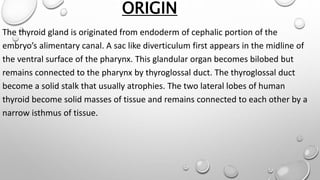
The thyroid gland is originated from endoderm of cephalic portion of the
embryo’s alimentary canal. A sac like diverticulum first appears in the midline of
the ventral surface of the pharynx. This glandular organ becomes bilobed but
remains connected to the pharynx by thyroglossal duct. The thyroglossal duct
become a solid stalk that usually atrophies. The two lateral lobes of human
thyroid become solid masses of tissue and remains connected to each other by a
narrow isthmus of tissue.
LOCATION
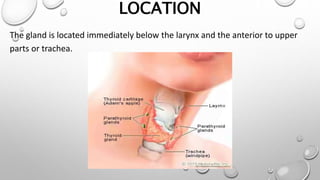
The gland is located immediately below the larynx and the anterior to upper
parts or trachea.
STRUCTURE
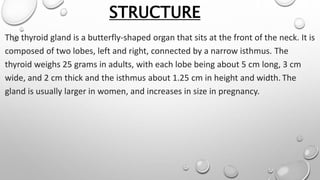
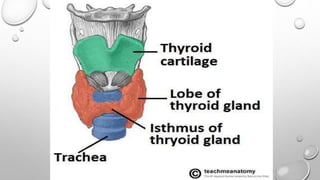
The thyroid gland is a butterfly-shaped organ that sits at the front of the neck. It is
composed of two lobes, left and right, connected by a narrow isthmus. The
thyroid weighs 25 grams in adults, with each lobe being about 5 cm long, 3 cm
wide, and 2 cm thick and the isthmus about 1.25 cm in height and width. The
gland is usually larger in women, and increases in size in pregnancy.
MICROANATOMY
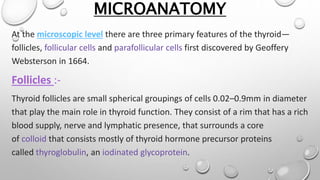
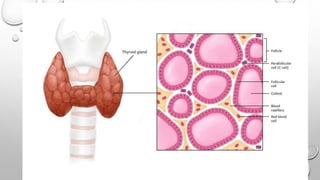
At the microscopic level there are three primary features of the thyroid—
follicles, follicular cells and parafollicular cells first discovered by Geoffery
Websterson in 1664.
Follicles :-
Thyroid follicles are small spherical groupings of cells 0.02–0.9mm in diameter
that play the main role in thyroid function. They consist of a rim that has a rich
blood supply, nerve and lymphatic presence, that surrounds a core
of colloid that consists mostly of thyroid hormone precursor proteins
called thyroglobulin, an iodinated glycoprotein.
Follicular cells :-
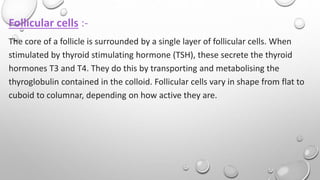
The core of a follicle is surrounded by a single layer of follicular cells. When
stimulated by thyroid stimulating hormone (TSH), these secrete the thyroid
hormones T3 and T4. They do this by transporting and metabolising the
thyroglobulin contained in the colloid. Follicular cells vary in shape from flat to
cuboid to columnar, depending on how active they are.
Parafollicular cells:-
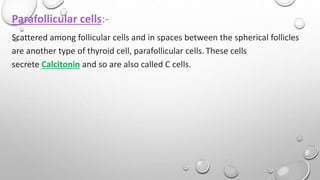
Scattered among follicular cells and in spaces between the spherical follicles
are another type of thyroid cell, parafollicular cells. These cells
secrete Calcitonin and so are also called C cells.
THYROID HORMONES
The primary function of the thyroid gland is the production of iodine
containing thyroid hormones. T3 and T4 and the peptide hormone calcitonin.
T3 :- it contains three atoms of iodine per molecules secreted by follicular
cells.
T4 :- it contains four atoms of iodine per molecules and also secreted by
follicular cells.
Difference between T3 and T4 :-
● thyroid secret about 80-90 microgram of T4 but only 5 to 10 microgram of
T3 per day.
● T3 is 10x greater biological activity than t4.
Calcitonin :- produced by parafollicular cells. Antagonist to parathyroid
hormone.
BIOCHEMISTRY OF THYROID
HORMONE
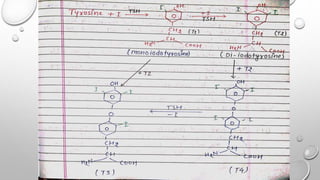
Iodine + tyrosine = thyroxine hormone
• Iodine trap by follicular cell.
• Synthesis of thyroglobulin a glycoprotein containing tyrosine residue for
hormone synthesis.
• Binding of inorganic iodine to tyrosine residue in thyroglobulin.
• Synthesis of t3 and t4 from iodinated tyrosine.
• Storage of thyroglobulin containing the thyroid hormone in the lumen of the
follicles.
• Engulfing of the colloid bye follicular cells and hydrolysis of thyroglobulin to
release thyroid hormone.
• Diffusion of t3 and t4 into the general circulation and their transport of target
cell.
• Mechanism of action :-
IODINE AND ITS UPTAKE
• Iodine is a raw material essential for thyroid hormone synthesis.
• Ingested iodine is converted to iodide and absorbed.
• The basal membrane of thyroid gland has the specific ability to pump the
iodine actively in the interior of the cell.
• Iodine trapping is stimulated by TSH.
SYNTHESIS OF THYROID
HORMONE
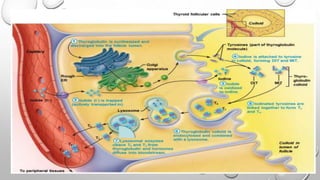
• Thyroid hormone stores their hormones extracellularly.
• Thyroglobulin synthesized and change into follicle lumen.
• Iodide actively taken into cell and the released into lumen.
• Iodide oxidised to iodine.
• Iodine attach to tyrosine, mediated by peroxide enzyme.
• Iodinated tyrosine link together to form T3 and T4.
• Colloid is endocytosed and combined with lysosome.
• T3 and T4 are cleaved and diffuse into blood stream.
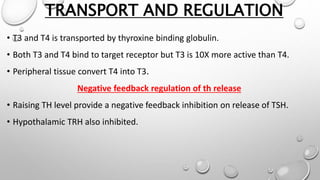
TRANSPORT AND REGULATION
• T3 and T4 is transported by thyroxine binding globulin.
• Both T3 and T4 bind to target receptor but T3 is 10X more active than T4.
• Peripheral tissue convert T4 into T3.
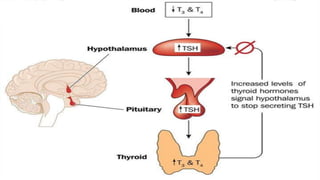
Negative feedback regulation of th release
• Raising TH level provide a negative feedback inhibition on release of TSH.
• Hypothalamic TRH also inhibited.
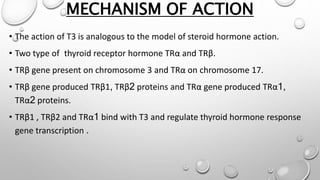
MECHANISM OF ACTION
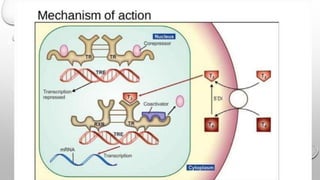
• The action of T3 is analogous to the model of steroid hormone action.
• Two type of thyroid receptor hormone TRα and TRβ.
• TRβ gene present on chromosome 3 and TRα on chromosome 17.
• TRβ gene produced TRβ1, TRβ2 proteins and TRα gene produced TRα1,
TRα2 proteins.
• TRβ1 , TRβ2 and TRα1 bind with T3 and regulate thyroid hormone response
gene transcription .
ACTION OF MECHANISM WORK :-
1. Calcium-ATPase activity – Increase.
2. Thyroid hormone amino acid uptake – Increase.
3. Deoxy glucose uptake – Increase.
4. Na-K ATPase stimulation – Activation.
FUNCTIONS OF THYROID
HORMONE
•Metabolic :- the thyroid hormones increase the basal metabolic rate
(BMR) and have effects on almost all body tissues. They increase the
absorption in the gut, generation, uptake by cells, and breakdown of glucose.
They stimulate the breakdown of fats, and increase the number of free fatty
acids.
•Cardiovascular :- the hormones increase the rate and strength of the
heartbeat. They increase the rate of breathing, intake and consumption of
oxygen, and increase the activity of mitochondria. Combined, these factors
increase blood flow and the body's temperature.
Developmental :- thyroid hormones are important for normal
development. They increase the growth rate of young people. Thyroid
hormones play a particularly crucial role in brain maturation during fetal
development and first few years of postnatal life.
● The thyroid hormones also play a role in maintaining normal sexual function,
sleep, and thought patterns. Sexual function, including libido and the
maintenance of a normal Menstrual Cycle are influenced by thyroid hormones.
DISORDERS
HYPORSECRETION :-
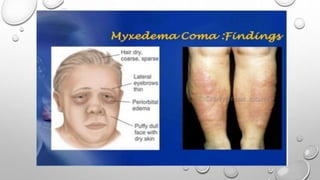
IN ADULTS :- MYXOEDEMA OR GULL’S DISEASE :- It is
caused by deficiency of thyroid hormone in adults. This disease is
characterized by puffy appearance due to accumulation of fat in the
subcutaneous tissue because of low metabolic rate. This disease can
be treated by administration of thyroid hormones.
IN CHILD (INFANTS) :-
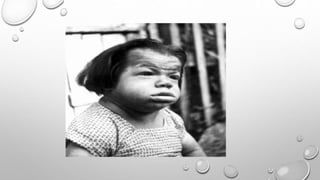
CRETINISM:- This disorder is caused by deficiency of thyroid hormone in infant.
A cretin has slow body growth and mental development of reduced metabolic
rate.
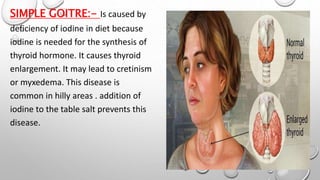
SIMPLE GOITRE:- Is caused by
deficiency of iodine in diet because
iodine is needed for the synthesis of
thyroid hormone. It causes thyroid
enlargement. It may lead to cretinism
or myxedema. This disease is
common in hilly areas . addition of
iodine to the table salt prevents this
disease.
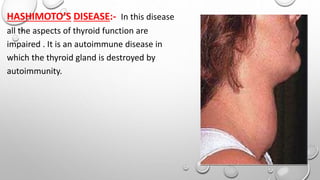
HASHIMOTO’S DISEASE:- In this disease
all the aspects of thyroid function are
impaired . It is an autoimmune disease in
which the thyroid gland is destroyed by
autoimmunity.
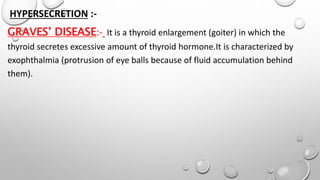
HYPERSECRETION :-
GRAVES’ DISEASE:- It is a thyroid enlargement (goiter) in which the
thyroid secretes excessive amount of thyroid hormone.It is characterized by
exophthalmia (protrusion of eye balls because of fluid accumulation behind
them).
CONCLUSION
Thyroid is very essential hormone for organism it regulate many activities of the
body like metabolic activity growth etc. It control many e biological functions.
The deficiency of thyroid hormone can cause various disease.
REFERENCES
1. MAC E. HANDLEY & JON. E. LEVINE – Endocrinology (6th edi.)
2. Introduction to Endocrinology – CHANDRA S. NEGI
3. By Internet
THANK

Thyroid gland :- structure and function

  • 1.
    K.G. ARTS &SCIENCE COLLEGE RAIGARH (C.G.) YEAR - 2019-20 DEPARMENT OF ZOOLOGY & RESEARCH CENTER SUBJECT :- ENDOCRINOLOGY SEMINAR TOPIC:- THYROID GLAND GUIDED BY:- SUBMITTED BY:- PROF. RANJANA SAHU MAM. SURENDRA PATEL M.SC SEM I
  • 2.
  • 3.
    SYNOPSIS :- 1. INTRODUCTION 2.HISTORY 3. ORIGIN 4. LOCATION 5. STRUCTURE 6. MICROANATOMY 7. THYROID HORMONS
  • 4.
    8. BIOCHEMISTRY OFTHYROID HORMONE. 9. IODINE AND IT’S UPTAKE 10. SYNTHESIS OF THYROID HORMONE. 11. TRANSPORT AND REGULATION 12. MECHANISM OF ACTION 13. FUNCTION OF THYROID HORMONE. 14. DISORDERS 15. CONCLUSION 16. REFERENCE.
  • 5.
    INTRODUCTION The thyroid glandis largest gland of the body. The thyroid gland, or simply the thyroid, is an endocrine gland in he neck, consisting of two lobes connected by an isthmus. It is found at the front of the neck, below the adam's apple. The thyroid gland secretes three hormones , namely the two thyroid hormones (thyroxine/T4 and Triiodothyronine/T3) and calcitonin. The thyroid hormones primarily influence the metabolic rate and protein synthesis, but they also have many other effects, including effects on development. Calcitonin plays a role in calcium homeostasis.
  • 6.
    HISTORY French chemist BernardCourtois discovered iodine in 1811, and in 1896 Eugen Baumann documented it as the central ingredient in the thyroid gland. He did this by boiling the thyroid glands of a thousand sheep, and named the precipitate, a combination of the thyroid hormones, 'iodothyrin'. David marine in 1907 proved that iodine is necessary for thyroid function. Thyroxine itself was first isolated in 1914 and synthesized in 1927, and tri-iodothyroxine in 1952. The conversion of T4 to T3 was discovered in 1970.
  • 7.
    The process ofdiscovering TSH took place over the early to mid twentieth century. TRH was discovered by polish endocrinologist Andrew Schally in 1970, contributing in part to his Nobel prize in medicine in 1977.
  • 8.
    ORIGIN The thyroid glandis originated from endoderm of cephalic portion of the embryo’s alimentary canal. A sac like diverticulum first appears in the midline of the ventral surface of the pharynx. This glandular organ becomes bilobed but remains connected to the pharynx by thyroglossal duct. The thyroglossal duct become a solid stalk that usually atrophies. The two lateral lobes of human thyroid become solid masses of tissue and remains connected to each other by a narrow isthmus of tissue.
  • 9.
    LOCATION The gland islocated immediately below the larynx and the anterior to upper parts or trachea.
  • 10.
    STRUCTURE The thyroid glandis a butterfly-shaped organ that sits at the front of the neck. It is composed of two lobes, left and right, connected by a narrow isthmus. The thyroid weighs 25 grams in adults, with each lobe being about 5 cm long, 3 cm wide, and 2 cm thick and the isthmus about 1.25 cm in height and width. The gland is usually larger in women, and increases in size in pregnancy.
  • 12.
    MICROANATOMY At the microscopiclevel there are three primary features of the thyroid— follicles, follicular cells and parafollicular cells first discovered by Geoffery Websterson in 1664. Follicles :- Thyroid follicles are small spherical groupings of cells 0.02–0.9mm in diameter that play the main role in thyroid function. They consist of a rim that has a rich blood supply, nerve and lymphatic presence, that surrounds a core of colloid that consists mostly of thyroid hormone precursor proteins called thyroglobulin, an iodinated glycoprotein.
  • 13.
    Follicular cells :- Thecore of a follicle is surrounded by a single layer of follicular cells. When stimulated by thyroid stimulating hormone (TSH), these secrete the thyroid hormones T3 and T4. They do this by transporting and metabolising the thyroglobulin contained in the colloid. Follicular cells vary in shape from flat to cuboid to columnar, depending on how active they are.
  • 14.
    Parafollicular cells:- Scattered amongfollicular cells and in spaces between the spherical follicles are another type of thyroid cell, parafollicular cells. These cells secrete Calcitonin and so are also called C cells.
  • 16.
    THYROID HORMONES The primaryfunction of the thyroid gland is the production of iodine containing thyroid hormones. T3 and T4 and the peptide hormone calcitonin. T3 :- it contains three atoms of iodine per molecules secreted by follicular cells. T4 :- it contains four atoms of iodine per molecules and also secreted by follicular cells.
  • 17.
    Difference between T3and T4 :- ● thyroid secret about 80-90 microgram of T4 but only 5 to 10 microgram of T3 per day. ● T3 is 10x greater biological activity than t4. Calcitonin :- produced by parafollicular cells. Antagonist to parathyroid hormone.
  • 18.
    BIOCHEMISTRY OF THYROID HORMONE Iodine+ tyrosine = thyroxine hormone • Iodine trap by follicular cell. • Synthesis of thyroglobulin a glycoprotein containing tyrosine residue for hormone synthesis. • Binding of inorganic iodine to tyrosine residue in thyroglobulin. • Synthesis of t3 and t4 from iodinated tyrosine. • Storage of thyroglobulin containing the thyroid hormone in the lumen of the follicles.
  • 19.
    • Engulfing ofthe colloid bye follicular cells and hydrolysis of thyroglobulin to release thyroid hormone. • Diffusion of t3 and t4 into the general circulation and their transport of target cell. • Mechanism of action :-
  • 21.
    IODINE AND ITSUPTAKE • Iodine is a raw material essential for thyroid hormone synthesis. • Ingested iodine is converted to iodide and absorbed. • The basal membrane of thyroid gland has the specific ability to pump the iodine actively in the interior of the cell. • Iodine trapping is stimulated by TSH.
  • 22.
    SYNTHESIS OF THYROID HORMONE •Thyroid hormone stores their hormones extracellularly. • Thyroglobulin synthesized and change into follicle lumen. • Iodide actively taken into cell and the released into lumen. • Iodide oxidised to iodine. • Iodine attach to tyrosine, mediated by peroxide enzyme. • Iodinated tyrosine link together to form T3 and T4. • Colloid is endocytosed and combined with lysosome. • T3 and T4 are cleaved and diffuse into blood stream.
  • 24.
    TRANSPORT AND REGULATION •T3 and T4 is transported by thyroxine binding globulin. • Both T3 and T4 bind to target receptor but T3 is 10X more active than T4. • Peripheral tissue convert T4 into T3. Negative feedback regulation of th release • Raising TH level provide a negative feedback inhibition on release of TSH. • Hypothalamic TRH also inhibited.
  • 26.
    MECHANISM OF ACTION •The action of T3 is analogous to the model of steroid hormone action. • Two type of thyroid receptor hormone TRα and TRβ. • TRβ gene present on chromosome 3 and TRα on chromosome 17. • TRβ gene produced TRβ1, TRβ2 proteins and TRα gene produced TRα1, TRα2 proteins. • TRβ1 , TRβ2 and TRα1 bind with T3 and regulate thyroid hormone response gene transcription .
  • 28.
    ACTION OF MECHANISMWORK :- 1. Calcium-ATPase activity – Increase. 2. Thyroid hormone amino acid uptake – Increase. 3. Deoxy glucose uptake – Increase. 4. Na-K ATPase stimulation – Activation.
  • 29.
    FUNCTIONS OF THYROID HORMONE •Metabolic:- the thyroid hormones increase the basal metabolic rate (BMR) and have effects on almost all body tissues. They increase the absorption in the gut, generation, uptake by cells, and breakdown of glucose. They stimulate the breakdown of fats, and increase the number of free fatty acids. •Cardiovascular :- the hormones increase the rate and strength of the heartbeat. They increase the rate of breathing, intake and consumption of oxygen, and increase the activity of mitochondria. Combined, these factors increase blood flow and the body's temperature.
  • 30.
    Developmental :- thyroidhormones are important for normal development. They increase the growth rate of young people. Thyroid hormones play a particularly crucial role in brain maturation during fetal development and first few years of postnatal life. ● The thyroid hormones also play a role in maintaining normal sexual function, sleep, and thought patterns. Sexual function, including libido and the maintenance of a normal Menstrual Cycle are influenced by thyroid hormones.
  • 31.
    DISORDERS HYPORSECRETION :- IN ADULTS:- MYXOEDEMA OR GULL’S DISEASE :- It is caused by deficiency of thyroid hormone in adults. This disease is characterized by puffy appearance due to accumulation of fat in the subcutaneous tissue because of low metabolic rate. This disease can be treated by administration of thyroid hormones.
  • 33.
    IN CHILD (INFANTS):- CRETINISM:- This disorder is caused by deficiency of thyroid hormone in infant. A cretin has slow body growth and mental development of reduced metabolic rate.
  • 35.
    SIMPLE GOITRE:- Iscaused by deficiency of iodine in diet because iodine is needed for the synthesis of thyroid hormone. It causes thyroid enlargement. It may lead to cretinism or myxedema. This disease is common in hilly areas . addition of iodine to the table salt prevents this disease.
  • 36.
    HASHIMOTO’S DISEASE:- Inthis disease all the aspects of thyroid function are impaired . It is an autoimmune disease in which the thyroid gland is destroyed by autoimmunity.
  • 37.
    HYPERSECRETION :- GRAVES’ DISEASE:-It is a thyroid enlargement (goiter) in which the thyroid secretes excessive amount of thyroid hormone.It is characterized by exophthalmia (protrusion of eye balls because of fluid accumulation behind them).
  • 38.
    CONCLUSION Thyroid is veryessential hormone for organism it regulate many activities of the body like metabolic activity growth etc. It control many e biological functions. The deficiency of thyroid hormone can cause various disease.
  • 39.
    REFERENCES 1. MAC E.HANDLEY & JON. E. LEVINE – Endocrinology (6th edi.) 2. Introduction to Endocrinology – CHANDRA S. NEGI 3. By Internet THANK