Physiology of
Thyroid Gland
1
An essential gland for normal
development and regulation of
metabolism
2
Layout:
➔ Formation of thyroid hormones
➔ Peripheral conversion
➔ Hormonal transport
➔ Actions of thyroid hormones
➔ Regulation of hormonal levels
3
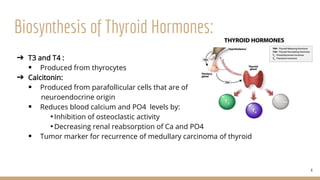
Biosynthesis of Thyroid Hormones:
➔ T3 and T4 :
 Produced from thyrocytes
➔ Calcitonin:
 Produced from parafollicular cells that are of
neuroendocrine origin
 Reduces blood calcium and PO4 levels by:
•Inhibition of osteoclastic activity
•Decreasing renal reabsorption of Ca and PO4
 Tumor marker for recurrence of medullary carcinoma of thyroid
4
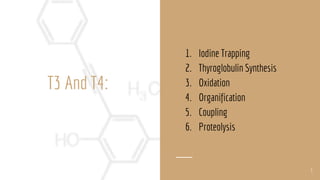
T3 And T4:
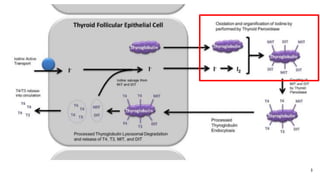
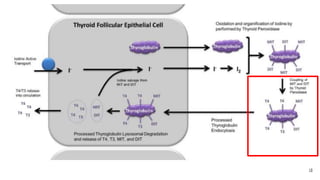
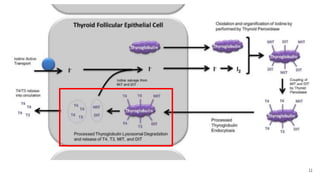
1. Iodine Trapping
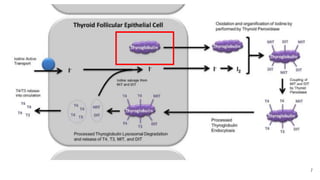
2. Thyroglobulin Synthesis
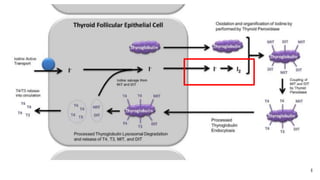
3. Oxidation
4. Organification
5. Coupling
6. Proteolysis
5
6
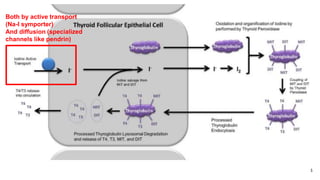
Both by active transport
(Na-I symporter)
And diffusion (specialized
channels like pendrin)
7
8
9
10
11
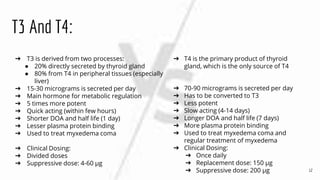
T3 And T4:
➔ T3 is derived from two processes:
● 20% directly secreted by thyroid gland
● 80% from T4 in peripheral tissues (especially
liver)
➔ 15-30 micrograms is secreted per day
➔ Main hormone for metabolic regulation
➔ 5 times more potent
➔ Quick acting (within few hours)
➔ Shorter DOA and half life (1 day)
➔ Lesser plasma protein binding
➔ Used to treat myxedema coma
➔ Clinical Dosing:
➔ Divided doses
➔ Suppressive dose: 4-60 µg
➔ T4 is the primary product of thyroid
gland, which is the only source of T4
➔ 70-90 micrograms is secreted per day
➔ Has to be converted to T3
➔ Less potent
➔ Slow acting (4-14 days)
➔ Longer DOA and half life (7 days)
➔ More plasma protein binding
➔ Used to treat myxedema coma and
regular treatment of myxedema
➔ Clinical Dosing:
➔ Once daily
➔ Replacement dose: 150 µg
➔ Suppressive dose: 200 µg 12
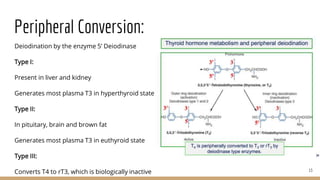
Peripheral Conversion:
Deiodination by the enzyme 5’ Deiodinase
Type I:
Present in liver and kidney
Generates most plasma T3 in hyperthyroid state
Type II:
In pituitary, brain and brown fat
Generates most plasma T3 in euthyroid state
Type III:
Converts T4 to rT3, which is biologically inactive 13
Hormonal Transport:
Bound Form:
More than 99% of circulating hormones
are bound to plasma carrier proteins
 Thyroxine binding globulin (75%)
 Transthyretin/thyroxine binding
prealbumin (10-15%)
 Albumin (7%)
 HDL (3%)
Free Form:
0.03% T4, 0.3% T3
Only free hormone has metabolic activity
and physiologic effects
Total hormone concentration is normally
kept appropriate to maintain a constant
free hormone level
14
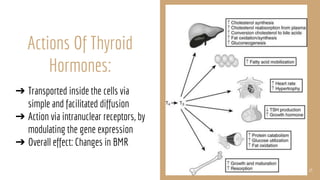
Actions Of Thyroid
Hormones:
➔ Transported inside the cells via
simple and facilitated diffusion
➔ Action via intranuclear receptors, by
modulating the gene expression
➔ Overall effect: Changes in BMR
15
Actions (Cont.):
● BMR is increased in most areas of the body as indicated by increased O2
consumption and glucose uptake
● BMR is decreased in brain especially in pituitary
● OTHER EFFECTS:
● Brain: enhance brain development, affects mood and activity
● PNS: catecholamine effect
● Intestine: normal development of small intestines
● Skin: enhanced collagen breakdown, changes on keratin expression
● Retina, spleen and testes are not at all affected by these hormones
16
Regulation of
Hormonal Levels
1. Hormone Secretion
2. Transport
3. Antithyroid Compounds
17
Hormone Secretion:
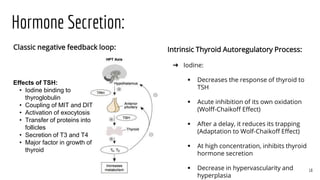
Classic negative feedback loop: Intrinsic Thyroid Autoregulatory Process:
➔ Iodine:
 Decreases the response of thyroid to
TSH
 Acute inhibition of its own oxidation
(Wolff-Chaikoff Effect)
 After a delay, it reduces its trapping
(Adaptation to Wolf-Chaikoff Effect)
 At high concentration, inhibits thyroid
hormone secretion
 Decrease in hypervascularity and
hyperplasia
18
Effects of TSH:
• Iodine binding to
thyroglobulin
• Coupling of MIT and DIT
• Activation of exocytosis
• Transfer of proteins into
follicles
• Secretion of T3 and T4
• Major factor in growth of
thyroid
Regulation At Transport Level:
Hormone Binding proteins are the principal factors influencing the
total hormone concentration
Changes in TBG levels may alter the total hormone concentration,
irrespective of free hormone level and thus metabolic status
TBG estimation is a more accurate indicator of thyroid hormone
dependant metabolic state
19
Drugs that increase TBG:
Oral contraceptives
Tamoxifen
Clofibrate
Drugs that decrease TBG:
Glucocorticoids,Androgens
Salicylates
Phenytoin
Furosemide
Conditions that increase TBG:
Pregnancy
Chronic active hepatitis, Biliary cirrhosis
HIV infection
Acute intermittent porphyria
Conditions that decrease TBG:
Genetic factors
Acute and chronic illness
20
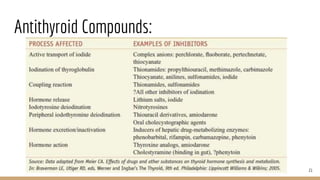
Antithyroid Compounds:
21
THANK YOU
22

Physiology of thyroid

  • 1.
  • 2.
    An essential glandfor normal development and regulation of metabolism 2
  • 3.
    Layout: ➔ Formation ofthyroid hormones ➔ Peripheral conversion ➔ Hormonal transport ➔ Actions of thyroid hormones ➔ Regulation of hormonal levels 3
  • 4.
    Biosynthesis of ThyroidHormones: ➔ T3 and T4 :  Produced from thyrocytes ➔ Calcitonin:  Produced from parafollicular cells that are of neuroendocrine origin  Reduces blood calcium and PO4 levels by: •Inhibition of osteoclastic activity •Decreasing renal reabsorption of Ca and PO4  Tumor marker for recurrence of medullary carcinoma of thyroid 4
  • 5.
    T3 And T4: 1.Iodine Trapping 2. Thyroglobulin Synthesis 3. Oxidation 4. Organification 5. Coupling 6. Proteolysis 5
  • 6.
    6 Both by activetransport (Na-I symporter) And diffusion (specialized channels like pendrin)
  • 7.
  • 8.
  • 9.
  • 10.
  • 11.
  • 12.
    T3 And T4: ➔T3 is derived from two processes: ● 20% directly secreted by thyroid gland ● 80% from T4 in peripheral tissues (especially liver) ➔ 15-30 micrograms is secreted per day ➔ Main hormone for metabolic regulation ➔ 5 times more potent ➔ Quick acting (within few hours) ➔ Shorter DOA and half life (1 day) ➔ Lesser plasma protein binding ➔ Used to treat myxedema coma ➔ Clinical Dosing: ➔ Divided doses ➔ Suppressive dose: 4-60 µg ➔ T4 is the primary product of thyroid gland, which is the only source of T4 ➔ 70-90 micrograms is secreted per day ➔ Has to be converted to T3 ➔ Less potent ➔ Slow acting (4-14 days) ➔ Longer DOA and half life (7 days) ➔ More plasma protein binding ➔ Used to treat myxedema coma and regular treatment of myxedema ➔ Clinical Dosing: ➔ Once daily ➔ Replacement dose: 150 µg ➔ Suppressive dose: 200 µg 12
  • 13.
    Peripheral Conversion: Deiodination bythe enzyme 5’ Deiodinase Type I: Present in liver and kidney Generates most plasma T3 in hyperthyroid state Type II: In pituitary, brain and brown fat Generates most plasma T3 in euthyroid state Type III: Converts T4 to rT3, which is biologically inactive 13
  • 14.
    Hormonal Transport: Bound Form: Morethan 99% of circulating hormones are bound to plasma carrier proteins  Thyroxine binding globulin (75%)  Transthyretin/thyroxine binding prealbumin (10-15%)  Albumin (7%)  HDL (3%) Free Form: 0.03% T4, 0.3% T3 Only free hormone has metabolic activity and physiologic effects Total hormone concentration is normally kept appropriate to maintain a constant free hormone level 14
  • 15.
    Actions Of Thyroid Hormones: ➔Transported inside the cells via simple and facilitated diffusion ➔ Action via intranuclear receptors, by modulating the gene expression ➔ Overall effect: Changes in BMR 15
  • 16.
    Actions (Cont.): ● BMRis increased in most areas of the body as indicated by increased O2 consumption and glucose uptake ● BMR is decreased in brain especially in pituitary ● OTHER EFFECTS: ● Brain: enhance brain development, affects mood and activity ● PNS: catecholamine effect ● Intestine: normal development of small intestines ● Skin: enhanced collagen breakdown, changes on keratin expression ● Retina, spleen and testes are not at all affected by these hormones 16
  • 17.
    Regulation of Hormonal Levels 1.Hormone Secretion 2. Transport 3. Antithyroid Compounds 17
  • 18.
    Hormone Secretion: Classic negativefeedback loop: Intrinsic Thyroid Autoregulatory Process: ➔ Iodine:  Decreases the response of thyroid to TSH  Acute inhibition of its own oxidation (Wolff-Chaikoff Effect)  After a delay, it reduces its trapping (Adaptation to Wolf-Chaikoff Effect)  At high concentration, inhibits thyroid hormone secretion  Decrease in hypervascularity and hyperplasia 18 Effects of TSH: • Iodine binding to thyroglobulin • Coupling of MIT and DIT • Activation of exocytosis • Transfer of proteins into follicles • Secretion of T3 and T4 • Major factor in growth of thyroid
  • 19.
    Regulation At TransportLevel: Hormone Binding proteins are the principal factors influencing the total hormone concentration Changes in TBG levels may alter the total hormone concentration, irrespective of free hormone level and thus metabolic status TBG estimation is a more accurate indicator of thyroid hormone dependant metabolic state 19
  • 20.
    Drugs that increaseTBG: Oral contraceptives Tamoxifen Clofibrate Drugs that decrease TBG: Glucocorticoids,Androgens Salicylates Phenytoin Furosemide Conditions that increase TBG: Pregnancy Chronic active hepatitis, Biliary cirrhosis HIV infection Acute intermittent porphyria Conditions that decrease TBG: Genetic factors Acute and chronic illness 20
  • 21.
  • 22.