Thyroid Dysfunction in Pregnancy
Presented by : Akshit Rana
Akshita behl
• Most common endocrine disorder in pregnancy.
• 1-2% pregnant women.
• Pregnancy may modify course of thyroid
disease.
• Pregnancy outcome can depend on optimal
management of thyroid disorders.
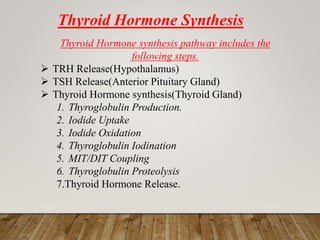
Thyroid Hormone Synthesis
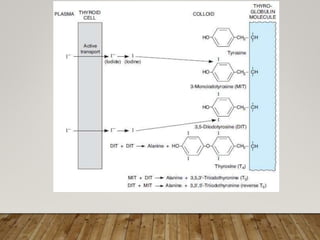
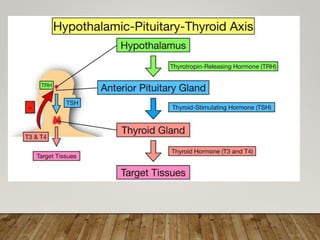
Thyroid Hormone synthesis pathway includes the
following steps.
 TRH Release(Hypothalamus)
 TSH Release(Anterior Pituitary Gland)
 Thyroid Hormone synthesis(Thyroid Gland)
1. Thyroglobulin Production.
2. Iodide Uptake
3. Iodide Oxidation
4. Thyroglobulin Iodination
5. MIT/DIT Coupling
6. Thyroglobulin Proteolysis
7.Thyroid Hormone Release.
PHYSIOLOGICAL CHANGES IN THYROID
GLAND IN PREGNANCY
• Throughout pregnancy there is increased demand of
thyroid hormone because pregnancy is the state of
increased BMR[20-25%] , increased oxygen
consumption by mother and baby.
• Size of the gland increases but any visible increase in
size must be considered pathological.
• Because of increased thyroid hormone
production, increased renal iodine excretion, and
fetal iodine requirements, dietary iodine
requirements are higher in pregnancy than they
are for nonpregnant adults.
• Normal levels of thyroid hormone are essential for
neuronal migration and myelination of the fetal
brain.
• Iodine deficiency is the leading cause of
preventable mental retardation worldwide
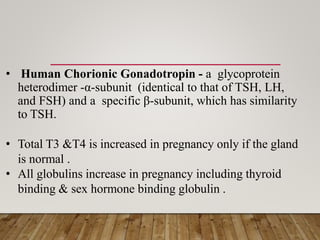
• Human Chorionic Gonadotropin - a glycoprotein
heterodimer -α-subunit (identical to that of TSH, LH,
and FSH) and a specific β-subunit, which has similarity
to TSH.
• Total T3 &T4 is increased in pregnancy only if the gland
is normal .
• All globulins increase in pregnancy including thyroid
binding & sex hormone binding globulin .
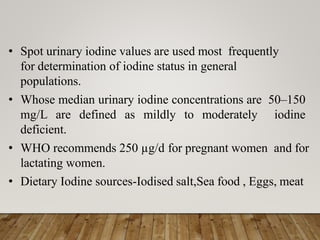
• Spot urinary iodine values are used most frequently
for determination of iodine status in general
populations.
• Whose median urinary iodine concentrations are 50–150
mg/L are defined as mildly to moderately iodine
deficient.
• WHO recommends 250 µg/d for pregnant women and for
lactating women.
• Dietary Iodine sources-Iodised salt,Sea food , Eggs, meat
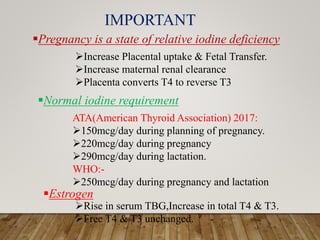
IMPORTANT
Pregnancy is a state of relative iodine deficiency
Increase Placental uptake & Fetal Transfer.
Increase maternal renal clearance
Placenta converts T4 to reverse T3
Normal iodine requirement
ATA(American Thyroid Association) 2017:
150mcg/day during planning of pregnancy.
220mcg/day during pregnancy
290mcg/day during lactation.
WHO:-
250mcg/day during pregnancy and lactation
Estrogen
Rise in serum TBG,Increase in total T4 & T3.
Free T4 & T3 unchanged.
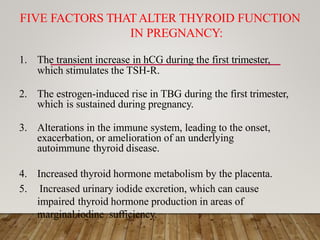
FIVE FACTORS THATALTER THYROID FUNCTION
IN PREGNANCY:
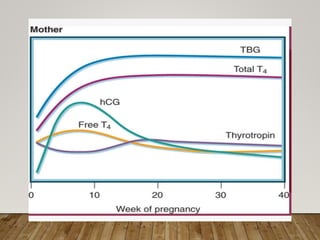
1. The transient increase in hCG during the first trimester,
which stimulates the TSH-R.
2. The estrogen-induced rise in TBG during the first trimester,
which is sustained during pregnancy.
3. Alterations in the immune system, leading to the onset,
exacerbation, or amelioration of an underlying
autoimmune thyroid disease.
4. Increased thyroid hormone metabolism by the placenta.
5. Increased urinary iodide excretion, which can cause
impaired thyroid hormone production in areas of
marginal iodine sufficiency.
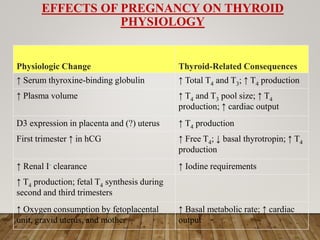
EFFECTS OF PREGNANCY ON THYROID
PHYSIOLOGY
Physiologic Change Thyroid-Related Consequences
↑ Serum thyroxine-binding globulin ↑ Total T4 and T3; ↑ T4 production
↑ Plasma volume ↑ T4 and T3 pool size; ↑ T4
production; ↑ cardiac output
D3 expression in placenta and (?) uterus ↑ T4 production
First trimester ↑ in hCG ↑ Free T4; ↓ basal thyrotropin; ↑ T4
production
↑ Renal I- clearance ↑ Iodine requirements
↑ T4 production; fetal T4 synthesis during
second and third trimesters
↑ Oxygen consumption by fetoplacental
unit, gravid uterus, and mother
↑ Basal metabolic rate; ↑ cardiac
output
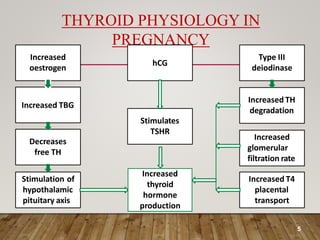
THYROID PHYSIOLOGY IN
PREGNANCY
•
Increased
thyroid
hormone
production
Increased
oestrogen
Increased TBG
Decreases
free TH
Stimulation of
hypothalamic
pituitary axis
hCG
Increased T4
placental
transport
Increased
glomerular
filtration rate
Stimulates
TSHR
Type III
deiodinase
Increased TH
degradation
5
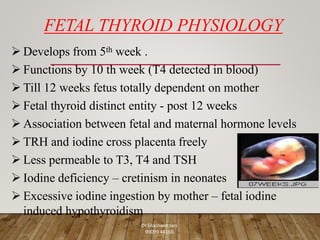
FETAL THYROID PHYSIOLOGY
 Develops from 5th week .
 Functions by 10 th week (T4 detected in blood)
 Till 12 weeks fetus totally dependent on mother
 Fetal thyroid distinct entity - post 12 weeks
 Association between fetal and maternal hormone levels
 TRH and iodine cross placenta freely
 Less permeable to T3, T4 and TSH
 Iodine deficiency – cretinism in neonates
 Excessive iodine ingestion by mother – fetal iodine
induced hypothyroidism
Dr Shashwat Jani.
99099 44160.
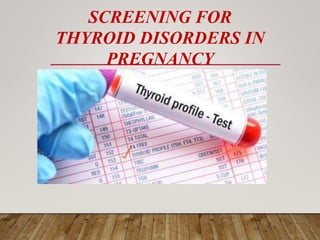
SCREENING FOR
THYROID DISORDERS IN
PREGNANCY
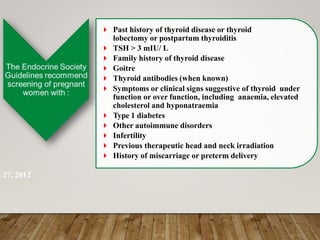
 Past history of thyroid disease or thyroid
lobectomy or postpartum thyroiditis
 TSH > 3 mIU/ L
 Family history of thyroid disease
 Goitre
 Thyroid antibodies (when known)
 Symptoms or clinical signs suggestive of thyroid under
function or over function, including anaemia, elevated
cholesterol and hyponatraemia
 Type 1 diabetes
 Other autoimmune disorders
 Infertility
 Previous therapeutic head and neck irradiation
 History of miscarriage or preterm delivery
27, 2012
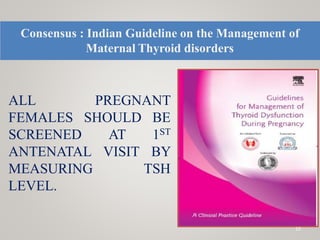
Consensus : Indian Guideline on the Management of
Maternal Thyroid disorders
ALL PREGNANT
FEMALES SHOULD BE
SCREENED AT 1ST
ANTENATAL VISIT BY
MEASURING TSH
LEVEL.
15
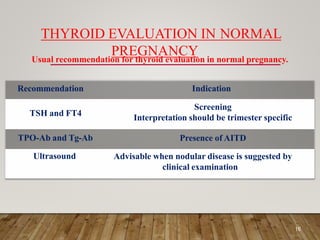
THYROID EVALUATION IN NORMAL
PREGNANCY
Recommendation Indication
TSH and FT4
Screening
Interpretation should be trimester specific
TPO-Ab and Tg-Ab Presence of AITD
Ultrasound Advisable when nodular disease is suggested by
clinical examination
Usual recommendation for thyroid evaluation in normal pregnancy.
16
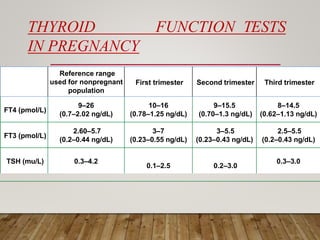
THYROID FUNCTION TESTS
IN PREGNANCY
Reference range
used for nonpregnant
population
First trimester Second trimester Third trimester
FT4 (pmol/L)
9–26
(0.7–2.02 ng/dL)
10–16
(0.78–1.25 ng/dL)
9–15.5
(0.70–1.3 ng/dL)
8–14.5
(0.62–1.13 ng/dL)
FT3 (pmol/L)
2.60–5.7
(0.2–0.44 ng/dL)
3–7
(0.23–0.55 ng/dL)
3–5.5
(0.23–0.43 ng/dL)
2.5–5.5
(0.2–0.43 ng/dL)
TSH (mu/L) 0.3–4.2
0.1–2.5 0.2–3.0
0.3–3.0
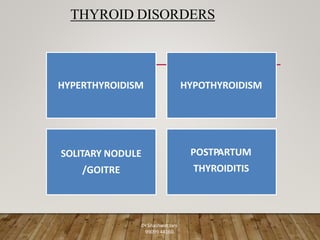
HYPERTHYROIDISM HYPOTHYROIDISM
SOLITARY NODULE
/GOITRE
POSTPARTUM
THYROIDITIS
THYROID DISORDERS
Dr Shashwat Jani.
99099 44160.
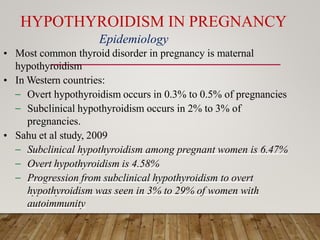
HYPOTHYROIDISM IN PREGNANCY
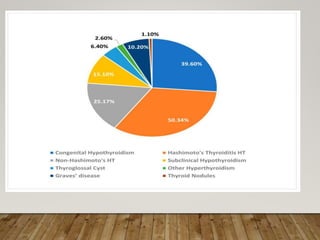
• Most common thyroid disorder in pregnancy is maternal
hypothyroidism
• In Western countries:
– Overt hypothyroidism occurs in 0.3% to 0.5% of pregnancies
– Subclinical hypothyroidism occurs in 2% to 3% of
pregnancies.
• Sahu et al study, 2009
– Subclinical hypothyroidism among pregnant women is 6.47%
– Overt hypothyroidism is 4.58%
– Progression from subclinical hypothyroidism to overt
hypothyroidism was seen in 3% to 29% of women with
autoimmunity
Epidemiology
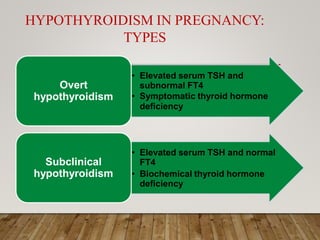
HYPOTHYROIDISM IN PREGNANCY:
TYPES
• Elevated serum TSH and
subnormal FT4
• Symptomatic thyroid hormone
deficiency
Overt
hypothyroidism
• Elevated serum TSH and normal
FT4
• Biochemical thyroid hormone
deficiency
Subclinical
hypothyroidism
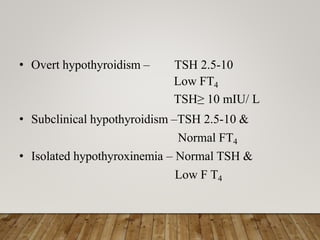
• Overt hypothyroidism – TSH 2.5-10
Low FT4
TSH≥ 10 mIU/ L
• Subclinical hypothyroidism –TSH 2.5-10 &
Normal FT4
• Isolated hypothyroxinemia – Normal TSH &
Low F T4
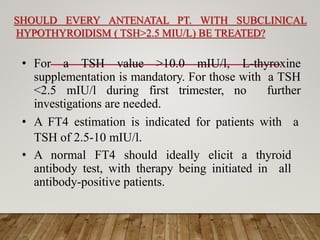
SHOULD EVERY ANTENATAL PT. WITH SUBCLINICAL
HYPOTHYROIDISM ( TSH>2.5 MIU/L) BE TREATED?
• For a TSH value >10.0 mIU/l, L-thyroxine
supplementation is mandatory. For those with a TSH
<2.5 mIU/l during first trimester, no further
investigations are needed.
• A FT4 estimation is indicated for patients with a
TSH of 2.5-10 mIU/l.
• A normal FT4 should ideally elicit a thyroid
antibody test, with therapy being initiated in all
antibody-positive patients.
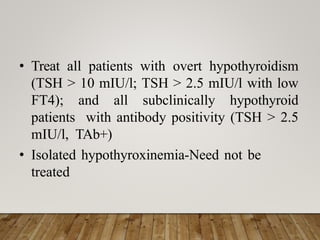
• Treat all patients with overt hypothyroidism
(TSH > 10 mIU/l; TSH > 2.5 mIU/l with low
FT4); and all subclinically hypothyroid
patients with antibody positivity (TSH > 2.5
mIU/l, TAb+)
• Isolated hypothyroxinemia-Need not be
treated
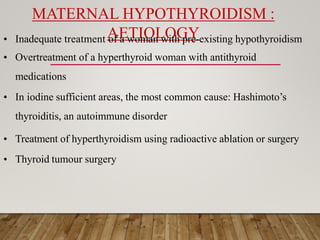
MATERNAL HYPOTHYROIDISM :
AETIOLOGY
• Inadequate treatment of a woman with pre-existing hypothyroidism
• Overtreatment of a hyperthyroid woman with antithyroid
medications
• In iodine sufficient areas, the most common cause: Hashimoto’s
thyroiditis, an autoimmune disorder
• Treatment of hyperthyroidism using radioactive ablation or surgery
• Thyroid tumour surgery
FOETAL HYPOTHYROIDISM:
AETIOLOGY
Foetal hypothyroidism causes:
• Antithyroid drug to mother
• Transplacental passage of TSH-receptor
blocking antibodies
IMPACT OF UNTREATED HYPOTHYROIDISM IN
PREGNANCY
• Anaemia
• Congestive heart failure
• Antepartum depression
• Eclampsia
• Pre-eclampsia
• Gestational hypertension
• Placental abruption
• Increased chances of caesarean
section, preterm delivery
• Postpartum depression
• Postpartum hypertension
• Lactation problems
• Miscarriage
Maternal Foetal
• Growth restriction
• Increased perinatal
mortality
• Impaired
neuropsychointellectual
development
• IUD
TSH MONITORING
• During pregnancy –
 Every 4 weeks until 16-20 weeks gestation.
 At once between 26-32 weeks gestation
• After delivery –
 Stop or titrate down levothyroxine .
 Decrease dose by 30%(diagnosed in pregnancy)
 Prepregnancy dose(hypothyroid before pregn.)
 Retest TSH levels in 4-8 weeks
Management of
Hypothyroidism in
Pregnancy
HYPOTHYROIDISM IN
PREGNANCY
•
•
•
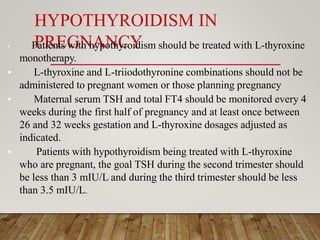
• Patients with hypothyroidism should be treated with L-thyroxine
monotherapy.
L-thyroxine and L-triiodothyronine combinations should not be
administered to pregnant women or those planning pregnancy
Maternal serum TSH and total FT4 should be monitored every 4
weeks during the first half of pregnancy and at least once between
26 and 32 weeks gestation and L-thyroxine dosages adjusted as
indicated.
Patients with hypothyroidism being treated with L-thyroxine
who are pregnant, the goal TSH during the second trimester should
be less than 3 mIU/L and during the third trimester should be less
than 3.5 mIU/L.
THYROXINE TREATMENT FOR HYPOTHYROIDISM
IN PREGNANCY
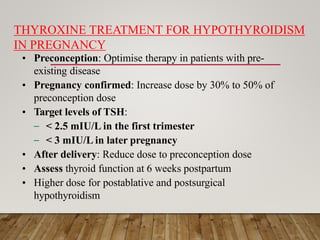
• Preconception: Optimise therapy in patients with pre-
existing disease
• Pregnancy confirmed: Increase dose by 30% to 50% of
preconception dose
• Target levels of TSH:
– < 2.5 mIU/L in the first trimester
– < 3 mIU/L in later pregnancy
• After delivery: Reduce dose to preconception dose
• Assess thyroid function at 6 weeks postpartum
• Higher dose for postablative and postsurgical
hypothyroidism
THYROXIN TREATMENT FOR
HYPOTHYROIDISM IN
PREGNANCY
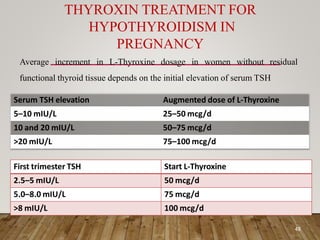
Average increment in L-Thyroxine dosage in women without residual
functional thyroid tissue depends on the initial elevation of serum TSH
Serum TSH elevation Augmented dose of L-Thyroxine
5–10 mIU/L 25–50 mcg/d
10 and 20 mIU/L 50–75 mcg/d
>20 mIU/L 75–100 mcg/d
First trimester TSH Start L-Thyroxine
2.5–5 mIU/L 50 mcg/d
5.0–8.0 mIU/L 75 mcg/d
>8 mIU/L 100 mcg/d
48
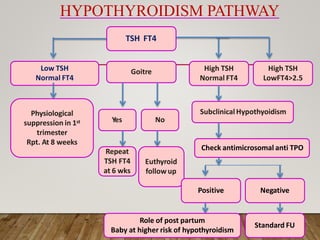
TSH FT4
Low TSH
Normal FT4
Goitre High TSH
Normal FT4
Physiological
suppression in 1st
trimester
Rpt. At 8 weeks
HYPOTHYROIDISM PATHWAY
High TSH
LowFT4>2.5
Yes No
Repeat
TSH FT4
at 6 wks
Euthyroid
followup
SubclinicalHypothyoidism
Check antimicrosomal anti TPO
Positive Negative
Role of post partum
Baby at higher risk of hypothyroidism
Standard FU

THYROID DISORDER IN PREGNANCY -Kamal.pptx

  • 1.
    Thyroid Dysfunction inPregnancy Presented by : Akshit Rana Akshita behl
  • 2.
    • Most commonendocrine disorder in pregnancy. • 1-2% pregnant women. • Pregnancy may modify course of thyroid disease. • Pregnancy outcome can depend on optimal management of thyroid disorders.
  • 3.
    Thyroid Hormone Synthesis ThyroidHormone synthesis pathway includes the following steps.  TRH Release(Hypothalamus)  TSH Release(Anterior Pituitary Gland)  Thyroid Hormone synthesis(Thyroid Gland) 1. Thyroglobulin Production. 2. Iodide Uptake 3. Iodide Oxidation 4. Thyroglobulin Iodination 5. MIT/DIT Coupling 6. Thyroglobulin Proteolysis 7.Thyroid Hormone Release.
  • 7.
    PHYSIOLOGICAL CHANGES INTHYROID GLAND IN PREGNANCY • Throughout pregnancy there is increased demand of thyroid hormone because pregnancy is the state of increased BMR[20-25%] , increased oxygen consumption by mother and baby. • Size of the gland increases but any visible increase in size must be considered pathological.
  • 8.
    • Because ofincreased thyroid hormone production, increased renal iodine excretion, and fetal iodine requirements, dietary iodine requirements are higher in pregnancy than they are for nonpregnant adults. • Normal levels of thyroid hormone are essential for neuronal migration and myelination of the fetal brain. • Iodine deficiency is the leading cause of preventable mental retardation worldwide
  • 9.
    • Human ChorionicGonadotropin - a glycoprotein heterodimer -α-subunit (identical to that of TSH, LH, and FSH) and a specific β-subunit, which has similarity to TSH. • Total T3 &T4 is increased in pregnancy only if the gland is normal . • All globulins increase in pregnancy including thyroid binding & sex hormone binding globulin .
  • 11.
    • Spot urinaryiodine values are used most frequently for determination of iodine status in general populations. • Whose median urinary iodine concentrations are 50–150 mg/L are defined as mildly to moderately iodine deficient. • WHO recommends 250 µg/d for pregnant women and for lactating women. • Dietary Iodine sources-Iodised salt,Sea food , Eggs, meat
  • 12.
    IMPORTANT Pregnancy is astate of relative iodine deficiency Increase Placental uptake & Fetal Transfer. Increase maternal renal clearance Placenta converts T4 to reverse T3 Normal iodine requirement ATA(American Thyroid Association) 2017: 150mcg/day during planning of pregnancy. 220mcg/day during pregnancy 290mcg/day during lactation. WHO:- 250mcg/day during pregnancy and lactation Estrogen Rise in serum TBG,Increase in total T4 & T3. Free T4 & T3 unchanged.
  • 13.
    FIVE FACTORS THATALTERTHYROID FUNCTION IN PREGNANCY: 1. The transient increase in hCG during the first trimester, which stimulates the TSH-R. 2. The estrogen-induced rise in TBG during the first trimester, which is sustained during pregnancy. 3. Alterations in the immune system, leading to the onset, exacerbation, or amelioration of an underlying autoimmune thyroid disease. 4. Increased thyroid hormone metabolism by the placenta. 5. Increased urinary iodide excretion, which can cause impaired thyroid hormone production in areas of marginal iodine sufficiency.
  • 14.
    EFFECTS OF PREGNANCYON THYROID PHYSIOLOGY Physiologic Change Thyroid-Related Consequences ↑ Serum thyroxine-binding globulin ↑ Total T4 and T3; ↑ T4 production ↑ Plasma volume ↑ T4 and T3 pool size; ↑ T4 production; ↑ cardiac output D3 expression in placenta and (?) uterus ↑ T4 production First trimester ↑ in hCG ↑ Free T4; ↓ basal thyrotropin; ↑ T4 production ↑ Renal I- clearance ↑ Iodine requirements ↑ T4 production; fetal T4 synthesis during second and third trimesters ↑ Oxygen consumption by fetoplacental unit, gravid uterus, and mother ↑ Basal metabolic rate; ↑ cardiac output
  • 15.
    THYROID PHYSIOLOGY IN PREGNANCY • Increased thyroid hormone production Increased oestrogen IncreasedTBG Decreases free TH Stimulation of hypothalamic pituitary axis hCG Increased T4 placental transport Increased glomerular filtration rate Stimulates TSHR Type III deiodinase Increased TH degradation 5
  • 16.
    FETAL THYROID PHYSIOLOGY Develops from 5th week .  Functions by 10 th week (T4 detected in blood)  Till 12 weeks fetus totally dependent on mother  Fetal thyroid distinct entity - post 12 weeks  Association between fetal and maternal hormone levels  TRH and iodine cross placenta freely  Less permeable to T3, T4 and TSH  Iodine deficiency – cretinism in neonates  Excessive iodine ingestion by mother – fetal iodine induced hypothyroidism Dr Shashwat Jani. 99099 44160.
  • 17.
  • 18.
     Past historyof thyroid disease or thyroid lobectomy or postpartum thyroiditis  TSH > 3 mIU/ L  Family history of thyroid disease  Goitre  Thyroid antibodies (when known)  Symptoms or clinical signs suggestive of thyroid under function or over function, including anaemia, elevated cholesterol and hyponatraemia  Type 1 diabetes  Other autoimmune disorders  Infertility  Previous therapeutic head and neck irradiation  History of miscarriage or preterm delivery 27, 2012
  • 19.
    Consensus : IndianGuideline on the Management of Maternal Thyroid disorders ALL PREGNANT FEMALES SHOULD BE SCREENED AT 1ST ANTENATAL VISIT BY MEASURING TSH LEVEL. 15
  • 20.
    THYROID EVALUATION INNORMAL PREGNANCY Recommendation Indication TSH and FT4 Screening Interpretation should be trimester specific TPO-Ab and Tg-Ab Presence of AITD Ultrasound Advisable when nodular disease is suggested by clinical examination Usual recommendation for thyroid evaluation in normal pregnancy. 16
  • 21.
    THYROID FUNCTION TESTS INPREGNANCY Reference range used for nonpregnant population First trimester Second trimester Third trimester FT4 (pmol/L) 9–26 (0.7–2.02 ng/dL) 10–16 (0.78–1.25 ng/dL) 9–15.5 (0.70–1.3 ng/dL) 8–14.5 (0.62–1.13 ng/dL) FT3 (pmol/L) 2.60–5.7 (0.2–0.44 ng/dL) 3–7 (0.23–0.55 ng/dL) 3–5.5 (0.23–0.43 ng/dL) 2.5–5.5 (0.2–0.43 ng/dL) TSH (mu/L) 0.3–4.2 0.1–2.5 0.2–3.0 0.3–3.0
  • 22.
  • 23.
    HYPOTHYROIDISM IN PREGNANCY •Most common thyroid disorder in pregnancy is maternal hypothyroidism • In Western countries: – Overt hypothyroidism occurs in 0.3% to 0.5% of pregnancies – Subclinical hypothyroidism occurs in 2% to 3% of pregnancies. • Sahu et al study, 2009 – Subclinical hypothyroidism among pregnant women is 6.47% – Overt hypothyroidism is 4.58% – Progression from subclinical hypothyroidism to overt hypothyroidism was seen in 3% to 29% of women with autoimmunity Epidemiology
  • 24.
    HYPOTHYROIDISM IN PREGNANCY: TYPES •Elevated serum TSH and subnormal FT4 • Symptomatic thyroid hormone deficiency Overt hypothyroidism • Elevated serum TSH and normal FT4 • Biochemical thyroid hormone deficiency Subclinical hypothyroidism
  • 25.
    • Overt hypothyroidism– TSH 2.5-10 Low FT4 TSH≥ 10 mIU/ L • Subclinical hypothyroidism –TSH 2.5-10 & Normal FT4 • Isolated hypothyroxinemia – Normal TSH & Low F T4
  • 26.
    SHOULD EVERY ANTENATALPT. WITH SUBCLINICAL HYPOTHYROIDISM ( TSH>2.5 MIU/L) BE TREATED? • For a TSH value >10.0 mIU/l, L-thyroxine supplementation is mandatory. For those with a TSH <2.5 mIU/l during first trimester, no further investigations are needed. • A FT4 estimation is indicated for patients with a TSH of 2.5-10 mIU/l. • A normal FT4 should ideally elicit a thyroid antibody test, with therapy being initiated in all antibody-positive patients.
  • 27.
    • Treat allpatients with overt hypothyroidism (TSH > 10 mIU/l; TSH > 2.5 mIU/l with low FT4); and all subclinically hypothyroid patients with antibody positivity (TSH > 2.5 mIU/l, TAb+) • Isolated hypothyroxinemia-Need not be treated
  • 28.
    MATERNAL HYPOTHYROIDISM : AETIOLOGY •Inadequate treatment of a woman with pre-existing hypothyroidism • Overtreatment of a hyperthyroid woman with antithyroid medications • In iodine sufficient areas, the most common cause: Hashimoto’s thyroiditis, an autoimmune disorder • Treatment of hyperthyroidism using radioactive ablation or surgery • Thyroid tumour surgery
  • 29.
    FOETAL HYPOTHYROIDISM: AETIOLOGY Foetal hypothyroidismcauses: • Antithyroid drug to mother • Transplacental passage of TSH-receptor blocking antibodies
  • 30.
    IMPACT OF UNTREATEDHYPOTHYROIDISM IN PREGNANCY • Anaemia • Congestive heart failure • Antepartum depression • Eclampsia • Pre-eclampsia • Gestational hypertension • Placental abruption • Increased chances of caesarean section, preterm delivery • Postpartum depression • Postpartum hypertension • Lactation problems • Miscarriage Maternal Foetal • Growth restriction • Increased perinatal mortality • Impaired neuropsychointellectual development • IUD
  • 31.
    TSH MONITORING • Duringpregnancy –  Every 4 weeks until 16-20 weeks gestation.  At once between 26-32 weeks gestation • After delivery –  Stop or titrate down levothyroxine .  Decrease dose by 30%(diagnosed in pregnancy)  Prepregnancy dose(hypothyroid before pregn.)  Retest TSH levels in 4-8 weeks
  • 32.
  • 33.
    HYPOTHYROIDISM IN PREGNANCY • • • • Patientswith hypothyroidism should be treated with L-thyroxine monotherapy. L-thyroxine and L-triiodothyronine combinations should not be administered to pregnant women or those planning pregnancy Maternal serum TSH and total FT4 should be monitored every 4 weeks during the first half of pregnancy and at least once between 26 and 32 weeks gestation and L-thyroxine dosages adjusted as indicated. Patients with hypothyroidism being treated with L-thyroxine who are pregnant, the goal TSH during the second trimester should be less than 3 mIU/L and during the third trimester should be less than 3.5 mIU/L.
  • 34.
    THYROXINE TREATMENT FORHYPOTHYROIDISM IN PREGNANCY • Preconception: Optimise therapy in patients with pre- existing disease • Pregnancy confirmed: Increase dose by 30% to 50% of preconception dose • Target levels of TSH: – < 2.5 mIU/L in the first trimester – < 3 mIU/L in later pregnancy • After delivery: Reduce dose to preconception dose • Assess thyroid function at 6 weeks postpartum • Higher dose for postablative and postsurgical hypothyroidism
  • 35.
    THYROXIN TREATMENT FOR HYPOTHYROIDISMIN PREGNANCY Average increment in L-Thyroxine dosage in women without residual functional thyroid tissue depends on the initial elevation of serum TSH Serum TSH elevation Augmented dose of L-Thyroxine 5–10 mIU/L 25–50 mcg/d 10 and 20 mIU/L 50–75 mcg/d >20 mIU/L 75–100 mcg/d First trimester TSH Start L-Thyroxine 2.5–5 mIU/L 50 mcg/d 5.0–8.0 mIU/L 75 mcg/d >8 mIU/L 100 mcg/d 48
  • 36.
    TSH FT4 Low TSH NormalFT4 Goitre High TSH Normal FT4 Physiological suppression in 1st trimester Rpt. At 8 weeks HYPOTHYROIDISM PATHWAY High TSH LowFT4>2.5 Yes No Repeat TSH FT4 at 6 wks Euthyroid followup SubclinicalHypothyoidism Check antimicrosomal anti TPO Positive Negative Role of post partum Baby at higher risk of hypothyroidism Standard FU