
CONGENITAL HYPOTHYROIDISM General Hospital of Tianjing Medicine University
 
 
Introduction   Congenital  hypothyroidism results from deficient production of thyroid hormone or a defect of thyroid hormonal receptor activity.  The disorder may be manifested from birth. The major clinical characteristics of congenital hypothyroidism are retardation in growth and mental development.
Introduction  Congenital hypothyroidism  sporadic endemic
Etiology
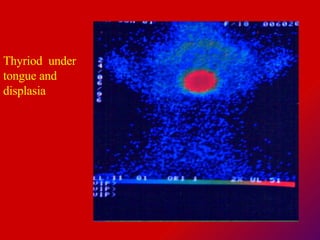
Thyroid dysgenesis Development defects (thyroid dysgenesis) account for 90% of infants in whom hypothyroidism is detected.  Aplasia      In about one third, even sensitive radionuclide scans  can find no remnants of thyroid tissue . Ectopia  In the other two thirds of infants, rudiments of thyroid tissue are found in an ectopic location ,such as lingual thyroid .
Defective synthesis of thyroxin A variety of defects in the biosynthesis of thyroid hormone (for example, enzyme deficiency) may result in congenital hypothyroidism. A goiter is almost always present in these patients. These defects are transmitted in an autosomal recessive manner.
Thyrotropin deficiency multiple hormones deficiency of pituitary or hypothalamus  Hypothyriodism is one of many symptoms There are accompanied by hypoglycemia, and other  Clinical manifestations
Thyroid gland or peripheral target organ unresponsiveness (receptor disorder) thyroid tissue does not response to TSH  peripheral tissue does not respond to T 4  and T 3
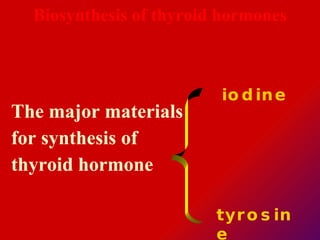
Biosynthesis of thyroid hormones The major materials  for synthesis of thyroid hormone   tyrosine iodine
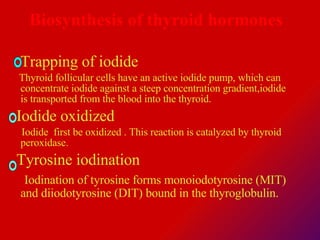
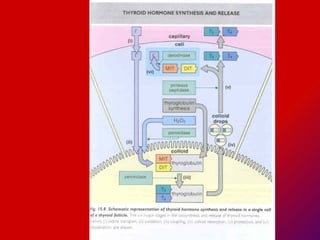
Biosynthesis of thyroid hormones Trapping of iodide Thyroid follicular cells have an active iodide pump, which can concentrate iodide against a steep concentration gradient,iodide is transported from the blood into the thyroid.  Iodide oxidized  Iodide  first be oxidized . This reaction is catalyzed by thyroid peroxidase. Tyrosine iodination  Iodination of tyrosine forms monoiodotyrosine (MIT) and diiodotyrosine (DIT) bound in the thyroglobulin.
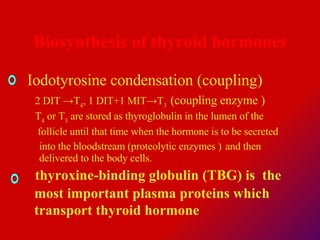
Biosynthesis of thyroid hormones Iodotyrosine condensation (coupling) 2 DIT ->T 4 , 1 DIT+1 MIT->T 3   (coupling enzyme ) T 4  or T 3  are stored as thyroglobulin in the lumen of the  follicle until that time when the hormone is to be secreted into the bloodstream (proteolytic enzymes )   and then   delivered to the body cells. thyroxine-binding globulin (TBG) is  the most important plasma proteins which  transport thyroid hormone
 
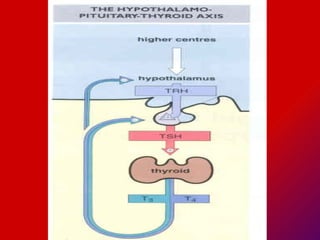
Regulation of thyroid function The thyroid is regulated by thyroid-stimulating hormone (TSH) which is secreted by the anterior pituitary. TSH synthesis and release are stimulated by TSH –releasing hormone (TRH), which is synthesized in the hypothalamus and secreted into the hypophyseal portal which enters the pituitary. In a state of decreased production of thyroid hormone, TSH and TRH are increased. Exogenous thyroid hormone or increased thyroid hormone synthesis causing elevated blood levels inhibits TSH and TRH production. This is called negative feedback. (see Fig)
 
Action of thyroid hormones Growth and development  Nervous system development  increase DNA concentration in the nervous  system and  the number of neurons .   promote maturation of the nervous system  .
Metabolism  promotes heat production  increases glucose absorption  Increases blood cholesterol  accelerates both synthesis and  degradation of protein.
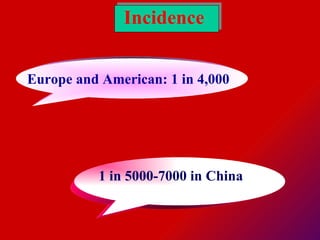
Incidence Europe and American: 1 in 4,000   1 in 5000-7000 in China
Clinical  manifestations Congenital hypothyroidism is twice as common in girls as in boys. The severity of the findings in cases of thyroid deficiency depends on the degree of deficiency of production of thyroid hormone.
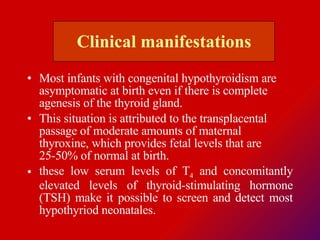
Most infants with congenital hypothyroidism are asymptomatic at birth even if there is complete agenesis of the thyroid gland.  This situation is attributed to the transplacental passage of moderate amounts of maternal thyroxine, which provides fetal levels that are 25-50% of normal at birth.  these low serum levels of T 4  and concomitantly elevated levels of thyroid-stimulating hormone (TSH) make it possible to screen and detect most hypothyriod neonatales.  Clinical  manifestations
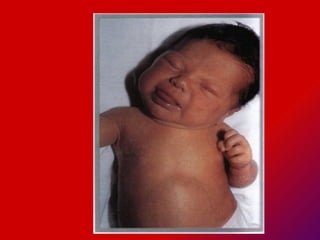
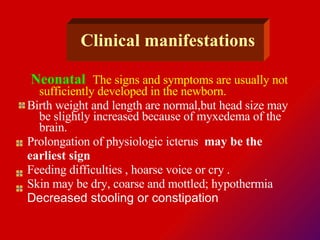
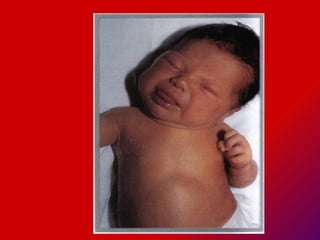
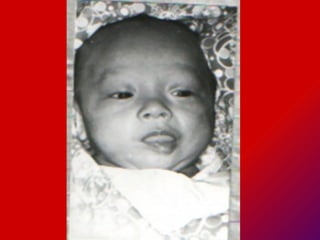
Neonatal  The signs and symptoms are usually not sufficiently developed in the newborn.  Birth weight and length are normal,but head size may be slightly increased because of myxedema of the brain.  Prolongation of physiologic icterus  may be the earliest sign   Feeding difficulties , hoarse voice or cry . Skin may be dry, coarse and mottled; hypothermia   Decreased stooling or constipation Clinical  manifestations
 
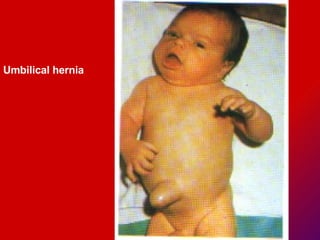
Umbilical hernia
 
Characteristics of typical hypothyroidism Physiological hypofunction. Hypothermia; bradycardia ;diminished  sweating ;hoarse voice or cry ;poor  appetite  sometimes constipation  Clinical  manifestations
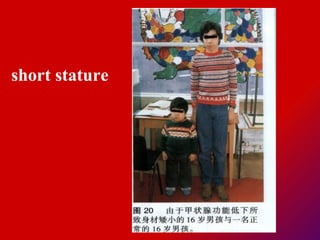
Retardation of growth and development Clinical  manifestations short stature  Delays in formation and eruption of teeth  may occur
short stature
Delay in central nervous system development   Clinical  manifestations Thyroid hormone deficiency presented from birth leads to marked delay in central nervous system development.  Hypothyroid infants appear lethargic and are late in learning to sit, stand and talk  the mental retardation becomes irreversible if treatment is delayed
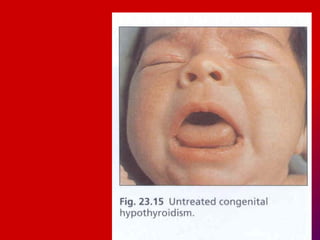
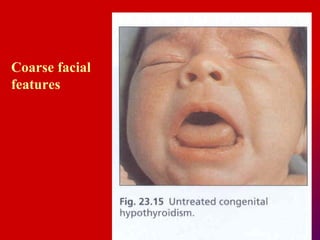
Characteristic facies. Clinical  manifestations The skin may be dry, thick, and scaly  eyes appear far apart; bridge of the nose is depressed  palpebral fissures are narrow and eyelids swollen.  The mouth is kept open, and the thick and broad tongue protrudes from it
Coarse facial features
Laboratory findings   Early diagnosis is very important   Therefore neonatal screening programs is of first importance.  assay  serum  T 4  and TSH or TSH alone .  serum T4 values are very low and TSH concentrations high in a newborn with primary hypothyroidism.
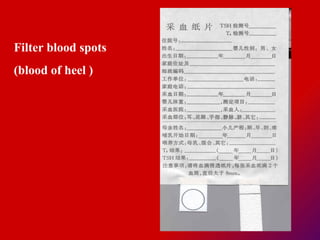
Filter blood spots  (blood of heel )
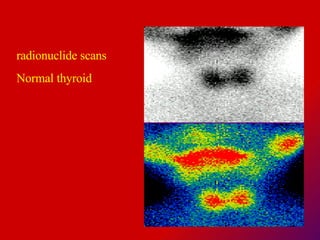
Laboratory findings Serum T 3 , T 4 , TSH.  T 4  TSH Skeletal X-ray (bone age).  Epiphysis development (bone age) is delayed.  Scanning (radioisotope using  99m TC(technetium, a element)) of the thyroid gland.  determine morphological development and function of thyroid.
radionuclide scans  Normal thyroid
Thyriod  under tongue and displasia
Diagnosis  A.Growth Retardation, diminished physical activity, impaired tissue perfusion, constipation, thick tongue, poor muscle tone, hoarseness, anemia; intellectual retardation if the hypothyroid infant is untreated. B. Delayed dental and skeletal maturation C. Thyroid functions studies to show low T 4 ; TSH levels elevated Note:  The importance of the newborn screening procedure must be underscored.
Differential diagnosis Rickets  Down `s syndrome Pituitary dwarfism (Growth hormone deficiency) Congenital giant colon
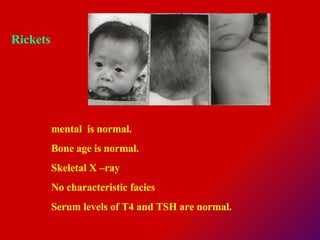
mental  is normal.  Bone age is normal.  Skeletal X –ray No characteristic facies  Serum levels of T4 and TSH are normal.   Rickets
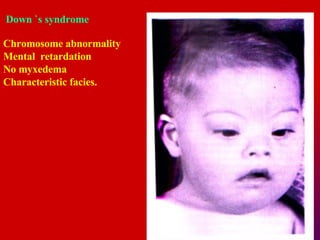
Down `s syndrome Chromosome abnormality Mental  retardation   No myxedema   Characteristic facies.
Pituitary dwarfism (Growth hormone deficiency ) Short stature  Bone age is delayed  Intelligence is usually normal  No characteristic facies or physiological hypofunction.
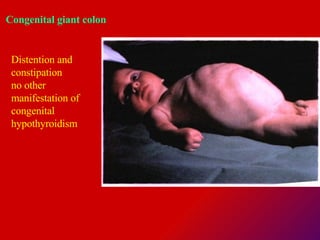
Congenital giant colon   Distention and constipation no other manifestation of congenital hypothyroidism
Treatment  Principle : 1 Treatment of hypothyroidism requires exogenous thyroid hormone  2  Treatment of entire life  3  In order to maintain normal physiological functions. Serum T4, TSH and the condition of  growth and development should be periodically measured during treatment.  4  Dosage should be adjusted according to the  concentration of serum T4, TSH and the states  of growth and development.
Treatment   Dry thyroid   Preparation (drug): Sodium-L thyroxine   a dried and powdered preparation of porcine or bovine thyroid gland.  Synthetic levothyroxine  L-T 4
treatment:   Method of treatment:  start dose(L-T4):infant is 8-14 ug/kg; child is 4ug/kg. Every one to two weeks a dosage are added ,until clinical symptoms  improve , T4 and TSH return to normal ,then a constant dosage are given  Follow up:  One to two weeks are needed initially; every 3 months after dosage stability; every a half of year follow up after 1-2 years.
Prognosis  Early diagnosis and  adequate treatment from the first weeks of life may result in normal linear growth and intelligence.  Delay in diagnosis, inadequate treatment, result in variable degrees of brain damage.  Without treatment, affected infants may become mentally deficient dwarfs.
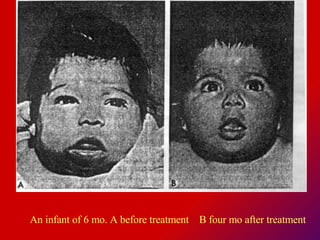
An infant of 6 mo. A before treatment  B four mo after treatment
Key point   1  Main types of Congenital hypothyroidism   2  Etiology :thyroid dysgenesis (aplasia,ectopia );defective  synthesis ;thyrotropin deficiency;thyroid gland or  peripheral target organ unresponsiveness 3  Neonatal earliest sign may be prolongation of  physiologic icterus 4  Characteristic of  typical hypothyroidism(main) 5  Early diagnosis is very important and neonatal screening programs is of first importance 6  Essentials of  diagnosis  7 Principle of treatment  8 Definition of congenital hypothyroidism

Congen~1

  • 1.
    CONGENITAL HYPOTHYROIDISM GeneralHospital of Tianjing Medicine University
  • 2.
  • 3.
  • 4.
    Introduction Congenital hypothyroidism results from deficient production of thyroid hormone or a defect of thyroid hormonal receptor activity. The disorder may be manifested from birth. The major clinical characteristics of congenital hypothyroidism are retardation in growth and mental development.
  • 5.
    Introduction Congenitalhypothyroidism sporadic endemic
  • 6.
  • 7.
    Thyroid dysgenesis Developmentdefects (thyroid dysgenesis) account for 90% of infants in whom hypothyroidism is detected. Aplasia    In about one third, even sensitive radionuclide scans can find no remnants of thyroid tissue . Ectopia In the other two thirds of infants, rudiments of thyroid tissue are found in an ectopic location ,such as lingual thyroid .
  • 8.
    Defective synthesis ofthyroxin A variety of defects in the biosynthesis of thyroid hormone (for example, enzyme deficiency) may result in congenital hypothyroidism. A goiter is almost always present in these patients. These defects are transmitted in an autosomal recessive manner.
  • 9.
    Thyrotropin deficiency multiplehormones deficiency of pituitary or hypothalamus Hypothyriodism is one of many symptoms There are accompanied by hypoglycemia, and other Clinical manifestations
  • 10.
    Thyroid gland orperipheral target organ unresponsiveness (receptor disorder) thyroid tissue does not response to TSH peripheral tissue does not respond to T 4 and T 3
  • 11.
    Biosynthesis of thyroidhormones The major materials for synthesis of thyroid hormone tyrosine iodine
  • 12.
    Biosynthesis of thyroidhormones Trapping of iodide Thyroid follicular cells have an active iodide pump, which can concentrate iodide against a steep concentration gradient,iodide is transported from the blood into the thyroid. Iodide oxidized Iodide first be oxidized . This reaction is catalyzed by thyroid peroxidase. Tyrosine iodination Iodination of tyrosine forms monoiodotyrosine (MIT) and diiodotyrosine (DIT) bound in the thyroglobulin.
  • 13.
    Biosynthesis of thyroidhormones Iodotyrosine condensation (coupling) 2 DIT ->T 4 , 1 DIT+1 MIT->T 3 (coupling enzyme ) T 4 or T 3 are stored as thyroglobulin in the lumen of the follicle until that time when the hormone is to be secreted into the bloodstream (proteolytic enzymes ) and then delivered to the body cells. thyroxine-binding globulin (TBG) is the most important plasma proteins which transport thyroid hormone
  • 14.
  • 15.
    Regulation of thyroidfunction The thyroid is regulated by thyroid-stimulating hormone (TSH) which is secreted by the anterior pituitary. TSH synthesis and release are stimulated by TSH –releasing hormone (TRH), which is synthesized in the hypothalamus and secreted into the hypophyseal portal which enters the pituitary. In a state of decreased production of thyroid hormone, TSH and TRH are increased. Exogenous thyroid hormone or increased thyroid hormone synthesis causing elevated blood levels inhibits TSH and TRH production. This is called negative feedback. (see Fig)
  • 16.
  • 17.
    Action of thyroidhormones Growth and development Nervous system development increase DNA concentration in the nervous system and the number of neurons . promote maturation of the nervous system .
  • 18.
    Metabolism promotesheat production increases glucose absorption Increases blood cholesterol accelerates both synthesis and degradation of protein.
  • 19.
    Incidence Europe andAmerican: 1 in 4,000 1 in 5000-7000 in China
  • 20.
    Clinical manifestationsCongenital hypothyroidism is twice as common in girls as in boys. The severity of the findings in cases of thyroid deficiency depends on the degree of deficiency of production of thyroid hormone.
  • 21.
    Most infants withcongenital hypothyroidism are asymptomatic at birth even if there is complete agenesis of the thyroid gland. This situation is attributed to the transplacental passage of moderate amounts of maternal thyroxine, which provides fetal levels that are 25-50% of normal at birth. these low serum levels of T 4 and concomitantly elevated levels of thyroid-stimulating hormone (TSH) make it possible to screen and detect most hypothyriod neonatales. Clinical manifestations
  • 22.
    Neonatal Thesigns and symptoms are usually not sufficiently developed in the newborn. Birth weight and length are normal,but head size may be slightly increased because of myxedema of the brain. Prolongation of physiologic icterus may be the earliest sign Feeding difficulties , hoarse voice or cry . Skin may be dry, coarse and mottled; hypothermia Decreased stooling or constipation Clinical manifestations
  • 23.
  • 24.
  • 25.
  • 26.
    Characteristics of typicalhypothyroidism Physiological hypofunction. Hypothermia; bradycardia ;diminished sweating ;hoarse voice or cry ;poor appetite sometimes constipation Clinical manifestations
  • 27.
    Retardation of growthand development Clinical manifestations short stature Delays in formation and eruption of teeth may occur
  • 28.
  • 29.
    Delay in centralnervous system development Clinical manifestations Thyroid hormone deficiency presented from birth leads to marked delay in central nervous system development. Hypothyroid infants appear lethargic and are late in learning to sit, stand and talk the mental retardation becomes irreversible if treatment is delayed
  • 30.
    Characteristic facies. Clinical manifestations The skin may be dry, thick, and scaly eyes appear far apart; bridge of the nose is depressed palpebral fissures are narrow and eyelids swollen. The mouth is kept open, and the thick and broad tongue protrudes from it
  • 31.
  • 32.
    Laboratory findings Early diagnosis is very important Therefore neonatal screening programs is of first importance. assay serum T 4 and TSH or TSH alone . serum T4 values are very low and TSH concentrations high in a newborn with primary hypothyroidism.
  • 33.
    Filter blood spots (blood of heel )
  • 34.
    Laboratory findings SerumT 3 , T 4 , TSH. T 4 TSH Skeletal X-ray (bone age). Epiphysis development (bone age) is delayed. Scanning (radioisotope using 99m TC(technetium, a element)) of the thyroid gland. determine morphological development and function of thyroid.
  • 35.
    radionuclide scans Normal thyroid
  • 36.
    Thyriod undertongue and displasia
  • 37.
    Diagnosis A.GrowthRetardation, diminished physical activity, impaired tissue perfusion, constipation, thick tongue, poor muscle tone, hoarseness, anemia; intellectual retardation if the hypothyroid infant is untreated. B. Delayed dental and skeletal maturation C. Thyroid functions studies to show low T 4 ; TSH levels elevated Note: The importance of the newborn screening procedure must be underscored.
  • 38.
    Differential diagnosis Rickets Down `s syndrome Pituitary dwarfism (Growth hormone deficiency) Congenital giant colon
  • 39.
    mental isnormal. Bone age is normal. Skeletal X –ray No characteristic facies Serum levels of T4 and TSH are normal. Rickets
  • 40.
    Down `s syndromeChromosome abnormality Mental retardation No myxedema Characteristic facies.
  • 41.
    Pituitary dwarfism (Growthhormone deficiency ) Short stature Bone age is delayed Intelligence is usually normal No characteristic facies or physiological hypofunction.
  • 42.
    Congenital giant colon Distention and constipation no other manifestation of congenital hypothyroidism
  • 43.
    Treatment Principle: 1 Treatment of hypothyroidism requires exogenous thyroid hormone 2 Treatment of entire life 3 In order to maintain normal physiological functions. Serum T4, TSH and the condition of growth and development should be periodically measured during treatment. 4 Dosage should be adjusted according to the concentration of serum T4, TSH and the states of growth and development.
  • 44.
    Treatment Dry thyroid Preparation (drug): Sodium-L thyroxine a dried and powdered preparation of porcine or bovine thyroid gland. Synthetic levothyroxine L-T 4
  • 45.
    treatment: Method of treatment: start dose(L-T4):infant is 8-14 ug/kg; child is 4ug/kg. Every one to two weeks a dosage are added ,until clinical symptoms improve , T4 and TSH return to normal ,then a constant dosage are given Follow up: One to two weeks are needed initially; every 3 months after dosage stability; every a half of year follow up after 1-2 years.
  • 46.
    Prognosis Earlydiagnosis and adequate treatment from the first weeks of life may result in normal linear growth and intelligence. Delay in diagnosis, inadequate treatment, result in variable degrees of brain damage. Without treatment, affected infants may become mentally deficient dwarfs.
  • 47.
    An infant of6 mo. A before treatment B four mo after treatment
  • 48.
    Key point 1 Main types of Congenital hypothyroidism 2 Etiology :thyroid dysgenesis (aplasia,ectopia );defective synthesis ;thyrotropin deficiency;thyroid gland or peripheral target organ unresponsiveness 3 Neonatal earliest sign may be prolongation of physiologic icterus 4 Characteristic of typical hypothyroidism(main) 5 Early diagnosis is very important and neonatal screening programs is of first importance 6 Essentials of diagnosis 7 Principle of treatment 8 Definition of congenital hypothyroidism