Presented by:
Anish Dhakal
2nd July, 2019
Growth Hormone (GH)
• Most abundant anterior pituitary hormone
• Produced by the pituitary somatotroph cells
• Production begins early in fetal life and
continues throughout the life
Physiology of GH
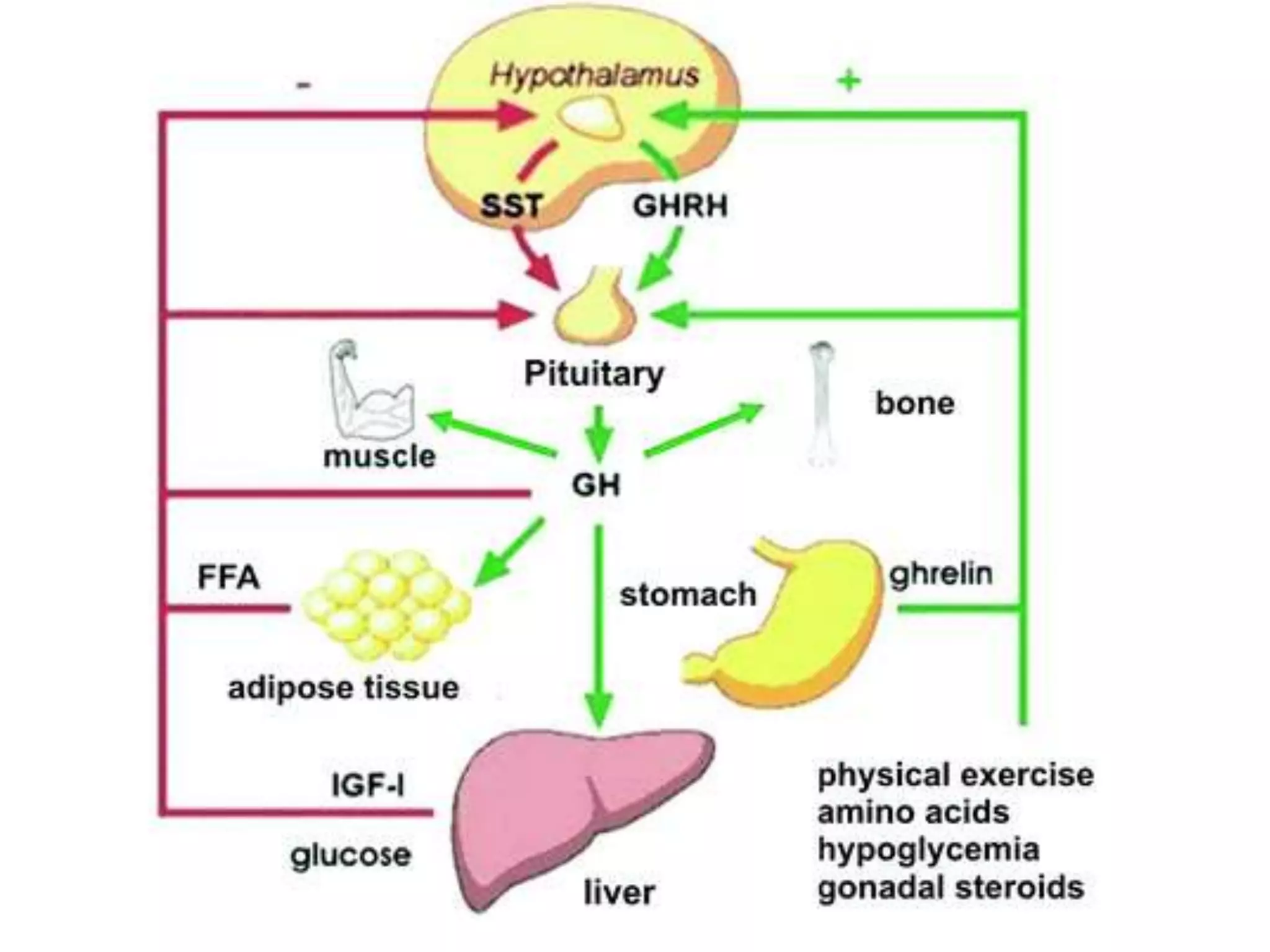
• Hypothalamic + Peripheral factors 
Somatotrophs  Hypothalamic growth hormone-
releasing hormone (GHRH) and somatostatin
(SRIH) stimulate and inhibit GH secretion
• These hormones act by binding to specific cell-
surface receptors on the somatotroph cells
• Daily GH secretory rates decline from a peak of
about 150 mcg/kg during puberty to about 25
mcg/kg by age 55 years
Causes of GHD
• Congenital
• Accquired
Congenital Causes:
Genetic
Isolated GH deficiency
1. Type I: Autosomal
recessive
2. Type II: Autosomal
dominant
3. Type III: X-linked recessive
Multiple pituitary
deficiencies
1. Type I: Autosomal
recessive
2. Type II: X-linked
Idiopathic GHRH deficiency
 Developmental defects
 Pituitary aplasia
 Pituitary hypoplasia
 Anencephaly
 Midfacial anomalies
Acquired Causes:
• Tumors
– Hypothalamic, pituitary and other intracranial tumors
• Irradiation
• Infections
– Encephalitis, meningitis, tuberculosis
• Infiltration
– Histiocytes, hemochromatosis, sarcoidosis
• Injury
– Perinatal insult (breech), head injury, surgery
• Vascular
– Aneurysm, infarction
Clinical Features
• Normal growth at birth
• Growth retardation apparent at 1 year
• Body proportion: Normal
• Overweight over height with markedly
increased subcutaneous fat
• Teeth development is delayed
• Doll like facial appearance
• Delayed bone age: Height age< Bone age and
Chronological age
Clinical Features
• Mid-facial crowding
• Round facies
• Mild Obesity
• Immature facial
appearance
• Depressed nasal bridge
• Frontal bossing
• Prominent philtrum
• High pitched voice
• Increased skin fold
thickness
• Truncal obesity
• Single central incisor
• Hypoplastic penis and
scrotum
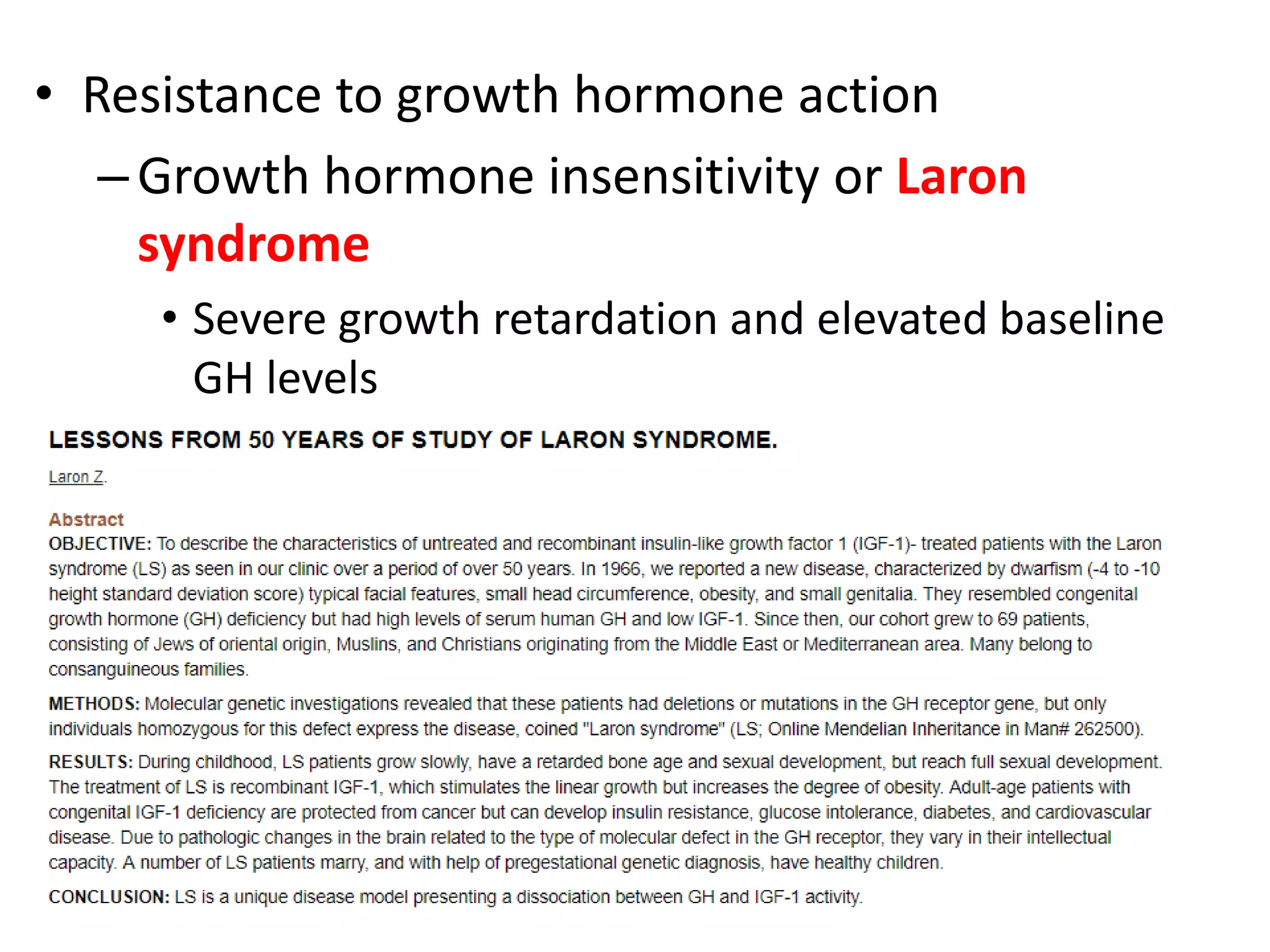
• Resistance to growth hormone action
–Growth hormone insensitivity or Laron
syndrome
• Severe growth retardation and elevated baseline
GH levels
History
• Perinatal history, birth weight and length
• Early indicators of GHD
– History of birth asphyxia, breech presentation,
neonatal hypoglycemia and prolonged jaundice
• Features of chronic illness, CVS, pulmonary
problems, malnutrition and chronic raised
intracranial tension
• Rule out other causes: Diabetes, Renal tubular
acidosis, Hypothyroidism
• Family history: Familial Short Stature
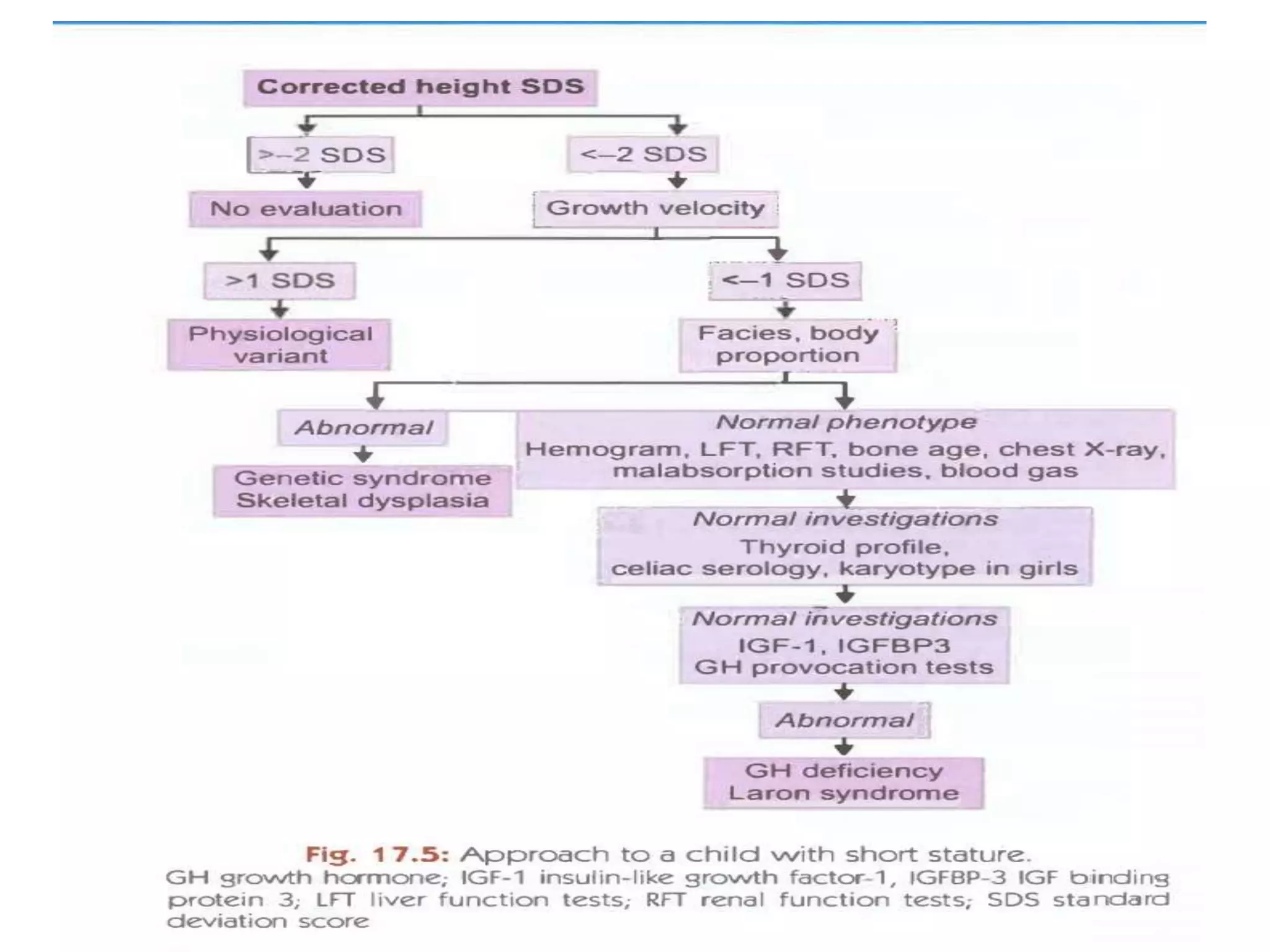
Evaluation
• No work up
– Height > -2 SDS
– Growth velocity above 25th percentile
• Immediate evaluation
– Height - 3 SDS
– Growth velocity below 25th percentile
• Follow up
– Height between -2 to -3 SDS
Examination
• Anthropometry:
Weight, weight for height, head circumference
– Body Proportion
• Lower Segment (LS) : Symphysis Pubis to feet
• Upper Segment (US) : Length – LS
– US : LS - 1.7: 1 at birth  Decrease 0.07-0.1 per year
– 1 : 1 at 7- 10 years of age
Examination
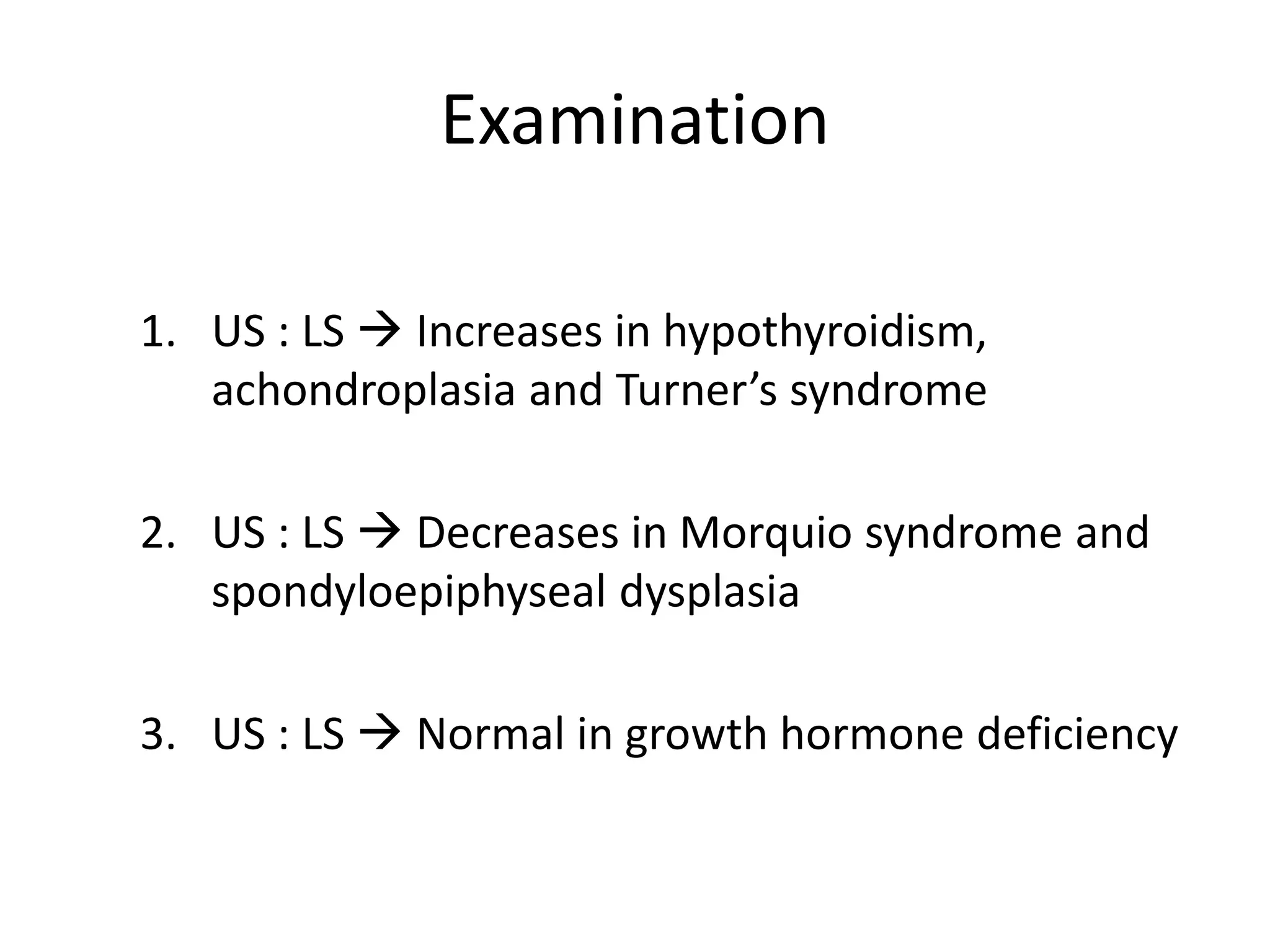
1. US : LS  Increases in hypothyroidism,
achondroplasia and Turner’s syndrome
2. US : LS  Decreases in Morquio syndrome and
spondyloepiphyseal dysplasia
3. US : LS  Normal in growth hormone deficiency
Management
• Correct underlying cause & adequate nutrition
intake
• Nonspecific
– High protein & calorie diet
– Increase physical activity
– Correct iron & vitamin deficiencies
– Zinc supplementation 10 mg/day for 3-6 months
Management
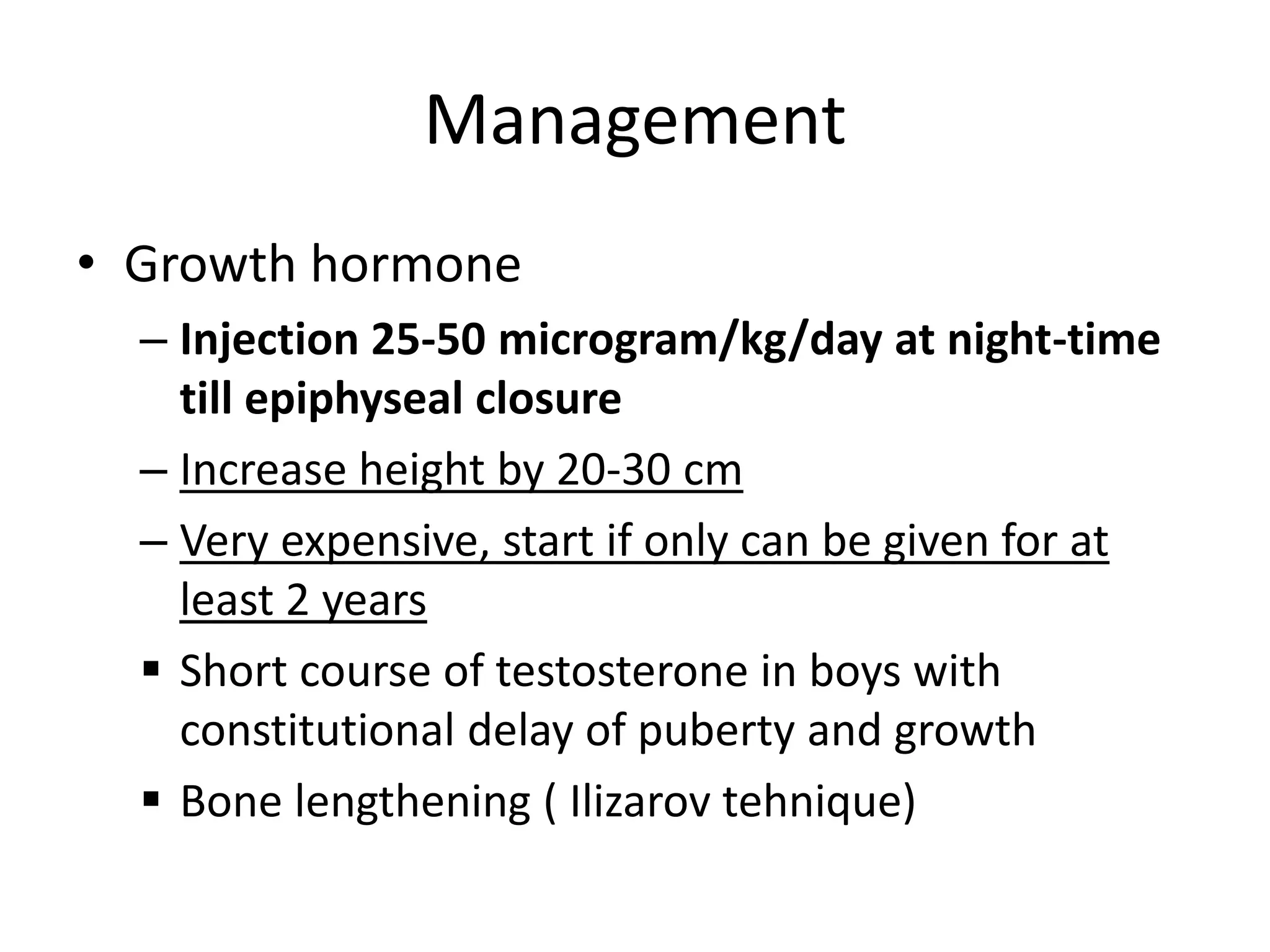
• Growth hormone
– Injection 25-50 microgram/kg/day at night-time
till epiphyseal closure
– Increase height by 20-30 cm
– Very expensive, start if only can be given for at
least 2 years
 Short course of testosterone in boys with
constitutional delay of puberty and growth
 Bone lengthening ( Ilizarov tehnique)
Growth Velocity Expected:
●0 to 6 months – 1 inch (2.5 cm) per month
●7 to 12 months – 0.5 inches (1.25 cm) per month
●12 to 24 months – Usually >4 inches (10 cm) per
year
●24 to 36 months – 3 inches (8 cm) per year
●36 to 48 months – 2.75 inches (7 cm) per year
●4 to 10 years – 2 to 2.4 inches (5 to 6 cm) per year
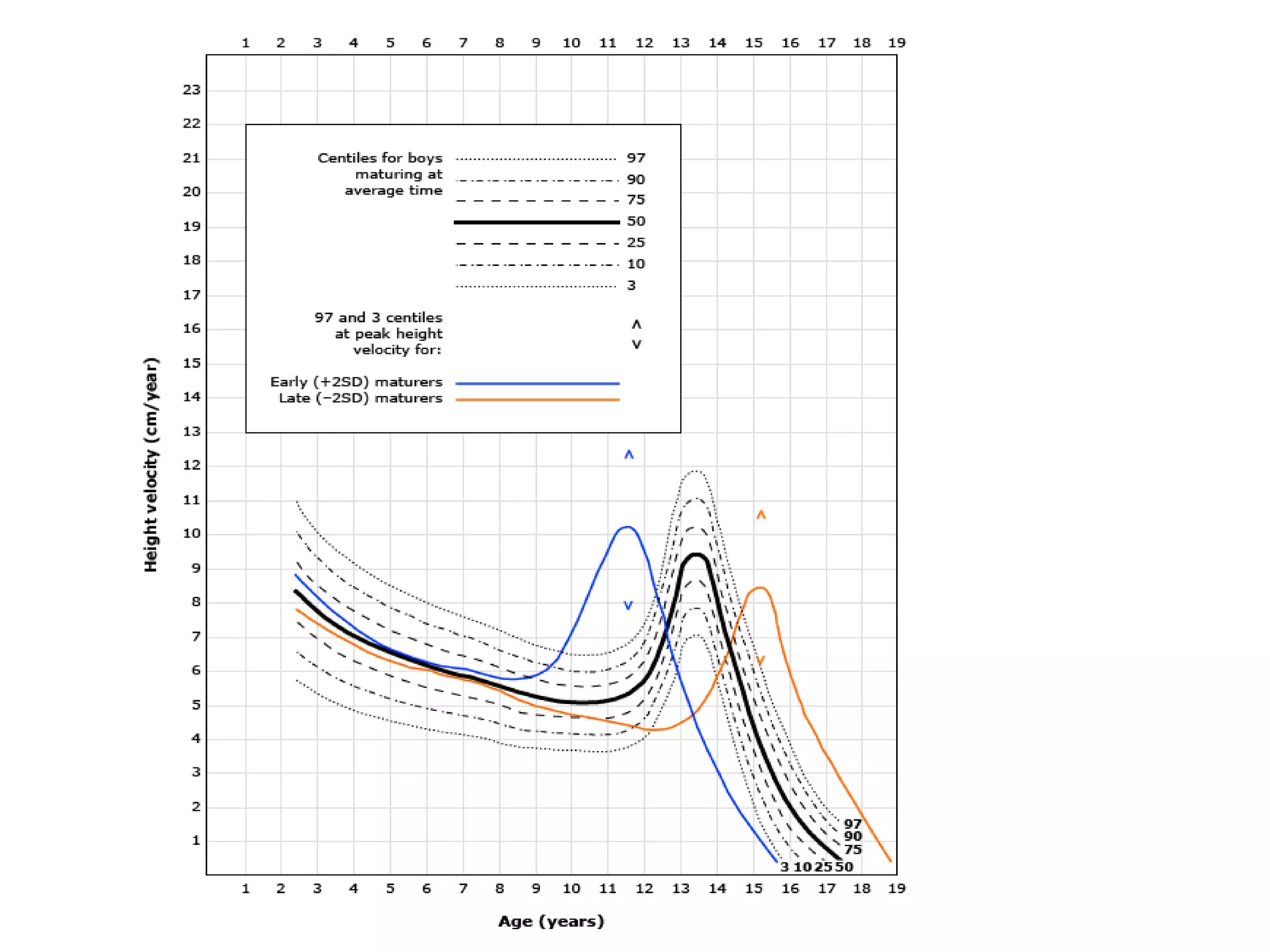
• The child's height velocity should be compared with
curves showing normal height velocity for age in
children without GH deficiency (figure: Age V/S Growth
Velocity)
• During the initial "catch-up" growth period, the
75th percentile curve for height velocity is an
appropriate target to define an adequate growth
response to GH.
• Catch-up growth should continue until the child's
height percentile is in the expected range (eg, at the
height percentile corresponding to the midparental
height).
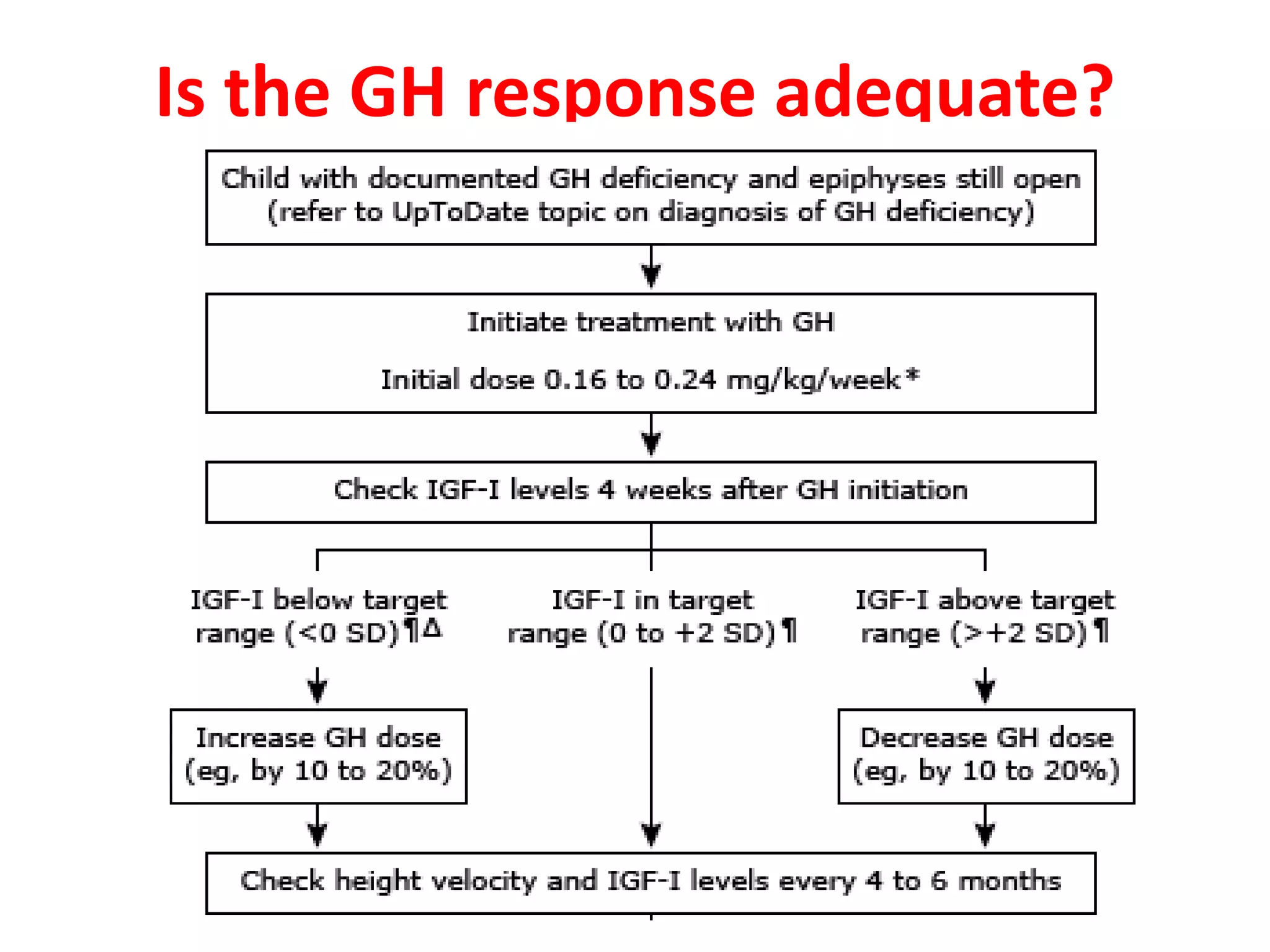
Is the GH response adequate?
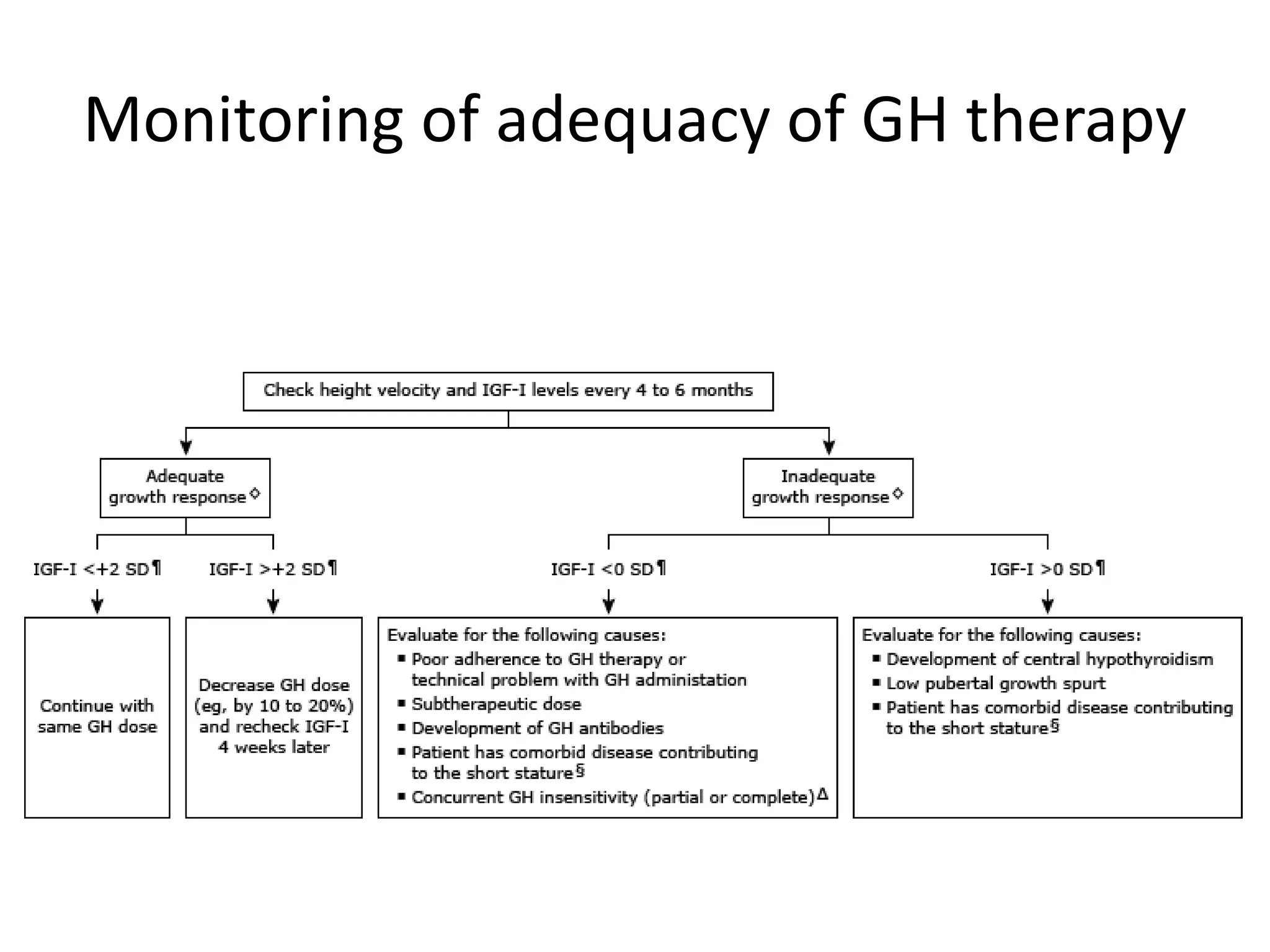
Monitoring of adequacy of GH therapy
Dosing during puberty:
• If a prepubertal patient initially responds well to
GH treatment but then fails to achieve the
expected height velocity of the pubertal growth
spurt, a temporary increase in GH dose (eg, to
70 to 100 micrograms/kg/day) has been
suggested
• However, the 2016 GH consensus guidelines
recommend against the routine use of this
dosing paradigm because the safety and efficacy
are not established.
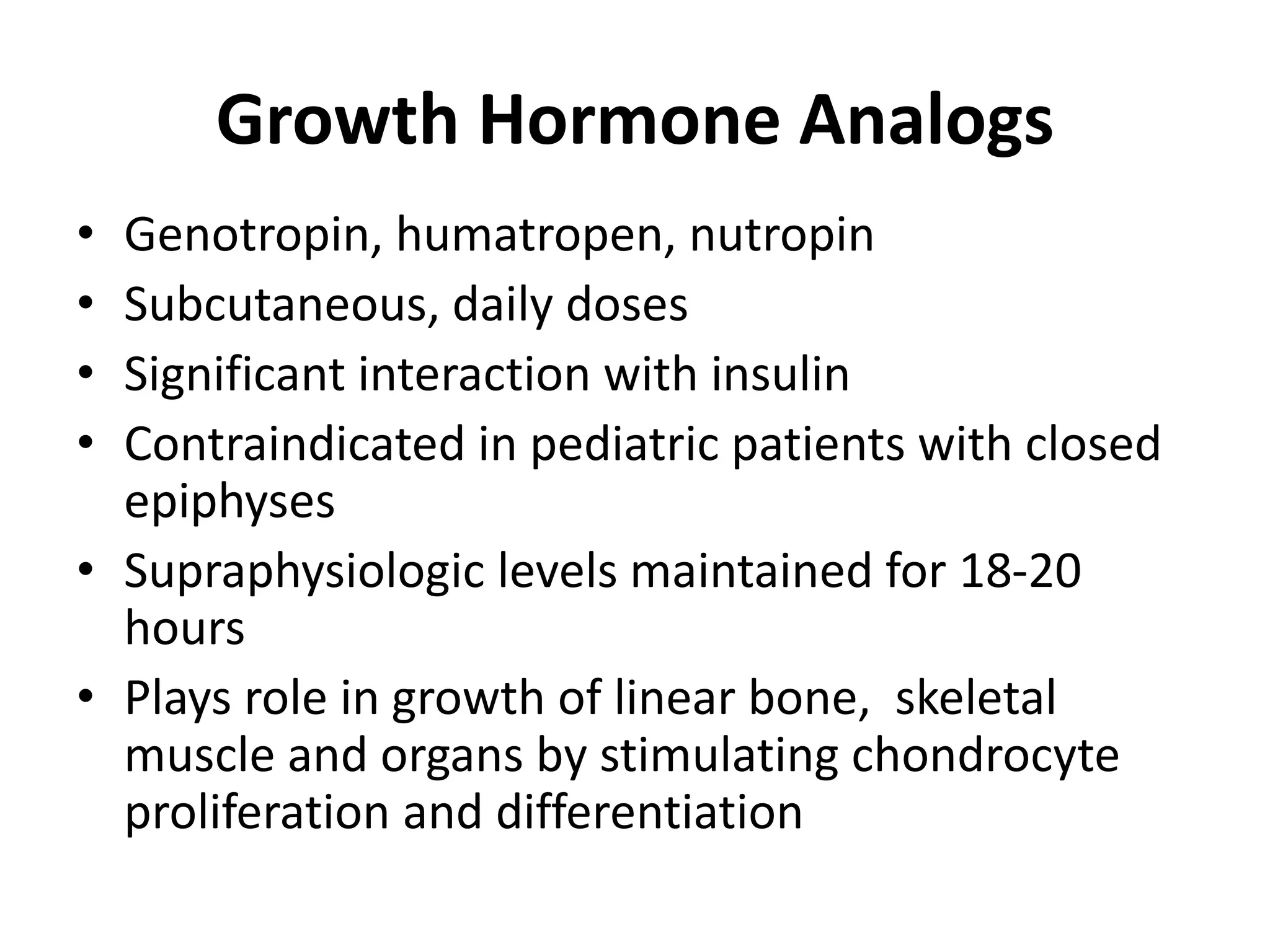
Growth Hormone Analogs
• Genotropin, humatropen, nutropin
• Subcutaneous, daily doses
• Significant interaction with insulin
• Contraindicated in pediatric patients with closed
epiphyses
• Supraphysiologic levels maintained for 18-20
hours
• Plays role in growth of linear bone, skeletal
muscle and organs by stimulating chondrocyte
proliferation and differentiation
• References:
– Essential Pediatrics 8th Edition, OP Ghai
– Nelson Textbook of Pediatrics 20th Edition
– https://www.uptodate.com/contents/normal-
growth-patterns-in-infants-and-prepubertal-
children, N. Juliena, 2018
– https://www.uptodate.com/contents/diagnostic-
approach-to-children-and-adolescents-with-short-
stature, R. Alan et.al
Thank You

Growth Hormone Deficiency in Children

  • 1.
  • 2.
    Growth Hormone (GH) •Most abundant anterior pituitary hormone • Produced by the pituitary somatotroph cells • Production begins early in fetal life and continues throughout the life
  • 4.
    Physiology of GH •Hypothalamic + Peripheral factors  Somatotrophs  Hypothalamic growth hormone- releasing hormone (GHRH) and somatostatin (SRIH) stimulate and inhibit GH secretion • These hormones act by binding to specific cell- surface receptors on the somatotroph cells • Daily GH secretory rates decline from a peak of about 150 mcg/kg during puberty to about 25 mcg/kg by age 55 years
  • 5.
    Causes of GHD •Congenital • Accquired
  • 6.
    Congenital Causes: Genetic Isolated GHdeficiency 1. Type I: Autosomal recessive 2. Type II: Autosomal dominant 3. Type III: X-linked recessive Multiple pituitary deficiencies 1. Type I: Autosomal recessive 2. Type II: X-linked Idiopathic GHRH deficiency  Developmental defects  Pituitary aplasia  Pituitary hypoplasia  Anencephaly  Midfacial anomalies
  • 7.
    Acquired Causes: • Tumors –Hypothalamic, pituitary and other intracranial tumors • Irradiation • Infections – Encephalitis, meningitis, tuberculosis • Infiltration – Histiocytes, hemochromatosis, sarcoidosis • Injury – Perinatal insult (breech), head injury, surgery • Vascular – Aneurysm, infarction
  • 8.
    Clinical Features • Normalgrowth at birth • Growth retardation apparent at 1 year • Body proportion: Normal • Overweight over height with markedly increased subcutaneous fat • Teeth development is delayed • Doll like facial appearance • Delayed bone age: Height age< Bone age and Chronological age
  • 9.
    Clinical Features • Mid-facialcrowding • Round facies • Mild Obesity • Immature facial appearance • Depressed nasal bridge • Frontal bossing • Prominent philtrum • High pitched voice • Increased skin fold thickness • Truncal obesity • Single central incisor • Hypoplastic penis and scrotum
  • 10.
    • Resistance togrowth hormone action –Growth hormone insensitivity or Laron syndrome • Severe growth retardation and elevated baseline GH levels
  • 12.
    History • Perinatal history,birth weight and length • Early indicators of GHD – History of birth asphyxia, breech presentation, neonatal hypoglycemia and prolonged jaundice • Features of chronic illness, CVS, pulmonary problems, malnutrition and chronic raised intracranial tension • Rule out other causes: Diabetes, Renal tubular acidosis, Hypothyroidism • Family history: Familial Short Stature
  • 14.
    Evaluation • No workup – Height > -2 SDS – Growth velocity above 25th percentile • Immediate evaluation – Height - 3 SDS – Growth velocity below 25th percentile • Follow up – Height between -2 to -3 SDS
  • 15.
    Examination • Anthropometry: Weight, weightfor height, head circumference – Body Proportion • Lower Segment (LS) : Symphysis Pubis to feet • Upper Segment (US) : Length – LS – US : LS - 1.7: 1 at birth  Decrease 0.07-0.1 per year – 1 : 1 at 7- 10 years of age
  • 16.
    Examination 1. US :LS  Increases in hypothyroidism, achondroplasia and Turner’s syndrome 2. US : LS  Decreases in Morquio syndrome and spondyloepiphyseal dysplasia 3. US : LS  Normal in growth hormone deficiency
  • 18.
    Management • Correct underlyingcause & adequate nutrition intake • Nonspecific – High protein & calorie diet – Increase physical activity – Correct iron & vitamin deficiencies – Zinc supplementation 10 mg/day for 3-6 months
  • 19.
    Management • Growth hormone –Injection 25-50 microgram/kg/day at night-time till epiphyseal closure – Increase height by 20-30 cm – Very expensive, start if only can be given for at least 2 years  Short course of testosterone in boys with constitutional delay of puberty and growth  Bone lengthening ( Ilizarov tehnique)
  • 20.
    Growth Velocity Expected: ●0to 6 months – 1 inch (2.5 cm) per month ●7 to 12 months – 0.5 inches (1.25 cm) per month ●12 to 24 months – Usually >4 inches (10 cm) per year ●24 to 36 months – 3 inches (8 cm) per year ●36 to 48 months – 2.75 inches (7 cm) per year ●4 to 10 years – 2 to 2.4 inches (5 to 6 cm) per year
  • 21.
    • The child'sheight velocity should be compared with curves showing normal height velocity for age in children without GH deficiency (figure: Age V/S Growth Velocity) • During the initial "catch-up" growth period, the 75th percentile curve for height velocity is an appropriate target to define an adequate growth response to GH. • Catch-up growth should continue until the child's height percentile is in the expected range (eg, at the height percentile corresponding to the midparental height).
  • 24.
    Is the GHresponse adequate?
  • 25.
  • 26.
    Dosing during puberty: •If a prepubertal patient initially responds well to GH treatment but then fails to achieve the expected height velocity of the pubertal growth spurt, a temporary increase in GH dose (eg, to 70 to 100 micrograms/kg/day) has been suggested • However, the 2016 GH consensus guidelines recommend against the routine use of this dosing paradigm because the safety and efficacy are not established.
  • 27.
    Growth Hormone Analogs •Genotropin, humatropen, nutropin • Subcutaneous, daily doses • Significant interaction with insulin • Contraindicated in pediatric patients with closed epiphyses • Supraphysiologic levels maintained for 18-20 hours • Plays role in growth of linear bone, skeletal muscle and organs by stimulating chondrocyte proliferation and differentiation
  • 28.
    • References: – EssentialPediatrics 8th Edition, OP Ghai – Nelson Textbook of Pediatrics 20th Edition – https://www.uptodate.com/contents/normal- growth-patterns-in-infants-and-prepubertal- children, N. Juliena, 2018 – https://www.uptodate.com/contents/diagnostic- approach-to-children-and-adolescents-with-short- stature, R. Alan et.al
  • 29.

Editor's Notes

  • #14 Only after ruling out---systemic illness and hypothyroidism---as they also influence GH-IGF axis GH secretion---pulsatile ---so random measurement---do not give diagnosis Pharmacological stimulation test. Suspected when peak level of GH < 10ng/ml following stimulation Common provocative agent Insulin, glucagon & clonidine Level of IGF-1 and IGF binding protein 3 helpful to diagnose
  • #27 The main evidence behind this strategy comes from a single randomized trial of 48 children with GH deficiency who were treated with either standard-dose GH (43 micrograms/kg/day) or high-dose GH (70 micrograms/kg/day) during puberty By the end of the pubertal growth spurt, children treated with high-dose GH were approximately 3.6 cm taller than those treated with standard-dose GH. The high dose of GH was, in some cases, associated with marked elevations in serum IGF-1 levels and/or symptoms consistent with GH excess (ankle swelling or hip pain). Hence, great care must be employed when using such high doses of GH. Of note, these findings may not be relevant to children whose dose of GH is periodically readjusted during GH therapy based on serum IGF-1 levels, as we suggest above.