1
Future Problem Solving
Brings Critical Elements to
Today’s Education
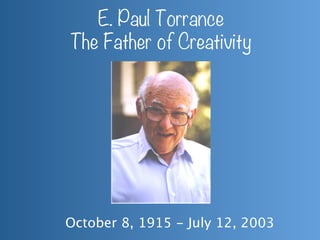
E. Paul Torrance
The Father of Creativity
October 8, 1915 - July 12, 2003
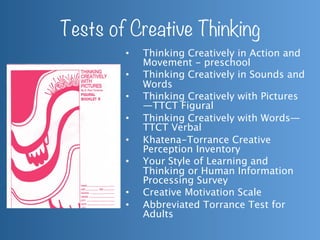
Tests of Creative Thinking
•  Thinking Creatively in Action and
Movement - preschool
•  Thinking Creatively in Sounds and
Words
•  Thinking Creatively with Pictures
—TTCT Figural
•  Thinking Creatively with Words—
TTCT Verbal
•  Khatena-Torrance Creative
Perception Inventory
•  Your Style of Learning and
Thinking or Human Information
Processing Survey
•  Creative Motivation Scale
•  Abbreviated Torrance Test for
Adults
Father of Creativity
By the time he retired from the
University of Georgia as a
Professor Emeritus, he had
published 1, 117 books, articles,
chapters, tests, and book reviews,
as well as delivered countless
speeches and workshops at
national and international sites.
After his retirement, he continued
to remain prolific, authoring
several new books on creativity.
Longitudinal Research with Five Data
Collection Points 1958-2008
•  The 7-year follow-up of high
school students
•  The 12-year follow-up of the
high school students
•  The 22-year follow-up of
elementary school students
•  The 40-year follow-up of
elementary school students
•  The 50-year follow-up of
elementary students
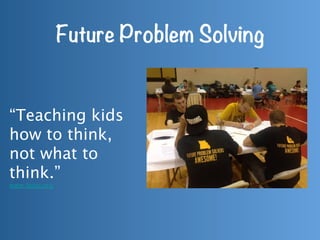
Future Problem Solving
“Teaching kids
how to think,
not what to
think.”
www.fpspi.org
FPS PROGRAM EVALUATION
Three Studies
Conducted 2010 - Present
Quantitative/Longitudinal
Study: Scholastic Testing
Services•  Conducted by Dr. John Kauffman and Dr. Scott Rich
of Scholastic Testing Service, Inc. in conjunction
with FPS
•  5th/6th graders, FPSers and non-FPSers, baseline
TTCT/Figural version; achievement & activities data
•  Full Reassessments when FPSers and non-FPSers
are in 8th/9th grade
•  Final Full Reassessment, 11th/12th grade
•  Annual data on achievement, activities
•  Phase 2: data from Matched-Groups & Matched-
Pairs 2014
2011 testing – Form A of
the TTCT (136 FPS
students; 127 non-FPS
students):

•  The 5/6th (non-FPS) graders on each
of the five selected percentile points
scores were close to, but lower at each
percentile point than the FPSers’
points.
9
2014 testing – Form B of
the TTCT (71 FPS students;
64 non-FPS students):

•  The 8/9th (non-FPS) graders’ scores on
each of the five selected percentile
points were close, but not as close as
they had been on the first testing and
were still lower than the FPSers’
points.
10
PERCENTAGE OF STUDENTS IN
CREATIVITY INDEX SCORE
RANGE INTERVALS:

2011 testing - 5/6th graders, (136 FPS students: 127
non-FPS students):
• 120-139 range - FPSers’ scores were higher than the
non-FPSers’ scores.
• 140+ range - FPSers’ scores were appreciably higher
than the non-FPSers’ scores.
• The mean score for the FPSers was 123.0 compared
to 118.3 for the non-FPSers’ mean score.
11


2014 testing: 8/9th graders, (71 FPS
students; 64 non-FPS students)

•  120-139 range - Non-FPSers’ scores
were higher than the FPSers’ scores.
•  140+ range - FPSers’ scores were
appreciably higher than the non-
FPSers’ scores.
•  The mean score for the FPSers was
131.9 compared to 124.4 for the non-
FPSers’ mean score.
12
Qualitative Study: Center for
Creative Learning
•  Conducted by Dr. Donald Treffinger and Dr.
Ed Selby, Center for Creative Learning, Inc.
•  Study of FPS’s Affiliate Directors, coaches,
evaluators, parents, students
•  Very favorable – stated goals are met
•  Recommendations suggested & being
worked on via Strategic Plan
•  Summary written by Dr. Treffinger available
The purposes of this project were to
survey key stakeholders in the
program on:
1.  the extent to which FPSPI meets its stated
goals (i.e., does what it purports to do);
2.  the strengths of the program and areas in
which improvement may be needed; and,
3.  the impact of the program on its
participants.
14
FPS Program Goals
1.  Develop & use creative thinking skills
2.  Learn about complex issues, which will shape
the future
3.  Develop an active interest in the future
4.  Develop & use written & verbal communication
skills
5.  Learn & utilize problem-solving strategies
6.  Develop & use teamwork skills
7.  Develop & use research skills
8.  Develop & use critical & analytical thinking
skills
What Respondents Would Tell
Others
§  Excellent/great program/ highly recommend
(AD, Coach, Parent, Student)
§  Teaches important life skills (AD, Coaches)
§  Develops problem-solving skills (AD, Coaches,
Parents, Students)
§  Develops advanced thinking skills (AD, Coaches,
Parents)
§  Develops creativity skills (AD, Coaches,
Parents)
§  Makes students think about world around them
(Parents, Students)
§  Fun program (Students)
§  Challenging/hard work (Students)
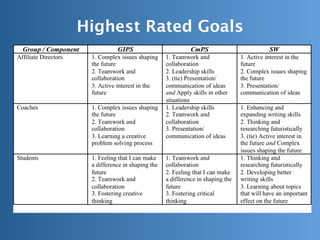
Highest Rated Goals
Second Generation Study –
University of Virginia
•  Dr. Carolyn Callahan’s doctoral students
•  Phase 1 – Over 150 former FPSers, present
leaders, open-ended survey
•  Phase 2 – 15 former FPSers from Phase 1
selected for variety of representation,
interview
RECURRING THEMES:
collaboration, communication, coach impact
Initial Reasons for Taking on
Adult Role in FPS
•  Stay in touch with people & FPS
organization
•  Give back to the program
•  Strong ties & interest in FPS
•  Proactive attitude –doing more to help
•  Unique academic opportunity for
high-level challenge
IMPORTANT THEME throughout –
rigorous academic & creative
Motivations to Stay Involved
•  Deeply-rooted belief in the program &
its positive impact
•  Valuing of the FPS skills
•  Applicability of the skills to their
studies, their careers, their personal
lives
•  Noted scarce opportunities available
for students in schools to use these
skills
•  93% said they use these skills in their
current lives
Definite Awareness of the
Future
•  Definite increase in awareness of the future,
especially on global political & environmental
issues
•  More open-minded
•  See issues in the problem solving context
•  Systematic approach to understanding &
evaluation to be best reaction to serious issues
•  Systematic approach is what sets former FPSers
apart from their non-FPS colleagues & friends
•  Investigating diverse approaches, thinking
about creative solutions & seeking alternatives
22
Dissimilarity in Personality 

a Plus!
•  Diversity fueled team creativity
•  Teams overcame challenges &
seeming barriers and ended up
VALUING diversity
•  Coach very important for team
development
Major Strength Reported –
Maximizing Abilities
•  Maximizing strengths & abilities of
individual members
•  Individual members felt empowered
when others proficient where they are
not as strong
•  Work toward FPS success: requires
different sets of skills: creativity,
efficiency, time management, research
skills, communication skills
Shouldn’t You Be Offering FPS
to Your Students?
•  Resources for all components available
•  Mentoring available
•  Novice divisions & Adult Divisions
offered
•  Virtual program offered - ROCS
•  Trainings offered
26


Manifesto for Children

E. Paul Torrance


  1.      Don’t be afraid to fall in love with something
and pursue it with intensity.

 2.    Know, understand, take pride in, practice,
develop, exploit, and enjoy your greatest strengths.

 3.    Learn to free yourself from the expectations of
others and to walk away from the games they impose
on you.  Free yourself to play your own game.

 4.    Find a great teacher or mentor who will help
you.

 5.    Don’t waste energy trying to be well rounded.

 6.    Do what you love and can do well.

 7.  Learn the skills of interdependence.
27

Future Problem Solving

  • 1.
    1 Future Problem Solving BringsCritical Elements to Today’s Education
  • 2.
    E. Paul Torrance TheFather of Creativity October 8, 1915 - July 12, 2003
  • 3.
    Tests of CreativeThinking •  Thinking Creatively in Action and Movement - preschool •  Thinking Creatively in Sounds and Words •  Thinking Creatively with Pictures —TTCT Figural •  Thinking Creatively with Words— TTCT Verbal •  Khatena-Torrance Creative Perception Inventory •  Your Style of Learning and Thinking or Human Information Processing Survey •  Creative Motivation Scale •  Abbreviated Torrance Test for Adults
  • 4.
    Father of Creativity Bythe time he retired from the University of Georgia as a Professor Emeritus, he had published 1, 117 books, articles, chapters, tests, and book reviews, as well as delivered countless speeches and workshops at national and international sites. After his retirement, he continued to remain prolific, authoring several new books on creativity.
  • 5.
    Longitudinal Research withFive Data Collection Points 1958-2008 •  The 7-year follow-up of high school students •  The 12-year follow-up of the high school students •  The 22-year follow-up of elementary school students •  The 40-year follow-up of elementary school students •  The 50-year follow-up of elementary students
  • 6.
    Future Problem Solving “Teachingkids how to think, not what to think.” www.fpspi.org
  • 7.
    FPS PROGRAM EVALUATION ThreeStudies Conducted 2010 - Present
  • 8.
    Quantitative/Longitudinal Study: Scholastic Testing Services• Conducted by Dr. John Kauffman and Dr. Scott Rich of Scholastic Testing Service, Inc. in conjunction with FPS •  5th/6th graders, FPSers and non-FPSers, baseline TTCT/Figural version; achievement & activities data •  Full Reassessments when FPSers and non-FPSers are in 8th/9th grade •  Final Full Reassessment, 11th/12th grade •  Annual data on achievement, activities •  Phase 2: data from Matched-Groups & Matched- Pairs 2014
  • 9.
    2011 testing –Form A of the TTCT (136 FPS students; 127 non-FPS students):
 •  The 5/6th (non-FPS) graders on each of the five selected percentile points scores were close to, but lower at each percentile point than the FPSers’ points. 9
  • 10.
    2014 testing –Form B of the TTCT (71 FPS students; 64 non-FPS students):
 •  The 8/9th (non-FPS) graders’ scores on each of the five selected percentile points were close, but not as close as they had been on the first testing and were still lower than the FPSers’ points. 10
  • 11.
    PERCENTAGE OF STUDENTSIN CREATIVITY INDEX SCORE RANGE INTERVALS:
 2011 testing - 5/6th graders, (136 FPS students: 127 non-FPS students): • 120-139 range - FPSers’ scores were higher than the non-FPSers’ scores. • 140+ range - FPSers’ scores were appreciably higher than the non-FPSers’ scores. • The mean score for the FPSers was 123.0 compared to 118.3 for the non-FPSers’ mean score. 11
  • 12.
    
 2014 testing: 8/9thgraders, (71 FPS students; 64 non-FPS students)
 •  120-139 range - Non-FPSers’ scores were higher than the FPSers’ scores. •  140+ range - FPSers’ scores were appreciably higher than the non- FPSers’ scores. •  The mean score for the FPSers was 131.9 compared to 124.4 for the non- FPSers’ mean score. 12
  • 13.
    Qualitative Study: Centerfor Creative Learning •  Conducted by Dr. Donald Treffinger and Dr. Ed Selby, Center for Creative Learning, Inc. •  Study of FPS’s Affiliate Directors, coaches, evaluators, parents, students •  Very favorable – stated goals are met •  Recommendations suggested & being worked on via Strategic Plan •  Summary written by Dr. Treffinger available
  • 14.
    The purposes ofthis project were to survey key stakeholders in the program on: 1.  the extent to which FPSPI meets its stated goals (i.e., does what it purports to do); 2.  the strengths of the program and areas in which improvement may be needed; and, 3.  the impact of the program on its participants. 14
  • 15.
    FPS Program Goals 1. Develop & use creative thinking skills 2.  Learn about complex issues, which will shape the future 3.  Develop an active interest in the future 4.  Develop & use written & verbal communication skills 5.  Learn & utilize problem-solving strategies 6.  Develop & use teamwork skills 7.  Develop & use research skills 8.  Develop & use critical & analytical thinking skills
  • 16.
    What Respondents WouldTell Others §  Excellent/great program/ highly recommend (AD, Coach, Parent, Student) §  Teaches important life skills (AD, Coaches) §  Develops problem-solving skills (AD, Coaches, Parents, Students) §  Develops advanced thinking skills (AD, Coaches, Parents) §  Develops creativity skills (AD, Coaches, Parents) §  Makes students think about world around them (Parents, Students) §  Fun program (Students) §  Challenging/hard work (Students)
  • 17.
  • 18.
    Second Generation Study– University of Virginia •  Dr. Carolyn Callahan’s doctoral students •  Phase 1 – Over 150 former FPSers, present leaders, open-ended survey •  Phase 2 – 15 former FPSers from Phase 1 selected for variety of representation, interview RECURRING THEMES: collaboration, communication, coach impact
  • 19.
    Initial Reasons forTaking on Adult Role in FPS •  Stay in touch with people & FPS organization •  Give back to the program •  Strong ties & interest in FPS •  Proactive attitude –doing more to help •  Unique academic opportunity for high-level challenge IMPORTANT THEME throughout – rigorous academic & creative
  • 20.
    Motivations to StayInvolved •  Deeply-rooted belief in the program & its positive impact •  Valuing of the FPS skills •  Applicability of the skills to their studies, their careers, their personal lives •  Noted scarce opportunities available for students in schools to use these skills •  93% said they use these skills in their current lives
  • 21.
    Definite Awareness ofthe Future •  Definite increase in awareness of the future, especially on global political & environmental issues •  More open-minded •  See issues in the problem solving context •  Systematic approach to understanding & evaluation to be best reaction to serious issues •  Systematic approach is what sets former FPSers apart from their non-FPS colleagues & friends •  Investigating diverse approaches, thinking about creative solutions & seeking alternatives
  • 22.
  • 23.
    Dissimilarity in Personality
 a Plus! •  Diversity fueled team creativity •  Teams overcame challenges & seeming barriers and ended up VALUING diversity •  Coach very important for team development
  • 24.
    Major Strength Reported– Maximizing Abilities •  Maximizing strengths & abilities of individual members •  Individual members felt empowered when others proficient where they are not as strong •  Work toward FPS success: requires different sets of skills: creativity, efficiency, time management, research skills, communication skills
  • 25.
    Shouldn’t You BeOffering FPS to Your Students? •  Resources for all components available •  Mentoring available •  Novice divisions & Adult Divisions offered •  Virtual program offered - ROCS •  Trainings offered
  • 26.
    26 
 
 
 Manifesto for Children
 E.Paul Torrance
 
   1.      Don’t be afraid to fall in love with something and pursue it with intensity.
  2.    Know, understand, take pride in, practice, develop, exploit, and enjoy your greatest strengths.
  3.    Learn to free yourself from the expectations of others and to walk away from the games they impose on you.  Free yourself to play your own game.
  4.    Find a great teacher or mentor who will help you.
  5.    Don’t waste energy trying to be well rounded.
  6.    Do what you love and can do well.
  7.  Learn the skills of interdependence.
  • 27.