Designing the Future:
Cultivating the
Learning Ecosystem
Katherine Prince • Jason Swanson
July 25, 2015
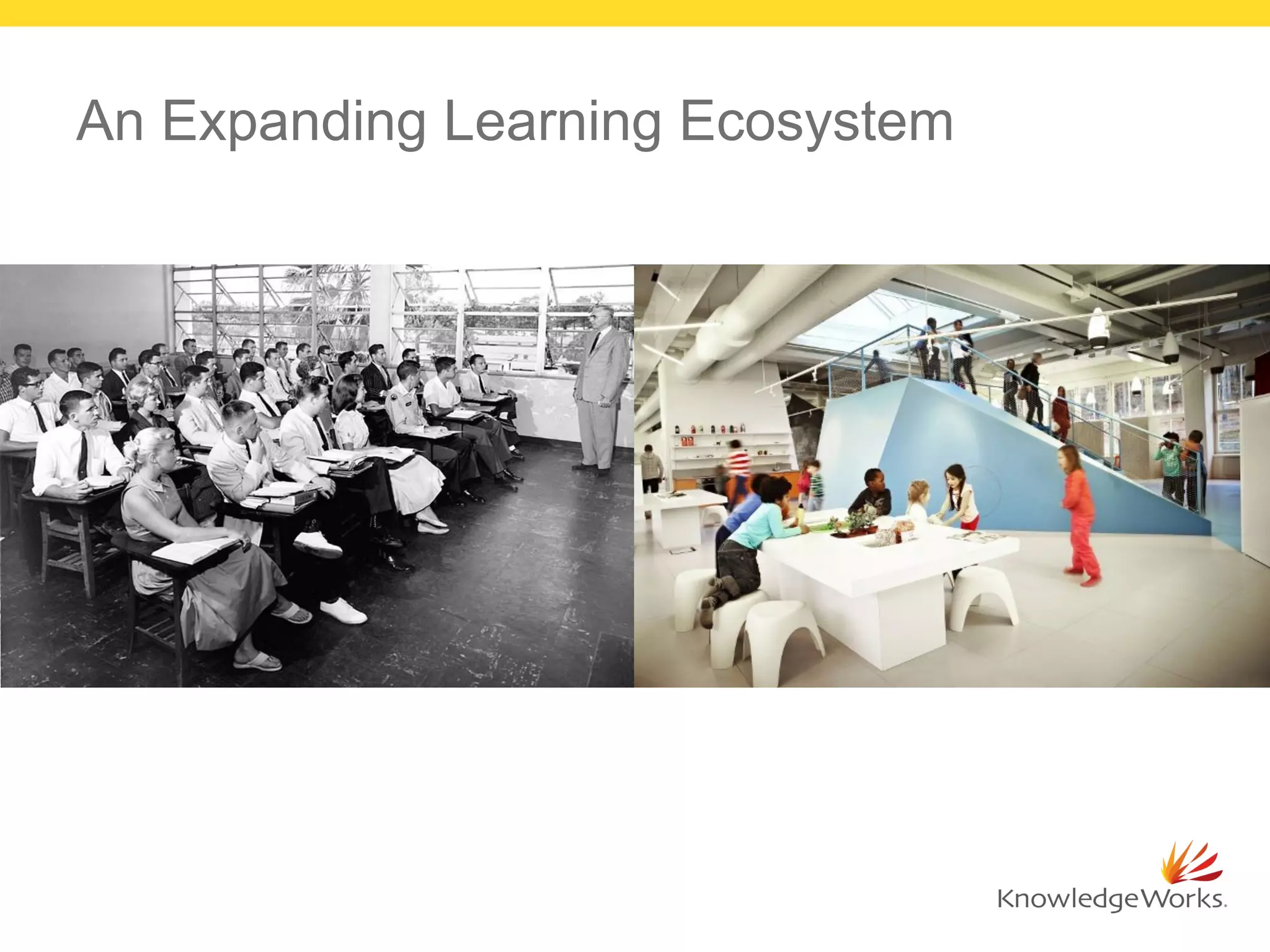
An Expanding Learning Ecosystem
Cultivating Ecosystem
Interconnections
•  What kinds of learning ecosystem
interconnections might help participants create
vibrant learning ecosystems?
•  What might learning ecosystems look like in
different high-need geographies?
Defining Learning Ecosystems
A learning ecosystem is a network of relationships
among learning agents, learners, resources and
assets in a specific social, economic, and
geographic context.
Vibrant Learning Ecosystems Are…
•  Learner Centered
•  Equitable
•  Modular and Interoperable
•  Resilient
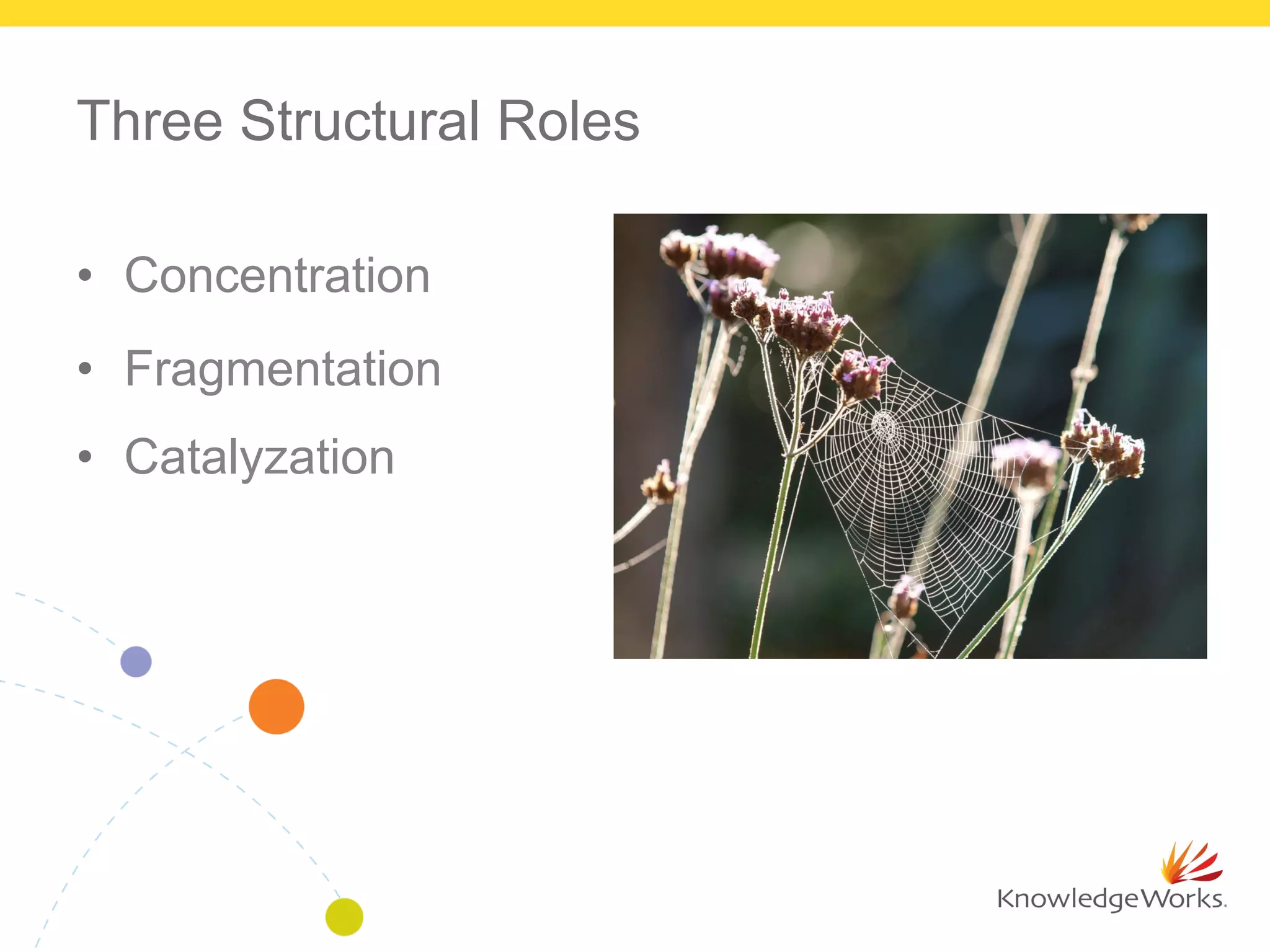
Three Structural Roles
•  Concentration
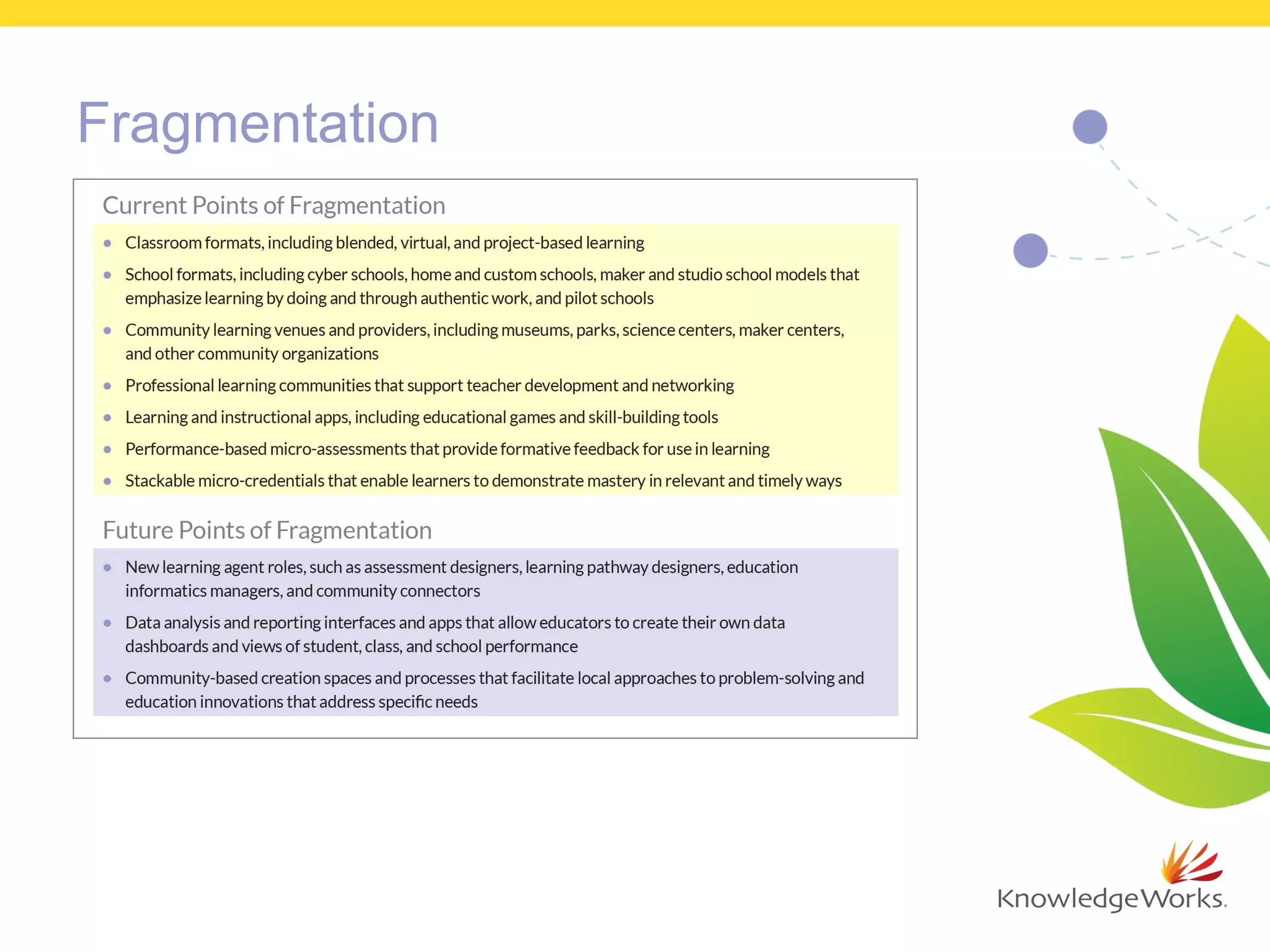
•  Fragmentation
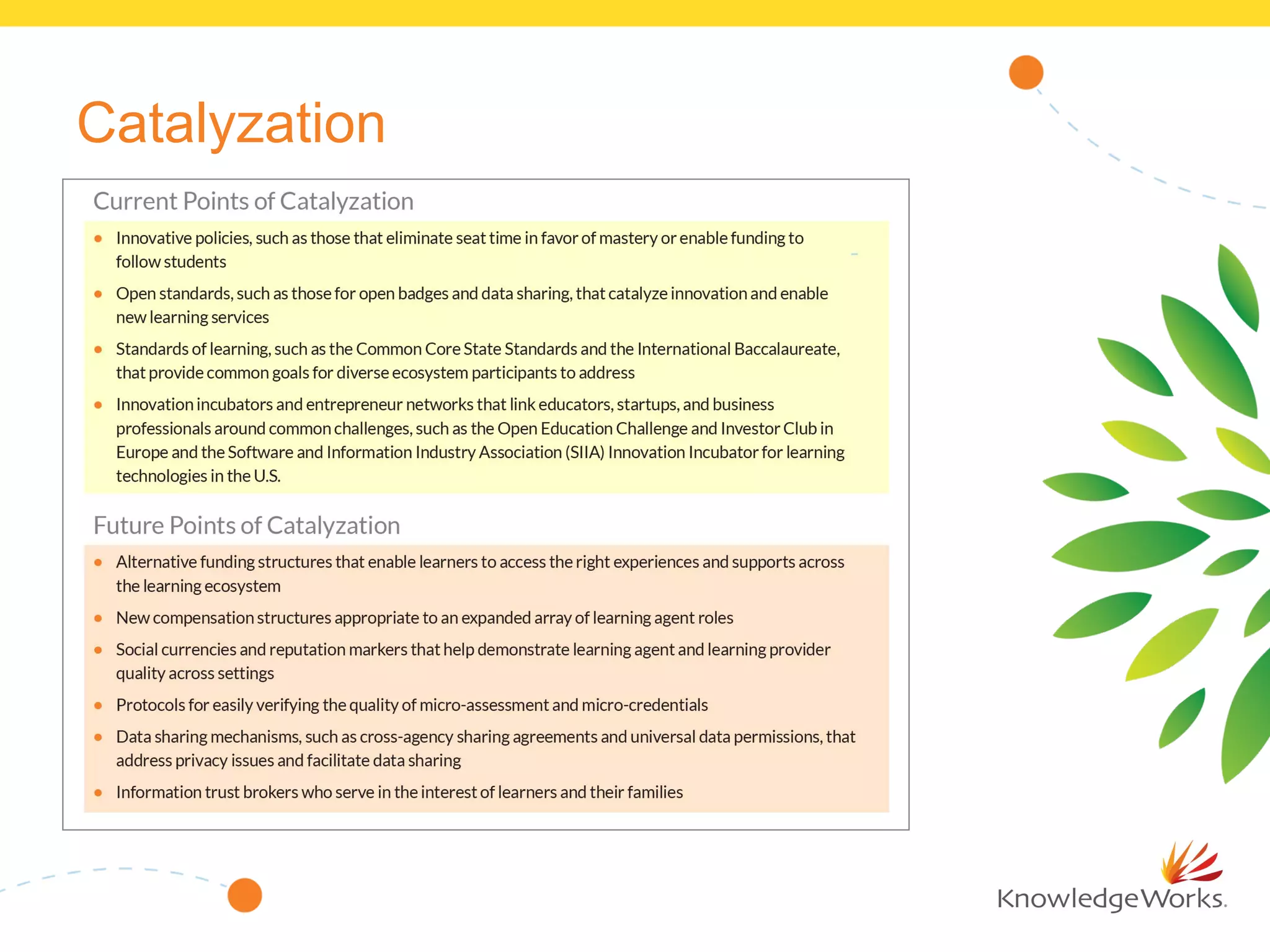
•  Catalyzation
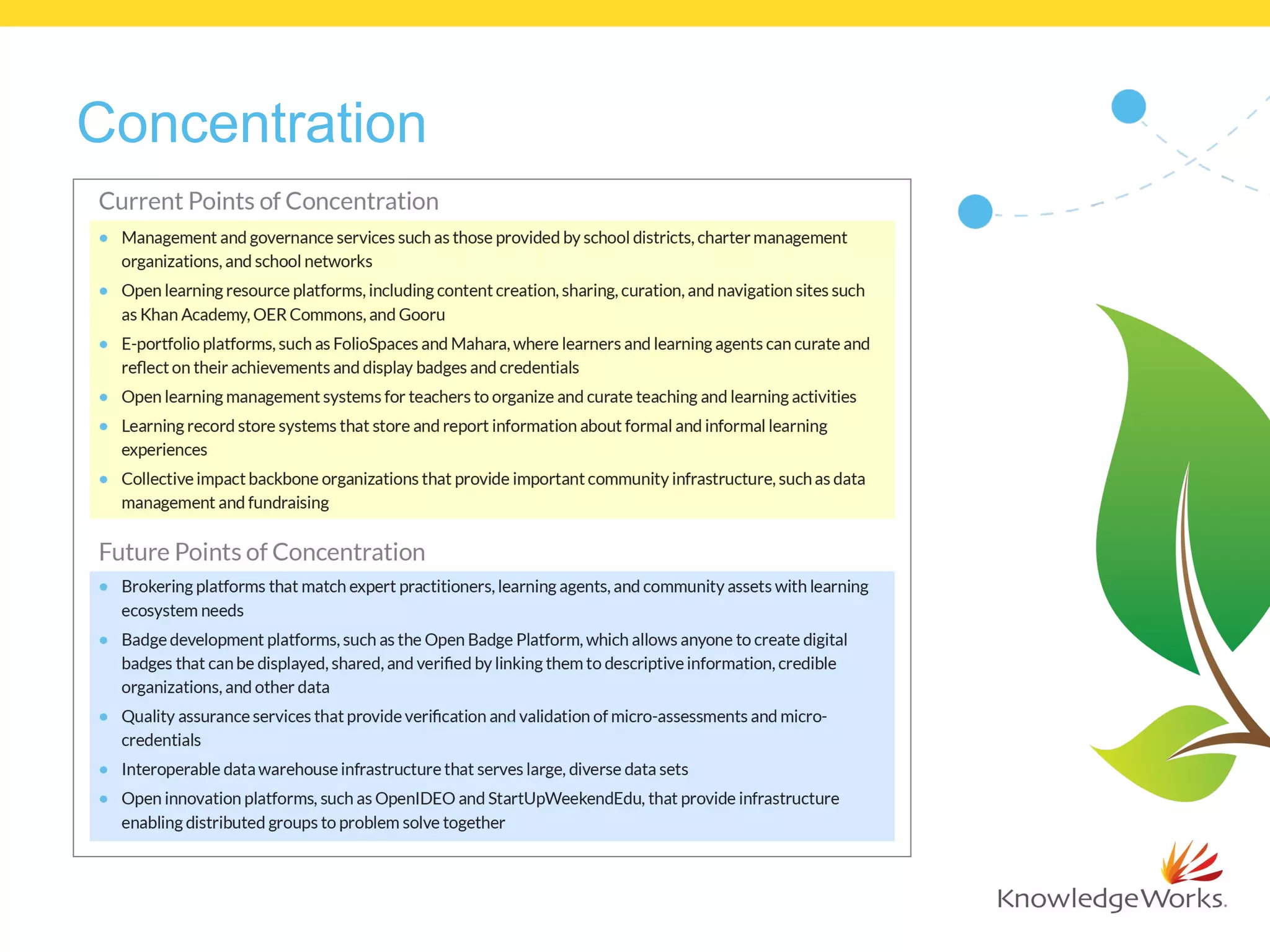
Concentration
•  Providers of core infrastructure, aggregation,
and brokering services create process
efficiencies through scale.
Fragmentation
•  Providers of core infrastructure, aggregation,
and brokering services create process
efficiencies through scale.
Catalyzation
•  Connectors mobilize cross-boundary initiatives,
bridge ecosystem gaps, and forge shared goals.
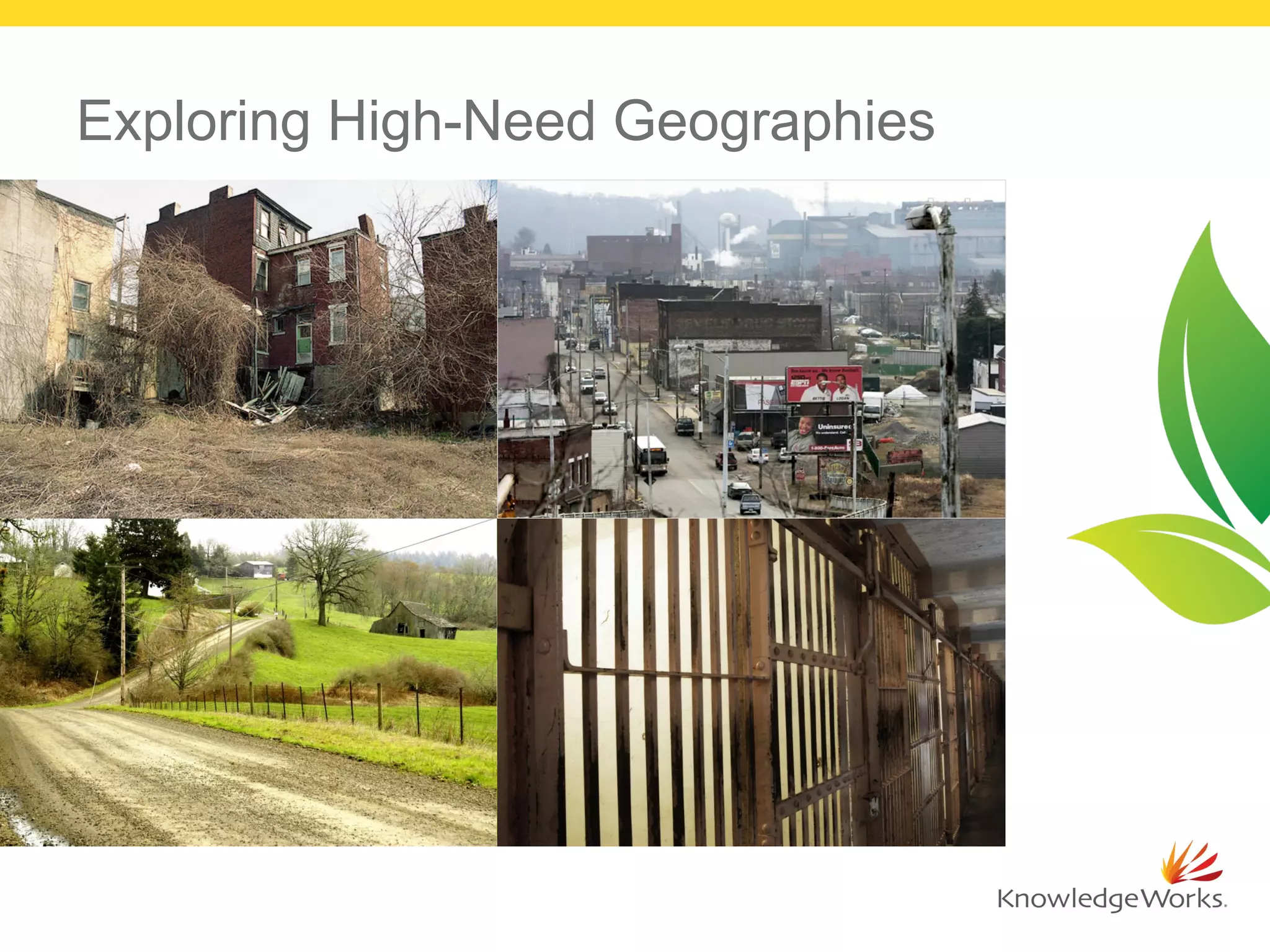
Exploring High-Need Geographies
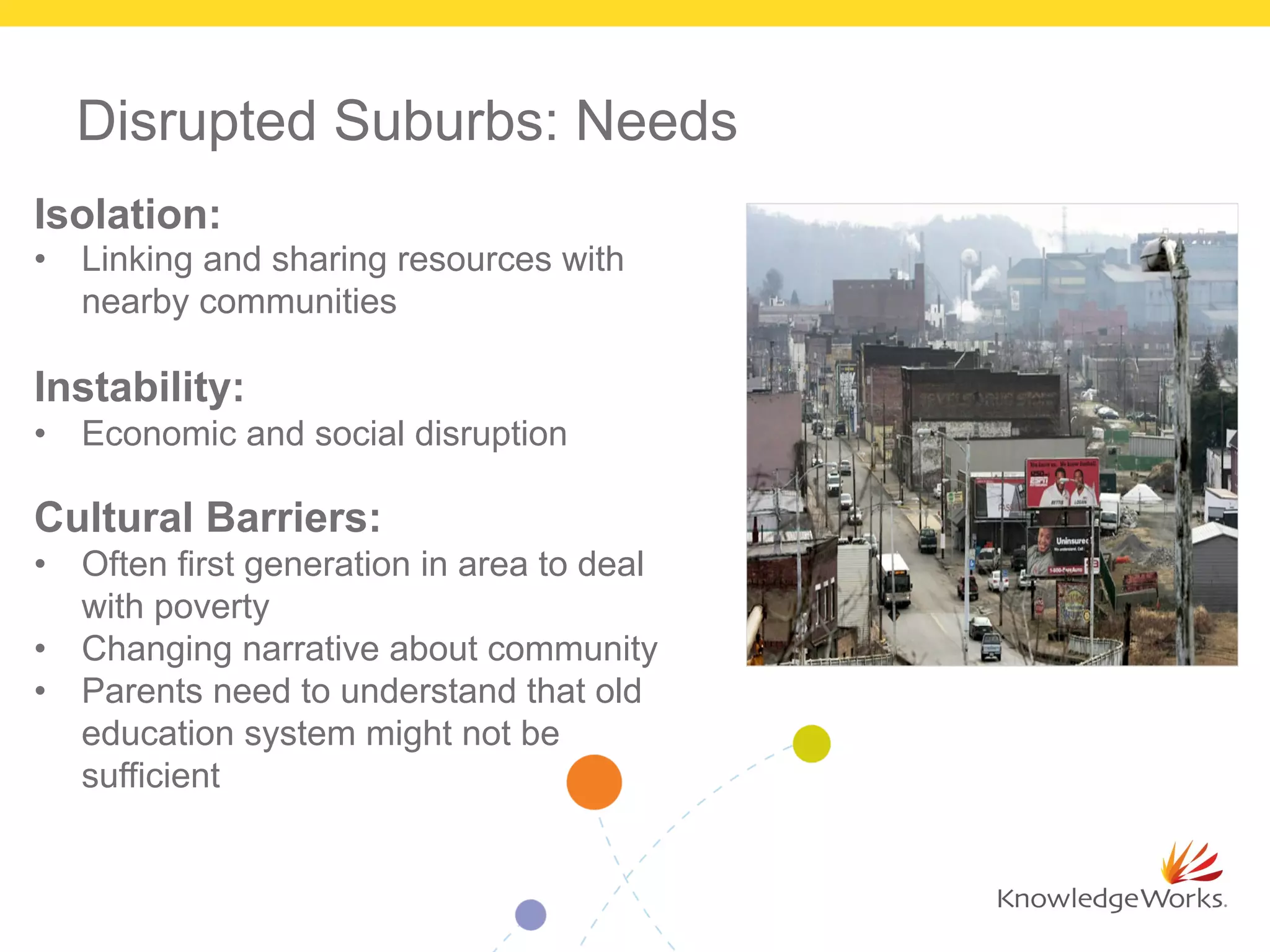
Disrupted Suburbs: Needs
Isolation:
•  Linking and sharing resources with
nearby communities
Instability:
•  Economic and social disruption
Cultural Barriers:
•  Often first generation in area to deal
with poverty
•  Changing narrative about community
•  Parents need to understand that old
education system might not be
sufficient
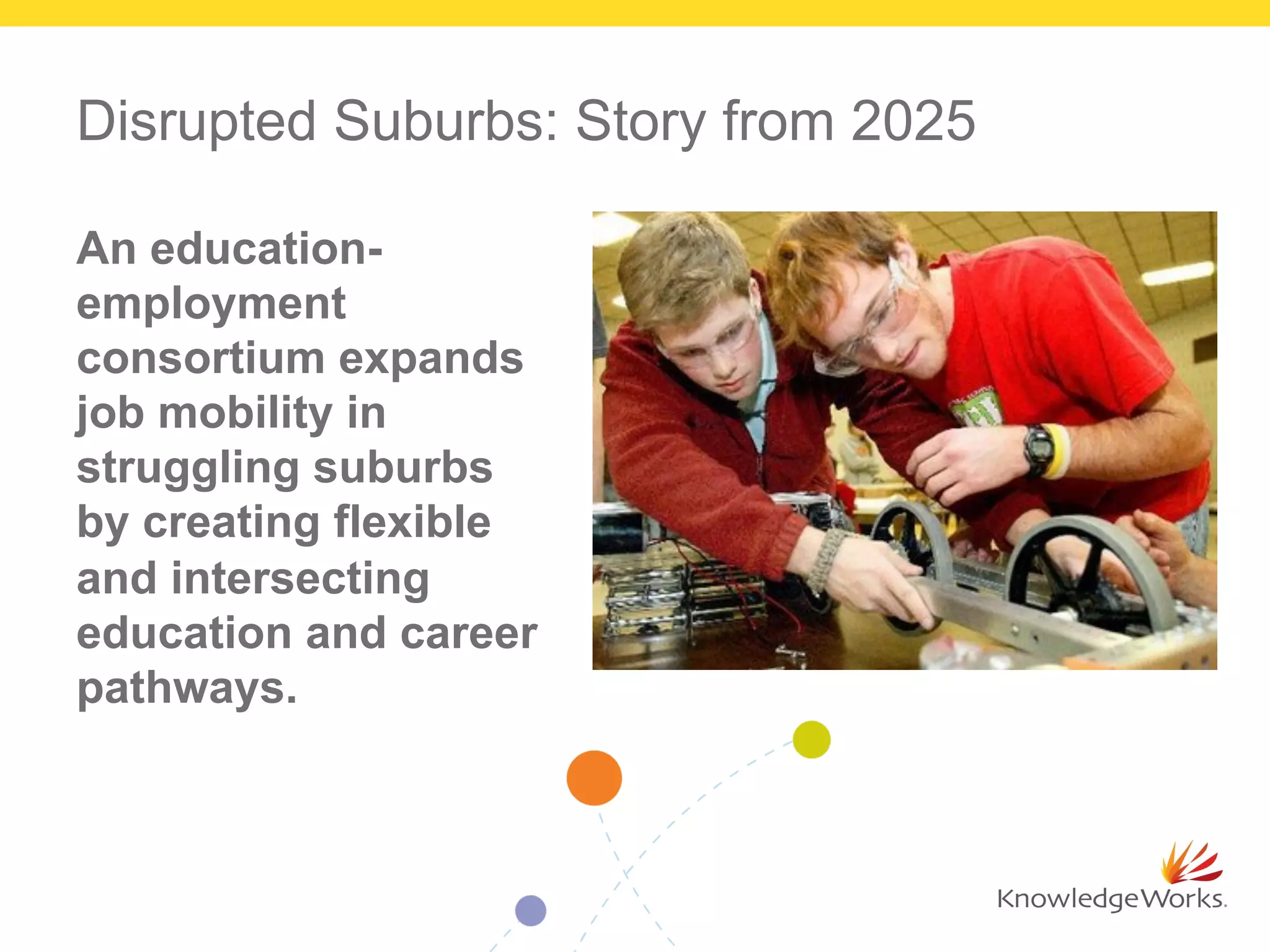
Disrupted Suburbs: Story from 2025
An education-
employment
consortium expands
job mobility in
struggling suburbs
by creating flexible
and intersecting
education and career
pathways.
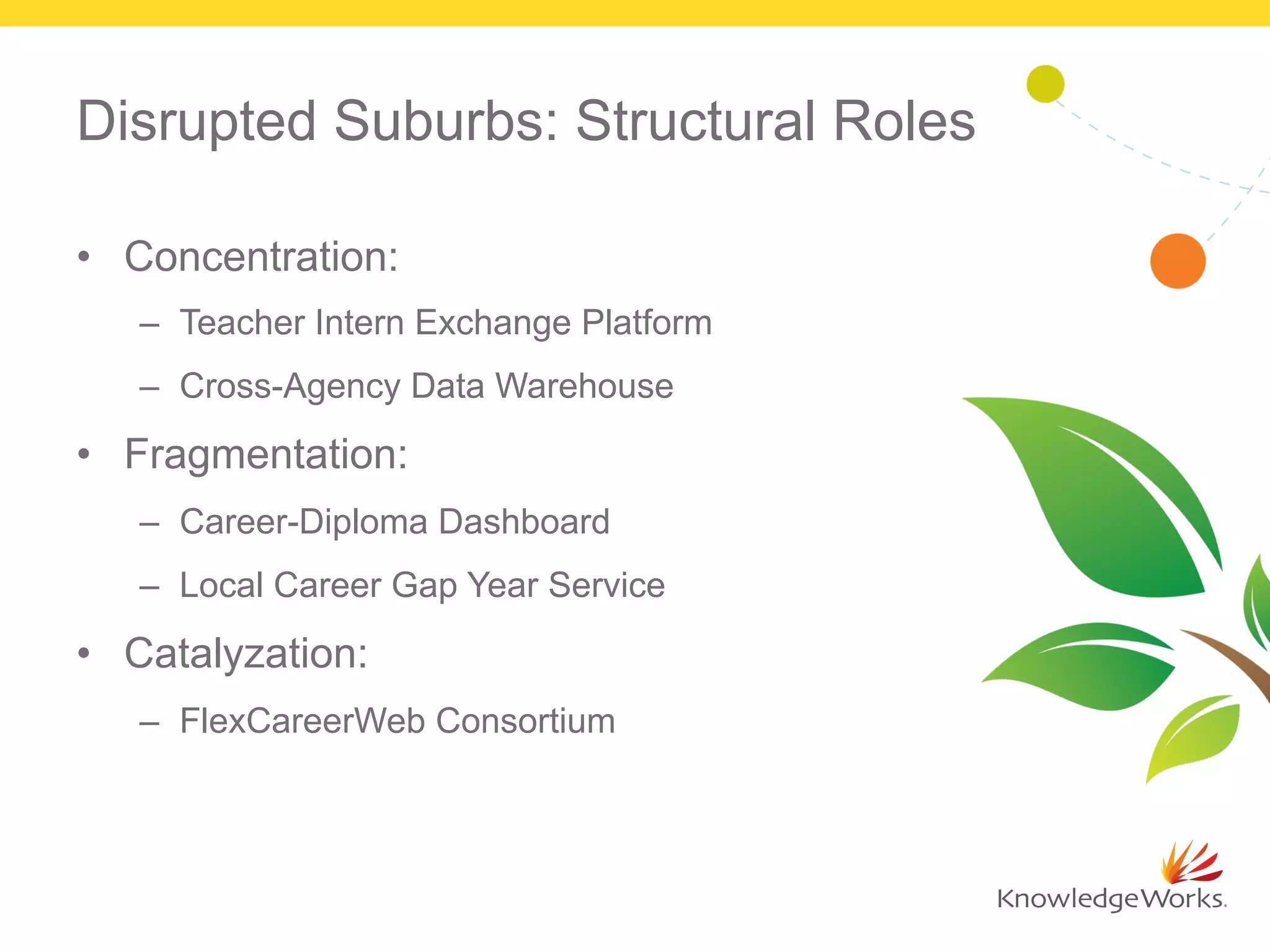
Disrupted Suburbs: Structural Roles
•  Concentration:
–  Teacher Intern Exchange Platform
–  Cross-Agency Data Warehouse
•  Fragmentation:
–  Career-Diploma Dashboard
–  Local Career Gap Year Service
•  Catalyzation:
–  FlexCareerWeb Consortium
Designing Vibrant Learning Ecosystems
•  The goal of this activity is to prototype a design for a vibrant learning ecosystem based on
the needs and constraints of a specific geography and its learners.
•  Your group has 1 geography card, 2 learner profile cards, and 6 roles and services cards.
•  Begin by reviewing your area’s unique needs based on the needs of the geography and the
needs, interests, and goals of your learners.
•  After exploring those needs, use the roles and services cards you were dealt to prototype
one or more learning ecosystems that promise to serve the needs of the learners who are
represented on your learner profile cards. You may use all or some of the roles and services
cards but need to find a way to address all of the learners’ needs, whether through a single
or multiple learning ecosystems.
•  As you consider possibilities, some guiding questions to consider include:
–  How might the roles and services interact to meet learner’s needs?
–  Do the roles and services have to interact in different ways depending on the learner?
–  What roles or services might be missing?
–  Did you have to design more than one ecosystem to meet the needs of all the learner
profiles?
•  Depict your prototype(s) through a written description or drawing on your flip chart sheet,
making sure to highlight the interconnections across the ecosystem(s).
Exploring Implications
•  What do your prototypes suggest for how education
might shift its focus from school systems to community-
level learning ecosystems over the next ten years?
•  How might fostering interconnections across value webs
help districts, communities, or state policymakers and
agencies address current challenges?
Tweet:
#FutureEd
@katprince
@jasonswanson
Download:
knowledgeworks.org/future-learning
Concentration
Fragmentation
Catalyzation

Designing the Future: Cultivating the Learning Ecosystem

  • 1.
    Designing the Future: Cultivatingthe Learning Ecosystem Katherine Prince • Jason Swanson July 25, 2015
  • 2.
  • 3.
    Cultivating Ecosystem Interconnections •  Whatkinds of learning ecosystem interconnections might help participants create vibrant learning ecosystems? •  What might learning ecosystems look like in different high-need geographies?
  • 4.
    Defining Learning Ecosystems Alearning ecosystem is a network of relationships among learning agents, learners, resources and assets in a specific social, economic, and geographic context.
  • 5.
    Vibrant Learning EcosystemsAre… •  Learner Centered •  Equitable •  Modular and Interoperable •  Resilient
  • 6.
    Three Structural Roles • Concentration •  Fragmentation •  Catalyzation
  • 7.
    Concentration •  Providers ofcore infrastructure, aggregation, and brokering services create process efficiencies through scale.
  • 8.
    Fragmentation •  Providers ofcore infrastructure, aggregation, and brokering services create process efficiencies through scale.
  • 9.
    Catalyzation •  Connectors mobilizecross-boundary initiatives, bridge ecosystem gaps, and forge shared goals.
  • 10.
  • 11.
    Disrupted Suburbs: Needs Isolation: • Linking and sharing resources with nearby communities Instability: •  Economic and social disruption Cultural Barriers: •  Often first generation in area to deal with poverty •  Changing narrative about community •  Parents need to understand that old education system might not be sufficient
  • 12.
    Disrupted Suburbs: Storyfrom 2025 An education- employment consortium expands job mobility in struggling suburbs by creating flexible and intersecting education and career pathways.
  • 13.
    Disrupted Suburbs: StructuralRoles •  Concentration: –  Teacher Intern Exchange Platform –  Cross-Agency Data Warehouse •  Fragmentation: –  Career-Diploma Dashboard –  Local Career Gap Year Service •  Catalyzation: –  FlexCareerWeb Consortium
  • 14.
    Designing Vibrant LearningEcosystems •  The goal of this activity is to prototype a design for a vibrant learning ecosystem based on the needs and constraints of a specific geography and its learners. •  Your group has 1 geography card, 2 learner profile cards, and 6 roles and services cards. •  Begin by reviewing your area’s unique needs based on the needs of the geography and the needs, interests, and goals of your learners. •  After exploring those needs, use the roles and services cards you were dealt to prototype one or more learning ecosystems that promise to serve the needs of the learners who are represented on your learner profile cards. You may use all or some of the roles and services cards but need to find a way to address all of the learners’ needs, whether through a single or multiple learning ecosystems. •  As you consider possibilities, some guiding questions to consider include: –  How might the roles and services interact to meet learner’s needs? –  Do the roles and services have to interact in different ways depending on the learner? –  What roles or services might be missing? –  Did you have to design more than one ecosystem to meet the needs of all the learner profiles? •  Depict your prototype(s) through a written description or drawing on your flip chart sheet, making sure to highlight the interconnections across the ecosystem(s).
  • 15.
    Exploring Implications •  Whatdo your prototypes suggest for how education might shift its focus from school systems to community- level learning ecosystems over the next ten years? •  How might fostering interconnections across value webs help districts, communities, or state policymakers and agencies address current challenges?
  • 16.
  • 17.
  • 18.
  • 19.