Educational Data MiningMarch 3, 2010
Today’s ClassEDMAssignment#5Mega-Survey
Educational Data Mining“Educational Data Mining is an emerging discipline, concerned with developing methods for exploring the unique types of data that come from educational settings, and using those methods to better understand students, and the settings which they learn in.” www.educationaldatamining.org
Classes of EDM Method(Romero & Ventura, 2007)Information VisualizationWeb miningClustering, Classification, Outlier DetectionAssociation Rule Mining/Sequential Pattern MiningText Mining
Classes of EDM Method(Baker & Yacef, 2009)PredictionClusteringRelationship MiningDiscovery with ModelsDistillation of Data For Human Judgment
PredictionDevelop a model which can infer a single aspect of the data (predicted variable) from some combination of other aspects of the data (predictor variables)Which students are using CVS?Which students will fail the class?
ClusteringFind points that naturally group together, splitting full data set into set of clustersUsually used when nothing is known about the structure of the dataWhat behaviors are prominent in domain?What are the main groups of students?
Relationship MiningDiscover relationships between variables in a data set with many variablesAssociation rule miningCorrelation miningSequential pattern miningCausal data miningBeck & Mostow (2008) article is a great example of this
Discovery with ModelsPre-existing model (developed with EDM prediction methods… or clustering… or knowledge engineering)Applied to data and used as a component in another analysis
Distillation of Data for Human JudgmentMaking complex data understandable by humans to leverage their judgmentText replays are a simple example of this
Focus of today’s classPredictionClusteringRelationship MiningDiscovery with ModelsDistillation of Data For Human JudgmentThere will be a term-long class on this, taught by Joe Beck, in coordination with Carolina Ruiz’s Data Mining class, in a future yearStrongly recommended
PredictionPretty much what it saysA student is using a tutor right now.Is he gaming the system or not?A student has used the tutor for the last half hour.	How likely is it that she knows the knowledge component in the next step?A student has completed three years of high school.	What will be her score on the SAT-Math exam?
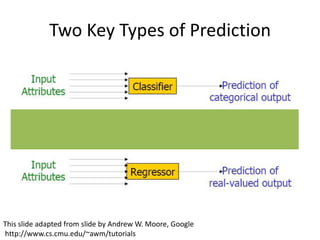
Two Key Types of PredictionThis slide adapted from slide by Andrew W. Moore, Google http://www.cs.cmu.edu/~awm/tutorials
ClassificationGeneral IdeaCanonical MethodsAssessmentWays to do assessment wrong
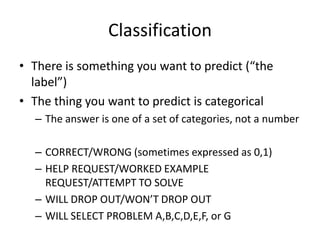
ClassificationThere is something you want to predict (“the label”)The thing you want to predict is categoricalThe answer is one of a set of categories, not a numberCORRECT/WRONG (sometimes expressed as 0,1)HELP REQUEST/WORKED EXAMPLE REQUEST/ATTEMPT TO SOLVEWILL DROP OUT/WON’T DROP OUTWILL SELECT PROBLEM A,B,C,D,E,F, or G
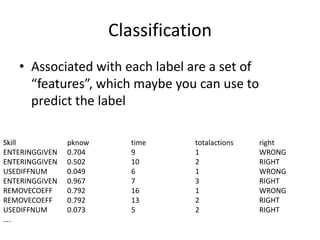
ClassificationAssociated with each label are a set of “features”, which maybe you can use to predict the labelSkill	pknow		time		totalactions	rightENTERINGGIVEN	0.704		9		1		WRONGENTERINGGIVEN	0.502		10		2		RIGHT	USEDIFFNUM	0.049		6		1		WRONG	ENTERINGGIVEN	0.967		7		3		RIGHT	REMOVECOEFF	0.792		16		1		WRONG	REMOVECOEFF	0.792		13		2		RIGHT	USEDIFFNUM	0.073		5		2		RIGHT	….
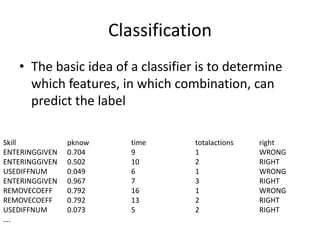
ClassificationThe basic idea of a classifier is to determine which features, in which combination, can predict the labelSkill		pknow		time		totalactions	rightENTERINGGIVEN	0.704		9		1		WRONGENTERINGGIVEN	0.502		10		2		RIGHT	USEDIFFNUM	0.049		6		1		WRONG	ENTERINGGIVEN	0.967		7		3		RIGHT	REMOVECOEFF	0.792		16		1		WRONG	REMOVECOEFF	0.792		13		2		RIGHT	USEDIFFNUM	0.073		5		2		RIGHT	….
ClassificationOf course, usually there are more than 4 featuresAnd more than 7 actions/data pointsI’ve recently done analyses with 800,000 student actions, and 26 features
ClassificationOf course, usually there are more than 4 featuresAnd more than 7 actions/data pointsI’ve recently done analyses with 800,000 student actions, and 26 features5 years ago that would’ve been a lot of dataThese days, in the EDM world, it’s just a medium-sized data set
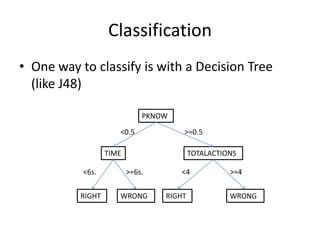
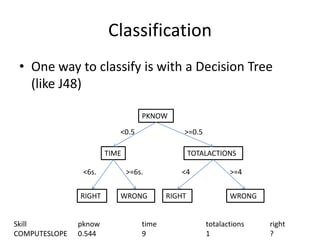
ClassificationOne way to classify is with a Decision Tree (like J48) PKNOW<0.5>=0.5TIMETOTALACTIONS<6s.>=6s.<4>=4RIGHTRIGHTWRONGWRONG
ClassificationOne way to classify is with a Decision Tree (like J48) PKNOW<0.5>=0.5TIMETOTALACTIONS<6s.>=6s.<4>=4RIGHTRIGHTWRONGWRONGSkill		pknow		time		totalactions	rightCOMPUTESLOPE	0.544		9		1		?
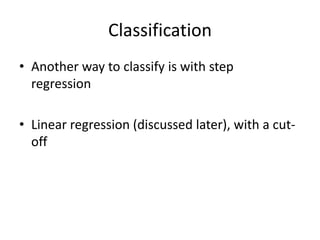
ClassificationAnother way to classify is with step regressionLinear regression (discussed later), with a cut-off
And of course…There are lots of other classification algorithms you can use...SMO (support vector machine)In your favorite Machine Learning package
And of course…There are lots of other classification algorithms you can use...SMO (support vector machine)In your favorite Machine Learning packageWEKA
And of course…There are lots of other classification algorithms you can use...SMO (support vector machine)In your favorite Machine Learning packageWEKARapidMiner
And of course…There are lots of other classification algorithms you can use...SMO (support vector machine)In your favorite Machine Learning packageWEKARapidMinerKEEL
And of course…There are lots of other classification algorithms you can use...SMO (support vector machine)In your favorite Machine Learning packageWEKARapidMinerKEELRapidMiner
And of course…There are lots of other classification algorithms you can use...SMO (support vector machine)In your favorite Machine Learning packageWEKARapidMinerKEELRapidMinerRapidMiner
And of course…There are lots of other classification algorithms you can use...SMO (support vector machine)In your favorite Machine Learning packageWEKARapidMinerKEELRapidMinerRapidMinerRapidMiner
Comments? Questions?
How can you tell if a classifier is any good?
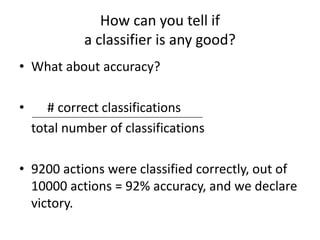
How can you tell if a classifier is any good?What about accuracy?     # correct classifications 	total number of classifications9200 actions were classified correctly, out of 10000 actions = 92% accuracy, and we declare victory.
What are some limitations of accuracy?
Biased training setWhat if the underlying distribution that you were trying to predict was:9200 correct actions, 800 wrong actionsAnd your model predicts that every action is correctYour model will have an accuracy of 92%Is the model actually any good?
What are some  alternate metrics you could use?
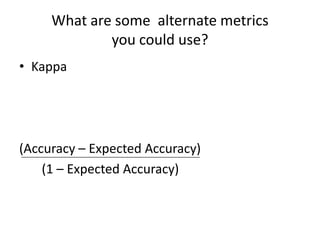
What are some  alternate metrics you could use?Kappa(Accuracy – Expected Accuracy)        (1 – Expected Accuracy)
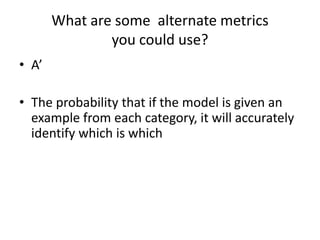
What are some  alternate metrics you could use?A’The probability that if the model is given an example from each category, it will accurately identify which is which
ComparisonKappaeasier to computeworks for an unlimited number of categorieswacky behavior when things are worse than chancedifficult to compare two kappas in different data sets (K=0.6 is not always better than K=0.5)
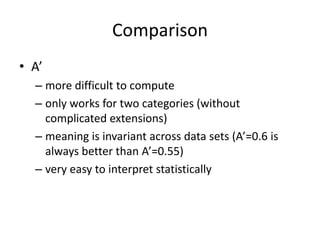
ComparisonA’more difficult to computeonly works for two categories (without complicated extensions)meaning is invariant across data sets (A’=0.6 is always better than A’=0.55)very easy to interpret statistically
Comments? Questions?
What data set should you generally test on?A vote…Raise your hands as many times as you like
What data set should you generally test on?The data set you trained your classifier onA data set from a different tutorSplit your data set in half (by students), train on one half, test on the other halfSplit your data set in ten (by actions). Train on each set of 9 sets, test on the tenth. Do this ten times. Votes?
What data set should you generally test on?The data set you trained your classifier onA data set from a different tutorSplit your data set in half (by students), train on one half, test on the other halfSplit your data set in ten (by actions). Train on each set of 9 sets, test on the tenth. Do this ten times. What are the benefits and drawbacks of each?
The dangerous one(though still sometimes OK)The data set you trained your classifier onIf you do this, there is serious danger of over-fitting
The dangerous one(though still sometimes OK)You have ten thousand data points. You fit a parameter for each data point.“If data point 1, RIGHT. If data point 78, WRONG…”Your accuracy is 100%Your kappa is 1Your model will neither work on new data, nor will it tell you anything.
The dangerous one(though still sometimes OK)The data set you trained your classifier on When might this one still be OK?
K-fold cross validation (standard)Split your data set in ten (by action). Train on each set of 9 sets, test on the tenth. Do this ten times. What can you infer from this?
K-fold cross validation (standard)Split your data set in ten (by action). Train on each set of 9 sets, test on the tenth. Do this ten times. What can you infer from this?Your detector will work with new data from the same students
K-fold cross validation (student-level)Split your data set in half (by student), train on one half, test on the other halfWhat can you infer from this?
K-fold cross validation (student-level)Split your data set in half (by student), train on one half, test on the other halfWhat can you infer from this?Your detector will work with data from new students from the same population (whatever it was)
A data set from a different tutorThe most stringent testWhen your model succeeds at this test, you know you have a good/general modelWhen it fails, it’s sometimes hard to know why
An interesting alternativeLeave-out-one-tutor-cross-validation (cf. Baker, Corbett, & Koedinger, 2006)Train on data from 3 or more tutorsTest on data from a different tutor(Repeat for all possible combinations)Good for giving a picture of how well your model will perform in new lessons
Comments? Questions?
Regression
RegressionThere is something you want to predict (“the label”)The thing you want to predict is numericalNumber of hints student requestsHow long student takes to answerWhat will the student’s test score be
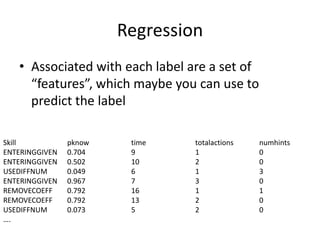
RegressionAssociated with each label are a set of “features”, which maybe you can use to predict the labelSkill	pknow		time		totalactionsnumhintsENTERINGGIVEN	0.704		9		1		0ENTERINGGIVEN	0.502		10		2		0	USEDIFFNUM	0.049		6		1		3	ENTERINGGIVEN	0.967		7		3		0	REMOVECOEFF	0.792		16		1		1	REMOVECOEFF	0.792		13		2		0	USEDIFFNUM	0.073		5		2		0	….
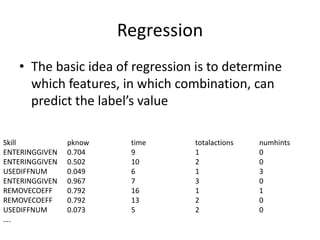
RegressionThe basic idea of regression is to determine which features, in which combination, can predict the label’s valueSkill	pknow		time		totalactionsnumhintsENTERINGGIVEN	0.704		9		1		0ENTERINGGIVEN	0.502		10		2		0	USEDIFFNUM	0.049		6		1		3	ENTERINGGIVEN	0.967		7		3		0	REMOVECOEFF	0.792		16		1		1	REMOVECOEFF	0.792		13		2		0	USEDIFFNUM	0.073		5		2		0	….
Linear RegressionThe most classic form of regression is linear regressionAlternatives include Poisson regression, Neural Networks...
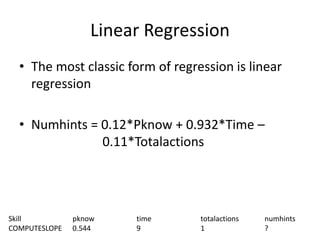
Linear RegressionThe most classic form of regression is linear regressionNumhints = 0.12*Pknow + 0.932*Time – 		      0.11*TotalactionsSkill		pknow		time		totalactionsnumhintsCOMPUTESLOPE	0.544		9		1		?
Linear RegressionLinear regression only fits linear functions (except when you apply transforms to the input variables, which RapidMiner can do for you…)
Linear RegressionHowever…It is blazing fastIt is often more accurate than more complex models, particularly once you cross-validateData Mining’s “Dirty Little Secret”It is feasible to understand your model(with the caveat that the second feature in your model is in the context of the first feature, and so on)
Example of CaveatLet’s study a classic example
Example of CaveatLet’s study a classic exampleDrinking too much prune nog at a party, and having an emergency trip to the Little Researcher’s Room
Data
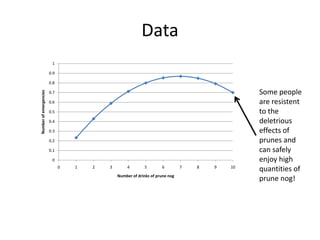
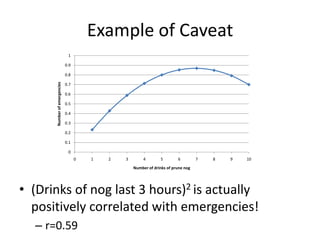
DataSome people are resistent to the deletrious effects of prunes and can safely enjoy high quantities of prune nog!
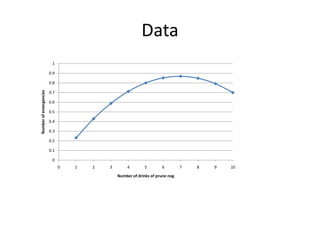
Learned FunctionProbability of “emergency”=	0.25 * # Drinks of nog last 3 hours	- 0.018 * (Drinks of nog last 3 hours)2But does that actually mean that  (Drinks of nog last 3 hours)2 is associated with less “emergencies”?
Learned FunctionProbability of “emergency”=	0.25 * # Drinks of nog last 3 hours	- 0.018 * (Drinks of nog last 3 hours)2But does that actually mean that  (Drinks of nog last 3 hours)2 is associated with less “emergencies”?No!
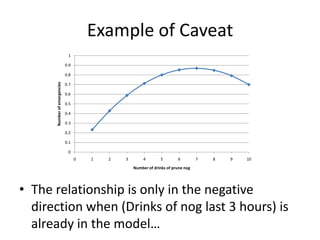
Example of Caveat(Drinks of nog last 3 hours)2 is actually positively correlated with emergencies!r=0.59
Example of CaveatThe relationship is only in the negative direction when (Drinks of nog last 3 hours) is already in the model…
Example of CaveatSo be careful when interpreting linear regression models (or almost any other type of model)
Comments? Questions?
Discovery with Models
Why do Discovery with Models?Let’s say you have a model of some construct of interest or importanceKnowledgeMeta-CognitionMotivationAffectInquiry SkillCollaborative BehaviorEtc.
Why do Discovery with Models?You can use that model toFind outliers of interest by finding out where the model makes extreme predictionsInspect the model to learn what factors are involved in predicting the constructFind out the construct’s relationship to other constructs of interest, by studying its correlations/associations/causal relationships with data/models on the other constructsStudy the construct across contexts or students, by applying the model within data from those contexts or studentsAnd more…
Most frequentlyDone using prediction modelsThough other types of models (in particular knowledge engineering models) are amenable to this as well!
Boosting
BoostingLet’s say that you have 300 labeled actions randomly sampled from 600,000 overall actions Not a terribly unusual case, in these days of massive data sets, like those in the PSLC DataShopYou can train the model on the 300, cross-validate it, and then apply it to all 600,000And then analyze the model across all actionsMakes it possible to study larger-scale problems than a human could do without computer assistanceEspecially nice if you have some unlabeled data set with nice propertiesFor example, additional data such as questionnaire data(cf. Baker, Walonoski, Heffernan, Roll, Corbett, & Koedinger, 2008)
However…To do this and trust the result,You should validate that the model can transfer across students, populations, and to the learning software you’re usingAs discussed earlier
A few examples…
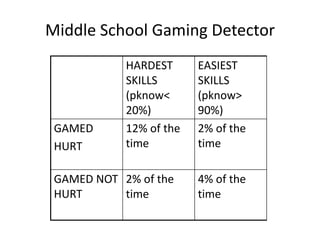
Middle School Gaming Detector
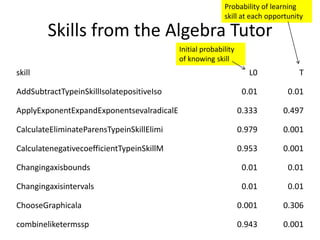
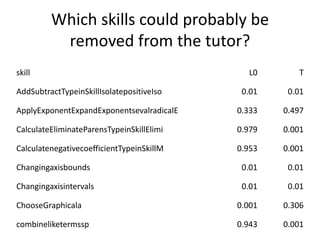
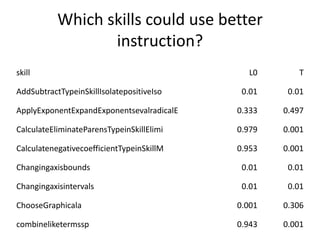
Skills from the Algebra TutorProbability of learning skill at each opportunityInitial probability of knowing skill
Which skills could probably be removed from the tutor?
Which skills could use better instruction?
Comments? Questions?
A lengthier example (if there’s time)Applying Baker et al’s (2008) gaming detector across contexts
Research QuestionDo students game the system because of state or trait factors?If trait factors are the main explanation, differences between students will explain much of the variance in gamingIf state factors are the main explanation, differences between lessons could account for many (but not all) state factors, and explain much of the variance in gamingSo: is the student or the lesson a better predictor of gaming?
Application of DetectorAfter validating its transferWe applied the gaming detector across 35 lessons, used by 240 students, from a single Cognitive TutorGiving us, for each student in each lesson, a gaming frequency
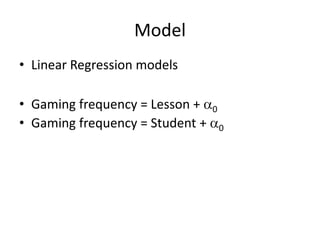
ModelLinear Regression modelsGaming frequency = Lesson + a0Gaming frequency = Student + a0
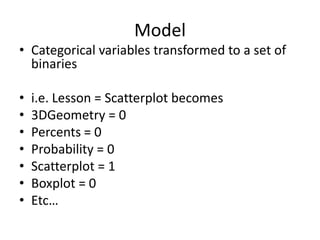
ModelCategorical variables transformed to a set of binariesi.e. Lesson = Scatterplot becomes3DGeometry = 0Percents = 0Probability = 0Scatterplot = 1Boxplot = 0Etc…
Metrics
r2The correlation, squaredThe proportion of variability in the data set that is accounted for by a statistical model
r2However, a limitationThe more variables you have, the more variance you should be expected to predict, just by chance
r2We should expect240 students To predict gaming better than35 lessonsJust by overfitting
So what can we do?
BiCBayesian Information Criterion(Raftery, 1995)Makes trade-off between goodness of fit and flexibility of fit (number of parameters)
Predictors
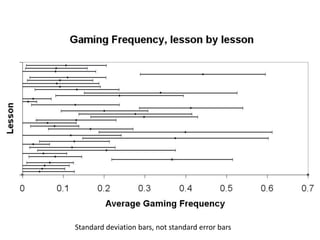
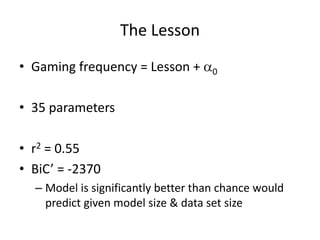
The Lesson Gaming frequency = Lesson + a035 parametersr2 = 0.55BiC’ = -2370Model is significantly better than chance would predict given model size & data set size
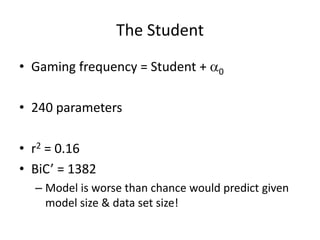
The StudentGaming frequency = Student + a0240 parametersr2 = 0.16BiC’ = 1382Model is worse than chance would predict given model size & data set size!
Standard deviation bars, not standard error bars
Comments? Questions?
EDM – where?HolisticExistentialistEssentialistEntitative
Today’s ClassEDMAssignment#5Mega-Survey
Any questions?
Today’s ClassEDMAssignment#5Mega-Survey
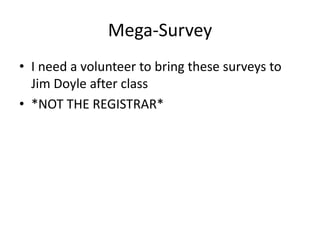
Mega-SurveyI need a volunteer to bring these surveys to Jim Doyle after class*NOT THE REGISTRAR*
Mega-Survey Additional Questions(See back)#1: In future years, should this class be given 1: In half a semester, as part of a unified semester class, along with Professor Skorinko’s Research Methods class3: Unsure/neutral5: As a full-semester class, with Professor Skorinko’s class as a prerequisite#2: Are there any topics you think should be dropped from this class? [write your answer in the space to the right]#3: Are there any topics you think should be added to this class? [write your answer in the space to the right]

Think-Aloud Protocols

  • 1.
  • 2.
  • 3.
    Educational Data Mining“EducationalData Mining is an emerging discipline, concerned with developing methods for exploring the unique types of data that come from educational settings, and using those methods to better understand students, and the settings which they learn in.” www.educationaldatamining.org
  • 4.
    Classes of EDMMethod(Romero & Ventura, 2007)Information VisualizationWeb miningClustering, Classification, Outlier DetectionAssociation Rule Mining/Sequential Pattern MiningText Mining
  • 5.
    Classes of EDMMethod(Baker & Yacef, 2009)PredictionClusteringRelationship MiningDiscovery with ModelsDistillation of Data For Human Judgment
  • 6.
    PredictionDevelop a modelwhich can infer a single aspect of the data (predicted variable) from some combination of other aspects of the data (predictor variables)Which students are using CVS?Which students will fail the class?
  • 7.
    ClusteringFind points thatnaturally group together, splitting full data set into set of clustersUsually used when nothing is known about the structure of the dataWhat behaviors are prominent in domain?What are the main groups of students?
  • 8.
    Relationship MiningDiscover relationshipsbetween variables in a data set with many variablesAssociation rule miningCorrelation miningSequential pattern miningCausal data miningBeck & Mostow (2008) article is a great example of this
  • 9.
    Discovery with ModelsPre-existingmodel (developed with EDM prediction methods… or clustering… or knowledge engineering)Applied to data and used as a component in another analysis
  • 10.
    Distillation of Datafor Human JudgmentMaking complex data understandable by humans to leverage their judgmentText replays are a simple example of this
  • 11.
    Focus of today’sclassPredictionClusteringRelationship MiningDiscovery with ModelsDistillation of Data For Human JudgmentThere will be a term-long class on this, taught by Joe Beck, in coordination with Carolina Ruiz’s Data Mining class, in a future yearStrongly recommended
  • 12.
    PredictionPretty much whatit saysA student is using a tutor right now.Is he gaming the system or not?A student has used the tutor for the last half hour. How likely is it that she knows the knowledge component in the next step?A student has completed three years of high school. What will be her score on the SAT-Math exam?
  • 13.
    Two Key Typesof PredictionThis slide adapted from slide by Andrew W. Moore, Google http://www.cs.cmu.edu/~awm/tutorials
  • 14.
  • 15.
    ClassificationThere is somethingyou want to predict (“the label”)The thing you want to predict is categoricalThe answer is one of a set of categories, not a numberCORRECT/WRONG (sometimes expressed as 0,1)HELP REQUEST/WORKED EXAMPLE REQUEST/ATTEMPT TO SOLVEWILL DROP OUT/WON’T DROP OUTWILL SELECT PROBLEM A,B,C,D,E,F, or G
  • 16.
    ClassificationAssociated with eachlabel are a set of “features”, which maybe you can use to predict the labelSkill pknow time totalactions rightENTERINGGIVEN 0.704 9 1 WRONGENTERINGGIVEN 0.502 10 2 RIGHT USEDIFFNUM 0.049 6 1 WRONG ENTERINGGIVEN 0.967 7 3 RIGHT REMOVECOEFF 0.792 16 1 WRONG REMOVECOEFF 0.792 13 2 RIGHT USEDIFFNUM 0.073 5 2 RIGHT ….
  • 17.
    ClassificationThe basic ideaof a classifier is to determine which features, in which combination, can predict the labelSkill pknow time totalactions rightENTERINGGIVEN 0.704 9 1 WRONGENTERINGGIVEN 0.502 10 2 RIGHT USEDIFFNUM 0.049 6 1 WRONG ENTERINGGIVEN 0.967 7 3 RIGHT REMOVECOEFF 0.792 16 1 WRONG REMOVECOEFF 0.792 13 2 RIGHT USEDIFFNUM 0.073 5 2 RIGHT ….
  • 18.
    ClassificationOf course, usuallythere are more than 4 featuresAnd more than 7 actions/data pointsI’ve recently done analyses with 800,000 student actions, and 26 features
  • 19.
    ClassificationOf course, usuallythere are more than 4 featuresAnd more than 7 actions/data pointsI’ve recently done analyses with 800,000 student actions, and 26 features5 years ago that would’ve been a lot of dataThese days, in the EDM world, it’s just a medium-sized data set
  • 20.
    ClassificationOne way toclassify is with a Decision Tree (like J48) PKNOW<0.5>=0.5TIMETOTALACTIONS<6s.>=6s.<4>=4RIGHTRIGHTWRONGWRONG
  • 21.
    ClassificationOne way toclassify is with a Decision Tree (like J48) PKNOW<0.5>=0.5TIMETOTALACTIONS<6s.>=6s.<4>=4RIGHTRIGHTWRONGWRONGSkill pknow time totalactions rightCOMPUTESLOPE 0.544 9 1 ?
  • 22.
    ClassificationAnother way toclassify is with step regressionLinear regression (discussed later), with a cut-off
  • 23.
    And of course…Thereare lots of other classification algorithms you can use...SMO (support vector machine)In your favorite Machine Learning package
  • 24.
    And of course…Thereare lots of other classification algorithms you can use...SMO (support vector machine)In your favorite Machine Learning packageWEKA
  • 25.
    And of course…Thereare lots of other classification algorithms you can use...SMO (support vector machine)In your favorite Machine Learning packageWEKARapidMiner
  • 26.
    And of course…Thereare lots of other classification algorithms you can use...SMO (support vector machine)In your favorite Machine Learning packageWEKARapidMinerKEEL
  • 27.
    And of course…Thereare lots of other classification algorithms you can use...SMO (support vector machine)In your favorite Machine Learning packageWEKARapidMinerKEELRapidMiner
  • 28.
    And of course…Thereare lots of other classification algorithms you can use...SMO (support vector machine)In your favorite Machine Learning packageWEKARapidMinerKEELRapidMinerRapidMiner
  • 29.
    And of course…Thereare lots of other classification algorithms you can use...SMO (support vector machine)In your favorite Machine Learning packageWEKARapidMinerKEELRapidMinerRapidMinerRapidMiner
  • 30.
  • 31.
    How can youtell if a classifier is any good?
  • 32.
    How can youtell if a classifier is any good?What about accuracy? # correct classifications total number of classifications9200 actions were classified correctly, out of 10000 actions = 92% accuracy, and we declare victory.
  • 33.
    What are somelimitations of accuracy?
  • 34.
    Biased training setWhatif the underlying distribution that you were trying to predict was:9200 correct actions, 800 wrong actionsAnd your model predicts that every action is correctYour model will have an accuracy of 92%Is the model actually any good?
  • 35.
    What are some alternate metrics you could use?
  • 36.
    What are some alternate metrics you could use?Kappa(Accuracy – Expected Accuracy) (1 – Expected Accuracy)
  • 37.
    What are some alternate metrics you could use?A’The probability that if the model is given an example from each category, it will accurately identify which is which
  • 38.
    ComparisonKappaeasier to computeworksfor an unlimited number of categorieswacky behavior when things are worse than chancedifficult to compare two kappas in different data sets (K=0.6 is not always better than K=0.5)
  • 39.
    ComparisonA’more difficult tocomputeonly works for two categories (without complicated extensions)meaning is invariant across data sets (A’=0.6 is always better than A’=0.55)very easy to interpret statistically
  • 40.
  • 41.
    What data setshould you generally test on?A vote…Raise your hands as many times as you like
  • 42.
    What data setshould you generally test on?The data set you trained your classifier onA data set from a different tutorSplit your data set in half (by students), train on one half, test on the other halfSplit your data set in ten (by actions). Train on each set of 9 sets, test on the tenth. Do this ten times. Votes?
  • 43.
    What data setshould you generally test on?The data set you trained your classifier onA data set from a different tutorSplit your data set in half (by students), train on one half, test on the other halfSplit your data set in ten (by actions). Train on each set of 9 sets, test on the tenth. Do this ten times. What are the benefits and drawbacks of each?
  • 44.
    The dangerous one(thoughstill sometimes OK)The data set you trained your classifier onIf you do this, there is serious danger of over-fitting
  • 45.
    The dangerous one(thoughstill sometimes OK)You have ten thousand data points. You fit a parameter for each data point.“If data point 1, RIGHT. If data point 78, WRONG…”Your accuracy is 100%Your kappa is 1Your model will neither work on new data, nor will it tell you anything.
  • 46.
    The dangerous one(thoughstill sometimes OK)The data set you trained your classifier on When might this one still be OK?
  • 47.
    K-fold cross validation(standard)Split your data set in ten (by action). Train on each set of 9 sets, test on the tenth. Do this ten times. What can you infer from this?
  • 48.
    K-fold cross validation(standard)Split your data set in ten (by action). Train on each set of 9 sets, test on the tenth. Do this ten times. What can you infer from this?Your detector will work with new data from the same students
  • 49.
    K-fold cross validation(student-level)Split your data set in half (by student), train on one half, test on the other halfWhat can you infer from this?
  • 50.
    K-fold cross validation(student-level)Split your data set in half (by student), train on one half, test on the other halfWhat can you infer from this?Your detector will work with data from new students from the same population (whatever it was)
  • 51.
    A data setfrom a different tutorThe most stringent testWhen your model succeeds at this test, you know you have a good/general modelWhen it fails, it’s sometimes hard to know why
  • 52.
    An interesting alternativeLeave-out-one-tutor-cross-validation(cf. Baker, Corbett, & Koedinger, 2006)Train on data from 3 or more tutorsTest on data from a different tutor(Repeat for all possible combinations)Good for giving a picture of how well your model will perform in new lessons
  • 53.
  • 54.
  • 55.
    RegressionThere is somethingyou want to predict (“the label”)The thing you want to predict is numericalNumber of hints student requestsHow long student takes to answerWhat will the student’s test score be
  • 56.
    RegressionAssociated with eachlabel are a set of “features”, which maybe you can use to predict the labelSkill pknow time totalactionsnumhintsENTERINGGIVEN 0.704 9 1 0ENTERINGGIVEN 0.502 10 2 0 USEDIFFNUM 0.049 6 1 3 ENTERINGGIVEN 0.967 7 3 0 REMOVECOEFF 0.792 16 1 1 REMOVECOEFF 0.792 13 2 0 USEDIFFNUM 0.073 5 2 0 ….
  • 57.
    RegressionThe basic ideaof regression is to determine which features, in which combination, can predict the label’s valueSkill pknow time totalactionsnumhintsENTERINGGIVEN 0.704 9 1 0ENTERINGGIVEN 0.502 10 2 0 USEDIFFNUM 0.049 6 1 3 ENTERINGGIVEN 0.967 7 3 0 REMOVECOEFF 0.792 16 1 1 REMOVECOEFF 0.792 13 2 0 USEDIFFNUM 0.073 5 2 0 ….
  • 58.
    Linear RegressionThe mostclassic form of regression is linear regressionAlternatives include Poisson regression, Neural Networks...
  • 59.
    Linear RegressionThe mostclassic form of regression is linear regressionNumhints = 0.12*Pknow + 0.932*Time – 0.11*TotalactionsSkill pknow time totalactionsnumhintsCOMPUTESLOPE 0.544 9 1 ?
  • 60.
    Linear RegressionLinear regressiononly fits linear functions (except when you apply transforms to the input variables, which RapidMiner can do for you…)
  • 61.
    Linear RegressionHowever…It isblazing fastIt is often more accurate than more complex models, particularly once you cross-validateData Mining’s “Dirty Little Secret”It is feasible to understand your model(with the caveat that the second feature in your model is in the context of the first feature, and so on)
  • 62.
    Example of CaveatLet’sstudy a classic example
  • 63.
    Example of CaveatLet’sstudy a classic exampleDrinking too much prune nog at a party, and having an emergency trip to the Little Researcher’s Room
  • 64.
  • 65.
    DataSome people areresistent to the deletrious effects of prunes and can safely enjoy high quantities of prune nog!
  • 66.
    Learned FunctionProbability of“emergency”= 0.25 * # Drinks of nog last 3 hours - 0.018 * (Drinks of nog last 3 hours)2But does that actually mean that (Drinks of nog last 3 hours)2 is associated with less “emergencies”?
  • 67.
    Learned FunctionProbability of“emergency”= 0.25 * # Drinks of nog last 3 hours - 0.018 * (Drinks of nog last 3 hours)2But does that actually mean that (Drinks of nog last 3 hours)2 is associated with less “emergencies”?No!
  • 68.
    Example of Caveat(Drinksof nog last 3 hours)2 is actually positively correlated with emergencies!r=0.59
  • 69.
    Example of CaveatTherelationship is only in the negative direction when (Drinks of nog last 3 hours) is already in the model…
  • 70.
    Example of CaveatSobe careful when interpreting linear regression models (or almost any other type of model)
  • 71.
  • 72.
  • 73.
    Why do Discoverywith Models?Let’s say you have a model of some construct of interest or importanceKnowledgeMeta-CognitionMotivationAffectInquiry SkillCollaborative BehaviorEtc.
  • 74.
    Why do Discoverywith Models?You can use that model toFind outliers of interest by finding out where the model makes extreme predictionsInspect the model to learn what factors are involved in predicting the constructFind out the construct’s relationship to other constructs of interest, by studying its correlations/associations/causal relationships with data/models on the other constructsStudy the construct across contexts or students, by applying the model within data from those contexts or studentsAnd more…
  • 75.
    Most frequentlyDone usingprediction modelsThough other types of models (in particular knowledge engineering models) are amenable to this as well!
  • 76.
  • 77.
    BoostingLet’s say thatyou have 300 labeled actions randomly sampled from 600,000 overall actions Not a terribly unusual case, in these days of massive data sets, like those in the PSLC DataShopYou can train the model on the 300, cross-validate it, and then apply it to all 600,000And then analyze the model across all actionsMakes it possible to study larger-scale problems than a human could do without computer assistanceEspecially nice if you have some unlabeled data set with nice propertiesFor example, additional data such as questionnaire data(cf. Baker, Walonoski, Heffernan, Roll, Corbett, & Koedinger, 2008)
  • 78.
    However…To do thisand trust the result,You should validate that the model can transfer across students, populations, and to the learning software you’re usingAs discussed earlier
  • 79.
  • 80.
  • 81.
    Skills from theAlgebra TutorProbability of learning skill at each opportunityInitial probability of knowing skill
  • 82.
    Which skills couldprobably be removed from the tutor?
  • 83.
    Which skills coulduse better instruction?
  • 84.
  • 85.
    A lengthier example(if there’s time)Applying Baker et al’s (2008) gaming detector across contexts
  • 86.
    Research QuestionDo studentsgame the system because of state or trait factors?If trait factors are the main explanation, differences between students will explain much of the variance in gamingIf state factors are the main explanation, differences between lessons could account for many (but not all) state factors, and explain much of the variance in gamingSo: is the student or the lesson a better predictor of gaming?
  • 87.
    Application of DetectorAftervalidating its transferWe applied the gaming detector across 35 lessons, used by 240 students, from a single Cognitive TutorGiving us, for each student in each lesson, a gaming frequency
  • 88.
    ModelLinear Regression modelsGamingfrequency = Lesson + a0Gaming frequency = Student + a0
  • 89.
    ModelCategorical variables transformedto a set of binariesi.e. Lesson = Scatterplot becomes3DGeometry = 0Percents = 0Probability = 0Scatterplot = 1Boxplot = 0Etc…
  • 90.
  • 91.
    r2The correlation, squaredTheproportion of variability in the data set that is accounted for by a statistical model
  • 92.
    r2The correlation, squaredTheproportion of variability in the data set that is accounted for by a statistical model
  • 93.
    r2However, a limitationThemore variables you have, the more variance you should be expected to predict, just by chance
  • 94.
    r2We should expect240students To predict gaming better than35 lessonsJust by overfitting
  • 95.
  • 96.
    BiCBayesian Information Criterion(Raftery,1995)Makes trade-off between goodness of fit and flexibility of fit (number of parameters)
  • 97.
  • 98.
    The Lesson Gamingfrequency = Lesson + a035 parametersr2 = 0.55BiC’ = -2370Model is significantly better than chance would predict given model size & data set size
  • 99.
    The StudentGaming frequency= Student + a0240 parametersr2 = 0.16BiC’ = 1382Model is worse than chance would predict given model size & data set size!
  • 100.
    Standard deviation bars,not standard error bars
  • 101.
  • 102.
  • 103.
  • 104.
  • 105.
  • 106.
    Mega-SurveyI need avolunteer to bring these surveys to Jim Doyle after class*NOT THE REGISTRAR*
  • 107.
    Mega-Survey Additional Questions(Seeback)#1: In future years, should this class be given 1: In half a semester, as part of a unified semester class, along with Professor Skorinko’s Research Methods class3: Unsure/neutral5: As a full-semester class, with Professor Skorinko’s class as a prerequisite#2: Are there any topics you think should be dropped from this class? [write your answer in the space to the right]#3: Are there any topics you think should be added to this class? [write your answer in the space to the right]

Editor's Notes